

Investing in Autism Therapy: Key Trends Shaping the U.S. ABA Therapy Sector

June 30, 2025

Applied behavior analysis (ABA) therapy remains the gold-standard intervention for children with autism spectrum disorder, and the market continues to present compelling opportunities for investors. However, success in this space increasingly depends on navigating a dynamic set of workforce, reimbursement and operational challenges.  

L.E.K. Consulting has supported numerous transactions and growth strategies across ABA therapy and the broader behavioral health landscape and brings a sharp, current perspective to this evolving sector.

Market snapshot

  • Strong growth fundamentals: The U.S. ABA therapy market is estimated in the $25 billion to $35 billion-plus range, growing at 10%-13% annually, driven by rising autism prevalence, expanded insurance coverage and greater provider capacity.
  • Underpenetrated demand: Waitlists remain common, especially in underserved geographies, due to ongoing constraints in the provider workforce — indicating substantial white space still to be captured.

Key themes for investors

  • Make-or-break labor dynamics: The field faces persistent shortages of Board Certified Behavior Analysts (BCBAs) and sometimes 100%-plus annual turnover among frontline Registered Behavior Technicians (RBTs). Platforms that build effective recruiting pipelines, career development programs and compensation structures are better positioned to scale sustainably.
  • Care setting shifts: While home-based ABA therapy remains the largest delivery setting, center-based programs are the fastest growing because they provide tighter clinical oversight, reduced travel downtime, easier capacity scaling and higher margins. Hybrid (center plus home) models and school-based programs are gaining traction as well. Parents value the socialization and structured therapy a center offers, but they also need support with ensuring their child can apply those same skills in the home environment. Meanwhile, school districts are turning to outside ABA therapy providers to address special education staffing gaps.
  • Evolving payer landscape: All 50 states now support ABA therapy via commercial mandates and/or Medicaid waivers. Commercial rates typically exceed Medicaid by 15%-25%, making payer mix a key margin lever. However, payers are increasingly implementing utilization management protocols, especially in high-growth states.
  • Technology as an enabler: Leading providers are investing in integrated electronic medical records, revenue cycle tools and analytics platforms that support scheduling, billing and outcomes tracking. Notably, some innovative operators are going further — the Center for Social Dynamics, for example, is leveraging virtual reality (VR) technology to help children safely rehearse challenging real-world scenarios such as airport security or street crossing. This not only enhances care delivery but also supports clinician productivity by optimizing deployment models and improving session structure.
  • Active M&A market: Despite recent volatility, deal activity has resumed with robust sponsor interest in scaled, multidisciplinary and tech-enabled platforms. Successful acquirers are focusing on integration, workforce sustainability and operational differentiation.

What differentiates high-performing platforms?

Our experience across a broad set of transactions highlights five traits that separate durable platforms from those that struggle:

  1. Labor stability: The best operators invest heavily in recruiting and retaining talent — offering salaried RBT roles, structured BCBA supervision and internal career pathways. Weak platforms rely on low-wage hourly labor and churn through their clinical workforce.
  2. Operational leverage: Scaled providers maximize BCBA productivity through smart scheduling, high-quality supervision models and lean administrative infrastructure. Strong platforms also invest in effective clinical teaming and thoughtful BCBA caseload management to balance productivity with care quality and staff sustainability. Underperformers tend to be bloated operationally or constrained by inefficient and unsustainable care delivery models.
  3. Payer alignment: Strong players build diversified payer mixes with favorable commercial rates and tight authorization management. Poor performers often lean heavily on out-of-network or low-rate Medicaid contracts, exposing themselves to audit or margin risk.
  4. Tech and data infrastructure: Top performers use integrated tech stacks and, increasingly, advanced tools such as VR or predictive analytics. This enhances both patient outcomes and clinical efficiency. Underperformers often rely on fragmented or manual systems.
  5. Culture and clinical quality: Strong companies foster positive cultures, emphasize family outcomes and gain traction with referrers and payers. In contrast, aggressive expansion without clinical oversight has led to reputational damage in several recent high-profile failures.

Our experience

We have advised on more than a dozen projects across the ABA therapy and pediatric behavioral health landscape since 2018, including commercial due diligence, growth strategy and vendor due diligence support. Our clients include leading private equity investors, strategic buyers and behavioral health operators. We’ve helped evaluate opportunities ranging from multistate clinic operators to autism-specific tech platforms and bring unmatched insight into what drives sustainable value creation — and what risks to avoid.

For more information, please contact us.

L.E.K. Consulting is a registered trademark of L.E.K. Consulting LLC. All other products and brands mentioned in this document are properties of their respective owners. © 2025 L.E.K. Consulting LLC

English
Executive Insights

Key Crop Input Trends for Growers Are Shifting

June 26, 2025

Key takeaways

Agricultural growers have steadily increased their use of generic crop protection products, driven by lower cost and growing confidence in quality.

Though many remain cautious, high satisfaction among users and interest in trialing suggest momentum will build across segments.

At the same time, biologicals like biopesticides and biofertilizers are gaining ground, with younger and row crop growers leading adoption. 

As older farmers exit and price pressures persist, the shift toward generics and biologicals is poised to accelerate further. 

As agricultural growers continue to shift from branded to generic crop protection products, a move fueled primarily by generics’ lower price points, that shift is expected to slow only slightly going forward. Meanwhile, the use of biologicals — in the forms of biopesticides, biostimulants and biofertilizers — is poised to increase due to their ability to improve yields, manage costs and aid soil health.

The outlook comes from a survey of more than 200 U.S. growers across a broad range of demographics and farm characteristics that L.E.K. Consulting conducted in February 2025. The distribution of respondents in the survey sample, which is directionally proportionate to the U.S. crop production landscape and includes a significant share of midsize to large growers, is relatively balanced across crop types and farm sizes, with larger farms skewing slightly more toward row crops.

As the results of our survey demonstrate, while growers’ success is largely dependent on producing consistent yields year over year, they are open to changing how they operate when they see strong data — and a good return on investment (ROI) — behind those changes. In other words, for both specialty input manufacturers and the investors in these companies, demand for both generic crop protection products and biologicals is likely to rise as their benefits are made increasingly clear.

Generic crop chemicals usage outlook

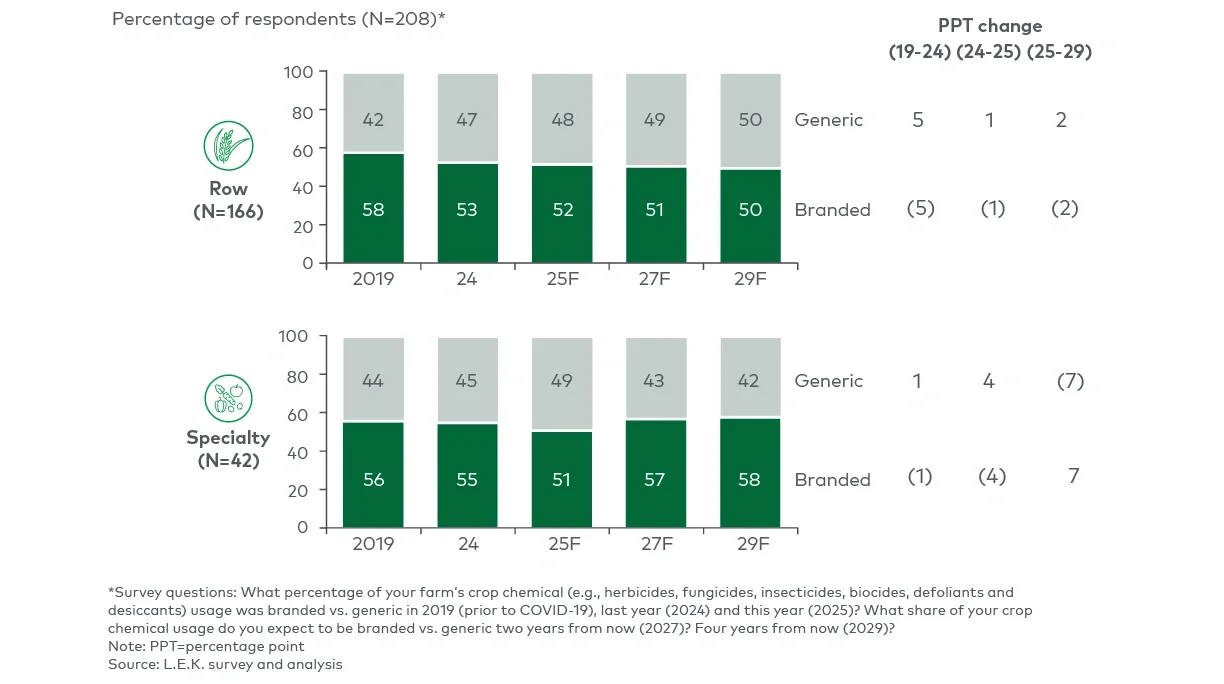
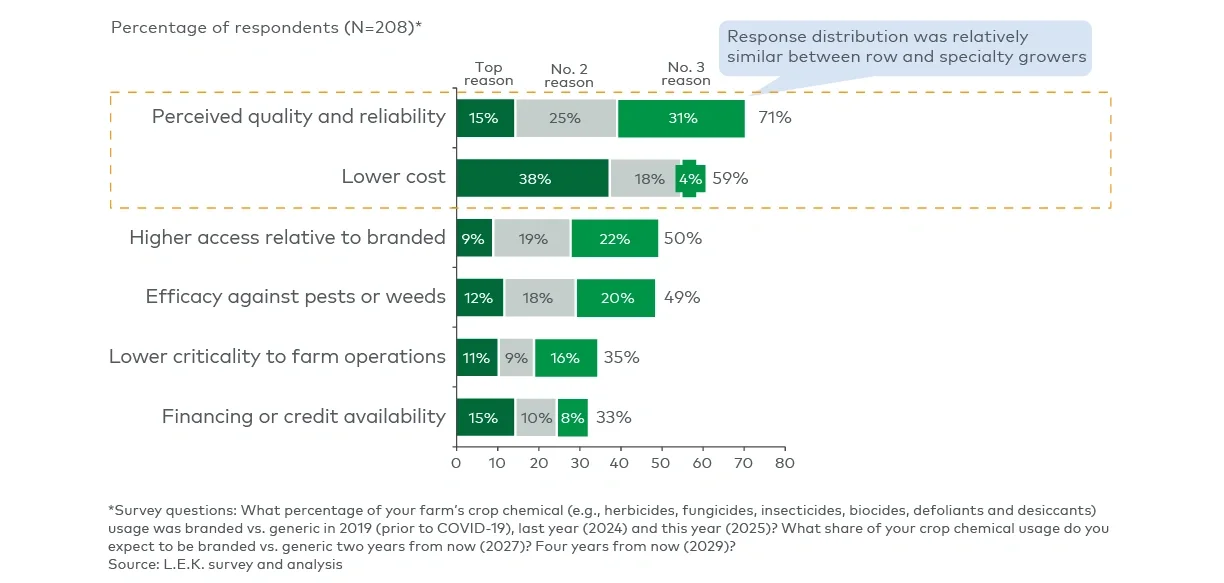
In the wake of COVID-19, both row and specialty crop growers’ use of generic crop protection products as a proportion of total crop chemicals rose an average of 5-6 percentage points, primarily due to their lower cost as well as supply chain challenges for branded products. Additionally, growers’ views indicate an increasingly strong belief in their quality and reliability, a clear sign that the gap between the perception of generic and branded products has been closing.

Going forward, through 2029, row crop growers expect a more moderate but continued shift (up 2 percentage points) toward the use of generic crop chemicals. Indeed, growers have already observed an increase in the prevalence of low-cost suppliers focused on generics, particularly for herbicides and insecticides, which is creating a more competitive sales environment at the supplier level. 

However, the recent tariff dynamics (if not resolved) could likely challenge generics — particularly those from China — by reducing the cost disparity relative to branded crop protection products. Meanwhile, specialty growers expect their use of branded chemicals to rebound (up 7 percentage points) (see Figures 1a and 1b). 

Figure 1a

Percentage of crop chemicals purchased, by generic vs. branded (2019, 2024, 2025F, 2027F, 2029F) 

Image
Percentage of crop chemicals purchased, by generic vs. branded (2019, 2024, 2025F, 2027F, 2029F)

Figure 1a

Percentage of crop chemicals purchased, by generic vs. branded (2019, 2024, 2025F, 2027F, 2029F) 

Image
Percentage of crop chemicals purchased, by generic vs. branded (2019, 2024, 2025F, 2027F, 2029F)

Figure 1b

Reasons for increased use of generic crop chemicals (2025) 

Image
Reasons for increased use of generic crop chemicals (2025)

Figure 1b

Reasons for increased use of generic crop chemicals (2025) 

Image
Reasons for increased use of generic crop chemicals (2025)

Figure 2

Current level of biological usage, by respondent’s primary crop type (2024) 

Image
Current level of biological usage, by respondent’s primary crop type (2024)

Figure 2

Current level of biological usage, by respondent’s primary crop type (2024) 

Image
Current level of biological usage, by respondent’s primary crop type (2024)

Biologicals poised to gain further adoption and usage

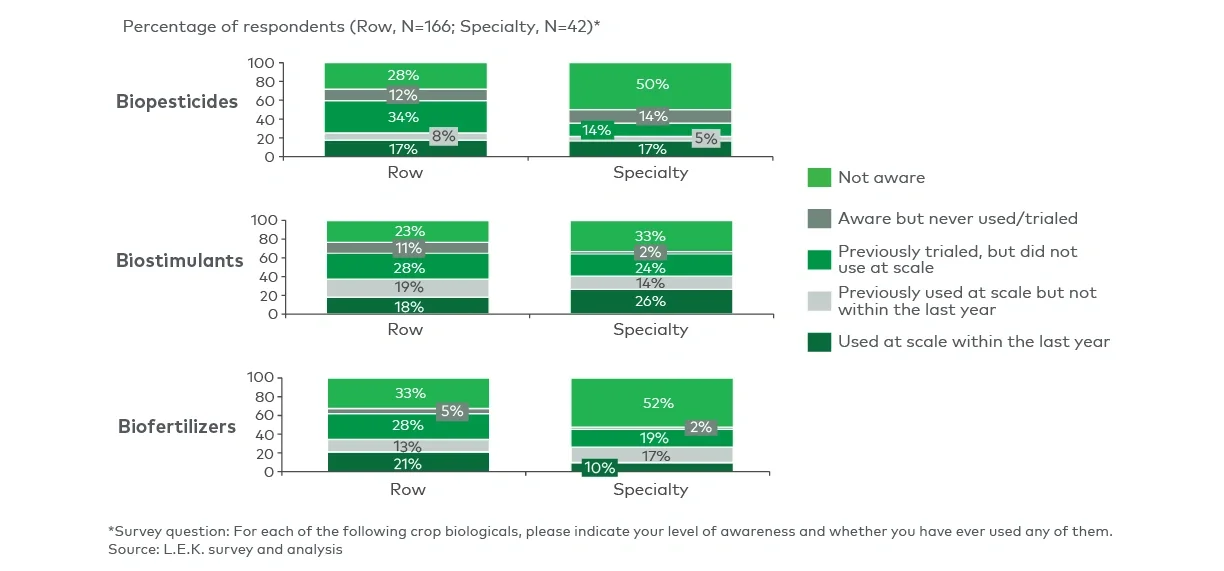
Roughly half of the growers we surveyed had used, or at least trialed, biopesticides, biostimulants and biofertilizers, with younger growers (i.e., under age 40) more likely to be using biologicals — biopesticides in particular — at scale. And awareness and usage are generally higher among row crop growers than among specialty crop growers. Indeed, row crop growers exhibit greater awareness of biologicals across types (15%-20% more row growers are aware of them, on average), especially biopesticides and biofertilizers.

That said, about a third of our survey respondents claimed to be unaware of each of those three biological segments, especially biopesticides and biofertilizers, meaning there’s room to increase awareness of them through field trial data and grower education (see Figure 2).

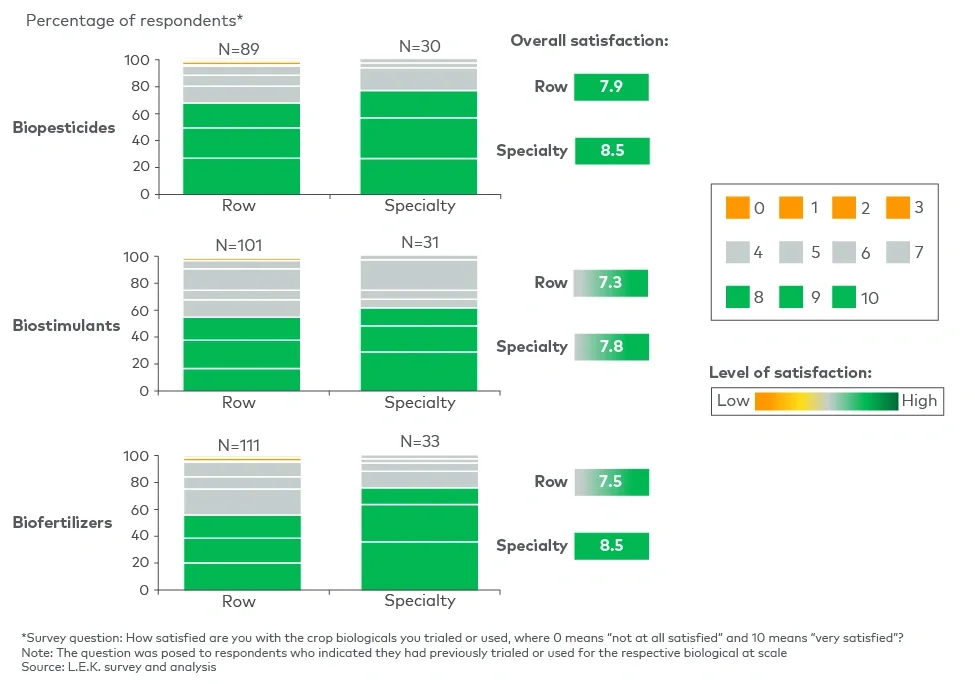
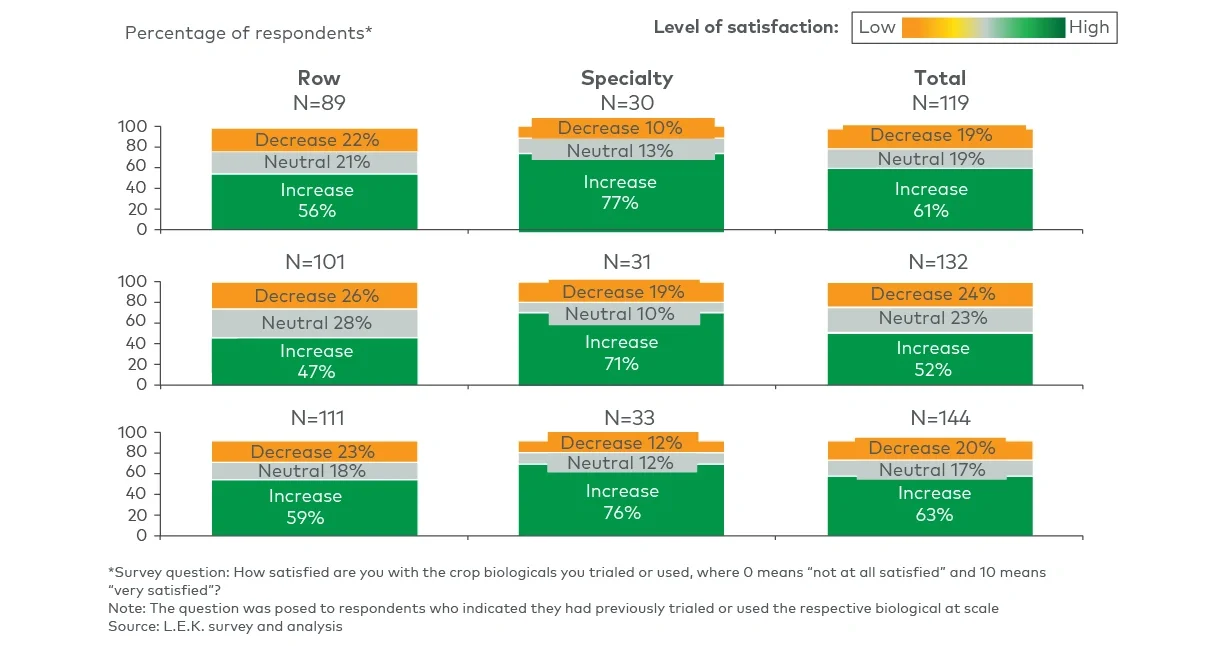
But for all three types of biologicals, growers who had used or even just trialed them exhibited relatively high satisfaction — biopesticides, biostimulants and biofertilizers all received 7s and 8s on a 10-point scale for satisfaction — and said they intended to increase their use of them going forward. The majority of users expect to increase their usage of biologicals over the next two years, with specialty growers (on average) expecting to increase their use of them more than row crop growers (see Figures 3a and 3b). 

Figure 3a

Current level of biological satisfaction, by respondent’s primary crop type (2024)

Image
Current level of biological satisfaction, by respondent’s primary crop type (2024)

Figure 3a

Current level of biological satisfaction, by respondent’s primary crop type (2024)

Image
Current level of biological satisfaction, by respondent’s primary crop type (2024)

Figure 3b

Expected change in usage of biologicals among users, by type (2024-26) 

Image
Expected change in usage of biologicals among users, by type (2024-26)

Figure 3b

Expected change in usage of biologicals among users, by type (2024-26) 

Image
Expected change in usage of biologicals among users, by type (2024-26)

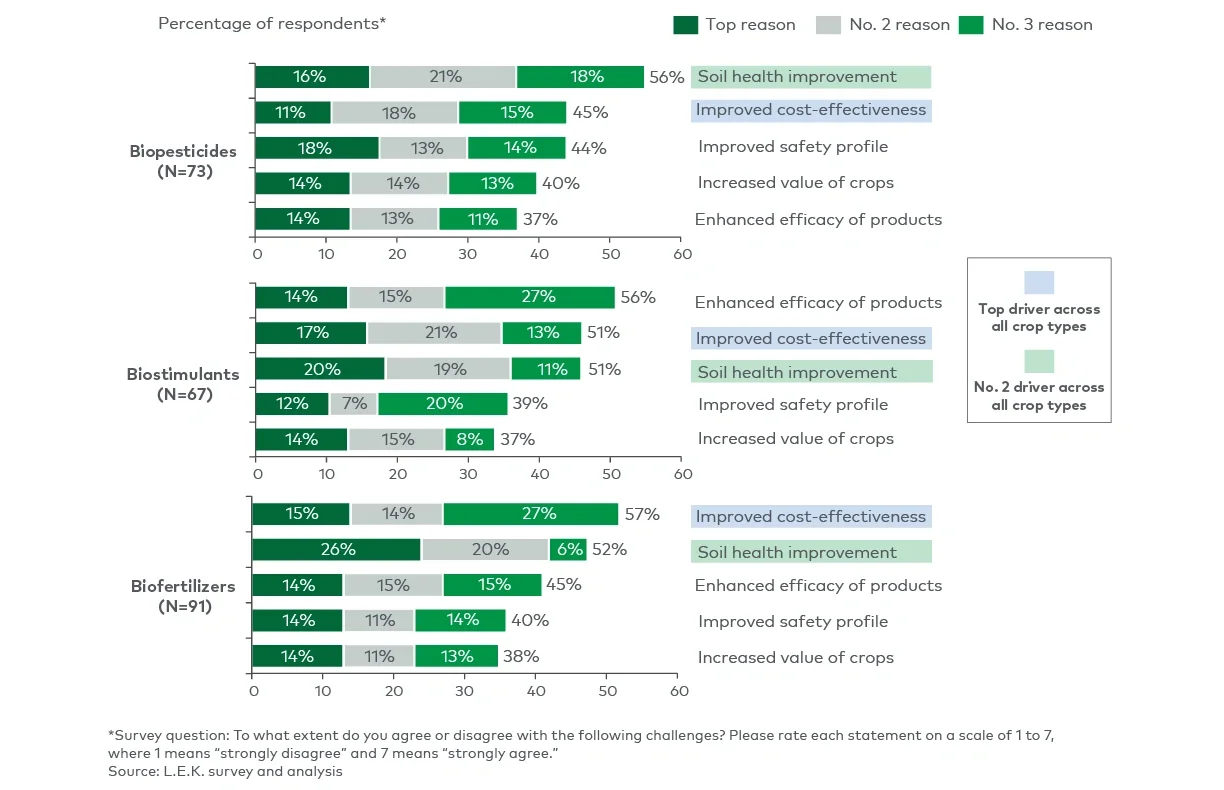
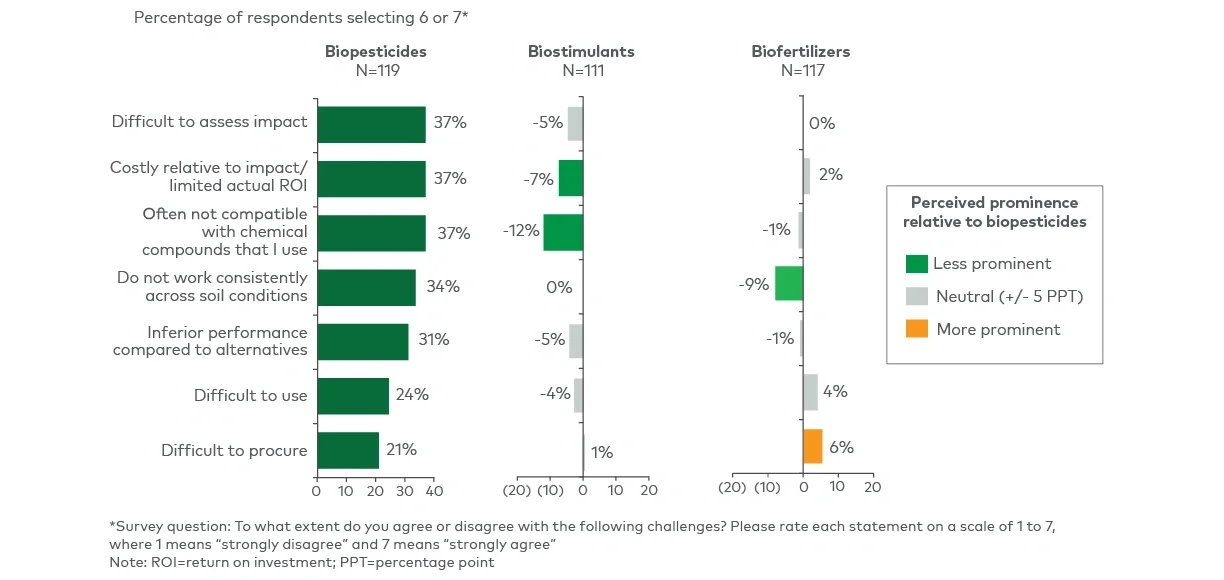
But while growers who expect to increase their usage of biologicals cited soil health improvement and improved cost-effectiveness as the top drivers for all three segments (biostimulant users also indicated a perceived increase in efficacy), accurately assessing their impact — and their true ROI — continues to be a challenge (see Figures 4a and 4b).

Figure 4a

Top drivers of increasing usage of biologicals, by type (2024-26) 

Image
Top drivers of increasing usage of biologicals, by type (2024-26)

Figure 4a

Top drivers of increasing usage of biologicals, by type (2024-26) 

Image
Top drivers of increasing usage of biologicals, by type (2024-26)

Figure 4b

Most prominent challenges/barriers to using crop biologicals 

Image
Most prominent challenges/barriers to using crop biologicals

Figure 4b

Most prominent challenges/barriers to using crop biologicals 

Image
Most prominent challenges/barriers to using crop biologicals

As to growers who have not used biologicals, they are relatively open to trialing/using them over the next two years: 25%-35% of nonusers of biologicals indicated that they definitely or probably will trial these products within the next two years, with interest particularly high for biostimulants versus biopesticides and biofertilizers. Less than 30% of growers who have not used biologicals indicated they are opposed to trialing or using each of the three biological segments included in the survey.

The larger demographic shift taking place will also play a big role in the adoption of biologicals. As older growers start to retire, they are handing the reins over to a generation that is more averse to, and thus less likely to use, synthetic chemicals.

Fertile ground for higher yields

Much like the weather, the agricultural growers’ space, while largely predictable, changes slowly over time. But it is already fertile ground for manufacturers of generic crop protection products and biologicals looking to get traction with growers as well as for their investors.

Indeed, as our survey results show, growers’ attitudes toward generic inputs are evolving. Their willingness to invest more in trial biologicals, for example, should be viewed as a green light for specialty input companies looking to get traction in this field. 

Meanwhile, our survey indicates that, primarily in an effort to secure better pricing, growers have been gradually shifting toward direct-from-manufacturer sourcing, a move that is expected to pick up speed in the near term. Indeed, if crop prices continue to remain low, growers indicated they are most likely to scale back on discretionary expenses. To learn more about the latest channel trends, don’t miss our companion survey piece.

To set up a meeting to learn more, please contact us

L.E.K. Consulting is a registered trademark of L.E.K. Consulting LLC. All other products and brands mentioned in this document are properties of their respective owners. © 2025 L.E.K. Consulting LLC 

Questions about our latest thinking?

English
Executive Insights

From Bench to Bedside: Academic-to-Industry Translation in European Biopharma

June 25, 2025

Key takeaways

Europe leads in academic biomedical research, publishing over twice as many papers as the US, but lags in commercialisation, with only 70% as many approvals for European-originated assets.

There is encouraging momentum: EU and national initiatives have expanded funding; venture capital investment has more than doubled since 2018; and universities are improving spin-out terms, launching innovation hubs and attracting global talent.

Key barriers in Europe relative to the US include weaker institutional support and incentives, lower capital availability and cultural differences, as well as more-fragmented public markets and venture ecosystems. 

Bridging this gap will require coordinated efforts to better support biotech ventures from spin-out to scale-up, strengthen global connectivity, and build the operational experience and networks characteristic of more mature ecosystems like the US. 

Introduction

Europe has long stood at the forefront of academic excellence in life sciences. It hosts 37 of the world’s top 100 life sciences universities (versus 34 in the US).1 Moreover, the continent consistently leads the US in biomedical publication volume and citation impact. Yet a persistent gap remains between scientific innovation and commercial output in Europe compared to the US.  

As the competition for biotech capital intensifies globally, key questions arise: How can stakeholders across the European ecosystem work to close the translational gap with the US? And what steps can European biotechs take to maximise their chances of success?

Diverging pathways from innovation to impact in Europe and the US

To highlight the commercial gap between the two markets, L.E.K. Consulting analysed the innovation pipeline from academic publication to drug approvals, focusing on drugs originating in academic or biotech institutions.2

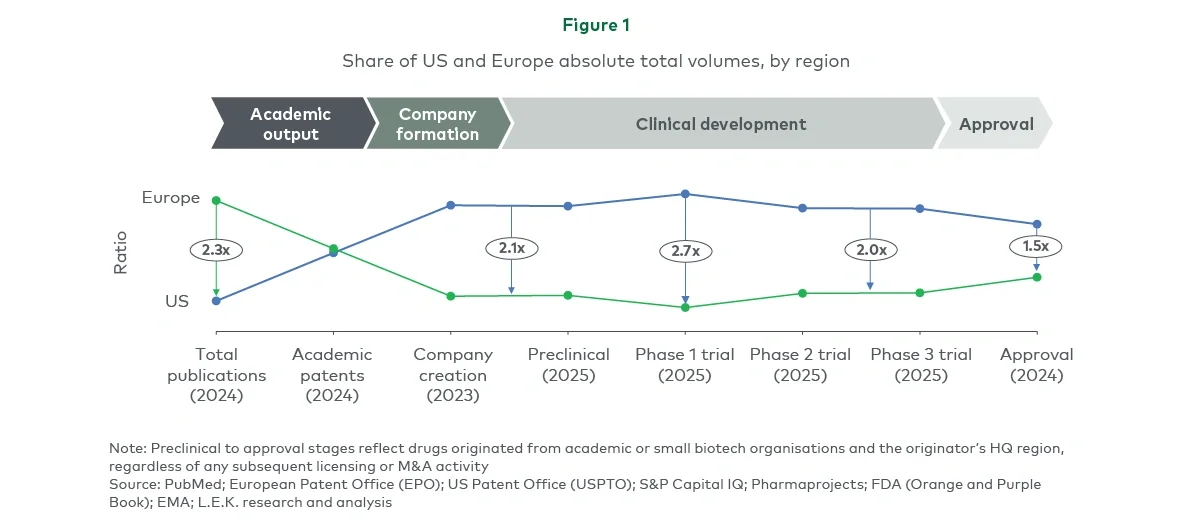
Europe publishes over twice as many publications as the US, but this advantage disappears at the academic patent stage (see Figure 1). In 2023, the US also founded more than twice as many biotech companies as Europe, despite a sharp decline in both regions since 2021.

The gap persists through development to the drug approval stage — US-originated intellectual property (IP) now accounts for 1.5 times more approvals than Europe, and this has been relatively consistent over the past five years.

Europe also lags in company maturation: US-headquartered small biotechs (revenue under $2 billion) independently launched more than three times as many drugs as European biotech peers from 2018 to 2024. 

Image
Share of US and Europe absolute total volumes, by region
Image
Share of US and Europe absolute total volumes, by region
Stage definitions and scope of inclusion
  • Publications: Total number of publications on PubMed, by location of the first author’s affiliated institution
  • Academic patents: Total number of patent applications generated by universities and other academic institutions from the Worldwide Patent Statistical Database PATSTAT, provided by the European Patent Office (EPO), by location of the applying academic
  • Company creation: Total number of newly formed therapeutic biotech companies on S&P Capital IQ (excluding medtech, diagnostics, other healthcare providers, etc.), by company headquarters  
  • Preclinical to Phase 3 trial: Total number of drugs in active development at the respective stage of development (highest phase reached) on Pharmaprojects with biotech originator irrespective of later acquisitions or out-licensing activity, by location of originator headquarters
  • Approval: New drug approvals (US Food and Drug Administration Orange and Purple books/European Medicines Agency) with original patent ownership (as per US Patent and Trademark Office/EPO) by academic or biotech entities, by headquarters of the IP owner 

Within Europe, national ecosystems show considerable heterogeneity. Countries such as Switzerland, the UK and the Nordics have the highest volume of patents and company formation relative to their publication output, driven by stronger technology transfer frameworks, dedicated university commercialisation arms, venture funding and a supportive regulatory environment. 

Barriers to translating academic innovation into biopharma output

Several systemic barriers hinder Europe’s ability to effectively translate academic research into commercial biopharma products.

1. Limited institutional support

European technology transfer offices (TTOs) are often more resource constrained than their US counterparts, limiting their ability to hire commercially experienced staff.3 Many focus on administrative or legal support and lack the business expertise needed to guide start-ups,4 hindering academic ventures from reaching early proof-of-concept and investment readiness.

Until recently, many European universities took as much as 30%-50% equity in spin-outs — far higher than the roughly 5% typically taken by US institutions — deterring founders and early-stage investors.  

2. Funding gaps and models

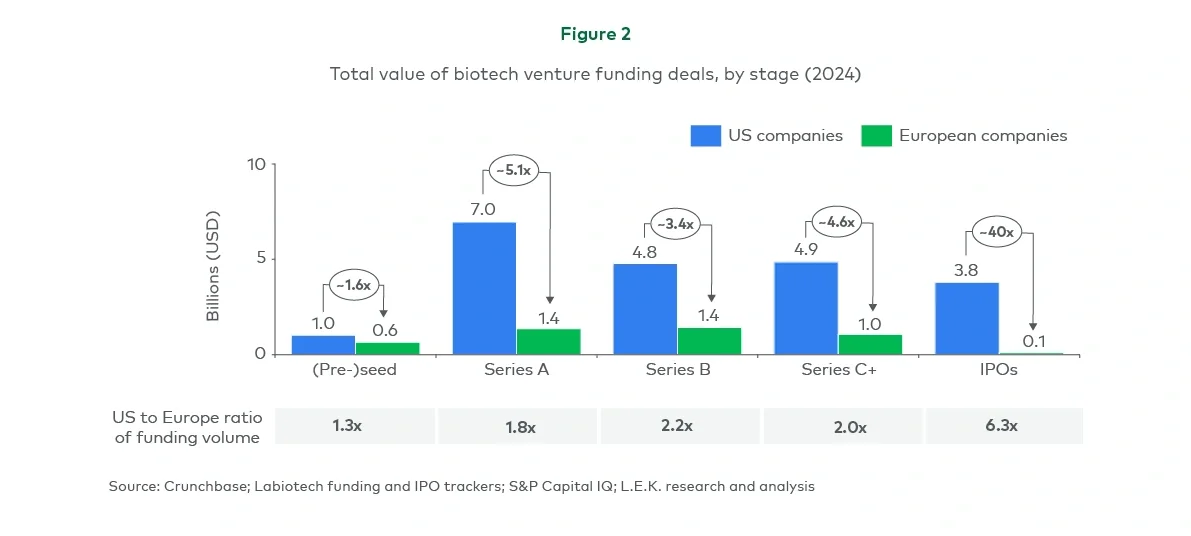
In 2024, US-headquartered biotechs secured 1.5 times more venture deals than their European peers — and over four times the value (see Figure 2). This gap is most acute in series A funding, critical for IND or clinical validation, but continues through series C+, limiting European biotechs’ ability to fund Phase 2/3 trials.  

Image
Total value of biotech venture funding deals, by stage (2024)
Image
Total value of biotech venture funding deals, by stage (2024)

Beyond funding, Europe also faces a structural gap in its venture ecosystem. Early-stage venture firms that actively incubate companies (e.g. Flagship Pioneering, Atlas Ventures) — providing direct assistance in navigating the transition from academia to biotech company — are more prevalent in the US.

Although initial public offering (IPO) markets are weak globally, European exchanges have long been less attractive than their US counterparts — offering less capacity, lower liquidity and more-onerous listing requirements. As a result, many European biotechs pursue M&A or list on Nasdaq, which accounted for approximately 70% of European biotech IPO value but only 30% of volume from 2018 to 2024.5

3. Talent and cultural differences

Founders and investors in the US are generally perceived to show a higher risk appetite, helping more biotech innovations progress through development. Culturally, US academics also tend to prioritise commercial impact, while European peers focus more on scientific impact, as measured by publications and citations.  

4. Ecosystem fragmentation

Europe’s fragmented regulatory landscape complicates biotech fundraising and scaling, requiring companies to engage investors across European markets to access growth capital. Navigating differing regulations for fundraising and IPOs requires early strategic planning, with cross-border investor syndicates increasingly essential for later-stage success.

Narrowing the gap: Encouraging signs and opportunities for acceleration

Despite structural challenges, Europe has gained momentum over the past five years, with progress in public initiatives, venture funding and academic infrastructure.  

  • EU initiatives: Programmes like the European Innovation Council, European Investment Fund, European Innovation Council Small and Medium-Sized Enterprises Executive Agency and Horizon have increased non-dilutive and blended finance to €1.4 billion in 2025 across industries, up from €1.2 billion in 2024.  
  • National support: National governments are also mobilising institutional and pension fund capital to support domestic innovation and later-stage venture funding (e.g. France’s Tibi 2, Germany’s WIN and the UK’s BPC).
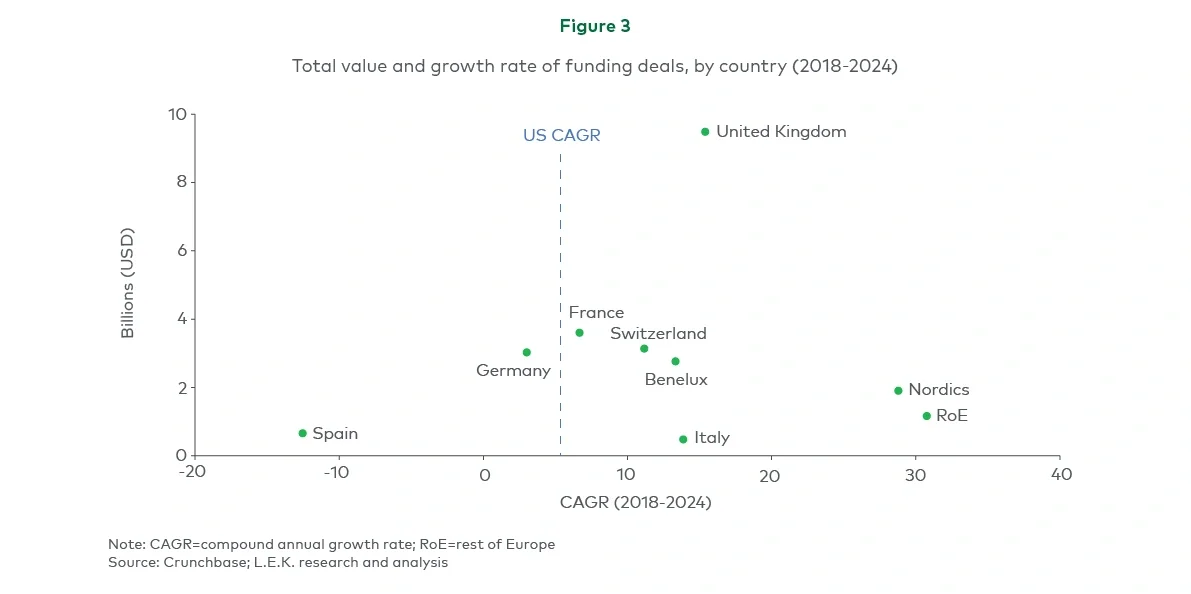
  • Venture growth: Despite a global downturn in biotech funding after 2021, European venture funding has returned to growth. More than doubling in value from 2018 to 2024, this has been led by the UK, Italy, the Nordics and Benelux. While US funding remains higher overall, Europe’s recovery has been faster and more stable in recent years (see Figure 3).
Image
Total value and growth rate of funding deals, by country (2018-2024)
Image
Total value and growth rate of funding deals, by country (2018-2024)
  • Founder-friendly TTOs: TTOs are adopting more-favourable terms for academic founders. For instance, UK universities have cut equity stakes by nearly 20% since 2020, with 2024 notably recording the highest number of pharma spin-outs since 2021.6
  • Global talent repatriation: Regulatory uncertainty and immigration policy in the US may prompt researchers to relocate to Europe’s growing ecosystems. New initiatives for attracting US researchers include Aix-Marseille’s €15 million Safe Place for Science, which drew almost 200 US applicants in its first month; a £50 million scheme by the UK government; and a “science passport” proposed by the EU to ease mobility.  
  • Incubator growth: European pharma companies are partnering more actively with academia through incubators and venture arms to derisk early-stage research. Novo Nordisk’s Science2Medicine iNNvest is one recent example.
  • University innovation hubs: Top universities are launching dedicated hubs to strengthen ties with industry. For example, the University of Cambridge’s Milner Therapeutics Institute and the University of Oxford’s BioEscalator offer infrastructure, funding support and co-location opportunities for academic entrepreneurs and biotech start-ups. Starting with Oxford in 2013, many European institutions have also launched in-house venture funds.

Strategic imperatives for the European biotech ecosystem

To narrow the translational gap with the US, Europe must complement scientific excellence with stronger institutional, financial and commercial infrastructure. While biotech founders are central to this progress, coordinated action across academia, public institutions, industry, investors and policymakers is essential.  

Our recommendations for each group are listed below:

  • Academia: Modernise spin-out models to facilitate commercial outcomes by offering attractive equity and IP licensing terms, further professionalise and better resource TTOs, and consider establishing or growing venture arms.
  • Public institutions: Increase public funding to derisk early-stage innovation and attract private investment, enable talent mobility, invest in infrastructure and implement founder-friendly policies. At later stages, employ mechanisms such as blended finance to extend company runways.
  • Large and midsize biopharma: Engage early with emerging biotechs through partnerships, licensing and minority investments while addressing late-stage funding gaps via co-development and hybrid financing structures.
  • Investors: Broaden investment support across the funding life cycle, particularly from series A onwards, and collaborate internationally to enable scaling.

In the race to commercialise innovation, European biotechs must now compete not only with well-capitalised US peers but also with China’s rapidly advancing biotech sector. To stay competitive, they can draw lessons from European success stories such as argenx and Immunocore, which have effectively bridged the gap from science to market.

Case studies of successful European biotechs demonstrate how early proof of concept and strong life cycle potential can unlock global funding
  • argenx (Belgium/the Netherlands): Gained investor traction by targeting a well-characterised pathway in autoimmune disease with broad applicability. Its early Vyvgart data provided clear clinical proof of concept, while the platform’s potential across multiple indications created a compelling LCM narrative. This combination enabled argenx to secure major global partnerships, scale rapidly and list on both Euronext and Nasdaq.
  • Immunocore (UK): Spun out from the University of Oxford, Immunocore leveraged its proprietary T-cell receptor (TCR) platform to target cancer and infectious diseases. Early institutional support, a clear IP pathway and robust international investor engagement enabled it to scale through clinical trials and achieve Food and Drug Administration approval for Kimmtrak, the first TCR therapeutic approved in the US. 

Key practices include:

  • Prioritising differentiated, derisked assets with clear clinical potential and room for life cycle expansion
  • Running lean and capital-efficient operations to extend runway and maintain optionality
  • Forming early strategic partnerships with global pharma to fund trials, enhance credibility and share risk
  • Engaging international investors and regulators early to secure access to capital, markets and approval pathways

By adopting these strategies, Europe’s emerging biotechs can chart a more direct course from discovery to global impact.

Conclusion

Europe has no shortage of scientific talent or breakthrough innovation. The challenge lies in building the institutional and financial bridges to convert this potential into sustained commercial impact.

Encouraging signs are emerging. Structural reforms are taking hold, venture funding is growing, and leading universities and companies are fostering more founder-friendly models. Yet persistent challenges, such as fragmented markets, a risk-averse culture and late-stage funding gaps, continue to hold Europe back.

To compete globally, European biotechs must be strategic and efficient. That means developing differentiated, derisked assets; operating with capital discipline; forming early partnerships with global pharma; and engaging international investors and regulators from the start.

With the right ecosystem support and a globally minded approach, Europe can convert its scientific potential into lasting biopharma leadership.

Contact the team to find out how L.E.K. can help.  

The authors would like to thank Katharina Novikov for her support in the development of this Executive Insights.

L.E.K. Consulting is a registered trademark of L.E.K. Consulting. All other products and brands mentioned in this document are properties of their respective owners. © 2025 L.E.K. Consulting

Endnotes 
1L.E.K. analysis of Times Higher Education World University Rankings 2025
2This was considered irrespective of which company ultimately developed or commercialised the drug 
3Global University Venturing, “Technology transfer offices struggle with recruitment and pay gaps.”
4Technovation, “Understanding the roles and involvement of technology transfer offices in the commercialization of university research;” Labiotech.eu, “How technology transfer offices can navigate biotech commercialization.”
5L.E.K. analysis of S&P Capital IQ, Labiotech IPO Tracker and Crunchbase 
6Beauhurst and Royal Academy of Engineering, “Spotlight on Spinouts: UK Academic Spinout Trends.” 

Questions about our latest thinking?

English
Executive Insights

How Pharma Companies Are Driving the Next Wave of Revenue Growth

June 25, 2025

Key takeaways

Future revenue growth among the top 15 biopharma companies is expected to be highly concentrated, with approximately 100 key assets projected to drive 80% of the $200 billion in incremental revenue between 2024 and 2030.  

Multi-disease assets are delivering outsized impact relative to their portfolio share, reinforcing the strategic benefit of prioritizing these over single-indication therapies.  

Around 70% of this growth will come from in-line products already on the market, highlighting the importance of lifecycle optimization, indication expansion, and disciplined launch execution as levers for sustained value creation.  

The majority of growth will come from core therapeutic areas where companies have existing scale and capabilities, underscoring the competitive advantage of therapeutic depth over diversification.  


While internal R&D remains essential, external innovation through business development and seamless deal integration will play an increasingly critical role in driving revenue growth.  

Introduction

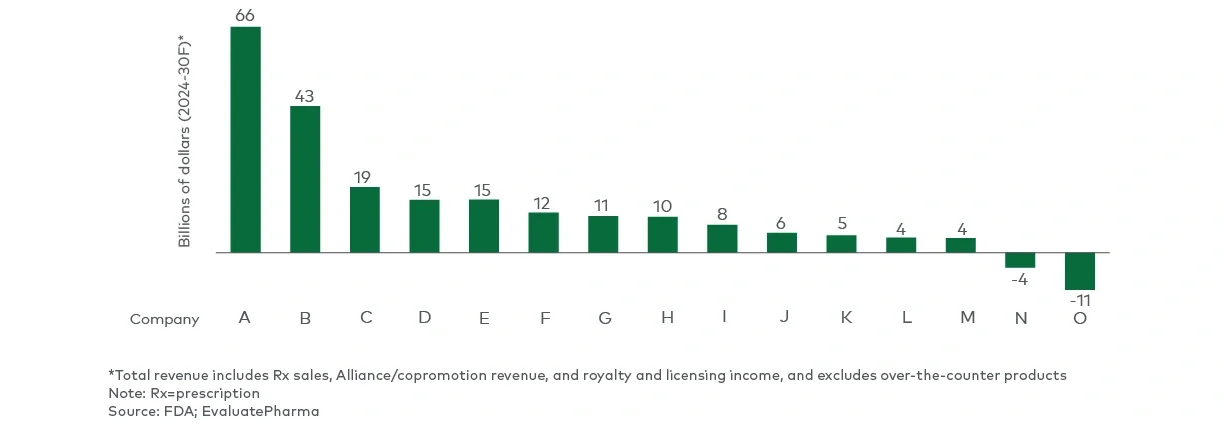
The top 15 biopharma companies account for 75% of total industry revenue, making their future performance a defining factor for the sector at large. Their strategies, investment decisions and execution disproportionately shape the trajectory of innovation and the creation of shareholder value across the entire sector. Despite facing loss of exclusivity (LOE) risks impacting 25%-30% of 2024 revenue, these companies are projected to grow their combined revenue by approximately $200 billion — a 30% increase — by 2030 (see Figure 1). 

Figure 1

Top 15 biopharma revenue growth (2024-30F) 

Image
Top 15 biopharma revenue growth (2024-30F)

Figure 1

Top 15 biopharma revenue growth (2024-30F) 

Image
Top 15 biopharma revenue growth (2024-30F)

Yet this growth is highly uneven. Nearly 80% of the projected revenue expansion is expected to come from just five companies, highlighting the growing divide between market leaders and the rest of the industry.

As executive teams navigate where and how to invest, a clear understanding of the underlying growth drivers — ranging from asset concentration and the mix of in-line versus pipeline contributions to life cycle potential, therapeutic focus and innovation sourcing — is critical for making informed decisions and sustaining long-term value creation.

Growth is concentrated — not evenly distributed

Growth through 2030 for the top 15 biopharma companies is driven by around 600 assets, half of which were marketed in 2024 and half of which are expected to be approved between 2025 and 2030.1 Yet revenue growth remains highly concentrated:

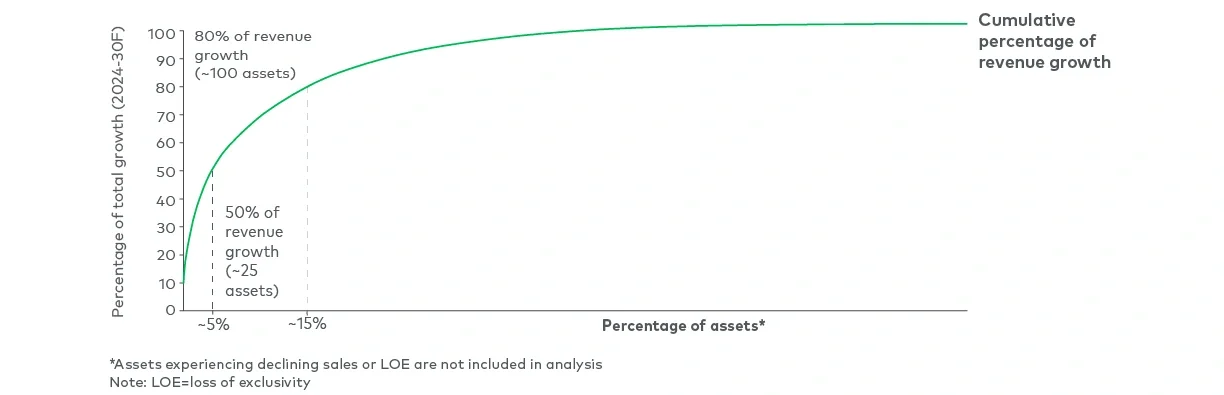
Just 15% of top-performing assets are expected to drive 80% of the industry’s projected growth through 2030. Even excluding glucagon-like peptide-1 agonists (GLP-1s), which account for nearly half of the top 15’s projected growth, the pattern holds, with 20% of non-GLP-1 assets generating 80% of the remaining growth (see Figure 2).

Top-performing companies don’t just aim for more product approvals; they strategically channel capital and resources into assets with the greatest potential for outsize commercial returns. These high-impact assets tend to scale well beyond their initial launch, often driven by geographic expansion, label extensions or significant differentiation in clinical outcomes. For leadership teams, the imperative is clear: Identify high-conviction opportunities early and commit decisively.

Spreading investments too thinly across a broad portfolio may dilute impact and prove less commercially effective. 

Figure 2

Concentration of revenue growth among top 15 biopharma assets 

Image
Concentration of revenue growth among top 15 biopharma assets

Figure 2

Concentration of revenue growth among top 15 biopharma assets 

Image
Concentration of revenue growth among top 15 biopharma assets

In-line assets are the backbone of growth

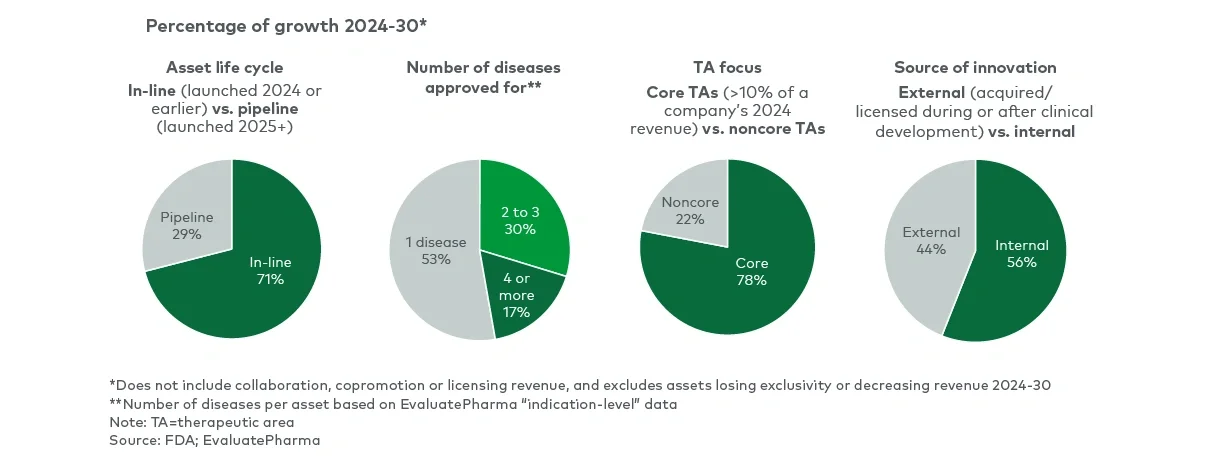
Over 70% of projected revenue growth through 2030 will come from in-line assets already on the market as of 2024 (see Figure 3). This places a premium on execution and life cycle management. To fully capture this value, companies must excel in launch performance, optimize market access and expand geographic reach. Sustained growth will depend less on new approvals and more on maximizing the potential of existing assets — ensuring they meet revenue expectations and then exceed them. 

Relying exclusively on existing products is not a viable strategy for long-term growth. Even the strongest in-line portfolios will inevitably face pressure from market saturation and LOE. To sustain momentum, companies must complement in-line growth with a consistent cadence of new product launches — not only to offset revenue decline but also to refresh the portfolio, maintain commercial relevance and reinforce investor confidence in the company’s innovation engine. 

Figure 3

Composition of top 15 biopharma 2024-30F revenue growth 

Image
Composition of top 15 biopharma 2024-30F revenue growth

Figure 3

Composition of top 15 biopharma 2024-30F revenue growth 

Image
Composition of top 15 biopharma 2024-30F revenue growth

Multidisease assets drive disproportionate value

“Portfolio-in-a-product” assets — therapies with the potential to address multiple diseases — are emerging as some of the most powerful growth drivers among the top 15 companies. Although they represent only about one-third of the combined portfolio density, these multi-indication assets are expected to account for nearly half of total projected revenue growth.  

Notably, just 13 such therapies, each spanning four or more indications, are set to deliver nearly 20% of topline expansion through 2030. Their outsize impact is a key differentiator between higher- and lower-growth players: The top five companies alone anticipate over $100 billion in growth from these assets — more than double the combined contribution expected from the bottom 10.

This underscores a critical strategic consideration. Therapies with the potential to scale across multiple diseases should be prioritized, as they offer not only greater revenue potential but also improved return on R&D and commercial investment.

Core therapeutic areas drive the majority of growth

Nearly 80% of projected revenue growth through 2030 is concentrated in core therapeutic areas — those already accounting for at least 10% of a company’s revenue.

This trend highlights the strategic advantage of building from a position of strength. By doubling down on familiar territory, companies can leverage established scientific expertise, trusted stakeholder relationships and existing commercial infrastructure to develop evidence strategies that resonate, accelerate launches, optimize access and gain share more efficiently than in less-familiar therapeutic areas.

In an environment defined by growing scientific complexity and mounting commercial pressure, companies that deepen their presence and enhance execution in core areas will be best positioned to drive consistent, capital-efficient growth.

Finding the right balance between external innovation and organic growth

External innovation — through M&A, in-licensing or strategic partnerships — remains a critical engine of growth in biopharma. Projections through 2030 show revenue growth is nearly evenly divided between internally developed assets and those sourced externally during or after clinical development. This balance does not yet reflect future deal activity, which is likely to tilt the mix even further toward external innovation over time.

This dynamic highlights a key strategic imperative: Companies must carefully balance internal R&D with external sourcing to remain competitive. Overdependence on internal pipelines can limit exposure to novel modalities and emerging science, while excessive reliance on external innovation may compress margins, introduce integration challenges and reduce long-term pipeline visibility. Striking the right balance is essential for sustained, capital-efficient growth in an increasingly complex and competitive landscape.

Key implications for pharma executives

Future growth in biopharma will depend on deliberate, insight-driven portfolio choices. The next generation of outperformers will distinguish themselves by reconfiguring their portfolios around a few core strategic principles:

  • Elevate post-launch execution and life cycle management
    Treat post-launch execution with the same strategic rigor as clinical development. Prioritize indication expansion, global market penetration and long-term value creation to fully realize the potential of in-line assets.
  • Double down on high-impact, scalable assets
    Focus investment on a select group of high-conviction programs with label expansion potential. Concentrating capital behind these assets can unlock disproportionate returns and build momentum across the portfolio.
  • Leverage strength in core therapeutic areas
    Deepen presence in therapeutic areas where scientific expertise, stakeholder relationships and commercial infrastructure already exist. Avoid the dilution and complexity that come with overdiversification into unfamiliar domains. 
  • Balance internal R&D with external innovation
    Maintain sourcing agility through a dual-engine model that combines internal research with targeted M&A, licensing and strategic partnerships. This approach ensures access to innovation across modalities and development stages while managing risk and capital efficiency.

Companies that align their commercial, development and investment strategies with these principles will be best positioned to drive sustainable, high-quality growth in an increasingly competitive environment.

For more information, please contact us.

Author’s note: Almost 50% of forecast revenue growth is attributed to the GLP-1 class. This concentration, however, does not impact the core findings and recommendations in the article.

Note: AI tools were used in the drafting of this article.

L.E.K. Consulting is a registered trademark of L.E.K. Consulting LLC. All other products and brands mentioned in this document are properties of their respective owners. © 2025 L.E.K. Consulting LLC 

Endnote
1The number of assets is not risk-adjusted for likelihood of approval 

Questions about our latest thinking?

English
Executive Insights

Revolution or Extinction? Rethinking SaaS in the Age of Agentic AI

June 24, 2025

Key takeaways

Agentic and generative AI are redefining software workflows, enabling autonomous, outcome-driven operations that reduce reliance on traditional user interfaces and manual inputs.

Three future scenarios are emerging. SaaS and AI may remain distinct, converge through integration, or see agentic AI eclipse SaaS entirely, with implications varying by industry and use case.

Traditional SaaS models face disruption on two fronts: agentic AI may bypass interfaces altogether, while generative AI empowers users to build customised software that mimics and potentially replaces SaaS platforms. 

SaaS vendors must move faster — rethinking architecture and pricing for an AI-native world. For users with significant SaaS spend, agentic AI offers a chance to reinvent how work gets done. 

Two of the most intriguing developments in the world of AI are the emergence of “agentic AI,” systems capable of autonomously planning, reasoning and executing multi-step tasks, and “generative AI,” capable of developing code and software. For SaaS companies, these trends present both a significant opportunity and a looming threat.  

As AI shifts from being a supportive feature to becoming an autonomous actor in its own right, the traditional SaaS business model faces pressure to adapt or risks obsolescence.

In this Executive Insights, we examine how the rise of agentic and generative AI is reshaping software workflows and redefining what SaaS platforms must become to stay relevant.

Understanding the difference: Agentic workflows vs SaaS

SaaS platforms, by design, serve as systems of record. They’re structured environments built to store, manage and present business-critical data through intuitive user interfaces. Examples include Salesforce, Zoom, Slack and Outlook. These platforms require users to input data manually and interact with software directly.

Agentic workflows, by contrast, introduce a more fluid and intelligent approach to interacting with systems and completing tasks. Rather than relying on human-driven inputs to operate static interfaces, agentic workflows enable AI agents to interpret high-level goals and autonomously determine the steps required to achieve them. These agents can access and orchestrate actions across tools, invoke APIs, query data sources and adapt their behaviour in real-time, reducing or even eliminating the need for direct user engagement.

The differences are foundational. SaaS platforms are inherently static and reactive, built around defined schemas and tightly bound logic. They’re powerful, but inflexible. Agentic workflows are dynamic and proactive, capable of adapting to changing conditions and contextual signals. Where SaaS requires human action at every step, agentic workflows shift the burden of execution from user to machine.

While it may seem natural to combine the structured, data-rich environments of SaaS with the intelligent automation of agentic workflows, the two originate from fundamentally different design philosophies. SaaS platforms are built around structured interfaces, manual control and the integrity of stored data. Agentic workflows focus on interpreting and acting on data flexibly and autonomously. Integrating them into SaaS demands rethinking how data flows, decisions are made and tasks are carried out, shifting from static systems to more adaptive, intelligent operations.

The dual threat to traditional SaaS

Adding to this complexity are two emerging types of AI-driven disruption. First, agentic workflows have the potential to replace the user interface (UI) and user experience (UX) layers of SaaS entirely. In this scenario, instead of interacting with dashboards and forms, users simply prompt an AI agent that retrieves data from a consolidated database and executes actions autonomously. Here, SaaS persists only as a backend service, while the workflow is owned and driven by agents.

Second, even if users retain a preference for the SaaS interface model, generative AI is now enabling them to build those very interfaces themselves. People and companies can increasingly use AI to create bespoke SaaS-like applications on the fly. These products look and feel like conventional SaaS platforms, but they’re customised, created without coding expertise, and crucially, they bypass the need for traditional SaaS providers altogether. This disruption challenges the entire SaaS economic model, as software is generated rather than purchased.

These disruptions are already unfolding. OpenAI’s Operator, for example, is a compelling example of agentic workflows in action. It allows users to plan and book a jazz concert with a single prompt, handling search, scheduling and payment autonomously.  

On the generative side, tools like Replit empower users to build functional software, such as a customised chess game for a child, without needing to write complex code. It’s not hard to imagine this extending to full-fledged CRMs or ERPs in the near future.

What does the future hold? Exploring three scenarios

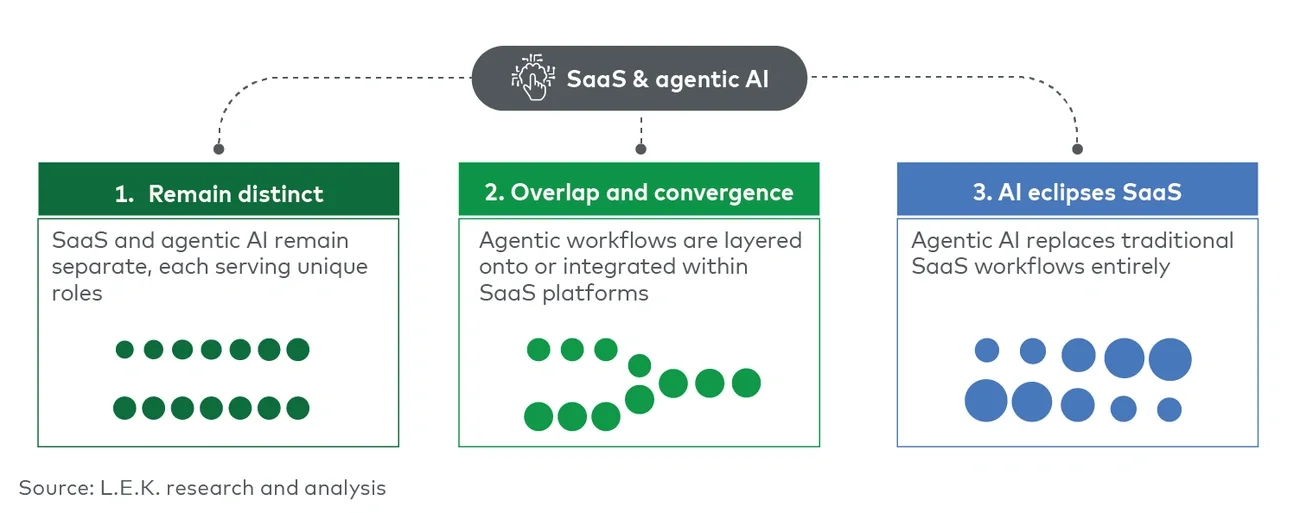
Whilst agentic AI presents a clear threat to SaaS, it also offers significant potential to enhance and augment existing platforms. Given the contrasting foundations of SaaS and agentic AI, there are three potential scenarios for how their relationship might evolve:

  • They may continue to operate distinctly
  • They may converge, with agentic workflows embedded into, or layered on top of, SaaS platforms
  • Agentic AI may eventually eclipse SaaS altogether

Below, we explore how each scenario might play out (see Figure 1). 

Figure 1

Three potential futures for SaaS and agentic AI

Image
Three potential futures for SaaS and agentic AI

Figure 1

Three potential futures for SaaS and agentic AI

Image
Three potential futures for SaaS and agentic AI

1. Remain distinct

There are strong reasons to believe that SaaS and agentic workflows will remain separate in many contexts. For one, issues of user trust and control remain paramount. Many users, particularly in regulated industries, prefer manual oversight, especially where compliance and precision are critical. Allowing AI agents to make autonomous decisions introduces risks that many organisations cannot accept.

Secondly, many verticalised industries, such as healthcare or manufacturing, rely on highly specialised SaaS tools that are deeply embedded into existing workflows. These tools offer niche functionality that is difficult for general-purpose AI to replicate.

Moreover, SaaS platforms benefit from mature integration ecosystems. Structured API-based connections, such as those linking CRMs to ERPs, are robust, standardised and hard to replicate in dynamic, agent-led architectures.

Finally, privacy considerations are a major concern. SaaS companies often design their products in compliance with strict local policies. Agentic AI systems, being inherently decentralised and adaptive, face challenges in meeting these requirements without significant additional oversight.

2. Overlap and convergence

Despite these distinctions, we’re already witnessing increasing overlap between SaaS and agentic workflows. In this scenario, the two paradigms complement one another, creating hybrid systems that enhance productivity and UX. For example, embedded AI agents are already transforming SaaS products:

  • Salesforce's Einstein AI acts as a copilot in CRM systems, automating data entry and suggesting next steps.
  • Adobe’s marketing agents perform A/B testing and generate content, while still allowing human designers to oversee branding decisions.

These are both examples of the first type of disruption, where agentic AI replaces traditional UI/UX interactions.

Agentic systems are also being used to orchestrate tasks across multiple SaaS tools. AI agents can now schedule meetings in Google Calendar, update tasks in Asana and send messages through Slack, all without human input.  

Additionally, SaaS interfaces themselves are evolving. Traditional dashboards and point-and-click interactions are giving way to conversational interfaces, with tools like Microsoft 365 Copilot enabling users to generate complex documents or analytics using simple natural language commands.

This convergence is already taking hold. According to the 2024 SaaS Benchmarks Report, 56% of companies reported that they’ve launched or tested AI features in their products within the past year. Of this group, 41% are monetising AI features, a number that’s up 9% from 2023. These overlaps suggest that SaaS and agentic AI are converging, with AI increasingly being layered on top of structured SaaS foundations to deliver more autonomous, user-friendly workflows.

However, the convergence between AI and SaaS may also prove disruptive to existing SaaS platforms. The rise of generative AI and low-code/no-code development means that companies can now build highly tailored solutions without relying on third-party SaaS vendors. In effect, companies and individuals are bypassing SaaS providers while still creating software that behaves like SaaS, just customised, more flexible and potentially cheaper.  

This trend is already visible in the increasing number of custom CRM builds and individual no-code projects that mimic traditional applications. Companies will end up with a product which looks and feels like the SaaS platforms they’re already used to using and trust but without the expensive price tag associated with traditional SaaS companies.  

3. AI eclipses SaaS

As adoption accelerates, a third scenario emerges: the potential for agentic AI to eclipse SaaS in certain domains. This may occur in response to growing consumer demands for faster, simpler and more customised solutions, something agentic AI is well positioned to deliver.  

In an environment where the first type of disruption, agentic AI interfaces, is fully established, businesses may begin rationalising their back-end systems into unified data repositories. AI agents, being agnostic to the application layer, can access and act on this data directly, removing the need for distinct SaaS applications entirely.

Alongside this, the second disruptive force continues to grow. As AI becomes capable of generating functional applications on the fly, businesses may stop subscribing to SaaS altogether. Instead, they’ll configure or request software tailored to their exact needs, delivered instantly by generative tools. Rather than buying licenses, they’ll pay for outcomes.

This dual pressure on the interface and infrastructure risks relegating SaaS to a “middle layer,” increasingly bypassed in favour of more agile, outcome-focused workflows. In marketing, for instance, agentic AI is already automating campaign management, content generation and customer insights, diminishing the role of traditional SaaS platforms.

Regulatory considerations

Regardless of which scenario ultimately prevails, agentic AI systems, whether standalone or embedded, will need to comply with local regulations, data protection laws and governance frameworks. This is especially critical as AI agents take on more decision-making authority.  

Companies must ensure that agentic systems remain auditable, secure and aligned with ethical standards.

Building trust in these systems will be essential. Organisations should prioritise transparency, user consent and robust data controls as they adopt AI-driven workflows.

What should companies do?

For SaaS businesses, the imperative is clear: adapt or risk becoming obsolete. Companies should begin by embedding AI capabilities into their platforms as core components that support autonomous workflows. They must also consider moving towards agent-native architectures. This means rethinking how data flows through their systems, how users interact with platforms and how platforms themselves can take action on behalf of users.

Furthermore, pricing and product models may need to evolve. As customers shift from paying for access (e.g. per-seat licensing) to paying for outcomes, SaaS providers must adjust accordingly.

Strategic responses will vary depending on which disruption a company believes to be more imminent to their SaaS platform. If the future lies in agentic interfaces replacing SaaS UIs, then companies must invest in building agentic workflows today, and becoming the orchestrators of these AI-powered systems.  

If the greater threat is generative SaaS built on the fly, then the goal should be to provide customers with flexible, build-your-own SaaS frameworks, effectively selling the tool that builds the tool. For example, rather than selling a static CRM platform, a company might offer an AI-powered builder that creates CRMs tailored to a client’s needs.

Investors, too, should evaluate whether the businesses they support have a clear AI roadmap and a defensible value proposition in an AI-first market. Customers will increasingly prioritise tools that deliver real-world results, not just dashboards and features.

Conclusion

The future of SaaS in the age of agentic AI isn’t black and white. In reality, all three scenarios — separation, convergence and eclipsing — will play out in parallel across different industries and company sizes.  

In regulated or highly specialised sectors, traditional SaaS will likely remain dominant. But in others, we’re already seeing the rise of “service-as-software” models, where outcomes matter more than interfaces and where AI agents orchestrate work with minimal human involvement.

Agentic AI doesn’t necessarily spell the end of SaaS, but it certainly marks the end of SaaS as we know it. The companies that embrace this transformation and reimagine their role in an AI-driven world will shape the next generation of enterprise technology. Those who fail to evolve risk being outpaced by an entirely new class of competitors.

Contact us to see how we can help. 

L.E.K. Consulting is a registered trademark of L.E.K. Consulting. All other products and brands mentioned in this document are properties of their respective owners. © 2025 L.E.K. Consulting

Questions about our latest thinking?

English
Executive Insights

How Sports Fandom Is Evolving in 2025: Insights From L.E.K.’s Annual Sports Survey

June 24, 2025

Key takeaways

Women’s sports are experiencing unprecedented growth, with the WNBA leading all leagues at a 65% year-over-year increase in avid fandom and star athletes like Caitlin Clark driving viewership increases of over 160%.

A significant generational divide exists in sports media consumption, with fans ages 18-29 allocating just 25% of their time to live sports content compared to 60% for fans over 60, signaling a shift toward highlights, social media clips and video games. 

League preferences vary significantly across age groups. Younger fans show stronger interest in the NBA, UFC and women’s sports, while sports like MLB, college football and the PGA exhibit lower avid fan incidence among fans ages 18-29 compared to those over 30.

MLS continues to face strategic challenges despite its role as the top U.S. soccer league, with 68% of avid pro soccer fans preferring international leagues, alongside limited traction for its exclusive streaming model among casual viewers. 

Introduction

Sports fandom in America continues to evolve in response to changing demographics, media fragmentation and shifting cultural preferences. To capture these dynamics, L.E.K. Consulting conducted its annual Sports Survey in January 2025, gathering insights from 4,520 U.S.-based adults who serve as primary decision-makers for media purchases in their households. Respondents evaluated over 20 professional and collegiate sports leagues across more than 50 distinct metrics.

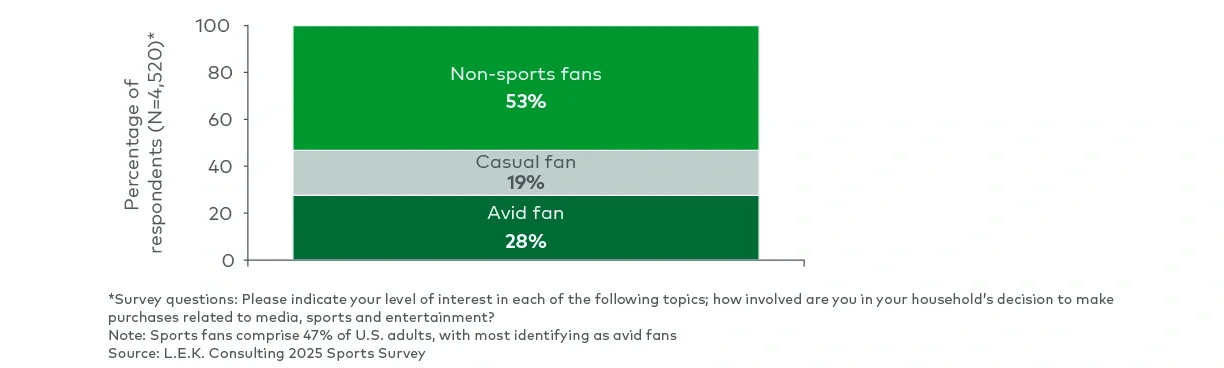
The data reveals that 47% of respondents identify as sports fans, with 28% describing themselves as avid fans and 19% as casual followers. The NFL stands out as the most popular league, with approximately 32% of survey respondents identifying as avid NFL fans — significantly higher than MLB (17%), college football (16%) and the NBA (14%) (see Figure 1). 

Figure 1

Interest in traditional sports (Dec. 2023, Jan. 2025)

Image
Interest in traditional sports (Dec. 2023, Jan. 2025)

Figure 1

Interest in traditional sports (Dec. 2023, Jan. 2025)

Image
Interest in traditional sports (Dec. 2023, Jan. 2025)

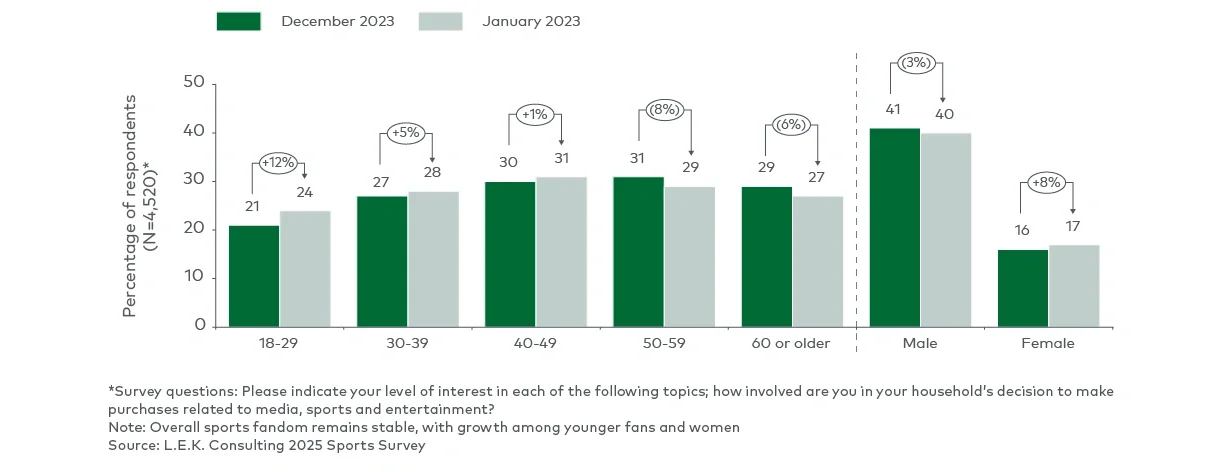
Even though overall sports fandom remained stable year over year, our demographic analysis uncovered important shifts in the composition of the fan base. Notably, younger adults under 30 showed a 12% increase in interest compared to last year, and women saw an 8% increase in sports engagement, suggesting a generational and demographic transformation in who is following sports (see Figure 2).

Figure 2

Change in avid interest in traditional sports, by age group and gender

Image
Change in avid interest in traditional sports, by age group and gender

Figure 2

Change in avid interest in traditional sports, by age group and gender

Image
Change in avid interest in traditional sports, by age group and gender

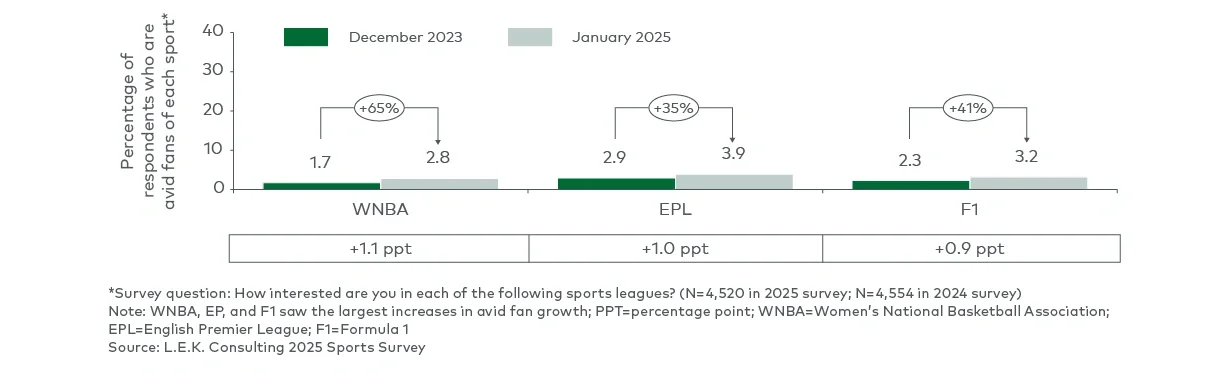
These demographic changes coincide with shifting league fortunes. Our analysis identified clear winners and losers in the competition for fan attention, with certain properties experiencing substantial growth and some traditional powerhouses facing declining interest. The Women’s National Basketball Association (WNBA) led all leagues with a remarkable 65% year-over-year growth in avid fandom, followed by the English Premier League (35%) and Formula 1 (F1) (41%). 

Conversely, men’s college basketball saw an 18% drop in avid fandom, followed by an 11% decline for college football and an 8% decrease for the NHL — representing millions of lost fans across these established leagues (see Figure 3). 

Figure 3

Top three largest percentage point increase in avid fan incidence (December 2023-January 2025)

Image
Top three largest percentage point increase in avid fan incidence (December 2023-January 2025)

Figure 3

Top three largest percentage point increase in avid fan incidence (December 2023-January 2025)

Image
Top three largest percentage point increase in avid fan incidence (December 2023-January 2025)

Women’s sports experience breakthrough momentum

The advance of women’s sports has moved beyond incremental growth to meaningful market impact. The WNBA’s 65% increase in avid fandom leads all leagues in growth, indicating a significant shift in the marketplace.

The survey asked interested fans to identify key drivers of their interest in women’s sports. Top reasons included the quality of play (25%), to support equal opportunities for women athletes (24%), strong role models (23%) and general sports fandom (22%). Female fans were especially likely to cite strong role models (33%), but male fans most often pointed to the quality of play (27%) and interest in sports more broadly (25%).

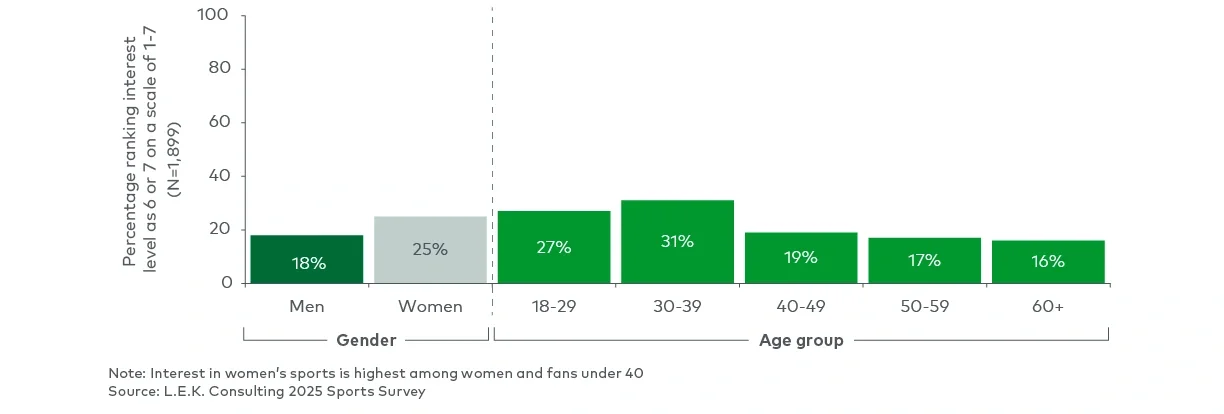
Interest in women’s sports is strongest among women and younger fans, creating a favorable demographic tailwind. While still a subset of the broader fan base, this engagement is broad-based and signals a healthy foundation for future growth (see Figure 4). 

Figure 4

Interest in women’s sports

Image
Interest in women’s sports

Figure 4

Interest in women’s sports

Image
Interest in women’s sports

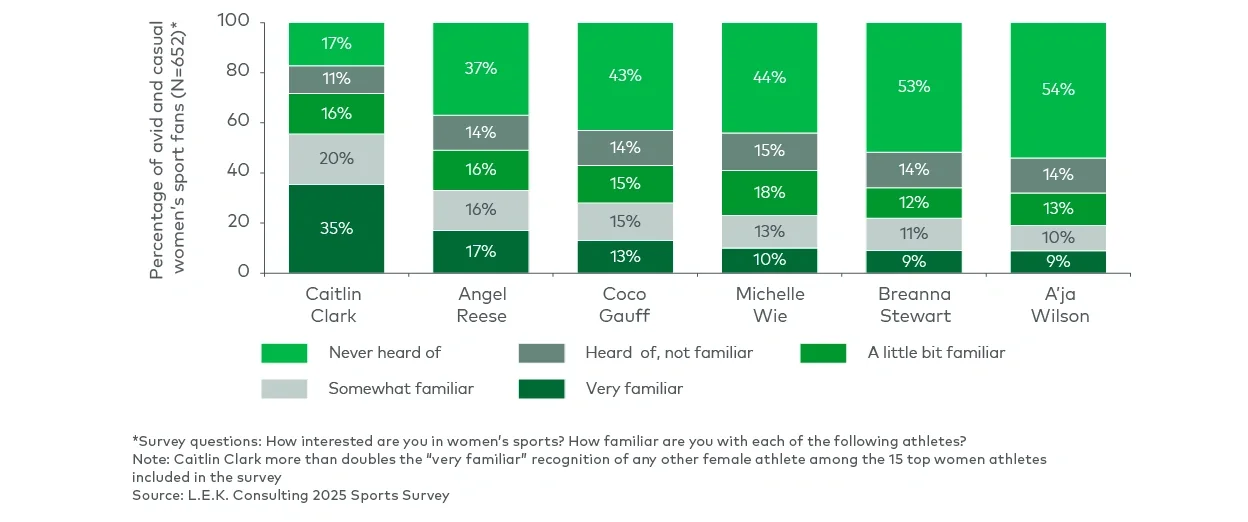
This momentum has translated into major media rights deals. The WNBA’s annual value jumped to $200 million, and the National Women’s Soccer League (NWSL) grew from $1.5 million to $60 million. The “Caitlin Clark effect” exemplifies this transformation. Her exceptional recognition among fans helped drive a 161% WNBA viewership increase, showing how transcendent stars can reshape league economics (see Figure 5). 

Figure 5

Familiarity with women athletes

Image
Familiarity with women athletes

Figure 5

Familiarity with women athletes

Image
Familiarity with women athletes

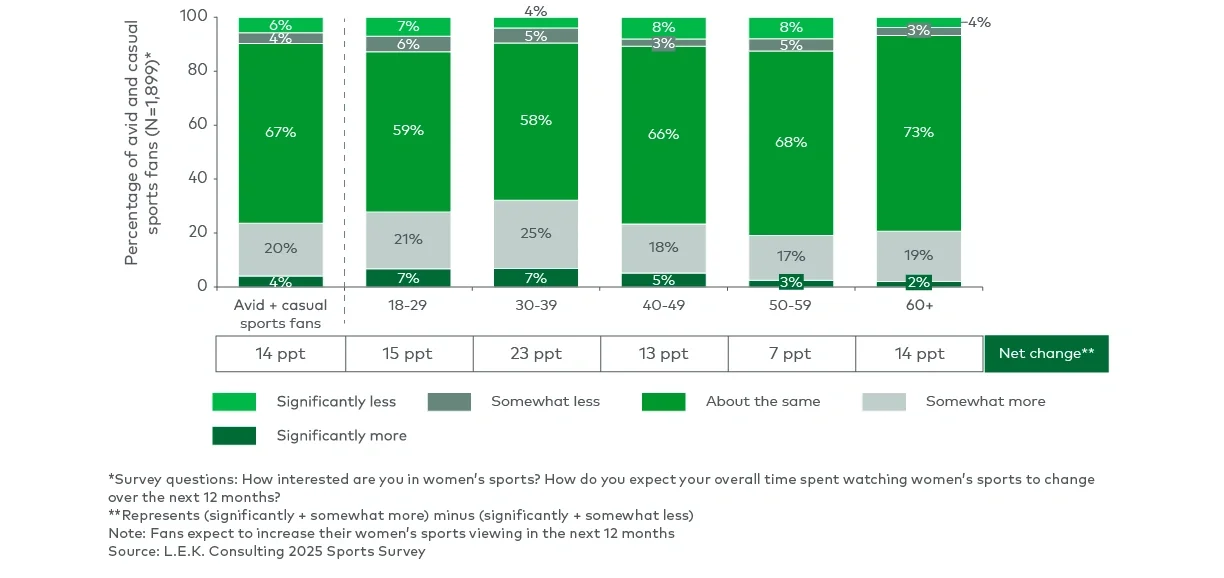
Looking ahead, fans expect their engagement with women’s sports to increase. The survey shows a positive 14% net change in expected viewing time for women’s sports over the next 12 months, with the strongest growth anticipated among fans ages 30-39. Even among older fans and casual viewers, the forecast remains positive (see Figure 6). 

Figure 6

Expected change in time watching women’s sports over the next 12 months

Image
Expected change in time watching women’s sports over the next 12 months

Figure 6

Expected change in time watching women’s sports over the next 12 months

Image
Expected change in time watching women’s sports over the next 12 months

Soccer’s complex position in the US

This demographic stability seen in women’s sports offers an interesting contrast to soccer’s more fragmented position in the American sports landscape. While women’s sports demonstrate consistent growth across age groups, soccer in the U.S. presents a more complex picture, with stark divisions between casual and avid fans. The NWSL has benefited from the broader women’s sports momentum, but men’s soccer displays a different pattern altogether.

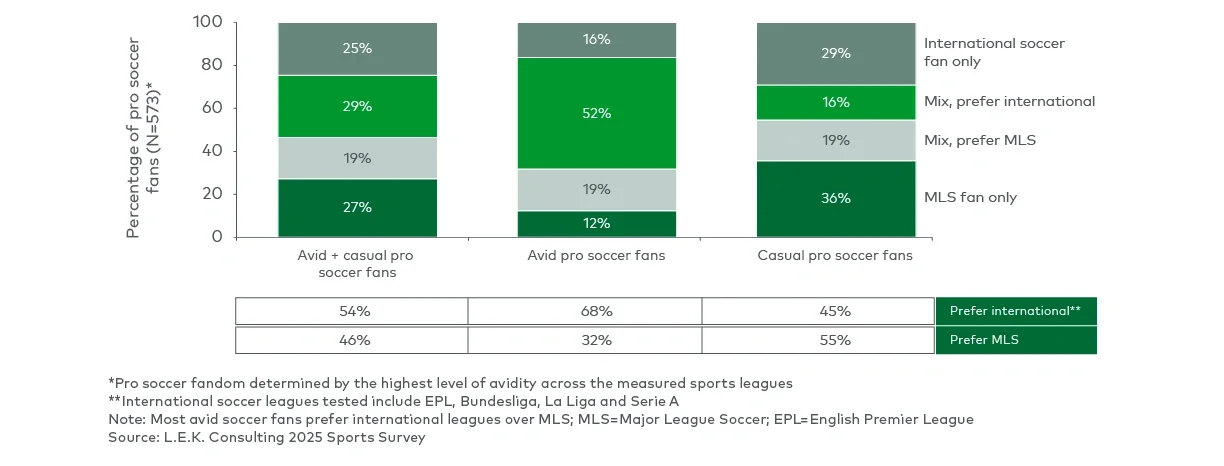
MLS holds the top spot for overall popularity among U.S. soccer leagues, with 3% of sports fans identifying as avid MLS fans and 10% as casual fans. However, among dedicated soccer enthusiasts, international leagues command greater allegiance.

The survey reveals that 68% of avid soccer fans prefer international leagues, with the English Premier League (EPL) leading the pack. This preference for international soccer is most pronounced among the most engaged fans, but casual soccer fans still favor MLS by a 55% majority (see Figure 7). 

Figure 7

Interest in MLS vs. international soccer leagues (January 2025)

Image
Interest in MLS vs. international soccer leagues (January 2025)

Figure 7

Interest in MLS vs. international soccer leagues (January 2025)

Image
Interest in MLS vs. international soccer leagues (January 2025)

When analyzing preference drivers, clear distinctions emerge between fans of different leagues. MLS fans primarily value local team support and star power (such as Lionel Messi), while EPL enthusiasts overwhelmingly cite the higher quality of play (46%), global star power (26%) and prestigious club history (24%). This highlights MLS’ central challenge: Despite attracting major stars, it still trails international leagues in perceived quality, particularly among avid fans.

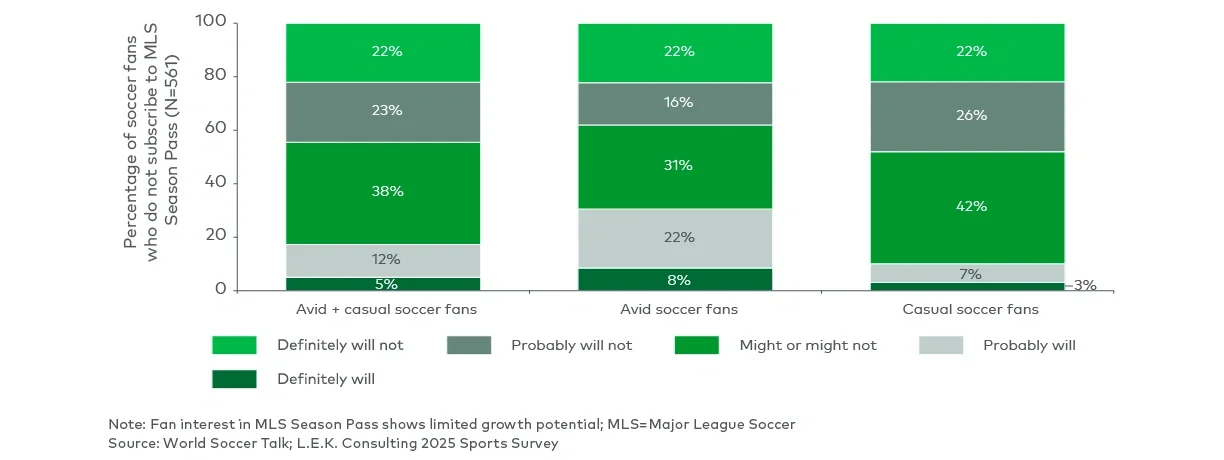
Despite early promise, MLS Season Pass adoption has seemingly stalled after initially reaching 2 million subscribers. The exclusive streaming model with Apple has raised accessibility concerns, which may be contributing to the significant viewership declines of MLS linear TV broadcasts, including the MLS Cup. Our survey data suggests MLS may risk losing relevance among the broader sports fan base, with limited subscription interest among nonsubscribers (see Figure 8). 

Figure 8

Likelihood to subscribe to MLS Season Pass next season

Image
Likelihood to subscribe to MLS Season Pass next season

Figure 8

Likelihood to subscribe to MLS Season Pass next season

Image
Likelihood to subscribe to MLS Season Pass next season

A changing media rights landscape

As fan preferences shift, so too does the business model supporting them. In a recent edition of Executive Insights titled “The Streaming War for National Sports Rights,” we explored the competitive dynamics of streaming platforms vying for premium sports content. Streamers are expected to invest $7.1 billion in national sports rights in 2025, up from $3.9 billion two years ago.

The draw? Live events consistently drive subscriber growth and advertising revenue, particularly among younger demographics that otherwise split their attention across TikTok, YouTube and gaming.

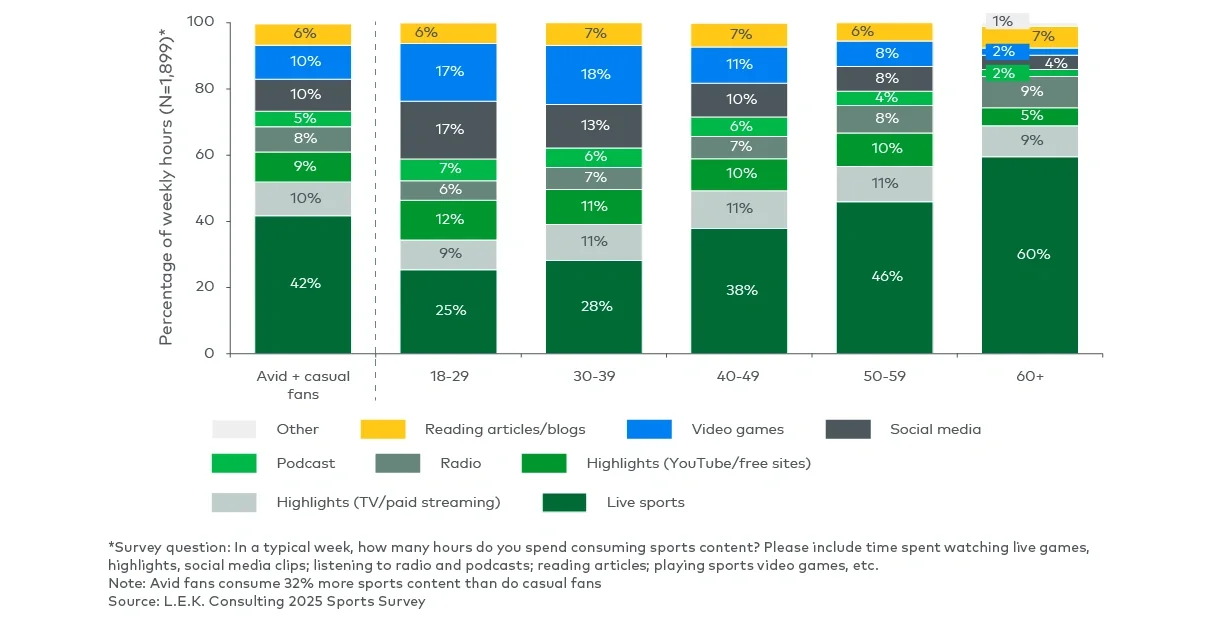
Our 2025 Sports Survey examined this dynamic through targeted questions about platform preferences and viewing habits. The data reveals that 46% of ESPN+ subscribers consider sports content “very important” to their subscription decision; however, fans ages 18-29 spend just 25% of their sports viewing time watching live sports content compared to 60% for fans over 60.

Although the women’s sports surge highlighted previously in this report is one outcome of this competitive environment, properties like UFC and F1 are also leveraging their unique audience demographics into stronger negotiating positions. Meanwhile, the regional sports network model faces existential challenges with the Diamond Sports/Main Street Sports Group bankruptcy proceedings — a topic we’ll explore in our next Executive Insights focused on the local media landscape.

Evolving fandom and shifting consumption

These changes in media rights reflect broader transformations in how fans engage with sports content. The 2025 Sports Survey underscores fundamental shifts in fan engagement. Avid sports fans consume approximately 32% more weekly sports content than do casual fans (20.5 hours versus 14.5 hours), but younger audiences are dramatically reshaping where and how that content gets consumed (see Figure 9). 

Figure 9

Average weekly per person hours consuming sports content among avid and casual sports fans, by age group (January 2025)

Image
Average weekly per person hours consuming sports content among avid and casual sports fans, by age group (January 2025)

Figure 9

Average weekly per person hours consuming sports content among avid and casual sports fans, by age group (January 2025)

Image
Average weekly per person hours consuming sports content among avid and casual sports fans, by age group (January 2025)

In addition to shifting platform preferences, total time spent consuming sports content is increasing. The 2025 Sports Survey shows that weekly viewership is rising across all age groups, with younger fans driving the most significant growth. Among fans ages 18-29, 39% reported watching more sports content than last year — a net increase of 23%, the highest of any age group. This growth is fueled largely by short-form content, social media and gaming — channels that reflect broader shifts in how sports content is consumed.

Age-based differences in media consumption are stark. Younger fans tend to prefer social media, gaming and on-demand formats over traditional live broadcasts; older audiences still dedicate the majority of their viewing time to live sports events.

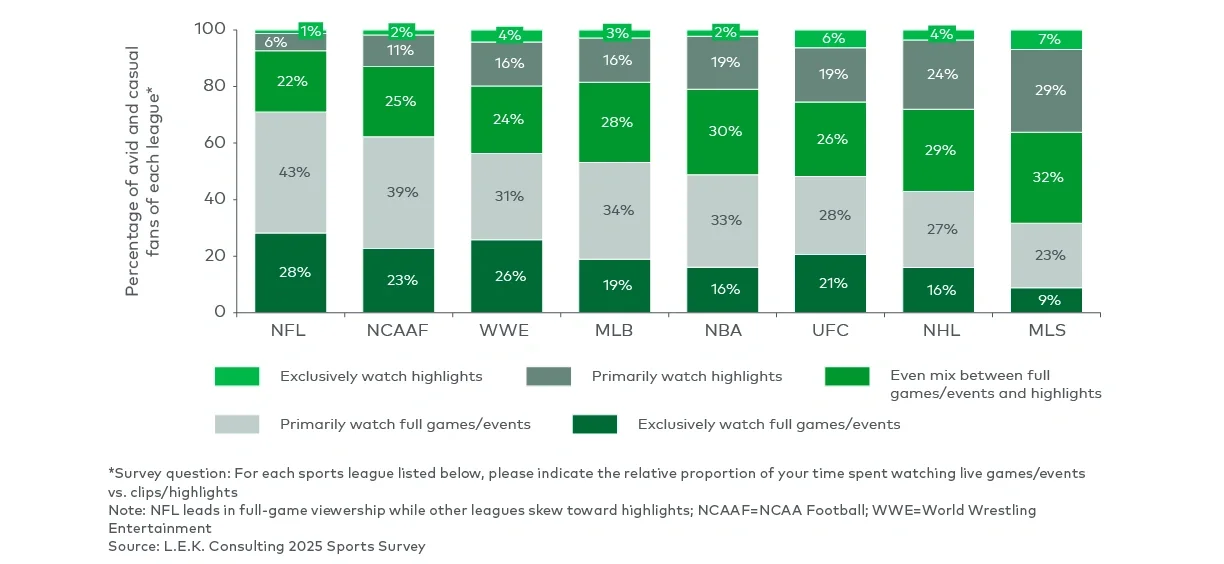
This fragmentation extends to viewing habits as well. NFL fans lead in full-game viewership, with 71% of fans primarily or exclusively watching full games. In contrast, only 32% of MLS fans fall into that category, with most favoring highlights or a mix of formats.  

Age further shapes these preferences. Younger fans (ages 18-39) are significantly less likely than are older fans (40+) to primarily or exclusively watch full games. The largest gaps between the two age groups appear in World Wrestling Entertainment (18 percentage points), MLB (17 percentage points), and NCAA football and NHL (13 percentage points each), highlighting a generational shift toward highlight-driven formats (see Figure 10). 

Figure 10

Watching preferences, by sports league

Image
Watching preferences, by sports league

Figure 10

Watching preferences, by sports league

Image
Watching preferences, by sports league

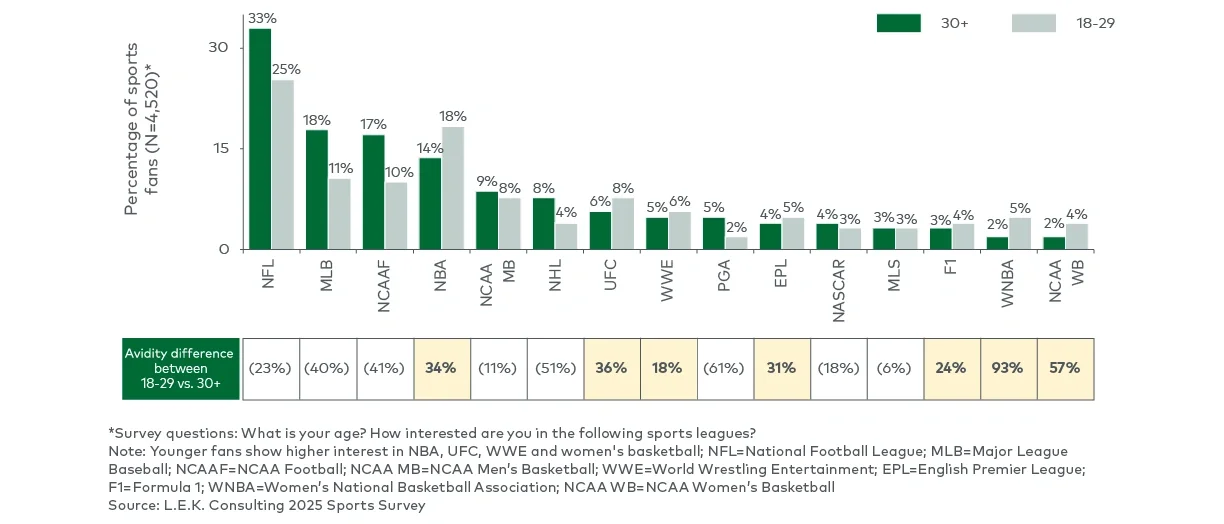
Most notable is the stark contrast in league preferences between age groups. The NFL remains the most popular league across all demographics, but its avid fan incidence is 8 percentage points lower among fans ages 18-29 compared to those over 30. In contrast, younger fans show higher levels of avidity for leagues like the NBA (18% among 18-29 versus 14% among 30+), UFC (8% versus 6%) and WNBA (5% versus 2%).  

These differences suggest that leagues with stronger digital engagement and social media presence are resonating more with the next generation of fans (see Figure 11). 

Figure 11

Avid fan incidence by sport (top 15 sports by avid incidence), age 18-29 vs. 30+ (January 2025) 

Image
Avid fan incidence by sport (top 15 sports by avid incidence), age 18-29 vs. 30+ (January 2025)

Figure 11

Avid fan incidence by sport (top 15 sports by avid incidence), age 18-29 vs. 30+ (January 2025) 

Image
Avid fan incidence by sport (top 15 sports by avid incidence), age 18-29 vs. 30+ (January 2025)

Meeting the next generation of fans

These evolving consumption patterns, combined with changing demographics and media landscapes, point to a future that’s more diverse, more digital and more fragmented. The growth of women’s sports, the rise of global leagues like EPL and F1, and the expanding definition of engagement are all reshaping what it means to be a sports fan.

To remain relevant, leagues and media partners must adapt by delivering shorter formats optimized for digital platforms, creating interactive social media touchpoints and developing mobile-first engagement strategies that complement traditional broadcasts. Properties that invest in star development, particularly among female athletes, stand to gain significant ground with the next generation. Our data clearly shows that the next generation isn’t abandoning sports; they’re simply engaging on their own terms.

About L.E.K. Consulting’s Sports practice

L.E.K. Consulting brings 40+ years of strategy experience to the sports industry. Our dedicated Sports practice works with leagues, broadcasters and platforms to deliver actionable strategies in media rights, audience segmentation and digital transformation. With a global team of 2,200+ professionals across 22 offices, we provide the analytical rigor needed to navigate industry shifts — from the surge in women’s sports to changing media consumption patterns.

For more detailed insights or to discuss how these findings might impact your organization, please contact us.

L.E.K. Consulting is a registered trademark of L.E.K. Consulting LLC. All other products and brands mentioned in this document are properties of their respective owners. © 2025 L.E.K. Consulting LLC 

Questions about our latest thinking?

English

Australian Airports: Funding the Future of Capacity and Connectivity

June 24, 2025

As Australia’s aviation network reaches the limits of its current capacity, a new wave of infrastructure investment is underway.  

In this video, L.E.K. Partner George Woods explores the next chapter of growth for the airport sector — from new terminals and runways to enhanced security and passenger experience.  

With over $20 billion in forecast capital expenditure over the next decade, George explains why this investment is essential to support long-term demand and maintain global and domestic connectivity.  

Learn how Australia's aviation sector is preparing for the future — sustainably and strategically. 

L.E.K. Consulting is a registered trademark of L.E.K. Consulting LLC. All other products and brands mentioned in this document are properties of their respective owners. © 2025 L.E.K. Consulting LLC

English

Strategic Considerations for Farebox Cost Recovery in Australia

June 23, 2025

Farebox cost recovery is a critical metric for the sustainability of public transport systems — but where do Australian networks stand today?  

In this video, L.E.K. Partner Mark Streeting examines recent shifts in farebox recovery across major states, including the impact of Queensland’s $0.50 fare initiative. He explores how agencies can drive higher recovery rates through smarter fare policies and cost-efficiency in operations.  

Drawing on publicly available data across rail, bus, and light rail systems in Sydney, Melbourne, and SE Queensland, Mark highlights the need for balanced strategies that address both revenue and cost sides of the equation.  

Watch this video to learn how strategic planning can support accessible, efficient and future-ready mobility systems. 

L.E.K. Consulting is a registered trademark of L.E.K. Consulting LLC. All other products and brands mentioned in this document are properties of their respective owners. © 2025 L.E.K. Consulting LLC

English
Executive Insights

AI Is Making Your Operating Model Obsolete — Here’s What It Should Look Like Instead

June 20, 2025

Key takeaways

In a world where artificial intelligence (AI) capabilities are widely available, businesses will have to understand the best way to use AI in order to stay competitive.

Five principles help the AI-first organization get the most out of AI as a “team member” while accommodating the technology’s rapid evolution.

An AI-first organization orients its operating model around outcomes rather than processes. 

Early adopters of the AI-first ethos have focused on developing general AI fluency while changing the operating model domain by domain. 

Businesses have always sought better ways of working, and to some extent, they’ve succeeded. Software as a service transformed the deployment of new tools. Remote work took down barriers to talent and collaboration. Agility reshaped teams into responsive, customer-focused value delivery units.

However, rarely have these factors fundamentally changed a company’s overall operating model. Most businesses still organize around how work is done rather than what the work achieves. Traditional enterprise technology may make tasks easier, but it’s still driving processes, not outcomes.

It’s not news to anyone that you can have great tech-powered processes and still fail to deliver meaningful outcomes. But the status quo was arguably workable so long as AI outputs were constrained by the availability of scarce, highly trained specialists. Then generative AI made AI-driven decisions directly accessible to anyone.

The other shoe dropped with the introduction of agentic AI, enabling systems to take on increasingly complex tasks.

As with other digital breakthroughs — think smartphones, cloud computing, the internet or the graphical user interface — AI isn’t likely to be intrinsically differentiating. You can expect competitors to have similar capabilities. This means the winning edge will go to businesses that understand the best way to deploy AI. And to enable that, businesses must revisit their operating models with an AI-first, outcome-oriented mindset.  

In the rest of this Executive Insights, we’ll show you what an AI-first organization looks like, discuss the approaches that some companies have taken to being AI-first and share a few tips to consider as you evaluate your own organizational construct.

Defining the AI-first organization

Let’s start with what “AI first” is not. It’s not about building a dedicated AI unit. Nor is it an evolution of the digital-first organization, which emphasizes the use of digital platforms such as customer relationship management systems, apps and digital supply chains.

An AI-first organization recognizes that not every decision needs to be made by a human and that the decisions humans do make are often improved with AI input. In the consumer industry, for example, human creativity delivers up to 20 times more high-interest innovations when paired with AI augmentation.

At the same time, you can’t simply provide workers with access to AI capabilities and expect that alone to yield transformative results. To go from AI-enabled to AI-first, the workplace must be redesigned to get the most out of adding AI as a team member.

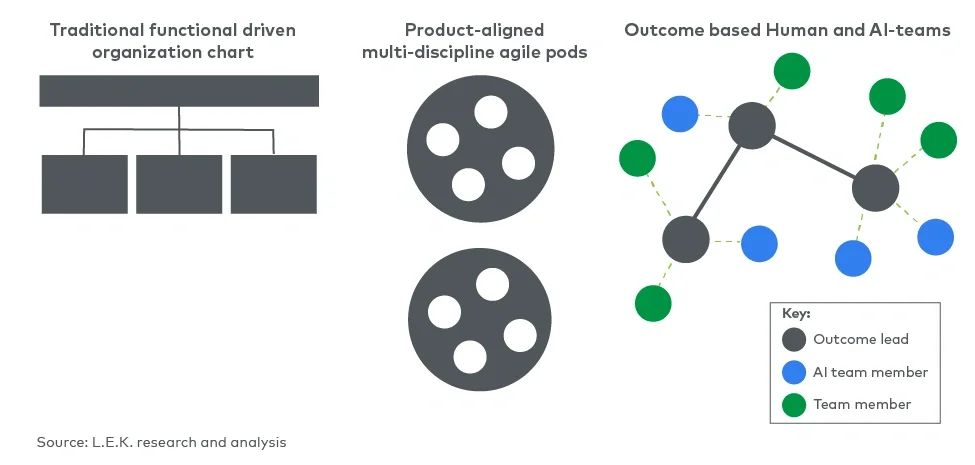
This means doing away with rigid structures and process-driven centralization, which are poorly suited to dynamic, real-time, unstructured intelligence and evolving beyond just agile pods. Instead, an AI-first organization deploys AI as a team member focused on outcomes connecting people and AI to deliver high-quality outcomes collaboratively (see Figure 1). 

Figure 1

The evolution to interconnected AI-enhanced teams 

Image
The evolution to interconnected AI-enhanced teams

Figure 1

The evolution to interconnected AI-enhanced teams 

Image
The evolution to interconnected AI-enhanced teams

The work itself is organized by decision domain or areas of authority that can cut across multiple departments (think allocating capital, setting a pricing strategy or hiring skilled staff). This way, organizations can accommodate the speed and uncertainty of AI while integrating it with business outcomes.

Breaking it down further, here are five principles that define an AI-first organization:

  1. Data-centric versus process-centric approach. Trust and prioritize data (both structured and unstructured) over rigid workflows.
  2. Continuous transformation. Make advancement part of daily operations, not just innovation labs.
  3. Loose pairings plus modular design. Design systems or services and teams for plug-and-play evolution.
  4. Empowerment. Empower employees — even individual contributors — to manage machines and collaborate with them to make the right decisions in an organization.
  5. Fluency over structure. Build organization wide fluency in AI and data rather than issuing top-down mandates. (This can also help close any AI talent gaps — a problem for 41% of executives, according to L.E.K. research.)

The idea is to put AI at the center of how the business makes decisions, does its work and ultimately delivers value to the market. 

Can AI be trusted?

AI systems can run into problems that call their reliability into question. Facial recognition systems have misidentified people as criminals. In-house tools have produced legal briefs citing nonexistent cases. Complex lending algorithms have denied loan applications without any explanation. 

Incidents such as these reflect the limitations of present-day AI technologies. To address these issues, more developers are adopting responsible AI (RAI) principles to guide their work. Some use in-house frameworks the way Microsoft and IBM do, while others rely on third-party standards such as those from the Institute of Electrical and Electronics Engineers or the Organisation for Economic Co-operation and Development.

Either way, developers are making progress. According to researchers from Stanford, the Massachusetts Institute of Technology (MIT) and Princeton, companies that build foundational models — large, deep, AI neural networks — increased their transparency significantly in just seven months, with the average score rising from 37 to 58 on a 100-point scale.  

The importance of trustworthy systems isn’t lost on business users. According to a recent MIT survey, 87% of executives consider RAI as a medium-to-high priority for their organization. An AI-first operating model can help organizations translate this widespread awareness into action by, among other things, ensuring people understand AI well enough to work with it wisely.

Early adopters of the AI-first construct

Some companies have already started to reshape themselves into AI-first organizations.

At Shopify, everyone is required to use AI in their work and can tap into a range of AI capabilities within the organization. Requests for additional head count at the ecommerce company are turned down unless teams can show why AI can’t do the job. Meanwhile, the CEO has encouraged employees to consider including AI agents in their project teams.

Duolingo is another company with a mandate to integrate AI with every position. The language-learning app maker, which has used AI to build new features and accelerate its content development process, is rolling out organization wide initiatives aimed at reshaping how employees work. Notably, Duolingo compares its recent decision to go AI-first with its pivotal 2012 shift to a mobile platform.

Then there’s Bank of New York Mellon Corp., also known as BNY. After a year of upskilling tens of thousands of employees on its enterprise AI platform, BNY announced plans to have autonomous AI handle processes in risk management, knowledge management and customer service. The bank is also looking at ways to use AI in product and service development, with an eye to reshaping financial market infrastructure.

The common thread through these examples is the pervasive nature of AI deployment. Even companies in heavily regulated industries are expecting major disruption from AI and are trying to get ahead of it by putting AI in the hands of everyone in the organization. In doing so, they’re laying the groundwork for a more fluid and modular understanding of how work gets done. 

Throwing out the playbook

Reorienting a business operating model from process to outcomes is hard because it requires deep structural, cultural and behavioral change. Most organizations are built around process efficiency, not outcome ownership. Changing that foundation requires a significant shift in mindset.

That may seem like a tall order. After all, not every company has the tech orientation of a Shopify or a Duolingo — not to mention the resources to develop AI fluency in advance the way BNY did. But any company can redesign work one domain at a time, using the five principles we outlined earlier as a guide. Here’s what the process looks like at a high level:

  • Build a coalition of the willing. Identify teams with the data and AI fluency to drive adoption and deployment. 
  • Define the work and outcomes. Develop a deep understanding of the tasks and outcomes that make an impact. Then work backward to develop AI (agents and other types) that can carry out the same.
  • Deploy AI. Gradually deploy AI solutions into teams. Establish the appropriate management approach and ratio of humans to AI for the right types of jobs.
  • Measure and adapt. Measure effectiveness and adapt deployment, adjusting as needed and as new AI capabilities emerge. Utilize feedback loops to enhance AI teammates’ effectiveness.
  • Scale. Shift deployment and scale across the organization, domain by domain.

AI progressed from tool to autonomous collaborator — one that can optimize processes, support decisions and orchestrate systems on the spot. Businesses that fail to capitalize on this capability will find themselves at a competitive disadvantage. On the flip side, companies that start the transition to an AI-first organization today can take their cues from early adopters. These steps can move you a long way toward preparing for the AI era, in which normal business operations are defined not by what they do but by what impact they want to create.

For more information, please contact us.

L.E.K. Consulting is a registered trademark of L.E.K. Consulting LLC. All other products and brands mentioned in this document are properties of their respective owners. © 2025 L.E.K. Consulting LLC 

Questions about our latest thinking?

English

Hospital Priorities 2025 China Edition: Key Findings for Medtech and Pharma Companies

June 20, 2025

Highlights from the 2025 Hospital Priorities Survey

Hospital executives report greater confidence in a positive budget outlook compared to previous surveys. Since the introduction of the medical insurance fund prepayment system in November 2024, 40% of surveyed hospitals claimed receipt of prepayments.

The push to use local medtech products has been a persistent trend, though interpretations of “local” vary — some hospitals consider factors beyond product manufacturing location.

Listing of National Reimbursement Drug List (NRDL)-negotiated drugs has been smoother, with approximately 50% of the public hospitals surveyed achieving automatic listing of NRDL-negotiated drugs. The prescription limit for NRDL drugs has also reduced meaningfully.

While offline channels remain the preferred method for clinician engagement with pharmas and medtechs, online platforms such as virtual conferences and company and third-party medical websites/apps are gaining traction.

Most of the public L3 hospitals surveyed plan to participate in or expand data transactions over the next one to three years — showing greater intent than public L2 and L1 and private hospitals.

To learn more about the priorities of hospitals in China for 2025, please be sure to download our analysis.

L.E.K. Consulting is a registered trademark of L.E.K. Consulting LLC. All other products and brands mentioned in this document are properties of their respective owners. © 2025 L.E.K. Consulting LLC

English
Subscribe to