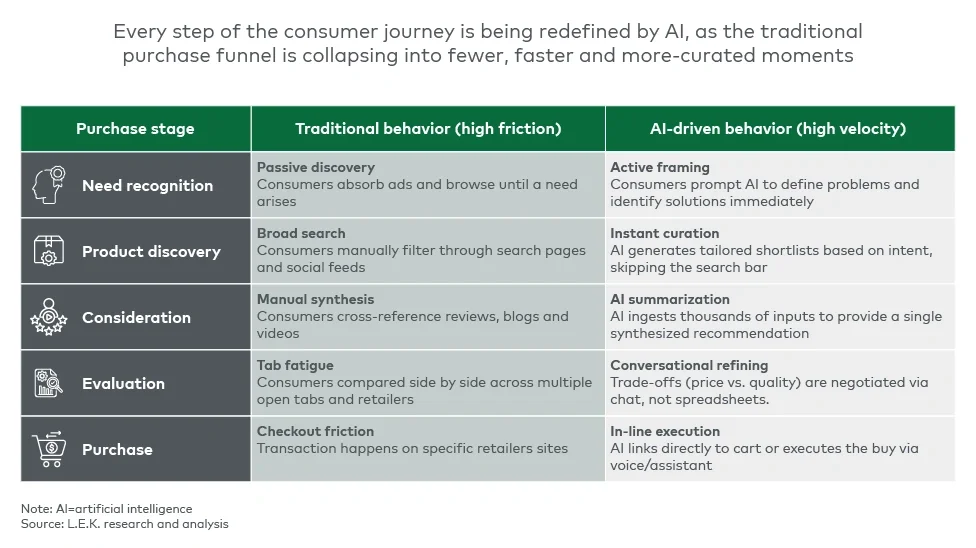
For advertisers, this creates a visibility problem. As consumers stay inside AI-generated responses instead of clicking through in zero-click interactions, attribution breaks and key touchpoints disappear. Brands need to show up directly in AI-generated answers, recommendations and product comparisons, instead of relying on search rankings or display ads.
Measurement shifts from impressions to outcomes
Performance-based advertising has already been gaining ground as marketers prioritize measurable outcomes over reach. AI accelerates this shift by compressing the consumer journey into fewer, platform-contained interactions, leaving less signal to measure and optimize.
Advertisers now expect platforms and partners to prove impact, not just deliver reach. Sales or ROI is now the most commonly cited measure of marketing success, raising that expectation further.
This raises the bar across the ecosystem. Channels that cannot tie spend to conversion face cuts, and intermediaries that generate volume without proving incrementality get deprioritized.
Content, commerce and community converge
The boundaries between media, creators and transactions are dissolving. Consumers increasingly discover and buy products without leaving social or video platforms, as TikTok, Instagram and YouTube offer native commerce layers that turn influencers into storefronts and communities into purchasing engines.
In 2025, 45% of U.S. TikTok users purchased directly within the platform, where conversion rates can reach 8%-12% versus roughly 2%-4% for traditional ecommerce.
This convergence redirects advertising spend toward platforms that can integrate discovery, engagement and checkout within a single experience. Creators who drive direct conversion command premium rates, while brands that still route consumers to external websites face friction that their competitors avoid.
Spend and power reallocated across the ecosystem
As AI reshapes discovery and attribution, every stakeholder in the advertising value chain faces pressure to adapt. The implications vary by position:
Advertisers
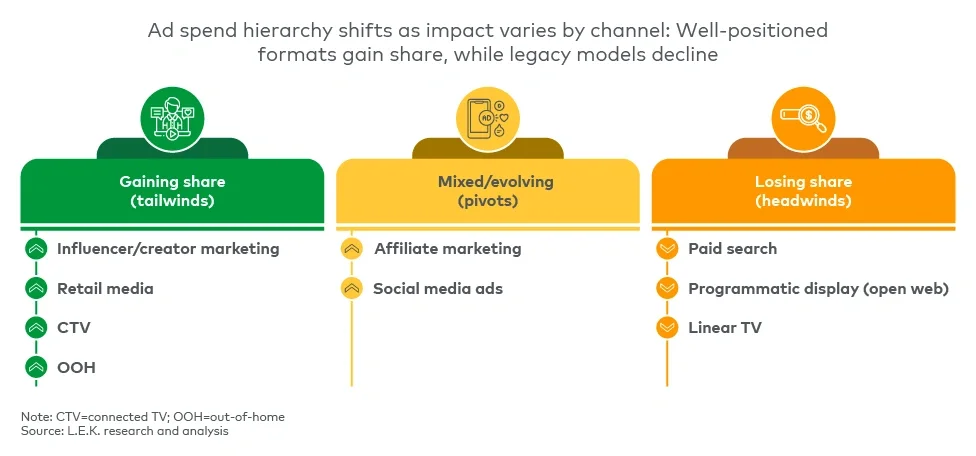
Brand visibility will increasingly depend on appearing in AI-generated recommendations, requiring structured product data, platform integrations and investment in generative engine optimization (GEO), alongside traditional search engine optimization (SEO). Advertisers will reallocate spend away from SEM, where AI-driven discovery is reducing click-through volume, toward platforms and formats with direct conversion potential. Budget decisions will sharpen around customer acquisition cost, lifetime value and incrementality.
Platforms and inventory owners
Search and content-driven platforms face pressure as consumers rely on AI-generated summaries instead of clicking through. While remaining traffic may be higher intent, it may not compensate for the decline in overall volume. Platforms must adapt as inventory that cannot tie to outcomes faces deprioritization and pricing pressure.
Intermediaries and affiliates
Traditional SEO and arbitrage-driven models are structurally disadvantaged as AI reduces reliance on click-driven discovery. In contrast, models built on trusted recommendations and direct conversion, particularly influencer and creator-led commerce, are more resilient, with 60% of consumers trusting what a creator says about a brand more than the brand itself. The gap is widening between models that can tie spend to outcomes and those that cannot.
Direction of travel for advertising models
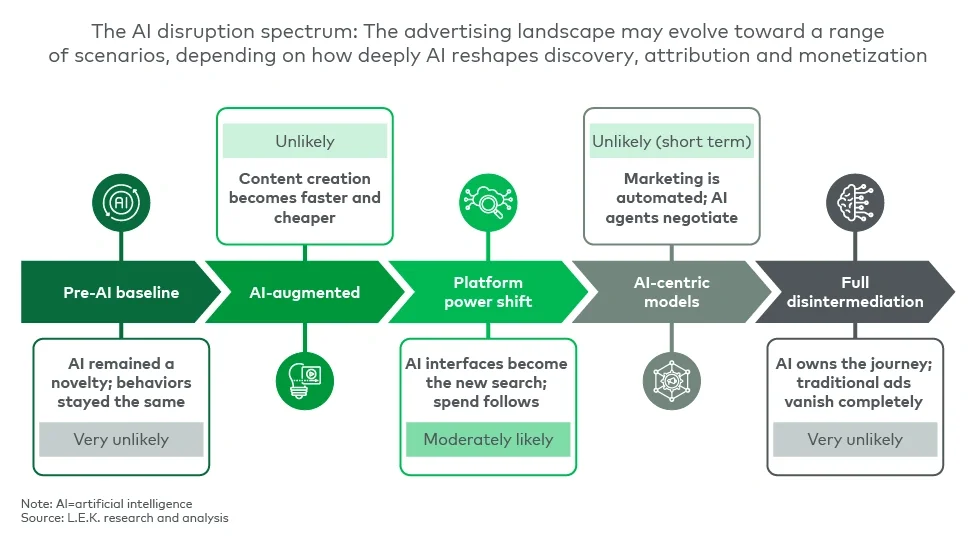
AI introduces varying degrees of disruption. The most extreme scenarios, where traditional ad models collapse entirely or marketing becomes fully automated and AI-driven, remain unlikely in the near term (see Figure 2). But moderate disruption is already underway.