Executive Insights

Competing in a Persistent K-Shaped US Economy

May 5, 2026

Key takeaways

Income bifurcation in the U.S. is approaching historic levels, raising the question of what comes next.

History suggests K-shaped economies reverse only after major economic and policy shifts, which are only partly in place today.

As the K-shaped economy reshapes demand, companies must choose a clear path: premium positioning, structural cost leadership or disciplined tiering.

Choosing the right path requires clarity on your core consumer, your source of competitive advantage and how profit is shared across channels and partners.

What income bifurcation means for consumer leaders

The “K-shaped economy” is now a familiar refrain in earnings calls. It describes a widening gap in consumer purchasing power, where higher-income households pull ahead while lower-income households face increasing pressure.

What is less clear for many leadership teams is how to act on it. Where is growth really coming from, and is your business positioned to win as that mix continues to shift?

This divergence shows up directly in how consumers spend, make trade-offs and respond to price. Upper-income and upper-middle-class households are driving a disproportionate share of growth and margin, while less affluent households remain under pressure. The result is a hollowing middle for many consumer-facing businesses. This dynamic is not purely one-directional. The middle is also splitting, with some households moving into the lower end of the upper-income cohort while others move down.

For operators, this is not just a macro observation. It directly shapes where demand sits, which brands maintain pricing power and which business models can sustain performance. Looking at how similar dynamics have played out historically helps clarify how companies should position themselves today.

Income disparity in historical context

To understand how to position for this environment, it is useful to look at how similar income dynamics have evolved in the past and what drove those shifts.

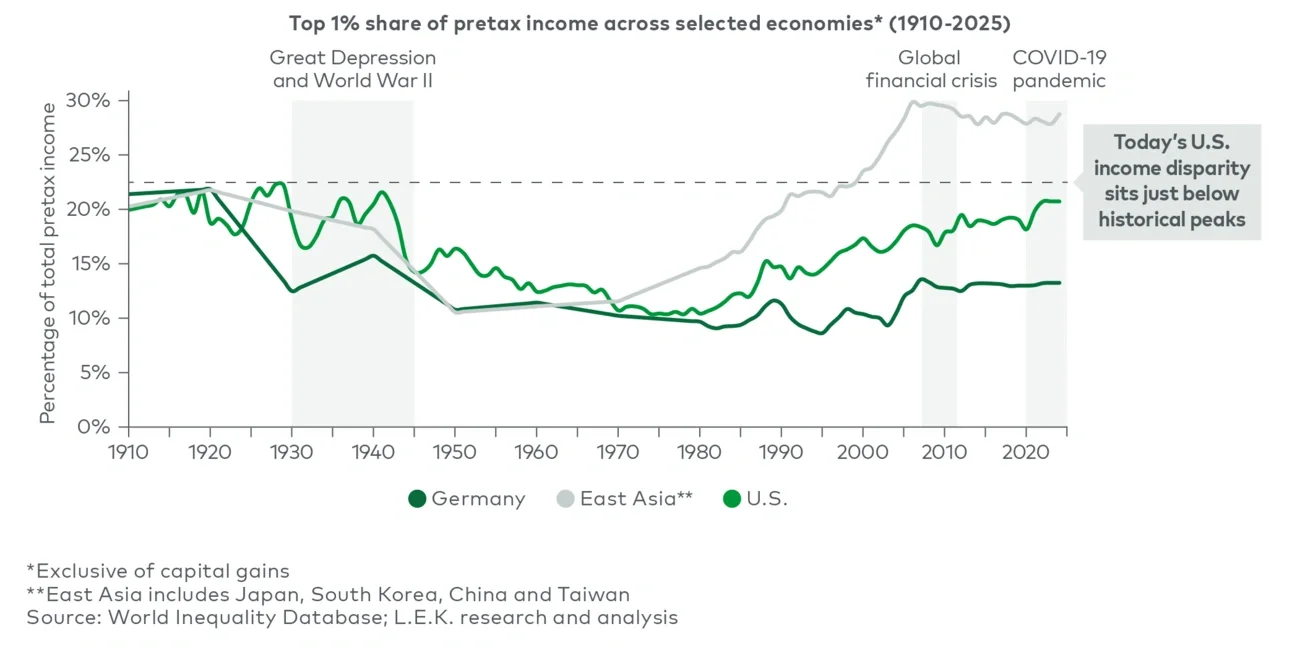
Income concentration in the United States is near historical peaks, with the top 1% capturing roughly one-fifth of total pretax income (see Figure 1). The gap between the top and the rest of the income distribution is unusually wide, even as other upper- and upper-middle-class consumers benefit as well.

Figure 1

Historical income concentration, by country/region

Image
Figure 1 represents historical income concentration, by country/region

Figure 1

Historical income concentration, by country/region

Image
Figure 1 represents historical income concentration, by country/region

However, there have been prior periods, both in the U.S. and globally, with comparable levels of income dispersion. In some cases, those K-shaped structures narrowed. The U.S. Great Compression (c. 1940-1980) and post-war Western Europe are well-known examples.

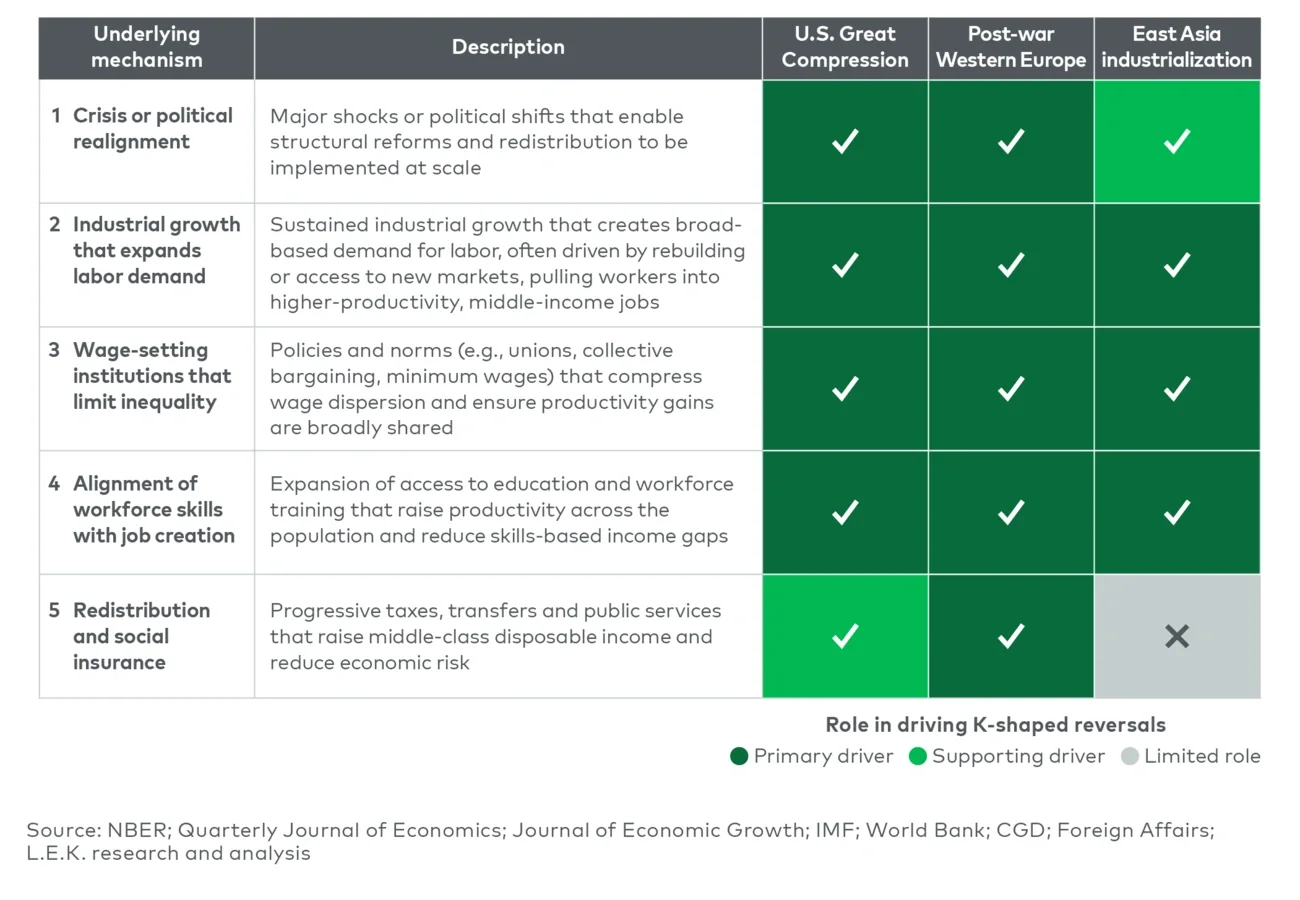
Across historical cases, compression followed major crises or political realignments that enabled reform at scale. Several bolstering forces tended to operate together (see Figure 2):

  • Industrial growth expanded middle-income employment
  • Wage-setting institutions limited dispersion and broadened the sharing of productivity gains
  • Workforce systems aligned skills with job creation
  • Redistribution and social insurance reinforced disposable income

Figure 2

Core mechanisms observed across historical use cases

Image
Figure 2 represents core mechanisms observed across historical use cases

Figure 2

Core mechanisms observed across historical use cases

Image
Figure 2 represents core mechanisms observed across historical use cases

When these forces operated together, income gaps narrowed.

The key question for consumer leaders today is whether similar conditions are reemerging, or whether the current environment is structurally different.

What winning looked like then vs. now

From roughly the 1940s through the 1980s in the U.S., the middle class expanded and income growth was more evenly distributed. For consumer companies, this created a clear playbook: Win by serving a broad consumer base. Scale and consistency drove success because a large share of households could be reached with similar products and price points. Mass-market positioning was an advantage, not a constraint: Companies such as Procter & Gamble, Coca-Cola and General Motors built enduring franchises by delivering reliable, widely accessible products to a large share of U.S. households.

Today’s environment is fundamentally different. As income dispersion widens, demand fragments across consumer groups with different needs and willingness to pay, creating trade-offs. At the same time, advances in digital channels and social media have shifted expectations from mass appeal toward personal relevance. The idea that the consumer is “one audience” has given way to a reality where consumers expect experiences, products and messaging tailored to them.

In this environment, advantage shifts toward companies that are tightly aligned to either high-income, high-engagement consumers or structurally advantaged in serving value-oriented segments, rather than those attempting to span the full market.

Structural signals in the current US economy

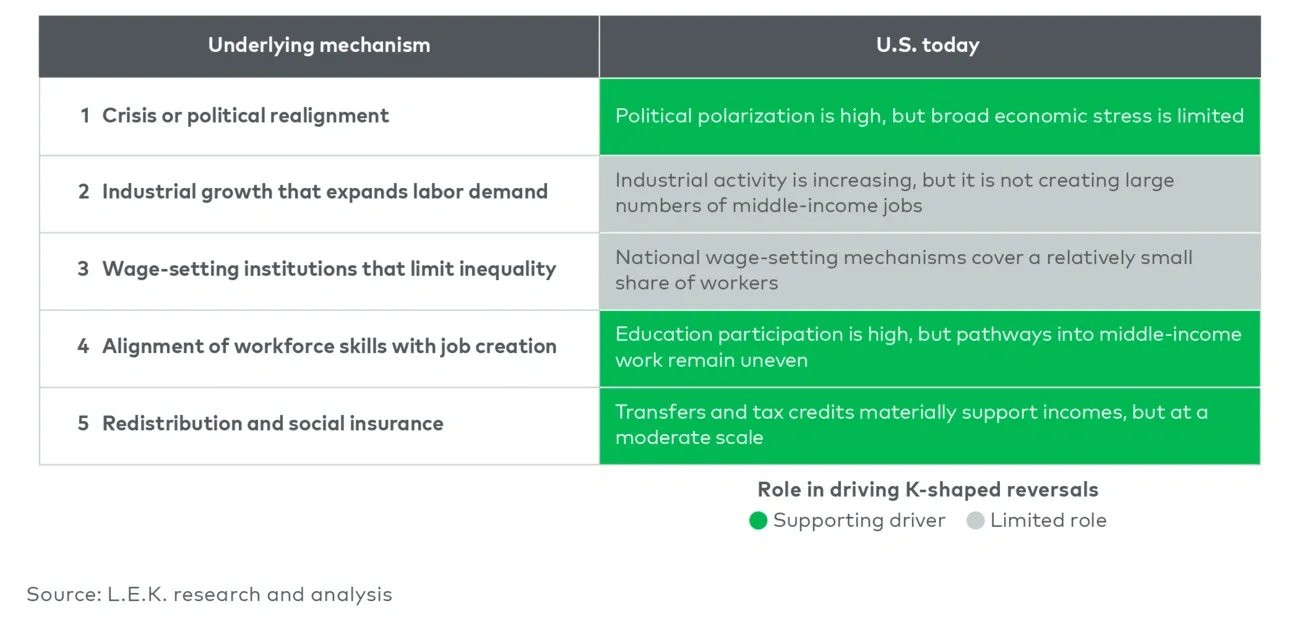
If the question is whether the middle is likely to rebuild, the current signals are mixed but not yet sufficient to suggest a durable shift (see Figure 3).

Figure 3

Directional mapping of current US conditions to reversal mechanisms

Image
Figure 3 represents directional mapping of current US conditions to reversal mechanisms

Figure 3

Directional mapping of current US conditions to reversal mechanisms

Image
Figure 3 represents directional mapping of current US conditions to reversal mechanisms

Recent wage acceleration among lower-income workers has been meaningful. Between 2019 and 2024, real wages for workers at the 10th percentile rose approximately 15%, compared with roughly 6%-7% for median and upper-income earners. Gains at the 20th percentile also outpaced the middle of the distribution. This represented a period of partial compression, driven primarily by tight labor markets in lower-wage service sectors.

However, these gains appear cyclical rather than structural. The recent acceleration coincided with an unusually tight labor market, not a redesign of the underlying systems that historically supported sustained income balance. As labor supply normalizes, continued upward pressure on lower-end wages becomes less certain.

More broadly, several of the structural forces that supported a growing middle-income base in prior periods remain limited today. Industrial expansion is occurring, but it is generating fewer broadly distributed middle-income jobs. Wage-setting institutions and redistribution play a more moderate role than in past decades.

Artificial intelligence (AI) is likely to reinforce this dynamic rather than reverse it. While advances in AI can drive meaningful productivity gains, those gains are not expected to translate into broad-based wage growth. In practice, productivity improvements often appear unevenly across the economy; they do not lift incomes uniformly. Management efforts to maximize shareholder value are also likely to drive at least some productivity gains to capital, rather than works. As a result, AI may increase overall output without materially expanding the middle-income consumer base.

Taken together, these signals suggest that while short-term compression can occur, the structural preconditions required to rebuild a broad middle-income base are not fully in place. Without a significant shift in these dynamics, demand is unlikely to re-center on a broad middle-income consumer.

What this means for consumer-facing businesses

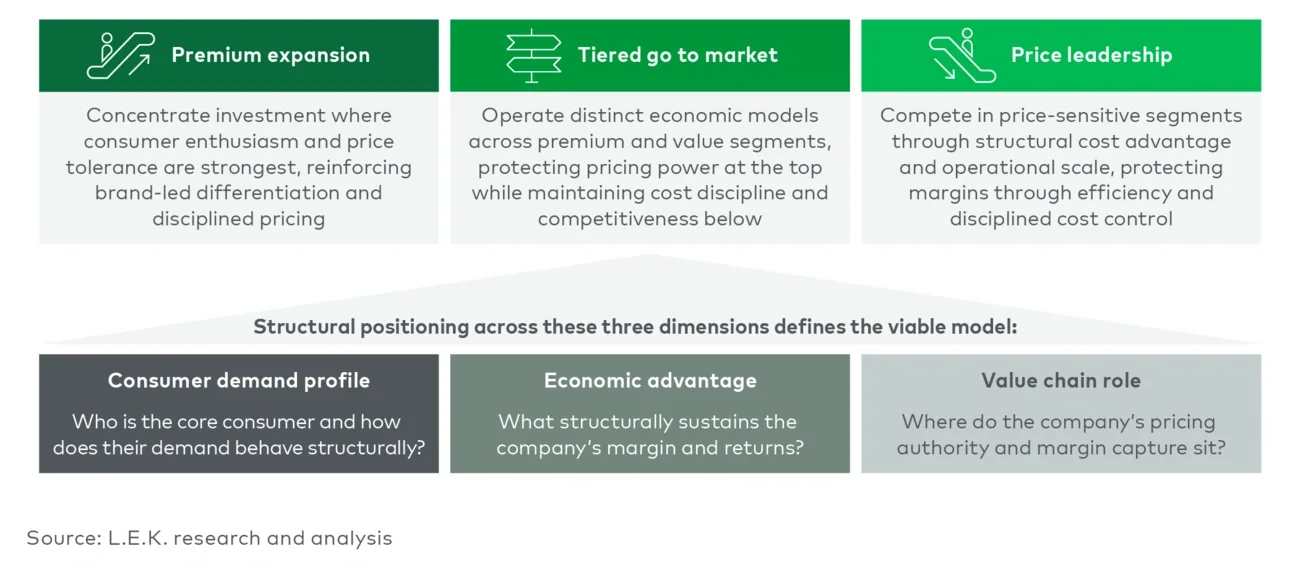
In a persistently bifurcated market, sustained outperformance tends to concentrate around three structurally coherent positions (see Figure 4). Each reflects a different alignment between consumer demand, economic advantage and value capture.
 

Figure 4

Three strategic paths and required structural conditions

Image
Figure 4 represents three strategic paths and required structural conditions

Figure 4

Three strategic paths and required structural conditions

Image
Figure 4 represents three strategic paths and required structural conditions

The first is premium concentration. Businesses anchored in higher-income, high-engagement segments can direct investment toward differentiation and brand reinforcement, protect pricing authority and prioritize the cohorts that drive disproportionate margin. Luxury brands, players differentiating via performance and experience-led categories often exemplify this model. Success depends on credible willingness to pay and effective pricing management.

The second is structural cost leadership. Where affordability and trade-offs dominate decision-making, advantage can come from scale, sourcing and operating efficiency. Off-price retailers, value grocers and scaled private-label players illustrate this path. Profitability relies on sustaining lower unit costs better than competitors do, not on stretching pricing power beyond what demand will support.

The third is disciplined tiered segmentation. Companies that operate across income cohorts must run premium and value propositions as distinct economic models, with clear price architecture and guardrails to prevent margin leakage. Global consumer brands with “good-better-best” portfolios or differentiated channel strategies often pursue this approach. The ability to segment without eroding overall returns becomes the central capability.

What becomes increasingly difficult to sustain is a broad middle-market position without a clear source of advantage. In a prior era, serving the average consumer was a viable strategy. Today, that same positioning risks being pulled in both directions — premium without sufficient willingness to pay or value without sufficient cost advantage.

This challenge is amplified by personalization. As consumers are increasingly targeted with tailored messaging, pricing and assortment, expectations rise for relevance at a more individual level. Companies attempting to serve multiple segments without clear separation often find their propositions blurred, making it harder to win decisively with any cohort.

In a K-shaped economy, strategic ambiguity carries a growing penalty.

Determining the right strategic path

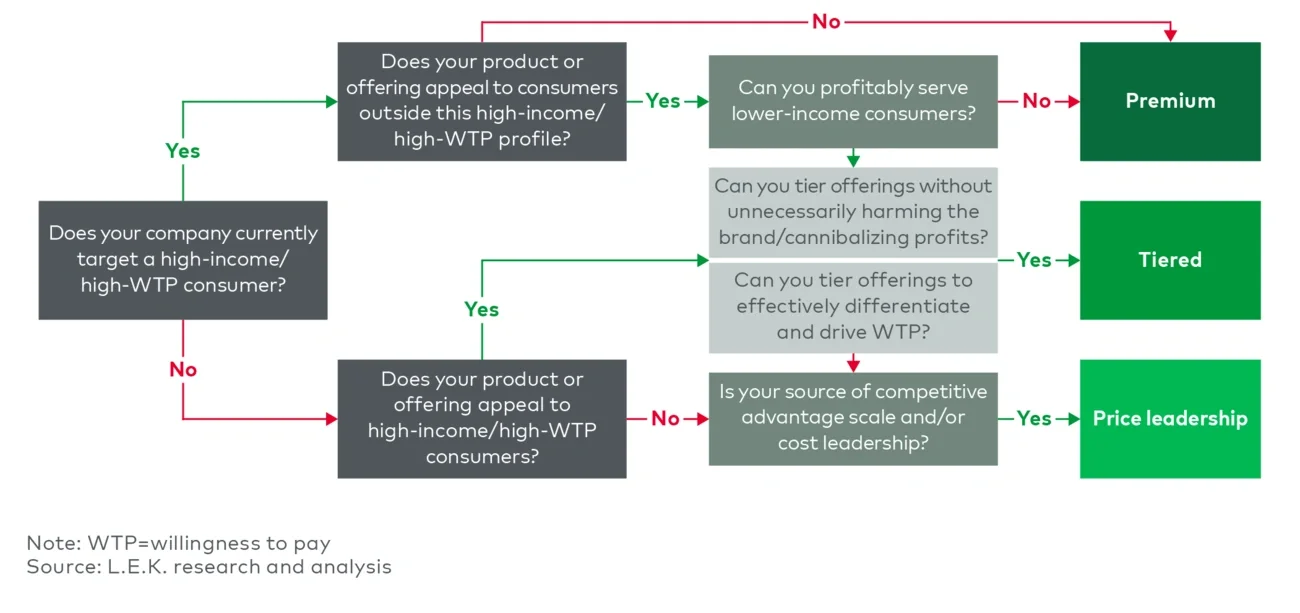
In a bifurcated economy, strategic direction should follow structural position. Whether tiered segmentation or price leadership is viable depends on three interrelated factors: the composition and behavior of the core consumer base, the source and durability of economic advantage, and where pricing authority and margin capture reside within the value chain (see Figure 5).

  1. Consumer demand profile: Start with the primary consumers by income cohort and category engagement. A business anchored in affluent, high-engagement consumers operates within a different economic envelope than one serving a broad, price-sensitive base.

    What fundamentally drives purchase decisions matters just as much. Are purchases rooted in identity and brand differentiation or in functional need and affordability? How resilient is demand when prices rise or economic pressure intensifies? Trade-down patterns, switching behavior and mix shifts often reveal the true structural position of the model.
  2. Economic advantage: The next lens is the source of profitability. Are margins driven by pricing power or by structural cost advantage enabled by scale and efficiency? Durability is critical. Where does the company earn disproportionate profits across segments, stock-keeping units or channels, and how exposed are those pools to mix shifts or competitive pressure?
     

    Premium expansion requires defensible willingness to pay. Price leadership requires enduring cost superiority. Tiered models require the ability to sustain distinct economics across segments without eroding overall returns.

  3. Value chain role: Finally, the company’s position in the value chain shapes what is feasible. Does it control pricing and customer relationships, or is margin subject to retailer, platform or supplier pressure? Can it manage distinct tiers without leakage across channels or segments?
     

    Taken together, these structural dimensions narrow the field of viable choices. In a persistent K-shaped economy, sustained performance depends on aligning strategy with how demand behaves, how margins are generated and where value is captured.


Figure 5

Structural position diagnostic: premium, tiered or price leadership

Image
Figure 5 represents structural position diagnostic: premium, tiered or price leadership

Figure 5

Structural position diagnostic: premium, tiered or price leadership

Image
Figure 5 represents structural position diagnostic: premium, tiered or price leadership

Key questions for consumer leaders

As income divergence persists, the most important task for leadership teams is not to diagnose the trend but to assess whether their current model is aligned to it. The following questions can help surface where a business may be exposed:

  • Where is our profit coming from today, and how dependent is it on consumer segments that may be under pressure?
  • Do we have true pricing power with our core customer, or are we relying on brand inertia that may not hold under increased trade-down pressure?
  • If demand shifts further toward either end of the income spectrum, where do we gain and where do we lose? Do we have a credible response?
  • Is our cost structure competitive enough to win in value-driven segments, or are we exposed if pricing comes under pressure?
  • How effectively are we using data and AI to tailor offerings, pricing and engagement to different cohorts, and where are we falling behind?

For many organizations, answering these questions candidly can reveal misalignment between strategy and market reality and where clearer choices are required.

Conclusion

In a market defined by divergence, strategy becomes an exercise in precision: precision about which customers sustain your economics, what they will pay for versus where trade-downs are possible and where your advantage truly comes from.

That is the practical challenge of competing in a persistent K-shaped economy — not predicting the cycle but building a model that performs through it.

For consumer leaders, the imperative is clear: Align the business to where demand is structurally going, not where it has historically been.

For more information, please contact us.

L.E.K. Consulting is a registered trademark of L.E.K. Consulting LLC. All other products and brands mentioned in this document are properties of their respective owners. © 2026 L.E.K. Consulting LLC

English