

AI’s Talent Trap: When Hiring Faster Still Means Falling Behind

April 10, 2026

As executives wrestle with where artificial intelligence (AI) truly fits in their company’s strategy (cost takeout, growth, resilience, product advantage, etc.), they are running into a blunt constraint: The talent that turns intent into production is scarce and increasingly challenging to retain. This goes beyond the flashy headlines about large technology firms’ top talent, such as Microsoft agreeing to pay Inflection about $650 million (licensing and related terms) while hiring most of the team (Reuters, March 21, 2024). 

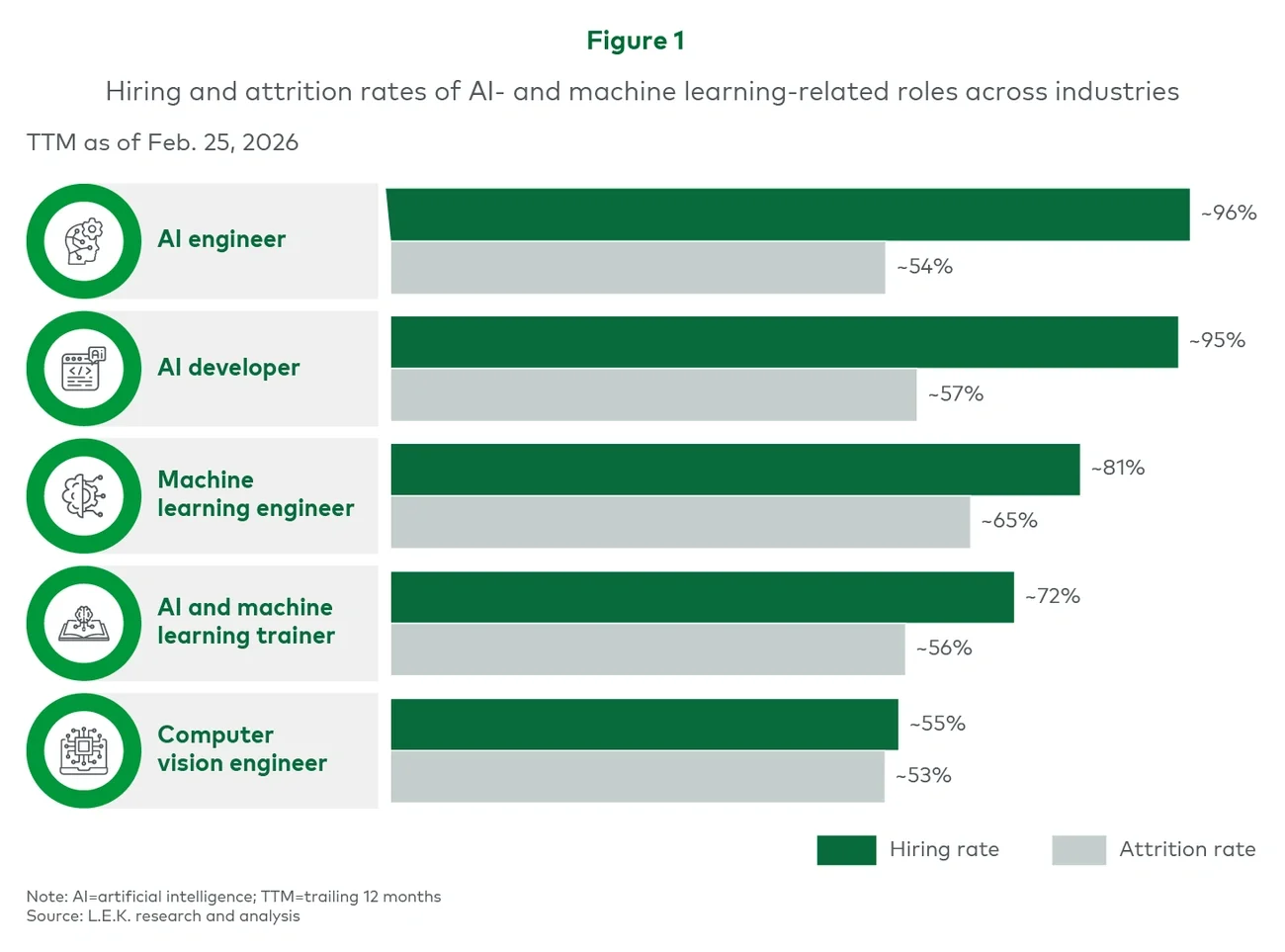
This challenge is not limited to Big Tech; in the past 12 months, many of the corporate roles with the highest combined hiring and attrition are AI- or machine learning-related roles (see Figure 1).
Image
Hiring and attrition rate of AI- and machine learning-related roles across industries
Image
Hiring and attrition rate of AI- and machine learning-related roles across industries

The problem on many executives’ minds has shifted from “Should we hire AI talent” to “Can we hire and keep the AI talent?” When AI roadmaps are fluid, integration into the operating model is unsettled and platform bets are in flux, AI teams feel like they are sprinting on shifting ground. The result is a costly loop: Overpay to hire, underclarify the objective, and then lose people before value lands. As a consequence, the organization likely concludes that “AI doesn’t work here.”

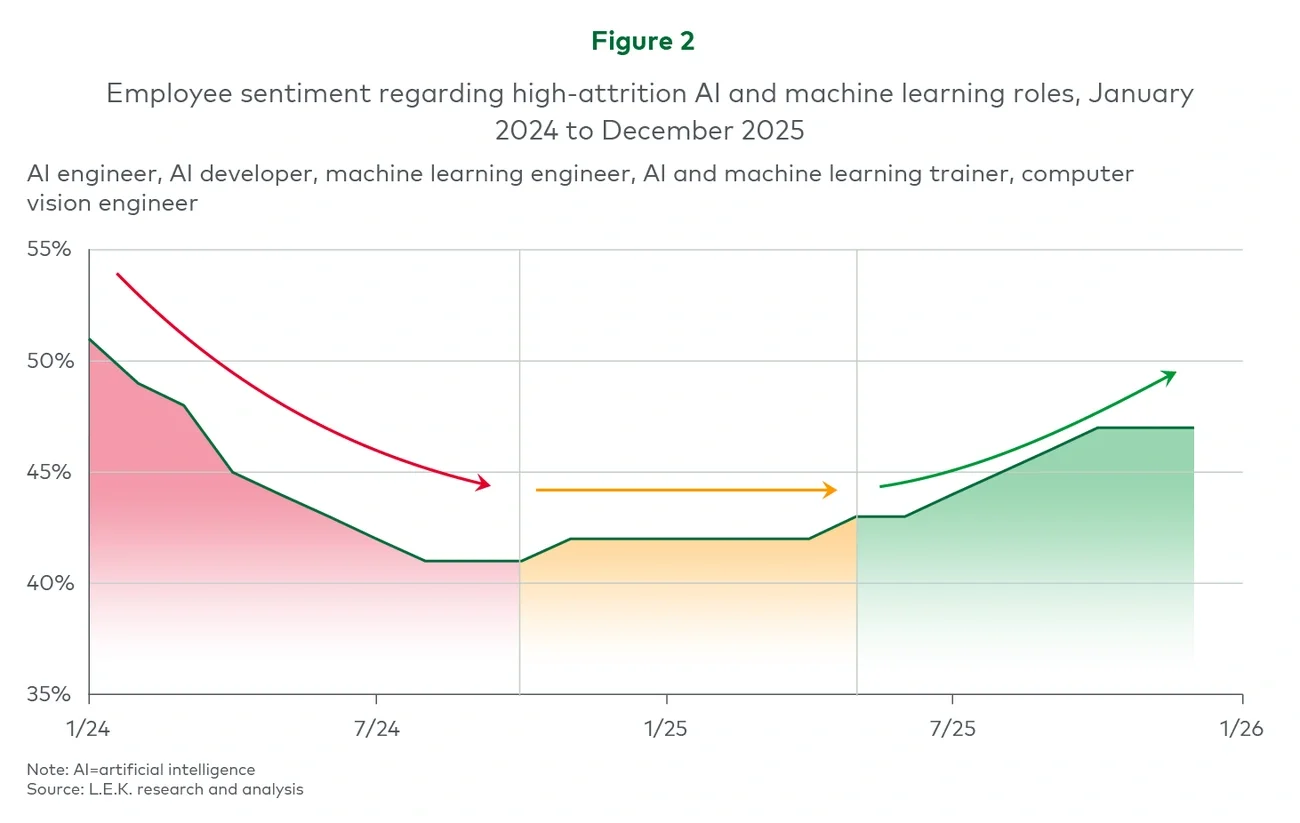
Employee sentiment data reinforces why retention is fragile. Across North America, employee sentiment about AI dipped through 2024 and then partially recovered into 2025, implying the existence of a window where uncertainty (strategy, funding, leadership conviction) drives churn in the most marketable roles (see Figure 2).

Image
Employee sentiment regarding high attrition AI and machine learning roles, January 2024 to December 2025
Image
Employee sentiment regarding high attrition AI and machine learning roles, January 2024 to December 2025

Critical moves to stabilize AI talent:

  • Sufficient ambition: People are looking for challenging problems, not cost reduction through automation; define a sufficiently ambitious AI strategy.
  • Roadmap clarity: Throwing talent at vague problems creates uncertainty in remit and progression; define the few bets well, what good looks like and a meaningful and clear end game.
  • Role architecture: Unclear job families (builder vs. translator vs. product vs. platform) create mismatched expectations; standardize roles, levels and growth paths.
  • Retention beyond compensation: Pay is table stakes; retention hinges on clear objectives, learning velocity and recognition calibrated to a hot market.
  • Operating model for speed: Ambiguity in decision rights (data, model risk, platform choices) slows progress; tighten ownership so work ships, not spirals.

Companies need to focus on retaining — not just hiring — AI talent. That requires an integrated workforce plan that links strategy to demand to supply to retention, so that AI investment translates into repeatable delivery outcomes rather than episodic wins.

For more information, please contact us.

L.E.K. Consulting is a registered trademark of L.E.K. Consulting LLC. All other products and brands mentioned in this document are properties of their respective owners. © 2026 L.E.K. Consulting LLC

English