


Executive Insights

Clinical Diagnostic Testing Trends Across Key Modalities: Insights From L.E.K.’s US Diagnostic Lab Survey (2025)

April 23, 2026

Key takeaways

Lab experts anticipate meaningful volume growth across major test modalities over the next three years, supporting a constructive demand outlook.

Molecular testing (NGS, PCR) leads the growth profile, with anatomic pathology advanced staining also expanding; growth is expected to remain concentrated in established disease areas, with oncology being the most consistent driver across modalities.

While many labs will continue to outsource advanced modalities (e.g., NGS, mass spectrometry), a meaningful share of labs, concentrated among AMCs and large community hospitals, anticipates establishing at least partial in-house capabilities over the next three years.

Vendor-switching intent is higher in emerging or advanced modalities (e.g., digital pathology slide scanners), suggesting greater share-shift potential for suppliers that combine differentiated clinical performance with operational efficiency.

Which diagnostic modalities are poised to see the highest volume growth? Which modalities are labs most likely to bring in-house versus continue to outsource? And where is vendor loyalty most likely to shift as the next refresh cycle approaches?

To answer these questions, L.E.K. Consulting surveyed 100-plus executives and directors across hospital and reference labs in our 2025 U.S. Diagnostic Lab Survey. This edition of Executive Insights summarizes expected volume growth, insourcing/outsourcing shifts, and purchasing and switching intent across diagnostic modalities.

Key trends

Test volume growth is expected across modalities, led by molecular and pathology advanced staining

More than 90% of respondents expect in-house test volumes to increase over the next three years, with the strongest momentum in molecular — next-generation sequencing (NGS), polymerase chain reaction (PCR) — and anatomic pathology advanced staining (see Figure 1). Among labs currently running NGS in-house, approximately 65% anticipate double-digit volume growth over the next three years, including 35% projecting growth above 30%, driven by expanding clinical utility in oncology and continued declines in sequencing costs. PCR also shows a strong growth outlook, with around 50% expecting more than 10% growth by 2028, reflecting continued demand and menu expansion in infectious disease (e.g., multiplex gastrointestinal and genitourinary panels).
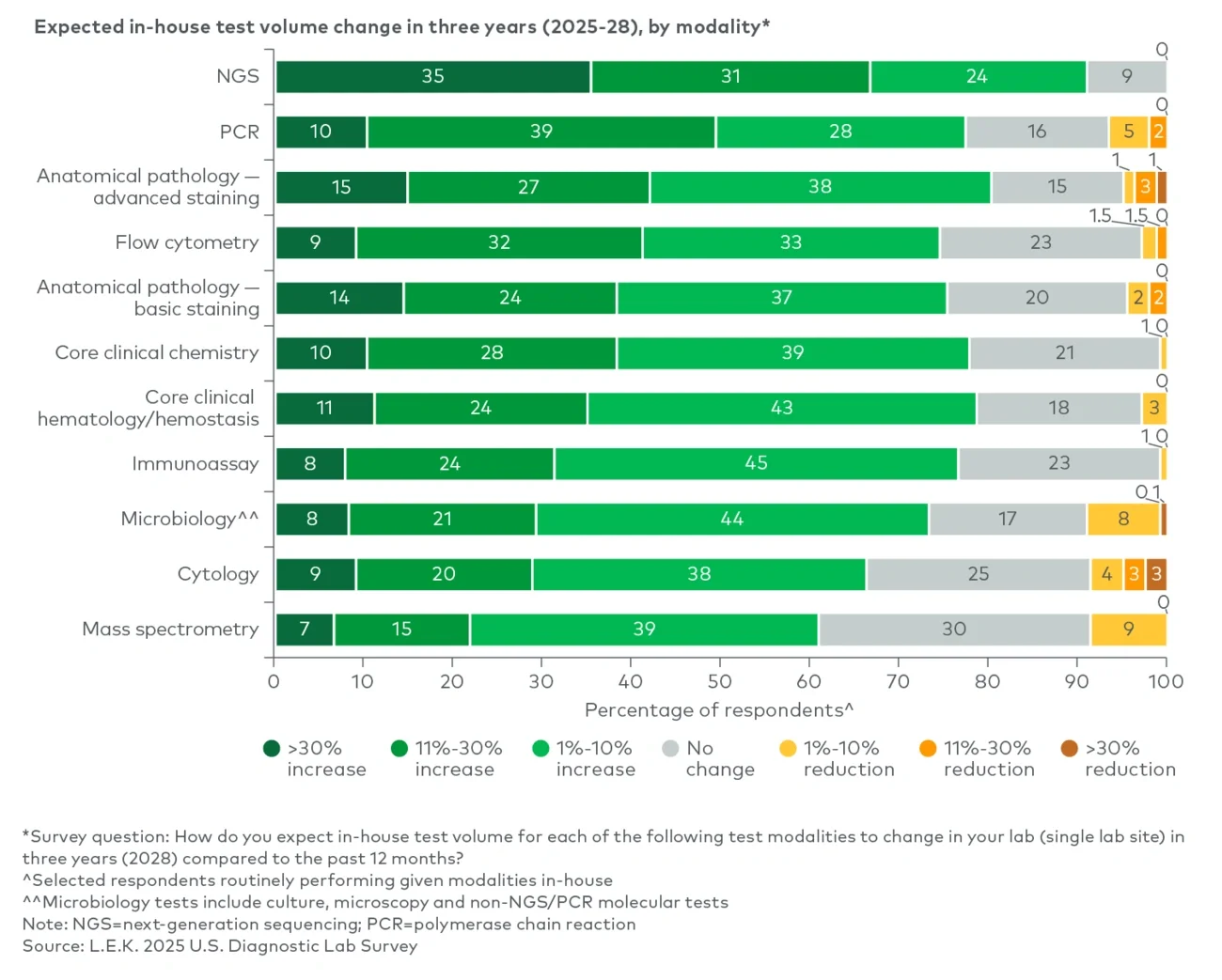
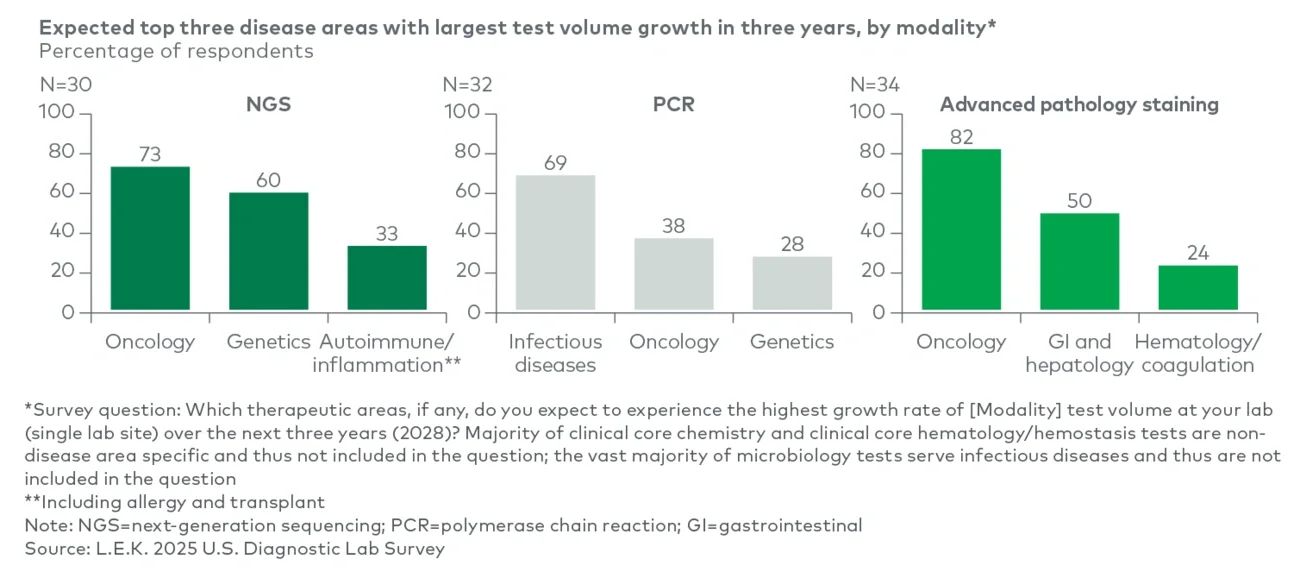
Figure 1

Expected three-year test volume growth by modality

Image
Figure 1 represents expected three-year test volume growth by modality

Figure 1

Expected three-year test volume growth by modality

Image
Figure 1 represents expected three-year test volume growth by modality

Anatomic pathology, especially advanced staining — i.e., immunohistochemistry (IHC), in situ hybridization (ISH), special stains — is also expected to grow, with a meaningful share of experts projecting double-digit growth over the next three years. Growth is supported by expanding use of IHC/ISH in biomarker-driven treatment decisions, including companion diagnostics, with digital pathology and workflow automation enabling greater scalability.

Other modalities are also expected to grow, but more modestly. Core clinical chemistry, hematology/hemostasis and immunoassay are projected by most experts to grow by 1%-10%, reflecting sustained testing demand and rising chronic disease burden requiring ongoing monitoring.

Oncology remains a key growth driver across modalities, with additional modality-specific growth coming from other therapeutic areas

Across modalities, including higher-growth areas, oncology remains the most consistent growth theme (see Figure 2). Respondents rank oncology among the top three growth areas across major modalities, especially anatomic pathology, NGS, cytology and flow cytometry, reflecting the breadth of testing capabilities needed to support the continued evolution of precision oncology.

Figure 2

Disease areas expected to drive growth in the fastest-growing modalities

Image
Figure 2 represents disease areas expected to drive growth in the fastest-growing modalities

Figure 2

Disease areas expected to drive growth in the fastest-growing modalities

Image
Figure 2 represents disease areas expected to drive growth in the fastest-growing modalities

Outside oncology, respondents identify additional disease areas expected to drive growth within specific modalities.

  • NGS: Growth is expected in genetic and hereditary disorders, driven by expanding germline/ somatic testing and hereditary risk assessment, and autoimmune/inflammation (including transplant), to identify disease etiology and phenotypic gene signatures
  • PCR: Infectious disease is the primary growth driver, reflecting sustained demand for rapid pathogen detection and identification to guide antimicrobial use
  • Anatomic pathology: Alongside oncology, gastrointestinal pathology is cited as a key growth area for both basic and advanced staining, consistent with sustained procedure volumes to diagnose and monitor chronic inflammatory or premalignant conditions

Overall, labs do not anticipate a meaningful shift in the core disease areas served by each modality, with oncology continuing to be the primary growth engine across most modalities.

Expanding across protein-, molecular- and tissue-based oncology solutions can allow suppliers to play a more integrated role in meeting clinical needs across the testing continuum.

Insourcing is expected to increase in select advanced modalities

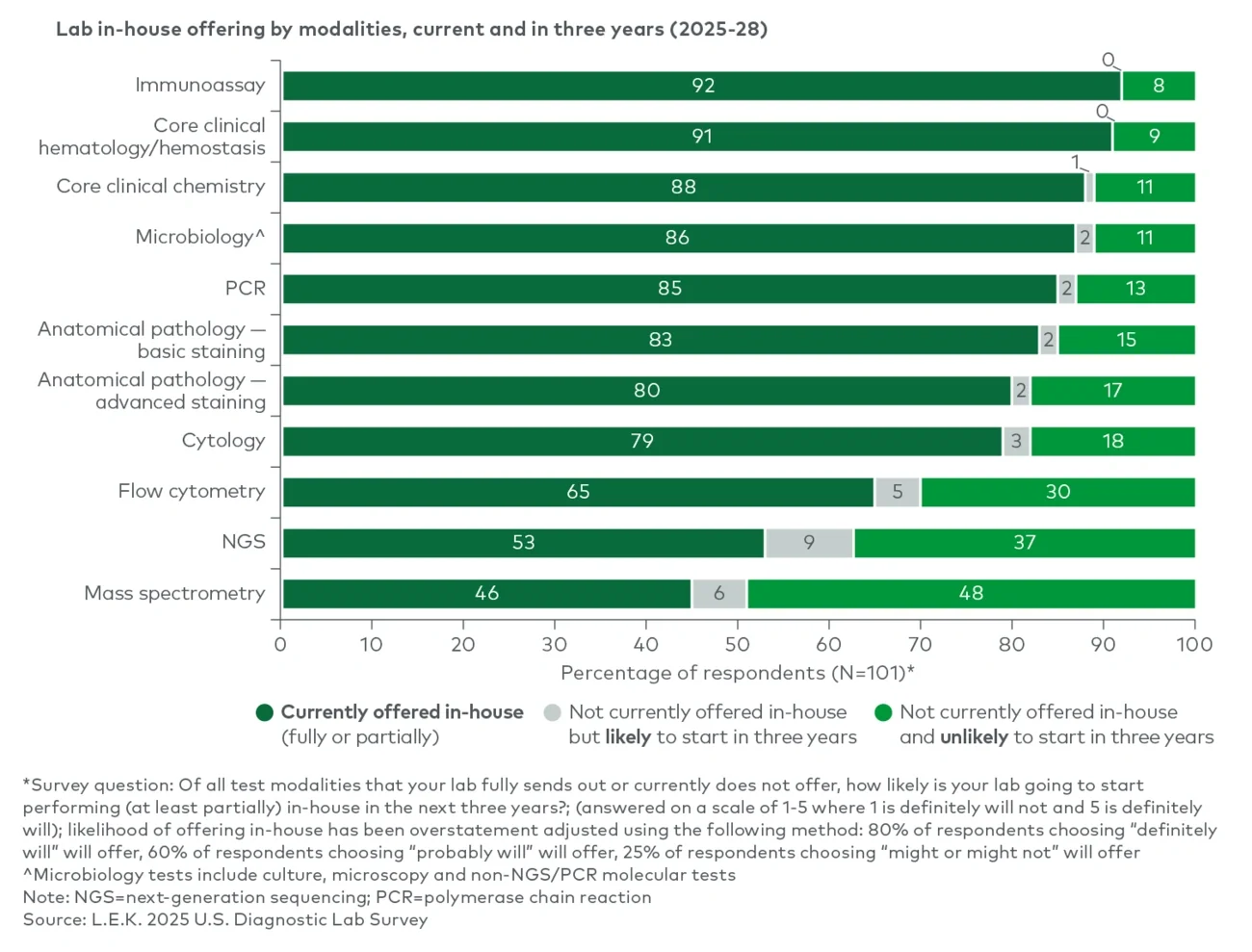
Operational and workflow complexities continue to shape which modalities are performed in-house versus outsourced. Highly automated, high-throughput modalities (e.g., immunoassay, core clinical chemistry/hematology, PCR) are typically run in-house, whereas a greater share of labs outsource more technically complex modalities such as flow cytometry (35% outsourced), NGS (roughly 45%) and mass spectrometry (around 55%) (see Figure 3). This reflects the need for specialized instrumentation, technical expertise and informatics, which can be challenging for smaller labs to fund and sustain.

Figure 3

Current and three-year outlook for in-house versus outsourced testing

Image
Figure 3 represents current and three-year outlook for in-house versus outsourced testing

Figure 3

Current and three-year outlook for in-house versus outsourced testing

Image
Figure 3 represents current and three-year outlook for in-house versus outsourced testing

Limited shifts toward additional insourcing are expected over the next three years for modalities that are already predominantly performed in-house (e.g., immunoassay, core clinical chemistry and hematology, anatomic pathology). In contrast, greater movement toward insourcing is expected in advanced modalities, particularly NGS: Approximately 20% of labs that currently fully outsource NGS anticipate establishing at least some in-house NGS capabilities in the next three years.

Academic medical centers (AMCs) and large community hospitals account for the majority of planned shifts toward insourcing in advanced modalities (60% for flow cytometry, 59% for NGS and 85% for mass spectrometry), reflecting their scale, technical expertise and investment capacity.

Vendor-switching intent in the upcoming instrument refresh cycles varies by modality, with advanced modalities showing greater potential for share shifts

Across major instrument categories, 60%-80% of surveyed labs expected to purchase a new instrument within the next five years. In high-throughput core platforms, purchasing skews toward replacement and consolidation, with decisions anchored in uptime, service coverage, cost per reportable result and workflow efficiency. In contrast, advanced platforms such as pathology slide scanners, NGS sequencers and mass spectrometry systems are more often intended to expand capacity as labs scale testing volumes.

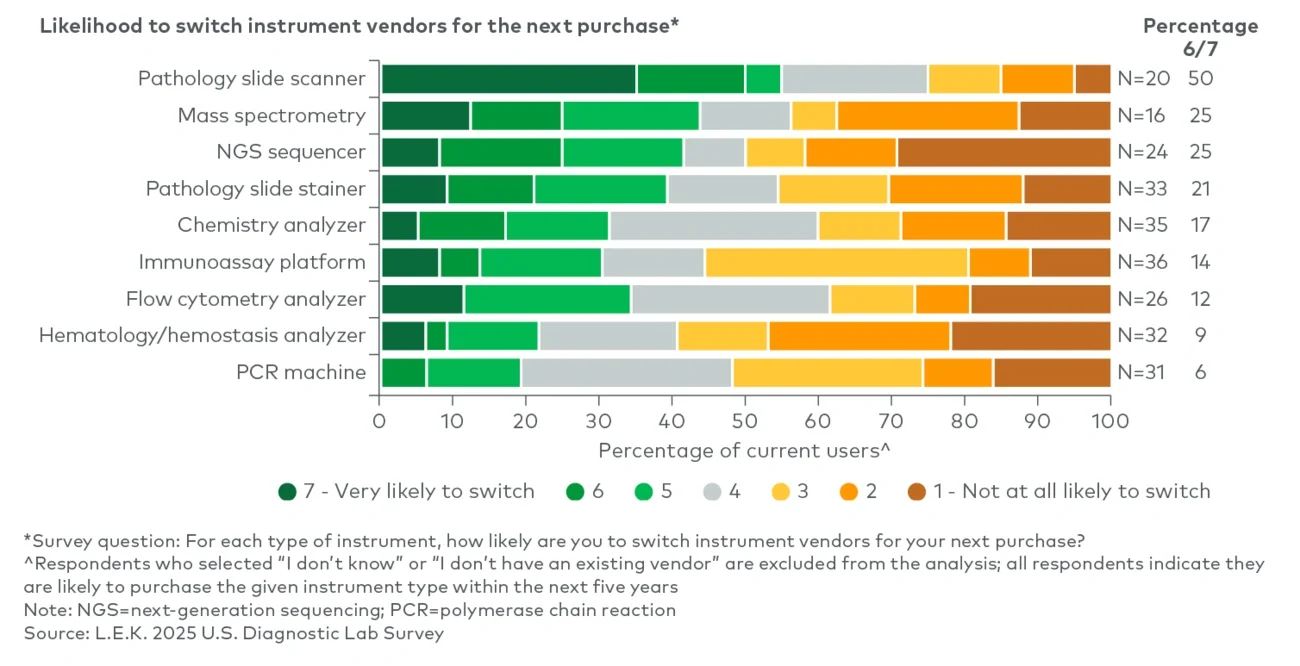
Current users of advanced modalities report materially higher willingness to switch vendors at their next purchase (see Figure 4), indicating a more competitive installed base relative to mature core platforms. Among current users, approximately 50% of pathology slide scanner users rate themselves “very likely” to switch vendors (6-7 on a 7-point scale), with around 25% for mass spectrometry and NGS sequencers.

Figure 4

Vendor-switching intent by instrument type

Image
Figure 4 represents vendor-switching intent by instrument type

Figure 4

Vendor-switching intent by instrument type

Image
Figure 4 represents vendor-switching intent by instrument type

Elevated switching intent in advanced platforms may reflect evolving needs as labs refine workflows and scale testing volumes, placing greater emphasis on scalability, informatics integration and service support in purchasing decisions. In this context, suppliers that demonstrate both technical differentiation and clear operational impact (e.g., turnaround time, throughput per full-time equivalent, rework reduction) are better positioned in upcoming purchasing evaluations.

Implications for manufacturers and lab suppliers

Strong demand expectations signal positive market momentum for diagnostics suppliers; however, success will require modality- and customer-segment-specific go-to-market strategies.

  • Strong in-house NGS growth expectation; tailor to the adoption and scaling journey

    • For established users: While clinical track record remains central, some labs are open to evaluating emerging platforms that can offer comparable performance with compelling economics and throughput aligned to volume demands.
    • For new adopters (still concentrated among AMCs and large community hospitals): End-to-end enablement plays a key role in reducing implementation friction, including validated workflows and standard operating procedures, applications support, bioinformatics integration, and reimbursement/reporting guidance. This support is increasingly offered by sample-to-answer platforms (e.g., Genexus, forthcoming Axelios) or through service and partnership models that facilitate clinical NGS build-out and ongoing operations.

    Stay tuned for an upcoming edition of Executive Insights discussing NGS testing demand and instrument purchasing trends, including sample-to-answer solutions.

  • Anatomic pathology: Operational efficiency and interoperability shape refresh decisions

    Rising test volumes and workflow complexity, amid continued reimbursement pressure, are placing greater demand on labs to improve operational efficiency. As digital pathology adoption accelerates and slide scanner refresh cycles create switching opportunities, vendors that demonstrate operational efficiency gains and deliver interoperability across the pathology stack (e.g., scanner, IMS, viewer, computational pathology applications) will be better positioned.


    Stay tuned for an upcoming Executive Insights edition discussing digital pathology adoption and instrument purchasing trends.

  • In core modalities, reliability and economics largely drive purchasing decisions

    In high-volume core modalities, limited greenfield adoption means most purchasing is replacement driven. While assay menu breadth and performance can be important differentiators, decisions are largely anchored in operational reliability and sustainable economics, with suppliers competing on uptime guarantees, service level agreements and transparent total cost of ownership.

To discuss these findings and translate modality-level growth into commercial actions across products, services and informatics, please contact us.

A special thank-you to the Healthcare Insights Center for their contributions to this Executive Insights.

Note: Artificial intelligence was used to support the drafting of this article.

L.E.K. Consulting is a registered trademark of L.E.K. Consulting LLC. All other products and brands mentioned in this document are properties of their respective owners. © 2026 L.E.K. Consulting LLC

English