Navigating the Shifting Landscape of Sports Fandom, Media Rights and Fan Engagement

July 2, 2025

Subscribe to Insight Exchange on Apple Podcasts, Spotify and Amazon Music and Audible for the latest episodes.

Sports fandom is evolving - and fast. Jeff Kaloski, L.E.K. Consulting Partner in media and entertainment practice, talks with Alex Evans, a Partner with LEK Consulting, and Geoff McQueen, also a Partner (together, they lead our sports and live entertainment practice, working with leaders across the sports industry, from leagues to teams to investors to service providers). They break down exclusive insights from our in-depth sports survey to reveal how changing fan behaviors, shifting demographics and media innovation are transforming the entire ecosystem.

From the rise of women’s sports to the disruption of traditional media rights and the surge in private equity interest, the panel explores what’s driving the next era of growth, and what it means for leagues, teams, broadcasters, investors and brands. 

Key themes covered:

  • The evolution of fandom: Who's watching, and how it’s changing
  • Youth-driven consumption shifts: Highlights, gaming, and social media over live games
  • The rise of women’s sports: Demographics, investment, and momentum
  • Local vs. national dynamics: Why the NFL and MLB still shine locally
  • Disruption in media rights: The fall of RSNs and the rise of streaming
  • Private equity’s growing role and the long-term opportunity in youth sports
  • Outlook for MLS vs. international leagues, especially post-World Cup 
Read the full transcript below

Announcer:
Welcome to Insight Exchange, presented by LEK Consulting, a global strategy consultancy that helps business leaders seize competitive advantage and amplify growth. Insight Exchange is our forum dedicated to the free, open and unbiased exchange of the insights and ideas that are driving business into the future. We exchange insights with the brightest minds of the day, the most daring innovators, and the doers who are right now rebuilding the world around us.

Jeff Kaloski:
Hi, everyone. Welcome to another episode of the podcast. Today we will explore the forces reshaping the world of sports media and fan engagement with exclusive insights from LEK Consulting. I'm Jeff Koloski, a partner in our media and entertainment practice. And today we're diving into one of the most dynamic periods in modern sports. From shifting fan behaviors to the explosive growth of women's sports, and from the rise of streaming to the unraveling of traditional media models. The sports landscape is in flux and the implications are big for leagues, media companies, investors and brands alike. So here's what we'll the current state of sports fandom and how different sports are being affected by the changing media landscape how fans are consuming sports content in new and surprising ways, the disruption of local and national media rights, the drivers behind growing enthusiasm for women's sports, the current status quo in soccer, and how MLS is faring relative to international leagues.

Jeff Kaloski:
Joining me to break it all down are Jeff McQueen and Alex Evans, leaders in LEK's sports practice and experts on where the industry is heading next. So why don't I throw it over to you guys so you can introduce yourselves?

Jeff McQueen:
Thanks, Jeff. Hi. This is Alex Evans. I'm a partner with LEK Consulting and along with my colleague Jeff McQueen, lead our sports and live entertainment practice where we work with leaders across the sports industry, from leagues to teams to investors to service providers to everyone within the broader sports ecosystem. So really excited for this conversation today. Jeff, do you want to introduce yourself?

Alex Evans:
Yeah. Thanks, Alex. So I'm Jeff McQueen, also a partner based out of Los Angeles, and, you know, along with Alex, work on all of the areas that he mentioned. And I think we've got a lot of really interesting topics to dive into today. So let's do it.

Voice Over Recording:
Great.

Jeff Koloski:
Thank you. I'm really looking forward to this. So let's start with what is the current state of sports fandom in the US.

Geoff McQueen:
U.S. yeah, it's really interesting, Jeff, because we've been doing this sports survey now for five years, so we do have some longitudinal data. And when we look at overall sports fandom, where it came out in our survey, about 28% avid professional and collegiate sports fans, about 19% casual fans. And that's generally been pretty consistent year to year. Certainly the last time we did it about 14 months ago, it's, it's right in line. And then we look back further historically and it's generally about the, the same. Where we do see some interesting trends is in some of the, the makeup of that and, and we'll, we'll get into that in a bit. But we also asked about some of the leagues and where is most of fandom there and here, unsurprisingly, the NFL is the clear leader in avid fans, followed by, you know, the next tier of sports, which is MLB, NCAA football and the NBA.

Geoff McQueen:
I think when we've shared this with clients, I think the surprise that everybody notes is how high MLB is. It's really the number two sport which at the national level it doesn't have quite the same cultural resonance as the NBA, but at the local level it remains really strong. And so as we think about how fandom has trended overall, we are seeing kind of flat year to year, but there are changes. We're seeing increases in avidity among the 18 to 29 age group and the 30, 39 age group also among women. We think this, you know, aligns well with a lot of the, the growing interest in women's sports where we see those groups, you know, over-index in their interest there. And indeed, when we look at the big winners in the sports leagues over the last year in terms of fandom gains, you know, it's, it's the WNBA, it's the EPL, it's formula one with WNBA being the biggest. And, and based on our fan incidents, you know, they've added over, you know, two and a half million avid fans just, you know, over the last year. And we think that's largely due to, due to Caitlyn Caitlin Clark.

Geoff McQueen:
She's got just a tremendous awareness and appeal. Beyond the core fan base of the WNBA has brought a lot of new fans to the game, evidenced by the, you know, record breaking attendance and TV ratings. And then we also, you know, looked at the who are the losers who are losing fans. And I think the big ones that stuck out in this year's survey was NCAA men's basketball and NCAA football, which saw, you know, meaningful declines year over year, you know, over a percentage point inhabit fan incidents. And we think a lot of that is likely due to, you know, one conference realignment, just, you know, creating haves and have nots, maybe turning off a segment of the population and then also the transfer portal and the nil rules where you have less, you know, year to year continuity in terms of the team and the players that may just be, you know, turning off those, those avid fans at the margins and leading to some declines. We also looked at just the younger, younger fans in particular and there you know, again we see winners and losers. You know, MLB, NCAA football and PGA kind of materially under index among the, you know, the under 30 group versus 30 plus. And on the flip side, you know, NBA, UFC, EPL and women's basketball, both the WNBA and collegiate do really well.

Geoff McQueen:
You know the NFL does under index a bit on that under 30 but they're still the number one sport among that age group by a pretty significant margin. Right. If you think about the under 30 avid fan, you know the difference between the NFL and the NBA is about the same as the NBA and MLB. And so that just, you know, highlights the strength of the NFL's just broad based offering and deep fan base.

Jeff Koloski:
Really, really interesting. What about how audiences are consuming sports? Did any interesting insights come through?

Geoff McQueen:
Yeah, I think when we look at kind of that age dynamic here again the under 40 sports fans consume more sports content in a given week than fans over 40, but they're consuming it in a much different way. There's much less emphasis on the live sports content itself. Only about 25% of their sports media consumption is live sports versus 60% for 60 plus. And instead they're spending more of their time consuming sports video games which is things like Madden and FC but also branded experience and experiences in Roblox. And then they're also spending a lot of time on social media, TikTok, Instagram and, and YouTube for highlights and user generated content. So we to kind of double click into this, we, we looked into, you know, the value of full games versus highlights and found really there are, you know, a couple dimensions here that, that that segment the fans. The first is going to be the age group under 40 versus over 40. Generally prefers, generally expresses a higher preference for, for just watching highlights or, or you know, primarily highlights versus full games.

Geoff McQueen:
And then the second dimension is the sport itself. So fans will generally watch full games of the NFL, of NCAA football and, and those types of sports. Whereas for MLS, NHL and UFC there's just a higher propensity for, for fans to rely on highlights to follow those sports. And so you've got kind of those two dimensions where you know, younger fans tend to prefer highlights and, and then games like football tend to capture more full Game viewership.

Jeff Koloski:
Yeah, I would obviously think this has implications for the long term value of the media rights for live sports content. And you also have or we've seen quite a bit of movement in the national sports rights landscape as streamers have gotten more aggressive. You think about what Netflix and Amazon and others are doing here, Alex, what are you seeing?

Alex Evans:
Yes, Jeff, you're absolutely right. The media rights marketplace has been really robust. If you look at national sports rights, they've been growing at about 9% annually over the past 10 to 15 years as leagues have really captured an increased share of consumer spending on TV and streaming. So if you look at what's been driving that from a league perspective, a lot of that is NFL, NBA and college football. But the rising tide has been lifting all boats. As you mentioned, Jeff, the digital platforms of streamers like YouTube, Amazon, Netflix are increasingly showing interest in life sports content and have been creating a more competitive bidding environment. So more bidders for a finite set of rights tends to drive the rights value upwards. However, there have been relative winners and losers.

Alex Evans:
Looking at the MLB as it's become increasing regionalized, as Geoff McQueen mentioned, the national rights for regular season games have become a little bit less valuable or perceived to be less valuable, limiting their increases in annual deal values in the last round of rights negotiations as well as ESPN even opting out of their Sunday Night Baseball agreement. If you look at college football, the Big Ten has really been the big winner. They've interestingly gone for six to seven year agreements which has allowed them to continue to drive annual deal values upward with more frequent bites at the apple. Their current deal is 1.15 billion per year versus 440 million in the prior round. You look in comparison to the SEC, arguably just as prestigious. They've signed a 20 year deal back in 2014 and then a separate 10 year deal in 2024. But because of that, they're not able to drive uplift in rights values as frequently as the Big Ten has been able to. They've seen really nice increases in their rights values too, going from 55 million on CPS to 300 million on their most recent ESPN, ABC deal.

Alex Evans:
But if you look at their overall conference media rights package, it's still below that of the Big Ten, about 700 million. And it'll be that way for the foresee, foreseeable future.

Jeff Koloski:
Really, really interesting. Thank you. I guess. I curious to understand if there are any other dynamics at play that have helped sports command such a dramatic increase in rights fees and your view on how likely this is to continue?

Alex Evans:
Yeah, Jeff, we think it's likely to continue. If you look at what's been driving this, why sports has been able to command these rights increases. Sports has been key to holding the pay TV ecosystem together, and sports are incredibly valuable to the legacy media companies. But we are seeing some cracks in that as viewership migrates to streaming platforms. And then streaming platforms are building out their advertising tools and targeting capabilities. And so linear TV advertising, which is been underwriting sports and has been incredibly resilient despite some of the pressures on pay tv, is expected to decrease in the next five years as the spend continues to migrate to streaming connected TV platforms. But at the same time, with the shift towards ad supported subscriptions, streaming platforms will become more aggressive bidders for sports rights in the next three to five years. As sports content drives viewership that's largely incremental to descriptive entertainment.

Alex Evans:
Viewership streamers will look to use live sports to acquire new subscribers, to retain existing subscribers, and to increase their monetization of subscribers through these more enhanced advertising platforms. And so as we look at sports rights, it's interesting. A number of the marquee properties are locked up for the time being, but there are a few that are coming up for bid. It'll be really interesting to watch. So we think of examples like UFC, MLB and even the NFL may have an early opt out. UFC in particular is going to be really fascinating. ESPN currently holds the rights. They're in a period of negotiation that's open negotiation right now.

Alex Evans:
And ESPN, according to our research, 40% of the ESPN subscriber base is avid or casual UFC fan. And ESPN is looking to launch a streaming service. So ESPN has a lot of motivations to retain ufc, but UFC is looking for very substantial rights increases. So we'll see how that plays out. MLB is also a really interesting negotiation to watch. It'll be interesting to see who ends up with Sunday night's baseball. The package that ESPN opted out of. Does ESPN come back for a lower rights fee or does a new partner emerge? To be determined.

Alex Evans:
But that will be again, interesting to watch.

Jeff Koloski:
Oh, thank you. How about we shift gears a little bit? Geoff, any thoughts on how local sports media rights are being disrupted?

Geoff McQueen:
Yeah, how much time do you have, Jeff? There's, there's a lot going on here, so I think we can, we can hit on a lot of different dynamics. But you know, local rights, they're a huge revenue driver for, for local teams in mlb, NBA and to and to a lesser extent the NHL and traditional RSNs. You know, you go back five, 10 years, they've been kind of in this long term secular decline. Everybody's acknowledged it, noted it, and five years ago it was in. Five years ago it'll be gone and it's still here. But the end is in sight. You can kind of see the economics starting to really be challenged over the next five years with the main street sports bankruptcy. You've got others kind of exiting the market.

Geoff McQueen:
So it's really this melting ice cube. And so teams need to prepare for a post RSN world. And there are have and have nots, right? Like the Yankees with yes network will be fine. The Dodgers with their $335 million per year local meteorites deal with spectrum. That's not going anywhere. And so you've really got these, these have and have nots. But teams are going to have to figure out what else can we do. And it puts monetization and reach into, into kind of direct conflict and tension with each other.

Geoff McQueen:
And so teams are really pursuing several different strategies. First we're seeing them kind of stay with their existing RSNs accepting a lower rights fee and just kind of keeping the status quo moving forward. It's less revenue than before, but it's still pretty good. It's guaranteed. But you've got to then deal with that declining reach and kind of the long term fan development issue. And then the other alternative, if you don't stay with the rsn, there are really a couple of things you can do. They're not necessarily mutually exclusive. You can do a combination.

Geoff McQueen:
The first is to partner with a local over the air channel. So here the team will broadcast and sell the TV ads. This results in variable revenue. Basically whatever you can sell in terms of sponsorship and marketing is the revenue associated with it. And so it's not a fixed fee. And now it's much more dependent on team performance. So if you think your team's going to do great and you invest in players and then on the back half of the year it kind of goes in the tank, you're going to realize a lot less revenue than you might have expected. On the flip side, you do get broader reach but less monetization.

Geoff McQueen:
And I think a couple examples here to point out. For the NBA, you've got the Jazz and the Suns that have done this for a couple years now and they saw pretty material increases at least in year one in viewership, partially due to the increased reach. I think the Suns, they were up almost 100%. Part of that was probably the acquisition of Kevin Durant. That drove a lot of that viewership, but certainly the distribution helped them reach that audience. The Jazz, on the other hand, saw a big increase in the first year. They were run over the air and they basically gave away all of the viewership gains in the, in the second year as it declined, you know, 50% as the, as the team performance really was challenged. And when you look at the monetization and kind of the figures that they've put out publicly, you know, the Jazz had about a $35 million RSN deal and they think they've reported that their media rights revenue is down 50%.

Geoff McQueen:
The Suns were closer to 13 to 15 million and they're down 25%. So that's a pretty meaningful gap for teams that are looking to monetize their local rights. So if you've got the local OTA viewership, you can do that. I think another alternative is to go direct to distributor. And here it's interesting. The Rangers I think are the best case to talk about. They've developed the Rangers Sports network, which conveniently the acronym is RSN and it's basically a part time RSN. They have cut out the middleman, cut out the bally sports middleman, sucked out all those legacy costs and only operate the network part time, pregame, in game, post game.

Geoff McQueen:
And they've cut direct deals with distributors. So there are kind of those guaranteed payments, that distribution and so they're able to broadcast games that way. And I think that is kind of an interesting middle ground. They've also done, the Rangers have also done a combination of that RSN direct to distributor approach along with a local over the air partnership. Well, they'll broadcast, I think it's like 10 to 15 games over the course of the season on Fridays. So you're kind of getting that reach with a little bit more monetization, which I think is kind of an interesting strategy moving forward. And then the last one that gets, I think a lot of press is direct to consumer, hey, just launch a direct to consumer offering. Sign up subscribers, get people to pay you directly.

Geoff McQueen:
It's a lot harder than it sounds. And there are white label providers out there that can help teams do this. But you know, for the most teams that offer this, it's basically a rounding error. There aren't any real subscribers. Very few people are willing to pay 20 to $25 a month for an MLB team's in market games. I think it can play a role, but it certainly can't be the driver.

Jeff Koloski:
Right.

Geoff McQueen:
And so if you just look at like the Padres, for example, their RSN averages about 50,000 viewers or it did back in, I think 2023, which is the last year even if you can converted 50,000 people to a paid subscription, you know, at 200 bucks for the season, like that's $10 million. That's, that's not a huge number in the MLB local media rights and there are a tremendous number of haircuts you can do before that even gets, you know, as it gets much smaller. So it's just, it's really not feasible long term. And it, it kind of creates this fandom death spiral where, you know, fewer people have access to the games, which means there are fewer fans, which means fewer people are willing to pay, which means you need to raise the price. And it just kind of spirals from there. So I think there's some real challenges with direct to consumer. And I think, you know, the, the leagues have, have made some, some mention about centralizing it or you know, you know, doing in market streaming and, and finding a partner. I think there may be a path forward there, but you've got to, I think, think through a number of different things because I think ultimately if it comes down to like an a la carte payment for in market games, even if you pair it with the out of market games, right.

Geoff McQueen:
If you park, you know, MLB TV out of market games, plus the local in market games, I just, I don't think you're going to get the subscriber base that, that you think you are. Leagues need to think really carefully about how they approach that.

Jeff Koloski:
Yeah. Wow. Really insightful. The landscape for local sports rights, it's, it's clearly shifting. It's a sign of how quickly traditional models are giving way to flexible, direct approaches. And that kind of disruption isn't just happening in how people watch sports. We're also seeing it impact what they watch. One of the biggest stories in the industry right now is the rapid rise of women's sports.

Jeff Koloski:
With growing fan interest, bigger media deals, and rising star power, women's leagues are getting more attention and investment than ever before. So what's behind this momentum? Can it continue and what does it mean for the future of the sports industry? Alex, do you want to share some thoughts?

Alex Evans:
Yeah. Thanks, Jeff. Women's sports are on fire. Women's sports have been getting a lot of attention and there's just been a flood of good news recently. WNBA, NWSL, NCAA, Women's basketball all have seen really nice increases in their sports rights deals. You see team sales like Angel City FC and NWSL you know, sell for record breaking amount 250 million. Caitlin Clark has been driving WNBA to record levels of attendance and ratings. And just a couple of weeks ago, MLB announced its investment in the Athletes Unlimited Softball league, really adding fuel to the growth of professional women's softball.

Alex Evans:
So again, a real flood of positive developments. We see in our survey work a lot of interest in women's sports, particularly among your younger fans and women, which is a really favorable demographic tailwind that can help propel women's sports more broadly over the longer term. We asked fans why they're interested in women's sports, what's driving this interest, and the reasons that rose to the top were high level quality of play, the presence of strong female role models, and just being a sports fan more generally. And it was interesting that the women we surveyed were much more likely than men to cite the strong female role models and supporting equal opportunities for women as motivators for their interest. Men were more likely to cite the high quality of play and being a sports fan more generally. If you look at some of the barriers to fandom in women's sports, somewhere around familiarity with the athletes and teams, there's some perception of a lower level of play. This was more among the male respondents and then just a general lack of local teams to support. But if you think about these reasons, the familiarity with the athletes and the lack of local teams to support these will likely diminish over time as women's sports grow and expand, become more mainstream, more franchises are launched.

Alex Evans:
So we expect again that tailwind of fan growth to continue. We asked sports fans about their intent to watch women's sports over the next 12 months, and avid sports fans and fans under 40 expected pretty strong growth in their viewership of women's sports going forward. Basketball and soccer have probably had the most press among women's sports over the past couple of years, but there are others that we could see growing as well. As I mentioned, MLB's investment AUSL could really bring softball to a bigger stage. There's also an active pro scene in women's volleyball and there are three active leagues competing today. If you think about the large base of women volleyball participants and a competitive NCAA scene, women's volleyball is a sport to watch. And there are some reasons to believe that that will occupy a much bigger stage going forward as well. So we're bullish.

Alex Evans:
We really like the outlook for women's sports.

Jeff Koloski:
Thanks, Alex. I'd love to unpack soccer a little bit further. Jeff is our resident soccer fanatic. How's MLS doing in the US I.

Geoff McQueen:
Don't know if I'd call myself the resident soccer fanatic, but, you know, pro soccer fandom is, it's interesting. It has a really interesting shape. So we found in the survey is that fandom of pro soccer is actually highest among 30 to 39 year olds. And fandom among 18 to 29 is actually about the same as 40 to 49. And so it creates this, you know, interesting shape where sports, you know, pro soccer fandom is peaking in that 30 to 39 group. And we thought this was interesting because, right, you think about that group, when they came of age, you know, 15, 20 years ago, it would, you know, the way they would watch soccer would be to go to a bar, watch the EPL on Saturday morning. And it really, we think, created this, you know, community and emotional connection to the league and teams. Whereas when the 18 to 29 group came up, soccer content was generally pretty readily available.

Geoff McQueen:
You could get it on streaming services, it was on broadcast tv, you had more MLS. And so it wasn't like you had to go to the bar on Saturday morning to watch, you know, the Tottenham Hotspur. Right? So it's just a different dynamic. And we think that may have actually impacted some of the fandom development around pro soccer. And just as they've had to compete harder for attention span against, you know, not just other sports, but Also, you know, TikTok, YouTube, etc. Among that 18 to 29 group. So, you know, when we think about that, the question if 18 to 29 fandom is actually lower than 30 to 39 among the age groups, is there another wave of interest to boost soccer more generally and MLS specifically, or is it really just is what it is at this point? And so I think that's TBD. But MLS has a lot riding on a successful World cup next year and it's really hoping it can drive a meaningful increase in fandom.

Geoff McQueen:
But then that also has the question of even if you drive that increase in fandom, are you able to capitalize on it and make it sustainable in the long term? And I think as we think back to some of the rights discussions earlier about reach, you think about MLS season pass and the reach it has there and how it's kind of paywalled on Apple TV, which is a service that, you know, has some great content but no one actually watches. When you look at the overall minutes viewed, I think it's a challenge. And so I think we can dig into that in a little bit more detail. But you know, I think MLS, you know, has, has, has placed a lot of chips in the center on the success of the World Cup. And so then, you know, in our survey we wanted to do is unpack. Where does MLS sit in kind of the hierarchy of, of U.S. soccer among U.S. soccer fans? And they do have the most avid and casual fans, but the EPL actually has the most avid fans.

Geoff McQueen:
We think this ties into the 30 to 39 year old age group dynamic that we mentioned above, where just like that community and that emotional connection creates more avidity and just makes it easier to stay engaged and you've kind of got other fans that you can bond with and drives that engagement. When you look at avid soccer fans, the EPL is actually the most preferred league. We asked about EPL, Serie A, La Liga, Bundesliga and MLS. And the EPL was the most preferred league among avid soccer fans. So about 47% cited EPL versus 32% for MLS and 21% for the other international leagues. However, among casual fans, it's another story here. 55% prefer MLS versus 45% for international. And so we asked them why MLS.

Geoff McQueen:
When we asked why MLS fans prefer MLS versus the international leagues, they really cited the ability to support local teams, the affordability of the product, MLS star power like Messi. Whereas when we asked the EPL fans, you know, why do you prefer the EPL to MLS? It was really about these, you know, kind of the long history of the league. It was the higher quality of play, global star power, prestigious clubs, long standing rivalries. You kind of have all of those factors that you can't really build up in the short term and just take time. And so we think that's, that's really the challenge for MLS there, I guess.

Jeff Koloski:
So the question I'll pose is, do you think MLS could become the number one league in the US?

Geoff McQueen:
It's possible, but it's certainly not guaranteed. I don't think they've done themselves any favors with fan development and the Apple TV deal. As kind of mentioned before, they haven't disclosed subscriber numbers since the initial announcement of about 2 million in 2023. But our survey suggests that that number hasn't grown much, if at all. And you factor in, right. They got the messy bump. You know, what happens if Messi goes to another league or retires? Like what happens to viewership then? And what will that do? I think that's another story. And then couple just.

Geoff McQueen:
We also asked non-subscribers, right. Like, is this something you're going to be interested in subscribing to in the future? You know, asking this about, you know, pro soccer fans. And generally there was pretty limited interest in subscribing. So if you're not already a subscriber, there's just, there's not a lot of additional people out there that are, you know, clamoring for the MLS season pass. And so we think it's going to, you know, MLS is going to struggle to build out a meaningful audience. And, you know, by being out of sight, out of mind, they, they risk, you know, kind of impacting their overall fan base development, which is a long term challenge. You can see this in the MLS cup ratings on linear tv. It's not, you know, it's not perfect because the linear TV system is eroding and it doesn't necessarily align very particularly well with the MLS fandom.

Geoff McQueen:
But just the year to year data. In 2022, MLS cup drew about one and a half million viewers to the English broadcast. Then they went on Apple TV and in 2023, that viewership dropped to 800,000 in 2023 and dropped to less than 500,000 in 2024. So that's a pretty steep drop off that I think would tie back to that. Out of sight, out of mind. And the lack of fan development and engagement.

Jeff Koloski:
Gosh, you're saying there's a chance, but it's a steep uphill climb. We've covered a lot. Clearly an exciting time in the world of sports. A lot is shifting and shifting quickly. What haven't we covered? What else should we chat about?

Alex Evans:
Yeah, Jeff, one thing I wanted to mention is just the growing private equity interest in sports. I'm talking not just about ownership of team franchises, which has been pretty common, but thinking more broadly about investing in the sports ecosystem. Many of our private equity clients are interested and active in sports investing. They see a lot of favorable tailwinds. Many of the things we've been talking about, including just the growing flow of rights, fees and advertising and sponsorship dollars into the sports ecosystem, the enduring strength and depth of fan engagement, the insulation from cyclicality and things like tariffs, the scarcity value of certain assets, and just the scalable growth of a number of emerging tech platforms, all of which can underpin a sports investment thesis. Where are these private equity firms investing? What are the types of things they're looking at? Things that we've been seeing are sports technology and analytics platforms, sports marketing agencies, venue management companies, emerging leagues and youth sports operators, to name a few. Again, a very interesting active area for us and one sort of something worth watching.

Jeff Koloski:
Geoff, anything you'd like to add?

Geoff McQueen:
No, I think Alex covered it. Maybe just, you know, put a point of emphasis on youth sports that's probably its own podcast in and of itself as that market just kind of continues to attract interest and continues to mature as youth sports professionalizes. And so there could be, you know, I think there's opportunities for private equity. There's probably also opportunities for sports leagues to, you know, consider a more holistic youth sports engagement strategy and how they can use that as a fan development tool to maybe offset some of the challenges that we talked about earlier with reach and monetization of content. So I think there's a lot of interesting activity going on here and it's a really interesting time to be in the space.

Jeff Koloski:
Thanks, Jeff. That wraps our discussion on the 2025 LEK sports fan viewership and Attendance Survey as helpful. We're happy to provide more detailed discussions on request, and we invite you to connect with us to learn more about LEK Consulting's extensive experience in providing strategic support to businesses and investors across the media and sports landscape, including on any and all the topics that we touched on today. So I want to thank Jeff and Alex for a really insightful, engaging, an exciting conversation today. Until next time, thanks for listening.

Announcer:
Thank you, our listeners, for joining us today at the Insight Exchange presented by L.E.K. Consulting. Links to resources mentioned in this podcast can be found in the Show Notes. Please subscribe or follow for future episodes wherever you listen to your podcasts. Also, we encourage you to submit your suggestions for future insights online @ lek.com. 

L.E.K. Consulting is a registered trademark of L.E.K. Consulting LLC. All other products and brands mentioned in this document are properties of their respective owners. © 2025 L.E.K. Consulting LLC 

English

Health and Safety Concerns and a Bid for Greater Functionality Are Impacting Packaging Materials Inputs

July 7, 2025

A potent combination of growing consumer awareness and increasing regulatory pressure is causing a rise in demand for packaging inputs that enhance safety while eliminating toxic chemicals and by-products.

Meanwhile, as consumers seek packaging that is both convenient and easy to use and brands face pressure to differentiate themselves, finding solutions that extend the shelf life of food is becoming an ever-greater priority, all while ecommerce necessitates packaging that is not just more durable but can also be produced more efficiently.

Both developments have tangible ramifications for packaging manufacturers and converters — and, by extension, the chemicals and materials companies that supply them in the packaging value chain.

Seeking safer alternatives

Not only are consumers becoming more educated about the potential health risks associated with packaging materials and the inputs that go into those materials, but regulations around chemicals used in packaging are becoming more stringent (e.g., banning per- and polyfluoroalkyl substances, aka PFAS, in food packaging). Extended producer responsibility policies are also increasingly holding brand owners who use packaging in their products responsible for the entire life cycle of those products, including the disposal of packaging chemical inputs, prompting companies to seek safer alternatives.

As a result, demand is increasing for packaging materials and inputs that enhance safety by eliminating certain chemicals and by-products and that provide similar levels of performance. Specific innovations in this field include water-based inks that eliminate the use of volatile organic compounds (VOCs), biopolymers that can replace phenol-based chemicals used as barrier coatings, and starch or acrylic adhesives that can replace more hazardous sodium-silicate adhesives.

Reduced VOCs (inks) — Unlike traditional solvent-based inks, which release harmful VOCs into the air during the drying process, water-based inks utilize water instead of solvent. Applications include printing on materials used for aseptic and fresh food packaging, paper cups, plates and food cartons, as well as those that are hygiene-specific.

Phenol-free materials (coatings) — Biopolymer coatings, which are derived from renewable resources like corn starch or sugarcane, are replacing phenol-based chemicals (such as PFAS) in food-contact packaging (e.g., containers, trays and to-go boxes), where they act as a barrier against moisture and grease.

Nontoxic, recyclable starch (adhesives) — Starch adhesives, which are used primarily in corrugated boxes, and acrylic adhesives, used with shipping labels, provide recyclable and nontoxic alternatives to more traditional sodium-silicate adhesives, which can irritate eyes and skin and have performance issues when wet or too dry.

Packaging material inputs are impacting — and improving — packaging functionality

Functionality is also driving the mix of packaging inputs more than ever before, with inputs that improve packaging performance increasingly in demand. It’s an opportunity that both chemicals and manufacturing companies in this space should embrace.

Packaging functionality starts with understanding the foundational “job” that the packaging is being asked to do. In some instances, for example, the packaging is critical to keeping products fresh and safe; in others, its primary functionality is to effectively convey the brand message and drive consumer shelf appeal.

Packaging functionality can also extend into operational efficiency in packaging conversion or printing, or when it comes to filling steps of the value chain. In these examples, helping increase production throughputs, yields and speed and minimizing production waste can be tangible value levers that accrue to packaging manufacturers, co-packers/co-fillers and brand owners.

Extending shelf life/reducing food waste (substrates) — “Active packaging” refers to packaging technologies designed to interact with the product or environment inside the package, such as oxygen absorbers or antimicrobial agents. Using active packaging not only reduces food spoilage but extends the shelf life of food to, ultimately, minimize food waste. It also makes food packaging more sustainable by removing the need for desiccant packs.

Applications include packaging for moisture-sensitive products, such as snacks, baked goods and pharmaceuticals, where maintaining an optimal humidity level is crucial for preventing spoilage and the growth of mold and mildew, which can compromise product quality.

Enhanced production efficiency (inks) — Ultraviolet (UV)-curable inks cure instantly under UV light, speeding up production by eliminating drying times and reducing emissions of VOCs. These inks also produce sharp, high-quality images with less ink spreading, which results in a higher-quality product. 

Flexible packaging, labels and high-end product packaging for cosmetics are among the applications, as are those that need fast throughput and high print quality, such as pharmaceuticals and food products.

The above are but a few examples of the shifts in packaging material inputs that are occurring, either due to health and safety concerns or a desire for increased functionality. There are, of course, other factors also influencing the selection of packaging materials inputs. To that end, we’ve published a three-part series on the topic, including the macro trends in packaging and how corporate sustainability goals are increasingly impacting the mix of packaging inputs.

To set up a meeting to learn more, please contact us.

L.E.K. Consulting is a registered trademark of L.E.K. Consulting LLC. All other products and brands mentioned in this document are properties of their respective owners. © 2025 L.E.K. Consulting LLC

English

Packaging Inputs Are a Key Tool Helping Brand Owners Make Progress Toward Their Corporate Sustainability Goals

July 3, 2025

As companies continue to strengthen their commitment to using sustainable packaging, packaging inputs that improve sustainability are increasingly in demand.

Sustainability, the focus of this article, is one of three broad macro trends in the packaging space, along with safety and functionality. And while the exact definition of “sustainable” may differ from company to company, when it comes to packaging, it means that all of a package’s components — including substrates, coatings, adhesives and inks — must themselves be sustainable.

A corporate mandate

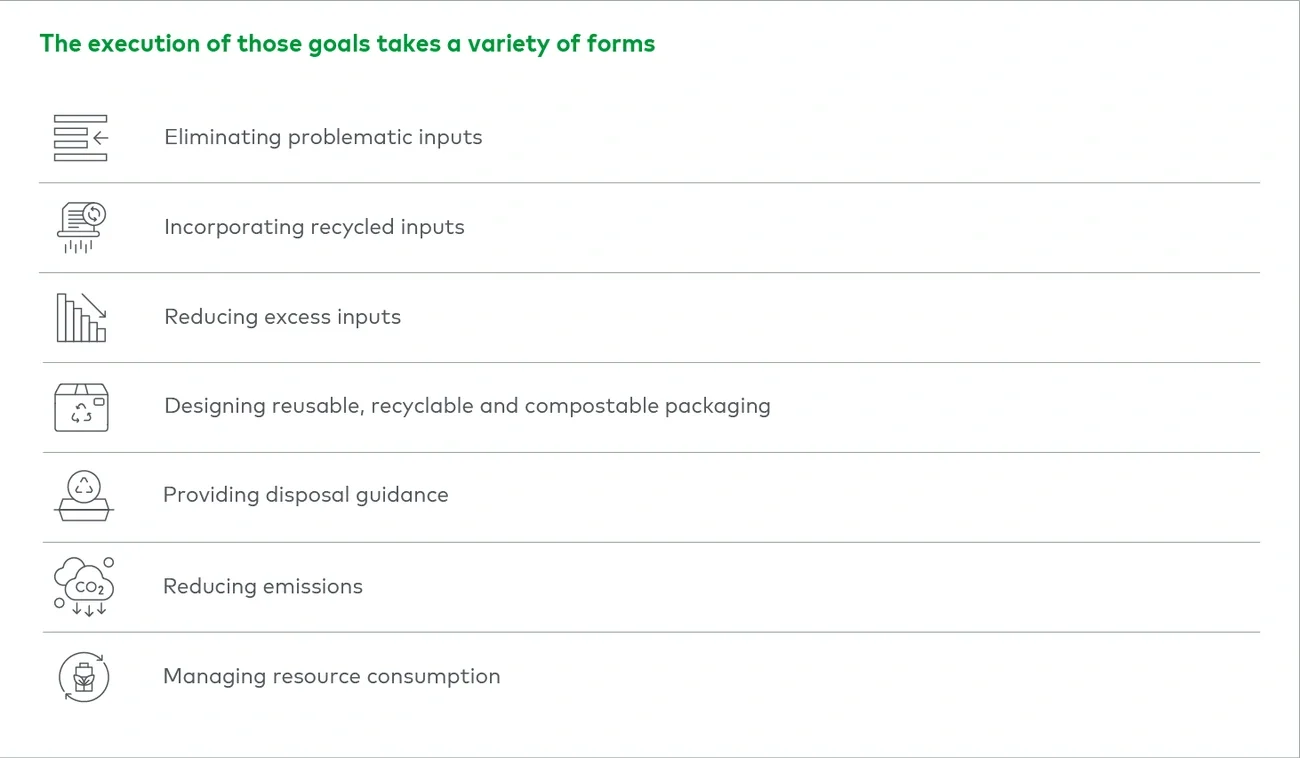
Corporate sustainability goals are being driven by a confluence of factors, namely the need to reduce environmental impact, the influence of consumer expectations and the evolution of the regulatory landscape (see Table 1).

Image
Table 1: the execution of those goals takes a variety of forms
Image
Table 1: the execution of those goals takes a variety of forms

But whereas package design and emission/resource reduction have been central commitments for more than 10 years, eliminating problematic inputs, reducing excess and providing disposal guidance have only emerged more recently.

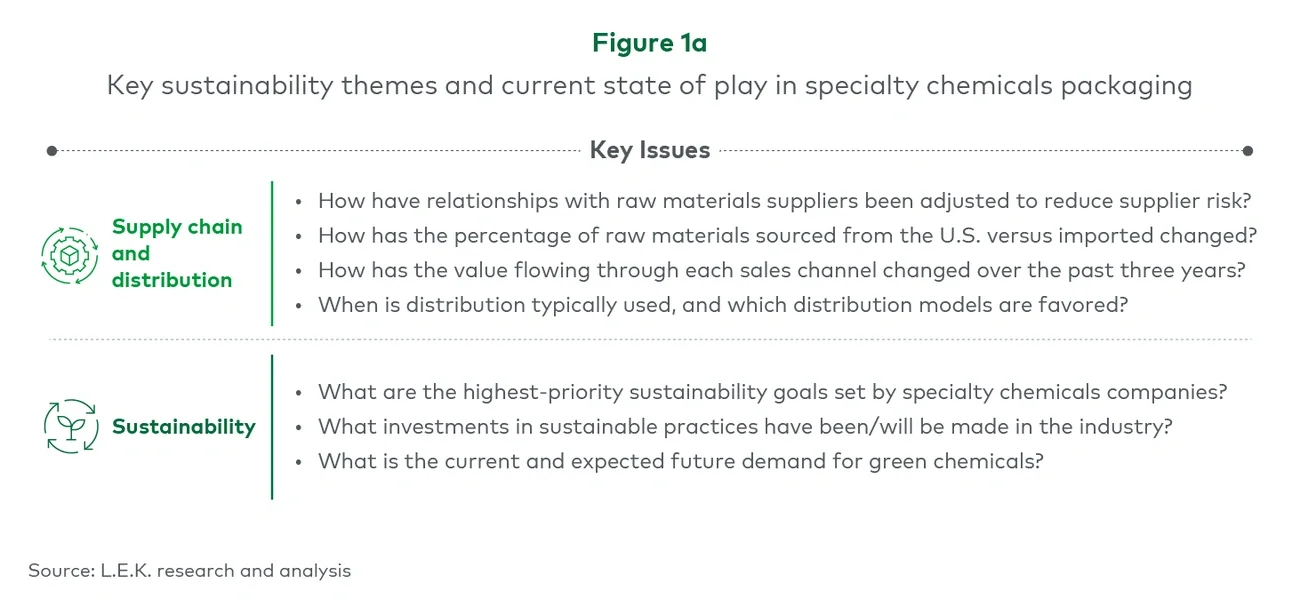
Generally speaking, companies are on track when it comes to meeting their emissions reduction targets but are struggling to meet recycled material and package design targets due to a host of infrastructure challenges (see Figures 1a and 1b).

Image
Figure 1a. Key sustainability themes and current state of play in specialty chemicals packaging
Image
Figure 1a. Key sustainability themes and current state of play in specialty chemicals packaging
Image
Figure 1b. Key sustainability themes and current state of play in specialty chemicals packaging
Image
Figure 1b. Key sustainability themes and current state of play in specialty chemicals packaging

4 innovations in packaging sustainability

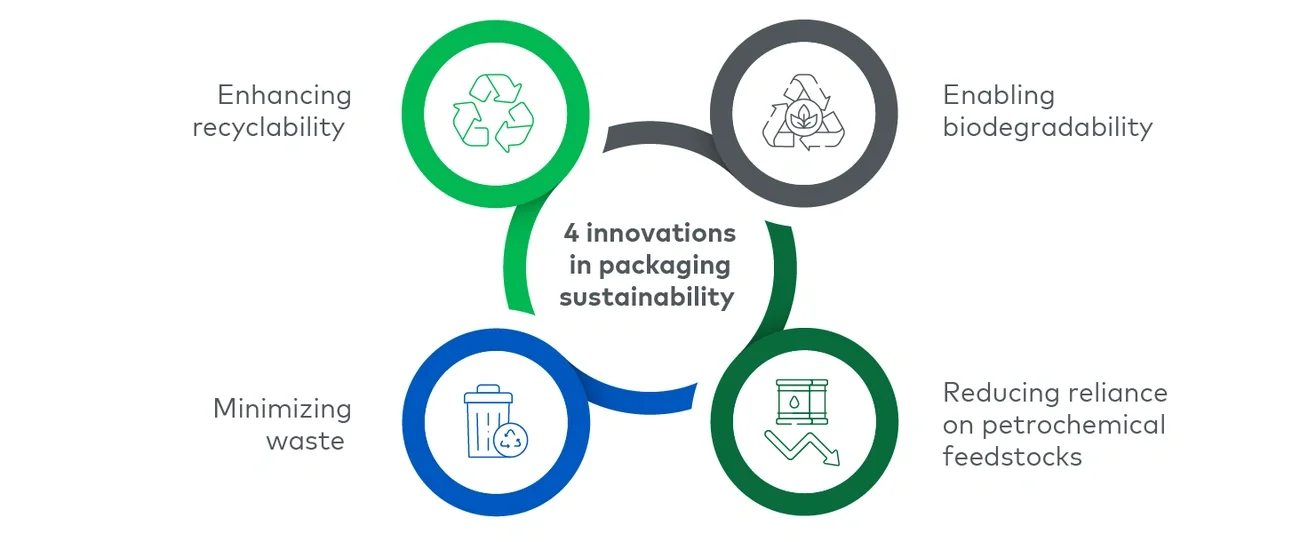
Companies are focused on four innovations that enhance recyclability, enable biodegradability, reduce reliance on petrochemicals and minimize waste, respectively.

Image
4 innovations in packaging sustainability infographic
Image
4 innovations in packaging sustainability infographic
  1. Enhancing recyclability (coatings) — Aqueous coatings are an example of materials transforming the landscape of paper-based packaging by enhancing functionality while preserving recyclability. For example, when applied to paper coffee cups and fast-food containers as a replacement for traditional plastic coatings, aqueous coatings ensure that these items can be recycled in existing paper recycling streams while providing a moisture, oxygen and grease barrier.
  2. Enabling biodegradability (substrates) — Bioplastics — plastic alternatives such as polylactic acid and polyhydroxyalkanoates (PHA) made from renewable feedstocks like food waste or agricultural waste — are expected to take share in the market as capacity expansions increase supply, blend capabilities enhance material characteristics (e.g., softness, flexibility) to compete with alternatives and equipment innovations reduce historical production inefficiencies. PHA bioplastic cutlery is increasingly being used by quick-service restaurants, for example, as a biodegradable alternative to conventional plastic utensils.
  3. Reducing reliance on petrochemical feedstocks (adhesives) — Lignin-based adhesives, for example, represent a breakthrough by utilizing a natural polymer found in wood to provide a renewable and more sustainable alternative to petroleum-derived adhesives. Fiberboard packaging and other paperboard products are among the areas where these adhesives are being utilized.
  4. Minimizing waste (coatings) — Silicone coatings used in linerless labels, for example, eliminate the need for a release liner, reducing both waste and packaging weight as compared to traditional pressure-sensitive labels, where the liner is typically discarded as waste. Food packaging and retail shipping labels are common applications.

All four of these sustainability innovations present opportunities, not just for the packaging makers and brand owners that leverage them, but also for the chemicals and materials firms that supply them.

Be sure to check out the rest of our three-part series, which delves into the macro trends in packaging as well as the impact of health and safety concerns and the desire for increased functionality.
To set up a meeting to learn more, please contact us.

L.E.K. Consulting is a registered trademark of L.E.K. Consulting LLC. All other products and brands mentioned in this document are properties of their respective owners. © 2025 L.E.K. Consulting LLC

English

Regenerative Agriculture Takes Root: Momentum Builds Across the Value Chain

July 2, 2025

Adoption of regenerative agriculture is accelerating, with retailers, CPG brands and growers all exploring its promise — yet unfamiliarity and infrastructure gaps remain hurdles. From boosting soil health to meeting sustainability goals, alignment across stakeholders is essential to unlock scale.


unlocking growth in regenerative agriculture


Download our infographic to see how value chain players are mobilizing.

Want to find out more? For deeper insights on how agribusinesses can prepare for this shift, read our 2-part Executive Insights series, “Key Crop Input Trends: How Growers Are Shifting” and “Agricultural Growers Turn Manufacturers: What to Expect in Essentials Spending,” or contact us for more information.

L.E.K. Consulting is a registered trademark of L.E.K. Consulting LLC. All other products and brands mentioned in this document are properties of their respective owners. © 2025 L.E.K. Consulting LLC

English
Executive Insights

A View Into the Promise of Continuous Manufacturing

June 30, 2025

Key takeaways

Continuous manufacturing (CM) has the potential to transform pharma production by cutting costs, improving quality and speeding up timelines. It replaces fragmented batch processes with an integrated, real-time system that reduces waste, uses less space and ensures consistent product quality.

CM is on the rise, with projected growth of 10%–15% per year, starting from a relatively low base of $2-3bn. Big Pharma is leading with high-volume drugs, while CDMOs are building platforms or partnering up with biopharma on specific projects.

High upfront costs, complex tech and limited product compatibility — as well as the pharma industry’s cautious mindset — make implementation challenging. Many products cannot yet be tested in-line, regulatory frameworks are still evolving and CM expertise is scarce.

CM has mostly been applied to small molecule and oral tablets, but near-to-mid-term adoption for biologics is starting, on a selective number of suitable products, with clear business cases.

Introduction

Pharmaceutical manufacturing is evolving. As the industry looks for ways to enhance efficiency, improve quality and strengthen supply chains, continuous manufacturing (CM) is emerging as a powerful alternative to traditional batch production.  

Though adoption has been gradual, CM is gaining momentum across pharma and CDMOs — backed by growing regulatory support and real-world successes.

This Executive Insights explores the interesting advantages and opportunities that CM offers to the pharmaceutical industry, the challenges of adapting production processes, and the evolving regulatory landscape. It also provides an outlook on CM adoption.

What is continuous manufacturing?

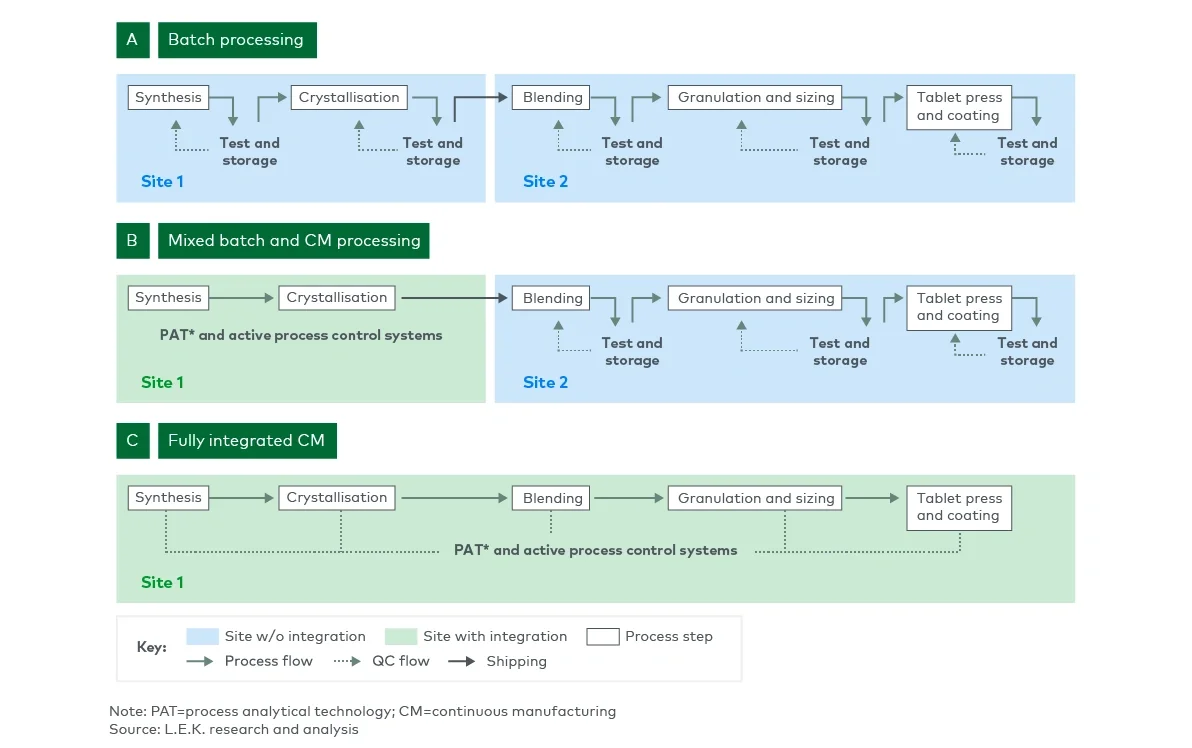
Continuous manufacturing is a fully integrated production process, where pharmaceuticals are created through an uninterrupted flow (see Figure 1). In its more integrated adoption, it covers the full process from production of pharmaceutical ingredients (APIs) to finished dosage form (FDF), streamlining everything into one cohesive system. This is a stark contrast to traditional batch processing, which is sequential, modular and often spread across multiple sites with significant downtime between each stage of the process.

In batch manufacturing, materials are processed in discrete steps, often with testing and storage between each of them, leading to inefficiencies, warehousing needs and batch-to-batch variation. Production volumes are not easily adjustable, and bottlenecks can arise when shifting between production lines. 

Figure 1

Process flow representation for tablet manufacturing

Image
Process flow representation for tablet manufacturing

Figure 1

Process flow representation for tablet manufacturing

Image
Process flow representation for tablet manufacturing

In CM, all steps are integrated into a closed-loop system, within a single facility. Process analytical technologies (PAT) and real-time quality control tools ensure continuous monitoring of product quality throughout the process.  

CM can be applied to both drug substances or APIs, and drug products or finished dose formulations (FDFs). While most applications today focus on one end of the value chain, a few fully integrated examples exist.

In addition, there are emerging hybrid approaches that combine continuous and automated manufacturing process with batch-to-batch operational control elements (for quality and compliance monitoring).  

One example is small-volume continuous (SVC) manufacturing, a setup that enables uninterrupted flow of materials while traceability is tight to a batch record (often defined as specific time frame). SVC is ideal for testing new configurations during early development phases and allows for flexible, frequent production cycles, and companies are increasingly mixing batch and continuous processes. 

Why and when is CM interesting?

Continuous manufacturing can provide a strategic advantage to pharmacos, driving efficiency, speed, precision and resilience. In some cases, it also accelerates time-to-market and innovation.

By using less APIs and operating within facilities that can be up to 70% smaller than traditional batch lines, CM reduces waste, lowers inventory requirements, cuts operational costs by as much as 50% and shortens production timelines. Its ability to operate with smaller volumes in combination with fully enclosed modular systems makes it suitable for handling production of highly potent API (HPAPI), reducing exposure risks for products with sensitive chemistries.

Integrated, real-time quality monitoring speeds up delivery, enhances consistency across production runs and reduces error rates, delivering superior product quality. CM is scalable by nature, which allows companies to flex production in line with demand by simply feeding frequency of materials and adjusting run times, without major infrastructure changes.

Proprietary CM processes can serve as a long-term differentiator (i.e. manufacturing efficiency, product quality, ability to scale up or down), reinforce competitive positioning (i.e. better costs and service pricing, improved timing, increased flexibility) and, in some cases, create barriers to generic competition (i.e. hard-to-replicate originator efficiency for new players).

For contract development and manufacturing organisations (CDMOs), CM efficiencies impact pricing power and operational appeal, improving the competitiveness of the service offering through faster, more cost-effective delivery.

Use cases

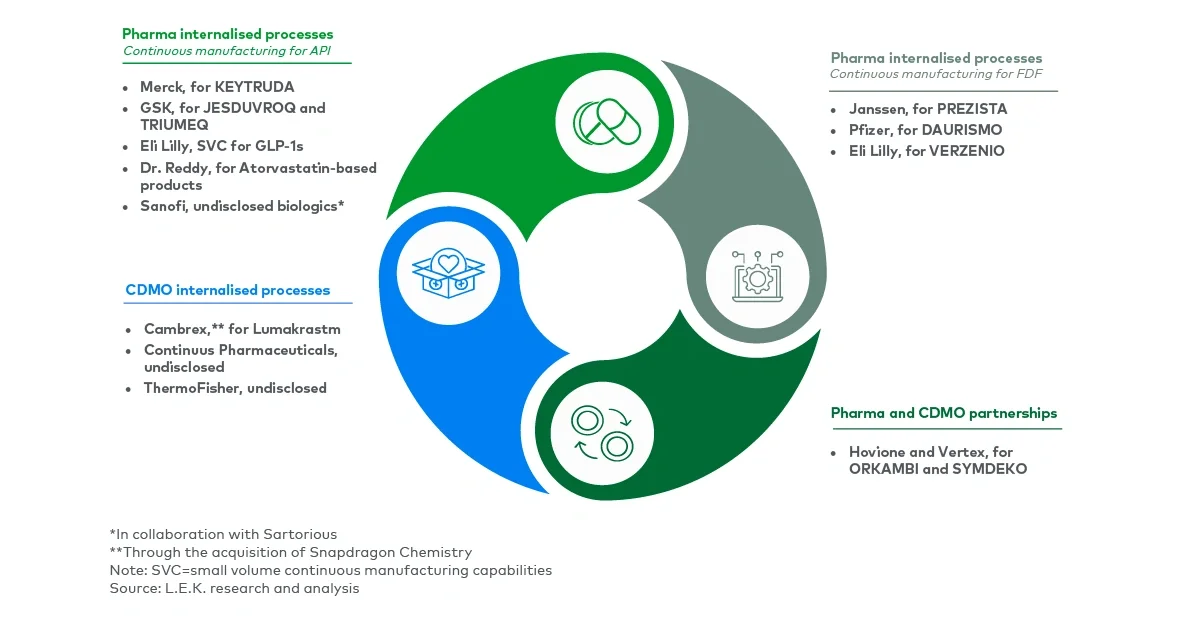
Real-world adoption of CM has occurred across the biopharma and pharma service industry (see Figure 2).  

Pharma companies have internalised CM for both APIs and FDFs. However, in most cases, they have kept the two ends of the manufacturing process separate. CDMOs have developed fully owned CM solutions as well as developed partnerships between pharma and CDMOs, with most use cases focusing on API CM.  

One of the most ambitious initiatives comes from Janssen, which set a target to produce 70% of its high-volume products using CM by 2025. The company has invested in dedicated facilities and transitioned key products (PREZISTA, TRAMCET), with regulatory approvals secured from the FDA and Japan’s PMDA.

Pfizer has similarly set a target of manufacturing approximately 70% of its small molecule, solid oral dose portfolio using CM by 2030, leveraging its Portable, Continuous, Miniature and Modular (PCMM) technology — featuring a footprint 60%–70% smaller than traditional systems — already implemented at its facilities in Groton, Connecticut and Freiburg.

Figure 2

Industry examples

Image
Industry examples

Figure 2

Industry examples

Image
Industry examples

Challenges for adopting CM

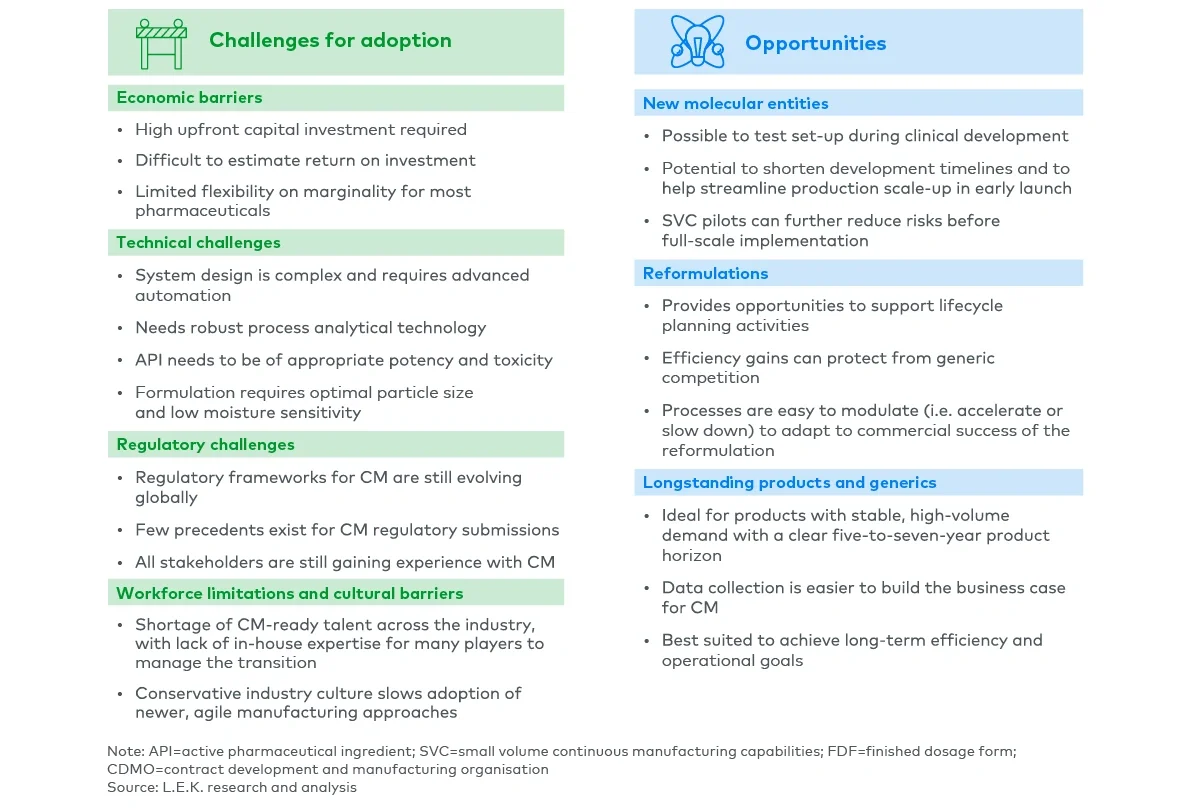
While continuous manufacturing holds significant promise, its widespread adoption is limited by a combination of economic, technical and regulatory challenges, as well as industry conservatism towards altering well-established and validated production processes.

The capital investment required can be substantial, making upfront costs a major hurdle. For generics manufacturers, the return on investment can be particularly difficult to meet given thin margins and high pressure on timing of product launch.  

Technically, CM demands advanced process automation and robust PAT, creating complexity in both design and operation. Physical and chemical compatibility is a key limiting factor, as CM works best with APIs and formulations with appropriate potency, moisture sensitivity, particle size and toxicity. Recent technological advantages have made CM more suitable for OEB ≥4 and HPAPI manufacturing.

Regulatory uncertainty remains a challenge. Global frameworks are still evolving and relatively few precedents are available, with regulators and industry alike still building experience with CM submissions.  

Compounding these issues is a widespread shortage of talent with the necessary capabilities and experience to operate CM production lines, with many organisations also lacking expertise to start and manage the transition from batch-to-batch to CM processes. Moreover, the deeply conservative industry culture continues to act as a brake on transformation towards newer, more agile approaches.

Opportunities to adopt CM

Although CM presents several challenges, there are numerous incentives and opportunities for companies considering its adoption (see Figure 3).  

CM is particularly well-suited for new molecular entities (NMEs) and reformulations, as it allows integration of continuous processes from the earliest stages of development. This enables production lines to be designed specifically for continuous operation, eliminating the need to retrofit traditional batch systems and aligning manufacturing strategy, efficiency goals and product lifecycle planning.

NMEs have a multi-year development and commercialisation runway, providing time for CM process refinement, cost optimisation and enhanced quality control. The flexibility to begin production with smaller volumes and scale up efficiently during the ramp-up phase further supports CM suitability. Additionally, the long lifecycle of NMEs ensures that efficiency gains from CM can be fully realised while the product is generating significant revenue.

Reformulations developed for CM processes have the additional advantage of lower production costs and shorter timelines. This can create meaningful differentiation compared to existing marketed formulations, enhancing their competitive value.

During clinical development, CM can be built into the process early, streamlining scale-up and accelerating timelines. Single-use or SVC pilots offer a critical opportunity, enabling companies to test and refine CM systems, while gathering data to support a strong business case before committing to full-scale implementation.

In select cases, the cost benefits of CM can justify its use for commercialised products with stable, high-volume demand and a clear five-to-seven-year market outlook. These products typically offer a more reliable return on investment, providing sufficient time for the CM process to reach optimal efficiency while the product remains profitable.

As innovation in system design and analytics continues, the range of products suitable for CM is expected to expand, opening new pathways for adoption across the industry. 

Figure 3

Challenges and opportunities in continuous manufacturing

Image
Challenges and opportunities in continuous manufacturing

Figure 3

Challenges and opportunities in continuous manufacturing

Image
Challenges and opportunities in continuous manufacturing

Criteria to determine CM suitability

When evaluating continuous processes for manufacturing pharmaceuticals, there are five main elements to consider:

  1. Product lifecycle alignment. Ideal candidates are products in clinical development, where processes can be optimised early, before commercialisation. Reformulations or indication expansions, particularly when aligned with new branding or market strategies, also present natural inflection points for transitioning to CM. Switching existing commercialised products or generics is generally less favourable due to potential supply disruptions, but may be justified for high-volume, stable-demand products.
  2. Long-term demand visibility. CM requires substantial capital, organisational and developmental commitment. A five-to-seven-year horizon tends to be a minimum requirement to offset the high costs of CM processes, justify the investment, and ensure ROI and resource commitment.
  3. Process control compatibility. CM is the most efficient for products with consistent and well-defined chemical/physical characteristics (e.g. potency, humidity sensitivity, controlled substances).
  4. In-line testing feasibility. Effective use of CM depends on the ability to conduct in-line quality testing, with current limitations in real-time analytical capabilities restricting CM’s applicability for products that require off-line, destructive assays (e.g. modified-release formulations), have complex formulations (e.g. bi-layer tablets, combination drugs), have low compatibility with PAT methodologies (e.g. low-dose drugs or colourless/odourless APIs), or are highly sensitive or unstable (e.g. some biologics, peptides or light-sensitive APIs).
  5. Clarity on efficiency gains. CM adoption must be supported by clear efficiency improvements in speed, cost or quality consistency as compared to batch-to-batch processes.

Adoption momentum and outlook for continuous manufacturing

Market analysts project 10%–15% annual growth in the CM landscape over the next five years, starting from a relative low base of $2-3bn, driven by advancing technologies, emerging use cases, growing regulatory alignment and overall confidence in the approach.

Several key trends are shaping this momentum:

  • Leading regulatory bodies have shifted from cautious observers to active supporters. The FDA has approved multiple CM-based applications and published a self-audit in 2022 to show that CM applications can gain market access faster than comparable batch processes. The WHO’s forthcoming 2025 guideline will establish a framework for CM, addressing best practices, risk management, process validation and system digitalisation.
  • Big Pharma is leading the charge, with Janssen, GSK, Eli-Lilly, Sanofi and others making strategic investments, typically starting with high-volume, oral solid dose products.
  • The emergence of small-volume continuous setups is lowering barriers to adoption by enabling experimentation in early development, helping build business cases before commercial-scale implementation.
  • Technological advancements in the isolation of reactors and the adoption of single-use systems are expanding CM applicability to HPAPI products, while the miniaturisation and increasing modularity of CM systems are reducing both the time and cost required to set up new production lines.
  • CDMOs’ co-developing of CM lines with pharmacos or launching in-house platforms offers more flexible, efficient services to pharma clients.
  • An expansion into biologics, with companies like Sanofi and Sartorius collaborating on continuous processes for biologics, is opening new frontiers and developing new use cases for CM.

Looking ahead, CM adoption will not happen overnight, and will likely remain product-specific and incremental, focusing most likely on assets with high-volume and long-term demand visibility that allow companies and CDMOs to build a business case that offsets capital expenditure and organisational effort.

How L.E.K. can help

With more than 25 years of experience, L.E.K. Consulting is a trusted advisor to leaders across the pharmaceutical and CDMO landscape, offering strategic guidance tailored to the complexities of pharmaceutical manufacturing.  

We work closely with clients to evaluate the business case for continuous manufacturing, and identify the products and assets best suited for transition. Our support extends to shaping go-to-market strategies, as well as facilitating the partnerships and investment decisions critical to successful implementation.

Connect with us to explore how we can help you stay ahead of the curve and drive growth through continuous innovation.

L.E.K. Consulting is a registered trademark of L.E.K. Consulting LLC. All other products and brands mentioned in this document are properties of their respective owners. © 2025 L.E.K. Consulting LLC 

Questions about our latest thinking?

English

Southeast Asia Hospital Insights Survey – Implications for Healthcare Operators and Investors

June 30, 2025

Why This Matters

Southeast Asia’s (SEA) private hospital sector is entering a critical transition. Shifting payor landscapes, rising costs, and growing investor expectations are pushing providers to rethink their models. Our latest survey of over a hundred private hospital executives across Singapore, Malaysia, Thailand, the Philippines, Indonesia, and Vietnam reveals how health systems are adapting in 2025, and what it means for operators, policymakers, and innovation partners.

What you’ll learn:

  • Where EBITDA margins are rising and where cost pressures dominate
  • Why a "two-speed" private hospital model is reshaping strategy
  • What’s holding back digital transformation, and who’s breaking through
  • How value-based care is quietly gaining traction in SEA

1. Hospital finances are diverging across the region

While more than 80% of hospitals in Singapore and Malaysia expect EBITDA improvements and increased capex over the next 12 months, optimism is more tempered in markets like Indonesia and the Philippines, where only ~50% project margins above 10%. At the same time, clinical and nonclinical cost pressures are rising sharply across all markets with most hospitals in each country forecasting spending increases on staff, facilities, and medical supplies.

2. Two-speed hospital systems are here to stay

A defining insight from this year’s survey is the bifurcation of SEA’s private hospital sector into two distinct models:

  • Premium private hospitals: Often PE-backed, digitally advanced, and focused on OOP/PMI patients. These tend to be smaller (<300 beds), have lower bed occupancy, but target 20%+ EBITDA margins.
  • Mass-market hospitals: Larger in size (>300 beds), with higher occupancy but lower profitability (10-20% EBITDA). These institutions rely more heavily on public reimbursement and serve broader populations.

This “two-speed” structure is reshaping everything from procurement to partnerships, with implications for pricing models, data capabilities, and specialty focus.

3. Value-based care is slowly gaining traction

Private equity-owned hospitals and those in developed SEA (Singapore, Malaysia, Thailand) are shifting toward value-based care contracts with value-driven outcomes initiatives in private healthcare groups and government-supported value-based care programs (e.g., shift from fee-for-service to diagnosis-related group payments). In developed SEA, 40% of respondents cite strengthening value-based agreements as a priority vs. just 23% in emerging markets.

4. Referral ecosystems vary and influence inpatient volumes

In slightly more developed SEA (Singapore, Thailand, Malaysia), brand reputation is the top drive of inpatient volumes. In emerging SEA (Indonesia, Philippines, and Vietnam), ER capabilities remain the top admission driver, cited by 78% of respondents. This divergence in demand drivers reinforces the need for tailored investment strategies in digital marketing, acute care, and physician engagement.

5. Digital ambition is high, but fragmentation persists

While 65% of hospital leaders believe digital health will unlock new value, 29% cite budget constraints and 27% cite lack of reimbursement clarity as major blockers. Despite strong interest in data monetization, only 6-8% of hospitals outside Singapore have active commercialization programs.

Key Takeaways

  • Two-speed systems will shape investment plays: Investors and operators must tailor strategies to premium vs. mass-market hospital models.
  • Digital health adoption lags infrastructure readiness: Ambition outpaces execution, offering opportunities for turnkey digital health partners.
  • Admission dynamics are local and varied: Inpatient drivers vary widely across SEA; there’s no one-size-fits-all model.

To learn more about Southeast Asia hospital priorities and the implications for healthcare operators and investors, please download our analysis.

L.E.K. Consulting is a registered trademark of L.E.K. Consulting LLC. All other products and brands mentioned in this document are properties of their respective owners. © 2025 L.E.K. Consulting LLC

English

Europe vs the US: Diverging Packaging Strategies for a New Market Reality

Part 4 of a four-article series on the 2025 European Brand Owner Packaging Survey
June 27, 2025

Packaging strategies are converging in ambition but diverging in execution. Both European and US brand owners face mounting pressures: rising costs, evolving consumer expectations and intensifying regulatory scrutiny. Yet how they respond to these challenges — and the strategic bets they’re making in 2025 — differs in meaningful ways.

L.E.K. Consulting’s latest proprietary brand owner packaging studies in Europe and the US reveal critical contrasts in investment priorities, sustainability expectations and cost management tactics.  

Across a combined 1,000+ respondents that either directly or indirectly make decisions about packaging purchasing (brand managers, packaging designers, procurement, etc.), the data shows that while innovation and sustainability remain top of mind, regional context is shaping how brand owners translate these goals into action.

This article, the final in our four-part series, examines the key differences (and a few important similarities) between European and US packaging agendas in 2025.

Cost pressure, different playbooks

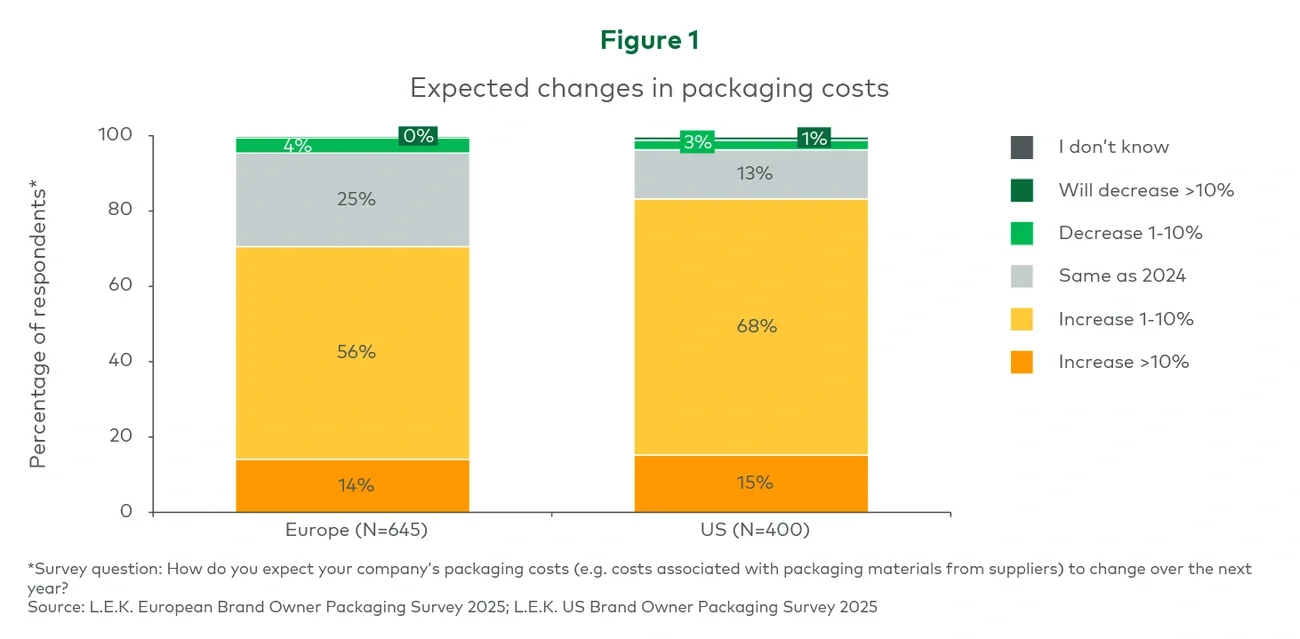
Both European and US brand owners anticipate higher packaging costs in 2025. But while 70% of European brands expect increases, the figure rises to 83% among their US counterparts (see Figure 1). 

Image
Figure 1. Expected changes in packaging costs
Image
Figure 1. Expected changes in packaging costs

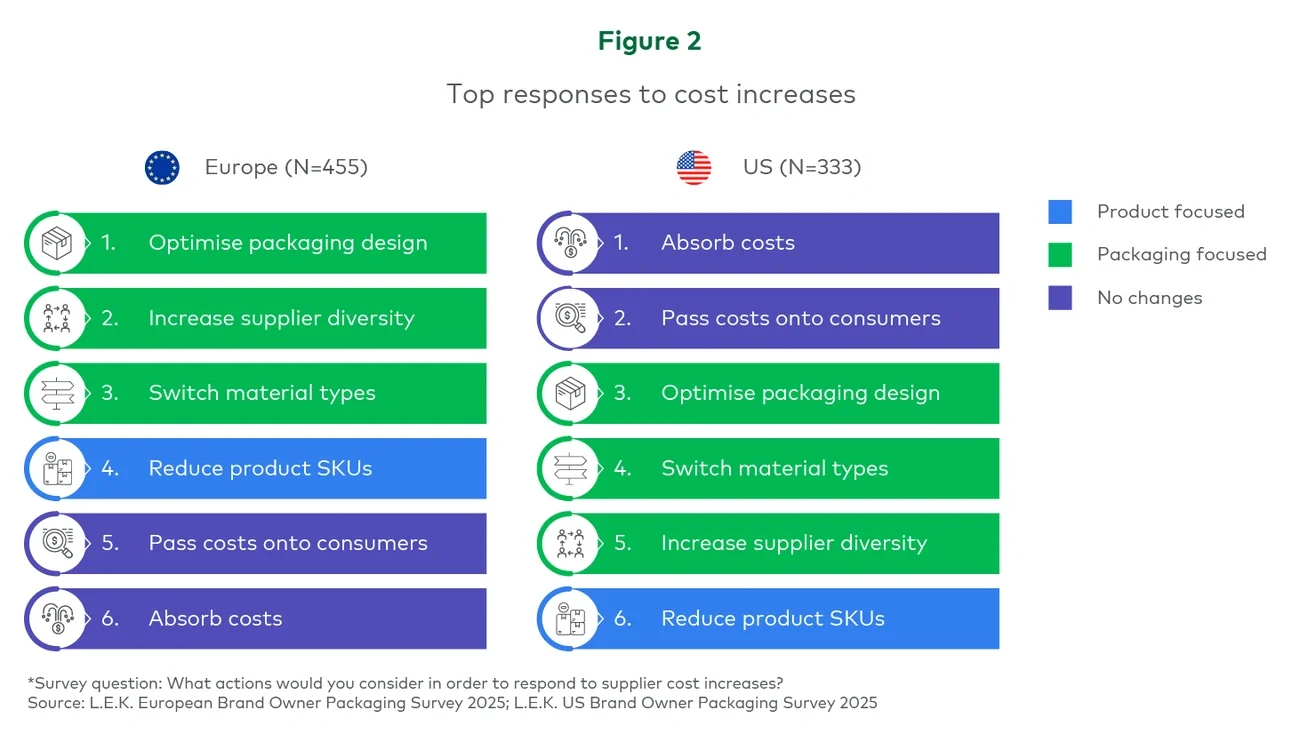
More interesting, however, is how each region plans to respond. In Europe, cost containment is driving a design-led approach: 71% of European brand owners rank packaging optimisation as their top response to cost increases, followed by supplier diversification and material switching​. Absorbing costs or passing them to consumers are distant last resorts (see Figure 2).

Image
Figure 2. Top responses to cost increases
Image
Figure 2. Top responses to cost increases

US brand owners have materially different priorities. Their most common strategies are absorbing costs and passing them along — tactics cited by over half of respondents​. Packaging changes come further down the list, suggesting that structural flexibility may be lower or that pricing power remains stronger in key US categories.

The implication: European brands are more likely to reengineer packaging to offset cost inflation, while US brands are leaning into commercial levers to protect margins. For packaging suppliers, this means Europe may demand more value-engineering capabilities, while US players may focus on a mix between cost absorption and pass through, thereby limiting the ability of packaging manufacturers to differentiate via value-engineering capabilities.

Sustainability: Ambition vs activation

Sustainability is a priority in both regions, but how it’s operationalised differs.  

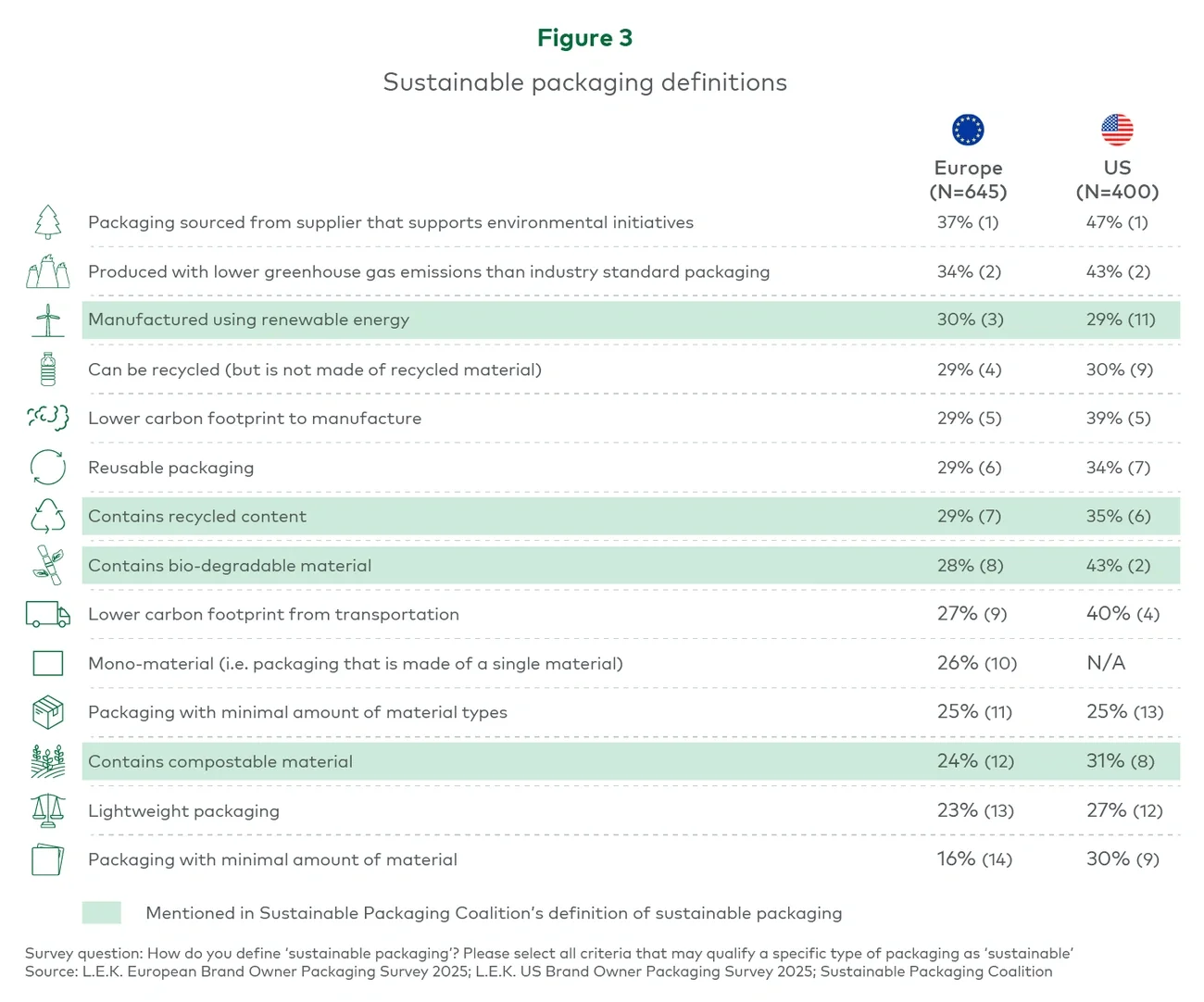
We found that US and European brand owners agree that sourcing packaging from suppliers that support environmental initiatives and packaging produced with lower greenhouse emissions are top definitions of sustainable packaging (see Figure 3).  

However, while European respondents find renewable energy use and recyclability to be key aspects of sustainable packaging, their US counterparts do not. In the US, biodegradability /compostability plays a more important role, as does the concern for low carbon transport footprint given larger distances on average. 

Image
Figure 3. Sustainable packaging definitions
Image
Figure 3. Sustainable packaging definitions

In Europe, regulatory frustration undermines some momentum. Slow or ineffective regulation is cited as the top barrier to sustainable packaging by over a third of respondents, particularly among larger firms​.  

US brands, facing a more fragmented (and limited) regulatory environment, cite fewer policy-related barriers. This is consistent with our observation that pressure for more sustainable packaging is more consumer than regulation led in the US.

Innovation: Parallel intent, divergent focus

On SKU innovation, both sides of the Atlantic are bullish. Roughly 80% of European and US brands expect to increase SKU investment over the next four years​​. But again, focus areas diverge.

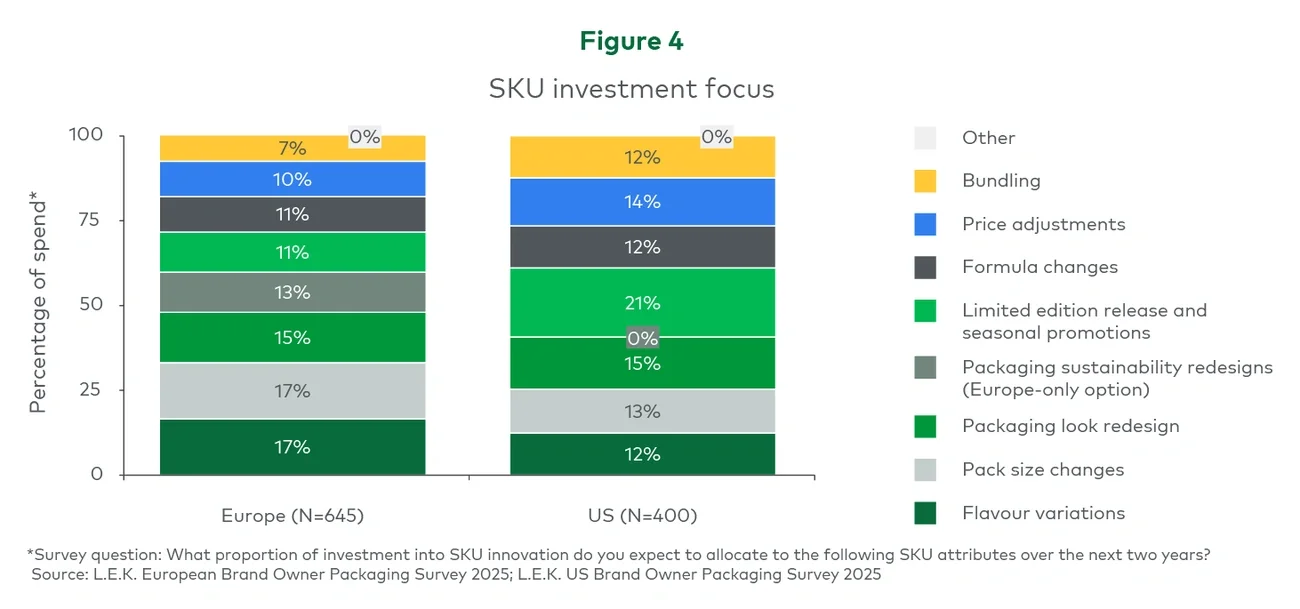
In Europe, investment is centred around flavour variations, pack size changes and packaging look redesigns​. These are agile, consumer-facing levers aligned with segmentation and premiumisation.

In the US, the top area of spend is limited edition and seasonal promotions, followed by price adjustments and bundling. The emphasis is more commercial, less structural — reflecting retail dynamics and promotional intensity​ (see Figure 4). 

Image
Figure 4. SKU investment focus
Image
Figure 4. SKU investment focus

This difference reflects the commercial DNA of each region. European brands are embedding innovation within R&D and design teams, often to meet diverse channel and market needs. US brands, meanwhile, are using packaging innovation as a marketing tool, launching “fewer, bigger, better” SKUs to capture consumer attention and drive core growth​.

Smart packaging: Converging momentum

One area of convergence is smart packaging. In both Europe and the US, features like freshness indicators, QR-enabled content and tamper-evident mechanisms are seeing increased adoption​. US brands are especially focused on consumer engagement and real-time feedback loops, while European brands emphasise shelf life and traceability.

The broader takeaway is clear: smart packaging is becoming a shared toolkit, though the application varies. For packaging partners, this suggests rising demand for embedded technology solutions and partnerships that go beyond materials.

Different routes to the same destination

US and European brand owners are navigating similar macro pressures with different instincts, constraints and levers. Europe leans towards structural design solutions and supplier-led sustainability. The US tends to rely on commercial tactics, market-facing innovation and incremental adaptation.

For packaging suppliers and partners, the message is simple: location matters. Winning in each region requires not just technical capability but understanding differing customer requirements — and how the same problem is solved differently depending on the context.

This concludes our 2025 European Brand Owner Packaging Survey series. If you missed the earlier articles, we encourage you to visit them:

Key insights from the US study are available here.  

Please contact us to find out more.

L.E.K. Consulting is a registered trademark of L.E.K. Consulting. All other products and brands mentioned in this document are properties of their respective owners. © 2025 L.E.K. Consulting

English
Executive Insights

With Tariffs, Everything Has Changed — But Everything Is the Same

June 27, 2025

Key takeaways

In 2025, sweeping tariffs under the Trump administration have disrupted global trade flows and forced U.S. companies to reassess supply chains.

Companies must assess risk exposure, optimize sourcing and simplify products to stay ahead of future shocks.

While the volatility is new, the solution is not — resilient, cost-efficient and end-to-end supply chains are now necessary.

Ultimately, those building flexible and data-driven supply strategies are best positioned to survive amid uncertainty.

While tariffs have long been a tool used by U.S. administrations, the tariffs announced by the Trump administration have been breathtaking in both their size and scope. As a result, everything has changed. These tariffs continue to threaten to materially disrupt supply chains and sourcing arrangements for countless U.S. companies. They demand action, even if no one knows how they will ultimately shake out. Even with the recent promises of reaching deals with China and others, there are pending deal contingencies and tariff rates that will drive the total costs higher.

On the other hand, everything is the same. One of the best ways to mitigate the impact of tariffs is to have a very strong, cost-efficient, end-to-end supply chain. But that’s always been true. Only now it’s not just a good idea; it’s absolutely necessary. U.S. companies need to optimize for each component across the value chain, ensuring they have transparency all the way through their Tier 1, Tier 2 and Tier 3 suppliers. And if they haven’t already, they need to do so immediately.

Those that don’t shore up their supply chain from end to end may survive these tariffs, or they may not. But those that do survive may even thrive.

Swift, steep action and reaction

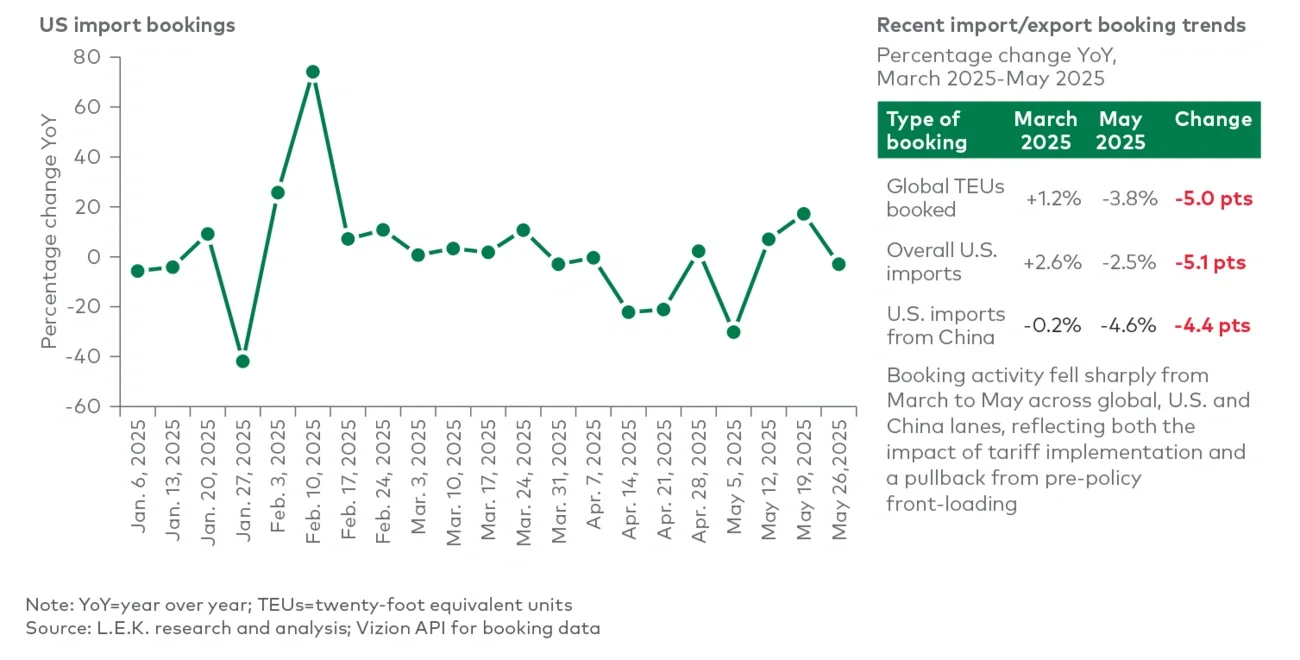
After being initially unveiled at the beginning of April, U.S. tariffs had an immediate impact on U.S. bookings, causing them to fall anywhere from 30% (overall U.S. exports) to 64% (both overall U.S. imports and U.S. imports from China) (see Figure 1).

Figure 1

Recent tariff impact: U.S. import bookings see major contraction

Image
Recent tariff impact: U.S. import bookings see major contraction

Figure 1

Recent tariff impact: U.S. import bookings see major contraction

Image
Recent tariff impact: U.S. import bookings see major contraction

Such swift and volatile change demands equally swift and significant action on the part of U.S. companies, which can be broken down into three steps:  

  1. Assess business impact and risk: Start by assessing the impact of current and potential tariffs on the supply base, the country-level diversification of suppliers and the ongoing risk of having to compete with “surge orders.”
  2. Optimize sourcing and product strategy: Reinforce the continuity of supply through strategic supplier diversification while simplifying product design in order to reduce sourcing complexity and cost exposure.
  3. Build end-to-end supply chain agility: Create an integrated strategy spanning suppliers, logistics and inventory to reduce volatility and ensure continuity across all tiers.

Assess business impact and risk

In order to develop strategies for navigating tariff risk, evaluating any impacts from shifting market/tariff dynamics across revenue, costs and branding is essential.  

Start by conducting a detailed risk exposure analysis. Assess any revenue impacts of unexpected swings in demand and other risks to the company’s top lines, particularly those related to tariff pressures, and build risk mitigation practices into the supplier/manufacturing network. Then break down the cost of goods sold and evaluate the supply base’s country of origin and tariff impact at the category level. Doing so will enable an accurate assessment of the risk involved and pave the way for building resilience into the entire supply base by right-sizing supplier lists, simplifying supply chains and improving planning.

Next, determine the magnitude of tariffs’ impact on the company. Assess the risk of any supply chain volatility, including the risk of having no supply once tariffs are in place, as well as the risk of any shortages of materials or production delays. And develop an understanding of any impact to the business’s cost structure and overall cost base that will take place once tariffs are activated.

Finally, assess any alternatives for the company’s supply chain. Conduct analyses to understand how to minimize the impact of tariffs and optimize the outcome (including minimizing supply risk and cost impact). Be sure to consider both short- and long-term supplier options and develop a dynamic strategy for reacting to any policy changes.

Optimize sourcing and product strategy

Optimizing and simplifying products, processes, capabilities and contracts can help the business get ahead of tariff-related market disruptions before they occur.  

When it comes to product design, align the product portfolio with evolving needs and supplier capabilities. Enhance supply chain agility, reduce complexity and mitigate tariff-related cost impacts by strategically shifting the product portfolio to align with an evolving supplier base. And get supplier feedback that will enable the business to identify cost-effective alternatives, make intelligent decisions and ensure the most effective degree of portfolio alignment possible.  

To optimize sourcing, practice excellence. Build sourcing capabilities, technologies and capacity in ways that will reduce lead times, costs and risks, and incorporate advanced planning and analysis capabilities and tools that will enable the business to stay one step ahead of changing market conditions.

Be sure to optimize contracts in ways that will help the business navigate a rapidly changing environment. That includes negotiating and managing them in ways that will mitigate any disputes, costs and delays, all while keeping tariff-related market volatility top of mind. And in order to build resilience into supplier relationships right from the start, be sure to also introduce price controls, strengthen any performance clauses and make the contracts as flexible as necessary.  

Build end-to-end supply chain agility

To ensure the product flow necessary for the business, build an alternative supplier plan. Identify potential new suppliers, monitor market trends and be sure to understand all the related supply-and-demand dynamics. Regularly evaluate and qualify alternative suppliers and distributors to proactively provide backup options, including maintaining one to two active suppliers as well as one backup supplier that qualifies for major categories. And to increase supply chain flexibility and resilience, reduce the business’s reliance on a limited number of suppliers or a particular geography while looking for additional suppliers in geographies not likely to be impacted by tariffs.

Meanwhile, minimize any impact of tariffs on the business’s existing supply base. Manage price volatility by negotiating with suppliers to share the burden of tariff costs, including renegotiating contracts terms (e.g., adjusting pricing or payment terms). Strategically shift volume to current suppliers located in geographies that are not (or are just minimally) impacted by tariffs. And incorporate hedging techniques to increase flexibility against tariff pressures, including forward or futures contracts with suppliers, scalable purchasing agreements, dual sourcing and flexible logistics networks.  

Don’t wait — move

There are numerous specific supply chain strategies companies can take to mitigate the impact of tariffs, such as shifting procurement to low-tariff or Free Trade Agreement-aligned countries to reduce cost exposure; rebalancing their global production to align with tariff, cost and risk profiles; and redesigning their products to reduce dutiable content without sacrificing quality. Other strategies include using bonded zones to defer or minimize duties on imported goods, adjusting order timing and stock levels to avoid excess duty costs, and using accurate Harmonized System codes to legally reduce tariff exposure (see Figure 2).  

Figure 2

Mitigating tariff impact through supply chain strategies

Image
Mitigating tariff impact through supply chain strategies

Figure 2

Mitigating tariff impact through supply chain strategies

Image
Mitigating tariff impact through supply chain strategies

No one can say for sure how the tariffs will play out in the coming months and years, or exactly how they will impact particular industries much less individual companies. But every U.S. company, regardless of which industry they are in or where else in the world they get their components, will only be able to weather the tariffs if they have a robust and cost-efficient supply chain underpinned by a deep understanding of their exposure to tariffs at every tier.  

For more information, please contact us.

L.E.K. Consulting is a registered trademark of L.E.K. Consulting LLC. All other products and brands mentioned in this document are properties of their respective owners. © 2025 L.E.K. Consulting LLC

Questions about our latest thinking?

English
Executive Insights

Agricultural Growers Turn to Manufacturers for Crop Inputs, Expect Essentials Spending To Stay Unchanged

June 27, 2025

Key takeaways

Responding to price pressure, growers are increasingly shifting toward buying inputs directly from manufacturers.

As a result, co-ops and small retailers are seeing their share shrink as more growers change sourcing habits. 

Large farms increasingly drive the shift by focusing on fertilizers and crop chemicals.

Ultimately, manufacturers and channels are rethinking sales strategies to adapt to evolving grower behavior. 

Agricultural growers have a variety of ways to source their inputs, including from established retailers, co-ops and distributors, as well as directly from manufacturers. But according to a survey L.E.K. Consulting conducted in February 2025, they are increasingly buying select crop inputs directly from manufacturers as they look to find the best prices available for key inputs. Many also report that they expect to continue doing so going forward.

Those are just a few of the key findings of our survey, which comprised more than 200 U.S. growers across a broad range of demographics and farm characteristics. 

Survey respondent distribution:

Category

Subcategory

Percentage

Region

Northeast

8%

West

20%

South

28%

Midwest

48%

Crop type

Specialty crops

20%

Row crops*

80%

Farm size

1,000-2,000 acres

34%

2,000-5,000 acres

34%

5,000+ acres

32%

*Larger farms tend to skew slightly more toward row crop production.

As our findings make clear, the market for crop inputs is changing, with repercussions for channel players on the one hand and input manufacturers on the other. In order to stay competitive, both should be evaluating how they go to market and making any necessary adjustments.

Growers are increasingly buying direct

A small but significant shift appears to be taking hold whereby an increasing share of growers are buying their seeds, fertilizers and crop chemicals directly from manufacturers. Grower responses suggest that number rose by approximately 2 percentage points from 2022 to 2024, to 21% from 19% for seeds and to 20% from 18% for fertilizers, and it’s expected to rise even further through 2026, to 22% for both (see Figures 1a and 1b). 

Figure 1a

Percentage of crop inputs sourced for all farm sizes, by crop input type and distribution channel (2022, 2024, 2026F)

Image
Percentage of crop inputs sourced for all farm sizes, by crop input type and distribution channel (2022, 2024, 2026F)

Figure 1a

Percentage of crop inputs sourced for all farm sizes, by crop input type and distribution channel (2022, 2024, 2026F)

Image
Percentage of crop inputs sourced for all farm sizes, by crop input type and distribution channel (2022, 2024, 2026F)

Figure 1b

Percentage of crop inputs sourced for all farm sizes, by crop input type and distribution channel (2022, 2024, 2026F)

Image
Percentage of crop inputs sourced for all farm sizes, by crop input type and distribution channel (2022, 2024, 2026F)

Figure 1b

Percentage of crop inputs sourced for all farm sizes, by crop input type and distribution channel (2022, 2024, 2026F)

Image
Percentage of crop inputs sourced for all farm sizes, by crop input type and distribution channel (2022, 2024, 2026F)

This shift to buying directly is being led by specialty crop growers (at about 31% versus around 19% of row crop growers). And while for the most part large/national retail chains are expected to hold on to their market share, co-ops and small/local retailers are already on track to lose share, of roughly 2 and 1 percentage points, respectively, from 2024 to 2026.

It’s also taking place across all grower age groups and at farms of all sizes, but predominantly larger ones (i.e., 5,000+ acres). Growers with more than 5,000 acres have seen a moderate uptick in direct-from-manufacturer sourcing for all products, but especially for fertilizers and crop protection chemicals and largely at the expense of local retailers/distributors and co-ops (see Figure 2). 

Figure 2a

5,000+ acre farms’ percentage of crop inputs sourced, by crop input type and distribution channel (2022, 2024, 2026F)

Image
5,000+ acre farms’ percentage of crop inputs sourced, by crop input type and distribution channel (2022, 2024, 2026F)

Figure 2a

5,000+ acre farms’ percentage of crop inputs sourced, by crop input type and distribution channel (2022, 2024, 2026F)

Image
5,000+ acre farms’ percentage of crop inputs sourced, by crop input type and distribution channel (2022, 2024, 2026F)

Figure 2b

5,000+ acre farms’ percentage of crop inputs sourced, by crop input type and distribution channel (2022, 2024, 2026F)

Image
5,000+ acre farms’ percentage of crop inputs sourced, by crop input type and distribution channel (2022, 2024, 2026F)

Figure 2b

5,000+ acre farms’ percentage of crop inputs sourced, by crop input type and distribution channel (2022, 2024, 2026F)

Image
5,000+ acre farms’ percentage of crop inputs sourced, by crop input type and distribution channel (2022, 2024, 2026F)

Figure 2c

5,000+ acre farms’ percentage of crop inputs sourced, by crop input type and distribution channel (2022, 24, 26F)

Image
5,000+ acre farms’ percentage of crop inputs sourced, by crop input type and distribution channel (2022, 24, 26F)

Figure 2c

5,000+ acre farms’ percentage of crop inputs sourced, by crop input type and distribution channel (2022, 24, 26F)

Image
5,000+ acre farms’ percentage of crop inputs sourced, by crop input type and distribution channel (2022, 24, 26F)

Growers choose channels — and purchases — primarily based on price

When it comes to choosing among channels, according to our survey, growers choose the channel with the lowest price (approximately 28% of respondents), followed by the one with the best service quality (around 21%) and the one with which they have a better relationship (about 20%).

Among grower types, specialty and row crop growers place particular importance on price, putting it as their top consideration at roughly 29% and approximately 26%, respectively. And that’s consistent across farm size; smaller growers (i.e., under 5,000 acres) place a similar emphasis on pricing as those with larger-acreage farms.

Indeed, all growers say they will most likely scale back on discretionary purchases if crop prices remain low. Topping that list of discretionary purchases are equipment upgrades and/or maintenance (about 22% of survey respondents), followed by soil enhancers (around 21%).

But while growers may moderately reduce spend on crop protection, labor and micronutrients, they are unlikely to change what they spend on essential, nondiscretionary inputs such as seeds and fertilizers.

The grower landscape is shifting

As our survey reveals, smaller channel players or co-ops may be at greater risk of losing share with nonmember customers. For input manufacturers, these findings suggest the potential need to reevaluate go-to-market strategies to adapt to shifting grower preferences.

Meanwhile, in a bid to save money, agricultural growers continue to shift from branded to generic crop protection products, while lower costs plus the promise of better soil health have them increasingly choosing biopesticides, biostimulants and biofertilizers. Our companion survey piece breaks it all down.

For more information, please contact us.

L.E.K. Consulting is a registered trademark of L.E.K. Consulting LLC. All other products and brands mentioned in this document are properties of their respective owners. © 2025 L.E.K. Consulting LLC 

Questions about our latest thinking?

English
Subscribe to