Image
report thumbnail
Special Report

Private Capital in Law Firms: Strategic Entry via ABSs

July 30, 2025

Private capital is gaining ground in legal services.

New Alternative Business Structure (ABS) frameworks in states like Arizona and Utah now allow nonlawyers to own equity in law firms, creating a pathway for direct investment in a sector long closed to outside capital. Early interest is focused on areas like personal injury, mass tort and estate planning, where high case volumes and limited tech adoption create room for transformation.

ABS models echo trends seen in healthcare and accounting, offering a blueprint for scaling through consolidation and operational upgrades. But risks (regulatory, reputational and structural) require careful navigation.

Download the full report to explore how the legal model is being redefined.

L.E.K. Consulting is a registered trademark of L.E.K. Consulting LLC. All other products and brands mentioned in this document are properties of their respective owners. © 2025 L.E.K. Consulting LLC

English

Physician Practice Consolidation in US Multi-Site Healthcare: Still Early Innings?

July 24, 2025

The current state of physician practice consolidation

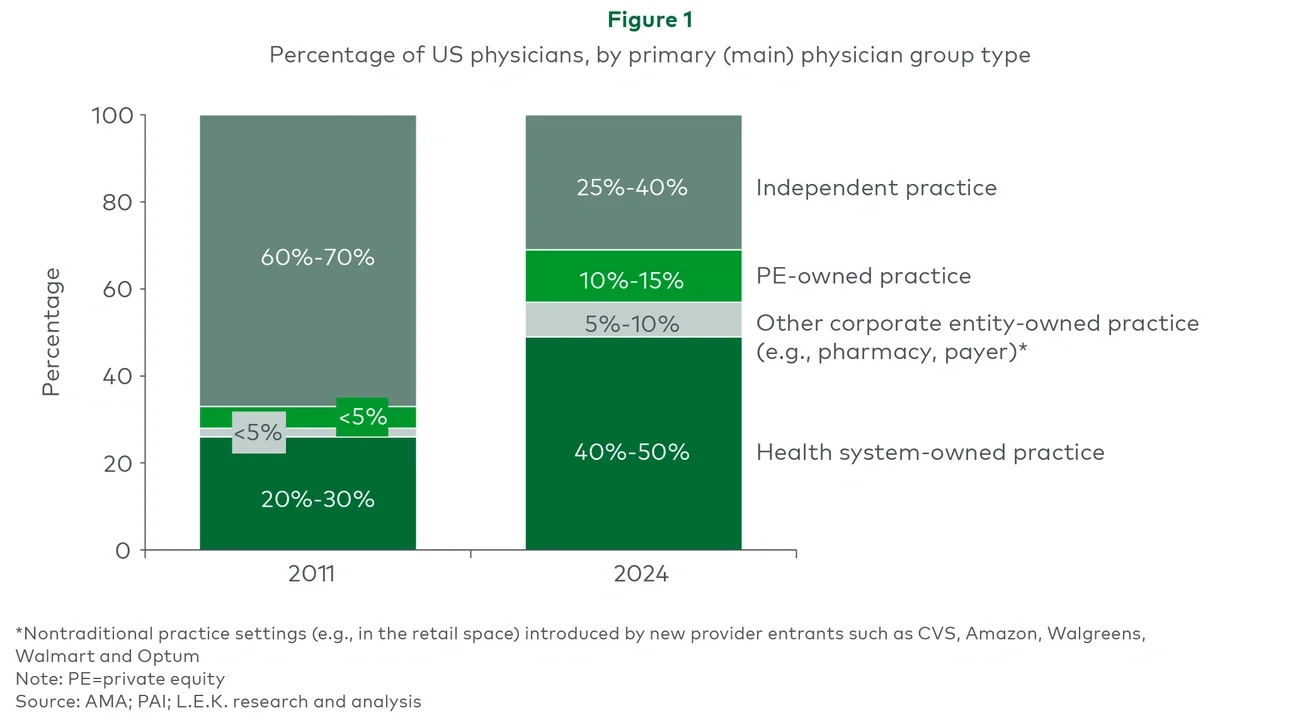
Over the past 15 years, the U.S. physician practice landscape has transformed. In 2011, more than 60% of physicians practiced in small, independent groups. In 2024, more than 60% of physicians were employed by a health system or a private equity (PE)- or corporate-owned group (see Figure 1). 

Image
Figure 1: Percentage of US physicians, by primary (main) physician group type
Image
Figure 1: Percentage of US physicians, by primary (main) physician group type

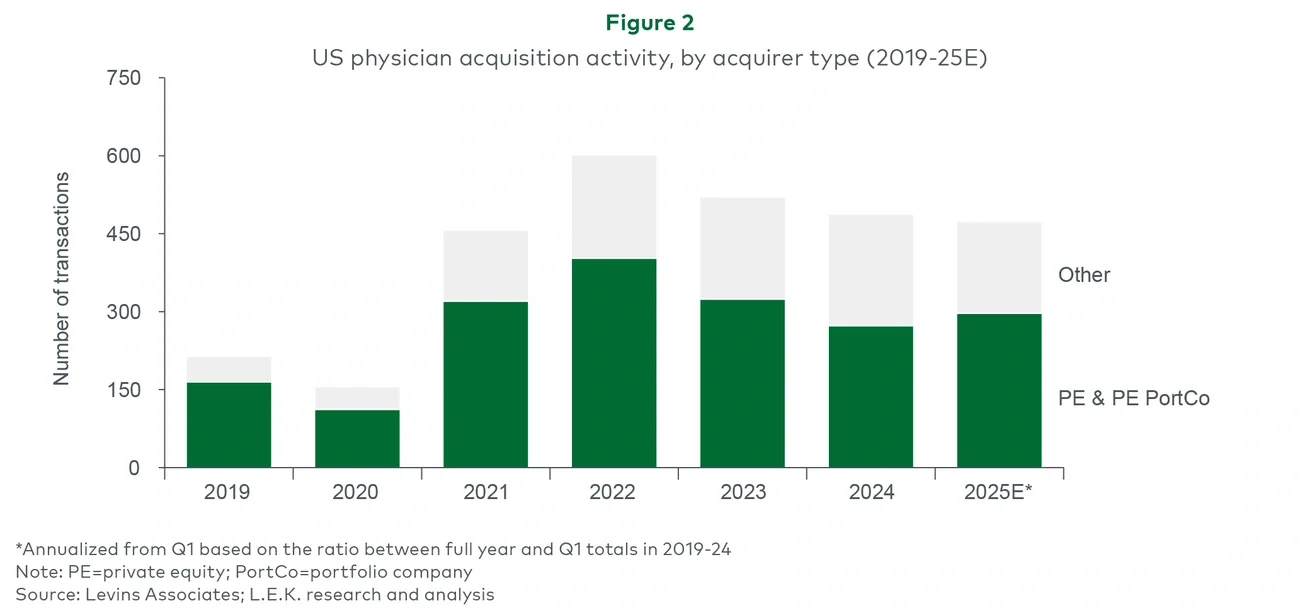
Acquisitions by PE-backed PPM platforms and other strategic acquirers of multi-site providers (e.g., insurers, distributors) have accelerated this trend. From 2019 to 2024, there were more than 2,400 physician group transactions in the U.S. (see Figure 2). 

Image
Figure 2 US physician acquisition activity, by acquirer type (2019-25E)
Image
Figure 2 US physician acquisition activity, by acquirer type (2019-25E)

Specialty-level PPM trends and headroom

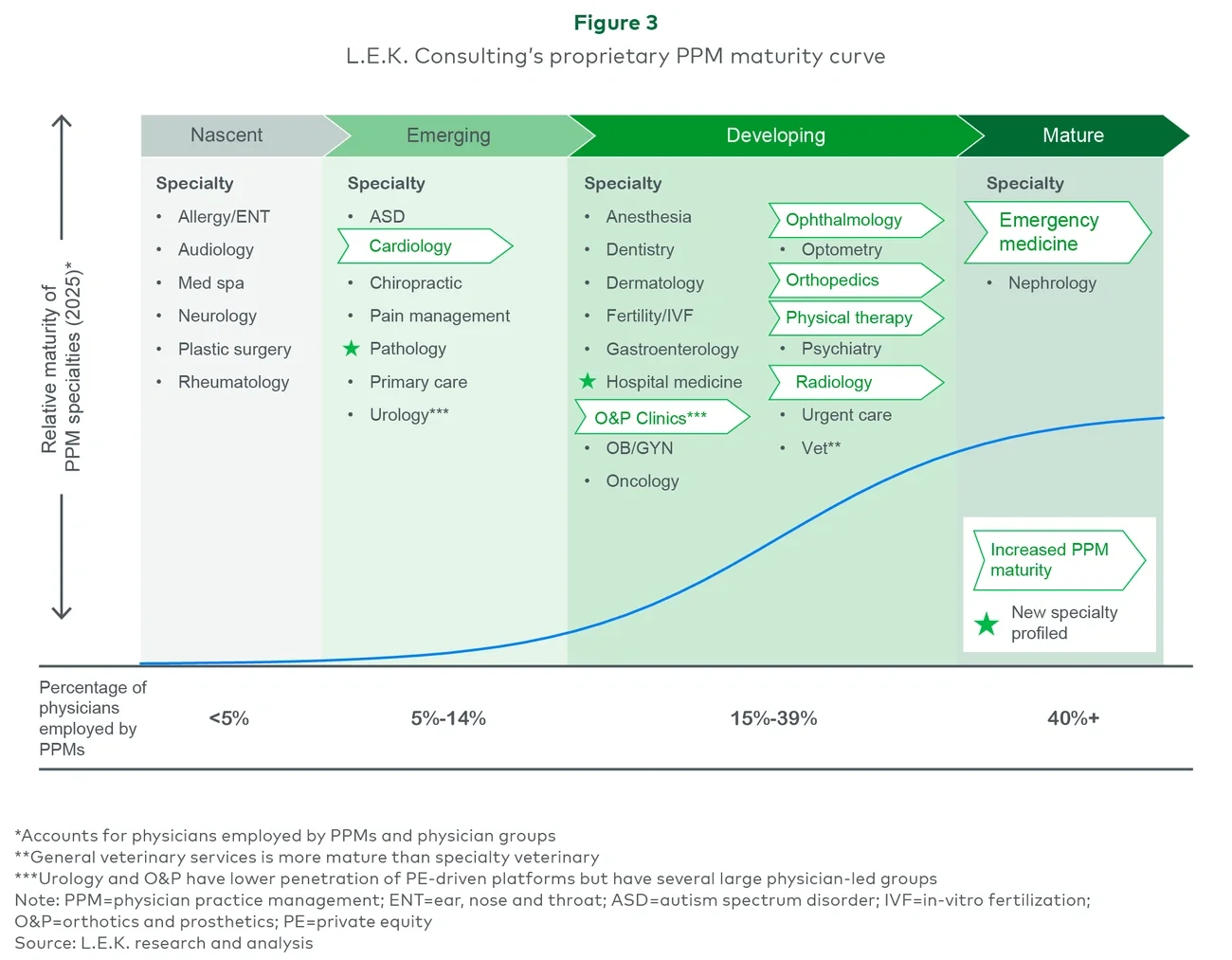
Given significant PPM deal activity over the past four years, L.E.K. Consulting has updated its proprietary PPM maturity curve (see Figure 3). No specialties have reverted to a lower “maturity” category, but several have seen significant activity in recent years and moved up:

  • Nascent to emerging: Cardiology has seen accelerated rates of consolidation, with an increase from one PE-owned group with seven locations in 2019 to 50 PE-owned groups with 320 locations in 2023.
  • Emerging to developing: Ophthalmology, orthopedics, physical therapy, radiology, orthotics and prosthetics clinics have all experienced continued practice consolidation and growth in the number of physicians employed by large, scaled groups.
  • Developing to mature: Emergency medicine is the only specialty to move to the mature category, joining nephrology. Emergency medicine is increasingly concentrated with large groups like Team Health, Sound Physicians and SCP Health.

We have also added two new specialties to our PPM curve analysis, denoted with a green star: pathology (emerging) and hospital medicine (developing).

Significant consolidation opportunities remain across specialties. In 13 of 32 specialties we tracked, less than 15% of physicians are employed by a PPM or large group platform. Of the remaining specialties, 17 are still developing and present additional roll-up opportunities for investors, health systems and other strategic buyers. 

Image
Figure 3: L.E.K. Consulting’s proprietary PPM maturity curve
Image
Figure 3: L.E.K. Consulting’s proprietary PPM maturity curve

Looking ahead: consolidation endures

We believe physician practice consolidation remains a long-term, secular trend in U.S. healthcare. The advantages of scale are clear. PE investors and strategic consolidators will continue to find opportunities as one of America’s last great cottage industries matures toward sophisticated, integrated models.

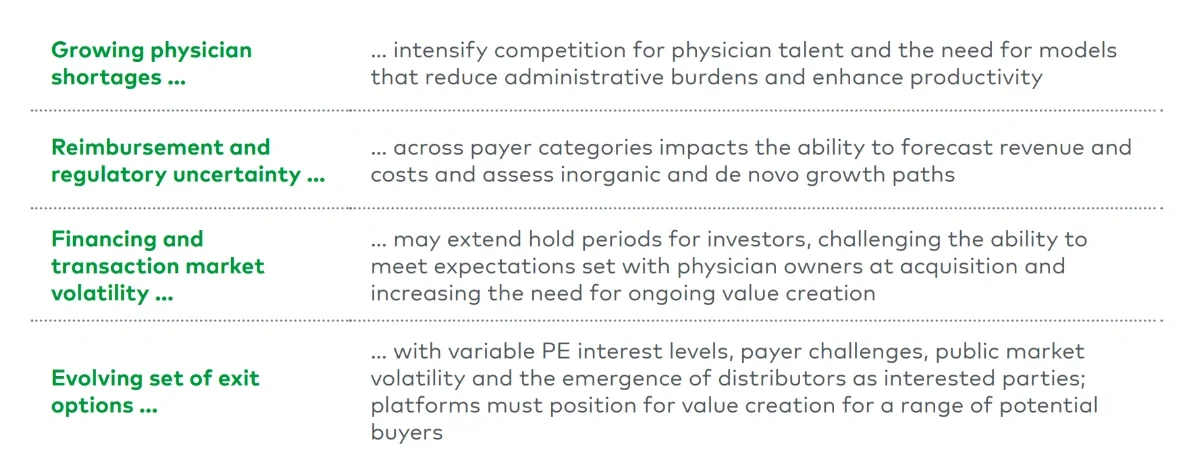
To succeed during the next chapter of consolidation, however, U.S. PPM platforms, investors and strategic consolidators will need to navigate an evolving set of trends and challenges: 

Table 1

Image
Table

Table 1

Image
Table

Strategic implications and imperatives

The next wave of value requires corporations and investors to combine specialty-specific expertise, value creation initiatives and data-driven market selection.

Key takeaways for PPM/MSO platforms and investors

  • Ensure the model creates ongoing value for member physicians. With increased expectations and extended and uncertain hold periods, it is critical that PPM/MSO platforms create real value for member physicians, especially between transactions.
  • Aim where white space and value creation potential combine. Identify practices in nascent, emerging and developing PPM specialties that have white space to pursue and would clearly benefit from value creation levers that an MSO can provide (e.g., ancillary revenue stream capture).
  • Be mindful of roll-up challenges in less mature specialties. Although many specialties have low PPM penetration, capturing white space in some requires overcoming real structural hurdles (e.g., limited value of a conventional MSO).
  • Use data to de-risk growth moves. Target platform/MSO growth with geographic precision — e.g., where share of independent/small practices remains high, competition is limited and payers favor scale. Retain expansion flexibility (tuck-ins, de novos).

Key takeaways for hospitals and health systems

  • Modernize the menu of physician relationship models. Direct physician employment is one option, but health systems can develop joint venture frameworks, MSO models and other structures to increase alignment with PPMs and independents where these models increase chances of success.
  • Ensure physician value proposition remains competitive. As scaled platforms enter a system’s markets and grow, expectations and opportunities to differentiate will evolve, and so should the system’s physician group models.
  • Take a data-driven approach to applying the right model by market and specialty. Competitive dynamics, value to the system and physician needs will differ significantly by market and specialty. Data and effective analysis can identify the right model for each market situation.
  • Use offense as the best defense to win where ownership is key. Identify must-win situations and apply the full toolkit — acquisition, ASC and other ancillary co-ownership with physicians, etc. — to secure the capacity that the system and its patients need.
  • Partner deliberately where counterparties are better placed. Partner with scaled platforms that can better meet the system’s needs. In doing so, seek opportunities to align incentives and co-create enduring value for physicians and communities.

How L.E.K. delivers results

L.E.K. has decades of provider experience across a range of specialties, including engagements with high-performing PPMs and health systems. We build on this knowledge base to deliver a full range of services to our clients, including transaction support (e.g., buy- and sell-side due diligence) and value creation services.  

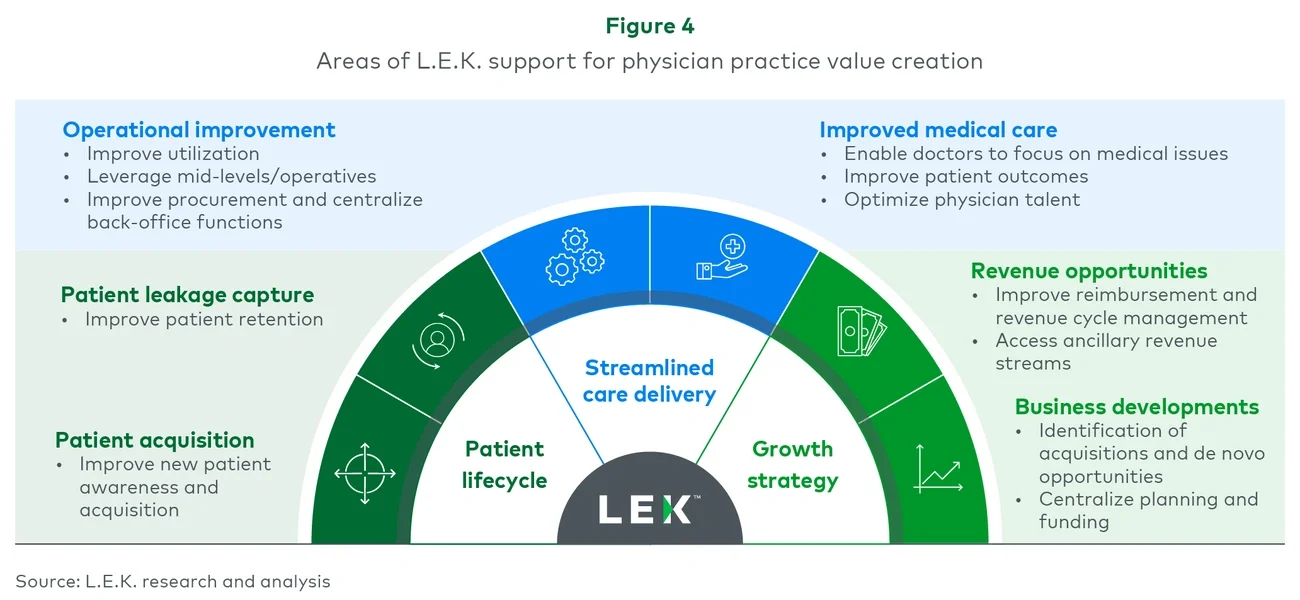
Value creation is critical for providers to improve profitability, grow their business and drive return on investment (ROI). We help optimize the patient life cycle, streamline care delivery/ operations and pursue growth initiatives (see Figure 4). 

Image
Figure 4: Areas of L.E.K. support for physician practice value creation
Image
Figure 4: Areas of L.E.K. support for physician practice value creation
Case study

Our team of experts collaborated with a leading multispecialty PPM organization to develop organic and inorganic strategies, optimize operations, refine the organizational structure and institute a more rigorous and disciplined acquisition process. The client grew profitably, became a publicly traded company and was acquired by a strategic buyer at an attractive valuation.

Seeking transaction support or ready to accelerate value creation for your business? Reach out to L.E.K.’s Healthcare Services practice for additional PPM insights or to discuss how we can unlock growth and efficiencies for your organization and increase ROI.

Contact us for more information. 

L.E.K. Consulting is a registered trademark of L.E.K. Consulting LLC. All other products and brands mentioned in this document are properties of their respective owners. © 2025 L.E.K. Consulting LLC 

English
Executive Insights

How AI Is Redefining SaaS Metrics and Forecasting

July 24, 2025

Key takeaways

Generative AI is accelerating the shift to usage-based pricing, making traditional SaaS metrics like ARR and NRR harder to interpret as revenue depends on real-time product usage instead of up-front contracts.

New forecasting metrics are gaining importance, including time to usage, usage ramp rate and volatility. These help companies better track adoption and improve revenue predictability.

ARR is being segmented into new metrics such as CARR, UARR and AI ARR to reflect different types of recurring revenue and clarify how AI features contribute to growth. 

Scaling usage-based pricing requires coordination across teams, with updates to compensation plans, billing systems and performance tracking to support real-time value delivery. 

Usage-based pricing is quickly becoming the standard for monetizing generative artificial intelligence (GenAI) features, promising stronger alignment between product value and revenue. But this shift introduces new complexity.  

With pricing tied to real-time usage rather than up-front contracts, traditional software as a service (SaaS) metrics like annual recurring revenue (ARR) and net revenue retention (NRR) become harder to rely on. Revenue no longer locks in at the point of sale. It unfolds over time, shaped by how and when customers engage with the product.

In Part 1 of this series, we looked at how GenAI is disrupting the fundamentals of SaaS pricing. Part 2 explored how companies are packaging AI features to drive adoption and monetization. In Part 3, we turn to the operational impact: how usage-based pricing is reshaping SaaS metrics, forecasting and internal alignment.

Why ARR is no longer enough

In seat-based pricing models, ARR served as the backbone of SaaS performance tracking. With fixed contracts, revenue was easy to recognize and forecasting followed a relatively stable rhythm.

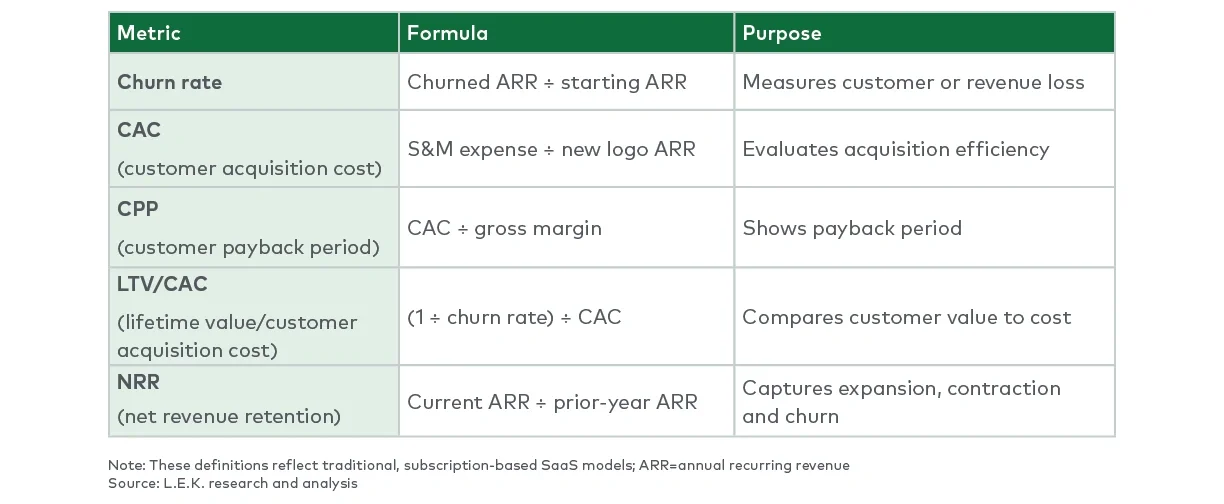
To understand why usage-based pricing introduces such complexity, it helps to revisit the standard metrics that have defined SaaS performance (see Figure 1).

Figure 1

Metrics defining SaaS performance 

Image
Metrics defining SaaS performance

Figure 1

Metrics defining SaaS performance 

Image
Metrics defining SaaS performance

Usage-based pricing disrupts this structure. ARR is no longer set at the time of contract and instead unfolds based on how and when customers use the product. This variability is especially pronounced with GenAI, where usage patterns can spike or drop with little warning.

As usage-based models scale, they reveal the limits of traditional SaaS metrics. Churn, customer acquisition cost (CAC), customer payback period (CPP), lifetime value/CAC (LTV/CAC) and net revenue retention (NRR) all rely on stable and predictable revenue. When ARR fluctuates, these metrics lose precision. Forecasting becomes harder. Churn and CAC are less reliable. NRR is often inflated in the early months of a new customer ramp.

As covered in Part 1, GenAI is accelerating this shift. It challenges legacy assumptions and pushes companies to rethink how they define, measure and project revenue.

How ARR is evolving

In response to these limitations, ARR itself is evolving. It has become a catchall label for everything from fixed subscriptions to variable usage and AI-driven pricing. As companies adapt the definition to reflect different combinations of committed, usage-based and forecasted revenue, the term has become more useful but also less consistent.

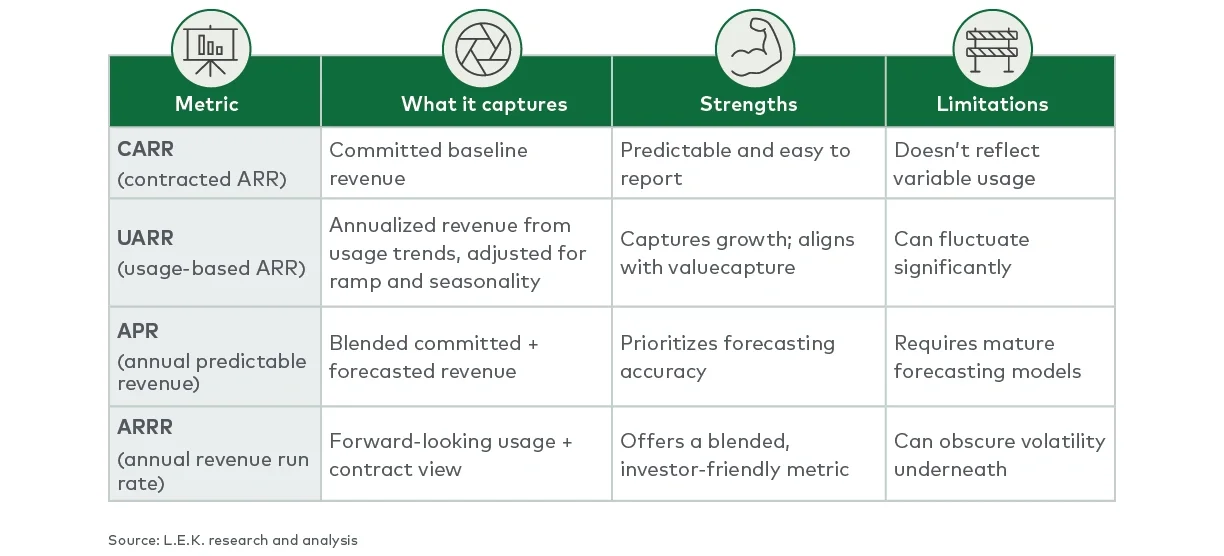
To adapt, many companies now separate baseline and variable revenue. Committed revenue is often defined as contracted ARR (CARR), where traditional metrics still apply. For variable revenue, some annualize recent usage, while others adopt usage-based ARR (UARR) to reflect account-level ramp patterns, especially when usage takes six to 12 months to stabilize.

A growing number of SaaS companies now break ARR into multiple components. Some distinguish between contracted and variable revenue, while others use blended metrics that reflect real usage patterns. We have included the most common of these evolving definitions (see Figure 2). 

Figure 2

ARR metrics

Image
ARR metrics

Figure 2

ARR metrics

Image
ARR metrics

For many SaaS companies, AI-driven features already account for a growing share of revenue. In some cases, AI makes up as much as 50% of total subscription revenue. To give investors and internal teams better visibility, some companies are introducing a new metric: AI ARR. This helps track more clearly how usage of GenAI features is contributing to recurring revenue growth.

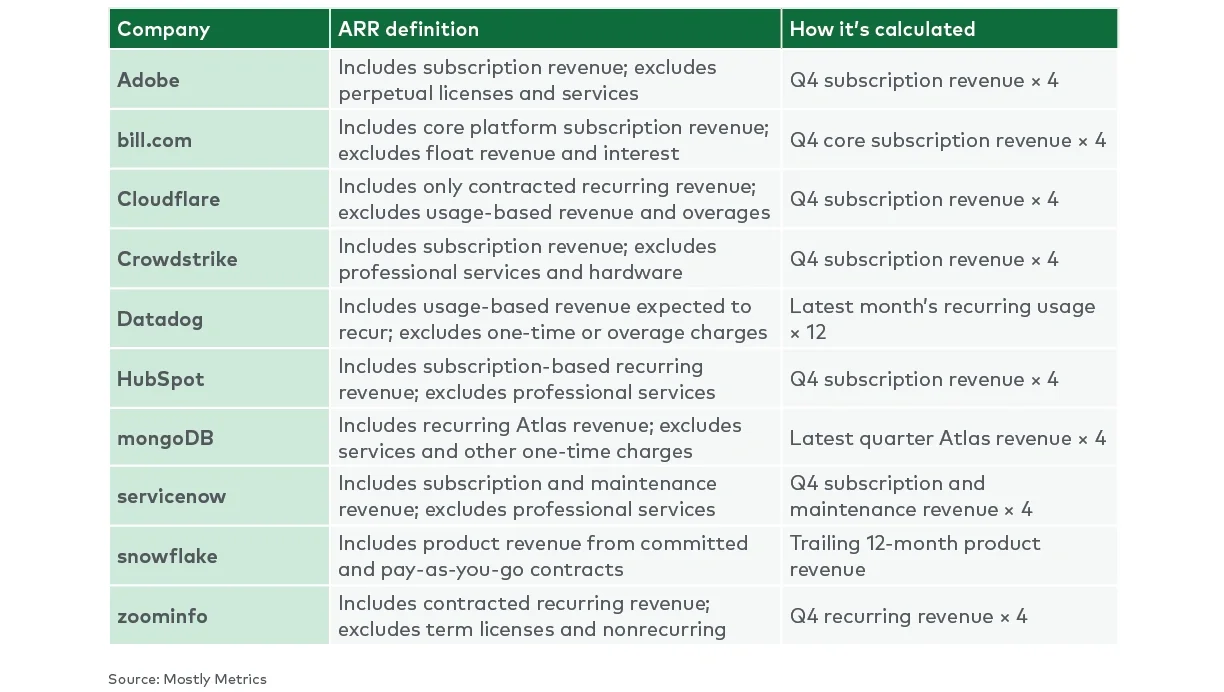
Public SaaS companies are already applying different interpretations of ARR (see Figure 3). 

Figure 3

Public SaaS companies use a wide range of definitions for ARR

Image
Public SaaS companies use a wide range of definitions for ARR

Figure 3

Public SaaS companies use a wide range of definitions for ARR

Image
Public SaaS companies use a wide range of definitions for ARR

These shifts signal a broader trend. ARR is still the headline number, but its meaning is changing. Understanding what sits underneath the label is now just as important as the number itself.

Beyond ARR: The new metrics supporting usage-based growth

Even with new definitions like CARR and UARR, headline metrics rarely tell the full story. To forecast growth more reliably, companies need granular, behavior-based indicators that show how customers ramp, expand and stabilize over time. These include:

  • Realized versus predicted revenue: A feedback loop for forecasting accuracy
  • Time to usage: Onboarding speed as a proxy for time to revenue
  • Usage ramp rate: Consumption growth during the first six to 12 months
  • Usage volatility: Stability and predictability after ramp-up
  • Cohort and customer-level tracking: Segmenting usage and retention trends to improve forecasting precision

These metrics help companies navigate usage-led pricing and give investors clearer visibility into AI-driven growth. To support this shift, many teams are rethinking how they use traditional revenue frameworks. NRR and GRR still matter, but both can mislead: NRR often appears inflated during ramp periods, while GRR understates growth by excluding expansion. Some investors view NRR below 90% as a red flag, prompting deeper scrutiny of ARR. That makes it even more important to pair headline metrics with usage-based indicators and customer-level forecasting.

Together, these new metrics reflect a more dynamic way of measuring performance that emphasizes not just what is sold, but also how customers grow and engage over time.

The cross-functional impact

Adopting new metrics is just the beginning. Turning usage-based pricing into a scalable, companywide strategy requires deep coordination across every function. This includes how deals are structured, how revenue is tracked and how performance is evaluated.

  • Sales teams need compensation plans that reward consumption and long-term growth, not just up-front deal size
  • Customer service and product must monitor and drive usage milestones that lead to expansion
  • Finance and operations are reworking billing systems, revenue recognition processes and cash flow models
  • Leadership and investors are looking for new ways to evaluate performance, especially during ramp periods when metrics like NRR can appear inflated

Monte Carlo, a data and AI observability company, took this challenge head-on. Their team described AI-native usage as “spiky,” with unpredictable patterns that made traditional monthly forecasts unreliable. In response, they shifted to daily revenue tracking. Pricing ownership moved to product, and go-to-market roles were rebuilt to better align with real-time customer behavior. Daily revenue became the shared performance metric across teams and board reporting, creating tighter alignment between product value and customer outcomes.

The rise of enablers

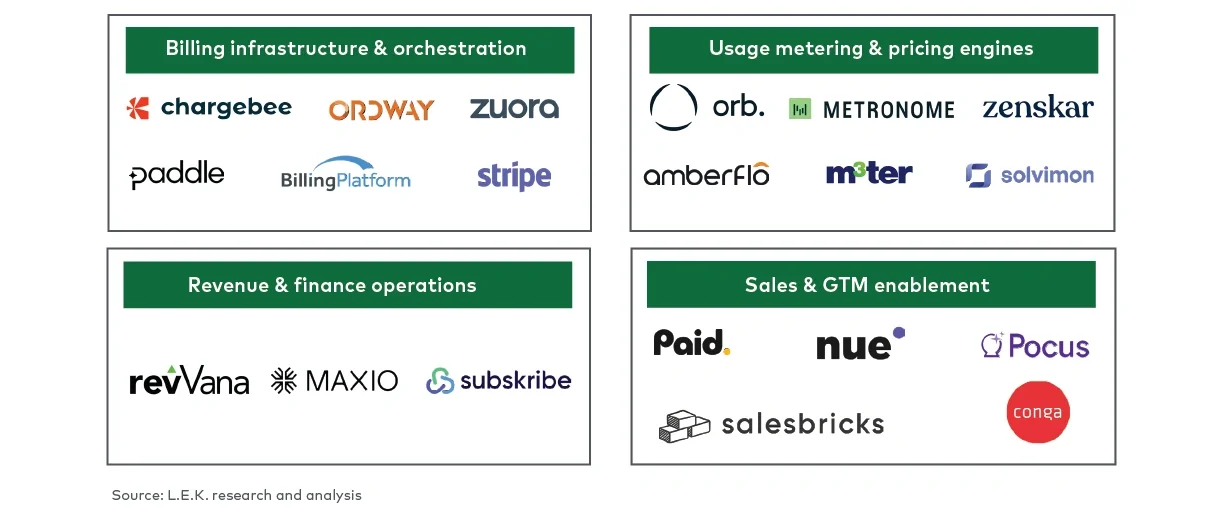
To support transformations like this, a new category of enablement tools has emerged. These platforms help SaaS companies meter usage, automate billing, recognize revenue and manage flexible pricing models (see Figure 4). 

Figure 4

New tools are emerging to help SaaS companies implement, manage and scale usage-based pricing models 

Image
New tools are emerging to help SaaS companies implement, manage and scale usage-based pricing models

Figure 4

New tools are emerging to help SaaS companies implement, manage and scale usage-based pricing models 

Image
New tools are emerging to help SaaS companies implement, manage and scale usage-based pricing models

Vendors like Metronome, Maxio and Orb are enabling more flexible usage tracking and billing infrastructure. Others like Pocus and Subskribe are helping go-to-market teams align pricing with product adoption and customer success. These tools are quickly becoming essential infrastructure for AI-native and usage-led SaaS companies.

The path forward

AI is accelerating the shift to flexible, performance-based pricing. The bigger challenge now is scaling it across sales, product and finance in a way that sustains growth.

As usage-based pricing becomes the norm, SaaS companies need to adapt not just their pricing strategies, but also the systems they use to measure and manage performance. Real-time value delivery demands real-time visibility into revenue.

In Part 4 of this series, we’ll explore how these shifts are influencing SaaS company valuations and reshaping how investors assess growth, predictability and profitability in an AI-powered world.

L.E.K. Consulting works with leading SaaS companies to adapt pricing strategies, build more resilient forecasting models and align operations with usage-based revenue. If your team is navigating this transition, we can help. Contact us to learn more. 

L.E.K. Consulting is a registered trademark of L.E.K. Consulting LLC. All other products and brands mentioned in this document are properties of their respective owners. © 2025 L.E.K. Consulting LLC

Questions about our latest thinking?

English
Image
report thumbnail

On the Cusp of a Cure: Is Asia Pacific Ready for the Precision Era? (China)

July 22, 2025

The Precision Era of medicine is arriving in Asia Pacific, driven by a critical mass of innovative therapies that will redefine treatment, attract investment and improve lives. Powered by advances in diagnostics, AI and genomic technologies, precision therapies offer curative potential for diseases once deemed untreatable, ushering in a new standard of care across oncology, rare genetic disorders and beyond.

This white paper series explores Asia Pacific’s readiness for the Precision Era — the current transformative period where generically prescribed and regularly administered treatments are increasingly giving way to potentially curative therapies tailored to individuals and their disease.  

Drawing on research across more than 1,000 clinical trials across four novel technologies and four markets, we assess the clinical, economic and social benefits of precision therapies, identify systemic barriers to precision therapy adoption, provide recommendations for improvement, and assess the value of widespread adoption across Australia, China, Japan and Korea. 

The Precision Era marks a significant turning point for China, as new, innovative therapies drive investment, improve livelihoods and workforce participation, support better patient outcomes, and stronger health systems. But regulation, knowledge and infrastructure must keep up for China to unlock the full potential of this era.

The ‘On the Cusp of a Cure’ white paper series was supported by an advisory committee of 16 pre-eminent regional experts in precision medicine, economic and health policy, and patient experience across Australia, China, Japan and Korea. It was also sponsored by Johnson & Johnson.  

Download the PDF to discover how precision therapies can drive life-changing outcomes and sustainable growth.

Editor’s Note: For more insights, please explore the country-focused white papers in the ‘On the Cusp of a Cure: Is Asia Pacific Ready for the Precision Era?’ series.

L.E.K. Consulting is a registered trademark of L.E.K. Consulting LLC. All other products and brands mentioned in this document are properties of their respective owners. © 2025 L.E.K. Consulting LLC

English
Executive Insights

The Next Frontier in Professional Cyber Services: Operational Technology Security

July 17, 2025

Key takeaways

The convergence of operational technology (OT) and information technology (IT) is heightening cyber risk across critical infrastructure sectors, bringing OT cybersecurity to the forefront of board-level priorities.

Clear differentiation hinges on sector fluency and regulatory depth, particularly in verticals with complex compliance environments.

Governance, risk and compliance stands out as the most attractive segment, supported by mandatory spend, predictable revenue streams and high outsourcing momentum. 

Winning players combine deep OT expertise with tailored, scalable solutions that translate cyber risks into business outcomes. 

The rising need for OT cybersecurity

The convergence of operational technology (OT) and information technology (IT) has dramatically increased cybersecurity risks in critical infrastructure sectors such as energy, transportation, utilities, telecommunications and manufacturing. Once isolated from external networks, OT systems are now increasingly connected, exposing them to cyber threats — including power outages, production shutdowns, supply chain disruptions and safety hazards — that could have catastrophic consequences.

OT security refers to the protection of industrial control systems, supervisory control and data acquisition (SCADA) systems and other critical infrastructure technologies from cyber threats. Unlike traditional IT security, which safeguards data and networks, OT security focuses on securing physical processes and machinery in the aforementioned sectors.

Several factors are accelerating the demand for OT-focused cybersecurity services, making it an attractive investment opportunity:

  • IT/OT convergence: As industrial systems integrate with corporate IT networks and cloud solutions, they inherit the vulnerabilities of digital networks, demanding sophisticated security measures.
  • Regulatory pressure and compliance requirements: Governments worldwide are tightening cybersecurity mandates for critical infrastructure — such as through the NIS2 Directive (EU), EASA cybersecurity standards in aviation (EU) and NIST-CSF (US) — driving mandatory investments in cybersecurity services.
  • Rising cyber threats: The increase in geopolitical cyber threats has elevated cybersecurity as a boardroom priority. Germany’s recent €500 billion infrastructure spending announcement directly amplifies the demand for OT-focused cybersecurity services, particularly in critical infrastructure sectors.
  • Cyber insurance evolution: Insurers are enforcing higher cybersecurity standards for OT-heavy industries, requiring security assessments, incident response planning and ongoing monitoring as part of their underwriting process.
  • Talent shortage in OT security: OT cybersecurity expertise remains scarce, pushing companies to outsource cybersecurity services, driving growth in professional and managed security service models.

This edition of L.E.K. Consulting’s Executive Insights highlights why this space presents a high-growth opportunity for investors. It also details why cybersecurity for industrial and critical infrastructure is not just a necessity but a regulatory and operational imperative.

Pockets of opportunity

Segments in the professional cybersecurity services market

The cybersecurity landscape is experiencing strong growth, presenting an £8-10 billion market opportunity in professional cybersecurity services in Western Europe alone — expanding at 10%-12% per annum. OT-heavy industries such as manufacturing, energy and critical infrastructure are driving 20%-30% of this total cybersecurity spend.

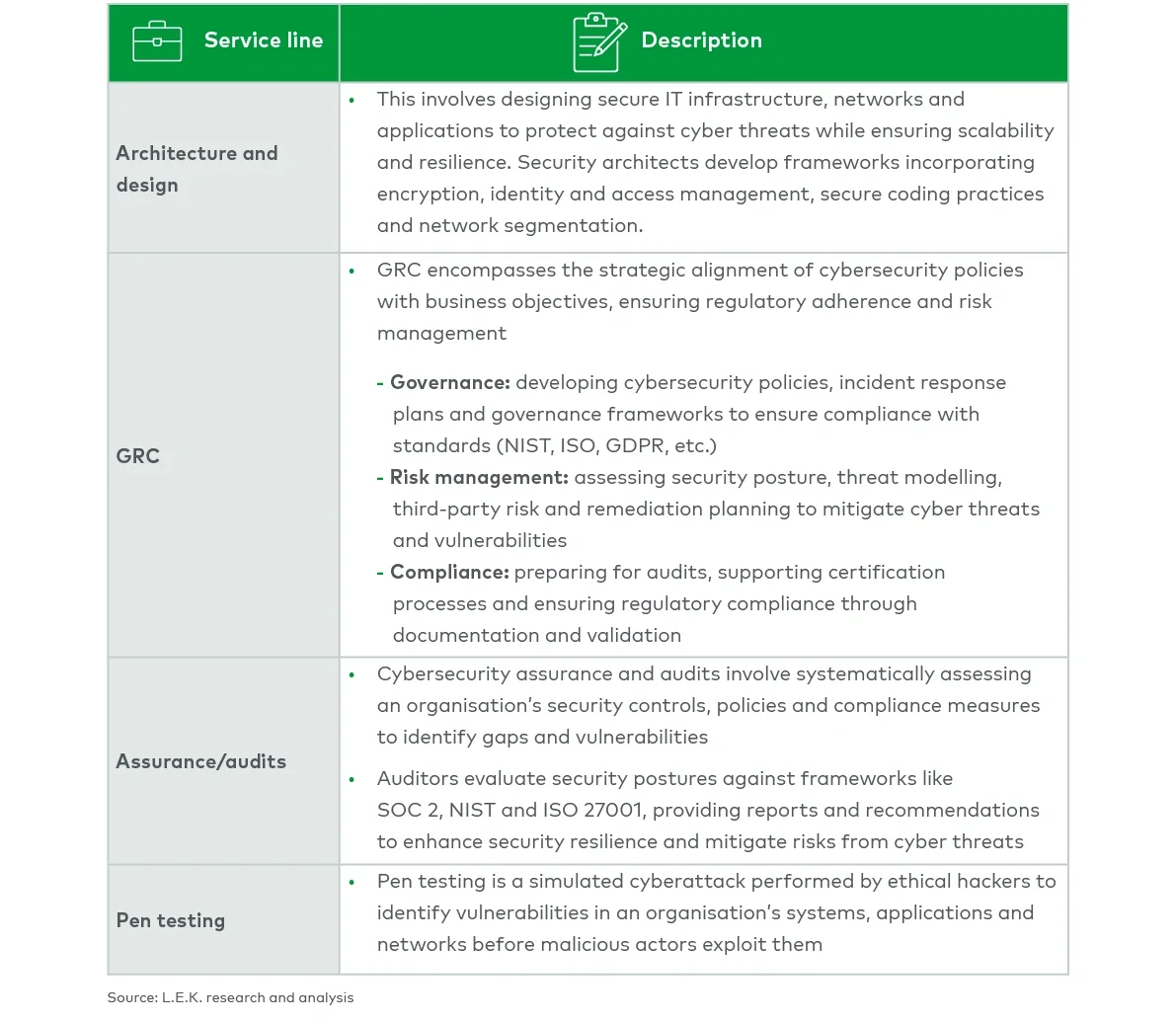
To better understand where the most attractive opportunities lie, professional cybersecurity services can be segmented into distinct service lines, each addressing critical aspects of cybersecurity risk management, compliance and resilience. Below, we break down the core professional cybersecurity service categories and their value propositions (see Figure 1). 

Figure 1

Key segments in professional cybersecurity services 

Image
Key segments in professional cybersecurity services

Figure 1

Key segments in professional cybersecurity services 

Image
Key segments in professional cybersecurity services

Key hotspots for investment

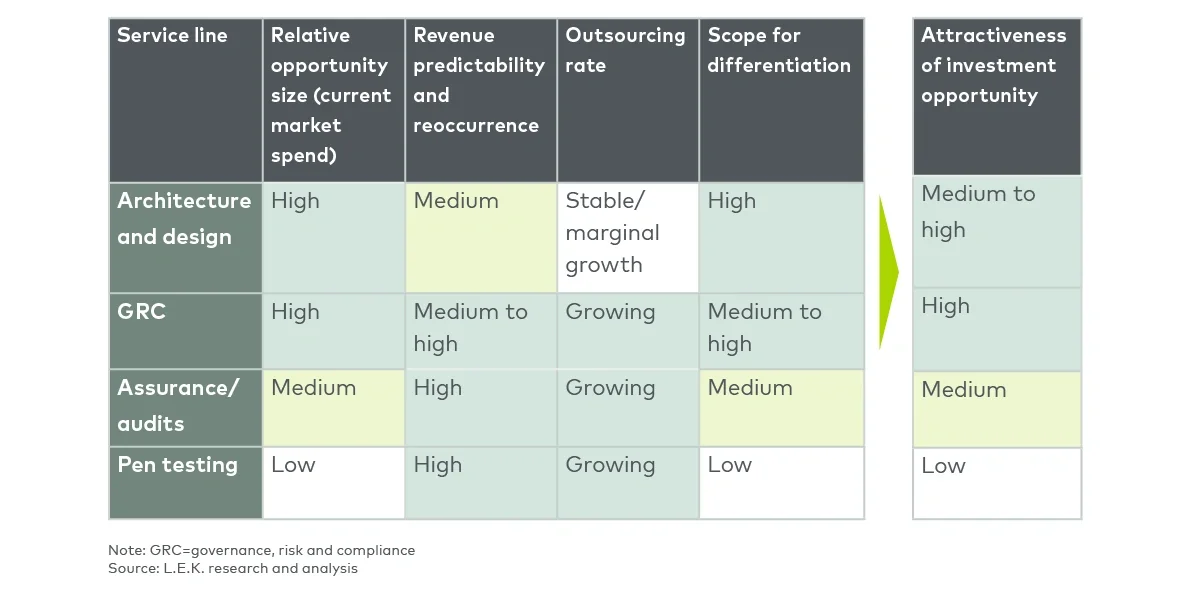
There are several factors to consider when evaluating an investment opportunity in professional cyber services (see Figure 2), including:

  • Market opportunity. How large is the market in this segment?
  • Revenue predictability. What is the level of reoccurring demand? Is it driven by predictable, ongoing needs of an organisation or one-off projects with higher demand volatility?
  • Outsourcing trends. Is the segment experiencing an increasing rate of outsourcing?
  • Scope of differentiation. Is there potential for differentiation, or is the market largely commoditised? 

Figure 2

Attractiveness of investment opportunity in professional cybersecurity services

Image
Attractiveness of investment opportunity in professional cybersecurity services

Figure 2

Attractiveness of investment opportunity in professional cybersecurity services

Image
Attractiveness of investment opportunity in professional cybersecurity services

Market opportunity and demand

The largest opportunities in professional cyber services lie in governance, risk and compliance (GRC) and architecture and design. These service lines command significant market spend as organisations invest in having a secure IT infrastructure design to protect against cyber threats while ensuring scalability and resilience.  

Aligning cybersecurity policies with business objectives to achieve robust risk management, mitigation and regulatory adherence is another key area of spend.

Revenue predictability and reoccurrence

High reoccurrence is a key driver of predictable revenues in cyber services. Assurance/audits and pen testing are highly reoccurring, fuelled by regulatory audits and compliance mandates. GRC services also exhibit strong reoccurrence, with governance projects being ad hoc (every few years), while risk management and compliance require continuous engagement. Architecture and design improvements follow a more periodic cycle, driven by large-scale infrastructure upgrades rather than ongoing needs.

Although individual organisations may increase or decrease their spending on professional cybersecurity services from year to year, overall market demand remains stable. This is because companies move through different phases of cybersecurity maturity — ramping up, optimising or scaling back — at different times, which evens out fluctuations at the broader market level.

Outsourcing rate

Outsourcing in cybersecurity is growing across most service lines, driven by specialised talent shortages, cost efficiency and regulatory requirements. Pen testing and assurance/audits are particularly mandated for third-party validation, making them prime candidates for outsourcing. However, architecture and design upgrades experience stable levels of outsourcing, as organisations prefer to retain in-house capability over critical security architecture elements.

Scope for differentiation

The degree of differentiation across service lines is shaped by three key factors:

  • Vertical/sector expertise. Understanding industry-specific regulations, business operations and data flows (e.g. in the energy sector, deep familiarity with IEC protocols; in manufacturing, expertise in SCADA/PLC security and knowledge of production workflows)
  • Technical capabilities. Certifications, subject-matter expertise, knowledge of specialised security frameworks
  • OT expertise. Knowledge of OT systems (e.g. SCADA, PLC, DCS and RTU) as well as industrial communication protocols and networks (e.g. Modbus, DNP3 and Profinet)

The architecture and design area offers the greatest scope for differentiation, as expertise in secure system design requires a deep understanding of sector-specific IT and OT configurations, unique operational risks and industry-specific attack vectors.  

GRC and assurance/audits also provide moderate differentiation, where strong regulatory expertise and technical competency in identifying critical vulnerabilities create competitive advantage.

The winning playbook in OT cybersecurity

A vendor’s right to win within OT cybersecurity is underpinned by deep technical OT expertise; vertical-specific knowledge of OT systems, regulations and the threat landscape; and highly skilled talent with sector-relevant experience.

  • Deep, technical OT expertise. Deep technical knowledge of OT systems, as well as industrial communication protocols and networks, is essential for cybersecurity vendors to identify and understand the security vulnerabilities in their clients’ IT/OT stack and to effectively advise on how best to harden their security posture through improved security architecture, practices, vulnerability assessments and workflows.  
  • Vertical-specific knowledge of OT systems, regulations and the threat landscape. Different sectors often have unique OT environments and associated challenges and threat vectors (e.g. risk associated with real-time system availability in aviation or ransomware threats in hospital operations). Having a deep understanding of such industry-specific applications and configurations of OT environments, operational risks and threat vectors — as well as cybersecurity frameworks and regulations — is crucial for vendors to deliver high-quality professional cybersecurity services.
  • Highly skilled talent with sector-relevant experience. Vendors must assemble teams with deep expertise in specific industries such as aviation, telecommunications and utilities. This enables them to win and deliver high-quality work that aligns their cybersecurity solutions and services to sector-specific risks, regulations and operational realities — subsequently establishing credibility and trust in the OT cybersecurity services space.

Conclusion

The OT professional cybersecurity services market presents a compelling investment opportunity, driven by:

  • Strong long-term demand drivers, including IT/OT convergence, evolving cyber threats, stricter cyber insurance standards, regulatory mandates and a critical talent shortage in OT security
  • Low competition from traditional IT security providers, positioning OT security as a niche but highly lucrative market
  • Strong differentiation opportunities and high barriers to entry

Within OT security’s professional services segment, the GRC service line stands out as a key investment opportunity, offering sizeable market spend, predictable reoccurring revenues, rising outsourcing trends and ample scope for differentiation.

How L.E.K. can help

We help investors evaluate asset readiness, commercial positioning and compliance scalability in OT security. Whether your organisation needs diligence, value creation planning or sector landscaping, we bring industry depth and transaction rigour.

“As OT systems become the front line of cybersecurity threats, the winners will be those that can blend deep domain expertise with tailored, scalable services. The next wave of value creation lies in enabling trust and resilience across critical industries.”

Romain Maitret, Technology Partner 

L.E.K. Consulting is a registered trademark of L.E.K. Consulting LLC. All other products and brands mentioned in this document are properties of their respective owners. © 2025 L.E.K. Consulting LLC

Questions about our latest thinking?

English

How a Strategic Pricing Overhaul Boosted Growth at Education Perfect

July 11, 2025

Subscribe to Insight Exchange on Apple Podcasts, Spotify and Amazon Music and Audible for the latest episodes. In this episode of Insight Exchange, Principal and Strategic Advisor Jade Kahn is joined by Jonathan Morgan, CEO of Education Perfect, to discuss the transformational journey of undertaking a strategic pricing review for one of Australia’s leading edtech companies. The conversation delves into the importance of aligning pricing with holistic business strategy, the complexities of managing growth across multiple markets and how collaboration with L.E.K. Consulting created lasting impact. Jonathan shares his experiences and insights on the partnership with L.E.K., detailing both the rationale and outcomes of the project, and reflecting on the vital role of expert guidance in establishing future-proof pricing architecture.  

Key points/topics covered:  

  • The critical role of pricing as part of an integrated go-to-market and business strategy, rather than a standalone initiative  
  • Education Perfect’s shift towards a simplified and future-proof pricing structure, yielding increased retention rates and team cohesion  
  • The value of external expertise and a broad, rigorous fact base in developing effective pricing strategies for global expansion  
  • The significance of thorough implementation support, with L.E.K. actively participating in Education Perfect’s internal processes  
  • Lessons and advice for other technology leaders considering pricing reviews as a lever for growth and sustainable competitive advantage
Read the full transcript below

Jonathan Morgan:
Often there is a mismatch between the value being added to whatever the situation is for the customer and the value being captured. Why did I even think of reaching out to Lek? I think Lek is known for being very good at pricing.

Jade Kahn:
A lot of what we try to do is have this holistic picture of it can't be done in a vacuum.

Jonathan Morgan:
There's a lot of complexity in our business. This is certainly a transformational project without a shadow of a doubt.

Announcer:
Welcome to Insight Exchange, presented by Lek Consulting, a global strategy consultancy that helps business leaders seize competitive advantage and amplify growth. Insight Exchange is our forum dedicated to the free, open and unbiased exchange of the insights and ideas that are driving business into the future. We exchange insights with the brightest minds of the day, the most daring innovators and the doers who are right now rebuilding the world around us.

Jade Kahn:
Today I'm joined by Jonathan Morgan, CEO of Education Perfect, one of Australia's premier edtech software providers. And we just wanted to have a fireside chat with Jonathan to hear about his experience working with Lek, specifically around some pricing strategy work that we did together. So, Jonathan, thank you for joining us today.

Jonathan Morgan:
Thanks for having me.

Jade Kahn:
Why don't we kick off? Why don't you just tell us a little bit about Education Perfect?

Jonathan Morgan:
So Education Perfect is the premier learning and assessment tool, online tool in Australia and also in some other countries, so New Zealand, Canada and some other locations around the world. And we really focus on three things, assessment instead, instruction and practice. And we focus on. We say K12, but really we get into our groove probably from year two up to year 12.

Jade Kahn:
Beautiful. And we're talking about. You've joined Education Perfect. It's coming up to two years.

Jonathan Morgan:
It's, I think, coming up to 18 months.

Jade Kahn:
Yeah, 18 months in. Tell us some of the key challenges that you've been facing as CEO of Education Perfect over the past 18 months.

Jonathan Morgan:
Yeah, I mean, I don't know if I would say challenge, but obviously with a change of leadership, it's inevitable that you get the opportunity to look at the strategy. And so one of the things we did early on was to take the time to think about what the best overall approach would be for the next few years. And that we did in terms of challenges around that. Obviously you want to focus your resources on the most impactful things that give you the best market position. And so probably there was moving some of those resources for some activities we were doing in the past that perhaps weren't paying off as well as we would hope and really put the emphasis on things that we think will pay out for us in the long term.

Jade Kahn:
And how, when you took stock of the situation, when you arrived, how did that current status allow you to set a direction or think forward around the strategy?

Jonathan Morgan:
So I've had the opportunity to do this a few times now, and so I've got an approach that I quite like, which is essentially looking at all the, you know, establishing the facts, look at the information that's available internally, get an external point of view, think about what the different players are doing in the market, where the industry's going, trends, all this sort of stuff. And it's really the outcome of that review, almost that review period, which ran for several months and culminated in a series of meetings to think about, right. How do we really think we can best position EP both to help students, but also to help other stakeholders? And ultimately, out of that came the strategy.

Jade Kahn:
And part of this was obviously a strategic review of the pricing. Tell us about why you decided to undertake a strategic review of the pricing and the go to market strategy and the timing.

Jonathan Morgan:
Yeah, so I think also as part of maybe an approach that I've settled on that seems to work well, there are certain things I like to do, so segmentation is something I like to look at often. I found that can lead to rebranding, which we did. So we rebranded the business in the middle of last year. And then pricing is always an area I want to look at. And I don't know if that's because of the success I've had over the years with pricing studies, or some of my career was spent on the commercial side. And in that environment, you learn very quickly that pricing is one of the biggest levers to growth. And so probably for both those reasons, relatively early on, we started thinking about how we would do a pricing study.

Jade Kahn:
So, yeah, to look at pricing early on in your tenure, that's something that's part of your CEO's playbook. And why do you frontload it?

Jonathan Morgan:
Well, it can have such a big impact on success. And what I found in different companies I've worked in over the years is that often there is a mismatch between the value being added to whatever the situation is for the customer and the value being captured. And of course, the problem there is that there's the ability to gain more resources, to invest in the product to make it even better, to add even more value to the customers, and so getting a level of confidence that the pricing level is at the right point, both to enable us to serve our customers as well as we can, but also to enable us to invest in things that will be valuable in the future is something that I always want to establish relatively early on.

Jade Kahn:
Great. And you've obviously had experience doing this before reviewing pricing, setting strategy. Were there specific goals or objectives that you set out to achieve at the start of this process, and what were they?

Jonathan Morgan:
I think really the primary goal was to be confident that we understood the drivers of value in the eyes of our customer, because that's very important. And that really leads through to what appropriate pricing would be for different sets of customers we look after. And then also wanting to make sure that we had a structure of pricing that was going to stand the test of time. So we had a fairly clear view of the things we were going to invest in over the coming years. We had a strong level of conviction over why those will be valuable in the classroom. And what we didn't want to have to do is every six months, rethink how we price our products. We wanted one simple model that customers could understand, that our staff could understand, that made sense to everyone and would really see us through the long term.

Jade Kahn:
So there's a future proofing.

Jonathan Morgan:
Yeah, 100%.

Jade Kahn:
So originally you reached out to Lek and just talk us through your process behind choosing Lek. Why did you choose to work with Lek on this? Very strategic. The word you used when we originally spoke was around this being potentially transformational.

Announcer:
Yep.

Jade Kahn:
Why is it that you chose to work with Lek on this project?

Jonathan Morgan:
This is certainly a transformational project without a shadow of a doubt. And I feel the same way today as I did when we had that first conversation. I think, originally, why did I even think of reaching out to Lek? I think Lek is known for being very good at pricing. And so they're one of the names you consider. But obviously there's a range of providers. But I think for us, as we got to know the different people who could help us with our project, we were really impressed by all the team that we met. Not only the expertise and the way they were asking the questions, even just trying to understand the situation, the. But the fact that you so clearly saw pricing as being one element in the context of a wider business strategy.

Jonathan Morgan:
And I think that's the thing that really came across to us early on. It wasn't like an isolated project that was kind of calculating some numbers. It was a driver behind an overall strategy that would touch many parts of the business. And through the project, I only saw that behavior play out through all the meetings we had.

Jade Kahn:
And why is it so important, Jonathan, that the pricing is just a component of a broader strategy and not just looked at in a vacuum?

Jonathan Morgan:
I think it's important because if you were to just do a dedicated, almost siloed pricing project, you may miss some of the color and the importance of thinking about it through the eyes of like an overall business strategy. And I also think it's very important from the point of implementation. So, yes, you could create a price book, for example, to oversimplify things, but would you actually understand whether that price book could be implemented in your industry with the customers you serve, with the staff you have, and the processes internally? And so I think to do that effectively, you need to consider everything in the round.

Jade Kahn:
I'm glad you see it that way because that's definitely how we see it. Right. That pricing form is part of a broader go to market and commercialization strategy. So happy to hear that. That's also the way that you're thinking about the world and talk us through the process of working with the LEK team. How was the interaction between your team, the EP team and the LEK team throughout the project?

Jonathan Morgan:
So I think right from the get go, you brought in the experts. Essentially we felt like we had the experts on a global basis talking to us from probably that first meeting. And so that got our attention straight away. And because they are clearly very good at what they do, even just in a matter of minutes talking, they are adding value by the questions they're asking, the way they're thinking about the challenges. Then as we moved into the actual project, I think I remember an area of sort of data gathering early on, both from internally talking to many different members of staff and trying to harness their experience, but also the depth of the data set that you established independently to make sure that, I presume all the recommendations you were making were grounded in a very reliable and detailed fact base. And then as we moved into the latter stages, the way in which we brought the team and the, you know, the other stakeholders we have on the journey, and then in particular the focus on getting the implementation right. I think those are the main parts that, you know, I saw through the process of working together.

Jade Kahn:
That's great. And we'll come back, I think, to talk about the implementation because it's a key part of any pricing strategy. It's not a theoretical, here's a presentation, it's can you implement this with your customer? So we'll come back to that in a second. But when we talk about the Findings and the recommendations. What can you share? What were the key findings that came out of this pricing study for you and the team?

Jonathan Morgan:
I think the key findings was a pricing architecture that not only resonated with all members of the team, but also we really believed would stand the test of time. And we have a lot of conviction internally that the way in which the structures have been set up now really will support us for many years to come. And I think, you know, that was probably what we were looking for, but we definitely got that. Alongside that, some of the ways in which you helped us think about critical areas like retention, I think really not only impressed the team, but over time they could see how valuable they were to how we were going about things internally. And then just more broadly, observations about the way in which the market was developing, trends around sort of customer adoption and the way that customers would likely change in their way of thinking about things into the future. I would say some of those things also came out as a consequence of what we did.

Jade Kahn:
Yeah, so a lot of what we try to do is have this holistic picture of it can't be done in a vacuum. How will different segments react and how can we actually roll it out to the, to the market that it sticks and that there's benefit to, as you said, the value is derived by the customers and then we're able to monetize some of that value.

Jonathan Morgan:
That's exactly what I saw.

Jade Kahn:
And the importance of implementation cannot be underestimated in these projects. Talk us through how you implemented the recommendations and what was the role that Lek helped in supporting you with the rollout.

Jonathan Morgan:
So I think by virtue of the way in which you take a broad approach, you were thinking through the reality of implementing the price book, as we might call it, right from the get go. And so I remember there was a way in which you were thinking of segmenting our customers that I think we call pathways. And I remember when I first took the team through this, there was a little bit of suspicion, even apprehension, thinking this feels like what we've done every year. But what I saw as we progressed through the year was a real buy in to that approach and a real appreciation that you had managed to simplify a very complex situation in a way that the staff could really engage with and made their job easier. And when I was catching up with some of our key staff just before and just after Christmas, as the year drew to a close, they all commented on how valuable that was and how it will be, you know, a way we use every year from now on. I think the other thing to mention is just how hands on you and the team were on implementation. I mean, this wasn't a case of sort of, you know, let us know if you need a hand. You were in the meetings with us, in the standups with us.

Jonathan Morgan:
Even some of the standups I think we had from this office where we're going through line by line how things are going and, you know, genuinely working as a collaborative team between yourselves and ourselves, just doing the work. And I think that was something which, if you haven't seen that before, that was really quite surprising and certainly something that the team got great value out of.

Jade Kahn:
So that's something that we're passionate about, right? Seeing the actual transformation and seeing the pricing strategy come to fruition and see those changes and having that commitment to work together with your team. And I think there was a good collaboration and bond that still exists to this day. We're still working together 100%. We're now a few months down the road from having implemented this or having worked together. Tell us about some of the initial changes or any of the changes to the business changes with the customers that this study has shown some initial impact.

Jonathan Morgan:
So we've seen huge success with implementing the pricing strategy in many different ways. And I think one of the ways in which we're most pleased is that retention is always important to a business like ours. And we've seen an increase already in the level of retention compared to prior years. And I think that's as a result of the work that we did together going into the future. Some of the pricing you've done for some of the new initiatives that are coming to fruition this coming year, I think we'll probably see the full extent of the value through the next probably 12 months or so. But even in these early stages, we've been really pleased with the results.

Jade Kahn:
And you mentioned the impact on the team. How has it galvanized your entire go to market organization knowing that they've got clarity on their pricing conviction that's built on a solid fact base and they can take that out and go have more robust conversations with customers?

Jonathan Morgan:
I think certainly knowing that it's steeped in so much research and thorough thought, particularly by people who do this for a living every day and see so many different situations, does help. I actually think almost the strongest part of the project is the simplicity with which you designed our future pricing architecture. I remember the day you unveiled it to us, sort of with all the synthesis of information that led up to that And I remember being struck by just how elegant it was. And I had a pretty good feeling right from that moment that it was going to serve us pretty well. Because if it's simple to understand for our staff, you it's simple to understand for our customers. It's simple to see how the things we will be bringing to the classroom over the next few years will fit into it. It's probably going to suit us very well.

Jade Kahn:
It sounds great. And from our perspective, to hear you see how it's bringing your team together and setting up for future success is very, very gratifying. You spoke about retention rates. Retention rates. Again, we don't need to share any details, but have you seen any other signs, any upticks, any encouraging signs around this project and how it's impacting your go to market and your relationships within accounts?

Jonathan Morgan:
I think that in parts of the business where we've implemented some of the recommendations, we've been pleased by how easy it was to implement those recommendations. There's also always a level of trepidation when you're trying to make sure that your pricing is right. There's sometimes questions from customers, there's things to work through, you're not quite sure how the market's going to take it. And in particular areas where we've been working quite closely since the project started, we've seen very good uptake and support for what we're trying to do. And I think the customers see the reason why we're doing it because it enables us to invest in areas that they're asking us for and they are wanting support in the classroom, on in other areas. Some of it has started to be implemented, but as I mentioned, some of the capabilities we bring to market will come to fruition this year. And so as we start to roll those out, we will get more information on how things are going.

Jade Kahn:
And have there been any unexpected outcomes that have surprised you?

Jonathan Morgan:
I think the unexpected outcome was what I was talking about earlier when I was talking about that way of thinking about segments that we called pathways, because there was a level of sort of hesitancy around the approach that you'd recommended, and then seeing that translate into genuine gratitude for simplifying what is quite a quite a complicated situation in our business. We're looking after, you know, 5,000 schools, 50,000 teachers, 1.8 million students. There's a lot of complexity in our business. You're talking about multiple subjects, multiple grade levels, multiple segments of education, multiple countries. And so for that to work smoothly across all those different environments, it is a lot for somebody to try and figure out on their own. And I think the structure you gave us to simplify all that is, as I said, something which the staff are genuinely grateful for and are very appreciative that you helped us with this.

Jade Kahn:
Well, it's definitely for us, very gratifying to hear. Share your thoughts on how satisfied are you? What was the experience of working with lek?

Jonathan Morgan:
Overall, we're very satisfied. And I think one of the reasons we're satisfied is because the project went as we hoped it would. It played out exactly as you and your colleagues said it would. The level of support was extremely high. And even today, I was texting with one of your colleagues even yesterday and he was replying very quickly, helping me think through one aspect of our pricing for this coming year. And you do feel like a genuine partnership has been formed, which, you know, let's see where that takes us in the coming years. But you really are an extension of our team and we reach out when we've got questions and, you know, we share information with you and ask for your perspective. And we've been very pleased with it from our side.

Jade Kahn:
Excellent to hear, Jonathan. So, Jonathan, as a CEO, as a leader, right, in an Australian global tech business, what do you consider the most crucial aspects of an effective pricing strategy?

Jonathan Morgan:
Well, you certainly want to make sure you're building it on a reliable fact base that is deep enough and broad enough that you won't end up coming back and questioning the conclusions relatively shortly after the project, because that's the worst case scenario. You've spent money, perhaps you started to implement, you realize you've gone amiss, and then you come back and you realize that, you know, actually a bigger fact base was needed. So that's definitely an important aspect. I think the second thing is experience. I think people with actual experience of doing similar pricing strategies for similar companies in similar markets is very important. And I also think the global perspective is also crucial because, you know, we're a company that is in many different countries around the world. We, we have ambitions to expand over the long term more globally. And so we want people who are bringing expertise and thinking that will serve us well into the future through the work we're doing.

Jonathan Morgan:
So I think those are probably the three I would mention, and we certainly got those on this project.

Jade Kahn: 
And thinking of that Australian tech company looking to enforce or not enforce or dominate the local market, grow globally, expand customer accounts, there'd be a lot of other CEOs or companies in your position. What advice would you give to other CEOs or other tech companies who are facing a similar challenge on the best way forward?

Jonathan Morgan:
Well, I would always look at pricing relatively early on. I think in any business I was running, even if I felt pretty good about the pricing, there's always the potential to think about it in new ways and more creative ways. And it can unearth opportunities you may not have thought about. And so the advice I would give and the advice I do give to other CEOs is relatively early on in the tenure. Do engage some pricing expertise and take a look at how you're going about structuring your pricing for success. And so I think that's what I'd say.

Jade Kahn:
You mentioned getting external expertise. Talk me through why having that outside perspective is helpful or what's the impact of having that outside expertise or external perspective in making sure that you as the CEO can go forward with confidence?

Jonathan Morgan:
Well, you need to know what you're doing on pricing. That's the primary thing. And I remember coming up through my career when I was in an earlier stage and I used to see people in rooms or spreadsheets trying to figure out the pricing. And you know, these are intelligent people making sensible, rational decisions about how to do things. And then as you start to understand pricing more and you realize the psychology that's involved and all the different levers to go into a good pricing strategy, you realize you can't do this on your own. You 100% need someone who is an expert in pricing and obviously there's different people you can use to help, but 100%, you need someone to help you with pricing. The idea that it's about being bright and able to use a spreadsheet and all the rest of it, that's really scratching the surface in what is involved in a pricing strategy. And so that's the main thing I would say.

Jade Kahn:
Excellent. And as we wrap up, is there anything that you would, I guess, care to share? How would you sum up overall, the entire experience of we're still in the experience, we're still working together, which is great. How would you sum up the partnership that we've built and the impact on education? Perfect.

Jonathan Morgan:
I think I would have used that word partnership, because I think that's how I feel and my team feels. I know that the different stakeholders involved in the project have fed back to me that they've been very pleased with how things have gone. They really like the depth and level of expertise that you've brought to this project. On a day to day note, I think the two teams like working together, they seem to enjoy their interactions. I think we do see you as an extension of our team. I think you use the word I would use, which is, you know, true partnership.

Jade Kahn:
So in the spirit of partnership, I'll say thank you for coming in here and spending some time with us today.

Jonathan Morgan:
Pleasure.

Jade Kahn::
Thank you, Jonathan.

Jonathan Morgan:
Thank you.

Announcer:
Thank you, our listeners, for joining us today at the Insight Exchange presented by LEK Consulting. Links to resources mentioned in this podcast can be found in the show Notes. Please subscribe or follow for future episodes wherever you listen to your podcasts. Also, we encourage you to submit your suggestions for future insights online@lek.com. 

L.E.K. Consulting is a registered trademark of L.E.K. Consulting LLC. All other products and brands mentioned in this document are properties of their respective owners. © 2025 L.E.K. Consulting LLC

English

Meeting the Growing Demand for SEN Services

July 9, 2025

The number of pupils with special educational needs in the UK continues to rise — placing increasing demands on schools, local authorities and care providers. In this video, L.E.K. Partner Louisa Chaves explores the pressures facing the system and how thoughtful investment and strategic planning can help ensure more children receive the support they need.

Watch the full video to understand where demand is increasing, how the funding landscape is evolving and what it takes to deliver high-quality, sustainable provision.

L.E.K. Consulting is a registered trademark of L.E.K. Consulting. All other products and brands mentioned in this document are properties of their respective owners. © 2025 L.E.K. Consulting

English
Executive Insights

Combination Vaccines: Converting Clinical Promise Into Commercial Scale

July 11, 2025

Key takeaways

Adult combination vaccines face complex commercial hurdles beyond safety and efficacy, including policy alignment, economic value and multistakeholder buy-in across patients, payers, providers and policymakers.

Pharmacies, payers and providers may have conflicting motivations that undermine adoption, necessitating tailored strategies to ensure economic and operational viability across the ecosystem.

While paediatric combos thrive due to aligned stakeholder incentives and established immunisation schedules, adult vaccines confront behavioural hesitancy, fragmented delivery infrastructure and declining compliance — especially evident post-COVID.

Relying on paediatric playbooks is insufficient; success in adult combos demands customised commercial models, rigorous demand testing, robust HEOR evidence, pricing innovation and policy engagement to navigate a complex, evolving landscape.

Combination vaccines now occupy a prominent role in many vaccine manufacturers’ pipelines, with six of the seven leading vaccine manufacturers investing through R&D and M&A (see Figure 1).

Figure 1

Presence of combination vaccines in the pipeline of top vaccine players

Image
Presence of combination vaccines in the pipeline of top vaccine players

Figure 1

Presence of combination vaccines in the pipeline of top vaccine players

Image
Presence of combination vaccines in the pipeline of top vaccine players

The prize is clear: an effective seasonal combination vaccine could tap into the $7 billion-plus global influenza vaccine market, and by boosting compliance among under-immunised segments, it may even expand the market.

While the headline benefits — streamlined schedules, fewer injections and improved adherence — seem clear on paper, real-world uptake in the adult segment remains largely untested. Adult vaccines, particularly those targeting healthy, working-age cohorts, face low baseline compliance and behavioural hesitancy, setting a high bar for commercial viability.  

Layered onto the political headwinds that marked the early Trump era, these factors demand a disciplined, evidence-led appraisal of the pathway to commercial scale.  

In this Executive Insights, we dissect the critical success factors and key implications for vaccine manufacturers.

Success hinges on more than clinical performance

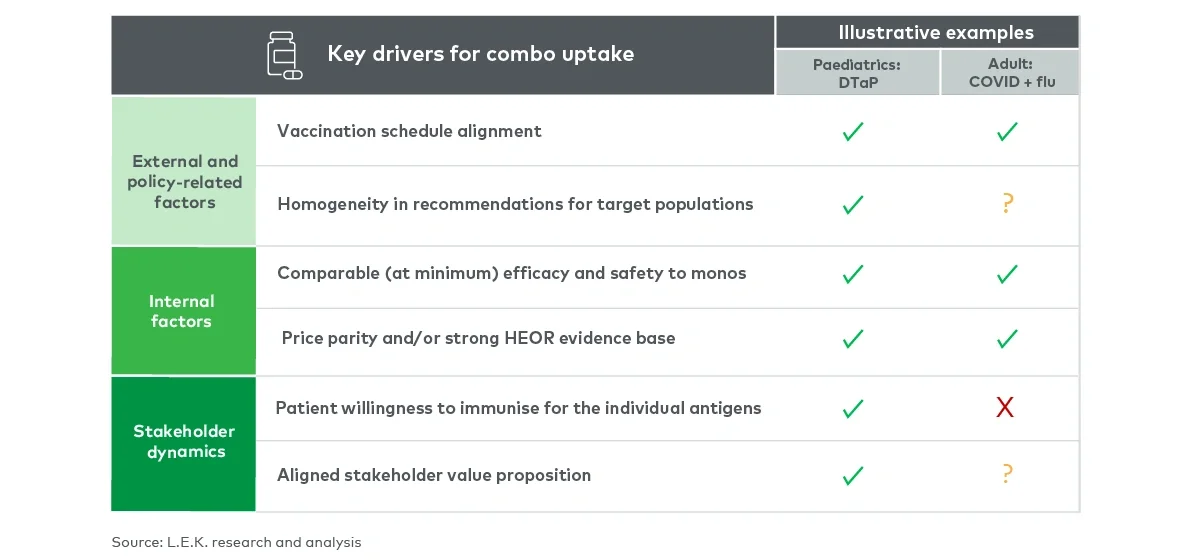
To succeed, adult combination vaccines must overcome challenges that extend beyond clinical efficacy. These include:

  • Policy alignment: are national immunisation schedules and regulatory guidance harmonised across target pathogens and age groups?
  • Clinical and economic comparability: do combinations match monovalents on safety and efficacy, and can they offer price parity or cost-effectiveness to secure broad market access?  
  • Stakeholder buy-in: are patients willing to be vaccinated with each antigen, and are the incentives of patients, payers, providers, pharmacists and policymakers aligned?

Paediatric combination vaccines have achieved sustained commercial success by addressing operational constraints in immunisation delivery while maintaining strong safety and efficacy profiles. Market share dominance in both high-income (hexavalent, more than 70% share) and low-to-medium income (pentavalent, more than 85% share) countries demonstrates their long-term strategic value

However, a side-by-side look at established paediatric combinations and the top adult candidates in development uncovers several differences (see Figure 2). To account for these differences, vaccine companies will need to deploy a different commercial strategy and mindset to achieve success in the adult combo space. 

Figure 2

Key drivers for combo uptake: paediatric vs adult

Image
Key drivers for combo uptake: paediatric vs adult

Figure 2

Key drivers for combo uptake: paediatric vs adult

Image
Key drivers for combo uptake: paediatric vs adult

Combo vaccine uptake starts with behavioural buy-in

Hexavalent formulations that combine diphtheria, tetanus, acellular pertussis, inactivated poliovirus, Haemophilus influenzae type b and hepatitis B have dominated the infant market in most high- and many middle-income countries since their rollout in the early 2000s. Before their arrival, these six antigens were administered via four separate injections, all of which had strong vaccination rates at the time of the combos’ launch. For instance, DTaP coverage exceeded 90% in the US before hexavalent combos entered the market.

The behavioural contrast between the paediatric market and its adult counterpart is stark. The adult respiratory market has proven much more complex and fragile. COVID-19 vaccine administration in the US has plummeted from more than 5,000 doses per million people daily in 2021 to fewer than 50 daily in 2024. This decline suggests a sceptical and disengaged adult population, creating structural headwinds that manufacturers must address through education, engagement and access strategies.

Misaligned incentives could stall market adoption

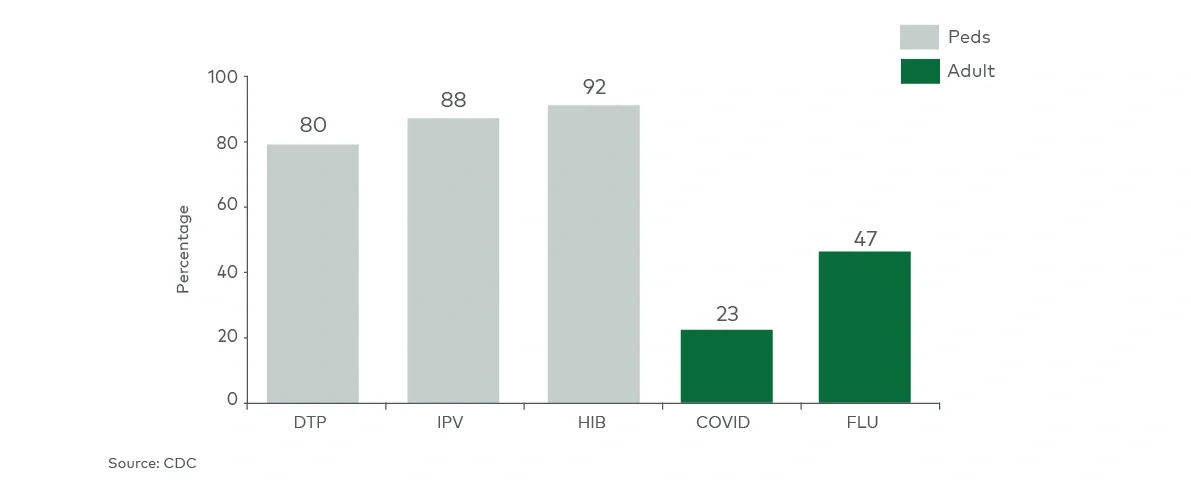
Unlike in paediatrics — where payer support, provider schedules, patient acceptance and public health priorities and policy are largely synchronised — adult seasonal vaccines sit at the intersection of competing stakeholder agendas (see Figure 3):

  • Patients appreciate the convenience of one shot, yet many are reluctant to take ‘extra’ antigens they view as nonessential (as illustrated in the COVID-19 example above).
  • Providers must navigate different immunisation schedules and the different choices and variations of combinations available, adding complexity to point-of-care counselling and inventory trade-offs.
  • Payers could see budget pressure if combos lift vaccine coverage rates, even at price parity, due to increased vaccination rates (VCR). Persuasive health economics and outcomes research (HEOR) evidence will therefore be critical to secure broad access and reimbursement.
  • Pharmacies are typically paid per administration, so fewer injections may erode margins. Without revised fee structures, their incentive to stock and promote combos may be limited.
  • Policymakers will need to consider real-world feasibility (e.g. alignment of combos with national immunisation schedules, strain update cadence, national health priorities and public sentiment towards individual components).

Figure 3

US adult vs paediatric vaccination rate (pre-combo launch)

Image
US adult vs paediatric vaccination rate (pre-combo launch)

Figure 3

US adult vs paediatric vaccination rate (pre-combo launch)

Image
US adult vs paediatric vaccination rate (pre-combo launch)

The launch context for future combination vaccines varies significantly, and some might have an easier road than others. For instance, adolescent vaccination, particularly in the realm of sexual health where there is an established schedule and existing infrastructure for HPV immunisation, or vaccines aimed at the older adult population where there is greater alignment around the need to vaccinate, could drive greater alignment among stakeholders. However, improving the health of the adult population — particularly in disease areas where political or other factors have created uncertainty around the need for vaccination — may present more complex challenges for combination strategies.

Manufacturers may need to rethink the commercial playbook

Simply relying on the paediatric combo playbook will not suffice. Manufacturers must pressure test the commercial rationale and share uptake expectations for each potential combination. If this assessment and/or our framework above reveal any critical gaps — such as lower-than-expected patient demand, uncertain payer support or policy misalignment — manufacturers should revisit their commercial strategy and/or investment levels accordingly.

To ensure commercial success, manufacturers may need to navigate specific challenges which require additional investment and a novel approach, including:

  • Carefully evaluating real-world demand scenarios: if patient demand or stakeholder alignment is weak, reassess go-to-market strategy and/or investment scale.  
  • Tailoring commercial model: higher investment in educational campaigns and HEOR data may be needed to drive demand for combos with one or more lower-priority antigens.
  • Planning for a competitive and dynamic landscape: expect direct competition (same target antigens), indirect overlaps (e.g. flu + COVID-19 vs flu + RSV) and displacement by incumbent monovalents.
  • Adopting fit-for-purpose pricing strategies: budget-conscious stakeholders will demand robust HEOR evidence and cost-effectiveness modelling that supports pricing expectations.
  • Shaping the policy environment: engage proactively on reimbursement models, pharmacist administration fees and tender-based procurement advantages.

The need for different commercial models and tactics, layered on top of potentially higher R&D outlays under evolving US policy and regulatory requirements, could tighten profit and loss headroom. Success will depend on disciplined portfolio prioritisation and innovative commercialisation tactics that concentrate resources where combination vaccines demonstrably move the needle.


Outlook: targeted investment and strategic discipline will define winners

Combination vaccines are a strategic opportunity, but not a guaranteed success. Their fate in the adult market will depend on behavioural insights, economic incentives and regulatory coordination.

Those who lead will be the ones who align stakeholder interests, deliver persuasive value propositions and invest with surgical precision. In a market constrained by platform complexity and commercial headwinds, clarity — not breadth — will distinguish market leaders from followers.

Contact us for a further discussion.

L.E.K. Consulting is a registered trademark of L.E.K. Consulting. All other products and brands mentioned in this document are properties of their respective owners. © 2025 L.E.K. Consulting

Questions about our latest thinking?

English
Subscribe to