Powering Forward: Energy’s Next Phase

November 17, 2025

2025 marks a new phase in the global energy transition — one defined by divergence. L.E.K. Consulting’s 7th Annual Global Energy Study, with insights gained from more than 300 senior executives worldwide, reveals how spending priorities are fragmenting across oil and gas (O&G), utilities and renewables as leaders balance ambition with execution realities.

This article kicks off our series on the realities of the energy transition in 2025 and the priorities shaping energy’s next phase. The series is supported by an infographic that distills this year’s survey data, with further articles to follow on grid resilience, AI adoption and flexibility in energy infrastructure.

About the survey

L.E.K. Consulting’s 2025 Global Energy Study — the firm’s seventh annual survey — captures perspectives from more than 300 senior executives across oil and gas, utilities, and renewables, complemented by over 25 in-depth interviews with industry leaders.

Respondents represent companies with revenues above $50 million and at least five years of industry experience, spanning North America, Europe, the Middle East, Asia-Pacific, Australia/New Zealand, Latin America and Africa.

This year’s study continues to explore capital investment expectations and drivers while introducing two new focus areas: the evolving role of natural gas and the adoption of AI in the energy sector.

Diverging investment priorities

Our 2025 Global Energy Study shows a sector pulling in different directions, revealing as much about each segment’s constraints as it does about their opportunities. 

O&G companies maintain modest investment plans, with capital expenditure expected to grow by around 3%-6% in 2025, balancing selective expansion with strict discipline amid geopolitical uncertainty and fragile supply chains. Utilities, meanwhile, are expected to increase annual investment by roughly 9%-12% over the next decade as they accelerate transmission and distribution expansion and upgrades to meet surging electrification and data-center demand.1 Renewables players continue to expand but face rising costs and regulatory volatility. 

Oil and gas: Disciplined growth, targeted transition

O&G majors remain cautious investors, keeping capital discipline at the center of strategy. Projects with predictable returns are prioritized, and acquisitions continue to be used as levers for scale and capability. 

Caution is likely to persist given macroeconomic uncertainty, project ambiguity and shareholder return priorities. As a result, selective spending is directed toward international and offshore projects, while efficiency gains and brownfield optimization remain paramount. 

Within that spend, companies are gradually increasing investment in energy transition initiatives — after only modest growth last year, spending is expected to nearly double by 2030, to 18% of total budgets, as confidence in proven decarbonization technologies builds.

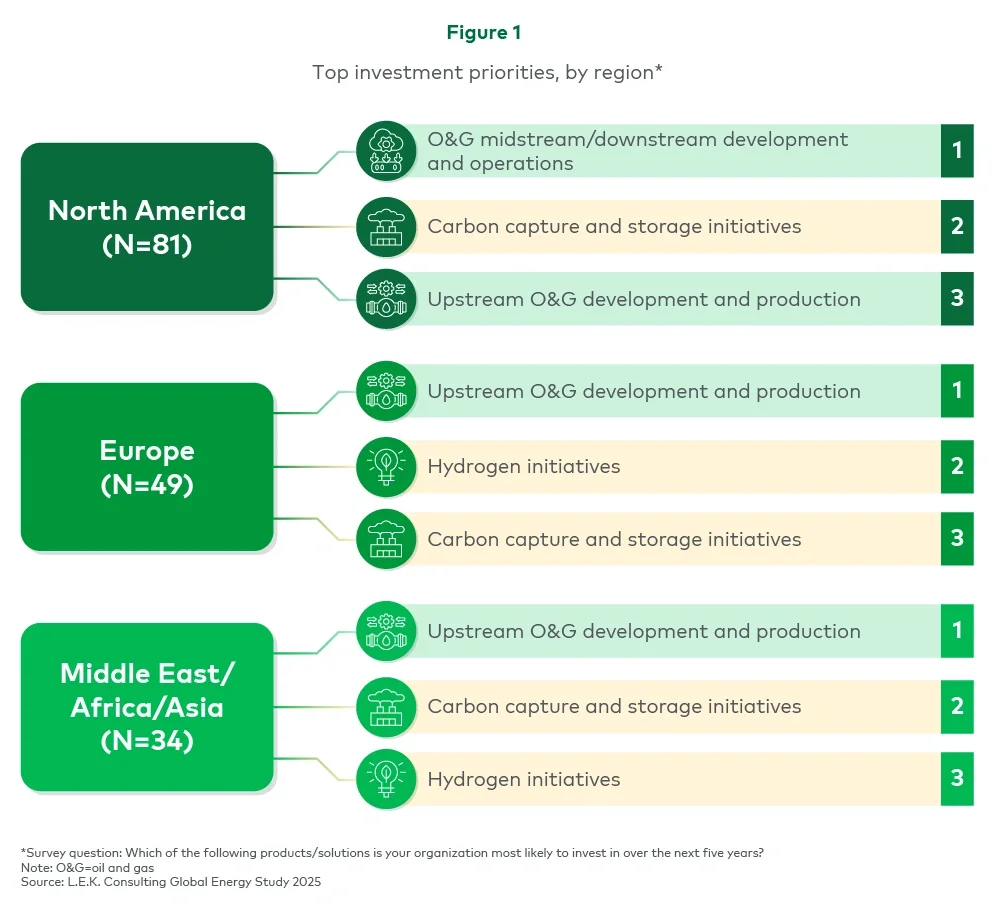
Transition bets, though, remain highly selective, with only around 1 in 10 companies ranking carbon capture and storage or alternative fuels among their top investment priorities. These focused plays are most common in Europe and the Middle East, where regulatory clarity is firmer and where investment strategies tend to align more with national energy and decarbonization goals (see Figure 1). 

For O&G, capital discipline has regained prominence after a brief period of diversification pressure around the energy transition. 

Image
Figure 1. Top investment priorities, by region
Image
Figure 1. Top investment priorities, by region

Utilities: Grid resilience under pressure

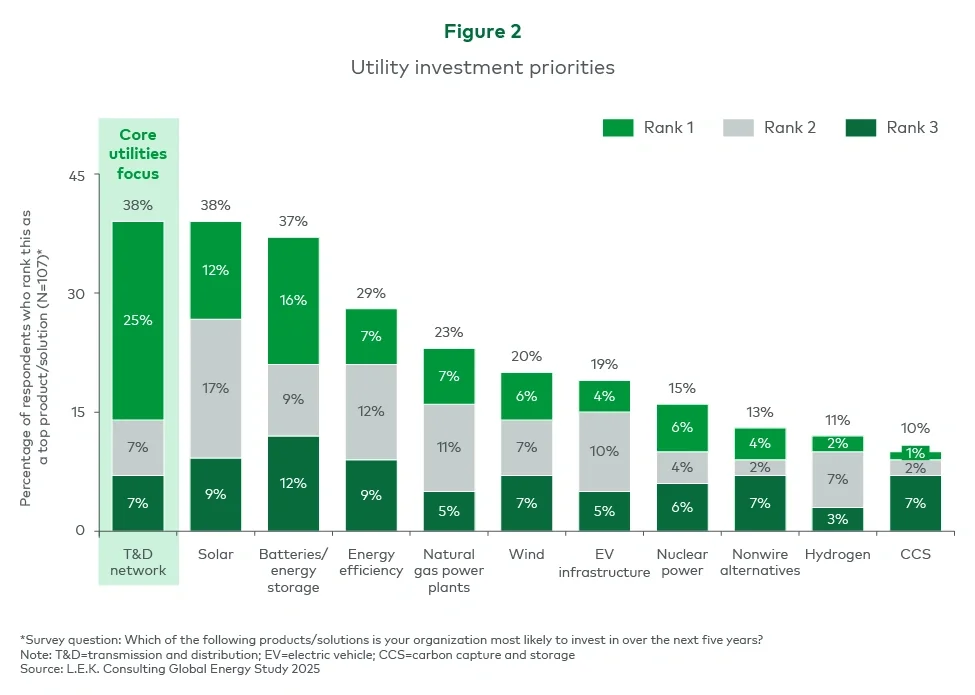
Utilities, by contrast, are in an acceleration phase. Load growth from electrification, electric vehicles and data centers has exposed the limits of aging infrastructure. Nearly 40% of utility executives rank grid modernization as their top investment priority, well ahead of nuclear or storage (see Figure 2). Yet reliability concerns are intensifying: 59% see a growing risk to power stability as renewables expand, prompting greater investment in battery storage, network flexibility and dispatchable power.

The challenge is timing. Turbine availability, interconnection queues and permitting delays continue to slow progress, forcing many operators to use energy efficiency, nonwire alternatives, and increasingly behind-the-meter (BTM) power for large, high-load customers until grid upgrades catch up.

Image
Figure 2. Utility investment priorities
Image
Figure 2. Utility investment priorities

Renewables: Growth meets reality

Renewables developers remain the most growth-oriented group, but their confidence is tempered by policy uncertainty and rising costs. 

Supportive policies in Europe, and generation needs in the U.S., continue to attract investment, yet permitting constraints, tariffs and supply-chain inflation have raised barriers. The outlook remains constructive for solar, storage and onshore wind, but developers acknowledge that commercial discipline now matters as much as policy support.

Gas and grid: Flexibility becomes the bridge

Natural gas continues to underpin system reliability and remains critical to the energy transition. Eighty percent of energy executives view gas as indispensable to the renewables transition, providing dispatchable backup for intermittent generation.

However, constraints are mounting. Only 22% of utilities express strong confidence that sufficient gas-fired power build-out will be achievable under current conditions, while 58% say a significant investment in gas infrastructure is required to meet the demand.

The result is a pragmatic response: BTM gas solutions are scaling rapidly as a bridge for power-intensive users such as data centers. Nearly half of new data center megawatts are expected to be powered off grid by 2030, mostly as temporary (less than two-year) solutions, though some may stay on longer depending on local interconnection costs and power prices. But BTM is too subject to potential constraints on equipment availability, and penetration growth will require a mix of solutions (e.g., turbines, reciprocating generators and fuel cells) to be available.

AI moves from pilot to performance

AI is shifting from the lab to the field. More than 60% of utilities now use AI for demand forecasting and 53% for predictive maintenance, while over half of O&G companies deploy it for performance analytics and downtime reduction.

Yet most firms acknowledge they are only scratching the surface, with data quality, return on investment measurement and governance continuing to pose challenges. Even so, 80% of energy leaders expect to achieve full value realization from AI within the next decade — a notably confident view given the sector’s current implementation maturity.

The message is clear: Scaling AI will depend on embedding it into operational decision-making, not treating it as a stand-alone digital experiment.

Navigating energy’s next phase

The global energy sector is entering a phase where execution precision defines progress. Each segment faces distinct pressures, but all share a common challenge: balancing investment discipline with the urgency to modernize and decarbonize. 

What unites them is a pragmatic approach. Growth continues, but selectively. Capital flows, but toward proven solutions. Innovation advances, but with a focus on performance and resilience. 

How L.E.K. can help

Our teams advise energy leaders on where to invest, how to build resilient infrastructure and when to accelerate transition bets. L.E.K.’s 2025 Global Energy Study provides the data and insight; our consulting expertise helps clients translate these findings into decisions that create value today and secure a position for tomorrow. 

For more details on the full study or to learn how these insights apply to your business, please contact our global energy team.


1 Capital IQ; company annual reports; IEF; IEA; EIA; FERC; L.E.K. research and analysis

L.E.K. Consulting is a registered trademark of L.E.K. Consulting LLC. All other products and brands mentioned in this document are properties of their respective owners. © 2025 L.E.K. Consulting LLC

English

The Future of AI in K-12 Education

October 31, 2025

L.E.K. Consulting’s Aakansha Sethi sat down with Carlos Fernandes, Managing Partner at Next Opus Ventures, to discuss how AI is reshaping the K-12 education landscape. From teacher-support tools that streamline instruction to student-facing solutions that drive engagement and personalization, AI is unlocking new opportunities across classrooms.

Watch the full conversation to gain insights into how technology is transforming learning experiences and shaping the future of education.

L.E.K. Consulting is a registered trademark of L.E.K. Consulting. All other products and brands mentioned in this document are properties of their respective owners. © 2025 L.E.K. Consulting

English
Executive Insights

Mission Analysis: Turning Transaction Data Into Strategic Retail Advantage

October 27, 2025

Key Takeaways

Mission analysis reveals the why behind the basket. By classifying each individual transaction into a set of defined missions based on the underlying shopping intention, retailers gain a behavioural lens that traditional demographic or loyalty segmentation cannot provide.

It is actionable at the store level. Coupling mission insight with catchment characteristics helps retailers understand how customers want to use their different locations, directly informing proposition and network optimisation decisions.

It is fast, repeatable and cost‑efficient. Because mission analysis leverages data — from tills, ecommerce and, where available, loyalty programmes — that most retailers already possess, it can be run quickly, refreshed regularly and scaled across the estate without major infrastructure investments.

L.E.K. Consulting brings the full toolkit. Our proprietary algorithms, consumer research design and commercial playbooks help retailers move from insight to measurable improvements in average transaction value, loyalty and estate productivity.

This Executive Insights is the second in our series on retail optimisation. In our first instalment, we outlined four strategic levers that leading retailers are using to sharpen performance and strengthen differentiation: customer strategy, store and network optimisation, pricing and promotions, and omnichannel excellence. 

Here, we explore one of the most powerful tools within the customer strategy lever — mission analysis — and examine how retailers can use it to turn transactional data into tangible commercial outcomes. 

Why a deeper customer understanding is critical for retailers

Personalisation and loyalty are now decisive battlegrounds in retail. Yet most retailers still rely on high‑level customer segments built around demographics and occasional surveys, with more advanced retailers incorporating data from a loyalty programme. 

Those approaches overlook a fundamental reality for most retailers: the same customer often shops with the same retailer for very different reasons. 

In grocery, a quick food‑to‑go dash at lunchtime is not the same as a weekend cupboard restock; in health and beauty, an emergency purchase of painkillers is not the same as a new make-up trial. Fundamentally, it is the mission (the reason why your customer is in your store at that moment) that carries distinct expectations of range, price, speed and service. 

Understanding these mission‑based needs matters because it enables retailers to:

  • Match proposition to context. Assortment, merchandising, staffing and services can be tailored to the missions most prevalent in each format and catchment.
  • Drive share of wallet and loyalty. When shoppers feel a mission is flawlessly met, they are likely to buy more and return more often.
  • Accelerate decision‑making. Mission analytics translate vast transaction logs into intuitive, board‑ready insights that cut through functional and category silos.

In short, mission analysis is a critical component of comprehensive customer understanding for multi-category retailers and underpins sustainable differentiation in an increasingly competitive market. 

What is mission analysis and why is it valuable?

Mission analysis is a data‑driven technique that classifies every basket into an intuitive ‘shopping mission’ based on the underlying shopping intent, such as a main shop, a meal for tonight, a cupboard restock, an emergency purchase or a beauty treat. 

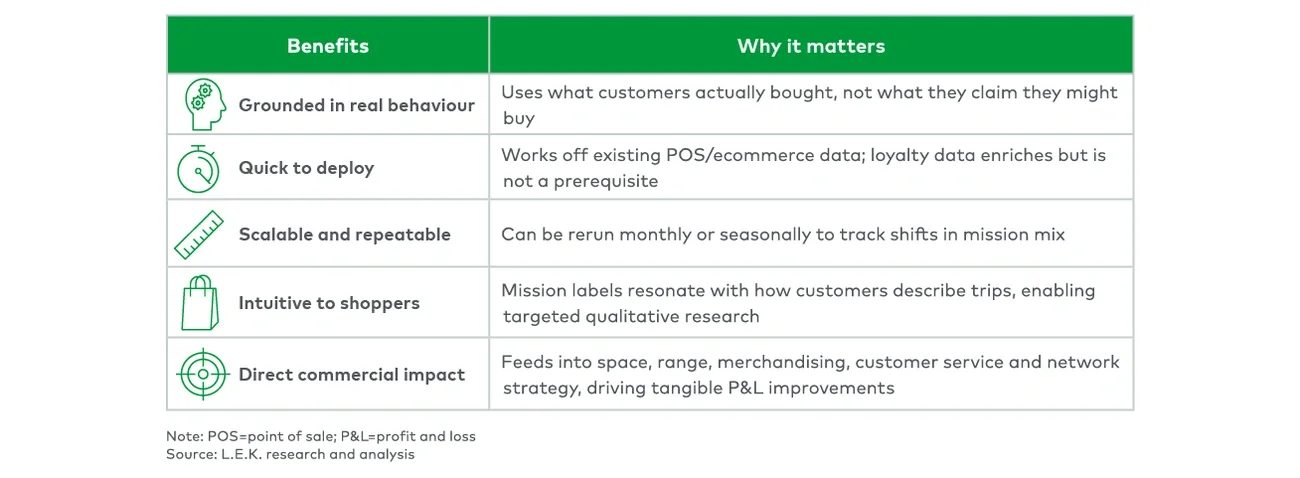
It augments existing customer insight and is particularly powerful for multichannel, multi‑category retailers where missions are often more important than demographics when it comes to shoppers’ expectations (see Figure 1).

Figure 1

Key benefits of mission analysis

Image
Key benefits of mission analysis

Figure 1

Key benefits of mission analysis

Image
Key benefits of mission analysis

How does mission analysis work?

The practical application of mission analysis involves four clear steps, each designed to unlock actionable insight from data most retailers already hold. 

Step 1. Define missions

We start by combining qualitative research (e.g. from focus groups and shop‑alongs) with expert input to draft an initial list of discrete shopping intents. This creates a comprehensive set of missions which is subsequently distilled to a mutually exclusive set of priority missions based on commercial relevance and data identifiability.

Step 2. Map transactions to missions

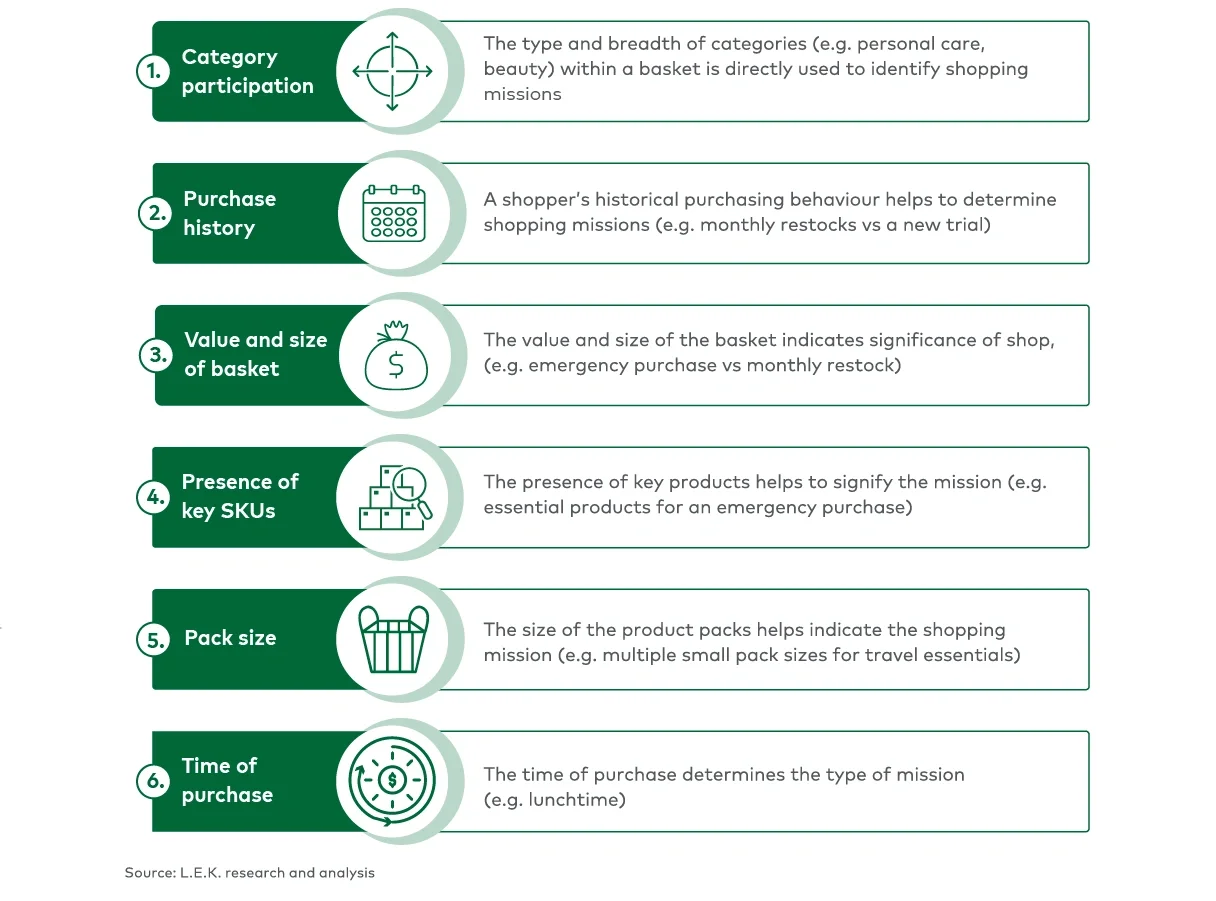
Using transaction‑level data, each basket is assessed across a range of relevant features (see Figure 2).  

Figure 2

Mission identification cues

Image
Mission identification cues

Figure 2

Mission identification cues

Image
Mission identification cues

Based on the selected set of features, each basket in your transaction database is mapped to key missions.

Step 3. Overlay with catchment characteristics

We then evaluate how mission mix varies across your estate and identify key catchment characteristics (catchment demographics, location type, competition, etc.) that are linked to the relative prevalence of each mission. This enables a clear understanding of what missions customers are looking to fulfil without being too constrained by your current offering choices. 

For the physical store network, this routinely reveals a significant number of locations that are currently underserving key customer missions because of existing choices, especially when it comes to space allocation and ranging. For online orders, it has the ability to point towards gaps in range or proposition, where missions are likely to be better served by alternatives (e.g. rapid delivery, a local convenience store). 

This estate level view helps pinpoint mismatches between store format and mission demand — such as commuter locations underserving grab and go shoppers or suburban stores over-indexed on discretionary missions with limited space to deliver. It reframes estate evaluation through the eyes of the customer rather than operational key performance indicators alone.

Step 4. Translate into commercial levers

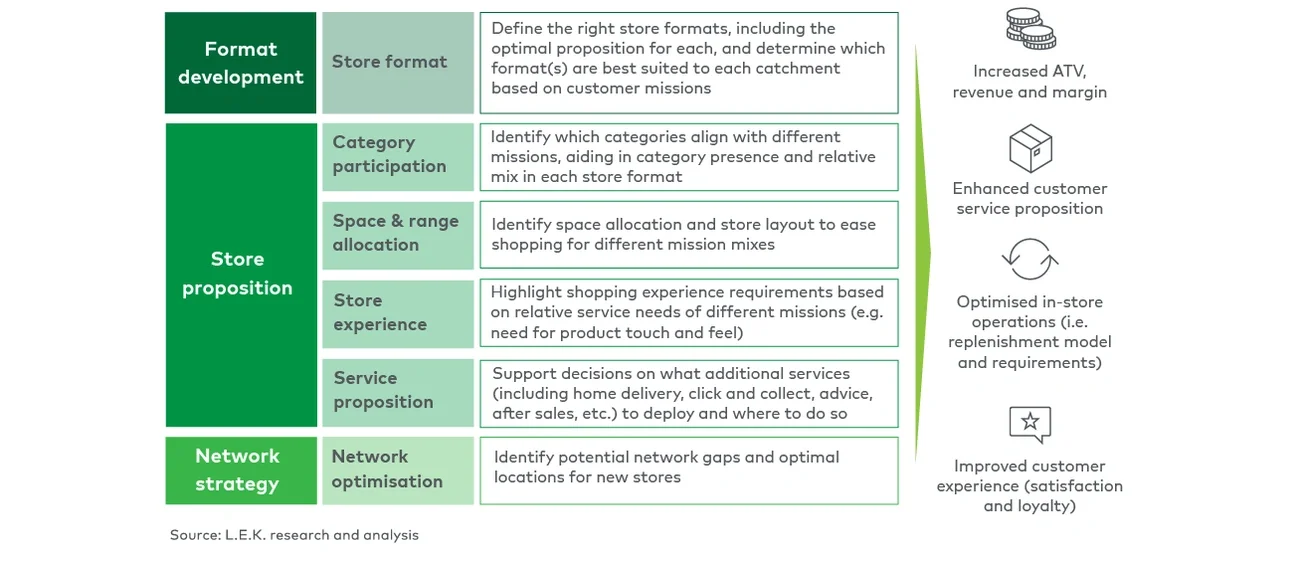
The output is a rich set of detailed information on customer behaviour, including ‘mission heatmaps’ showing, for example, where food‑to‑go or beauty discovery missions over‑index across the estate. These insights guide decisions on (see Figure 3):

  • Channel and format development and deployment. Selecting the optimal concept(s) to serve catchment.
  • Category participation and ranging. Rightsizing categories and breadth/depth of SKUs to mission prevalence.
  • Service proposition. Where to invest in in-store advice, click and collect, self‑checkout, rapid delivery, etc.
  • Network strategy and space allocation. Identifying white spots and relocation priorities at a macro estate level, and rebalancing deployment of space at a store level.

Figure 3

The impact of mission analysis on retail operations

Image
The impact of mission analysis on retail operations

Figure 3

The impact of mission analysis on retail operations

Image
The impact of mission analysis on retail operations

Crucially, mission analysis doesn’t require starting from scratch. It integrates with existing data systems, supports agile decision cycles and can be piloted in priority regions before scaling. This makes it a low risk, high return initiative that can drive immediate value while feeding longer term transformation roadmaps.

Looking ahead

As cost‑of‑living pressures persist and shopper journeys fragment further across channels, mission analysis offers retailers a pragmatic, data‑backed route to stay ahead of expectations without over‑investing in blanket personalisation. 

The methodology is proven, the data is already in‑house and the commercial levers are squarely within management control.

How L.E.K. can help

L.E.K. has extensive experience in developing mission‑led customer strategies for retailers. Our approach integrates three capabilities:

  • Advanced analytics. Proprietary mission‑allocation tools built to handle billions of transactions at speed.
  • Consumer insight. Targeted research that probes shopper motivations, key purchase criteria and pain points within each mission, turning data patterns into human truths.
  • Action‑oriented strategy. Cross‑functional playbooks covering proposition, operations, channel and network, underpinned by robust financial modelling.

These types of engagements can generate more than 10% revenue uplift and over 20% uplift in operating profit from optimising retailer propositions to better match customer missions.

Discuss how mission analysis could unlock value for your business

English
Image
The Builders’ Merchant Branch of the Future report cover

The Builders’ Merchant Branch of the Future

October 23, 2025

The builders’ merchant sector is changing fast. Shifting customer expectations, digital disruption, sustainability and safety are reshaping how branches must operate.

This new report — produced in conjunction with the Builders Merchants Federation, L.E.K. Consulting and Steve Collinge — identifies 7 core pillars of the Builders’ Merchant Branch of the Future.

Drawing on insights from industry leaders, branch visits and real-world examples, it provides a practical framework for success, showing where change is both necessary and achievable.

What you’ll find inside:

  • The 7 pillars shaping the future merchant branch
  • Case studies and best practice from leading merchants
  • Practical recommendations you can act on today
  • Insights into how merchants can build loyalty, resilience and growth
     

Fill in the form to access your copy of The Builders’ Merchant Branch of the Future and see how these pillars can help you stay ahead.

L.E.K. Consulting is a registered trademark of L.E.K. Consulting LLC. All other products and brands mentioned in this document are properties of their respective owners. © 2025 L.E.K. Consulting LLC

English

Enhancing Delivery Outcomes in Major Capital Projects

October 21, 2025

As Australia embarks on a new wave of major capital investment, the spotlight is shifting from project ambition to delivery performance.

In this video, L.E.K. Partners Mark Streeting and Ian Kershaw examine the persistent challenges that undermine major project execution. They explore how governments and private stakeholders can adopt a more disciplined, learning-driven approach to avoid repeating the mistakes of past mega-projects.

With capital spend expected to remain elevated, this conversation offers timely insights on why robust delivery planning must match the rigour of business case development and how project owners can embed a culture of accountability, adaptability and delivery excellence.

Watch now to discover how to improve outcomes across Australia’s infrastructure pipeline.

L.E.K. Consulting is a registered trademark of L.E.K. Consulting LLC. All other products and brands mentioned in this document are properties of their respective owners. © 2025 L.E.K. Consulting LLC

English
Subscribe to