AI Breaks Out: From Pilot Projects to Energy’s Digital Engine
Part 3 of L.E.K. Consulting’s Powering Forward series on the realities of the energy transition
- Article
Part 3 of L.E.K. Consulting’s Powering Forward series on the realities of the energy transition
Artificial intelligence (AI) is gaining real traction within operations across the energy sector. Limited trials have given way to broader deployment, and it is becoming a part of how utilities and oil and gas (O&G) operators manage commercial growth, reliability, risk, cost and system planning. L.E.K.’s 2025 Global Energy Study captures this shift clearly.
Adoption is increasing across the value chain, though progress is uneven and often held back by data limitations and organizational hurdles. Even so, companies remain committed to strengthening the foundations required for reliable, scaled use.
Our 2025 Global Energy Study — the firm’s seventh energy annual survey — captures perspectives from more than 300 senior executives across oil and gas, utilities, and renewables, complemented by over 25 in-depth interviews with industry leaders.
Respondents represent companies with revenues above $50 million and at least five years of industry experience, spanning North America, Europe, the Middle East, Asia-Pacific, Australia/New Zealand, Latin America and Africa.
This year’s study continues to explore capital investment expectations and drivers while introducing two new focus areas: the evolving role of natural gas and the adoption of AI in the energy sector.
Viewed through L.E.K.’s AI Delta lens, AI use cases typically fall into three categories: performance (driving efficiency, reliability and cost reduction), competitiveness (improving decision quality and commercial outcomes), and differentiation (enabling new business models and revenue streams). Today, energy companies are deploying AI most actively in performance use cases, with selective progress in competitiveness applications and more limited adoption of differentiation-driven models. This pattern reflects a sector focused on reliability and near-term value creation as it moves from pilot activity toward broader, scaled use.
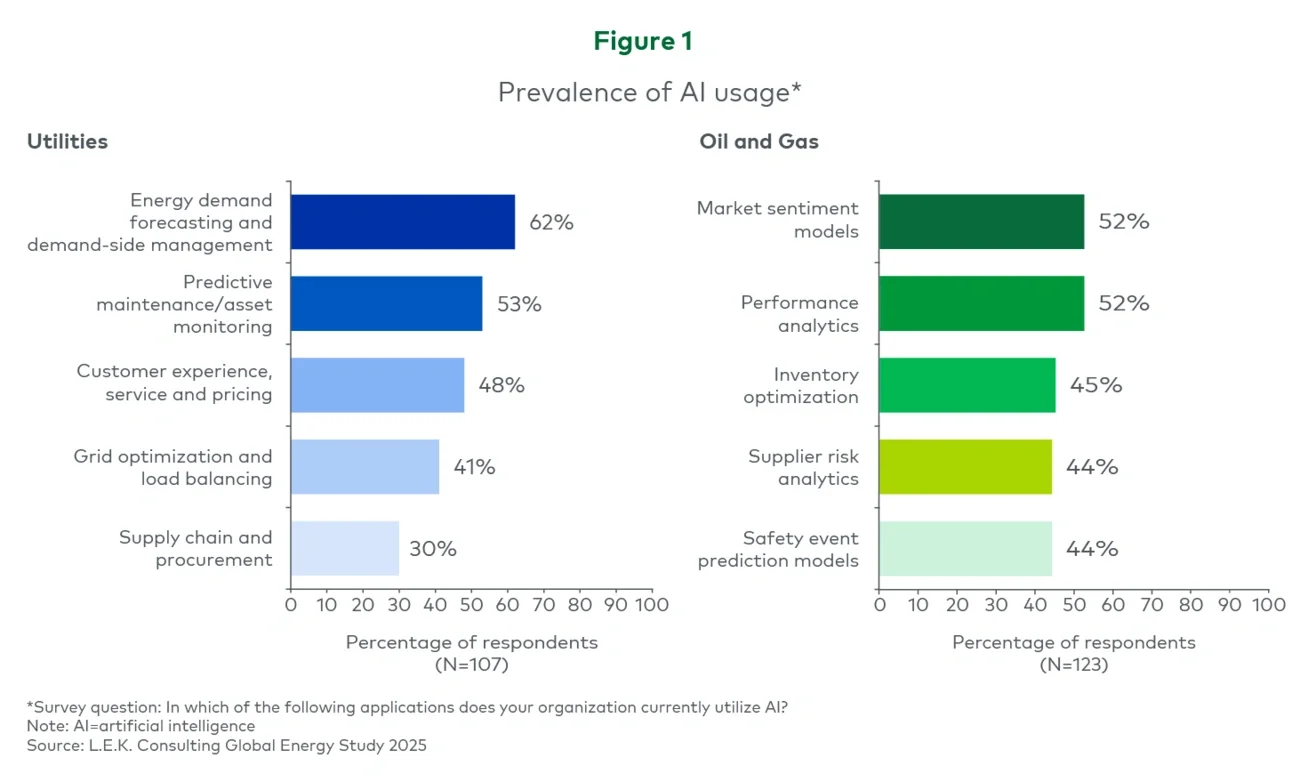
Utilities are taking the lead in operational AI. Survey data shows that 62% use AI for energy-demand forecasting, helping operators anticipate load more accurately during periods of rising electrification. Fifty-three percent use predictive maintenance and asset monitoring tools, which aid early identification of equipment risks and reduce unplanned outages.
Utility adoption extends beyond system operations. Forty-eight percent apply AI to customer experience and service management. A smaller share deploy AI in supply chain and procurement functions, reflecting slower data standardization in those areas. These patterns signal steady movement toward broader digital operations, with a clear priority placed on applications that strengthen reliability.
O&G companies show a distinct pattern. More than half rely on AI for market-sentiment modeling and performance analytics. These tools support trading, planning and operational scheduling. Additional use cases include inventory optimization, supplier-risk analytics, anomaly detection and real-time drilling support. Uptake varies widely across these applications, with analytical functions seeing higher adoption than field-level automation.
Together, these results show that AI is taking on a more central role. Usage is rising where data volume is sufficient and where the link between model output and operational efficiencies is direct (see Figure 1).
AI expansion brings operational constraints. Survey respondents identify three barriers more often than others: data quality limitations, workflow integration challenges, and governance gaps around ownership and oversight. These issues appear across both utilities and oil and gas firms.
Implementation difficulties are cited most frequently, with more than one-quarter calling them the clearest bottleneck. Executives describe cases where model accuracy is strong but integration into existing workflows remains incomplete. Others highlight inconsistent data availability or insufficient feedback loops for model refinement. These challenges limit AI’s reliability in production environments.
Importantly, these constraints are less about the underlying technology and more about organizational readiness. As seen across other asset-intensive industries, the majority of AI value creation depends on process integration, data quality and operating-model alignment rather than model performance alone. Without clear ownership, redesigned workflows and consistent governance, even technically robust AI solutions struggle to deliver repeatable impact at scale.
Companies are addressing these issues through infrastructure upgrades and more structured approaches to deployment. More than half identify IT system modernization and data platform improvements as top priorities. Many are also advancing initiatives to clarify governance, improve data hygiene, and ensure alignment between digital teams and operational leaders.
The study’s interviews reinforce this picture, as leaders point to a real need for standardized inputs and clearer accountability. These steps determine whether AI contributes consistently to operational or commercial results.
Executives express a mix of caution and confidence when evaluating AI’s current value. Some rely on AI in limited settings, while others apply it broadly yet struggle to quantify the impact. Data fragmentation and incomplete integration are some of the biggest roadblocks which continue to inhibit performance.
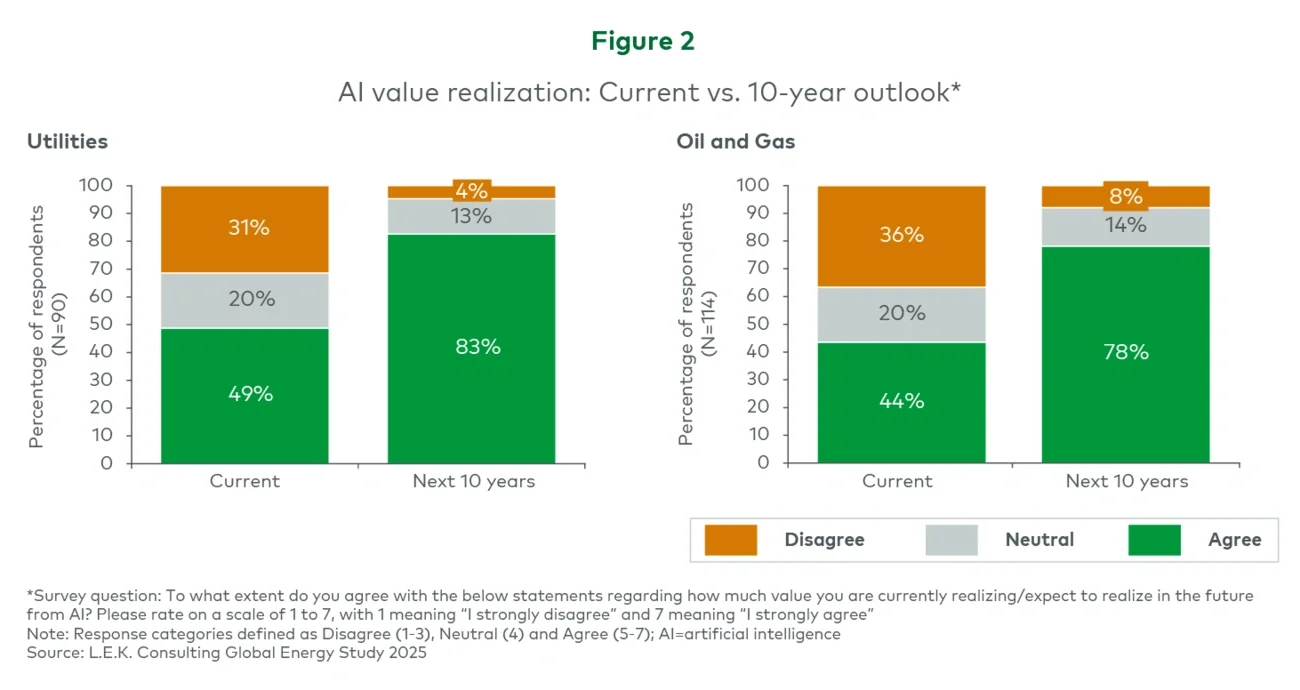
The long-term view is markedly more optimistic than the current assessment. While only 49% of utilities and 44% of O&G respondents believe their organizations are fully realizing AI’s value today, that figure rises to 83% and 78%, respectively, when looking ahead 10 years. This gap highlights a consistent pattern across the sector: Leaders recognize that meaningful value has yet to be captured at scale, but remain confident that the underlying opportunity is substantial (see Figure 2).

Utilities rely on AI to improve forecasting accuracy, enhance asset visibility and support outage management. These applications help operators manage load variability and rising levels of distributed generation. AI adoption is also growing in customer-facing tasks, especially those that benefit from real-time service data. Utilities remain cautious about more advanced operational applications, reflecting the need for stable data foundations.
O&G companies emphasize commercial and analytical use cases. Market models, performance analytics and inventory optimization tools are among the most common applications today. More advanced operational capabilities such as virtual flow metering or real-time drilling optimization show lower penetration but rising interest. Adoption is accelerating in areas with clear links to cost reduction and risk management.
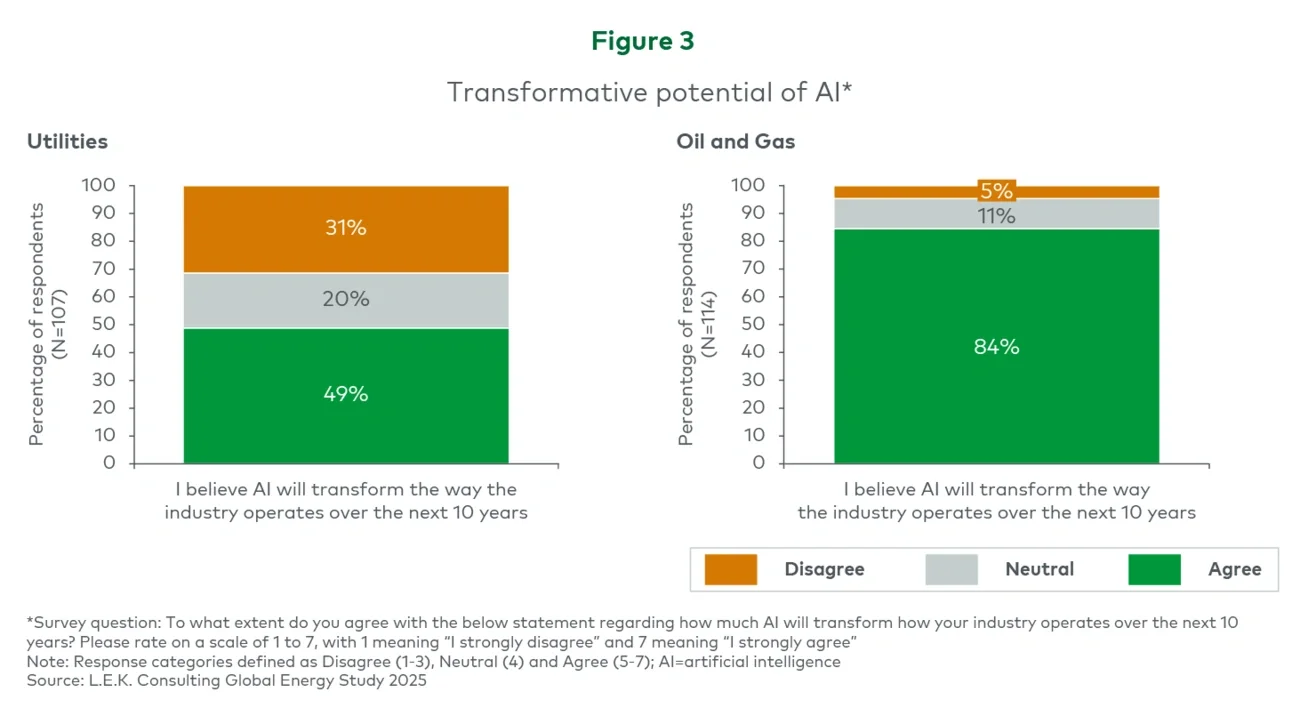
This trajectory helps explain why O&G executives express particularly strong confidence in AI’s long-term impact. A significant majority believe AI will materially reshape O&G networks over the next decade, reflecting the breadth of potential applications across upstream, midstream and downstream operations. Each segment is building AI maturity through applications aligned with its operational priorities (see Figure 3).
AI is becoming an integral part of how energy companies run their systems. Future progress depends on stable data, coherent governance, closer integration between technical and operational teams, and consistent deployment through the workflow. Together, these factors increasingly determine whether AI remains a collection of pilots or becomes a durable engine of operational and commercial value.
This article concludes our Powering Forward series which examines the realities of the energy transition in 2025.
Across the series, we explore how energy leaders are recalibrating capital allocation, strengthening grid resilience and embedding AI into core operations.
Explore the full series:
Our teams advise energy leaders on where to invest, how to build the data, process and operating foundations for AI at scale,and when to accelerate transition bets. Our 2025 Global Energy Study provides the data and insight and our consulting expertise helps clients translate these findings into decisions that create value today and secure a position for tomorrow.
For more details on the full study or to learn how these insights apply to your business, please contact our global energy team.
L.E.K. Consulting is a registered trademark of L.E.K. Consulting LLC. All other products and brands mentioned in this document are properties of their respective owners. © 2026 L.E.K. Consulting LLC