Unlocking Biopharma Opportunity in Japan

May 8, 2026

Japan offers strong growth potential for biopharma, with efficient access and two main entry strategies—licensing or local build—each offering significant value if executed with the right approach.

English

Japan's Pharma Opportunity­­: Accelerating Access to Innovation

May 8, 2026

Japan is rapidly improving access to innovative medicines through recent policy changes, creating new opportunities for pharma companies to enter and grow in this evolving market. For those ready to act, it represents a strategic growth opportunity despite existing access gaps.

English

Improving End-to-End Supply Chain Performance for a Leading US Wire and Cable Manufacturer

May 6, 2026

Background and challenges

A leading U.S. wire and cable manufacturer had built a strong market position around customer service, short lead times and a broad stock-keeping unit offering. Rapid growth, however, had increased complexity across the supply chain and placed a strain on production and warehousing. L.E.K. Consulting was engaged to perform an end-to-end supply chain assessment and identify opportunities to improve efficiency, reduce costs and support future growth without compromising service.

The diagnostic found strain across production and warehouse operations, with opportunities to strengthen planning, optimize inventory and order allocation, improve procurement and freight management and enhance performance across sites and work centers.

Approach

We conducted a comprehensive operational diagnostic across the full supply chain, spanning planning, inbound supply, sourcing, manufacturing, distribution center operations and final-mile freight. The team combined plant visits, management working sessions and detailed operational and financial analysis to identify improvement opportunities across the network.

End-to-end supply chain diagnostic

The assessment identified a broad portfolio of end-to-end supply chain initiatives, with value concentrated in four key areas:

  • Planning and coordination: Strengthening demand and production planning, improving coordination across plants and optimizing production scheduling
  • Cost and procurement discipline: Enhancing supplier management, improving payment terms, strengthening procurement processes and capturing strategic sourcing savings
  • Asset productivity and manufacturing execution: Improving data visibility, asset management, production rates, downtime performance and operator training
  • Network and logistics efficiency: Optimizing inventory strategy, reel allocation, storage and picking methods, lane management and carrier mode selection

We quantified the impact of these opportunities and translated the findings into a practical implementation roadmap, enabling the client to prioritize initiatives, sequence execution and move quickly toward value capture.

Results

Working closely with the client leadership team, we successfully:

  • Identified 10%-16% in full run-rate net income uplift across the end-to-end supply chain, with minimal capital expenditure and incremental labor costs required
  • Freed up  25% of incremental production capacity
  • Developed a practical implementation roadmap, with most initiatives able to begin immediately and the overall program designed for execution over roughly one year

The project delivered a clear enterprisewide view of where value could be created across its supply chain while preserving the customer-centric agile operating model that had supported its growth.

For more information, please contact us

L.E.K. Consulting is a registered trademark of L.E.K. Consulting LLC. All other products and brands mentioned in this document are properties of their respective owners. © 2026 L.E.K. Consulting LLC 

English

Recognizing When Supply Chain Simplification Is Overdue

May 6, 2026

Supply chain complexity rarely stems from a single misstep. Instead, it builds over time through well-intentioned decisions. Examples include line extensions, customer-specific packaging, channel-driven assortment expansion and innovation to protect or grow share.

Each decision makes sense on its own. Collectively, however, they reshape the portfolio and supply chain.

As complexity builds, portfolios expand, networks fragment and production schedules grow increasingly volatile. Working capital requirements rise while service becomes less predictable. Teams end up managing systems far more intricate than intended, where utilization seems high but capacity is constrained by changeovers, short runs and volatility.

In this environment, growth can paradoxically weaken performance. Revenue increases, yet margin quality erodes. Volume expands, but operating leverage stays limited. What looks like scale often hides structural inefficiencies in the portfolio and supply chain.

Without a strategy that evolves alongside the portfolio, supply chain complexity becomes a barrier to growth.

The four warning zones of structural complexity

Executives often sense rising complexity but struggle to pinpoint when it starts to destroy value. In our experience, the signals show up in four places: the portfolio, financial performance, operations and governance.

1. Portfolio signals: When sprawl outpaces strategy

The first signals tend to appear in the portfolio. SKU counts climb as product variants, custom configurations and channel requirements accumulate. Innovation outpaces rationalization until the portfolio reflects layers of historical decisions more than it does strategy.

As this happens, SKU roles blur. Some add volume but dilute margin. Others increase operational burden without meaningful differentiation or demand.

  • Does every SKU have a clear role?
  • Do you distinguish between “good” and “bad” complexity?
  • How is the portfolio shaped beyond the aisle?

When portfolio breadth outpaces strategic clarity, simplification becomes a strategic reset that reconnects commercial ambition with operational reality.

2. Financial signals: When growth fails to deliver leverage

These issues rarely appear directly on the P&L. Instead, they drag down performance.

A growing share of revenue falls below margin targets. Fixed-cost absorption masks operating profit dilution. Margin variability increases across comparable offerings. Working capital creeps upward as more buffers are introduced to manage volatility.

Meanwhile, hidden costs — production scrap, additional handling, obsolete inventory — continue to pile up.

  • Do you measure complexity?
  • What does it cost?
  • Are you tracking leading or lagging indicators?

When growth fails to boost margins or capital efficiency, complexity is often the cause. Growth without discipline doesn’t scale.

3. Operational signals: When the supply chain is constantly firefighting

Structural complexity can destabilize operations. Production schedules fragment, changeovers multiply and run lengths shorten. The result is more downtime and lower overall equipment effectiveness (OEE). What begins as isolated adjustments gradually becomes systemic disruption across plants and distribution networks.

Teams compensate by relying more heavily on external manufacturing, overtime, cross-plant transfers and last-minute schedule adjustments. Capacity may look full, but throughput declines due to frequent line resets, idle gaps and continuous replanning.

  • Is service slipping or inventory rising to compensate?
  • Do OEE, cost or waste lag peers?
  • Are you overly reliant on external partners?

Here, the issue isn’t total capacity but how it’s used. Simplification restores stability and makes capacity productive again.

4. Governance signals: When complexity grows by default

What isn’t measured is rarely managed.

Many organizations don’t track complexity in a structured way. Portfolio decisions follow financial and commercial goals, while stage-gate processes assess revenue potential and overlook operational impact. Complexity gets added deliberately and removed reactively.

Rationalization tends to occur episodically, often during downturns, rather than through a consistent process.

  • Do you measure and track complexity?
  • Are decisions siloed across functions?
  • Do you revisit innovation performance after launch?

Without clear metrics, shared ownership and disciplined decision processes, complexity grows by default.

Simplification as a growth enabler

Too often, organizations treat supply chain simplification as a cost exercise. In reality, its impact is far broader.

Eliminating unnecessary complexity improves structural profitability and frees resources for reinvestment. A tighter portfolio reduces changeovers, stabilizes production and improves service. Capacity shifts to higher-value innovation. Forecast accuracy strengthens while working capital declines and margin quality improves.

Just as important, simplification restores discipline. It forces explicit trade-offs and aligns commercial ambition with operational reality so growth creates value.

Sustainable portfolio management follows a simple rule: Every product must earn its place by justifying its profitability, operational burden and customer value. When teams embed this discipline into governance — measuring, reviewing and applying it consistently — simplification becomes a continuous source of competitive advantage.

L.E.K. Consulting is a registered trademark of L.E.K. Consulting LLC. All other products and brands mentioned in this document are properties of their respective owners. © 2026 L.E.K. Consulting LLC

English

How to Create Transformational Procurement Value for an Industrial Manufacturer

May 6, 2026

In 10 months, L.E.K. Consulting helped a mid-market industrial manufacturer with a procurement transformation. The program improved earnings before interest, taxes, depreciation and amortization by 30% and payables by 24 days, unlocking millions of dollars in cash. More broadly, procurement evolved from a tactical purchasing function into a strategic capability that creates value, improves supply chain resilience and enables growth. The transformation included three core phases: indirect sourcing, direct sourcing and operating model evolution.

Proving out the value of procurement with indirect strategic sourcing

Historically, decision-making had been decentralized, unmeasured and organizationally vague. Indirect supplier decisions were distributed to plants, service centers and corporate functions. Suppliers were managed through local relationships, and few contracts were in place.

We reset procurement policy and contract standards, developed value analytics and introduced new suppliers. An array of analytically infused sourcing levers — strategic negotiations, cost modeling, benchmarking requests for proposal (RFPs) and demand management — created value.

In four months, procurement generated 20% savings across indirect spend and implemented new contracts and supplier management practices. The leadership team started to reset their expectations for procurement and shape a broader reorganization of the supply chain and procurement.

Reshaping the supply chain strategy and expanding the value equation through direct strategic sourcing

After establishing credibility through a rigorous, productive indirect program, we were given permission to address direct spend and a mandate to transform the way the company bought its materials.

There were some parallels to the indirect program, but the complexity was much higher. The company had grown through a series of acquisitions, building an industry-leading product portfolio. For the supply chain, this meant complexity — tens of thousands of parts, a national footprint and a global supply base.

Critically, the business had not integrated its supply chain teams and there was no dedicated procurement leader. Contracts were being signed at plants without procurement’s involvement. One plant optimized for itself, despite the broader leverage the full network of plants created. Externally, a shapeshifting geopolitical landscape created new tariff exposure and supply chain risk.

We led a collaborative, cross-functional program, deploying our seven-step strategic sourcing process and tool kit. Ninety percent of the direct spend was sourced, with categories ranging from steel, synthetic rubber, stamped parts and extruded plastic parts to bearings, bushings and sub-assemblies.

Fifteen percent savings was delivered across 15 categories. Two hundred-plus suppliers were engaged in RFPs and negotiations. New cost, economic order quantity and inventory models were implemented. A make-versus-buy evaluation led to vertical integration of engineered parts.

Significant value was created beyond cost savings:

  1. Sole source risk was reduced by 50% through new supplier qualifications, with a path to fully eliminate the company’s risk over two years.
  2. Tariff exposure was reduced by 30%, and exposure to China was reduced by 75%.
  3. Improved payment terms extended days payable outstanding by 24 days, freeing up millions of dollars in cash.
  4. Supplier productivity programs were established with strategic suppliers, building a pipeline of value engineering projects.
  5. Commodity risk management practices were deployed, including market intelligence and index-based pricing.

Procurement had not only transformed the company’s cost position, but also reshaped how it engaged its supply base.

Evolving the operating model to institutionalize capabilities and create a sustainable value engine

To truly transform procurement, the operating model needed to evolve.

L.E.K. collaborated with management to shape the new model and supported the implementation. A procurement leader was hired. The team was reorganized to bring all direct and indirect spend under management. New procurement process, policy, technology and tools were implemented. Critically, the C-suite supported procurement, buying in on sourcing strategies, funding new supplier qualification and tooling, and communicating wins across the business.

With the right structure, tools, and leadership in place, procurement had transformed into a leading capability and value creation engine.

For more information, please contact us.

L.E.K. Consulting is a registered trademark of L.E.K. Consulting LLC. All other products and brands mentioned in this document are properties of their respective owners. © 2026 L.E.K. Consulting LLC

English
Executive Insights

Competing in a Persistent K-Shaped US Economy

May 5, 2026

Key takeaways

Income bifurcation in the U.S. is approaching historic levels, raising the question of what comes next.

History suggests K-shaped economies reverse only after major economic and policy shifts, which are only partly in place today.

As the K-shaped economy reshapes demand, companies must choose a clear path: premium positioning, structural cost leadership or disciplined tiering.

Choosing the right path requires clarity on your core consumer, your source of competitive advantage and how profit is shared across channels and partners.

What income bifurcation means for consumer leaders

The “K-shaped economy” is now a familiar refrain in earnings calls. It describes a widening gap in consumer purchasing power, where higher-income households pull ahead while lower-income households face increasing pressure.

What is less clear for many leadership teams is how to act on it. Where is growth really coming from, and is your business positioned to win as that mix continues to shift?

This divergence shows up directly in how consumers spend, make trade-offs and respond to price. Upper-income and upper-middle-class households are driving a disproportionate share of growth and margin, while less affluent households remain under pressure. The result is a hollowing middle for many consumer-facing businesses. This dynamic is not purely one-directional. The middle is also splitting, with some households moving into the lower end of the upper-income cohort while others move down.

For operators, this is not just a macro observation. It directly shapes where demand sits, which brands maintain pricing power and which business models can sustain performance. Looking at how similar dynamics have played out historically helps clarify how companies should position themselves today.

Income disparity in historical context

To understand how to position for this environment, it is useful to look at how similar income dynamics have evolved in the past and what drove those shifts.

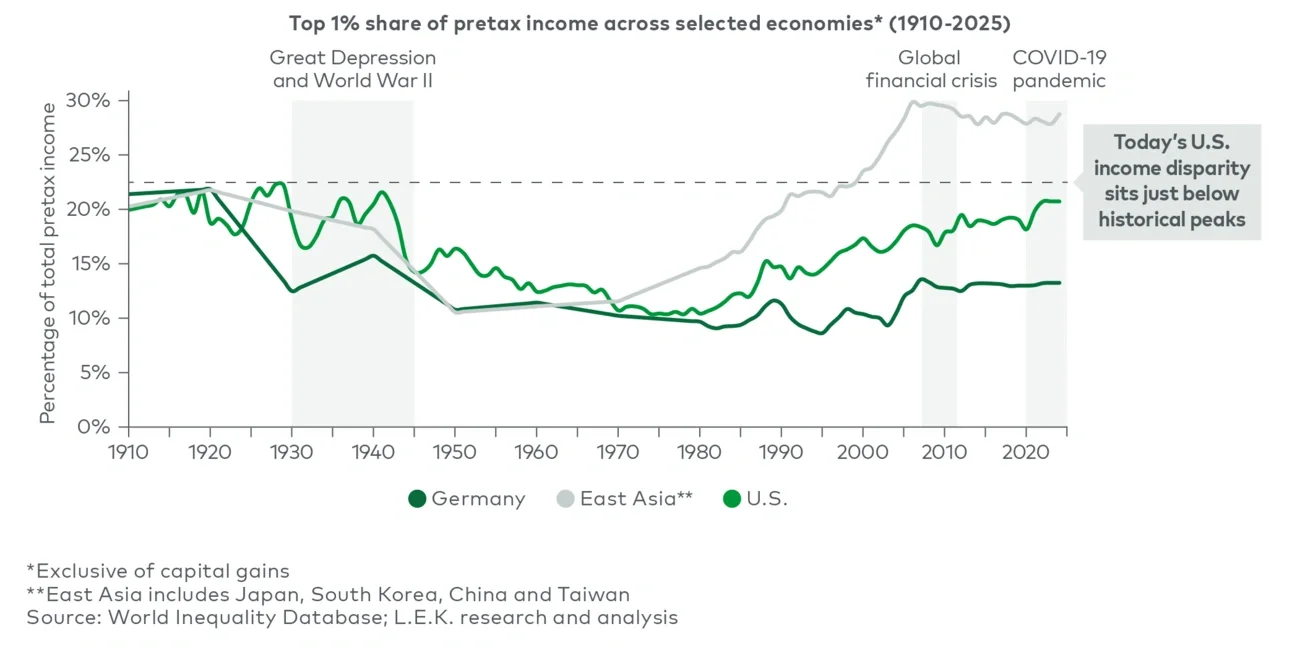
Income concentration in the United States is near historical peaks, with the top 1% capturing roughly one-fifth of total pretax income (see Figure 1). The gap between the top and the rest of the income distribution is unusually wide, even as other upper- and upper-middle-class consumers benefit as well.

Figure 1

Historical income concentration, by country/region

Image
Figure 1 represents historical income concentration, by country/region

Figure 1

Historical income concentration, by country/region

Image
Figure 1 represents historical income concentration, by country/region

However, there have been prior periods, both in the U.S. and globally, with comparable levels of income dispersion. In some cases, those K-shaped structures narrowed. The U.S. Great Compression (c. 1940-1980) and post-war Western Europe are well-known examples.

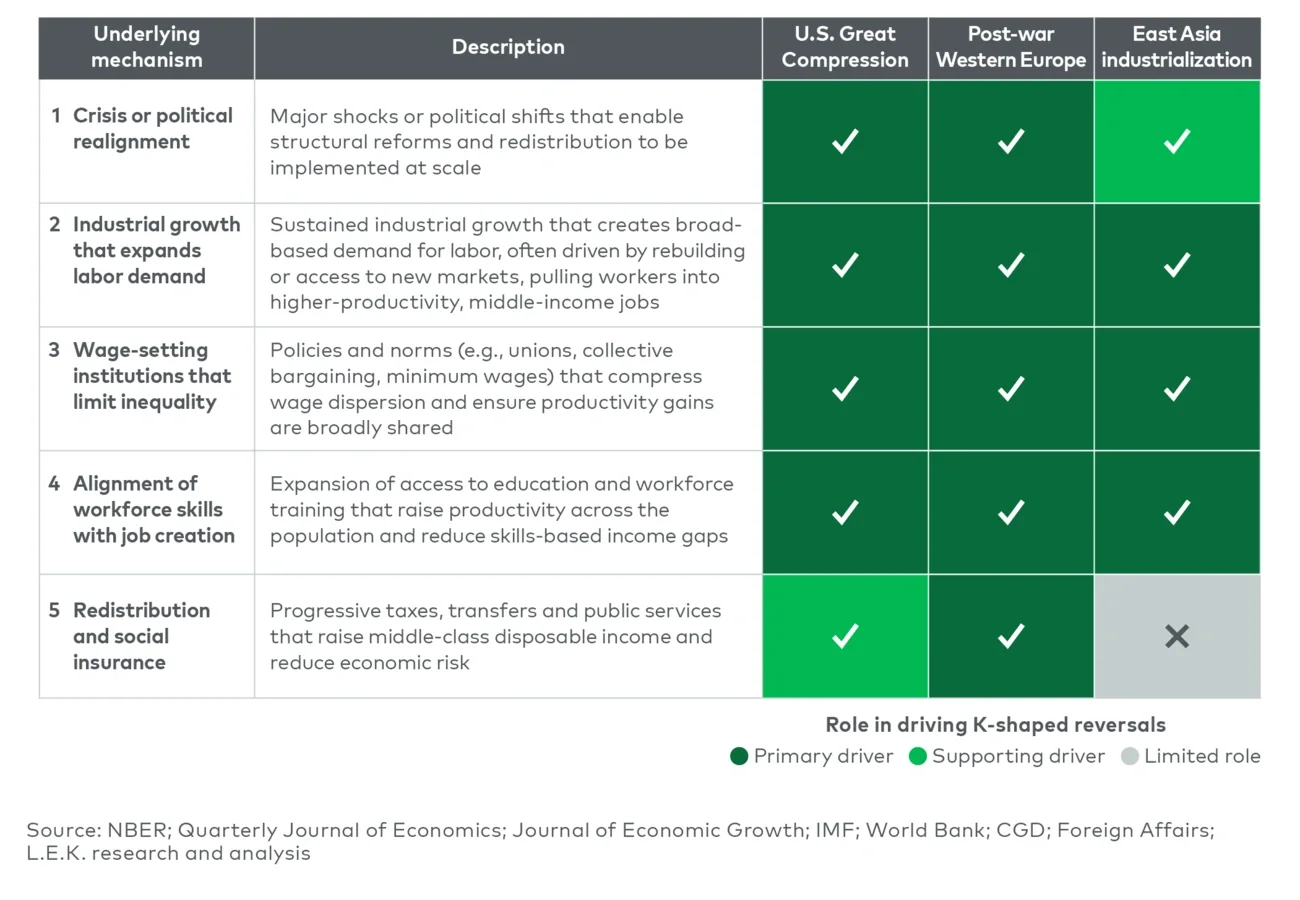
Across historical cases, compression followed major crises or political realignments that enabled reform at scale. Several bolstering forces tended to operate together (see Figure 2):

  • Industrial growth expanded middle-income employment
  • Wage-setting institutions limited dispersion and broadened the sharing of productivity gains
  • Workforce systems aligned skills with job creation
  • Redistribution and social insurance reinforced disposable income

Figure 2

Core mechanisms observed across historical use cases

Image
Figure 2 represents core mechanisms observed across historical use cases

Figure 2

Core mechanisms observed across historical use cases

Image
Figure 2 represents core mechanisms observed across historical use cases

When these forces operated together, income gaps narrowed.

The key question for consumer leaders today is whether similar conditions are reemerging, or whether the current environment is structurally different.

What winning looked like then vs. now

From roughly the 1940s through the 1980s in the U.S., the middle class expanded and income growth was more evenly distributed. For consumer companies, this created a clear playbook: Win by serving a broad consumer base. Scale and consistency drove success because a large share of households could be reached with similar products and price points. Mass-market positioning was an advantage, not a constraint: Companies such as Procter & Gamble, Coca-Cola and General Motors built enduring franchises by delivering reliable, widely accessible products to a large share of U.S. households.

Today’s environment is fundamentally different. As income dispersion widens, demand fragments across consumer groups with different needs and willingness to pay, creating trade-offs. At the same time, advances in digital channels and social media have shifted expectations from mass appeal toward personal relevance. The idea that the consumer is “one audience” has given way to a reality where consumers expect experiences, products and messaging tailored to them.

In this environment, advantage shifts toward companies that are tightly aligned to either high-income, high-engagement consumers or structurally advantaged in serving value-oriented segments, rather than those attempting to span the full market.

Structural signals in the current US economy

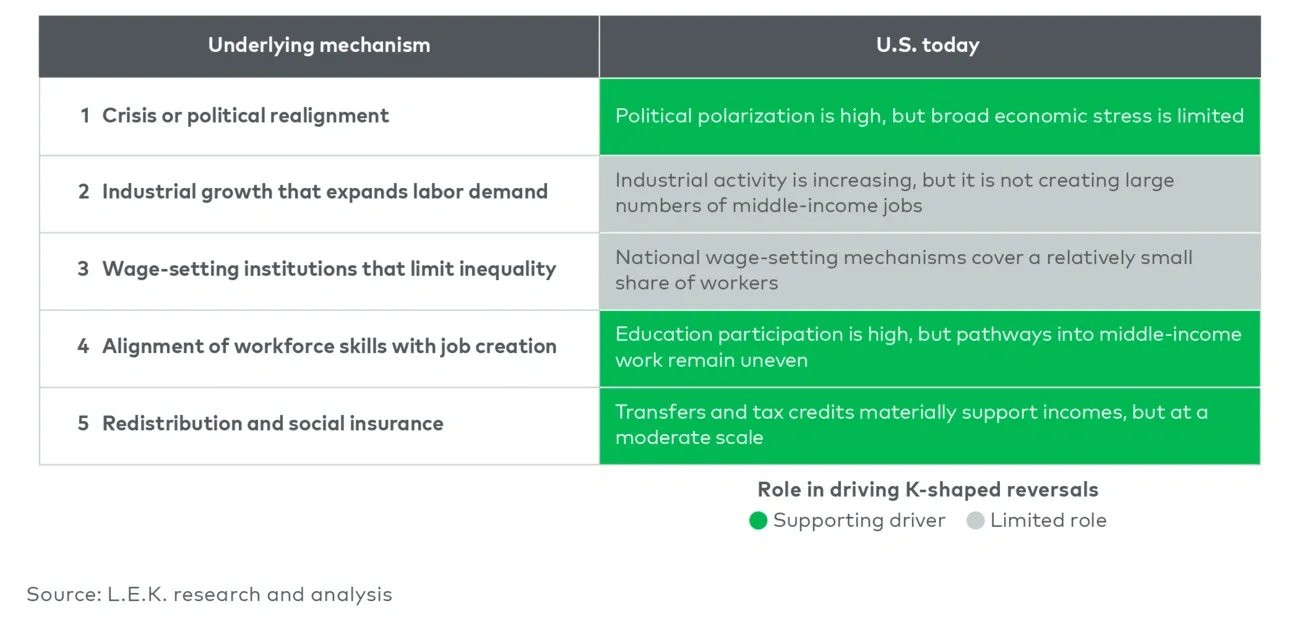
If the question is whether the middle is likely to rebuild, the current signals are mixed but not yet sufficient to suggest a durable shift (see Figure 3).

Figure 3

Directional mapping of current US conditions to reversal mechanisms

Image
Figure 3 represents directional mapping of current US conditions to reversal mechanisms

Figure 3

Directional mapping of current US conditions to reversal mechanisms

Image
Figure 3 represents directional mapping of current US conditions to reversal mechanisms

Recent wage acceleration among lower-income workers has been meaningful. Between 2019 and 2024, real wages for workers at the 10th percentile rose approximately 15%, compared with roughly 6%-7% for median and upper-income earners. Gains at the 20th percentile also outpaced the middle of the distribution. This represented a period of partial compression, driven primarily by tight labor markets in lower-wage service sectors.

However, these gains appear cyclical rather than structural. The recent acceleration coincided with an unusually tight labor market, not a redesign of the underlying systems that historically supported sustained income balance. As labor supply normalizes, continued upward pressure on lower-end wages becomes less certain.

More broadly, several of the structural forces that supported a growing middle-income base in prior periods remain limited today. Industrial expansion is occurring, but it is generating fewer broadly distributed middle-income jobs. Wage-setting institutions and redistribution play a more moderate role than in past decades.

Artificial intelligence (AI) is likely to reinforce this dynamic rather than reverse it. While advances in AI can drive meaningful productivity gains, those gains are not expected to translate into broad-based wage growth. In practice, productivity improvements often appear unevenly across the economy; they do not lift incomes uniformly. Management efforts to maximize shareholder value are also likely to drive at least some productivity gains to capital, rather than works. As a result, AI may increase overall output without materially expanding the middle-income consumer base.

Taken together, these signals suggest that while short-term compression can occur, the structural preconditions required to rebuild a broad middle-income base are not fully in place. Without a significant shift in these dynamics, demand is unlikely to re-center on a broad middle-income consumer.

What this means for consumer-facing businesses

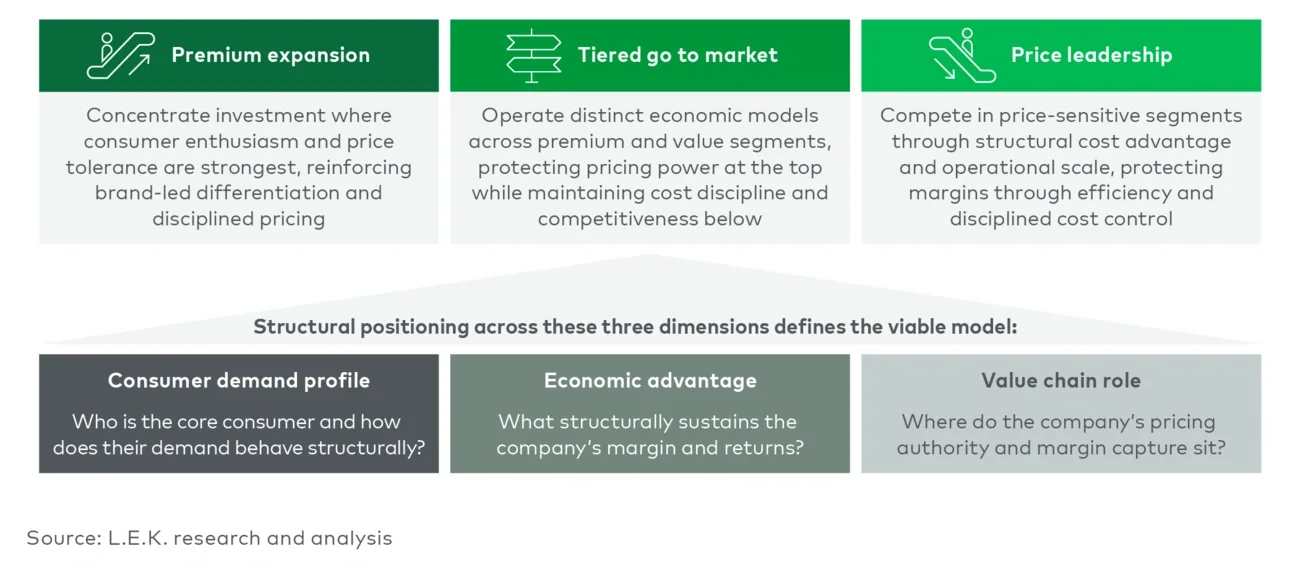
In a persistently bifurcated market, sustained outperformance tends to concentrate around three structurally coherent positions (see Figure 4). Each reflects a different alignment between consumer demand, economic advantage and value capture.
 

Figure 4

Three strategic paths and required structural conditions

Image
Figure 4 represents three strategic paths and required structural conditions

Figure 4

Three strategic paths and required structural conditions

Image
Figure 4 represents three strategic paths and required structural conditions

The first is premium concentration. Businesses anchored in higher-income, high-engagement segments can direct investment toward differentiation and brand reinforcement, protect pricing authority and prioritize the cohorts that drive disproportionate margin. Luxury brands, players differentiating via performance and experience-led categories often exemplify this model. Success depends on credible willingness to pay and effective pricing management.

The second is structural cost leadership. Where affordability and trade-offs dominate decision-making, advantage can come from scale, sourcing and operating efficiency. Off-price retailers, value grocers and scaled private-label players illustrate this path. Profitability relies on sustaining lower unit costs better than competitors do, not on stretching pricing power beyond what demand will support.

The third is disciplined tiered segmentation. Companies that operate across income cohorts must run premium and value propositions as distinct economic models, with clear price architecture and guardrails to prevent margin leakage. Global consumer brands with “good-better-best” portfolios or differentiated channel strategies often pursue this approach. The ability to segment without eroding overall returns becomes the central capability.

What becomes increasingly difficult to sustain is a broad middle-market position without a clear source of advantage. In a prior era, serving the average consumer was a viable strategy. Today, that same positioning risks being pulled in both directions — premium without sufficient willingness to pay or value without sufficient cost advantage.

This challenge is amplified by personalization. As consumers are increasingly targeted with tailored messaging, pricing and assortment, expectations rise for relevance at a more individual level. Companies attempting to serve multiple segments without clear separation often find their propositions blurred, making it harder to win decisively with any cohort.

In a K-shaped economy, strategic ambiguity carries a growing penalty.

Determining the right strategic path

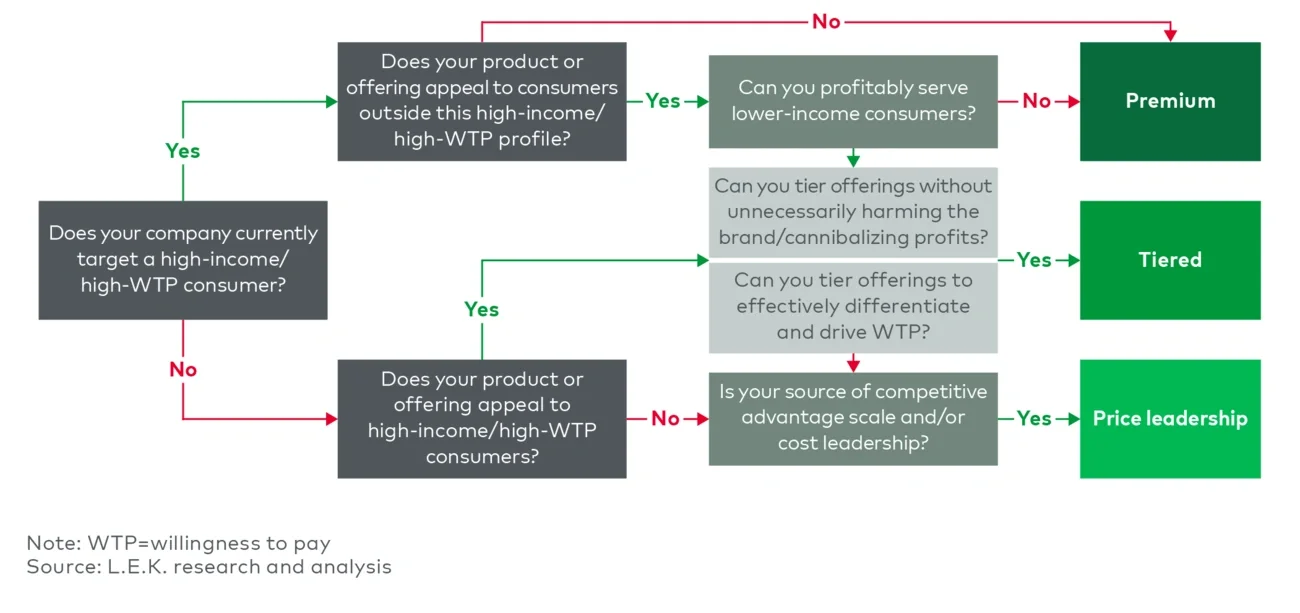
In a bifurcated economy, strategic direction should follow structural position. Whether tiered segmentation or price leadership is viable depends on three interrelated factors: the composition and behavior of the core consumer base, the source and durability of economic advantage, and where pricing authority and margin capture reside within the value chain (see Figure 5).

  1. Consumer demand profile: Start with the primary consumers by income cohort and category engagement. A business anchored in affluent, high-engagement consumers operates within a different economic envelope than one serving a broad, price-sensitive base.

    What fundamentally drives purchase decisions matters just as much. Are purchases rooted in identity and brand differentiation or in functional need and affordability? How resilient is demand when prices rise or economic pressure intensifies? Trade-down patterns, switching behavior and mix shifts often reveal the true structural position of the model.
  2. Economic advantage: The next lens is the source of profitability. Are margins driven by pricing power or by structural cost advantage enabled by scale and efficiency? Durability is critical. Where does the company earn disproportionate profits across segments, stock-keeping units or channels, and how exposed are those pools to mix shifts or competitive pressure?
     

    Premium expansion requires defensible willingness to pay. Price leadership requires enduring cost superiority. Tiered models require the ability to sustain distinct economics across segments without eroding overall returns.

  3. Value chain role: Finally, the company’s position in the value chain shapes what is feasible. Does it control pricing and customer relationships, or is margin subject to retailer, platform or supplier pressure? Can it manage distinct tiers without leakage across channels or segments?
     

    Taken together, these structural dimensions narrow the field of viable choices. In a persistent K-shaped economy, sustained performance depends on aligning strategy with how demand behaves, how margins are generated and where value is captured.

Figure 5

Structural position diagnostic: premium, tiered or price leadership

Image
Figure 5 represents structural position diagnostic: premium, tiered or price leadership

Figure 5

Structural position diagnostic: premium, tiered or price leadership

Image
Figure 5 represents structural position diagnostic: premium, tiered or price leadership

Key questions for consumer leaders

As income divergence persists, the most important task for leadership teams is not to diagnose the trend but to assess whether their current model is aligned to it. The following questions can help surface where a business may be exposed:

  • Where is our profit coming from today, and how dependent is it on consumer segments that may be under pressure?
  • Do we have true pricing power with our core customer, or are we relying on brand inertia that may not hold under increased trade-down pressure?
  • If demand shifts further toward either end of the income spectrum, where do we gain and where do we lose? Do we have a credible response?
  • Is our cost structure competitive enough to win in value-driven segments, or are we exposed if pricing comes under pressure?
  • How effectively are we using data and AI to tailor offerings, pricing and engagement to different cohorts, and where are we falling behind?

For many organizations, answering these questions candidly can reveal misalignment between strategy and market reality and where clearer choices are required.

Conclusion

In a market defined by divergence, strategy becomes an exercise in precision: precision about which customers sustain your economics, what they will pay for versus where trade-downs are possible and where your advantage truly comes from.

That is the practical challenge of competing in a persistent K-shaped economy — not predicting the cycle but building a model that performs through it.

For consumer leaders, the imperative is clear: Align the business to where demand is structurally going, not where it has historically been.

For more information, please contact us.

L.E.K. Consulting is a registered trademark of L.E.K. Consulting LLC. All other products and brands mentioned in this document are properties of their respective owners. © 2026 L.E.K. Consulting LLC

English
Image
LEK Lincoln logo

The Renaissance of Healthcare Logistics Part 3

Investment Opportunities and Implications
May 11, 2026

Attractive investment opportunities in healthcare logistics

Healthcare logistics presents a compelling investment profile defined by high barriers to entry, recurring contract revenue, attractive margins, resilient growth and clear paths to scale.

High barriers to entry: Healthcare logistics requires specialized knowledge (which is highly concentrated and rare), strict regulatory compliance (e.g., good manufacturing practice, or GMP; good distribution practice (GDP); chain-of-custody standards), validated processes and expensive temperature-controlled infrastructure. These barriers limit new entrants and protect incumbents.

Fragmented market structure: Many brokers, cold-chain providers, couriers and niche 3PLs remain small and regionally focused. This fragmentation creates clear opportunities for consolidation, roll-ups and capability integration.

Recurring revenue and contractual stability: Long-term contracts with pharmaceutical companies, medtechs, contract research organizations, labs and hospitals provide predictable, recurring revenue streams with strong customer retention.

Attractive margin profiles: Margins are supported by specialized expertise, regulatory credibility and the urgent, mission-critical nature of shipments. Time sensitivity and compliance risk allow providers to command premium pricing.

Growth and structural resilience: Demand is fueled by biologics, clinical trials, diagnostics, personalized medicine, aging populations and chronic disease prevalence. End markets are significantly less cyclical than in traditional freight.

Scalability and platform creation: Operators can integrate multiple regional players into national or global platforms, expanding service breadth and geographic coverage while capturing operational synergies.

Global expansion opportunities: Cross-border pharmaceutical flows, clinical trial activity and international biologics distribution create opportunities for network expansion and freight forwarding capabilities.

Strategic assets: Operators have the option to underpin their competitive position with ownership of specialized and differentiation assets such as GDP-certified cold storage and cross-docking facilities or hard-to-replicate fleet networks for compliant cold-chain last-mile services.

Diverse strategic exit pathways: Scaled, specialized platforms represent attractive acquisition targets for global integrators, healthcare-focused 3PLs and pharma services providers seeking capability enhancement.

Opportunities for AI disruptive growth: Significant potential exists for value creation and disruptive growth in a data-rich environment with AI multiple expansion tailwinds.


There is a wide range of potential areas for investment. A selection of high-value healthcare logistics segments includes:

Preclinical and R&D: R&D samples, bulk drugs and application programming interfaces

Clinical trials: Vaccines and investigational medicinal products

Biological samples: Reagents, patient samples and collection kits

Cell and gene therapy: Autologous and allogeneic therapies requiring ultracontrolled handling

Blood and reproductive materials: Bone marrow, cord blood, eggs, sperm and embryos

Organ and tissue transport: Organs, grafts, heart valves and other life-critical materials

Direct-to-patient/direct-to-provider: Clinical drug therapies and medical devices

Specialized medical and lab equipment: High-value, sensitive instruments

Durable medical equipment: Long-term patient devices such as mobility aids and respiratory equipment


These segments share common characteristics: regulatory scrutiny, time sensitivity, temperature control and high consequence of failure. Investment interest is additionally strong in operators offering the following services:

Cold storage and temperature-controlled warehousing: Continuous monitoring of temperature and humidity with GMP/GDP compliance

Courier and final-mile delivery: Secure, chain-of-custody transport to hospitals, clinics, pharmacies or patients

Time-critical and expedited transportation: Guaranteed delivery windows for organs, biologics and clinical trial materials

Freight forwarding and customs brokerage: Cross-border expertise for pharmaceuticals and medical equipment

Clinical trial supply chain management: End-to-end storage, labeling, distribution and tracking services

Medical device and equipment logistics: White-glove handling, installation and technical services

Reverse logistics: Recalls, reprocessing and compliant disposal of regulated materials

AI-enabled orchestration and visibility platforms: Predictive routing, temperature analytics, risk scoring and exception management


Increasingly, value creation is driven not only by physical infrastructure, but also by data integration, automation and AI-enabled decision support layered across these services.

Implications for strategics, investors and founders

The current environment is creating a distinct sense of urgency for both financial and strategic buyers to secure high-quality assets before competitive intensity further increases.

Strategics: A narrowing window

In the period immediately following the last freight cycle, private equity participation was comparatively muted, providing corporates with a unique opportunity to acquire niche healthcare operators. That window is closing rapidly as financial sponsors reenter resilient verticals with conviction.

Strategic buyers now face several pressures:

  • The need to acquire or partner with AI-enabled, niche operators to defend and expand market share
  • Growing competitive threat from technology-native entrants without legacy infrastructure
  • Increasing customer expectations for integrated, end-to-end, data-driven solutions

Corporations that delay risk are encountering heightened competition, higher valuation multiples and reduced availability of scaled, high-quality targets.

Private equity: Capability-driven platform strategies

For private equity, healthcare logistics remains one of the most attractive areas within the broader transportation and supply chain sector.

Key themes include:

  • Continued opportunity to consolidate fragmented parts of the ecosystem (e.g., brokers, cold-chain operators and last-mile providers,roll-up strategies that are increasingly capability-driven, combining cold chain, final mile, clinical trial management, customs expertise and data visibility into integrated offerings
  • Focus on solution control rather than network density alone, using tech-enabled capabilities to deliver differentiated value that supports premium pricing and longer customer contracts

Importantly, many sponsors are underwriting exits to strategic buyers rather than other financial sponsors. As a result, platforms are being designed from inception to fill clear capability gaps for global integrators and healthcare-focused 3PLs, with early investment in governance, reporting infrastructure and integration readiness.

Family- and founder-owned operators: A generational opportunity

Historically run for steady cash flow and long-standing customer relationships, many family-and founder-owned healthcare logistics businesses are being rerated as institutional-quality assets. Their domain expertise, regulatory credibility and embedded customer trust represent significant strategic value.

Many owners underestimate how attractive their businesses are to both strategic and financial buyers. With strong demand across the buyer universe, founders have a unique opportunity to unlock growth capital, accelerate technology and AI enablement, expand geographically, broaden service offerings, and professionalize systems and management infrastructure.

A wide range of transaction structures — including minority investments, structured partnerships and majority sales with meaningful equity rollover — allow founders to retain leadership and participate in a second, often larger value-creation event.

For more information, please contact us.

L.E.K. Consulting is a registered trademark of L.E.K. Consulting LLC. All other products and brands mentioned in this document are properties of their respective owners. © 2026 L.E.K. Consulting LLC

English
Subscribe to