European Brand Owner Packaging Survey 2026: Demand Outlook – Growth Returns, but Remains Uneven

Part 1 of a five-article series
May 29, 2026

Packaging demand across Europe is stabilising following several years of disruption, but growth remains uneven and structurally constrained. While the market has moved past the sharp volatility of recent years, macroeconomic softness and persistent overcapacity continue to limit the pace of recovery. In addition, the external environment has become more uncertain since the survey was conducted, which may affect the near-term demand outlook.

About the survey

L.E.K. Consulting’s European Brand Owner Packaging Survey 2026 is based on responses from approximately 400 brand owners in the the UK, Germany, France and Spain. Respondents span major end markets such as food and beverage, healthcare, beauty and personal care, and consumer electronics.

The survey was conducted in December 2025 and January 2026 and captures brand owner perspectives on packaging demand, cost dynamics, sustainability and innovation priorities. As such, findings reflect market sentiment at the start of 2026.

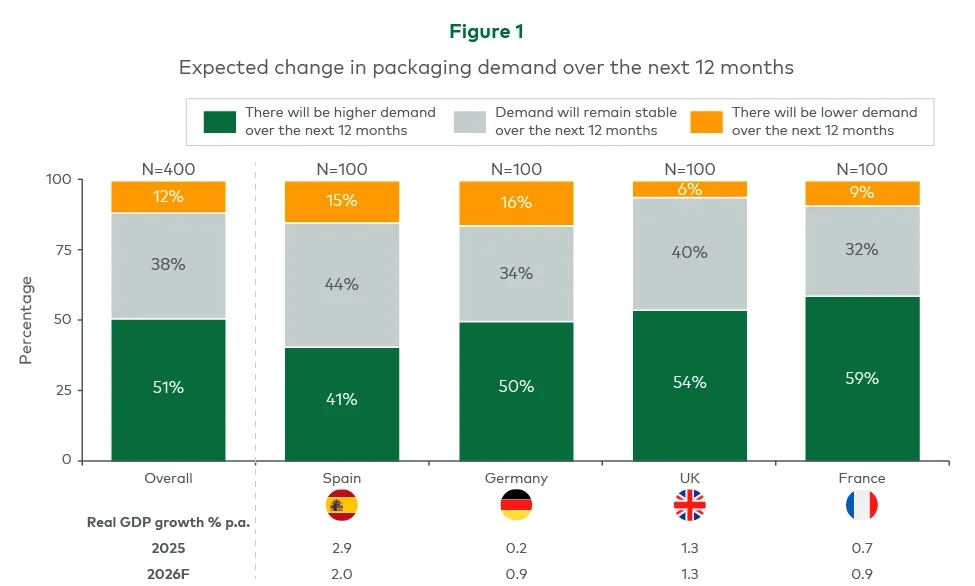
Survey results indicate a more balanced outlook. Around half of respondents expect packaging demand to increase over the next 12 months, with a further approximately 40% anticipating stable volumes (see Figure 1). This points to a market that is no longer contracting but not yet returning to sustained expansion.

Image
Figure 1 represents expected change in packaging demand over the next 12 months
Image
Figure 1 represents expected change in packaging demand over the next 12 months

The recovery is also uneven across geographies. France and the UK show relatively stronger momentum, while Germany and Spain remain more cautious. These differences reflect broader economic divergence as well as variation in category mix and consumer demand resilience.

Demand recovery is underway, but remains constrained

The current demand outlook reflects a market transitioning from volatility to stability. The sharp fluctuations seen during recent years, driven by pandemic effects, supply chain disruption and inflation, have largely subsided. However, the underlying growth profile remains modest.

Two factors are shaping this environment. First, macroeconomic conditions continue to weigh on consumption in several key markets. Second, overcapacity across parts of the packaging value chain is limiting the extent to which volume growth translates into improved utilisation and pricing.

As a result, the near-term outlook is best characterised as stabilisation rather than expansion. Growth is returning, but at a measured pace and with limited visibility on sustained acceleration.

Category growth is diverging

Demand expectations vary significantly by end market. Beauty and personal care is the standout category, with 68% of brand owners expecting demand to increase over the next 12 months. Beverage and healthcare, pharma and wellness also remain relatively robust, both at 55%. At the other end of the spectrum, food and foodservice is more subdued at 45%, while household and pet food appears weakest, with only 33% expecting growth.

These differences reflect underlying category dynamics. Higher-growth segments tend to combine innovation intensity, premiumisation opportunities and stronger consumer demand resilience. More mature categories, particularly those exposed to price-sensitive consumers, face slower recovery and greater pressure on volumes.

Beyond category dynamics, cost pressures continue to shape packaging decisions, even as demand stabilises. Around 69% of European brand owners expect packaging costs to increase over the next year, reinforcing the persistence of inflationary pressure across materials and supply chains.

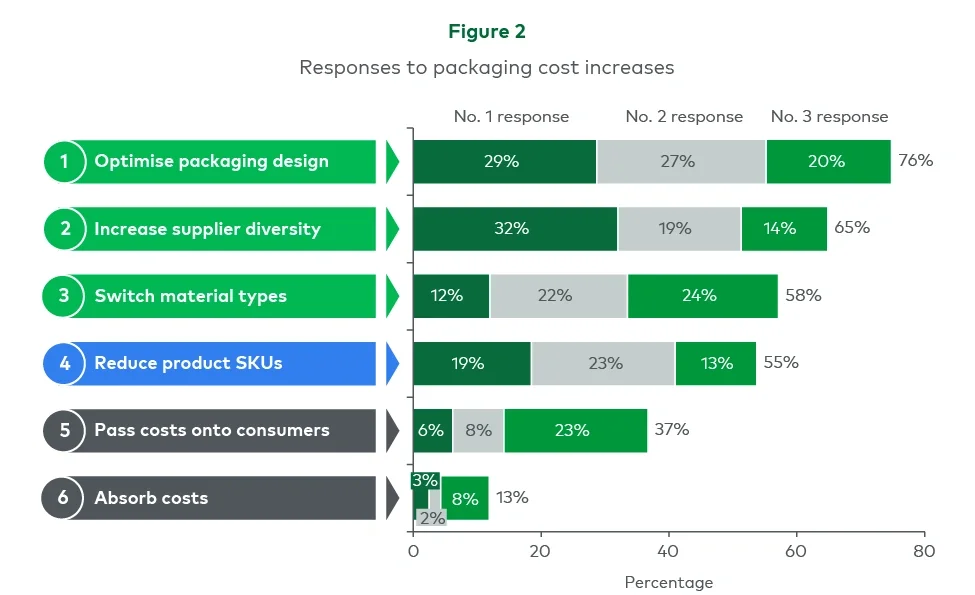
However, the primary response is not to absorb or pass through these increases, but to adjust packaging itself. Most respondents prioritise packaging design optimisation, alongside actions such as supplier diversification and material substitution (see Figure 2).

While cost pass-through remains part of the toolkit, its effectiveness is increasingly constrained. Consumer pricing has risen materially in recent years, outpacing income growth in many markets. As a result, retailers are under pressure to maintain price competitiveness and are pushing cost increases back through the value chain.

This design-led approach marks a clear distinction from the US, where brand owners are more likely to rely on pricing actions. In Europe, packaging is increasingly treated as a controllable lever within the cost base, with less reliance on pass-through as the primary mechanism for managing cost increases.


Image
Figure 2 represents responses to packaging cost increases
Image
Figure 2 represents responses to packaging cost increases

Private label is reshaping volume dynamics

Consumer behaviour is playing an increasingly important role in shaping packaging demand. The continued expansion of private label is a central factor.

Survey responses indicate that nearly half of brand owners expect private label consumption to increase, with 25% expecting part of this shift to persist over the longer term. This suggests that part of the recent downtrading cycle may become structurally embedded.

For packaging demand, this has two implications. First, volume growth may increasingly be concentrated in private label segments, often with different packaging requirements and cost expectations. Second, branded portfolios may need to adapt, either through repositioning or through changes in packaging formats and specifications.

At the same time, packaging spend as a share of retail selling price is expected to increase in several categories, including healthcare, beauty and personal care and consumer electronics.

This suggests value growth may continue even where volumes remain constrained, driven by material choices, functionality requirements and evolving consumer expectations.

Supply chain shifts continue to influence demand

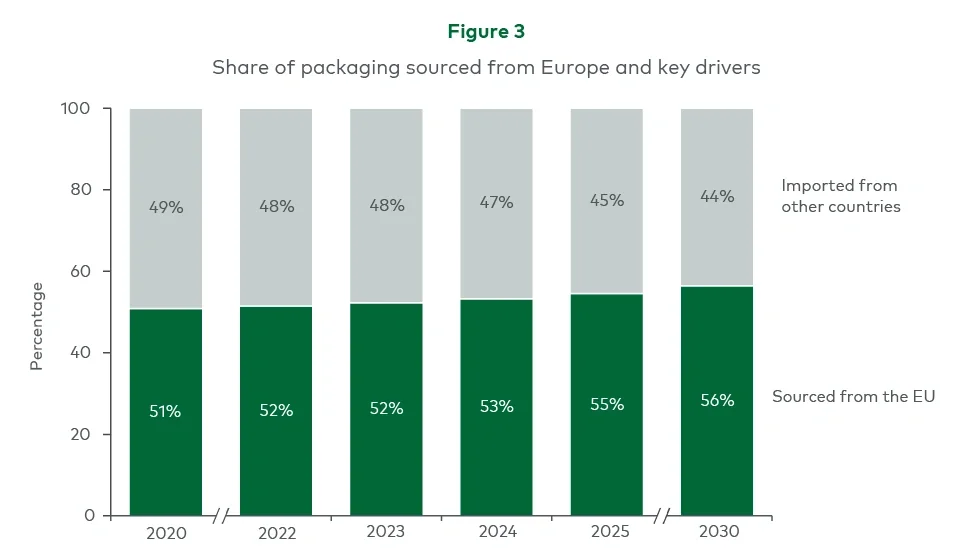
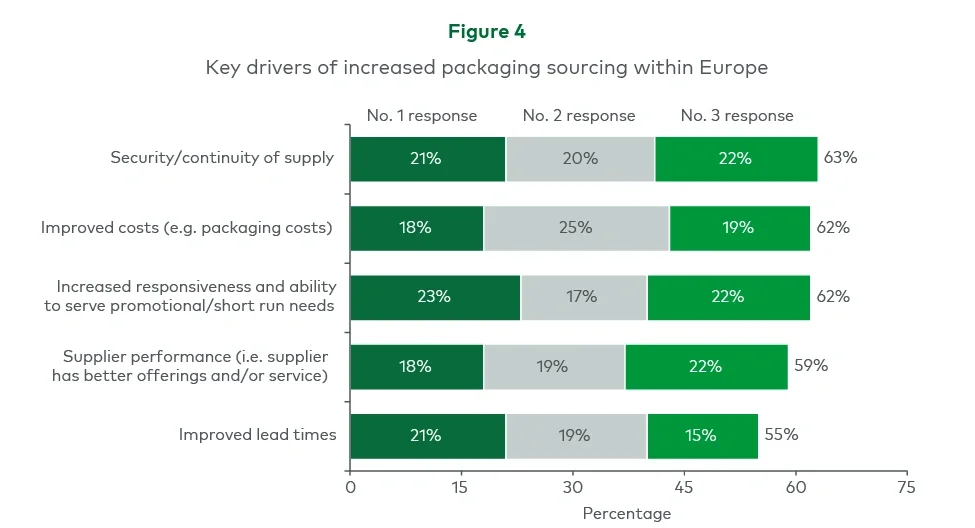
Changes in sourcing strategy remain an important driver of packaging demand patterns. European brand owners are continuing to increase the share of packaging sourced within the region, primarily to improve security of supply and manage costs (see Figure 3). The key drivers of this shift are security of supply and cost, with responsiveness also remaining an important consideration (see Figure 4).

Image
Figure 3 represents share of packaging sourced from Europe and key drivers
Image
Figure 3 represents share of packaging sourced from Europe and key drivers

This shift towards regionalisation supports demand for local packaging capacity, even in a low-growth environment. It also increases the importance of responsiveness, reliability and proximity to customers as competitive differentiators.

External factors are adding further complexity. US tariffs are having a mixed impact on packaging demand, with 40% of European brand owners reporting an increase in volumes, compared with 23% reporting a decline.

This variation reflects differences in category exposure and supply chain structure. In some cases, tariffs are driving short-term increases in packaging demand through inventory builds and sourcing shifts within Europe. In others, they are reducing demand where trade flows have shifted towards domestic or lower-tariff supply routes.

The implication is that tariffs are less a direct driver of demand growth and more a source of volatility, requiring packaging suppliers to manage both structural shifts in sourcing and short-term fluctuations in volumes.

Image
Figure 4 represents key drivers of increased packaging sourcing within Europe
Image
Figure 4 represents key drivers of increased packaging sourcing within Europe

Implications for the packaging value chain

The demand environment for European packaging is improving but remains selective. Growth is uneven across categories and shaped by shifts in consumer behaviour and ongoing supply chain adjustments.

For packaging suppliers and investors, several priorities emerge. Exposure to higher-growth segments such as healthcare and beauty & personal care is increasingly important, as is the ability to serve both branded and private label demand effectively. Regional footprint and supply chain responsiveness are becoming more critical as sourcing continues to localise.

At the same time, operational discipline remains essential. With brand owners prioritising packaging redesign, material switching and supplier diversification and with limited scope for sustained cost pass-through, pricing pressure is likely to persist.

Companies that align their portfolios to areas of relative growth, while maintaining flexibility in capacity and sourcing, will be better positioned to capture value in a constrained market.

In the next article, we examine how sustainability priorities are evolving and what this means for packaging materials and design choices.

To discuss how these trends apply to your business, please contact us.

L.E.K. Consulting is a registered trademark of L.E.K. Consulting LLC. All other products and brands mentioned in this document are properties of their respective owners. © 2026 L.E.K. Consulting LLC

English