Education Pulse Survey

Priorities and Perspectives from K-12 and Higher Education Administrators
February 24, 2026

English
Image
US Footwear, Apparel, and Accessories Brand Heat Index report cover
Special Report

2026 US Footwear, Apparel, and Accessories Brand Heat Index

Get the full breakdown — see which brands are winning and what is driving their heat across categories, generations and genders.
February 24, 2026

The race for brand heat is tighter than ever. L.E.K. Consulting’s 2026 Brand Heat Index reveals which footwear, apparel and accessories brands are capturing attention, which are gaining momentum and how heat varies across gender and generation.

Based on a survey of approximately 6,000 U.S. consumers ages 14 to 55 who have purchased footwear, apparel or related goods in the past 12 months, the report measures relative brand popularity across major categories using a standardized heat index, with consumers evaluating approximately 650 brands.

In 2026, outdoor and athletic categories continue to generate the highest heat scores overall, competition at the top is increasingly tight and premium brands are rising across multiple segments. For the first time, this year’s Index also includes Bags & luggage, as well as Outdoor equipment & sporting goods, expanding the view of brand momentum beyond footwear and apparel into accessories and gear.

Highlights from this year’s findings

  • Outdoor and athletic categories continue to have the highest heat scores overall, as consumers look to these brands for both performance and lifestyle occasions.
  • Competition at the top is intensifying, with seven out of 16 footwear and apparel categories showing the top three brands within 10 points of one another.
  • Premium brands are rising across categories, with accessible luxury performing particularly well in dress and select footwear segments.
  • Brand heat differs meaningfully by gender and generation, with women and younger consumers featuring a higher proportion of newcomer brands in their Top 10 rankings.
  • Bags & luggage and outdoor equipment & sporting goods make their debut this year, with digitally native and recreation-driven brands showing strong cross-generational relevance.

What is driving these shifts? Consumer feedback indicates that a strong, authentic social media presence is a core driver of brand heat, particularly among younger generations, where social-native emerging brands appear in multiple Top 10 lists. Generational and gender differences play a critical role in shaping brand momentum, requiring targeted and segment-specific strategies to win.

With emerging brands gaining ground, premium players climbing the ranks and competition tightening across categories, understanding brand heat at a granular level has never been more important.

Talk to us

Curious about what it takes to build brand heat in your increasingly competitive market? Let’s explore where you stand, what could unlock brand heat and where you could go next.

English
Executive Insights

AI at First Launch: Key Use Cases for Biotechs

February 23, 2026

Key takeaways

Biotechs face a commercialization gap: Lean teams, limited infrastructure, and tight budgets make it hard to match large-pharma launch sophistication without overspending; however, AI can expand capacity without additional headcount, but real value comes from a focused set of practical use cases — not broad enterprise platforms.  


Three applications consistently deliver strong ROI for first-time launches: Agentic field-force copilots, market access automation for FRMs and lightweight data-driven commercial operations.  

Evidence shows meaningful gains — higher field productivity, faster payer resolution, and far less manual analytics — achievable with modest investment.  


Biotechs succeed by starting narrow, staying compliant, embedding AI into daily workflows, and scaling over time, achieving pharma-grade precision without pharma-grade overhead.  

The challenge

Scaling from a development-stage biotech to a fully commercial organization is a pivotal moment in value creation, but it also brings greater operational complexity and financial risk. To manage this inflection point, emerging biotechs often adopt intentionally lean commercial models, including small field teams, tight budgets, limited customer-support capacity and fragmented data infrastructure.

These choices allow companies to move fast and preserve capital, but their limitations become increasingly noticeable as the business grows. Advanced commercial capabilities become practical only when true scale is achieved — typically when a company has multiple products on the market. At that stage, organizations can fully benefit from sophisticated approaches such as broad omnichannel campaigns, vendor-driven analytics, enterprise next-best-action engines, and comprehensive patient and provider support services. Before reaching scale, however, these capabilities are often too expensive, too complex and misaligned with near-term ROI. As a result, emerging biotechs must learn to commercialize effectively with less — prioritizing targeted investments, streamlining operating models, and implementing pragmatic data and technology strategies that balance ambition with reality.

This article highlights a set of novel AI use cases, proven in large pharma, that can be adapted to smaller biotechs as they prepare for their first launch.

A focus on commercial efficiency

The promise of AI is, in part, to give smaller biotechs a practical way to narrow the commercial gap with larger pharma companies. But capturing the early value of that promise depends on focusing on a few targeted use cases — those that directly address the most pressing bottlenecks at launch.

A disciplined approach to AI enables biotechs to expand their operational capacity and impact without adding headcount.Three proven AI applications in drug commercialization consistently deliver positive returns and can be realistically implemented by biotechs preparing for their first launch.

1. Meeting efficiency and agentic field force copilots

The first suggestion is obvious. Make sure your teams have operationalized the meeting efficiency features that you probably already own! These include AI based meeting prep tools and meeting close out tools, such as transcription and CRM management features.

Beyond the basics, AI copilots can help lean sales teams operate with the efficiency of a much larger force — planning routes, sequencing HCP visits, generating compliant personalized content and linking CRM data to specific account activities. These capabilities boost day-to-day productivity, and they also strengthen the foundation for more advanced commercial processes.

One of the most important of those processes is dynamic targeting, which many biotechs rely on to find the right patients and prioritize the right accounts. Agentic copilots can enhance this system by feeding real-time signals back into the CRM targeting loop, improving both accuracy and efficiency. By drawing on broader data sources — claims, referral patterns, digital interactions — copilots can uncover insights such as predicting early adopters or emerging high-value accounts that would otherwise remain hidden.

Not every biotech needs copilot support, especially those selling into a small set of specialized centers with well-defined patient populations. But for lean field teams operating in more diffuse markets, copilots can be used selectively — for example, when prospecting beyond a core HCP call list — to extend reach without disrupting a relationship-driven model.

What the research shows

L.E.K. Consulting’s experience indicates that 10% to 15% of AI use cases deliver roughly 80% of the value, with field productivity consistently among the top drivers. Public examples support this pattern. J&J’s Rep Copilot, which manages automated call planning and routing, was one of the few pilots that proved ROI-positive. Several large pharma companies, including Takeda, Pfizer and Sanofi, have also adopted Salesforce’s Life Sciences Cloud, an agentic platform used for hyper-personalized HCP engagement, route optimization and automated sampling. 

How this fits the biotech model

In a competitive landscape where large pharma sets the standard for launch excellence, biotechs can close the gap by systematically turning CRM insights into targeted, scalable commercial actions. Lean field teams can expand their effective reach by optimizing call plans, prioritizing high-value interactions and personalizing engagement through integrated CRM-driven insights.

Risks and mitigations

Buy rather than build. Start narrow (e.g., scheduling and call preparation). Ensure CRM data is clean.

2.Market access automation: Amplifying the reach of FRMs

Prompt and proactive handling of payer hurdles can shape a launch trajectory as much as prescriber willingness to adopt a new therapy. In specialty areas like rare disease and oncology, field reimbursement managers (FRMs) play a critical role in helping physicians and patients navigate prior-authorization requirements, denials, appeals and benefit verification. Yet biotechs typically have only a small FRM team, and limited support can lead to delays that put patients at risk and weaken a brand’s competitive position.

Compounding the challenge, large FRM deployments and practice support services have conditioned many practices to expect hands-on support for even routine PA steps. AI can help bridge this gap by extending the productivity and reach of reimbursement teams, enabling small FRM groups to manage more cases, support more prescribers and reduce time to therapy.

What the research says

Biotechs have several practical options for expanding reimbursement capacity through AI and automation. Many industries already use chat-based triage to route work efficiently, and similar tools can help FRMs prioritize cases. Paperwork can be scanned and basic fields auto-completed while preserving patient anonymity, and custom LLMs, as Novartis demonstrated with Alia in medical communications, can support compliance.

Existing networks such as Surescripts also enable “touchless” prior authorization and real-time benefit checks, reducing cycle times. Automation tools can pre-fill payer forms and generate real-time status alerts. And when claims are denied, AI-driven appeal solutions such as Waystar’s Altitude Create can automate appeal letters, surface insights on appeal pathways and escalate stalled cases — helping small teams manage a higher volume with greater precision.

Fit for biotechs

Instead of scaling FRM headcount linearly, AI copilots can take on the repetitive, time-consuming tasks of case management, allowing FRMs to concentrate on the complex situations that truly require human judgment. This creates meaningful leverage, enabling a small FRM team to support far more providers and patient cases across geographies.

Risks and mitigations

Transparency and oversight must be maintained. Poorly governed automation can trigger payer pushback, so all payer-facing materials must remain compliant and fully auditable. Compliance should be built early as an enterprise capability — even before a biotech’s first commercial launch — and applied consistently across new platforms.

3.Smarter commercial operations

AI can transform how biotechs access, analyze and act on commercial data. For lean organizations that cannot support large pharma’s full “customer 360” engines, the opportunity lies in adopting a focused orchestration layer that turns disparate data into clear, actionable priorities. With a disciplined approach, biotechs can own the intelligence while renting the underlying infrastructure, turning data into a true competitive asset.

Practical solutions include dynamic patient-finding and targeting tools that improve efficiency and help resolve growth slowdowns at the district or regional level. AI can also automate many of the manual dashboarding and data-management tasks that consume commercial and field-leadership time, allowing business insights teams to concentrate on higher-value analysis.

AI is likewise reshaping commercial content creation and approval. Without discipline, biotechs risk generating too much content with too little impact. Staying effective requires AI that accelerates the creation of high-value assets while streamlining MLR review and ensuring compliance.

What the research says

Industry analyses find that refreshing dynamic targeting weekly, instead of quarterly, accelerates the adoption of new insights and strengthens HCP engagement. Data and CRM providers also report that AI-enabled sales force effectiveness can significantly expand field capacity without increasing headcount.

Across our biotech work, we’ve seen business insights teams spend 15% to 20% of their time manually generating reports, often limited to lagging indicators. For a typical biotech BIA team, this can amount to one FTE each year — time and resources that should instead be focused on developing predictive insights for decision-makers.

Fit for biotechs

For emerging biotechs, the goal isn’t to replicate large-pharma complexity; it’s to build a lightweight, agile operating system for commercial execution. By owning the orchestration logic (targeting, prioritization, messaging) and renting data infrastructure, biotechs can stay nimble, scale efficiently and avoid vendor lock-in as the organization evolves.

Risks and mitigations

Start by owning orchestration and insights, not the raw data infrastructure. Ensure unified data governance (see Figures 1 and 2). 

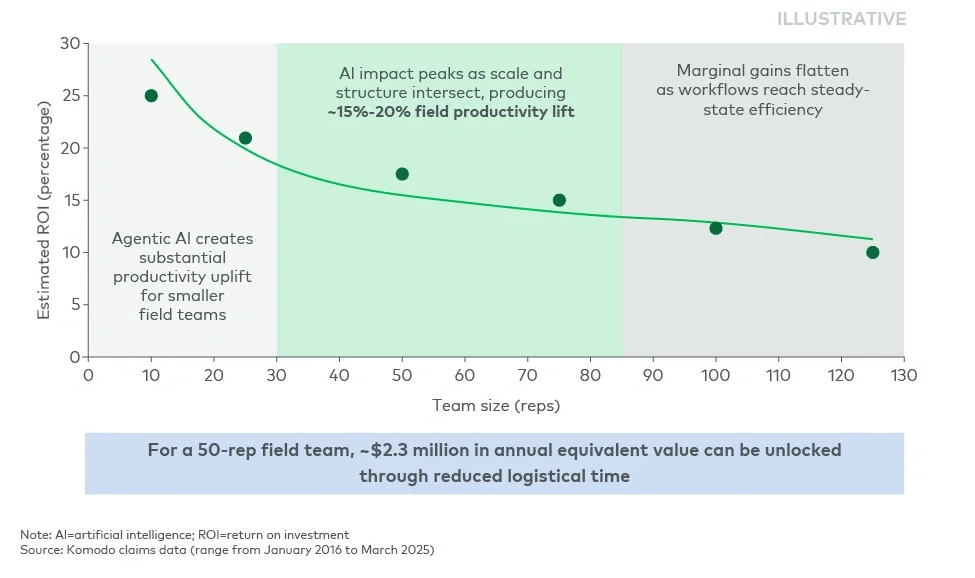
Copilots increase biotech field force efficiencies

Introducing an AI Rep Copilot can deliver substantial productivity gains. Below is an illustrative model based on conservative assumptions from industry pilots and benchmarks.


Figure 1

Agentic AI ROI 

Image
Figure 1 . Agentic AI ROI

Figure 1

Agentic AI ROI 

Image
Figure 1 . Agentic AI ROI

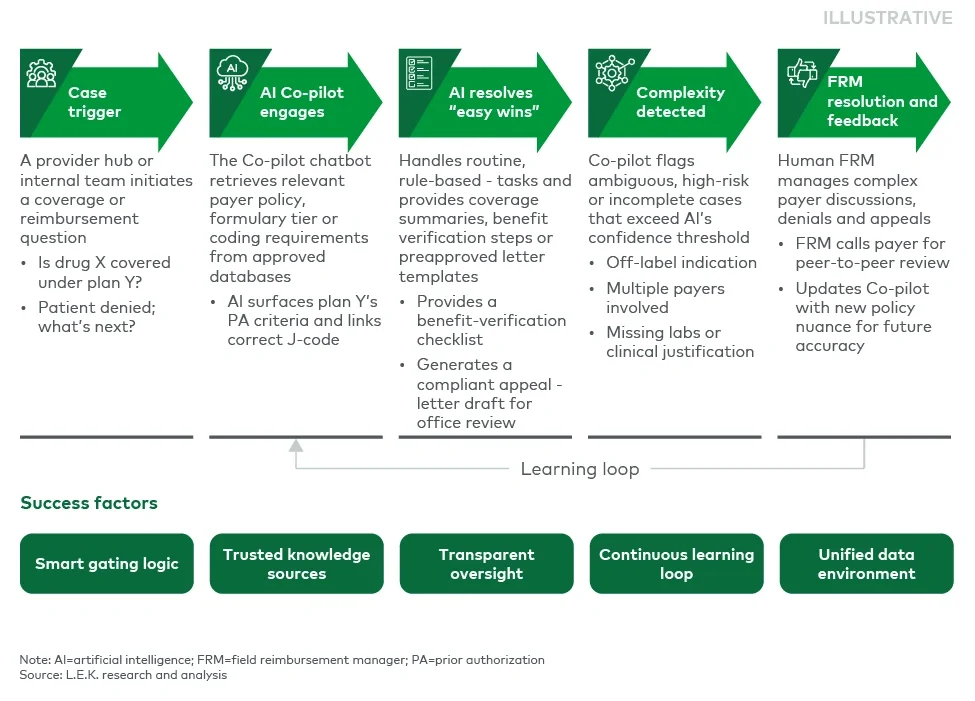
Agentic PA processing to enable FRM support

Agentic support for PA denial processing can leverage workflows from adjacent industries and deliver successful outcomes.

Figure 2

AI-to-human field reimbursement management triage flow

Image
Figure 2 . AI-to-human field reimbursement management triage flow

Figure 2

AI-to-human field reimbursement management triage flow

Image
Figure 2 . AI-to-human field reimbursement management triage flow

Takeaways for executives

Biotechs can easily overlook where AI truly adds value in commercialization, whereas often that caution is warranted. It prevents unnecessary spend, complex implementations and chasing hype. But with the right guidelines, commercial leaders can pinpoint a small set of AI applications that reliably deliver positive ROI and avoid expensive change management later. These include:

  • Starting narrow with tools that expand scale (rep scheduling, PA automation, predictive patient-finding) and building from there
  • Prioritizing use cases that work without scale, and deferring broad NBA or omnichannel systems until the organization is larger
  • Designing your GTM model to scale up around these high-ROI applications, especially for first launches
  • Embedding AI into daily workflows, treating copilots as extensions of sales, access and medical teams
  • Done well, these steps give first-time biotechs pharma-grade precision and efficiency — without pharma-grade overhead.

For more information, please contact us

L.E.K. Consulting is a registered trademark of L.E.K. Consulting LLC. All other products and brands mentioned in this document are properties of their respective owners. © 2026 L.E.K. Consulting LLC 

English

Europe’s Sustainable Food Shift: Where the Next Wave of Value Creation Lies

February 18, 2026

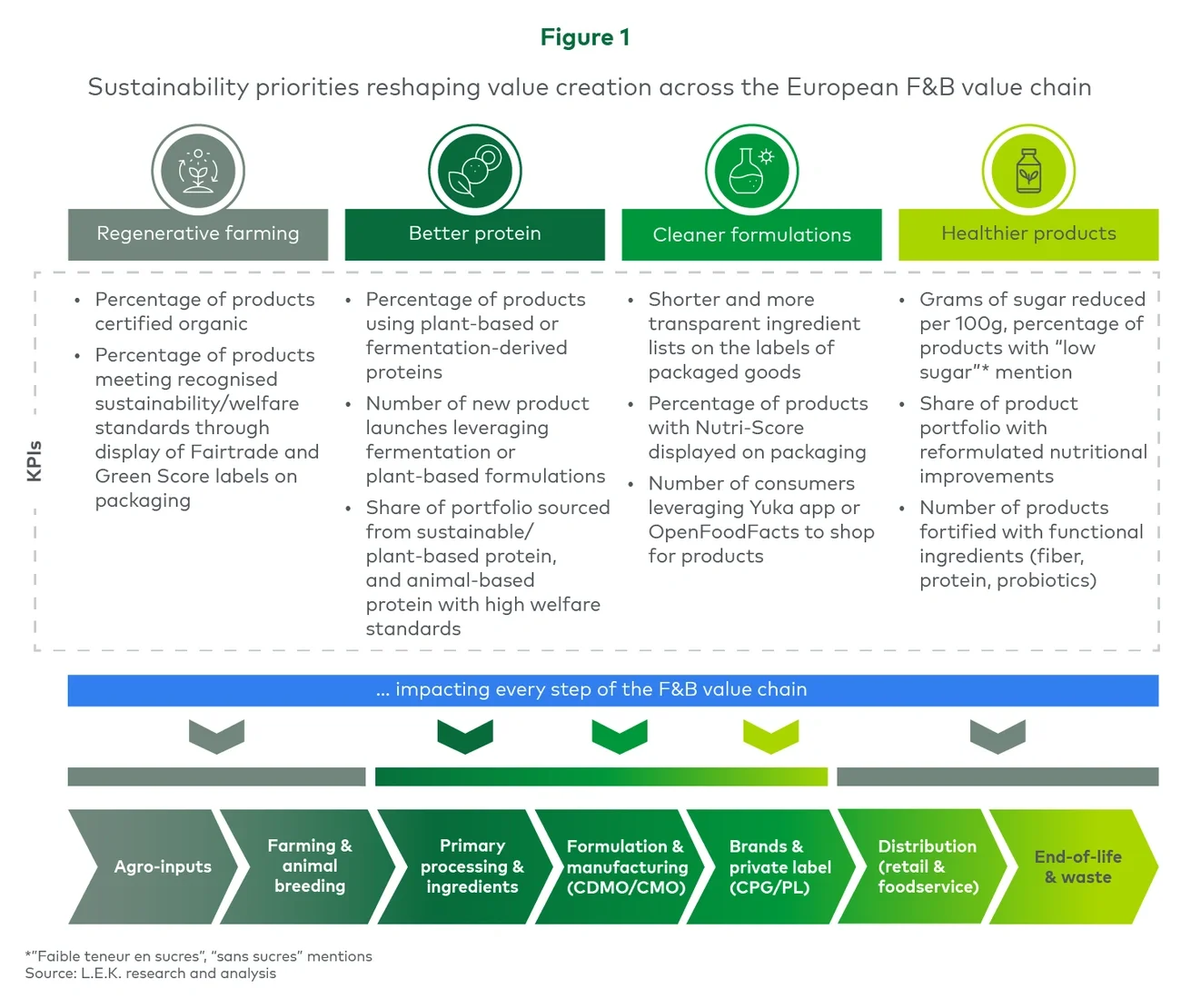
Across Europe, the pursuit of healthier and more sustainable diets is reshaping supply chains and product portfolios. What began as a movement among conscious consumers now influences how value is created and captured across the food and beverage sector (see Figure 1).

Image
Europe sustainable food shift figure 1
Image
Europe sustainable food shift figure 1

At a recent lunch on the topic, hosted in partnership with Lincoln International, we illustrated how this shift has gathered pace.

A shift in consumer behaviour

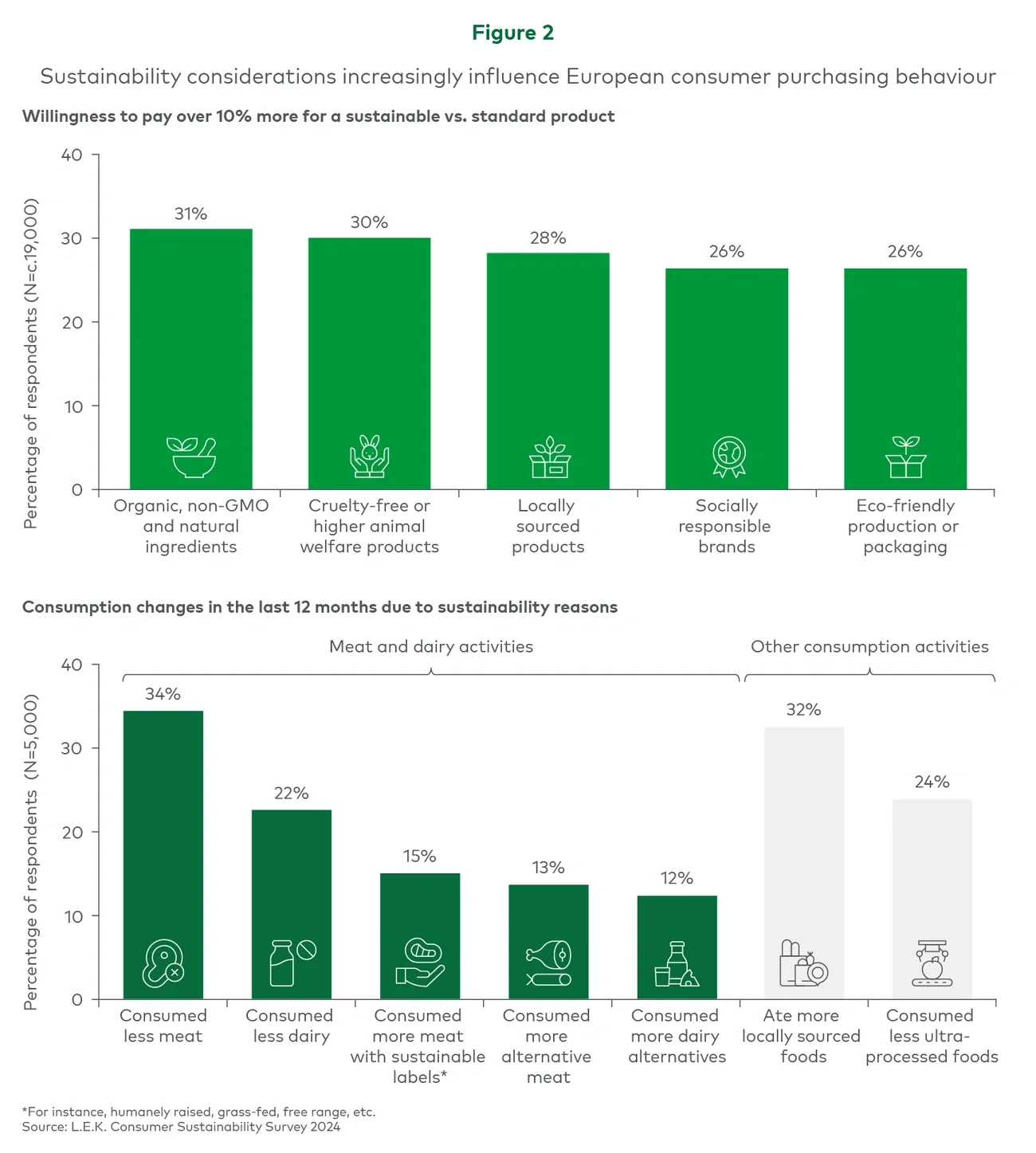
European consumers have moved beyond signaling good intentions. They are changing what they buy and how they assess quality, even in the face of squeezed disposable incomes (see Figure 2).

Image
Europe sustainable food shift figure 2
Image
Europe sustainable food shift figure 2

L.E.K.’s 2024 Sustainability Survey found that almost 60% are willing to pay more for products with proven nutritional benefits, and nearly half now seek sustainable alternatives even in tighter economic conditions.

Digital transparency tools such as Yuka have also made product data an everyday reference point, reinforcing accountability across brands.

Policy pressure with commercial consequences

Europe’s regulatory framework is no longer an abstract goal-setting exercise. The Farm to Fork Strategy and Common Agricultural Policy are directing substantial funding toward organic and regenerative production. Updated labelling and information standards are tightening definitions and rewarding verifiable sustainability claims.

Increasing consumer demand and regulatory measures have created clear incentives for manufacturers to reformulate, although progress varies by category and price tier. Major food companies have reduced additives, cut sugar and salt, and introduced nitrite-free product lines in response to Nutri-Score and consumer scrutiny.

The result is a more transparent and disciplined market in which compliance and competitiveness increasingly align.

Innovation and capital flow through the value chain

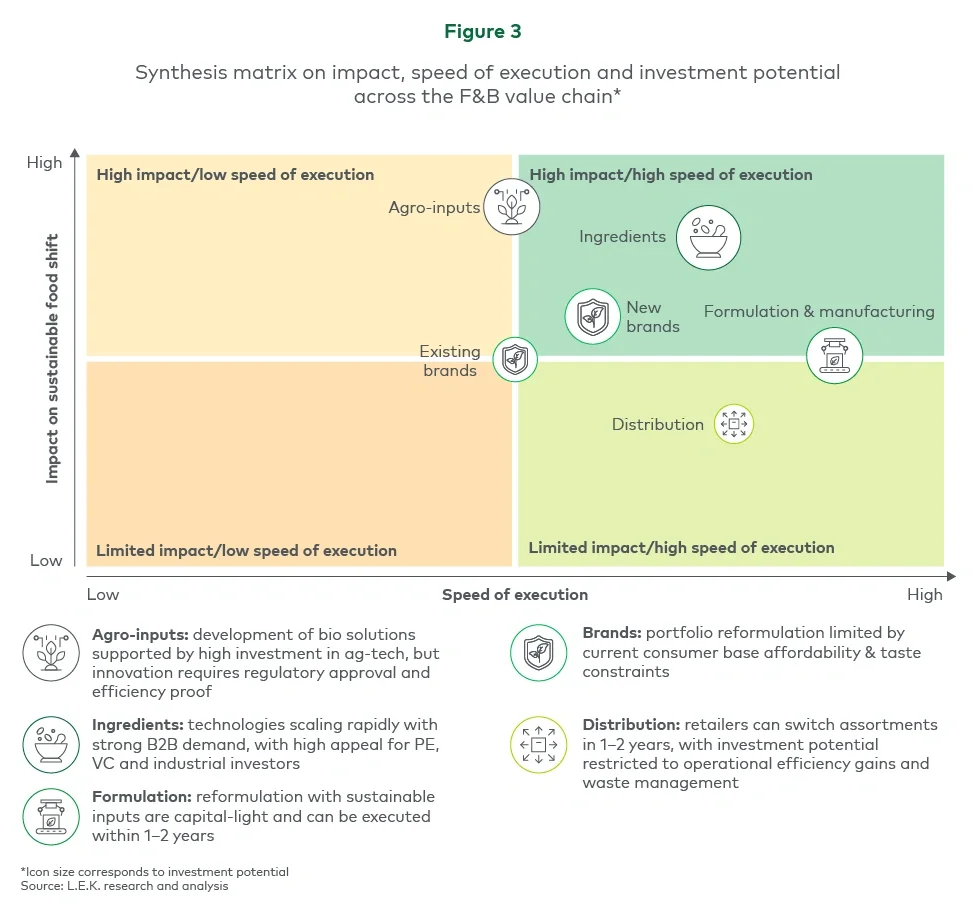
The transition is generating distinct areas of opportunity across the value chain. Below, we identify four in particular:

  • Biostimulants and regenerative inputs: Biological solutions are improving yields and soil resilience while reducing fertiliser use. The European biostimulants market, now around $1.4 billion, is expanding at roughly 10% a year, driven by better product performance and strong policy support.
  • Clean-label functionality: Ingredient innovation continues to be driven by the naturalisation of formulations (replacement of synthetics, shorter and more recognisable ingredient lists), while increasingly focusing on delivering taste and texture parity with conventional products to secure repeat purchase.
  • Traceability and sourcing systems: Digital platforms and certification networks are turning supply-chain transparency into measurable equity.
  • Waste reduction and upcycling: Waste management is shifting from compliance to efficiency, capturing new value in energy, ingredients and logistics.

Each area is underpinned by investable science, repeatable business models and visible environmental impact (see Figure 3).

Image
Europe sustainable food shift figure 3
Image
Europe sustainable food shift figure 3

Investment momentum and consolidation

Recent M&A activity across Europe shows where strategic investors are placing their bets. Ingredient and formulation specialists have attracted sustained attention, offering scalability and steady B2B demand. Regenerative farming platforms and biocontrol companies appeal to investors seeking IP-based defensibility and predictable returns. Emerging brands, meanwhile, are focusing on verified sourcing and functional nutrition as differentiators.

Sustainability is proving to be an engine of pricing power and brand preference. Capital is following the operators that can demonstrate both environmental and financial performance.

However, critical challenges remain. Price-sensitive consumers still limit the reach of organic products; flavour and texture continue to constrain plant-based adoption; and inconsistent labelling erodes trust. Each issue has a technical solution: cost reduction through regenerative sourcing and scale efficiencies, sensory improvement through R&D partnerships, and transparent certification backed by evidence rather than claims.

The strategic horizon

Our analysis points to a set of clear priorities for executives hoping to shape the pace of progress:

  • Strengthen supply-chain resilience and cost competitiveness through regenerative, diversified and more efficient sourcing models.
  • Accelerate ingredient naturalisation at scale, while ensuring sensory and functional parity with conventional formulations.
  • Embed verified data and certification to build trust, ensure compliance and support credible sustainability claims across the product lifecycle.

The sustainable food shift is well underway, but unlocking its full potential depends on converting it into disciplined strategy and measurable results — while addressing the constraints that could otherwise slow mainstream adoption.

Contact us to find out more.

L.E.K. Consulting is a registered trademark of L.E.K. Consulting LLC. All other products and brands mentioned in this document are properties of their respective owners. © 2026 L.E.K. Consulting LLC

English
Image
Look Forward 2026 Report thumbnail
Special Report

Look Forward 2026: Strategic Priorities for Creating Value

L.E.K. Consulting’s annual perspectives on the strategic priorities shaping the year ahead
February 11, 2026

As organisations enter 2026, uneven growth, tighter capital discipline and sustained cost pressure are reshaping how value is created. Across sectors, leadership focus is shifting from ambition to delivery — with pricing, productivity and digital execution now central to performance.

Look Forward 2026 brings together L.E.K. Consulting’s perspectives on the strategic priorities shaping the year ahead, outlining what organisations need to do to deliver performance and create value in a more demanding environment.

Sectors covered

  • Consumer – Capturing value more deliberately
  • Financial Services – Scaling advice and productivity
  • Healthcare – Redesigning access, delivery and economics
  • Industrials – Focusing on performance and resilience
  • Life Sciences – Responding to pressure across the value chain
  • Transport & Logistics – Competing beyond capacity


Explore the full report

Read Look Forward 2026 online or download a copy to examine the cross-sector forces shaping 2026, the priorities facing leadership teams, and how organisations are converting strategy into execution and value creation.

Want to discuss the implications for your organisation?

If you would like to explore how the themes in Look Forward 2026 apply to your sector or organisation, please contact one of the authors.

English
Image
The Biopharma Imperative

The Biopharma Imperative

L.E.K. Insights on Innovation, Growth, and Competitive Advantage
February 11, 2026

This collection brings together a focused selection of L.E.K. Consulting’s perspectives on the forces reshaping life sciences and biopharma. The sector continues to push at the boundaries of scientific possibility while navigating capital constraints, accelerating competition and rising expectations from patients, regulators and investors. The pieces included here examine those pressures with clarity and offer practical guidance on how leaders can respond with confidence.

Our insights highlight the strategic consequences of rapid advances in areas such as radiotherapeutics, next—generation oncology partnerships, AI and quantum computing. We also explore the commercial realities facing organisations as they compete in fast—moving therapeutic markets, reassess portfolio priorities, raise R&D productivity and operate in a more selective funding environment. Across these topics, a consistent message emerges: competitive advantage will rest with organisations that pair scientific ambition with disciplined decision—making and operational focus.

At L.E.K., we help clients interpret change and convert it into decisive action. By distilling market signals, emerging opportunities and the pressure points that matter most, this collection offers leaders a clear view of what it takes to steer successfully through a period of structural shifts.

For further insights into our analysis, download the full booklet.

Contact us for more information.

L.E.K. Consulting is a registered trademark of L.E.K. Consulting LLC. All other products and brands mentioned in this document are properties of their respective owners. © 2026 L.E.K. Consulting LLC

English
Subscribe to