
Executive Insights

No Insurer Wins Alone: Competing in the Ecosystem Era

February 12, 2026

Key takeaways

For decades, vertical integration has been the hallmark of the insurance industry’s strength.  

Ecosystems are now redefining value creation across connected home, mobility, health, wealth and small business.  

In a market that is increasingly defined by speed, data and interconnected experiences, distance between the insurer and the end customer is a competitive liability.  

In this context, the question is no longer whether insurers should participate, but what role they will play. 

For decades, vertical integration has been the hallmark of the insurance industry’s strength. Many carriers built closed systems and outsourced noncore processes/services to vendors governed by service-level agreements (SLAs). In many lines, insurers also relied on independent agents and other third parties as primary distribution, which further reduced direct customer interactions. While the model delivered predictable operations, these structures often left insurers one step removed from customers.

In a market that is increasingly defined by speed, data and interconnected experiences, that distance has become a competitive liability. SLAs created structural blind spots for insurers by separating vendor performance from customer outcomes. Additionally, new and expanded distribution channels (e.g., aggregators, marketplaces, consumer products) have further isolated insurers from the end customer. Without customer access, carriers are starved of the insight needed to innovate, differentiate and compete at market speed.

Legacy servicing and sales models can’t keep up. Incumbent service providers have been slow to adapt, burdened by legacy systems and a reluctance to build and sustain the partnerships needed for innovation. Their belief that emerging models wouldn’t stick has become a costly strategic misread, leaving insurers disconnected from the important moments that build loyalty and trust.

Ecosystems are now redefining value creation across connected home, mobility, health, wealth and small business. These ecosystems are interconnected networks of companies that collaborate to serve customer needs in a unified, seamless experience — often orchestrated through shared data, APIs and digital infrastructure. This model replaces fragmented, vendor-driven handoffs with aligned incentives and continuous engagement. 

In this context, the question is no longer whether insurers should participate, but what role they will play. In this Executive Insights, L.E.K. Consulting examines the benefits of ecosystem participation, compares participation models and outlines a path for carriers to compete in a future defined by collaboration, not control. 

P&C insurers must embrace partnerships to stay competitive

Historically, customers pieced together solutions on their own, buying P&C coverage here and benefits coverage there. Carriers catered to this by being product-driven organizations. Today’s buyers are different; they want solutions and experiences built specifically for them.

They’re no longer comparing insurers to other insurers. Instead, they’re holding the industry to the elevated experience and service standards set by Amazon, Uber and other digital leaders — holistic, personalized, always available, seamlessly executed and connected across a broader portfolio of needs.

Insurance companies that once dominated the industry, leveraging a vertical integration model, have lost their edge. To compete effectively now, they must overhaul operating models, integrate and update technology, and produce products that customers want. New models such as embedded distribution, usage-based offerings and integrated service platforms are reshaping how customers buy and engage. To close innovation and customer journey gaps, insurers will have to participate in ecosystems powered by strategic partnerships.

Winning insurers will stop asking “How can I serve my customer?” and instead ask “How can we, together, deliver what the customer truly needs at the moment they need it?” Insurers that continue to leverage a self-contained model will risk missing out on new customers, channels and capabilities. To capitalize, they need to stop treating service partners as vendors or interchangeable add-ons, and start seeing them as cocreators of a broader customer experience and solution, innovation collaborators and market extenders.

No insurer controls the customer journey alone. Today, success requires partnership.

Ecosystem leaders in action

These dynamics aren’t just theoretical. Ping An, Marsh and Uber are examples of how insurers can create competitive advantages by redefining their role in ecosystems.

Ping An

Ping An is one of the world’s most valuable insurance groups and has evolved into an ecosystem orchestrator serving more than 240 million retail customers. Since 2008, it has rebuilt its model around technology and connected ecosystems across financial services, insurance, banking and asset management, in addition to health, auto services and smart city solutions. This structure links internal platforms with a broad network of third-party partners to deliver more comprehensive offerings.

For example, the Auto Owner app brings together insurance functions and automotive aftermarket services, giving car owners a single place to manage claims, request roadside assistance, and book repairs or maintenance through an extensive network of external service providers. This integrated approach boosts cross-selling and retention. Customers holding four or more contracts have a 98% retention rate, far higher than single-product users.

By connecting services and channels across its ecosystem, Ping An makes it easier for customers to adopt multiple products, increasing overall stickiness.

Marsh

Amazon requires all third-party sellers to carry product liability insurance, safeguarding their businesses against costly claims or legal action resulting from defective products or accidental damage. To make coverage easier and more affordable, Amazon partnered with Marsh to launch the Amazon Insurance Accelerator. This program connects sellers with a curated network of top small-business insurers.

Through a simplified application process, sellers can obtain competitive quotes and policies that are both Amazon-compliant and tailored to their specific risks.

Uber

Uber has built a global mobility ecosystem that connects riders, drivers, vehicle providers and service partners on a single platform. Insurance plays a critical but embedded role within this ecosystem. To meet varying regulatory and risk requirements, Uber maintains commercial auto insurance on behalf of drivers, working with different insurance carriers across states and renewing these arrangements regularly so coverage aligns with local requirements. Coverage for drivers is integrated directly into the platform, activated dynamically based on trip status and usage, and designed to remove friction for both drivers and riders.

By embedding insurance into the broader mobility journey and coordinating with multiple carriers, Uber protects ecosystem participants while maintaining control over the customer experience. Insurance becomes an enabler of the broader ecosystem, not the focal point.

These case studies underscore that ecosystem success depends on understanding and reshaping the full customer journey, not just individual touchpoints.

Rebuilding the customer relationship through ecosystems

Many insurers engage at discrete touchpoints within noninsurance ecosystems such as by offering auto coverage at the point of sale. This reactive approach leaves pre- and post-interactions a mystery, driving limited engagement, inconsistent loyalty and overlooked opportunities.

Disintermediation and limited touchpoints have weakened customer loyalty. Retention can no longer be assumed; it has to be earned continuously. Insurers that continue to serve customers at distinct touchpoints, either directly or through third parties, won’t understand broader customer needs and therefore limit the value they can deliver.

In a more transparent market, customer buying power will only increase. Insurance companies must understand, anticipate and deliver against these needs to remain relevant in the new ecosystem. To be successful, these companies will need to revisit core value propositions, invest differently and commit to change.
Ecosystems as growth engines

There are three paths to ecosystem participation:

  • Participants: Plug into existing ecosystems
  • Enablers: Provide infrastructure to ecosystem leaders
  • Orchestrators: Build and govern the ecosystem

Whether insurers participate, enable or orchestrate, they gain access to valuable customer data. This data can help them better understand the customer life cycle, meet multiple needs, increase engagement frequency, tailor solutions and deepen relationships.

Consider a home purchase. Traditionally, insurers offered homeowners’ coverage and optional riders such as for jewelry. However, a true ecosystem orchestrator understands the broader chain of potential needs triggered by a home purchase, including home security, auto purchase, life insurance and even pet adoption. By connecting the dots through partnerships, insurers can capture a larger share of wallet and build stickier relationships.

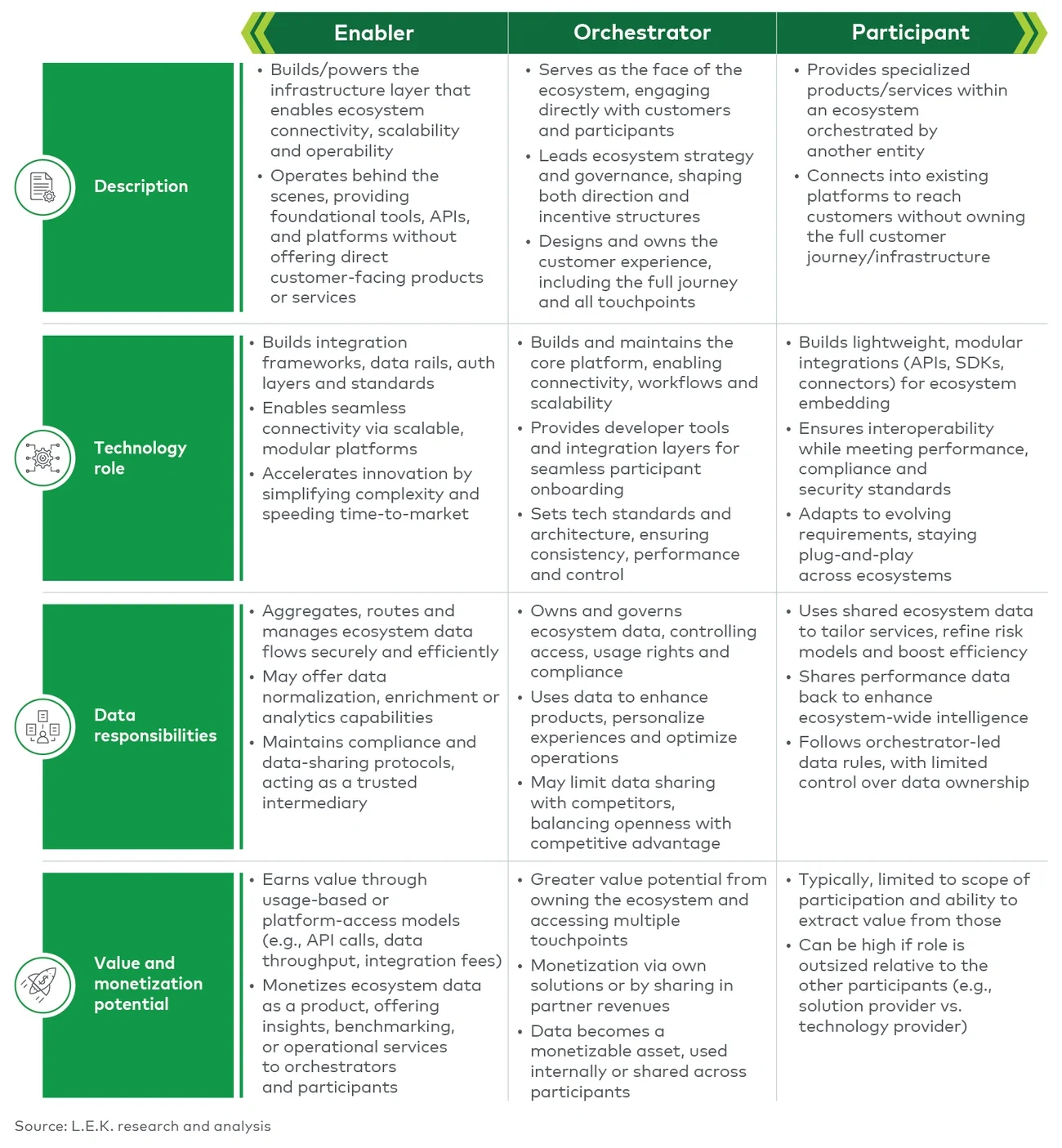
Orchestration is complex and costly. Understanding the differences between orchestrators and enablers/participants is essential, particularly for insurers that have traditionally operated as enablers. The chart maps out key considerations of ecosystem players

(see Figure 1). 

Image
Figure 1   Ecosystem orchestration can be highly accretive as insurers gain access to partner value opportunities and data is leveraged as an asset

Ecosystems unlock growth, but only if you choose your role with intent: orchestrator, enabler or participant. 

Finding your role in the ecosystem

We help insurers shift from closed, vertically integrated models to open, ecosystem-driven strategies. Insurers have to first develop a thorough understanding of their customers’ needs and intentions. The central question shifts from “What do we offer?” to “What is the customer trying to achieve?”

Before repositioning, insurers must answer these questions:

  • What parts of the customer journey can we influence?
  • Which partners expand our ability to solve more of the customers’ problems?
  • How can we better position ourselves to shape the journey?
  • How can we enhance the customer journey by improving customer experience and outcomes?

Once insurers define where they want to play, they must evaluate internal realities, including: Is our performance management system equipped to drive innovation, or do we need strategic partnerships to fill the gaps? Do we have resources to commit? Is there an appetite for shared risk?

This self-assessment is critical. To make the leap from product to solutions, insurers must identify capability gaps and determine how to address them, whether through partnerships, acquisitions or targeted investments.

Take auto insurance: Delivering personalized policies often requires partnering with original equipment manufacturers to access real-time driver behavior data in addition to investing in a customer-facing platform. For carriers without the appetite for building these capabilities, acquiring or partnering with a technology provider that offers the necessary infrastructure can provide a faster path.

Who should orchestrate vs. participate?

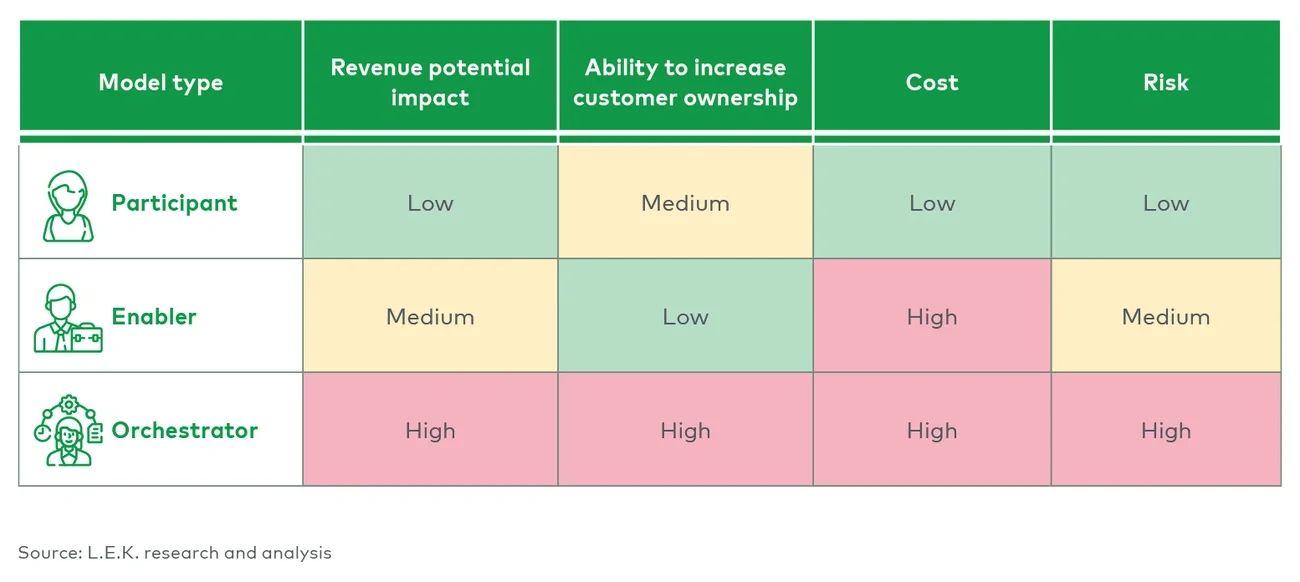
Embedded insurance alone presents enormous potential, with a projected CAGR of approximately 26% through 2033. But capturing this growth depends on more than attaching products at the point of sale. It requires insurers to define their role in the ecosystem — participant, enabler or orchestrator — and to act decisively.

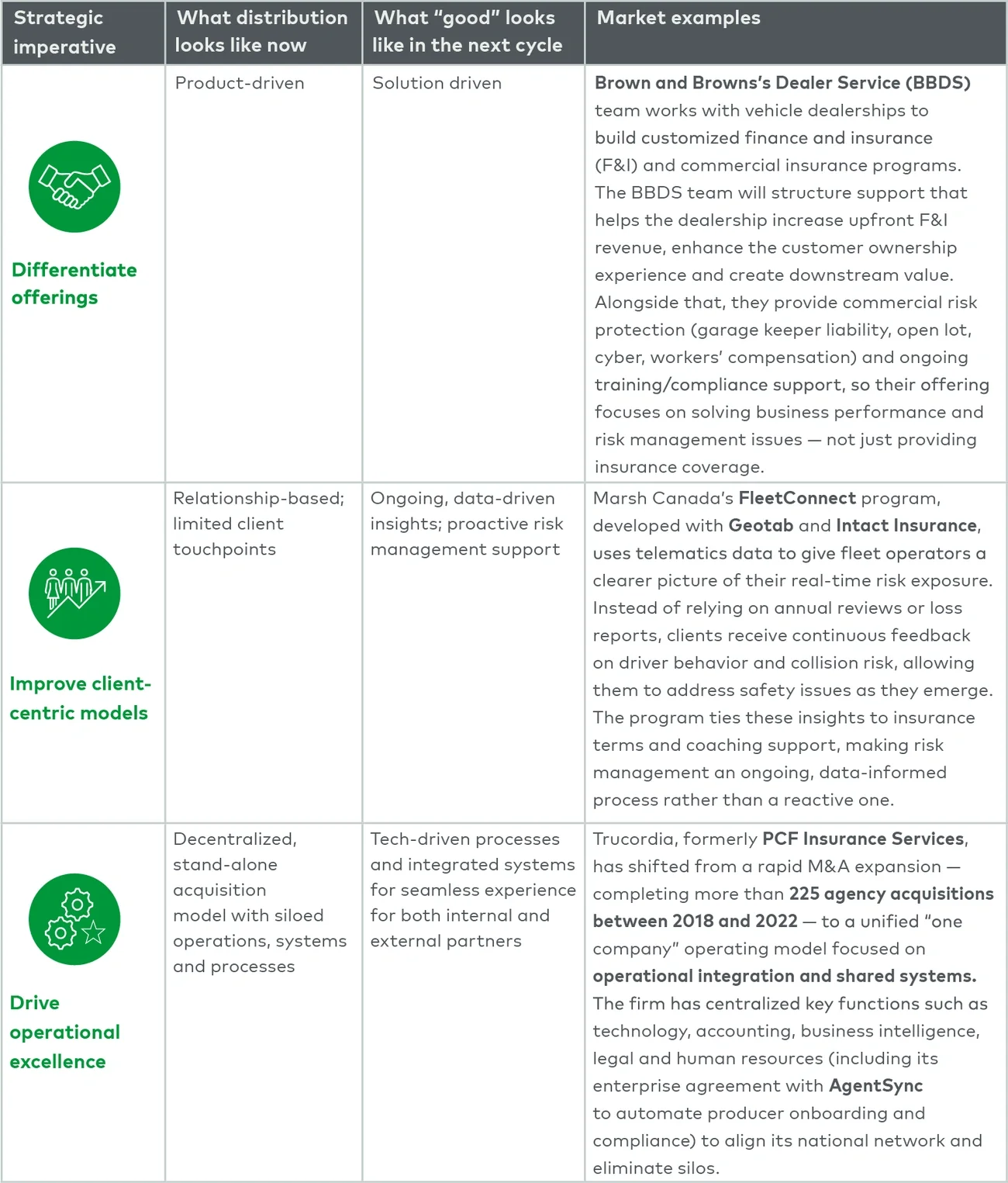
Not every insurer should orchestrate, but all insurers must determine their role within the ecosystem. The table illustrates what is at stake (see Table 1). 

Image
Table 1. Model type features

Why insurers must build, not just protect

The next insurance leaders won’t be those that protect their turf. Instead they will be those that build the terrain. The window to orchestrate ecosystems is open now, and hesitation will only result in irrelevance. Insurers don’t need to rebuild from scratch; they need to define the role they intend to play and recruit partners who will help them own the customer journey.

The future isn’t about owning more; it’s about becoming indispensable to the journeys customers are already living.

Contact us to find out more.

L.E.K. Consulting is a registered trademark of L.E.K. Consulting LLC. All other products and brands mentioned in this document are properties of their respective owners. © 2026 L.E.K. Consulting LLC 

English
Image
DLTA | LEK logo thumbnail
Special Report

eDiscovery: State of the Industry — The Shift Toward Advisory-Led, AI-Enabled Execution

February 11, 2026

The eDiscovery industry is being reshaped by expanding data volumes, accelerating use of AI, and an increasingly fragmented tools landscape. For many clients, the challenge is not any single change, but the accumulation of them which requires careful coordination and technical expertise to ensure legal defensibility.

Alternative Legal Service Providers (ALSPs) help clients navigate these challenges, translating AI from promise into practical use-cases, guiding defensibility strategy, and resolving complex data issues.

For the first time, the eDiscovery: State of the Industry Report brings together leading ALSPs, in a collaboration between L.E.K. Consulting and DLTA, to share insights drawn from aggregated data, analysis, and perspectives representing thousands of matters. The report aims to provide the industry with an end-to-end view of discovery workflows, AI and technology adoption, and the expanding role of ALSPs.

Highlights

  • Discovery workflows are non-linear and iterative, with ALSPs responsible for end-to-end execution across 500–550 petabytes of managed data, while actively managing 2.5–3x additional unseen data beyond hosted platforms.
  • ALSPs are leading AI adoption for the industry, collectively piloting and deploying nearly 100 AI tools across the EDRM in 2025.
  • ALSPs are playing a greater strategic advisory role often before matters even begin, guiding information governance, early scoping, and case strategy to improve downstream work steps.
  • Variability across legal workflows, data environments, and client risk tolerances structurally impedes the emergence of a single end-to-end technology solution; ALSPs remain the operating layer that preserves chain of custody and ensures legal defensibility for clients.

Fill in the form to access your copy of eDiscovery: State of the Industry — The Shift Toward Advisory-Led, AI-Enabled Execution.

For more information, please contact us.

L.E.K. Consulting is a registered trademark of L.E.K. Consulting LLC. All other products and brands mentioned in this document are properties of their respective owners. © 2026 L.E.K. Consulting LLC

English

Education Pulse Survey: Priorities and Perspectives from K-12 and Higher Education Administrators

February 6, 2026

L.E.K. Consulting’s latest Education Pulse Survey examines how U.S. K-12 districts and higher education institutions are resetting priorities as pandemic-era funding rolls off and regulatory conditions remain fluid. Drawing on responses from nearly 200 administrators nationwide, the analysis captures how leaders are navigating enrollment pressure, policy uncertainty and shifting budget expectations.

The findings show that overall budgets have been more resilient than anticipated, but uncertainty is slowing purchasing and investment decisions. In K-12, districts are protecting teacher pay, core curriculum, special education and student safety, while applying tighter scrutiny to supplemental programs.

Student mental health and workforce retention now rank among the most pressing system-wide challenges.

In higher education, leaders are prioritizing instruction, academic support and enrollment stabilization, with regulatory developments shaping the timing of major investments.

Across both sectors, AI adoption is emerging as a measured but growing area of focus, led by practical, near-term use cases rather than large-scale transformation.

Download the full analysis to explore the detailed findings and understand how education leaders across the U.S. are reallocating spend for the year ahead.

L.E.K. Consulting is a registered trademark of L.E.K. Consulting LLC. All other products and brands mentioned in this document are properties of their respective owners. © 2026 L.E.K. Consulting LLC

English

The GenAI Shift: New Discovery Patterns and the Next Wave of Advertising Spend

February 9, 2026

Advertising spend is shifting. GenAI is rapidly becoming the first stop for early-stage discovery, reducing top-funnel search and open-web traffic as informational queries move into chat interfaces. Deeper product research, shopping activity and purchase intent remain strong in mid- and lower-funnel channels.

As intent concentrates downstream, advertising spend continues to flow toward closed ecosystems like social commerce, influencers and retail media, where fewer visits deliver higher purchase readiness and performance is easier to measure.

Download our analysis to see how GenAI is reshaping consumer discovery and the next wave of advertising spend. 

The GenAI Shift: New Discovery Patterns and the Next Wave of Advertising Spend

For more information, please contact us.

L.E.K. Consulting is a registered trademark of L.E.K. Consulting. All other products and brands mentioned in this document are properties of their respective owners. © 2026 L.E.K. Consulting

English
Executive Insights

P&C Commercial Lines Distribution Reinvented: Why Legacy Strategies Won’t Win the Next Cycle

February 3, 2026

Key takeaways

The era of easy growth has ended, as distribution benefited for years from hard-market pricing, cheap capital and a fragmented competitive landscape that rewarded expansion over efficiency.

As a result, softer pricing, higher interest rates and a shrinking pool of acquisition targets are forcing property and casualty (P&C) distributors to pivot from growth-by-deal to growth-by-performance.

With prices softening and high-quality M&A targets drying up, distributors must now earn growth through operational excellence, integration and differentiation.

Winning in the next cycle will require a reset in both strategy and execution

The era of easy growth has ended. For years, distribution benefited from hard-market pricing, cheap capital and a fragmented competitive landscape that rewarded expansion over efficiency. Carriers leaned on external distribution partners to reduce in-house underwriting costs and extend their reach, while managing general agents (MGAs) emerged as engines for specialty growth.

Now, the next stage in the cycle has arrived. Global insurance pricing fell 4% in Q3 2025 alone,1 a clear signal that market tailwinds have turned into headwinds.

With prices softening and high-quality M&A targets drying up, distributors must now earn growth through operational excellence, integration and differentiation. The industry is moving from adding volume to engineering value.

Yet as players pivot toward value creation, they must do so against a more complex and competitive backdrop.

The shifting landscape: Complications on the horizon

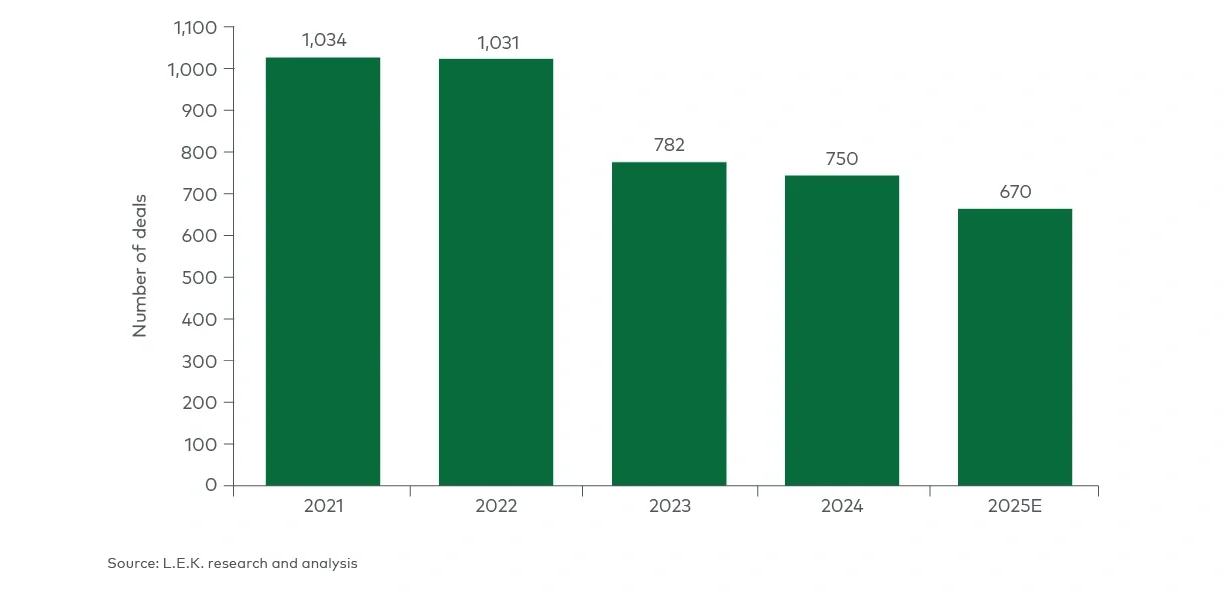
Softer pricing, higher interest rates and a shrinking pool of high-quality acquisition targets are forcing P&C distributors to pivot from growth-by-deal to growth-by-performance. After years of frenzied M&A activity, the market has entered a period of consolidation fatigue (see Figure 1).

As rate increases are no longer the main driver for revenue growth, distributors looking to grow must elevate service, embed advisory capabilities and align with evolving client needs.

This shift reverberates beyond brokers. Carriers are under pressure to offer seamless digital connectivity, consistent underwriting appetite and faster decision-making to maintain their preferred partner status. MGAs must now prove their worth through underwriting (UW) profitability, real-time data visibility into UW/claims (beyond a periodic bordereau) and risk services that extend beyond placement.
 

Figure 1

Announced insurance agent/broker deals (US and Canada)

Image
Figure 1 represents announced insurance agent/broker deals (US and Canada)

Figure 1

Announced insurance agent/broker deals (US and Canada)

Image
Figure 1 represents announced insurance agent/broker deals (US and Canada)

SME quote: “The distribution game is fundamentally changing. Legacy levers won’t deliver as effectively in this next era, and the window to close operational excellence gaps is closing fast. Distributors that fail to make the strategic and operating model shifts today won’t have a seat at the table tomorrow.”

For brokers, MGAs and carriers, staying relevant now depends on modernization, but this is no longer just about technology. It’s about driving measurable value. Those that convert modernization into tangible outcomes for clients and carriers will set the new standard of performance.

Value creation as the differentiator

While value creation is the clear imperative, achieving it is far from easy. L.E.K. Consulting is working with clients across the insurance industry to solve this challenge.

Distributors must focus efforts across three key dimensions where that transformation is already taking shape:

Table 1

Image
Table 1

Table 1

Image
Table 1

SME quote: “The competitive environment has changed. Distributors aren’t just facing macroeconomic headwinds — they’re up against competitors engineered for integration and operational excellence, while serving customers who are smarter and more demanding than ever.”

In addition to improving underwriting quality and technology integration, MGAs must improve visibility into book performance, which can often feel like a black box. MGA clients also want claims analytics to understand claims trends, benchmark against peers and manage premiums.

For carriers, value creation increasingly depends on choosing distribution partners that offer both scale and insight — those with access to clean data, niche specialization and integrated risk solutions.

6 imperatives to compete and win

Winning in the next cycle will require a reset in both strategy and execution. Success won’t come from incremental change but from executing a focused set of strategic shifts.

We have identified six imperatives that will define the next era of commercial P&C distribution.

1. Shift from consolidation to integration

Brokers and MGAs must shift focus from targeting the next investment to extracting the value from past acquisitions. Private equity sponsors and strategic acquirers are prioritizing EBITDA improvement through synergy realization and platform integration. Distributors should aim to unify systems and data infrastructure across entities, harmonize compensation, and optimize market access.

Carriers must now extract value from their web of MGA and broker relationships. While MGAs want to maintain flexibility with underwriting and pricing, carriers look to control risk and maintain reliable returns. Carriers should leverage near real-time data (vs. monthly/quarterly reports) that enables them to spot emerging trends and resolve issues with MGAs before losses mount.

2. Choose your lane and own it

Distributors should shift from being generalists to serving as specialists. In mature markets, distributors must look to exploit and sharpen expertise, which can include geography, client size and client segment. Next-generation distributors won’t try to be everything to everyone. Instead, they will identify core strengths and build upon them.

The key to specialization is differentiating. Determine whether your company competes best on differentiated products, customer excellence or operational efficiency. Distributors that try to compete on too many fronts will fail against market specialists and niche providers.

Successful specialization requires a clear-eyed assessment of existing strengths and how to deploy them effectively. For example, one broker used a locally driven, relationship-based model to dominate in the middle market through deep client loyalty. By contrast, some high-touch, bulge-bracket players have struggled to move down-market, where midsize clients have very different needs, and far less appetite or budget for complex service models.

For carriers, developing a segmented distribution strategy will be essential. A well-defined approach should clearly delineate which risks are best served through delegated authority arrangements (e.g., MGAs) and which are more effectively handled in-house or through digital direct-to-client channels.

3. Leverage scale in fee negotiations

In the recent hard market, higher rates, restrictive underwriting conditions and limited capacity forced distributors to broaden their carrier relationships. Rather than relying solely on preferred markets, brokers had to engage a wider range of carriers to secure adequate coverage for clients. This approach prioritized availability over alignment to meet demand.

Now the balance of power has shifted back toward distribution. As carriers return to growth mode and expand capacity, brokers can optimize their placement strategies. Brokers should now focus on capturing contingent income opportunities, particularly those linked to premium volume.

Acquisitions frequently leave brokers with multiple trade agreements across the same trading partners. Once centralized, that volume shifts to bargaining power that improves terms and rates.

MGAs that grew and developed profitable books through innovation and calculated risk-taking can now leverage their supplier power with both carriers and reinsurers that seek to grow in a more competitive environment. This can include negotiating better fronting terms, quota shares and deals. Carriers must defend margins by tiering partners based on performance, tightening governance over delegated authority and investing in automation to reduce servicing costs. Shifting toward outcome-based compensation and building low-cost digital or embedded channels can further offset rising distribution expenses while preserving underwriting control.

4. Deliver risk solutions, not just policies and coverage

Insurance buyers demand more than policy placement; they want a partner that will help manage and mitigate risk. Brokers and MGAs must integrate policies with operational risk tools and advice. Risk analytics tied to policies provide a servicing advantage over generalist distributors. More important, these integrated tools provide distributors with valuable risk and claims data that can inform their own product design and enable more accurate pricing.

To meet rising customer expectations, distributors must actively collaborate with managed service providers, insurtechs, and data platforms to gain richer insights and deliver more holistic solutions. These partnerships unlock new avenues for distributors to bring innovative offerings — such as cybersecurity monitoring, Internet of Things-enabled alerts, telematics-driven products and supply chain analytics — to market.

Carriers can co-invest or white-label such offerings, empowering their distribution partners to differentiate at the point of sale while deepening client engagement. In doing so, carriers move from being passive capacity providers to becoming active solution enablers, reinforcing retention, improving underwriting performance and creating value beyond price.

5. Evolve from data points to market value

Players that can move from data collection to data-driven action will set themselves apart in the market. But it’s not just about owning and activating data; brokers, MGAs, and carriers that build or own the infrastructure to aggregate client data will gain a larger share of the value chain. How? This infrastructure empowers seamless connectivity across the ecosystem, the integration of advisory tools and smarter UW decisions. This can fundamentally shift current client ownership dynamics.

A connectivity hub can automate paper-based submissions and instantly compare quotes across carriers, reducing turnaround time from days to hours and giving clients greater visibility into the process. Additionally, advanced advisory tools can incorporate disaster scenario modeling into client reports, moving beyond simple coverage demonstration to identify potential exposures and recommend proactive risk-mitigation strategies. For carriers, ingesting and leveraging distribution data will allow them to better manage risk and reduce volatility.

6. Double down on digital, or risk irrelevance

Ignoring the digital capabilities of newcomers, including rapid product launches and API-enabled architecture, will result in a diminished spot on the value chain. Distributors must invest in digital to provide the proactive service and improved client experience that insureds demand. Small commercial carriers can already offer digital quoting and policy management and can better identify cross-sell opportunities than larger distributors.

Client quote: “Digital tools aren’t optional. They determine whether we retain and grow clients or lose them to more nimble competitors.”

Navigating the next horizon

Next-gen leaders will engineer advantage through sharper focus, stronger integration and smarter data orchestration. While market tailwinds have faded, opportunity hasn’t. Brokers, MGAs and carriers that start the transformation today through system integration, digitized processes and aligning everything to client outcomes will win the next cycle. Change is coming. Will you lead it?

For more information, please contact us.

Endnote:
1InsuranceInsiderUS.com, “Global insurance pricing falls 4% over Q3: Marsh.”
https://www.insuranceinsiderus.com/
article/2fht83n5vu44f0uma3uo0/lines-of-business/commercial-lines/global-insurance-pricing-falls-4-over-q3-marsh?zephr_sso_ott=wigJQQ

L.E.K. Consulting is a registered trademark of L.E.K. Consulting LLC. All other products and brands mentioned in this document are properties of their respective owners. © 2026 L.E.K. Consulting LLC

English

Top Priorities and Strategic Imperatives for US Manufacturers: Supply Chain Optimization

February 2, 2026

This article is part of a series that analyzes key themes from L.E.K. Consulting’s eighth annual U.S. manufacturer survey. It discusses how procurement and supply chain best practices are evolving to meet new realities.

U.S. manufacturing firms have faced a series of supply chain disruptions in recent years, from COVID-triggered input availability challenges to navigating the current tariff environment. Together these disruptions have added a growing element of uncertainty to the procurement process and caused companies — both large and small — to reassess their procurement and supply chain strategies.

Now, as domestic manufacturers look to build resiliency into their supply chains, a shift is taking place toward greater reshoring, the prioritization of energy security and a need for supplier diversity — all of which present opportunities for manufacturers to unlock new growth.

But while there are now macro tailwinds toward greater domestic production, companies still need to manage through the uncertainty associated with tariffs and international trade.

Optimize across the value chain

One of the best ways to mitigate the impact of tariffs is to have a very strong, cost-efficient, end-to-end supply chain. To that end, L.E.K. has developed an assessment and mitigation framework to support U.S. companies as they look to optimize for each component across the value chain. Our mitigation plan ensures companies have transparency all the way through their Tier 1, Tier 2 and Tier 3 suppliers.

With prevailing costs and import duties for raw materials and finished goods in flux, it is also incumbent on manufacturers to ensure procurement and supply chain continuity and flexibility. Indeed, mitigating negative impacts from tariffs and addressing trade controls/sanctions are among the top concerns for companies in the near term, while more costly and time-intensive initiatives (e.g., relocating manufacturing, shifting supply chains) are being held until the longer-term outlook and any related implications become clearer. This is leading to manufacturers prioritizing the vetting of potential new suppliers and reviewing their respective in-house pricing strategies to ensure operating teams have the flexibility to respond to any changes in market conditions (see Figure 1).

Image
Figure represents executives' actions currently being taken to prepare for tariffs
Image
Figure represents executives' actions currently being taken to prepare for tariffs

Streamline and simplify

In a bid to adapt their supply chains and procurement processes, rather than making significant capital outlays, U.S. industrial manufacturers are prioritizing short-term actions that allow them to address headwinds and invest in future-proofing their operations. This has led category leaders to examine their existing procurement and manufacturing processes to identify opportunities for streamlining and simplification, in order to avoid and/or mitigate disruptions while simultaneously reorienting for greater future resiliency.

Some industrial companies are placing greater emphasis on incorporating software into their supply chain monitoring processes. The goal is to improve accuracy and create efficiencies that will yield both near- and long-term benefits. But while longer-term investment decisions may be required, most firms are holding off on more significant changes (e.g., restructuring their supply chains) as they await further confirmation as to where trade policies and sourcing dynamics will normalize.

L.E.K. supports manufacturers across end markets, helping them navigate their most pressing supply chain and procurement challenges. We bring proprietary perspectives on potential impact, procurement/sourcing strategies, and operational due diligence to identify stress points and inefficiencies in existing sourcing models — delivering tangible cost savings and productivity improvements.

For more information, please contact us.

L.E.K. Consulting is a registered trademark of L.E.K. Consulting LLC. All other products and brands mentioned in this document are properties of their respective owners. © 2026 L.E.K. Consulting LLC

English

Finding the New Balance: Rewards Cards After the Visa-Mastercard Merchant Settlement

January 21, 2026

For the past two decades, rewards credit cards have relied on a delicate four-way balance: Issuers and their co-brand partners fund rich rewards with interchange economics; consumers “pay” through annual fees, interest and often higher prices passed through by merchants; and merchants swallow acceptance costs in exchange for conversion and ticket lift.

The November 2025 Visa-Mastercard settlement disrupts this equilibrium by giving merchants new tools to say “no” or “not without a fee” to consumers presenting specific card types. This settlement is unfolding alongside a broader set of legal and regulatory developments in Washington that could further reshape credit card economics, underscoring that the rewards model now faces multiple, overlapping sources of pressure.

Below is a breakdown of what’s in the settlement, why it matters, and the questions issuers and co-brand partners should be asking now.

What has been agreed: Headline features of the settlement

After nearly 20 years of litigation in “In re Payment Card Interchange Fee and Merchant Discount Antitrust Litigation,” Visa and Mastercard have agreed to a revised equitable relief settlement with U.S. merchants. Although it still requires court approval and could be appealed, L.E.K. Consulting has summarized some key provisions.

Modified “honor all cards” rule 

Merchants can choose whether to differentially accept or decline Visa or Mastercard commercial credit cards, all standard consumer credit cards and/or all premium consumer credit cards (where most high-fee/high-rewards products sit). They can make different choices for Visa versus Mastercard, and there will be mandatory visual identifiers on commercial and premium cards to support selective acceptance at checkout. 

Expanded surcharging flexibility on credit (not debit)

Merchants may surcharge consumers presenting Visa- or Mastercard-branded credit cards the lower rate of 3% or their cost of acceptance at the brand level or at the individual product level (for example, only premium rewards cards). They can surcharge one card scheme but not another or surcharge schemes differently, and they can surcharge Visa/Mastercard regardless of whether they surcharge American Express or Discover. 

Rate cuts and caps for credit interchange

Visa and Mastercard commit to reduce the average effective credit interchange rate by at least 10 basis points (bp) for five years. Standard consumer credit cards are capped at 125 bp for eight years. 

Broader steering and acceptance tools, including wallets

Merchants can decline premium or commercial cards, conduct A/B testing to gauge customer response by location (e.g., online/offline channel, urban/rural geo, standard/micro store type) and steer within digital wallets under the same rules that apply for plastic cards. They can accept some wallets and not others or enable certain wallets only online. 

Merchant buying groups and education

The settlement explicitly enables merchant buying groups to negotiate interchange and rules collectively. A $21 million education fund will support merchant understanding of the new rule set. 

Changes for merchants at checkout and customer response scenarios

In practical terms, the settlement gives merchants a more granular tool kit for influencing their payment acceptance economics. 

Friction at the point of sale (POS), customer pushback and the cost of change mean that wide-scale hard declines of premium cards are unlikely outside a few high-margin or cost-sensitive sectors. More probable early moves are:

  • Surcharges for the customer across all credit cards or at the premium tier
  • Quiet pilots in specific categories such as fuel, small-ticket retail, and high-fee delivery or subscription verticals to test consumer response
  • More aggressive acceptance strategies in ecommerce, where routing and tender steering are easier to control and A/B test via checkout flows

 
As merchants adjust their acceptance and pricing strategies, consumer behavior will play a critical role in determining the real impact — particularly in the current rising-cost environment, which is already trying consumer patience at checkout. Several plausible scenarios emerge.
Scenario A: Consumers absorb occasional surcharges but maintain primary card habits

Assuming surcharging is applied inconsistently and only at selected merchants:

  • Many consumers may tolerate a 1%-3% fee at the POS when the convenience or rewards outweigh the cost
  • Premium cards remain “top of wallet,” but frustration grows in categories with frequent surcharging
  • Card issuers may respond with targeted statement credits to mitigate visible pain points


Scenario B: Consumers shift toward standard credit or debit cards to avoid fees

More widespread surcharging or selective declines could accelerate behavioral change:

  • Consumers may begin carrying a “backup card” (standard credit) specifically to avoid surcharges
  • Frequent travelers or high-spending households may continue to favor premium cards, but occasional cardholders may migrate to lower-fee tenders
  • Debit rewards programs could become more attractive if they avoid surcharges and offer competitive earn rates, particularly for certain customer segments


Scenario C: Consumers become more tender-agnostic and more price-sensitive

If merchant communication at checkout normalizes discussions of payment cost:

  • Awareness grows that paying with a premium card is “more expensive,” even if consumers do not fully understand interchange
  • Some consumers may choose based on real-time price signals at the POS, not on habit
  • A portion of consumers may shift toward merchant-preferred tenders, including instant bank pay, store cards or buy now, pay later (BNPL)


Scenario D: Consumers push back, creating reputational or operational risk for merchants

If surcharging or selective acceptance becomes too visible or inconsistent:

  • High-value customers may take their business elsewhere when confronted with fees on premium cards
  • Merchants could face backlash for “penalizing loyalty,” especially in categories with strong co-brand ecosystems (e.g., travel, luxury retail)
  • Consumer dissatisfaction may moderate how aggressively merchants deploy the new tools


Strong customer research will be important for understanding customer behaviors across segments — though we do believe premium cards will always have an important role in the market.

Modest changes may have limited impact, while widespread surcharging or declines could quickly reshape top-of-wallet dynamics.

Implications for issuers

For issuers, the settlement is less about the headline 10 bp rate cut and more about optionality shifting toward merchants. It introduces new vectors of risk including:

  • Selective acceptance risk for premium portfolios
    Premium cards such as Chase Sapphire Reserve or Citi Prestige sit squarely in the “premium consumer” bucket that merchants are now explicitly allowed to decline.
    Even limited merchant adoption could erode top-of-wallet status if consumers experience checkout friction and feel compelled to carry a standard card backup.

  • Normalization of surcharging on rewards spend
    The settlement codifies up to 3% surcharges on credit card usage, including at the product level for premium rewards cards. Over time, consumers may start seeing “3% fee for rewards cards” in the same way they see out-of-network ATM fees today. Issuers face a choice: Allow the fee to bite, effectively reducing the net value of rewards and risking attrition. Or partially offset the fee via statement credits, targeted rebates or merchant-funded offers, which would compress economics.
  • Interchange compression and portfolio mix shift 
    With standard consumer interchange capped at 1.25% for eight years, there is now a clear economic wedge between standard and premium products. If merchants actively steer away from premium, issuers may see volume migrate to capped-interchange standard cards without commensurate reduction in rewards expectations.
  • Greater focus on non-interchange revenue and engagement
    To defend program economics, issuers are likely to lean harder on:
    • Annual fees, co-brand partner funding, and cross-selling into deposits, lending and wealth
    • High-margin lending (revolvers) and ancillary fees, which regulators are already scrutinizing
Implications for co-brand partners

Co-brand partners (airlines, hotel groups, retailers, tech platforms) are exposed in two ways: Their economics are deeply tied to premium card interchange, and their customer experience is closely associated with card usability.
Several potential shifts emerge:

  • Value proposition under more visible fees
    If a cardholder faces a surcharge at checkout specifically on a co-brand premium card, the perceived value of miles or points is immediately questioned. Programs with high earn rates but limited redemption value may come under particular pressure as customers do the math at the till. And increased consumer education will be important, especially for cards with higher annual fees.
  • Negotiation dynamics with issuers
    If issuers need to rely less on premium interchange and more on partner-funded benefits, co-brands may be pushed to increase contribution (higher mileage purchasing costs, more marketing support, more exclusivity or a different share of annual fee revenues). 
    Conversely, strong brands with demonstrable incremental spend may be able to argue for a greater share of a shrinking economic pie, especially where they can provide alternative low-cost payment rails (e.g., direct debit or account to account).
  • Channel and tender diversification
    Leading travel and retail brands already promote alternative rails such as BNPL, pay-by-bank or private-label/store cards. The settlement makes it incrementally more attractive for a co-brand to:
    • Offer own-brand tenders that are cheaper to accept and still reward-rich (e.g., debit rewards, bank-linked wallets)
    • Push “direct” channels where they can control tender steering and surcharging narratives
  • Competitive positioning versus American Express
    American Express is not directly covered by this settlement and thus is outside the new caps and specific rule changes. However, the surcharging rules allow merchants to surcharge Visa/Mastercard even if they do not surcharge Amex, or vice versa, which creates scope for targeted merchant strategies against the highest-cost brands. Co-brand programs on the Amex network will need to model whether they become more exposed to surcharging and nonacceptance if merchants treat Amex as the “top tier” to discourage.

Where this leaves the rewards balance — and questions to ask now

This settlement does not immediately dismantle the U.S. rewards ecosystem. The fee reductions are modest on a systemwide basis, and the behavioral leap required for merchants to actively decline popular premium cards is significant.

However, it does these three important things:

  • It breaks the illusion that merchants must accept every flavor of premium card if they accept the brand at all
  • It normalizes explicit pricing of credit card usage, particularly for high-reward products
  • It legitimizes merchant coalition-building and experimentation (buying groups, pilots, wallet steering) that could, over time, reshape volume flows

Given that, we suggest the following questions for senior teams.

The settlement is not the end of the story. It is a negotiated compromise in a world where merchant activism, regulatory scrutiny and new payment technologies are all moving in the same direction: more transparency on costs and more leverage for payers of those costs. Issuers and co-brands that start stress-testing their portfolios and customer experience now will be better positioned if and when merchants decide to use the new tools they have just been given.

For more information, please contact us.

L.E.K. Consulting is a registered trademark of L.E.K. Consulting LLC. All other products and brands mentioned in this document are properties of their respective owners. © 2026 L.E.K. Consulting LLC 

If you are an issuer, you should be asking:
  • How concentrated are our economics in premium interchange, and what is our profit-and-loss sensitivity to
    • A meaningful shift of volume from premium to standard cards
    • 1%-3% surcharges on a portion of our premium portfolio volume?
  • Which merchant verticals are most likely to use the new tools first, and how exposed are we by sector and by co-brand partner?
  • Do we have a clear strategy for supporting customers at the POS when surcharges or nonacceptances occur (e.g., education, alternative tenders, statement-credit offers)?
  • Are we comfortable with our non-interchange revenue mix and our ability to deepen relationships via deposits, lending and wealth if interchange compression accelerates?
  • How do our network choices (Visa, Mastercard, Amex and potentially others over time) position us if legislative pressure continues to build on interchange and routing?
If you are a co-brand partner, you should be asking:
  • Where does my co-brand program sit on the spectrum from “essential spend enabler” to “nice to have” rewards, and how resilient is customer usage if fees become more visible?
  • How dependent is my economics on high-interchange and premium card spend, and what happens to the program NPV if:
    • A portion of my customers shift to lower-tier cards
    • Key merchants in my ecosystem introduce differentiated surcharging?
  • Should I accelerate alternative tender strategies (store cards, debit rewards, account to account, wallets) that keep customers in my ecosystem while reducing acceptance costs?
  • Do I have the right contractual levers with my issuing partner to rebalance economics if interchange is further constrained, or if merchant behavior materially changes?
  • How should I communicate with my most valuable customers about possible changes without undermining confidence in the program before anything becomes real?
English
Subscribe to