

Executive Insights

When Does a CDMO Roll-Up Become a Platform?

A framework for investor decision-making in consumer health and beauty
June 1, 2026

Key takeaways

Platform valuation premiums are driven by observable operating capabilities rather than scale alone, with cross-site commercial integration as the clearest differentiator

Cross-selling is the most reliable indicator of platform economics. L.E.K. Consulting benchmarks indicate best-in-class cross-site revenue can reach 25% in Europe-only platforms and 50% in cross-continent platforms, though most achieve materially less

Structural advantages can support a base-case valuation, while execution-dependent levers should be treated as conditional upside

Operational maturity, particularly data visibility, integration discipline and central control, determines whether value creation can be realised

Platform economics are earned, not assumed

In consumer health and beauty, the distinction between a collection of manufacturing assets and a fully functioning contract development and manufacturing organisation (CDMO) platform is a primary determinant of value. Investors may value asset collections at 8–12x EBITDA multiples, while fully integrated platforms can command 15–20x EBITDA multiples or more. The gap reflects more than perception. It reflects differences in operating model, commercial integration and the ability to generate repeatable value

A platform is not defined by the number of sites it owns. It is defined by its ability to route customers, data and capabilities across those sites through a coordinated commercial and operational infrastructure. By contrast, a portfolio aggregates assets under common ownership but leaves them largely independent.

The practical question for investors is therefore straightforward: can the business operate as a single system rather than a collection of parts? The answer determines whether platform economics are real and whether valuation premiums are justified.

The platform test: Commercial integration, visibility and control

A CDMO platform combines local specialist capabilities with a centralised operating spine. This distinction is particularly important in consumer health and beauty, where customer fragmentation, stock-keeping unit complexity and speed-to-market requirements are higher than in traditional pharmaceutical outsourcing.

Three conditions determine whether a platform model is functioning effectively.

First, commercial integration must enable customers to buy across formats through a single relationship. Where sales teams remain siloed by site, cross-selling remains aspirational rather than embedded in the operating model. Evidence of multi-site customers and increasing wallet share is therefore a critical indicator of platform maturity.

Second, the central team must have sufficient visibility into performance to manage the business actively. This includes timely and granular insight into margins, utilisation, working capital and pipeline. Without this, scale introduces complexity without sufficient control.

Third, the platform must capture economic benefits from scale without weakening local responsiveness. In this sector, customer intimacy and technical agility are often decisive. Over-centralisation can undermine both, limiting the very advantages the platform is intended to create.

Failure in any one of these dimensions typically prevents platform economics from fully materialising.

Four engines of value creation

Our analysis identifies four primary engines through which CDMO platforms create value: commercial growth, structural resilience, margin expansion and repeatable M&A (see Figure 1).
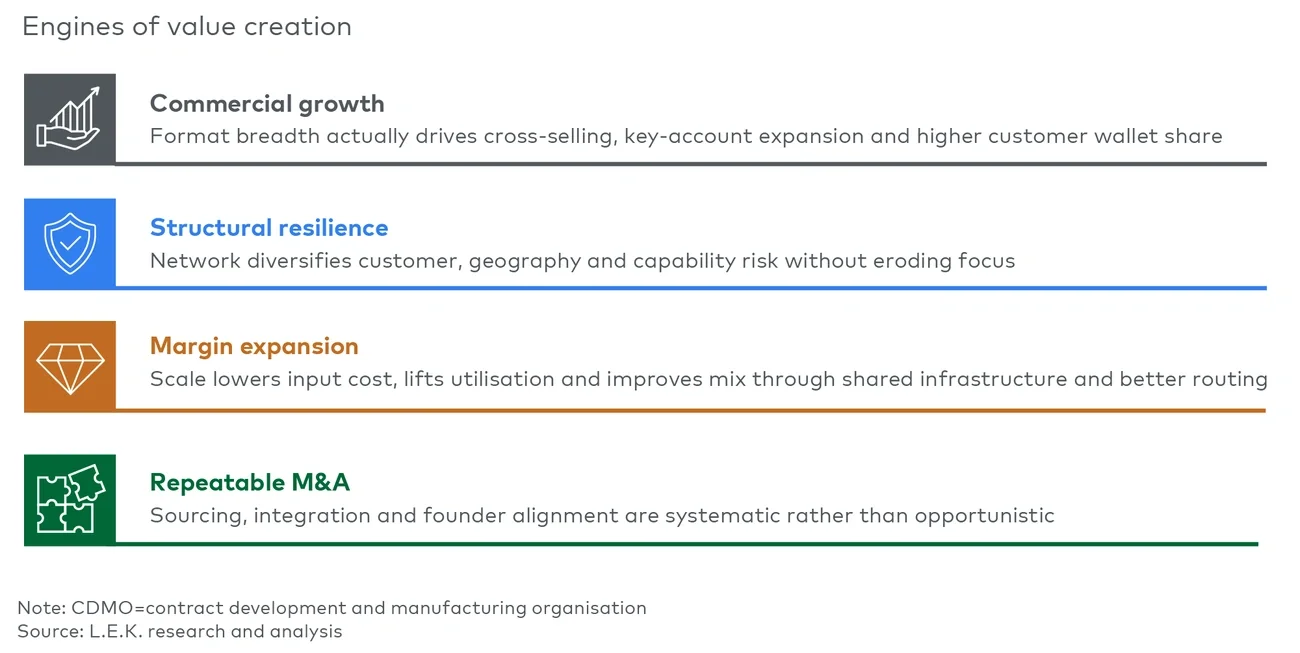
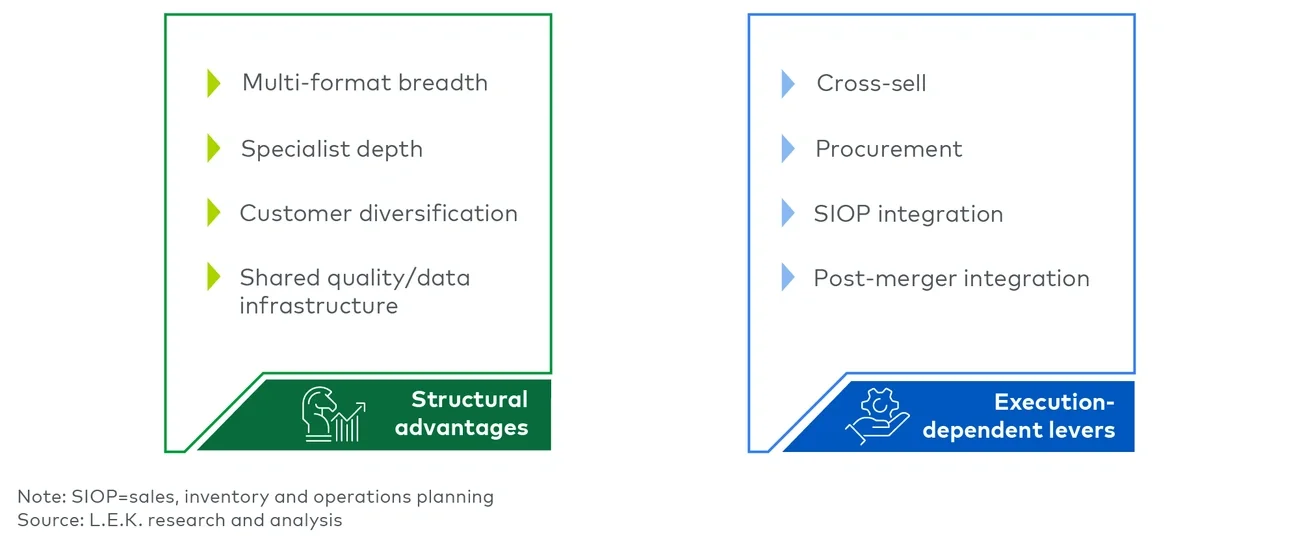
Figure 1

Four Engines of CDMO Platform Value Creation

Image
Figure 1: Four Engines of CDMO Platform Value Creation

Figure 1

Four Engines of CDMO Platform Value Creation

Image
Figure 1: Four Engines of CDMO Platform Value Creation

Commercial growth is driven by cross-selling, key-account expansion and increased customer wallet share across formats. Structural resilience arises from diversification across customers, geographies and capabilities, reducing dependency on individual sites or segments. Margin expansion reflects procurement leverage, improved utilisation and shared infrastructure. Repeatable M&A enables systematic sourcing and integration of acquisitions, supported by standardised playbooks.

This framework provides a more precise lens than do generic buy-and-build narratives, particularly when assessing sustainability of returns.

Structural advantages versus execution-dependent levers

Not all value drivers carry equal certainty. A critical distinction exists between structural advantages embedded in the platform design and execution-dependent levers that require sustained operational delivery (see Figure 2).

Figure 2

Structural Advantages vs Execution-Dependent Value Levers

Image
Figure 2: Structural Advantages vs Execution-Dependent Value Levers

Figure 2

Structural Advantages vs Execution-Dependent Value Levers

Image
Figure 2: Structural Advantages vs Execution-Dependent Value Levers

Structural advantages include multi-format breadth, specialist depth at site level, customer and geographic diversification, and shared quality or data infrastructure. These characteristics can typically be observed and supported through diligence.

Execution-dependent levers include cross-sell penetration; procurement harmonisation; sales, inventory and operations planning integration; central key-account management; and post-merger integration discipline. These are contingent on management capability and organisational maturity.

The implication for investors is direct. Structural advantages can support base-case assumptions, while execution levers should be probability-weighted and discounted appropriately.

Empirical buy-and-build evidence reinforces this distinction. Published private equity (PE) performance research covering more than 2,000 transactions found that deals deepening into a core industry generated an average internal rate of return of c.44%, versus c.16% for diversification plays. Experience compounds, but scale does not guarantee returns. Industry research on healthcare PE similarly describes platform tuck-in strategies as proven value creation tools, with investors increasingly adopting a barbell approach: targeting either premium scaled assets with clear differentiation or sub-scale platforms where operational improvement drives growth.

Where platform value is proven and where it remains theoretical

A disciplined investment approach requires distinguishing between different tiers of value creation evidence.

Proven value is observable in current operations. This includes existing cross-site revenue, measurable utilisation headroom and demonstrated ability to transfer production across sites. The most reliable indicator is the trajectory of multi-site revenue as a share of total revenue, rather than any absolute threshold.

Near-term realisable value typically lies in procurement and overhead efficiencies. Industry benchmarks suggest that centralised procurement can deliver 7%-10% savings on direct spend, alongside margin uplift within a relatively short time frame. However, these outcomes depend on standardised specifications, aligned quality systems and supplier consolidation — conditions that are not universally present.

Theoretical upside includes full cross-sell potential, format mix optimisation and geographic expansion. While these are credible sources of value, they depend on sustained execution over multiple years and should not be underwritten on the same basis as proven economics.

For investors, distinguishing between these tiers is essential to maintaining valuation discipline and protecting downside risk.

Operational maturity determines investability

Platform value is ultimately determined by operational maturity rather than scale. The most effective diligence approach combines market sizing and competitive mapping with a structured assessment of how the platform operates in practice.

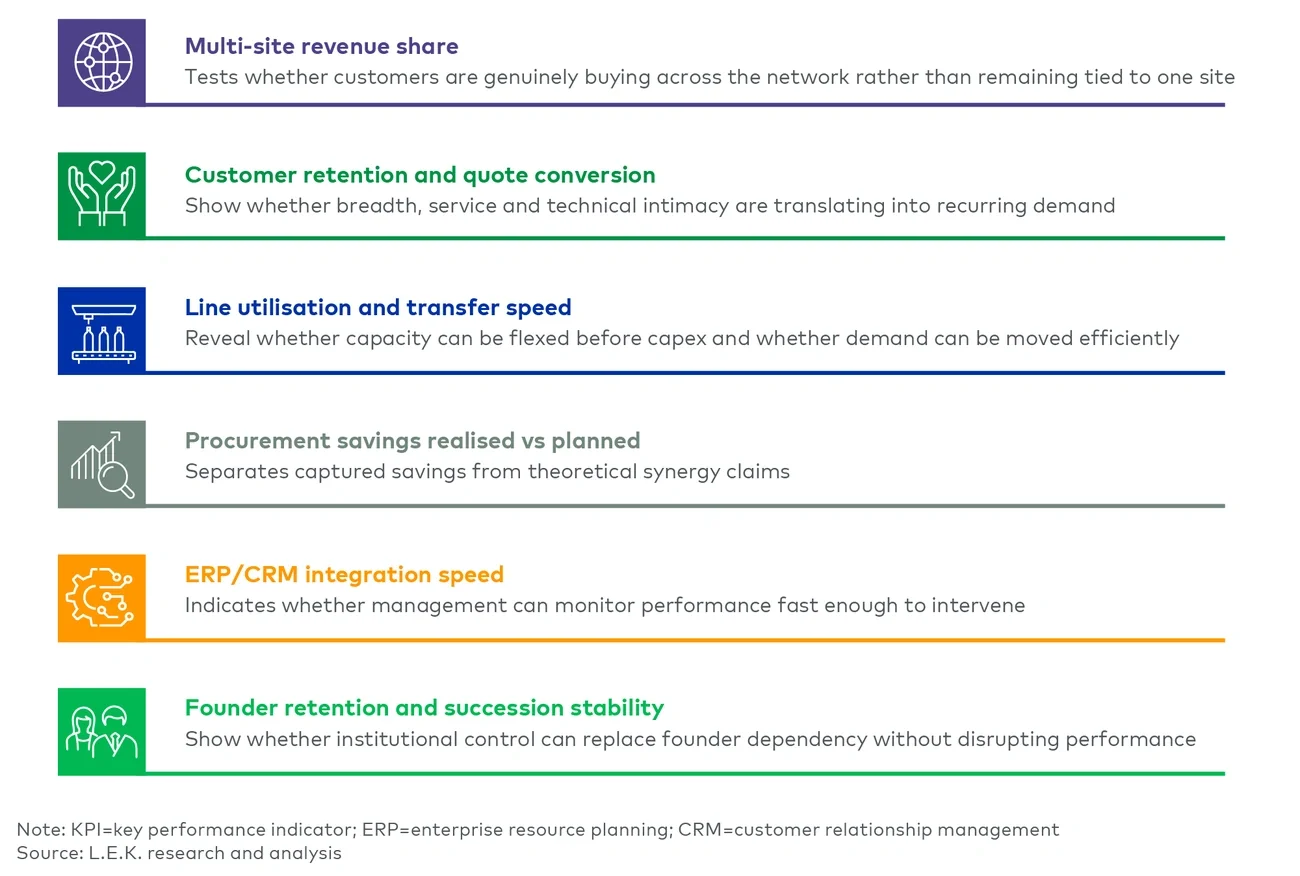
Key performance indicators provide a practical test of maturity (see Figure 3).

Figure 3

Operational KPIs for Assessing Platform Maturity

Image
Figure 3: Operational KPIs for Assessing Platform Maturity

Figure 3

Operational KPIs for Assessing Platform Maturity

Image
Figure 3: Operational KPIs for Assessing Platform Maturity

These include multi-site revenue share, customer retention by vintage, quote-to-order conversion rates, line utilisation, production transfer speed, procurement savings realised versus planned, integration speed across enterprise resource planning and customer relationship management systems, and founder retention stability.

Each key performance indicator tests a specific dimension of platform functionality. For example, multi-site revenue share indicates whether customers are engaging with the platform as a network rather than individual sites, while transfer speed reveals whether capacity can be flexed efficiently across the system.

Where management cannot provide these metrics consistently and at sufficient granularity, platform maturity is typically overstated.

Our maturity assessment framework evaluates seven dimensions: cross-selling effectiveness, business-as-usual operational capability, integration governance and playbook quality, targeted performance support from the centre, procurement optimisation, M&A screening sophistication, and M&A competitiveness with founders.

Scaling constraints emerge as platforms grow

As CDMO platforms expand beyond the initial phase of acquisitions, structural constraints begin to emerge.

Cost pressure from lower-cost regions becomes increasingly relevant, particularly where competitors in Asia or Eastern Europe can offer structurally lower production costs. Maintaining competitiveness requires targeted investment in technology and capabilities rather than cost-based competition.

At the same time, central visibility becomes more difficult to maintain. Operating models that function effectively with a limited number of sites often struggle as complexity increases. Scaling requires investment in systems, data infrastructure and central resources to preserve control.

Finally, acquisition selectivity tends to decline as the pool of attractive targets narrows. This increases the risk of pursuing suboptimal transactions to sustain growth. Strong integration discipline, supported by a repeatable playbook with defined milestones and governance, becomes critical in mitigating this risk.

For investors, the implication is clear: beyond the first wave of acquisitions, integration quality is a more important determinant of value than acquisition volume.

Implications for diligence and underwriting

Effective diligence should focus on verifying platform economics through observable evidence.

  • Prove platform economics with observable data. Confirm the existence and growth of multi-site customers, analyse cross-sell performance by acquisition cohort, review the extent of shared systems adoption and assess how effectively the central team intervenes in underperforming areas. If these cannot be produced, the platform story is incomplete.
  • Separate realised value from underwritten upside. Existing revenue synergies and utilisation improvements should carry higher conviction than future procurement savings or mix benefits. Underwrite each category at different discount rates.
  • Assess operational bottlenecks at line level, not group average. Bottlenecks in quality assurance, labour or scheduling are often masked at the group level but can materially affect performance. Site visits and line-level data are non-negotiable.
  • Test governance and integration under stress. The robustness of integration processes, clarity of decision rights and ability to manage founder transitions are more predictive of future outcomes than are acquisition pipelines.
  • Reward focused depth and penalise adjacent sprawl. In fragmented consumer health manufacturing, disciplined expansion in the core tends to outperform breadth pursued for narrative value alone.

Platform value depends on operating system, not scale

The central question for investors is not whether outsourcing demand in consumer health and beauty will continue to grow. The structural tailwinds are well established. The more important question is whether a given platform has built the operating system required to capture that growth.

Valuation premiums should be reserved for businesses that demonstrate three capabilities: repeatable customer routing across sites, supported by growing multi-site revenue; central operational control, evidenced by timely visibility and intervention; and disciplined M&A execution, enabled by standardised integration processes.

Where these conditions are met, the platform model is credible and the value creation pathway is clear. Where they are not, the business remains a portfolio, regardless of scale.

Investors should therefore prioritise platform maturity assessment as a core diligence workstream, supported by rigorous analysis and bottom-up operational validation.

Contact us for a discussion on how these insights apply to your portfolio or a specific opportunity.

L.E.K. Consulting is a registered trademark of L.E.K. Consulting. All other products and brands mentioned in this document are properties of their respective owners. © 2026 L.E.K. Consulting

English