India Hospital Insights Survey

September 19, 2025

Why this matters

India’s private hospital sector is accelerating into a new era of transformation. Growth expectations remain high, but operators are facing complex trade-offs: balancing frontline staff shortages, rising clinical investment and digital transformation with evolving patient expectations and cost pressures. Our latest survey of 100 hospital executives across India reveals the new rules of the game in 2025.

What you’ll learn:

  • Where investment is going, and why
  • How hospitals are streamlining procurement and the impacts of localization
  • Why digital is both a promise and a puzzle


1. India’s hospitals are bullish but cost-focused 

Almost all private hospitals expect to post a budget surplus in the next three years, with private equity (PE)-owned facilities significantly more likely to report expected EBITDA margins above 20%-30%. Clinical staff salaries account for 37% of budgets today, and over 60% of respondents expect increases in this category, along with capital expenditure.

That said, out-of-pocket payments make up approximately 50% of private hospital revenue, with government funding contributing less than 5%, highlighting a system that still relies heavily on private direct payers.

2. Hospitals are actively rebalancing operations 

India’s hospital executives are planning to expand key specialties such as bariatric surgery (52%), geriatrics (51%) and cosmetic surgery (50%). On the services side, investments are headed toward home-based long-term care (49%), laboratory services (46%) and outpatient clinics (45%). Strategically, staff shortages (37%) and new IT infrastructure (34%) top the priority list.

3. Procurement strategies are evolving; size and ownership matter 

Hospitals are employing different standardization strategies depending on their size: large hospitals are reducing the number of SKUs per category, while smaller hospitals prefer consolidating spend with a single supplier per department. For PE-owned hospitals, 57% of respondents indicate medical consumables are the top target for standardization. For other private hospitals, the focus is on surgical instruments and off-patent drugs.

4. Purchasing dynamics require tailored go-to-market strategies 

When buying from medtech companies, the most important criteria across all types of hospitals are cost (42%-62%), physician preference (39%-56%) and innovativeness (32%-48%). Across institution types, the CEO is the most influential buyer, especially for high-cost capital expenditures. However, procurement directors are the most important decision-makers for low-cost products and practicing physicians influence midtier purchases, especially in PE-owned hospitals. This underscores the need for tailored go-to-market approaches by product type and hospital size. 

Local sourcing requirements are increasingly shaping purchasing behaviors, with approximately 45% of hospitals reporting restrictions on imported products in certain categories or mandates to purchase domestically manufactured products. The trend is especially pronounced in Delhi, where 60% of hospitals report restrictions on imports.  

5. Digital health adoption is real but uneven 

Hospital leaders across India believe digital tools will reduce medical errors (43%), boost staff efficiency (41%) and drive new revenue (41%). Yet digital health faces headwinds: Leaders worry about job replacement (33%), cite inadequate IT infrastructure (30%) and say budget constraints are a barrier (29%), particularly at large hospitals.

And hospitals with more-advanced electronic medical record (EMR) systems are more likely to participate in data-sharing platforms than are those with basic EMR systems.  
 

English

Rethinking Ground Access to Australian Airports

September 15, 2025

Cars will remain the primary way Australians travel to airports for the foreseeable future, creating ongoing demand for roads, parking and curbside access.

In this video, L.E.K. Partner Ian Kershaw explores how airports can respond with smarter approaches to ground access. He highlights opportunities to expand parking capacity more efficiently, manage curbside congestion and introduce pricing strategies that reduce pressure on infrastructure while improving customer experience.

Watch this video to learn how airports can make long-term choices that balance growth, efficiency and passenger convenience.

L.E.K. Consulting is a registered trademark of L.E.K. Consulting LLC. All other products and brands mentioned in this document are properties of their respective owners. © 2025 L.E.K. Consulting LLC

English

Toll Reform in Australia: Rethinking Models for Urban Infrastructure

September 15, 2025

Tolled roads are an essential part of supporting mobility across Australia’s major cities. As infrastructure requirements expand, it is important to review the commercial and pricing models that shape these networks.

In this video, L.E.K. Partner Mark Streeting discusses the criteria for assessing future toll corridors, the potential of network-wide tolling and the role of innovation in tolling technology. He explains how distance-based pricing and more flexible approaches to tolling can support sustainable infrastructure while delivering value for motorists and cities.

Watch this video to learn how toll reform can balance financial sustainability, customer expectations and long-term urban mobility.
 

L.E.K. Consulting is a registered trademark of L.E.K. Consulting LLC. All other products and brands mentioned in this document are properties of their respective owners. © 2025 L.E.K. Consulting LLC

English
Image
pot loc logo
Special Report

Uncovering Growth Opportunities in Skincare Through Behavioural Segmentation

September 16, 2025

Facial skincare has traditionally been organised around product types, age groups and skin categories. But consumer behaviour has evolved, and these divisions no longer capture how people choose, buy and use skincare today.

To explore this shift, L.E.K. Consulting partnered with research firm Potloc to survey more than 3,500 consumers across the US, UK and France. The findings provide a clear view of changing attitudes and routines — and the implications for brands.

Read our Special Report to find out more.  

English
Executive Insights

Unleashing Growth: How Innovation Is Reshaping Animal Health

September 12, 2025

Key takeaways

The next growth wave in animal health will be delivered by advanced biologics, gene and cell therapies, next-generation vaccines, live biotherapeutics and AI-enabled platforms that support discovery and clinical deployment.
 

For those with companion animals, these developments promise chronic-disease control and better quality of life for pets, along with less heartache for their owners. For livestock producers, efficiency, sustainability and antimicrobial-resistance mitigation are unlocked.

These innovations are not an end in themselves. They target persistent unmet needs that can no longer be solved by legacy drugs, broad-spectrum antibiotics or labour-intensive livestock management. 

Companies that systematically align unmet needs with technology and innovation, organisational capability and economic value will be in a position to capture incremental market value over the next decade.

Animal health is at a strategic inflection point. Rising pet ownership and ‘pet humanisation’, tightening antimicrobial-resistance (AMR) regulation, climate-driven feed volatility and the accelerating technology transfer from human medicine have raised expectations and risk. The question is not whether innovation will impact the animal health market, but rather who will lead that drive and how quickly. 

L.E.K. Consulting has identified five pain points in executive agendas across species:

  1. Chronic companion animal diseases are underserved by existing treatments
  2. AMR-driven pressures are driving efforts to curb blanket antibiotic use in livestock
  3. Feed-cost inflation and climate-related stress are constraining producer margins
  4. Delayed diagnoses are reducing the effectiveness of treatments
  5. Fragmented data is obscuring lifetime value and delaying adoption

A focus on innovation is required to address these challenges and realise emerging opportunities. By leveraging breakthroughs in biologics, gene and cell therapies, vaccines and digital tools, the animal health industry can deliver significant improvements in both companion animal care and livestock production.

This Executive Insights is the third in a series on animal health. The first explored key drivers reshaping animal health, their implications for the industry’s future and valuable insights drawn from innovations in human health. The second detailed four major company archetypes within animal pharma and identified tailored growth strategies that you can use to create value through consolidation, operational efficiencies and targeted innovation. 

Innovation today

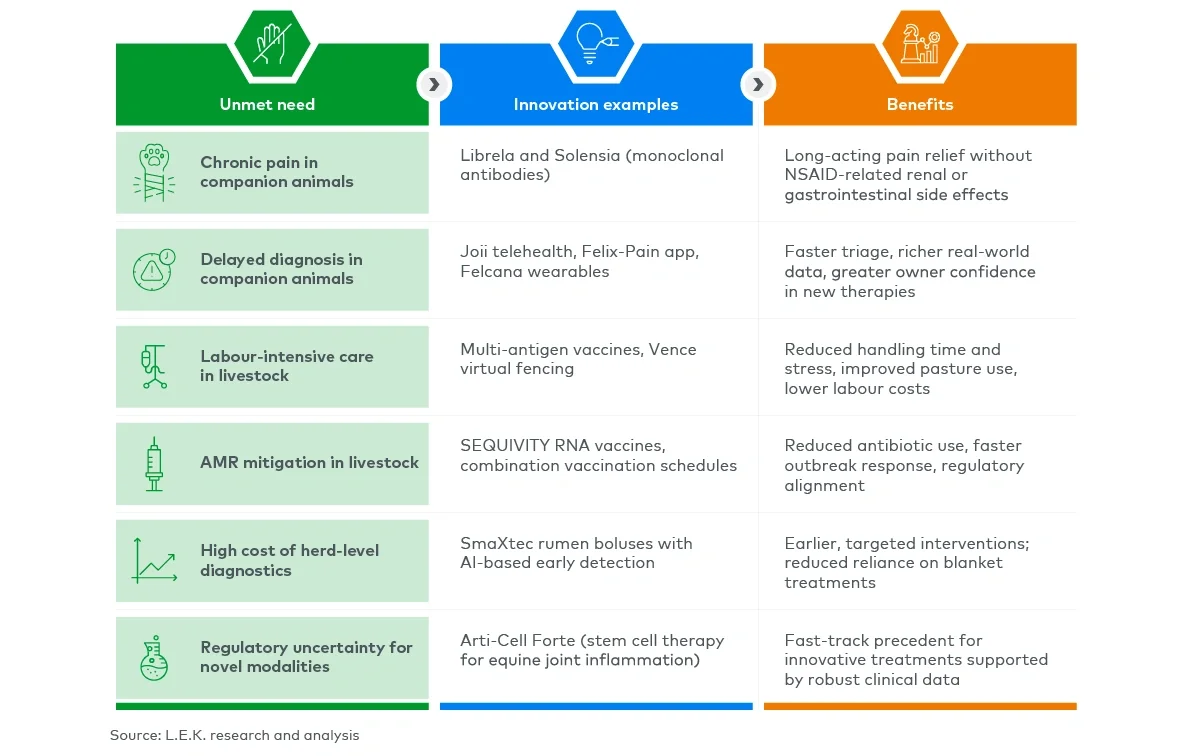
Innovation in animal health is already altering standards of care in the clinic and economics on the farm, offering early evidence of how quickly value can shift when technology is matched to the right unmet need (see Figure 1). 

Figure 1

Figure 1. Innovations in animal health are already delivering measurable clinical and economic benefits

Image
Figure 1. Innovations in animal health are already delivering measurable clinical and economic benefits

Figure 1

Figure 1. Innovations in animal health are already delivering measurable clinical and economic benefits

Image
Figure 1. Innovations in animal health are already delivering measurable clinical and economic benefits

Some specific examples of pain points, responses and the strategic benefits are highlighted below.

Precision and prevention in companion care

Disease-modifying biologics
When Zoetis launched its anti-nerve growth factor monoclonal antibody treatments — Librela for dogs and Solensia for cats — in 2023, it did more than add two products to the osteoarthritis category. For the first time, veterinarians were able to offer long-acting pain control without the renal or gastrointestinal side effects of NSAIDs. 

Uptake has been rapid: One million U.S. dogs were treated within a year, nearly doubling franchise revenue, which shows that owners are willing to pay a premium for innovation that meaningfully improves quality of life for their pets.

AI-enabled triage and monitoring
Digital tools are shortening diagnostic time and creating real-world evidence that feeds directly into R&D and life cycle management. For example, the Joii tele-consult platform has logged more than two million video consultations since its introduction in 2019, moving routine cases out of clinic time and generating longitudinal data to monitor symptom progression. Computer-vision apps such as Felix-Pain quickly deliver an objective feline pain score, and wearables from Felcana reveal subclinical changes in gait and behaviour. 

These tools provide veterinarians with earlier insight and give animal pharma companies richer post-market data. They also make owners more confident in using novel therapies.

Productivity and sustainability in livestock

Combination vaccines for labour‑efficient protection
Multi‑antigen vaccines are gaining ground in cattle, poultry and swine production because they cut handling time, reduce stress‑related weight loss and simplify cold‑chain logistics. Examples include Zoetis’ Bovi‑Shield Gold One Shot (respiratory plus M. haemolytica) and Boehringer Ingelheim’s Inglevac CircoFLEX/MycoFLEX duo for swine. 

Producers report fewer needle sticks per animal and up to 30% lower administration costs. Regulators also view combination schedules favourably when they reduce antibiotic reliance.

Rapid-cycle RNA vaccines
In as little as eight weeks, Merck Animal Health’s SEQUIVITY platform can design, manufacture and ship custom swine vaccines — enabling it to keep pace with mutating strains and regional outbreaks. Early adopters report lower mortality and reduced antibiotic use, turning alignment with regulatory standards into a competitive advantage.

Hardware-plus-AI herd management
Labour is one of the most significant costs in large-scale grazing systems. Vence’s virtual fencing collars let a single technician steer a thousand-head herd via tablet, improving pasture use and animal welfare while cutting fencing capital expenditure. 

Inside the animal, SmaXtec’s rumen boluses stream continuous pH, temperature and motion data; algorithms detect impending mastitis or rumen acidosis days before clinical signs appear, enabling targeted intervention as well as a reduction in blanket treatments.

Validated stem-cell therapy
Arti-Cell Forte, approved for equine joint inflammation, shows that when robust data is available, regulators are willing to fast-track novel modalities. The precedent eases the path for the next wave of cell-based products for other animals.

Clearly, early adopters are capitalising on innovation through two approaches: premium pricing where clinical benefits are shown and measurable return on investment where economic outcomes are the primary concern. The valuable real-world data generated is giving them a durable edge that later entrants won’t have.

The next wave of innovation

Today’s market innovation is just the beginning. A larger wave is building in the pipeline — one that could broaden the definition of ‘animal health company’, reset regulatory norms and attract fresh investment into the sector. We have grouped the coming breakthroughs into four themes.

Formulation fundamentals

Let’s not forget the basics
Incremental innovations — heatstable vaccines, fixed-dose parasiticide combinations, palatable chewables and multimonth injectables — continue to deliver outsized returns through improved compliance and wider geographic reach. Examples include Elanco’s three-month Credelio Plus chewables (long-acting tulathromycin formulations that reduce onfarm labour) and heat-tolerant poultry vaccines that sidestep the cold-chain constraints found in emerging markets. 

These lower tech upgrades often bring the fastest returns. They also free up veterinary time and create a bridge for adopting higher tech modalities.

Transformational therapies

One-shot gene cures
By acquiring Scout Bio, Ceva gained an adeno-associated virus platform with the potential to deliver a single injection that drives years-long production of therapeutic proteins inside an animal. Lead assets target the anaemia of chronic kidney disease (CKD), osteoarthritis pain and diabetes — conditions that currently require lifelong management. Successful launch would shift the business model from repeat prescriptions to one-time treatments, leading to discussions about veterinary reimbursement, pricing and ownership economics.

Off-the-shelf stem cell regeneration
Gallant Therapeutics is engineering allogeneic stem cell products that can be stored, shipped and injected without animal-specific processing. Early data in feline CKD and canine osteoarthritis go beyond just symptom relief; they suggest potential for disease modification. If confirmed, insurers and corporate veterinary groups may consider regenerative medicine as a means to potentially reduce total lifetime care costs.

New platforms and tools

‘Doggybone’ DNA (dbDNA) and self-amplifying RNA vaccines
Touchlight’s enzymatic dbDNA avoids bacterial fermentation and antibiotic-resistant genes, enabling gram-scale production within days. Ceva has signed a broad license to apply the technology in food animals, starting with avian and swine pathogens. In parallel, ECO Animal Health is developing self-amplifying RNA (saRNA) constructs that achieve comparable immune responses at only one-tenth the dose of conventional messenger RNA. Both platforms lower time-to-variant and reduce the cold-chain burden in addition to bolstering the economic case for precision vaccination.

Targeted bacteriocins and microbiome-derived actives
Originally developed for shrimp, Organicin Scientific’s narrow-spectrum peptides illustrate how species-specific antimicrobials can tackle AMR but preserve beneficial flora. The same discovery engines could be retargeted to poultry, swine and even methane-reducing bovine applications.

AI drug design and microbiome mining

AI-driven approaches in human biotechnology are now being applied to veterinary science. Vetigenics uses algorithms to analyse immunoglobulin sequences and develop canine-specific monoclonal antibodies within a short time. BiomEdit processes microbiome datasets to identify probiotic combinations that may reduce antibiotic use and improve feed conversion. Antimicrobial peptides designed by Peptidus AI use computational methods to optimise potency and stability. Initial collaborations have reported a two-to-fourfold decrease in wet-lab screening costs and timelines. 

Traditional advantage in this space once rested on the manufacturing footprint; however, these examples tell us that future differentiation could be driven by control of data, algorithms and cross-species intellectual property. Firms without a digital infrastructure may be looking at speed or cost-competitiveness challenges.

Strategic re-segmentation in animal health

Innovation is no longer limited to single products. Today it is helping reshape the entire structure of the animal health industry. 

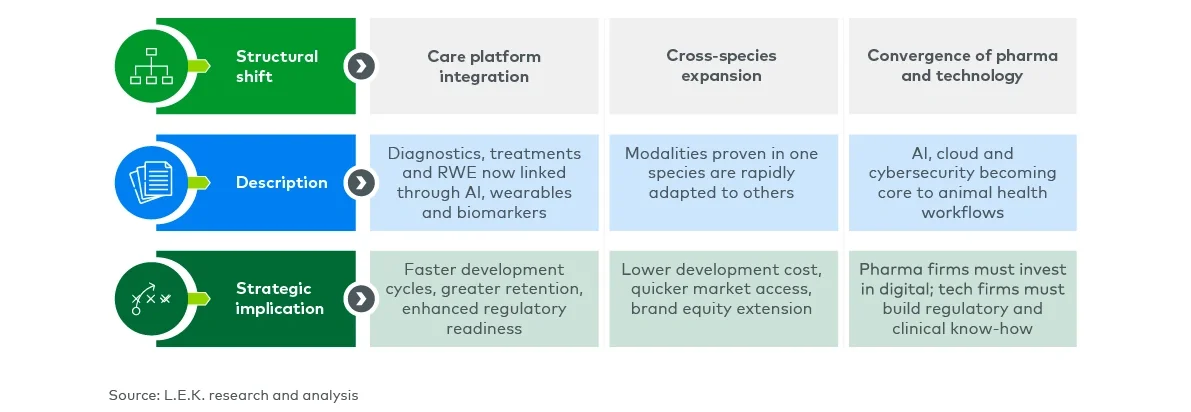
Three major structural shifts are redefining the creation and distribution of value within this sector (see Figure 2):

  • Diagnostics and therapeutics are merging into data-rich care platforms
    AI imaging, smart wearables and point-of-care biomarker panels now feed algorithms that guide treatment decisions and generate post-market evidence. Companies that have both detection and intervention capabilities can integrate processes, shorten regulatory cycles and increase their customer retention.
  • Early adopters are capitalising on species innovation
    After a modality such as monoclonal antibodies or saRNA is proven effective in one species, the costs and risks of applying it to additional species are significantly reduced. Early movers file canine-to-feline or poultry-to-swine extensions within 12 to 18 months, gaining scale and brand advantages before competitors can react.
  • Pharma and tech are merging
    Digital capabilities such as cloud, cybersecurity and machine learning are now equally as vital as traditional pharma processes. Animal pharma companies without digital expertise risk losing ground to tech firms. On the other hand, tech companies must acquire regulatory and commercial know-how if they are to capitalise on healthcare data.

These structural changes mean that portfolio reviews should move beyond the traditional species-versus-modality matrix. 

Figure 2

Figure 2. Innovation is driving structural change across the animal health value chain

Image
Figure 2. Innovation is driving structural change across the animal health value chain

Figure 2

Figure 2. Innovation is driving structural change across the animal health value chain

Image
Figure 2. Innovation is driving structural change across the animal health value chain

In order to generate the greatest value, leaders should allocate resources strategically to areas where their expertise in biology, data, software and services converge. Build, buy or partner decisions must involve this capability-focused approach to segmentation so that opportunities and risks can be accurately assessed. 

How to capture the opportunity

Innovation may be abundant, but capital, organisational bandwidth and risk tolerance are finite. Companies need a disciplined process to convert potential into executable strategy. 

This five-step process can help you turn a longlist of possibilities into a shortlist of actions:

  1. Prioritise indications
    Start where unmet clinical need intersects with proven willingness to pay. Companion-animal chronic diseases and AMR-sensitive livestock indications often rise to the top because they combine benefits for the animal with clear economic or regulatory drivers.
  2. Map technology options
    For each priority indication, catalogue which modalities (e.g. biologic, gene therapy, RNA vaccine, AI-enabled small-molecule design, hardware-plus-software) can realistically address the biology, regulatory route and delivery economics. With this step, you can avoid early focus on a single ‘hot’ technology.
  3. Screen assets
    Create a longlist of companies, programmes or platforms, then score them on technology fit, development speed, commercial synergy and cultural alignment. With focused triage here, you can remove the need for unnecessary diligence later.
  4. Assess capability gaps
    Cross-reference your shortlist against in-house strengths in manufacturing, data science, regulatory science and go-to-market execution. When the gap is larger, a buy or partner strategy may be more appropriate; when the gap is smaller, a build strategy would be more practical.
  5. Model value under multiple scenarios
    Run net present value, decision tree or real options analyses under different scenarios. Stress-test for potential delays, regulatory outcomes and pricing downside. Then you will be able to choose the access model that maximises your risk-adjusted return.

This process offers a portfolio of options matched to risk appetite and strategic ambition.

How L.E.K. can help

Advanced modalities and AI tools have moved beyond proof of concept. Companies that act decisively to align unmet need, technology fit and capability build are expected to capture disproportionate value. Organisations that fall behind may face the possibility of being confined to commodity segments.

L.E.K. Consulting combines sector insight with proven frameworks to help corporates and investors decide where to play, how to win and how to execute rapidly.

L.E.K. Consulting is a registered trademark of L.E.K. Consulting LLC. All other products and brands mentioned in this document are properties of their respective owners. © 2025 L.E.K. Consulting LLC

English

Navigating Investment in a New Era for Energy Transition

September 11, 2025

Energy leaders are under pressure to deliver solutions that are sustainable, resilient, and economically viable — all while navigating technological uncertainty and regional complexity. In this video, L.E.K. Partners Amar Gujral and Rebecca Scotton share insights from a new survey of over 320 executives across the global energy value chain, revealing how investment priorities are shifting.

Watch the full video to learn where the energy transition is headed — and what it means for your business.  

Looking for more detail?  Read the our Executive Insights: Energizing the Future: Navigating Investment in a New Era for Energy Transition, or for a more visual breakdown of the Global Energy Study findings, please download our infographic

English
Subscribe to