How AI Is Changing SaaS Pricing

December 24, 2025

As 2025 comes to an end, the pattern of the past few years is clear. AI has accelerated the steady shift toward consumption-aligned pricing and moved pricing to the center of product and revenue strategy.

The shift is showing up across every tier of the market, including the largest enterprise platforms. Atlassian raised cloud prices by up to 10% in October, citing higher compute demands and new AI features. Microsoft announced it would end volume-based enterprise cloud discounts beginning November 1, bringing customers closer to list rates and raising costs for many large accounts.

Across the market, seat-based and flat-fee models continued to lose ground. Usage-based and hybrid structures gained traction as vendors linked price to activity like data processed, tokens used or application programming interface (API) calls made. The shift began before 2025, but adoption stepped up meaningfully this year as AI features scaled.

At L.E.K. Consulting, our B2B SaaS Pricing team spent the year analyzing how AI is reshaping packaging, forecasting, metrics and value capture. Here’s what we learned and what decision-makers should watch for in 2026.

The future role of AI in SaaS pricing

AI is reshaping how software companies deliver and price value. Rising compute and data costs have exposed the limits of flat or seat-based pricing, which often fail to reflect what it takes to serve each customer. Many vendors are testing usage-based models that tie price to metrics such as tokens processed, API calls made or automated outputs performed.

AI is also improving pricing decisions. New tools analyze customer behavior in real time and test elasticity across segments, helping teams adjust packages and price points quickly. Some software-as-a-service (SaaS) firms now use AI to refine their own pricing engines, turning internal data into tangible results.

Pricing is becoming more dynamic and data driven, better aligned with how customers use and value software.

Read the full article: The Future Role of Generative AI in SaaS Pricing

AI product packaging strategies

AI is forcing software companies to rethink how they bundle and sell products. Traditional feature tiers rarely work when AI capabilities span multiple functions or create different levels of value for each customer.

Many vendors are moving toward modular packaging, separating AI features from core functionality so customers can choose what they need. Others are adding usage-based add-ons or premium assist tiers that scale with adoption. The challenge is to price AI features in a way that reflects real customer value without creating confusion.

Read the full article: AI Product Packaging Strategies: Making Strategic Choices in the AI Era

How AI is redefining SaaS metrics and forecasting

AI is reshaping how SaaS companies track and predict performance. Usage-based and hybrid pricing have made revenue less predictable, forcing teams to rethink what healthy growth looks like.

Recurring revenue now fluctuates with consumption. Metrics like ARR and retention tell only part of the story, so finance teams are adding indicators such as revenue by cohort, net dollar expansion and usage trends in order to understand behavior more accurately.

AI tools are improving forecasting. They process usage data in real time, model seasonality and flag churn risk earlier, replacing static plans with rolling data-driven views of performance.

For investors, transparency now matters more than predictability. Companies that can clearly link usage to revenue are earning stronger market confidence.

Read the full article: How AI Is Redefining SaaS Metrics and Forecasting

How consumption-based pricing reshapes growth, profitability and value

The last installment in this series explores how consumption-based pricing is changing the economics of SaaS. By tying revenue directly to product use, these models reshape how companies grow and how investors assess value.

When customers pay for actual usage, adoption drives revenue in real time. That can accelerate growth, but it also increases variability. To gauge stability, finance teams now track metrics such as margin by cohort, payback period and the mix of committed versus uncommitted spend.

Investors reward companies that manage this variability well. Firms with clear visibility into usage, disciplined cost control and transparent reporting earn stronger valuation multiples than peers using static models.

Read the full article: How Consumption-Based Pricing Reshapes Growth, Profitability and Value

How AI will shape SaaS pricing in 2026

Over the past year, AI has reshaped how SaaS companies build, price and measure value. The shift from static to dynamic models is still underway, but its direction is clear.

Industry research points to 2026 as a year of stabilization. Pricing models are expected to consolidate around hybrid approaches that balance predictability and flexibility. As AI features become standard across products, many software firms will face new margin pressures, forcing tighter discipline in how features are priced and packaged. Emerging forecasts point to a shift from experimentation to proof, with buyers demanding clear evidence of value rather than novelty.

As 2026 approaches, companies that refine their usage-based and AI-driven pricing models will build more stable revenue systems tied directly to performance. 

For investors and operators, the message is clear: Pricing is now a core part of product strategy, and those that treat it that way will lead the next phase of SaaS growth.

How L.E.K. can help

L.E.K. works with software and technology leaders to design pricing models that create measurable results. Our B2B SaaS Pricing team helps companies assess pricing architecture, evaluate new monetization models and use data to guide decisions on packaging, forecasting and value capture.

If your organization is introducing AI features, shifting to usage-based pricing or preparing for 2026 planning, reach out to our team to explore how L.E.K. can help.

L.E.K. Consulting is a registered trademark of L.E.K. Consulting LLC. All other products and brands mentioned in this document are properties of their respective owners. © 2025 L.E.K. Consulting LLC 

English
Executive Insights

Rethinking SMB Strategy: From Fragmented to Focused

December 23, 2025

Key takeaways

Small and medium-sized businesses (SMBs) face strict lending criteria from community banks and often turn to high-interest alternatives, while relying on fragmented, disconnected tools that fail to address core cash-flow, payments and operational needs.

Fintechs and embedded finance providers fill service gaps with fast, data-driven lending, seamless digital experiences and integrated workflows that improve SMB cash flow, operations and platform loyalty.

As a result, finance providers must rethink how they serve SMBs by addressing the needs of both the business and the owner, and by delivering connected solutions aligned to the SMB life cycle.

Banks and fintechs can better serve SMBs by leveraging their respective strengths — banks’ trust and capital and fintechs’ speed and digital experience — while delivering solutions that integrate services and align to SMB life-cycle needs.

Fragmented and competitive, yet full of potential, SMBs power nearly half the U.S. economy. We all know and patronize SMBs: your neighborhood bakery, the auto shop down the street, a growing online retailer. These businesses often open as scrappy startups, and some still are.

But SMBs remain fractionally served by a combination of banks, fintechs and online platforms. Many owners fund their businesses using personal finances, and some already qualify as high-net-worth individuals involved in other ventures. Larger businesses have access to cash and capital to keep them afloat in turbulent times, but SMBs don’t have that luxury — and holistic solutions are scarce. Among finance providers, the real winners will be those that connect the dots between SMBs’ unique, urgent needs and deliver the services that add value.

As providers covet the potential of more broadly serving SMBs, it’s not clear whether they are truly meeting SMBs’ needs. Each player — whether bank, fintech, or platform — is built on strengths and must confront current gaps. Understanding both these trade-offs and the conditions that drive SMBs is key to building a defensible and differentiated strategy that will guide finance providers into the future.

Easing SMB pain points

For a bakery whose mixer breaks down or a mechanic facing seasonal fluctuations, a quick loan can mean the difference between staying open and shutting down. Yet community banks’ strict lending criteria exclude many SMBs, forcing them to take on high-interest loans, further straining their resources. 

SMBs want to partner with financial services providers that understand their business, invest in their success and anticipate their needs. One small-business lender illustrates this with a local bakery client: the lender spotted cash flow trends, including uncovering a predictable 18-month oven repair cycle, and offered proactive financing to prevent costly downtime. It’s a perfect example of turning insight into action.

But insight alone isn’t enough. SMBs also need help with day-to-day tasks that add up to big impact: managing payments, optimizing cash flow, streamlining operations. These essentials are rarely met by a single, connected solution. SMBs need these services embedded in the tools and platforms they already use, but instead they’re left piecing together solutions — each addressing parts of the greater whole. And as SMBs juggle fragmented relationships and systems, finance providers lose wallet share and loyalty opportunities.

Redefining how SMBs are served

SMBs offer a dual opportunity for finance providers prepared to serve both the business and the owner. Though individual and business finances often overlap, the needs of the two remain distinct. Providers that ignore this reality risk leaving money on the table — especially in terms of wealth management. Expanding your outlook to serve the owner of multiple auto dealerships can rival, or even exceed, the value of lending to a single corporate dealer.

Because they have limited safety nets, SMBs feel market shocks more deeply than their larger peers do. Effectively serving this segment requires life cycle awareness, as each stage is characterized by demands for specific resources, capabilities and needs. The stages of SMB growth can include everything from side hustles running on personal accounts to professionally managed businesses with specialized financial systems. The needs of each SMB become more complex and specialized as the company grows. The right solutions must be delivered at the right time.

Unlike large companies, SMBs evolve rapidly and unpredictably — often faster than providers do — and their financial needs vary widely at each stage of growth, from startup through maturity. To help SMBs survive, their providers must evolve alongside them. Above all, SMBs want to streamline operations, make smarter decisions and lay the foundation for sustainable long-term growth. They need value-added services that grow with them.

The SMB financial services landscape is filled with point solutions. Banks hold deposits. Fintechs deliver fast, data-driven lending. Platforms like Etsy and Shopify have made significant strides with embedded services and distribution. But traditional playbooks won’t work in this fragmented market. SMBs want providers that can:

  • Deliver value in their specialized area
  • Seamlessly connect services across payments, lending, wealth and cash flow
  • Align solutions that meet their business’s evolving life cycle needs

Banks/fintechs take diverging paths, while embedded finance redraws the battlefield

In a crowded market, finance providers must win the right to serve their customers. Banks cover the basics, but SMBs pursue solutions that go beyond deposits and transactions. Rigid processes and limited personalization have pushed SMBs to turn to faster, more flexible alternatives. Providers must reframe intent from transactional tools to strategic assets that drive SMB value.

Fintechs and software providers have filled service gaps with solutions that address workflow management, payments, reporting and transaction enablement. Rather than looking for new opportunities to address areas of the value chain, SMB providers should now seek to improve their customer orientation, better understand their customers and o design sets of services that meet customers’ needs.

By digging down into the service needs of SMBs, embedded finance providers have already staked their claim in the SMB market. Fundbox started as an SMB lender and, with 500,000-plus connected SMBs, has transformed into the pioneer of embedded working capital solutions for SMBs. Its rapid approval and funding process, along with revolving lines of credit of up to $150,000, helps SMBs manage their critical short-term cash flow needs.

Taking a very different path, Stripe Capital evolved from payments provider to SMB platform, extending its money-movement edge into financing. By offering seamless access to capital, free from traditional credit hurdles, it helps SMBs improve cash flow and growth while deepening platform loyalty.

Furthermore, Stripe addresses a fundamental SMB challenge: unifying financial operations. Its platform combines banking features, working-capital financing, real-time reporting and payment products into one seamless experience. By continually layering new services onto its core offering, Stripe has captured a greater share of wallet while strengthening customer loyalty.

Where does the market move from here?

SMBs want unified solutions — not deposits here, payments there and cards elsewhere. To meet that need, finance providers must target the stages where they add the most value and double down on providing it.

L.E.K. Consulting starts by evaluating opportunities across six key dimensions, including the questions SMBs ask when developing a go-to-market strategy:

  1. Trust
    Trust extends beyond just reliability. Is the provider truly invested in the SMB’s success? Will they be willing to go the extra mile when needed?
  2. Capital access
    This is table stakes. Can the provider deliver at the speed and urgency of the borrower? Is capital affordable?
  3. Digital experience
    Is the provider’s solution seamless, fast and intuitive? Does it elevate the customer experience?
  4. Embedded relevance
    Does the solution integrate with key business tools that SMBs already use? Is the integration clunky, or is it user-friendly? Does it make life easier for SMBs by eliminating manual and redundant processes?
  5. Nuanced understanding
    Does the offering provide personalized services based on rich data insights about the business and its pain points? Does the provider serve up the right product at the right time? Does the provider cater to both the entity and the individual?
  6. Life cycle alignment
    Does the tool continue to deliver relevant insights as the SMB matures? Do the products align to the evolution and life cycles of the SMB?

Challengers are winning SMBs’ business by delivering more integrated, intuitive and real-time experiences. By understanding and addressing the Achilles’ heels of competitors, they can address the critical needs that they are distinctly positioned to fulfill. In the best-case scenario, they can build a competitive moat, making it difficult for competitors to challenge their turf.

How banks can win

Banks don’t need to replicate the services of fintechs in order to compete. By embedding value across the SMB life cycle, they can reclaim lost ground and define their role in the evolving ecosystem. In the short term, banks should focus on defending their core by:

  • Leveraging strong relationships
    Where trust is already established with current customers, inform them of the bank’s options that can help with their small business needs.
  • Digitizing cautiously but deliberately
    Offer basic banking products and introduce light digital offerings — mobile banking, bill pay, etc.
  • Pursuing incremental wins without disrupting current models
    Rather than rebuilding from scratch, banks should utilize some contextual intelligence for product offerings — but the sophistication of products should remain relatively the same.
  • Evaluating partnership and increased capability opportunities
    To encourage innovation and scale impact, banks should seek fintech partners that can accelerate their time to market while leveraging their core strengths of trust, capital and compliance.

By owning the middle — where SMBs outgrow one-size-fits-all solutions but still need guidance — banks can stay relevant, defend their core and build sustainable advantage.

How fintechs can win

Fintechs have long recognized that SMB banking requires more than just products. Success depends on delivering seamless experiences and embedding data-driven solutions tailored to SMBs’ needs.

Though they have advantages in speed, flexibility, SMB insight and digital experience, fintechs still trail banks in trust and capital access. To maintain momentum, they should continue leveraging their ability to serve SMBs across growth stages while meeting both business and personal needs.

For fintechs and digital banks, it’s about staying the course and defending competitive advantages. Here’s how:

  • Double down on speed and simplicity
    SMBs value frictionless experiences.
  • Build trust
    Transparency and strong customer support are a winning combination among SMBs.
  • Embed lending into the ecosystems
    Start by improving on offerings that SMBs already use — from payroll and invoicing to enterprise resource planning tools. 

Focus is the path to winning SMBs’ loyalty

Winning in the SMB market takes strategy, not brute force. While banks hold the relationships and capital, fintechs counter with speed and agility. Growth is real, but winning here requires fresh delivery models and strategic investment.

The path to growth in the SMB market isn’t about offering more; it’s about providing what matters most to SMBs at the right time. Banks, fintechs and embedded players must evolve with SMBs, adapt to their needs, anticipate their next steps and deliver value across the life cycle.

Winning this market won’t happen overnight, but those that connect the dots can unlock immense potential. Whoever simplifies and integrates will own the SMB market. 

For insights on how your organization can expand your SMB market reach, please contact us.

L.E.K. Consulting is a registered trademark of L.E.K. Consulting LLC. All other products and brands mentioned in this document are properties of their respective owners. © 2025 L.E.K. Consulting LLC 

English

St Mary’s University: Shaping Success in Higher Education (Part 1)

December 19, 2025

Anthony McClaran
Anthony McClaran

In this conversation, Ashwin Goel and Professor Anthony McClaran, Vice-Chancellor of St Mary’s University, Twickenham, explore how the university is redefining success in global higher education. 

The discussion highlights St Mary’s international strategy, its distinctive approach to student support and its commitment to academic excellence as it enters new markets. 

The video offers key insights into the strategic priorities shaping the university’s international expansion.

L.E.K. Consulting is a registered trademark of L.E.K. Consulting LLC. All other products and brands mentioned in this document are properties of their respective owners. © 2025 L.E.K. Consulting LLC 

English
Executive Insights

Building Defensibility: 5 Moats Separating Top Ad Agencies From the Rest

December 18, 2025

Key Takeaways

Proprietary technology and data capabilities remain the most durable moat, especially when they drive measurable performance gains.

Vertical and segment expertise creates defensibility through deep credibility in complex industries and in uniquely demanding segments such as small and medium business (SMB) and midmarket clients.

Specialized service expertise that leverages artificial intelligence (AI) in areas like marketing automation, analytics and performance media enables differentiation and premium positioning. 

Institutional client relationships supported by broad service adoption reduce churn and strengthen valuation, while effective M&A integration capability continues to separate top performers from the rest. 

Ad agencies are undergoing one of the most significant shifts in decades, driven by consolidation, new technology and evolving client expectations. This edition of L.E.K. Consulting’s Executive Insights is Part 2 of our series on the agency landscape. In Part 1, we outlined four consolidation models reshaping the industry, from holdco mergers like IPG-Omnicom to private equity (PE) rollups and focused specialists. Each reflects a different strategic response as platforms like Google, Meta, Amazon and Walmart Connect take a greater share of digital ad budgets and as consultancies move deeper into marketing.

Still, consolidation alone doesn’t determine competitive advantage. As artificial intelligence (AI) commodifies creative work and narrows execution differences, agencies need moats that can’t easily be replicated. The real question is, what makes an agency’s position defensible?

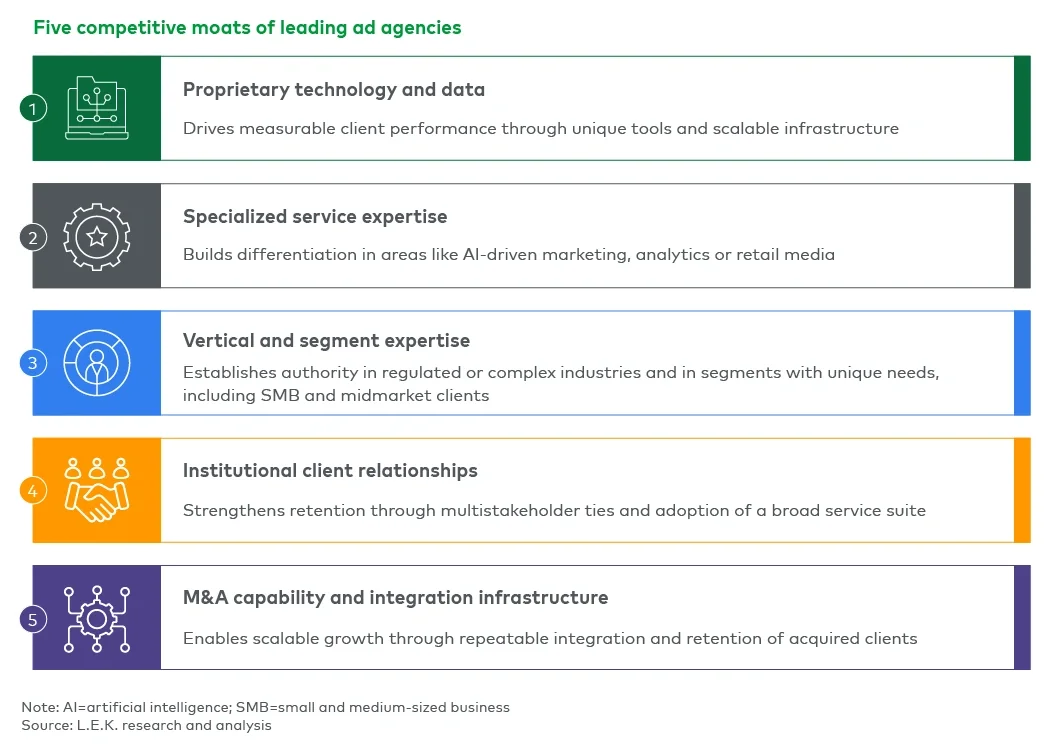
Our work with agency operators and investors has revealed five key protective moats that agencies build to create a long-term advantage (see Figure 1). Read on for a closer look at each.

Figure 1

Leading ad agencies build defensibility across five moats that reinforce one another to drive long-term performance

Image
Leading ad agencies build defensibility across five moats that reinforce one another to drive long-term performance

Figure 1

Leading ad agencies build defensibility across five moats that reinforce one another to drive long-term performance

Image
Leading ad agencies build defensibility across five moats that reinforce one another to drive long-term performance

1. Proprietary technology and data

The most durable moats are built on technology infrastructure that competitors can’t easily match. Relying solely on off-the-shelf tools rarely creates meaningful differentiation.

WPP, the holding company behind GroupM, Ogilvy and VML, increased its investment in WPP Open, its AI-powered marketing operating system, from £250 million in 2024 to £300 million in 2025. The platform helped secure major wins including Amazon and Unilever.

PMG’s proprietary marketing operating system, Alli, is the result of a long-term technology investment and now manages $6 billion in media spend annually. It consolidates data from more than 30 sources per client and automates campaign optimization and creative analysis through AI.

The question for evaluating an agency’s tech moat isn’t whether they use AI but rather: Does the agency possess proprietary tools that enhance client performance in measurable ways? Can these capabilities scale without proportional increases in headcount?

2. Specialized service expertise

Capabilities in AI-enabled marketing automation, analytics tools, performance media (retail media, CTV) and influencer or social commerce are attracting strong buyer interest in M&A.

Accenture Song’s August 2025 acquisition of Superdigital added deep expertise in short-form video and influencer partnerships. Previsible’s July 2025 acquisition of Internet Marketing Ninjas brought legacy SEO and authority-building capabilities to its AI-native search platform. These specialized service capabilities enable differentiation and premium positioning in competitive categories.

3. Vertical and segment expertise

Agencies that specialize in serving clients in specific industry verticals or client segments tend to build stronger and more durable client relationships than generalists do. This focus enables agencies to deliver not only creative solutions but also industry insight, compliance precision and a deep understanding of the client’s priorities, all of which drives trust and retention.

In complex and highly regulated verticals, such as finance, legal and healthcare, specialization creates defensibility and differentiation. Agencies that have deep institutional knowledge and are compliant with regulatory frameworks and data privacy requirements are better equipped to command premium pricing and repeat business.

For example, in 2023, Amulet Capital Partners and Athyrium Capital Management formed Unlock Health through the merger of Eruptr and DECODE. The result is a $500 million healthcare marketing platform, illustrating how vertical focus strengthens defensibility and consolidation value.

The same principle applies to client-size segments. Agencies that serve small and medium-sized businesses (SMB) or midmarket clients can tailor offerings to limited budgets, faster decision cycles and hyperlocal targeting. Companies such as Scorpion, Thrive Digital and Hibu have built strong positions with regional SMB clients by packaging digital marketing, lead management and reputation services into scalable, high-retention programs.

For additional perspective on how digital-first strategies are redefining defensibility in marketing, see our recent piece “Is Your B2B Marketing Strategy Obsolete? Here’s How Leaders Stay Ahead.

4. Institutional client relationships

Are client relationships institutional, rooted in the agency’s broader capabilities or dependent on a small number of individuals whose departure could jeopardize the account?

Top-performing agencies with deeply institutionalized relationships can reach client retention rates near 97%, while others struggle with constant churn. This directly influences valuation. Agencies selling at premium EBITDA multiples of eight to 12 times often demonstrate low client concentration and relationship longevity averaging around 22 years.

Defensibility increases when relationships are spread across multiple stakeholders, often across multiple business units or brands, and supported by a broad suite of adopted services. Agencies embedded in several teams through strategy, creative, media, analytics and technology work are far harder to displace than those limited to a single service line.

In contrast, relationships concentrated among a few senior leaders or tied to one niche offering are vulnerable to disruption, price pressure and internal shifts within the client organization.

5. M&A capability and integration infrastructure

The ability to successfully acquire and integrate other agencies has become a valuable moat. Consider successful exits: Croud completed five strategic acquisitions during its PE hold period, carefully staged over two years. Two Circles made three acquisitions within its first year. Both achieved strong exits because the acquisitions delivered material value.

Compare this with the broader market reality: Bolt-on acquisitions dropped 40% year over year in 2024, with more than a quarter of PE-backed firms (27%) now adopting organic-only growth strategies, often due to harsh lessons from botched integrations.

Agencies with genuine M&A capabilities demonstrate:

  • Documented integration playbooks covering day-one operations through team and process integration
  • Financial and operational systems built to absorb acquisitions without disruption
  • Track records with measurable retention rates after acquisition

Without these capabilities, acquisitions fail to create the intended defensibility.

Implications for investors and agency leaders

Few agencies excel across all five dimensions, but those that lean into their strongest moats tend to build the most durable positions. We’ve outlined several key factors for investors and operators to consider when evaluating the defensibility of their company’s or a target’s market position.

For investors:

  • Prioritize targets with at least two demonstrable moats backed by quantifiable metrics, not just claims in pitch decks.
  • Assess moat durability under current market pressures. Is proprietary tech actually delivering measurable performance advantages, or is specialized expertise eroding as platforms democratize the capability?
  • Evaluate transferability through ownership transitions. Client relationships dependent solely on the founder won’t survive the sale, regardless of earnout structures.

For operators:

  • Audit current positioning against all five moats quarterly. Identify which dimensions are strengthening versus eroding.
  • Choose battlegrounds deliberately. Becoming exceptional at service expansion requires different investments from those for building proprietary technology.
  • Document institutional knowledge aggressively. The difference between a personal relationship and an institutional one is whether the departure of your top client lead would trigger account reviews.

Navigating today’s agency landscape takes perspective and experience. L.E.K. brings together advertising industry veterans who have advised many of the world’s leading agencies. We help investors and operators evaluate M&A opportunities, assess competitive moats and build defensible growth strategies. Learn more about our media industry expertise or contact us to discuss how we can help.

L.E.K. Consulting is a registered trademark of L.E.K. Consulting LLC. All other products and brands mentioned in this document are properties of their respective owners. © 2025 L.E.K. Consulting LLC

English

St Mary’s University: Shaping Success in Higher Education (Part 2)

December 19, 2025

Anthony McClaran
Anthony McClaran

In this concluding discussion, Ashwin Goel speaks with Professor Anthony McClaran, Vice-Chancellor of St Mary’s University, Twickenham, to examine the key success factors for universities pursuing international expansion. 

The conversation explores how institutions can navigate regulatory environments, build meaningful student experiences abroad and uphold consistent standards of quality across borders. It underscores that genuine partnership and a commitment to academic excellence are foundational to sustainable global growth in higher education.

English

On the Cusp of a Cure: Preparing Asia Pacific for the Precision Era

December 18, 2025

Precision medicine is gaining real momentum across Asia Pacific as new tools and technologies enable treatments that target the root cause of disease. These therapies offer curative potential for conditions that previously had limited options.

L.E.K. Consulting's On the Cusp of a Cure series, supported by Johnson & Johnson, examines how ready the region is for this shift. Built on extensive evidence, it outlines the benefits of precision therapies, the barriers slowing adoption and the actions needed to strengthen system capability.

Watch the video to understand how precision therapies are shaping the next standard of care in Australia, China, Japan and Korea.

L.E.K. Consulting is a registered trademark of L.E.K. Consulting LLC. All other products and brands mentioned in this document are properties of their respective owners. © 2025 L.E.K. Consulting LLC

English
Executive Insights

State of the Medtech Customer Base: Insights From L.E.K.’s 2025 US Health System Executive Survey

December 17, 2025

Key Takeaways

There is a clear divide in the financial health of U.S. health systems: Approximately 50% report that their organization’s financial position is constrained, and roughly 50% report their financial position being solid or even strong; expectations for operating margin growth have decreased since 2024.

Most hospitals expect to increase medical supply spend by less than 5% annually, maintaining stable investment despite broader market uncertainty and pressuring medtechs to absorb tariff-driven price increases.

Operational and cost efficiency lead strategic priorities, while innovation demand is concentrated among progressive systems that possess the scale and coordination to adopt new technologies and shape market standards.

To succeed in this environment, medtechs could consider four imperatives: Lead with efficiency, strengthen supply chain partnerships, expand value-added services and collaborate closely with innovation-oriented systems. 

Every year, L.E.K. Consulting surveys hospital and health system executives to understand how their organizations are performing financially, what their purchasing behaviors are and how their strategies are evolving in response to market conditions. This current view, as well as a longitudinal perspective, offers medtech leaders a clear idea of how hospitals are positioned to invest, innovate and partner.

This year’s results reflect a medtech hospital customer base that is navigating evolving policy and economic pressures. Tariff exposure and other federal health policies are weighing on hospitals’ finances and investment decisions. At the same time, demand for new technology and services has not disappeared, but it is being reshaped by structural constraints and sharper prioritization.

In this article, we summarize what we heard regarding the state of the medtech customer base, including:

  • Trends that medtech executives need to know about hospitals’ evolving investment constraints and priorities
  • How these dynamics are affecting spend outlook and purchasing expectations
  • What actions medtech companies can take to stay competitive in this changing landscape

Key trends

1. The financial divide

This year reveals a divided picture in terms of health systems’ financial health. Approximately 50% report that their organization’s financial position is solid or strong, and 50% report their financial position is constrained or at high risk. There is also a divide in liquidity, with more than half of respondents reporting that their system holds less than 180 days of cash on hand. A significant portion of the medtech customer base is therefore operating under financial strain, putting downward pressure on medtech companies.

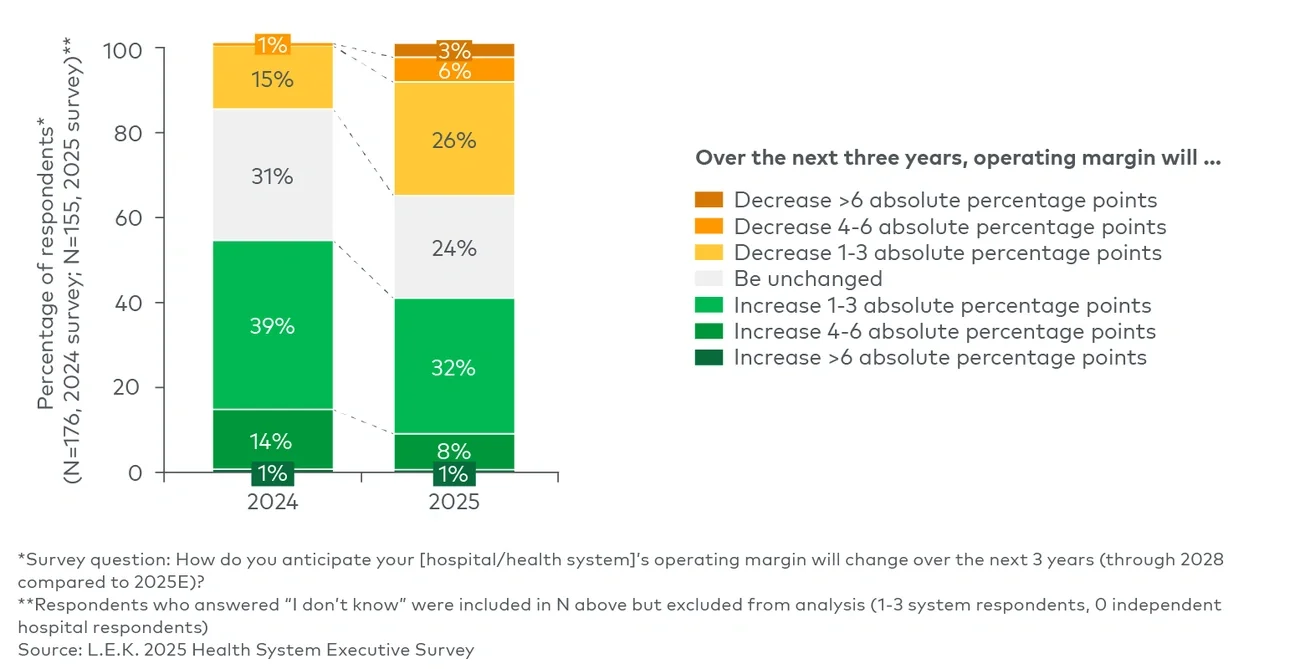
Health systems also have a less optimistic outlook for operating margin growth than they did in 2024. The proportion of systems expecting margins to decrease more than doubled (see Figure 1).

Figure 1

Hospital/health system operating margin expectations over the next three years (2024; 2025)

Image
Hospital/health system operating margin expectations over the next three years (2024; 2025)

Figure 1

Hospital/health system operating margin expectations over the next three years (2024; 2025)

Image
Hospital/health system operating margin expectations over the next three years (2024; 2025)

These tempered outlooks reflect a challenging operating environment. Rising costs, tariff exposure and reimbursement uncertainty continue to weigh on hospital margins. Medicaid and Affordable Care Act funding/eligibility changes are expected to reduce covered lives, and potential 340B reform could further pressure income. For hospitals with thinner liquidity and more policy-sensitive payer mixes, these factors amplify risk and limit flexibility for investing in growth.

2. Operational and cost efficiency and revenue capture as top priorities

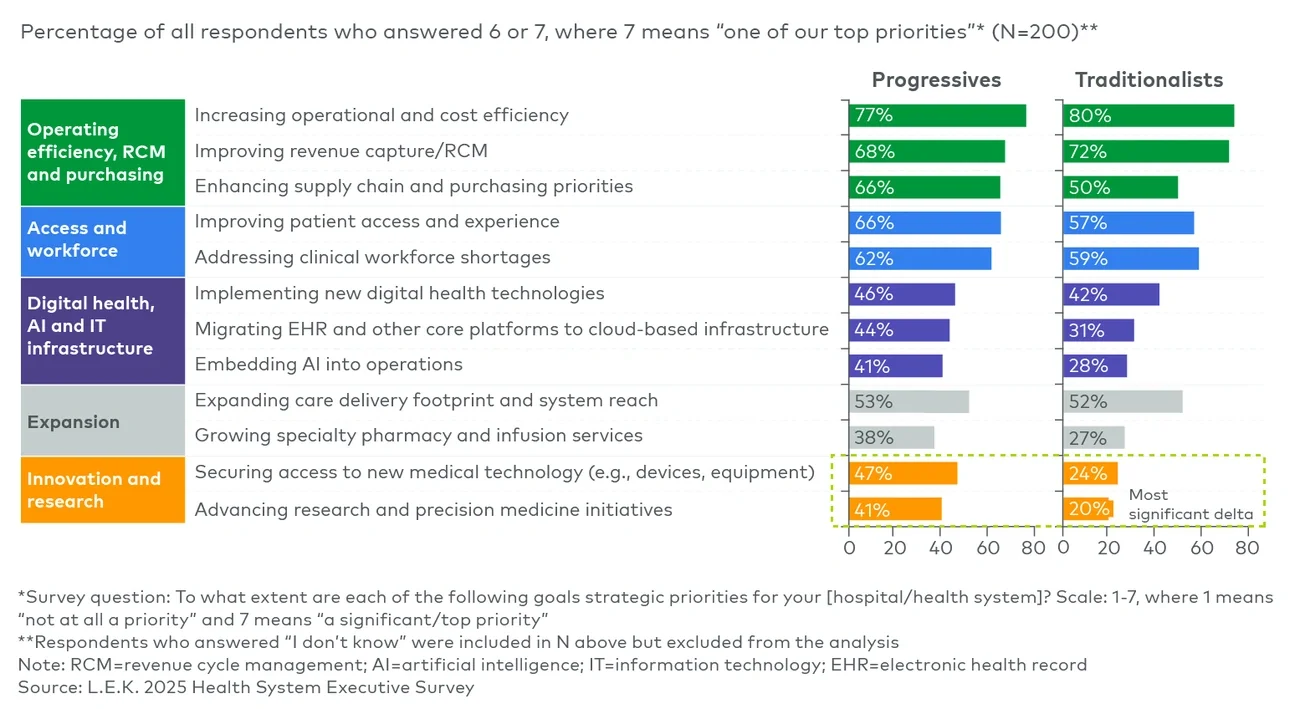
Despite differences in financial health, most health system leaders share a common set of top strategic priorities. Nearly 80% cite operational and cost efficiency as a top priority, while nearly 70% cite improving revenue capture, underscoring a sector-wide push to improve margin performance (see Figure 2). Supply chain resiliency and cost containment also rank high on the list. These priorities span both progressive systems, with diversified non-acute reach and more value-based participation, and traditionalist systems, whose footprints remain centered on acute, fee-for-service care.

Figure 2

Hospital/health system strategic priorities

Image
Hospital/health system strategic priorities

Figure 2

Hospital/health system strategic priorities

Image
Hospital/health system strategic priorities

3. Continued investment in non-acute care sites

More than half of hospitals are also prioritizing expanding their care delivery footprint and system reach, particularly in primary and specialty care and ambulatory surgery centers (ASCs), highlighting the continued shift toward non-acute growth channels and diversified patient access. This continued migration reflects a structural shift in where medtech demand originates. ASCs and freestanding specialty centers require equipment that is smaller-scale, lower-cost and easier to operate. For suppliers, success will increasingly depend on tailoring product design, pricing and service models to these environments.

4. Focus on supply chain resiliency and cost reduction

Two-thirds of progressive systems and half of traditionalist systems identify supply chain and purchasing improvement as a top priority. Specifically, supply chain executives are focused on resiliency and cost containment. To increase resiliency, we expect leaders to dual source critical stock-keeping units where possible, preapprove substitutes and set forward-buy triggers for tariff or shortage risk. To reduce costs, we expect to see them consolidating redundant vendors, running competitive RFPs and leveraging GPOs and distributors more thoughtfully where those measures improve pricing and terms.

5. Divergence in approach to investment and innovation

Progressive systems are significantly more likely to prioritize several initiatives related to innovation and investment, including securing access to new medical technology, advancing research and precision medicine, embedding AI into operations, and growing their specialty pharmacy and infusion services.

For medtech suppliers, this divergence matters. Innovation demand is increasingly concentrated among those with the scale, coordination and non-acute reach to adopt and integrate new technologies. Financially constrained and acute-centric systems, by contrast, are primarily focused on efficiency and cost control, adopting innovation selectively and focusing on solutions that directly improve efficiency or mitigate risk. As a result, growth for medtechs will come from deepening engagement with the systems best positioned to invest and influence broader market adoption. Deeper engagement can range from more personalized commercial discussions to product or workflow codevelopment, co-marketing partnerships and, in select cases, even joint ventures.

Spend outlook: Stability over expansion

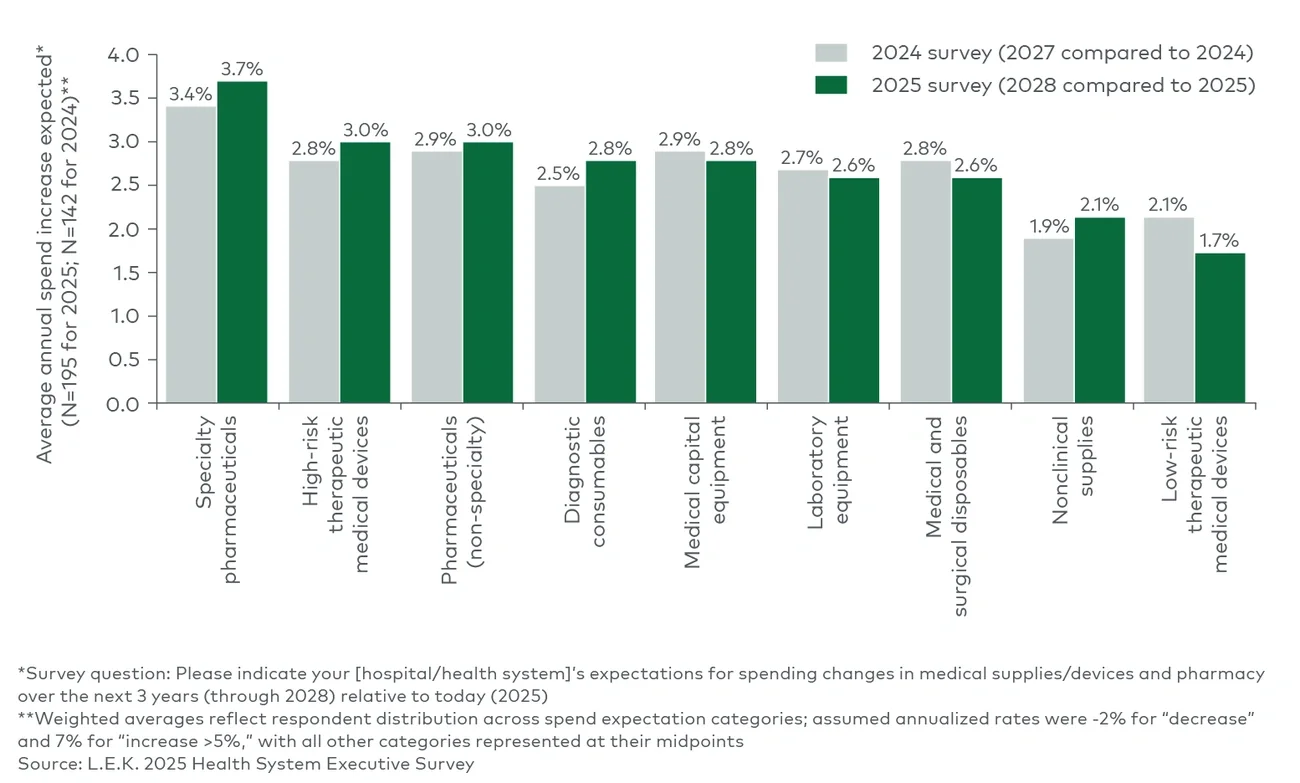
Beyond strategic priorities, the survey also gauged hospitals’ expectations for spending on medical supplies, devices and pharmacy. Most expect modest nominal growth of around 2%-4% per annum on average for most product categories (see Figure 3), translating to a stable or slightly contracting picture in real terms — evidence that spending discipline remains a defining feature of the market.

Figure 3

Medical supplies/devices and pharmacy spend expectations over the next three years relative to current

Image
Medical supplies/devices and pharmacy spend expectations over the next three years relative to current

Figure 3

Medical supplies/devices and pharmacy spend expectations over the next three years relative to current

Image
Medical supplies/devices and pharmacy spend expectations over the next three years relative to current

This steady outlook persists despite ongoing tariff exposure, labor inflation and supply chain cost pressure — indicating that hospitals do not expect to absorb major price increases. Instead, they anticipate suppliers will share in cost mitigation, whether by absorbing tariff and input cost impacts or by managing device and supply pricing through contracting discipline, product standardization and sourcing efficiencies such as multiyear agreements or volume-based rebates.

For medtech companies, the implications are clear: Pricing leverage will stay limited, even as demand for clinically essential products holds steady. Hospitals will also look to features beyond clinical performance alone, increasingly assessing how products influence total cost and workflow efficiency. They will favor suppliers that guarantee continuity, offer substitution options and support product standardization. They will also value devices that capture structured data or integrate billable events in electronic medical records to improve coding accuracy and payment integrity.

Positioning medtech for success in this environment

The 2025 L.E.K. Hospital Survey highlights a customer base focused on financial discipline and selective innovation. For medtech executives, four imperatives stand out:

1. Lead with efficiency. 

Clearly quantify and communicate how products lower total cost — through reduced procedure time, shorter staffing requirements or higher throughput — and integrate this message into commercial, marketing and clinical discussions.

2. Strengthen supply chain partnerships. 

Collaborate with providers to reduce disruption risk and total cost. This may include premium programs for guaranteed supply continuity, collaborative forecasting or standardization frameworks that balance choice and efficiency.

3. Expand value-added services. 

With average selling price pressure intensifying, build complementary offerings — such as workflow optimization support, staff training or digital integration services — that create measurable operational value.

4. Collaborate closely with innovation-oriented systems. 

Medtech growth will increasingly depend on partnerships with providers that are actively shaping care models and technology adoption. Collaboration may include tailored commercial engagement, shared development of products or workflows, or broader strategic alliances.

In upcoming Executive Insights, we will explore how hospitals are continuing to expand into ambulatory and other non-acute sites of care, how they are deploying AI and digital tools to improve efficiency, and more.

To discuss these findings — and how your organization can position for success in this evolving environment — please reach out to our Medtech team.

A special thank you to the Healthcare Insights Center for their contributions to this EI.

Note: AI was used to support the drafting of this article.

L.E.K. Consulting is a registered trademark of L.E.K. Consulting LLC. All other products and brands mentioned in this document are properties of their respective owners. © 2025 L.E.K. Consulting LLC

English
Special Report

Fueling Growth: Consumer and M&A Themes Reshaping Nutritional Supplements

December 17, 2025

The U.S. nutritional supplements market — valued at around $69 billion in 2024 and expected to reach nearly $87 billion by 2028 — continues to attract strong consumer and investor attention. Demand is shifting as new health priorities, product innovation and digital commerce reshape how consumers engage with the category.

This Special Report examines the dynamics behind these changes and their impact on investment and acquisition activity. From the influence of GLP-1 weight-loss drugs to rising interest in cognitive, women’s and metabolic health, we highlight where growth is building and how brands are adapting to maintain relevance.

Highlights

  • Market resilience: Supplements remain a durable, growing segment of consumer health, supported by ongoing product innovation.
  • New health behaviors: GLP-1 use is creating distinct nutritional needs, while focus on cognition, hormone balance and metabolic health expands.
  • Digital commerce: Amazon now dominates category sales, and TikTok is accelerating discovery and trial among younger audiences.
  • Investment trends: Strategic M&A has slowed, but investor confidence remains high in brands built on endurance, backed by science and shaped by disruptive marketing.

Conclusion

The nutritional supplements market is entering a more selective phase. Brands that demonstrate clear efficacy and strong consumer connection will lead the next period of growth. For investors, understanding where demand is concentrating will be key to identifying long-term value.

For further insights into our analysis, download the full report.

Contact us for more information.

English
Subscribe to