

Margin Uplift and Operational Improvements for a Rapidly Growing Industrial Manufacturer

May 6, 2025

Background and challenges

A manufacturer of high-pressure vessels and storage tanks was struggling to keep up with monthly demand and deliveries. Despite increasing volumes, the manufacturer faced rising unit costs and supplier delays resulting in production disruptions.  

The client and its investors engaged L.E.K. Consulting to evaluate opportunities to optimize costs and ramp up production capacity to meet increasing market demand.

Approach

To achieve these objectives, our team undertook a comprehensive analysis across manufacturing operations, engineering and procurement to uncover opportunities for cost optimization and capacity expansion:

Cost optimization

L.E.K. deployed its Rapid Opportunity Diagnostic to develop procurement initiatives to reduce cost and risk exposure.  

A spend cube, category profiles and supplier matrices were rapidly developed to model the current direct materials ecosystem and generate insights into supplier concentrations, pricing, historic supplier performance and supply risks.

Category sourcing strategies were evaluated and incremental opportunities were developed, including:  

  • Insourcing vs. outsourcing assessment: Evaluated critical sourcing categories resulting in cost-benefit quantification, strategic de-risking of the supply chain and support for volume growth
  • Value engineering: Recommended product redesign to eliminate over-engineered components, significantly reducing sourcing costs
  • Alternate manufacturing processes: Suggested alternate viable manufacturing processes for sourced metallic components, which had better pricing driven by production scale efficiencies without sacrificing quality
  • Incumbent negotiations: Identified opportunities with existing suppliers based on cost models and pricing insights
  • Contract evaluations: Determined opportunities for renegotiations, such as payment terms, to enable cash conservation

A strategic roadmap was developed to prioritize and time phase 15+ projects across four categories that allowed the company to allocate its resources pragmatically and hold them accountable on value and timing.

Operational efficiency and throughput expansion

To address production capacity constraints, our team created a process map and identified bottleneck process steps at current and future volume projections. We evaluated different options to increase production to required levels by:

  • Eliminating production bottlenecks: Identified and eliminated bottlenecks in the production process through process redesign and capex investments  
  • Optimizing facility layout: Optimized the facility layout to reduce transportation waste within the plant and improve direct labor efficiency

Results

Our team of experts identified and quantified 15+ opportunities across four procurement categories, resulting in $20M+ in annualized cost savings and a 30% reduction in per-unit costs. Additionally, the team planned five projects with the client to streamline production bottlenecks, ramp up throughput and optimize the shop-floor layout.

A strategic in-sourcing project was developed that would stabilize the supply chain for a critical component facing supplier reliability concerns. A business case was developed to evaluate the returns on the significant in-sourcing capex investment — a payback period under 2 years which exceeded finance’s requirements.  

L.E.K. worked closely with management to develop the roadmap and resources required to implement this ambitious program. Opportunities were sequenced based on impact, risk and overall timing into a 2-year roadmap. The management team engaged L.E.K. to assist with the program management of the in-sourcing project.  

For more information, please contact us.

L.E.K. Consulting is a registered trademark of L.E.K. Consulting LLC. All other products and brands mentioned in this document are properties of their respective owners. © 2025 L.E.K. Consulting LLC

English

Transforming a Global Medical Device Supply Chain: International Network Optimization and Operational Excellence

May 27, 2025

Background and challenges

A manufacturer and distributor of medical devices had been struggling to navigate all-too-common supply chain challenges: Sharply rising labor costs in their facilities and costly freight from international manufacturing sites to distribution centers, as well as distribution centers to customers. The company engaged L.E.K. Consulting to assess its 4-wall DC operations and distribution network. As part of a broad supply chain cost takeout across the distribution and transportation network, our team assessed savings opportunities across transportation, distribution and labor.  

Approach

The L.E.K. team collaboratively led two workstreams - network optimization and 4-Wall DC efficiency.  

Network Optimization: We deployed best-in-class network modelling tools to baseline the current state and test hundreds of potential scenarios. Real-time benchmarks were used to ensure accurate results that reflected today’s supply chain, while also modelling sensitivities to ensure go-forward feasibility. Ultimately, L.E.K.:

  • Determined the optimal location for a free trade zone warehouse to effectively service 10 countries in the Americas, improve lead times, consolidate air and less-than-container load shipments to full container load, and delayed inventory decisions while avoiding incremental tax and tariff implications
  • Assessed the physical footprint across the Americas supply chain to identify redundant facilities and strategically place greenfield distribution centers to improve customer service levels and reduce the cost to serve
  • Optimized outbound parcel network, shifting multiple high-density customer markets to zone 2 from zones 4-6

4-Wall DC efficiency: Our team of experts spent 3 weeks on-site, working hand-in-hand with leadership and floor teams to diagnose pain points, identify opportunities and kick-start execution of cost savings. During the time onsite, we:

  • Assessed the primary Americas distribution facility to reduce labor spend and improve productivity
  • Redesigned the labor staffing model to right-size headcount to demand levels
  • Reconfigured slotting and replenishment strategy to improve the flow of work and enhance productivity
  • Designed a cascading KPI and accountability structure to sustain change

Results

Working closely with the client leadership team, L.E.K. created significant value that improved customer experience, enhanced its supply chain capacity and capabilities, and reduced cost to serve:

  • Reduced average end-to-end lead times by 25% in the Americas
  • Generated 5%-10% cost reduction across the network
  • Lowered 4-wall DC labor spend by more than 20% through advanced labor planning and management, optimized slotting and replenishment strategies, and balanced facility workflow

For more information, please contact us.

L.E.K. Consulting is a registered trademark of L.E.K. Consulting LLC. All other products and brands mentioned in this document are properties of their respective owners. © 2025 L.E.K. Consulting LLC

English

Procurement Excellence as Competitive Advantage: Lowering Costs to Elevate Products

May 6, 2025

Background and challenges

An outsourced drug compounder was struggling to remain cost competitive in a price-sensitive market. The company engaged L.E.K. Consulting to scrutinize its current spend profile and identify specific actions that would help it establish a more competitive cost position in the market. The company had a limited history of undertaking such systematic spend reviews, dissuaded by limited supply base optionality as well as the complexity of navigating change in a highly regulated production environment.  

Approach

L.E.K. leveraged the company’s existing data to build a systemic view of spend across key categories and identify levers to improve its cost base:

  • Evaluated group purchasing organizations (GPOs) for molecules and active pharmaceutical ingredients, finding that GPOs could provide current formulations at a lower cost
  • Analyzed historical instances of supply disruptions and proposed changes in supplier mix to build a more secure base, thereby increasing supply security and minimizing instances of paying premium prices to guarantee product availability
  • Assessed spending on primary packaging against prevailing market prices and introduced the client to new channel partners that could provide current products at lower prices
  • Identified further alternatives for primary packaging and consumables that could deliver additional savings but required regulatory certification
  • Analyzed freight and other services’ spend to identify immediate savings

Following the identification of the change opportunities, L.E.K. focused on aligning the findings with the needs of internal stakeholders. The resulting plan detailed implementation requirements, including any regulatory changes, and aligned cross-functional stakeholders for execution.

Results

The sourcing strategies enabled the client to improve supply availability and reduce the addressable spend by 10%, including:  

  • A 5% cost reduction in pharmaceutical molecules
  • A 15%-20% cost reduction in primary packaging and consumables
  • A 10% cost reduction in freight and other services

This project highlights both the importance of procurement optimization in controlling costs to boost market competitiveness and the achievability of expense reduction, even with change constraints.

For more information, please contact us.

L.E.K. Consulting is a registered trademark of L.E.K. Consulting LLC. All other products and brands mentioned in this document are properties of their respective owners. © 2025 L.E.K. Consulting LLC

English
Executive Insights

The AR and AP Renaissance: A New Era of Financial Management

May 5, 2025

Key takeaways

Investor interest in accounts receivable (AR) and accounts payable (AP) automation is growing as chief financial officers increasingly recognize the need to modernize outdated systems, creating a strong market for artificial intelligence-driven solutions that enhance cash flow management and operational efficiency.  

The convergence of AR and AP with payments is a key driver of value creation, as businesses seek to integrate real-time payment capabilities and optimize working capital, further increasing demand for automation tools.  

M&A and private equity investments in AR and AP software providers are accelerating, with recent deals highlighting strong market confidence and the potential for continued growth in automation and embedded payment solutions.  

Regulatory shifts around digital assets and stablecoins are opening new opportunities for AR and AP solutions to streamline cross-border transactions, reduce settlement times and enhance financial workflows.  

While automation in AR and accounts payable AP has existed for years, artificial intelligence (AI) is now fundamentally transforming these financial processes and driving their convergence with payment technologies. Today, market differentiation comes not just from adopting automation but also from leveraging AI-driven insights within AR and AP, integrating embedded payment functionality and exploring emerging technologies such as stablecoins.

Drawing on L.E.K. Consulting’s experience evaluating acquisitions and guiding strategic decisions for financial software leaders, this Executive Insights explores how the next generation of AR and AP solutions is creating new value across the ecosystem. As M&A activity accelerates, companies that understand both the AI transformation and payment convergence trends will be best positioned for growth and market leadership.

Demand drivers: Why AR and AP are more important than ever

Two key forces are fueling the growth of AR and AP automation: mounting financial pressures that make cash flow efficiency essential and the increasing accessibility of automation tools for businesses of all sizes. Together, these trends create a prime opportunity for software providers and investors to capitalize on value creation in this space. 

1. The cash flow imperative

For businesses today, cash flow efficiency remains a top priority — a trend that took hold during the COVID-19 pandemic when liquidity became critical for survival. Five years later, AR and AP processes — the backbone of how money moves through a company — remain essential to financial stability. These functions provide real-time visibility into cash inflows and outflows, improving forecasting, liquidity planning and working capital optimization, such as capturing early payment discounts. At the same time, external forces such as tariffs, supply chain disruptions and economic volatility further underscore the need for agile cash flow management.

High interest rates have increased borrowing costs, intensifying the need for efficient cash management since the pandemic. Financial pressures continue mounting — 77% of small businesses cite rising costs as a major challenge and 52% struggle with operating expenses, while businesses of all sizes face 3.6% higher labor costs and projected 5.8% increases in health insurance premiums for 2025. Despite these pressures, many companies still rely on outdated AR and AP systems, creating significant inefficiencies, such as:

  • Only 9% of AP departments have fully automated their processes, meaning most businesses still depend on outdated systems for at least some of their workflow
  • Nearly half of invoices are still processed manually, leading to inefficiencies and higher costs
  • Over 70% of AR invoices are still sent by mail, costing firms $16-$22 per invoice — an avoidable expense in an increasingly digital world
  • Even large enterprises face inefficiencies — 60% use five or more AP systems, reducing visibility and complicating financial management

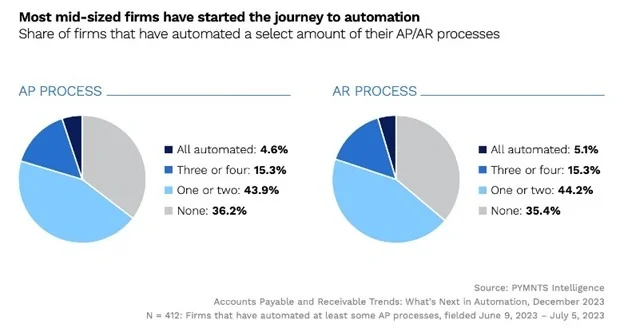
Despite growing interest in automation, full adoption remains rare, with just 4.6% of AP processes and 5.1% of AR processes fully automated. This gap highlights the urgent need for more efficient AR and AP processes to address liquidity strain, rising costs and limited financial agility, creating a significant opportunity for AI-driven solutions to streamline operations and optimize cash flow (see Figure 1).

Figure 1

Adoption automation percentage of midsize firms 

Image
Adoption automation percentage of midsize firms

Figure 1

Adoption automation percentage of midsize firms 

Image
Adoption automation percentage of midsize firms

Source: PYMNTS

2. The technology accessibility shift

The barrier to adopting advanced financial automation has dramatically lowered. Cloud- based platforms, AI-driven insights and ready-to-implement automation solutions now make sophisticated financial tools accessible to companies of all sizes — not just enterprises with large IT budgets.

Recent data confirms this acceleration: Seventy-eight percent of middle-market chief financial officers plan to increase AI investment in AR this year, with an average planned spend of $3.16 million per firm. Additionally, 55% of middle-market firms are willing to pay a 3% fee to automate invoice approvals and payments, highlighting the demand for AI-driven efficiency. With companies losing an average of 3.1% of revenue (approximately $14 million) due to payment collection issues, AI adoption is becoming a financial necessity.

The rise of AI in AR and AP automation

AI is transforming AR and AP automation from a back-office function into a driver of smarter financial decision-making. Beyond efficiency gains, AI-powered solutions are enhancing financial intelligence, risk management and cash flow optimization. 

From efficiency gains to smarter decision-making

AI is transforming financial operations with intelligent AR and AP solutions that go far beyond basic automation. These systems now enhance every aspect of the financial process with unprecedented efficiency. Key applications include:

  • Fraud detection and prevention technology, such as technology-assisted review, learns from payment behaviors to flag potential fraud risks and reduce financial losses
  • Cash flow optimization models analyze historical trends and real-time data to predict fluctuations and recommend proactive adjustments
  • Invoice processing and reconciliation are being improved through natural language processing, which automates invoice matching, reconciliation and approvals, reducing errors and manual work
  • Customer and vendor communication solutions, including AI-powered chatbots, handle customer inquiries, vendor disputes and payment status updates, improving response times and accuracy
  • Smart payment scheduling technology optimizes payment timing based on cash flow forecasts and vendor terms, helping businesses avoid late fees and capture early payment discounts
  • Risk and compliance monitoring systems scan transactions for compliance issues, anomalies and potential regulatory risks, reducing exposure to financial penalties

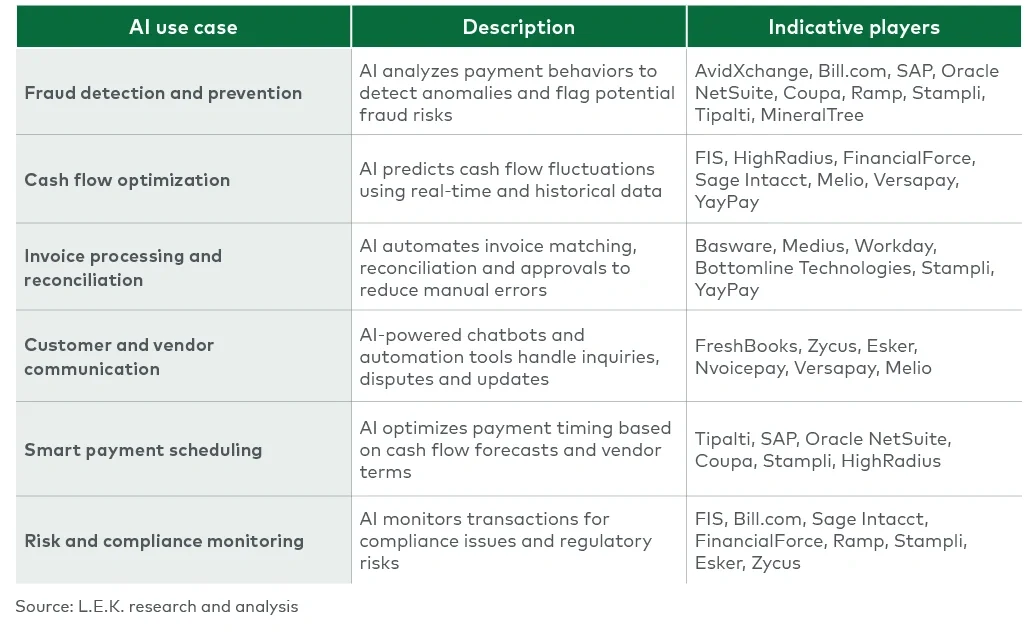
The AI-driven AR and AP market is shaped by both established leaders and innovative newcomers. While industry giants offer robust enterprise integrations, emerging players excel in automation, AI insights and embedded financial solutions, creating a vibrant competitive landscape (see Table 1). 

Table 1

AI landscape overview 

Image
AI landscape overview

Table 1

AI landscape overview 

Image
AI landscape overview

Ease of AI integration into tech stacks

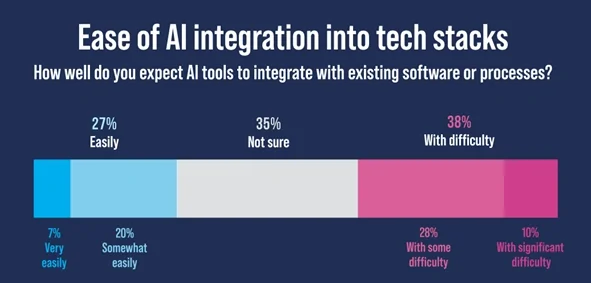
Integrating AI into existing financial systems, both in reality and perception, remains challenging. According to Accounting Today, only 27% of accountants believe AI integration will be easy, while over two-thirds find it difficult or are uncertain about the challenges (see Figure 2). 

Figure 2

Ease of AI integration into tech stacks 

Image
Ease of AI integration into tech stacks

Figure 2

Ease of AI integration into tech stacks 

Image
Ease of AI integration into tech stacks

Source: Accounting Today

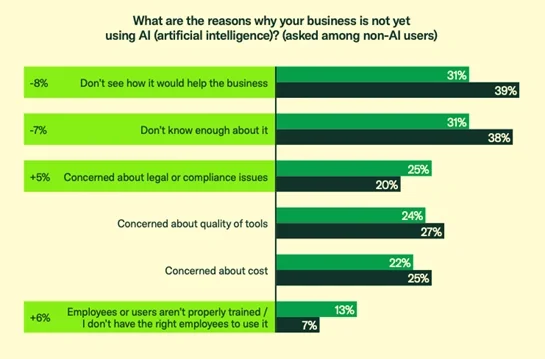
Many businesses hesitate to adopt AI solutions — whether as stand-alone solutions or as embedded features within existing financial platforms — due to a lack of awareness and understanding. This creates adoption challenges, as users must navigate new capabilities without dedicated AI training. Recent research highlights the primary barriers to AI adoption among small businesses: Thirty-nine percent do not perceive a clear business value while 38% lack sufficient knowledge about AI (see Figure 3). 

Figure 3

Reasons for not yet implementing artificial intelligence 

Image
Reasons for not yet implementing artificial intelligence

Figure 3

Reasons for not yet implementing artificial intelligence 

Image
Reasons for not yet implementing artificial intelligence

Source: U.S. Chamber of Commerce

This highlights a fundamental challenge: Most businesses still lack sufficient knowledge about AI — in terms of both in terms of available tools and their capabilities. As awareness grows, education efforts from vendors and system integrators will play a crucial role in driving adoption. To bridge this gap, providers must not only offer seamless solutions but also prioritize customer education, clearly demonstrating AI’s benefits and real-world applications.

At the same time, momentum is building toward AI-driven financial intelligence. Businesses are moving beyond basic automation, leveraging AI to make smarter, more strategic financial decisions in real time. As adoption accelerates, another major shift is reshaping financial technology: the integration of payment functionality into financial automation. 

The convergence of AR/AP and payments

As AI transforms financial operations, another significant trend is reshaping the industry: the convergence of AR and AP systems with embedded payment functionality.

Why payment integration is the next big shift

AR and AP solutions are now merging with payment technologies as businesses seek to incorporate real-time payment capabilities directly into their automation platforms. For example, Ramp’s integration with Oodo’s enterprise resource planning system reduced bill processing time from five to eight minutes to just one to two minutes per recurring vendor. These types of integrations, which can include emerging cryptocurrency and stablecoin options for cross-border transactions, are creating multiple advantages:

  • Faster receivables processing, improving cash flow predictability
  • Seamless supplier/vendor payments, reducing transaction friction
  • New revenue streams for AR and AP vendors expanding into embedded finance
  • Reduced costs and settlement times through cryptocurrency payment rails

The Trump administration’s potential relaxation of digital asset regulations prompts businesses to explore diverse payment options within their AR and AP systems, fostering greater financial innovation.

For example, SAP’s Digital Currency Hub enables enterprises to make and receive payments using stablecoins, automating processes and enhancing cross-border transactions.

Additionally, fintech companies such as Request Finance and Gilded Finance offer solutions that allow businesses to seamlessly manage crypto payments and accounting.

Stripe’s recent acquisition of Bridge further reinforces this shift, enabling stablecoin payments and making it easier for businesses to send and receive money using digital currencies. These developments highlight that stablecoin payments are no longer hypothetical — they are already being integrated into financial operations.

Investor confidence in AR and AP automation

As AR and AP automation continues to evolve, investor confidence in AI-powered financial platforms is surging. Recent funding activity demonstrates strong market conviction, with both venture capital and private equity firms backing solutions that transform financial operations.

Venture capital momentum is accelerating across the automation landscape:

  • In March, Flex raised $225 million in equity and debt funding to expand its all-in-one business and personal financial management platform for business owners, signaling continued investor appetite for modern, integrated AR and AP tools.
  • In October 2024, Melio raised $150 million in Series E funding, reaching a $2 billion valuation, to expand its business-to-business payments partnerships.
  • In 2024, Ramp raised $150 million through a secondary share sale, pushing its valuation to approximately $13 billion.
  • In May 2023, Tipalti secured $150 million in growth financing to support product innovation and customer expansion.
  • Newer entrants have also attracted sizable early-stage rounds in 2025, including Auditoria.AI, which raised $38 million in Series B funding, and Anchor, which secured $20 million in Series A funding.

Private equity investments reinforce market confidence:

  • Great Hill Partners invested in MineralTree, a provider of AP and payment automation solutions, before it was acquired by Global Payments in 2021.
  • In 2023, Great Hill Partners invested in Enumerate, a vertically focused software-as-a- service accounting and payments leader.
  • In 2024, FTV Capital invested $90 million in BillingPlatform, a software provider focused on invoicing solutions.
  • In 2024, Aquiline Capital Partners and Level Equity made a majority investment in DocuPhase, a provider of AP and AR automation solutions.
  • In 2024, Silver Lake and GIC acquired Zuora, an enterprise billing software provider, in a $1.7 billion deal.

Strategic M&A activity is equally revealing of market trends. Flywire’s 2024 acquisition of Invoiced exemplifies this pattern — combining payment solutions with AR and AP capabilities and highlighting the growing convergence of payment processing and financial management systems.

These investments collectively signal strong confidence in specialized financial technology and reflect increasing demand for integrated platforms that streamline the entire financial workflow. 

The AR and AP renaissance is just beginning

AR and AP have evolved from back-office functions to strategic financial drivers. As AI, automation and embedded payments reshape the landscape, competitive advantage will go to companies that integrate these capabilities effectively.

With automation becoming standard, businesses must now focus on optimization rather than adoption. Forward-thinking organizations are already embedding AI into financial workflows, integrating payment processing and exploring stablecoins and AI-driven payment intelligence.

L.E.K. Consulting helps financial leaders navigate this evolving landscape. Contact us to explore how we can support your firm’s financial technology strategy.

L.E.K. Consulting is a registered trademark of L.E.K. Consulting LLC. All other products and brands mentioned in this document are properties of their respective owners. © 2025 L.E.K. Consulting LLC

Questions about our latest thinking?

English

Cost Pressures Take Centre Stage in European Packaging Decisions

Part 1 of a four-article series on the 2025 European Brand Owner Packaging Survey
May 5, 2025

This year, packaging costs have become a dominant issue for brand owners across Europe. With inflationary pressures lingering and supply chain disruptions still rippling through global markets, the majority of companies now see rising packaging costs not as a blip but as a structural reality. The result is a shift in how companies are managing both day-to-day procurement and long-term packaging strategy.

To understand how brand owners are responding, L.E.K. Consulting conducted its fourth annual European Brand Owner Packaging Survey in December 2024 and January 2025. This year’s study includes responses from 645 brand owners across six major markets — Germany, France, the UK, Spain, Italy and Poland — spanning a diverse range of sectors from food and beverage to healthcare, beauty and consumer electronics.

This article, the first in a series, explores the cost trends shaping packaging decisions in 2025. Subsequent pieces will examine how brand owners are rethinking investment, sustainability and innovation in response to these pressures.

The cost outlook: Sharp increases ahead

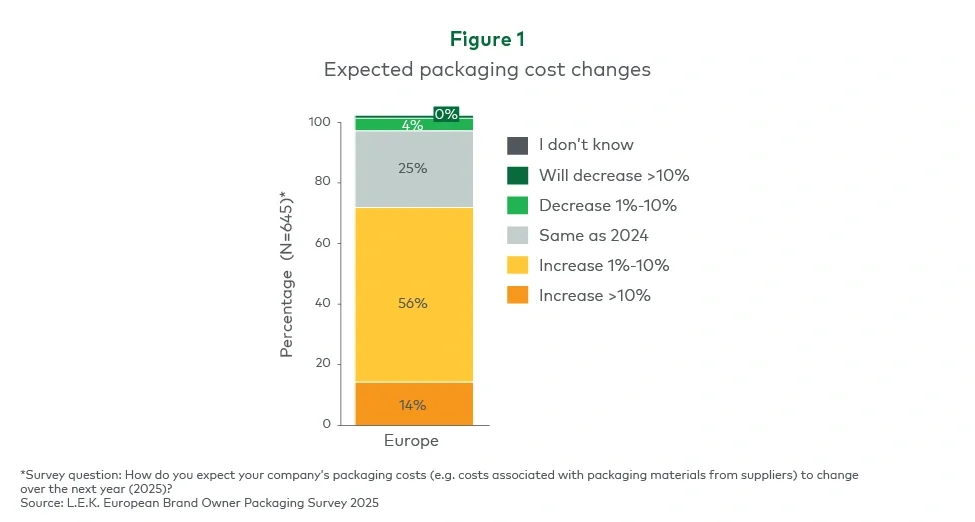
It’s little wonder that cost now sits at the top of the agenda for European packaging executives. More than 70% of European brand owners expect packaging costs to increase over the coming year. A full 56% anticipate rises in the range of 1%-10%, and a further 14% expect increases to exceed 10% — figures that underscore the intensity of cost pressures facing the market (see Figure 1). 

Image
Figure 1. Expected packaging cost changes
Image
Figure 1. Expected packaging cost changes

The root causes are familiar, yet persistent: ongoing inflation, volatile commodity pricing, rising energy and transportation costs, and increasingly fragmented global supply chains. These compounding factors strike packaging especially hard, given its exposure to multiple raw materials and reliance on complex, often international, supplier networks.

In this environment, packaging costs are a central constraint shaping product design, procurement strategy and even broader sustainability initiatives. Since then, of course, the US administration’s issuance of material and widespread tariffs has complicated the matter further, reinforcing the cost inflation as well as the trading volatility.

Europe’s design-led approach to cost mitigation

Faced with these mounting pressures, European brand owners are not sitting still. Instead of simply absorbing higher costs or passing them along to customers, most are taking proactive steps to redesign packaging and reengineer their supply chains.

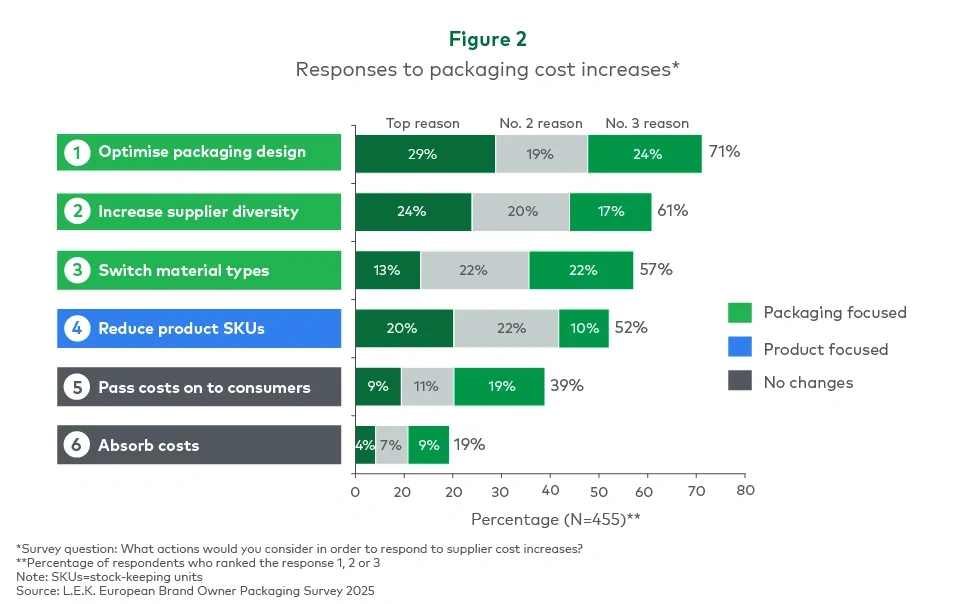
Survey data reveals that 71% of respondents ranked optimising packaging design among their top three cost responses, making it the most common strategy by a clear margin. Also, 61% are diversifying their supplier base, and 57% are switching material types to lower-cost alternatives (see Figure 2). 

Image
Figure 2. Responses to packaging cost increases
Image
Figure 2. Responses to packaging cost increases

Interestingly, traditional levers like passing costs on to consumers or absorbing them internally are far less popular. Only 39% of respondents identified cost pass-through as a top-three strategy, and a mere 19% are considering absorption. This design-first approach signals a more strategic and long-term response to margin compression — one that prioritises flexibility and efficiency over short-term fixes.

In effect, European brand owners are engineering packaging to be more resilient: lighter, simpler and more cost-effective, with a deliberate move away from dependency on any single supplier or input material.

Cost now drives material decisions

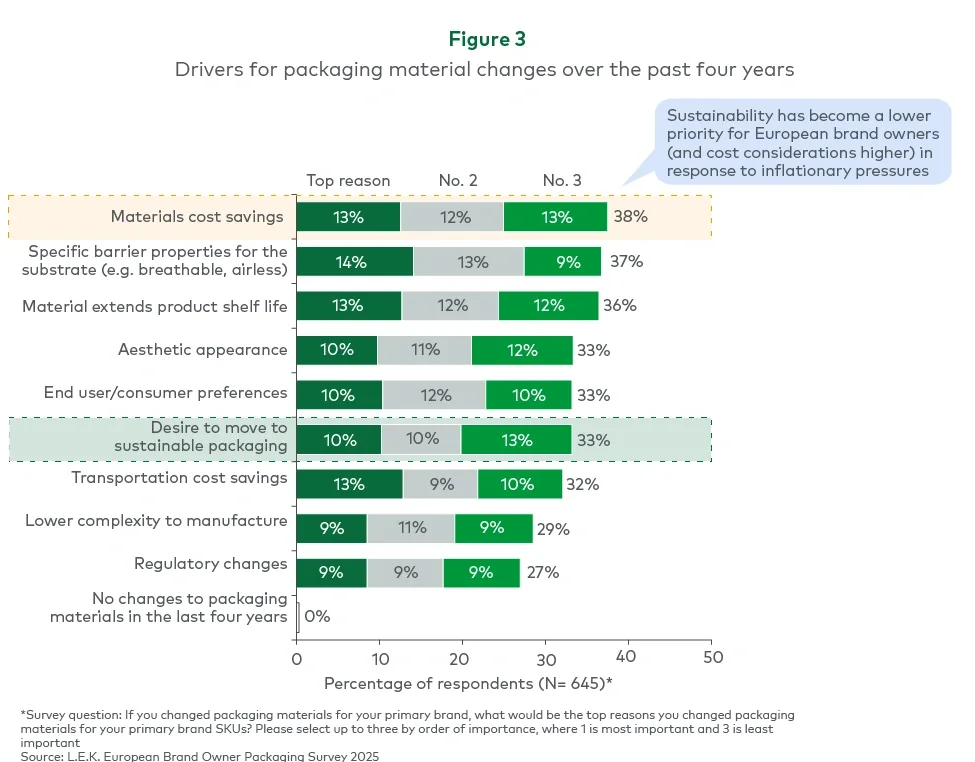
The cost squeeze is redefining why packaging materials are being changed in the first place. In previous years, sustainability was the dominant motivator for packaging innovation; this year, it has fallen to sixth place. Instead, material cost savings have emerged as the top driver of change, with 38% of respondents citing cost as the primary reason for switching materials in the past four years.

Other important factors influencing material decisions include functional improvements, such as shelf-life extension and aesthetic considerations (see Figure 3). 

Image
Figure 3. Drivers for packaging material changes over the past four years
Image
Figure 3. Drivers for packaging material changes over the past four years

This shift suggests a rebalancing of priorities. While sustainability remains important, it is no longer the overriding priority in packaging strategy. Instead, cost, performance and consumer experience are now being weighed together — each a critical component of the decision calculus.

Looking ahead: Innovation under pressure

As we move through 2025, cost pressures will continue to be the defining constraint on packaging strategy. But they may also become a catalyst for innovation. Expect to see a wave of experimentation around lightweighting, modular design and alternative materials, as brands look to balance cost reduction with consumer expectations and regulatory compliance.

This new landscape will require brand owners to find a more sophisticated equilibrium — one that harmonises cost, sustainability and performance without compromising the integrity of the product or the brand.

In our next article, we’ll examine how companies are reallocating investment in packaging: where the money is going and what that reveals about future priorities.

Please contact us to find out more.

L.E.K. Consulting is a registered trademark of L.E.K. Consulting All other products and brands mentioned in this document are properties of their respective owners. © 2025 L.E.K. Consulting 

English

Artificial Intelligence/Machine Learning Pricing Optimization for an Online Marketplace for Local Service Professionals

May 5, 2025

Background

A global online services marketplace sought to unlock new revenue potential through pricing innovation as it evaluated strategic paths to further penetrate its large total addressable market. The client was exploring a future state in which it would play a more direct role in transactions between buyers and sellers, and pricing emerged as a key lever to support this evolution. L.E.K. Consulting was engaged to assess and enhance the client’s pricing framework to drive recurring revenue, improve monetization, strengthen buyer and seller engagement, and introduce greater discipline around discounting and price transparency.

Approach

We deployed over 50 artificial intelligence (AI)/machine learning (ML) models tailored to specific service categories and seller segments, automating pricing decisions while incorporating seller characteristics such as return on investment, retention behavior and business type. The models were designed to dynamically adjust to changing market conditions and were separately assessed in a robust A/B and causal impact testing framework.  

This approach enabled the client to shift toward targeted, behavior-driven pricing strategies and reduce reliance on manual discounting. Integrated into the client’s cloud environment, the system featured real-time dashboards and analytics to guide ongoing optimization.

Results

The AI/ML-powered pricing engine delivered a 5%-10% uplift in incremental revenue within two months. The automation eliminated inefficiencies and supported smarter, faster pricing decisions, all while maintaining a strong customer experience. With this scalable solution in place, the client is now positioned to continue evolving its business model, improve platform economics and unlock future growth opportunities.

For more information, please contact us.

L.E.K. Consulting is a registered trademark of L.E.K. Consulting LLC. All other products and brands mentioned in this document are properties of their respective owners. © 2025 L.E.K. Consulting LLC

English

Developing a Modern Data Strategy in the Building Materials Market

May 5, 2025

Background

A leading purchaser, installer and distributor of building materials recognized that the absence of a cohesive data strategy was limiting its growth potential and creating issues resulting in lost revenue. Critical data resided on outdated platforms, limited governance and inconsistent data practices hindered quality, and the lack of clear leadership and capabilities in data strategy held the organization back.

To drive transformative growth, the client engaged L.E.K. Consulting to develop a comprehensive data strategy, laying the foundation for an advanced, streamlined technology infrastructure. With this new strategy, the client is now positioned to enhance data quality, leverage insights more effectively, harness the power of artificial intelligence (AI) and fuel sustainable growth, strengthening its market leadership and operational efficiency.

Approach

To establish a strong foundation for the client’s digital transformation, we began by assessing current data capabilities and mapping future data needs to enable goals such as ecommerce, automation and AI. This deep analysis revealed critical technology investments, necessary enhancements to data processes and structures, and adjustments to team organization and the operating model.

After a rigorous cost-benefit analysis and close collaboration with client leadership, our team prioritized high-impact investments that would drive measurable value. For each initiative, we crafted a business case, clearly outlining projected costs, benefits and potential challenges, supported by detailed implementation roadmaps with designated owners, timelines and key steps for success.

To ensure sustainable growth, our team also designed an optimized operating model. This framework specified the future-state roles and team structure, key governance processes, and important considerations for managing complexities over time.  

Results

Through its collaboration with our team of experts, the client gained a comprehensive framework for a data strategy, including a macro-operating model, essential roles and an optimized team structure. Equipped with this strategic clarity, the client implemented targeted initiatives that transformed data into a growth-enabling asset, allowing it to drive business performance and capture new opportunities in the market. Now the client is positioned to capitalize on data-driven insights, accelerate digital growth and maintain a competitive edge in the evolving market.

For more information, please contact us.

L.E.K. Consulting is a registered trademark of L.E.K. Consulting LLC. All other products and brands mentioned in this document are properties of their respective owners. © 2025 L.E.K. Consulting LLC

English

What CFOs Miss About Indirect Spend

May 2, 2025

Indirect spend — often invisible, decentralized and unchallenged — can quietly absorb 10% of a company’s revenue. Yet unlike direct costs, it rarely receives structured oversight. For chief financial officers (CFOs), it represents a largely untapped lever to drive enterprise-wide impact.

While direct materials and labor are usually closely managed, indirect spend is typically scattered across departments, inherited over time and overseen by functional leaders without the time, context or incentive to optimize for value. Here’s what that can look like in practice:

  • A mid-market tech company pays three different rates for identical cybersecurity services.
  • A global brand uses more than 70 marketing agencies across regional teams with overlapping capabilities.
  • A software as a service (SaaS) company renews dozens of tools annually without benchmarking or usage reviews.
  • An enterprise human resources (HR) team outsources to three separate recruiting firms — all sourcing from the same candidate pool.

These aren’t outliers — they reflect a broader pattern across companies lacking a coordinated approach to indirect spend. Over time, this blind spot creates ripple effects throughout the business, including:

  • Budgets growing unchallenged while savings opportunities go unrealized
  • Supplier lists ballooning, creating redundant and overlapping services
  • Functional teams spending valuable time managing transactional relationships
  • Finance leaders lacking visibility for informed capital allocation decisions
  • Contracts auto-renewing with outdated pricing or misaligned terms
  • Compliance risks growing as oversight fades

Without clear ownership, supplier relationships stagnate. Functional teams stick with what’s familiar, and tactical purchases gradually accumulate into inefficiencies that slow the business and drain resources. 

Procurement as a strategic lever

To get a handle on fragmented, inefficient spend, more CFOs are adopting indirect procurement — using clear policies, shared visibility and smarter sourcing to drive better results.

Done right, indirect procurement introduces structure and discipline into spending that often goes unmanaged. It helps organizations consolidate suppliers, clarify ownership and establish clear metrics that drive better supplier outcomes.

Organizations that implement structured procurement practices typically see both hard-dollar savings and operational lift. A well-executed transformation can reduce indirect spend by 10%-15% in the first year while freeing up functional teams and improving supplier performance.

Strong procurement practices also unlock:

  • Consolidated spend for improved terms and volume leverage
  • Full visibility into supplier performance, overlap and spend
  • Reduced administrative burden for business teams
  • Clearer trade-offs between cost, quality and service
  • Better insight into risk and contractual obligations

Just as important, strategic procurement reframes suppliers as potential partners in your transformation — not simply suppliers of goods or services. When selected and managed intentionally, they can bring in specialized expertise, increase speed to value and help internal teams focus on what they do best.

The indirect procurement checklist

For many companies, the need to formalize indirect procurement creeps up gradually until it becomes impossible to ignore. That inflection point often comes around the $250 million revenue mark, when complexity begins to outpace the systems, policies and informal controls that once worked (but it’s worth noting that even companies below this mark can benefit from early structure that prevents inefficiencies from taking root).

At this size, purchasing decisions multiply, often without clear coordination or accountability. What starts as a series of local workarounds can quickly become a structural liability. 

The following questions may help assess your organization’s current indirect procurement capabilities:

  • Can you identify your top 20 indirect suppliers by total enterprise spend without running a special report?
  • Do you have visibility into auto-renewals across your SaaS and service contracts?
  • Has anyone benchmarked your pricing against the market in the past 18 months?
  • Is there a clear owner for supplier performance management across key categories?
  • Do you have a consistent process for bringing on new suppliers that includes competitive bidding?
  • Is supplier spend challenged as a part of your budgeting process across corporate functions?
  • Are business units and corporate functions bringing cost-savings ideas to reduce party spend?
  • Are there policies and controls in place to manage indirect spend?
  • Are there visibility tools and controls in place to manage purchasing card spend?
  • Do you have visibility into your supplier risk exposure?

If you answered “no” to one or more of these questions, indirect procurement could be a meaningful lever to drive value in your business.  

The case for center-led procurement

One proven approach is a center-led procurement model. Unlike fully decentralized or rigidly centralized systems, this hybrid model balances local autonomy with enterprise-wide coordination. It allows teams to tailor supplier relationships to their needs while benefiting from shared insights, negotiated terms and aligned goals.

This approach creates a procurement center of excellence that:

  • Sets policies and standards
  • Negotiates enterprise agreements
  • Provides sourcing expertise to business units and corporate functions
  • Maintains visibility across all significant spending
  • Tracks and reports on savings and value creation 

By treating procurement as a strategic enabler — not just a back-office function — CFOs can realize new efficiencies, reduce risk and unlock competitive advantage through smarter indirect spend.

Transform your indirect spend

L.E.K. Consulting’s Supply Chain and Operations team helps CFOs turn fragmented, inefficient spend into a source of lasting value. In one recent engagement, we partnered with a global manufacturer to build a structured indirect procurement function from the ground up — delivering 15% annual savings across freight, packaging, maintenance and HR services while laying the foundation for long-term efficiency (read more here: Creating Value Through Indirect Procurement in Manufacturing).

Contact us to learn how we can help your organization turn indirect spend into a source of strategic advantage.

L.E.K. Consulting is a registered trademark of L.E.K. Consulting LLC. All other products and brands mentioned in this document are properties of their respective owners. © 2025 L.E.K. Consulting LLC 

English
Subscribe to