Four Levers, One Goal: Better Results in Retail

June 10, 2025

Retail is evolving — shaped by shifting consumer habits, digital disruption and rising cost pressures. In this video, L.E.K. Partner Jan Schneiderbanger explores how retailers can strengthen performance by putting customer insight at the heart of their strategy.

Watch the full video to learn how leading retailers are using data to improve store relevance, enhance personalisation and drive omnichannel growth.

Want to go deeper on strategy? Read the first article in our series on retail optimisation here

L.E.K. Consulting is a registered trademark of L.E.K. Consulting. All other products and brands mentioned in this document are properties of their respective owners. © 2025 L.E.K. Consulting

English
Executive Insights

What Every Executive Should Know About Agentic AI

June 5, 2025

Key takeaways

As AI capabilities expand rapidly, agentic systems are emerging to handle disruption with autonomous learning.

Building on this shift, agentic AI drives dynamic, compliant decisions through real-time perception and reasoning.

As adoption spreads, early movers are deploying agentic tools in service and supply chains for operational gains.

To sustain momentum, organizations must integrate agentic AI strategically with strong governance and orchestrated execution.

The biggest threat facing your business is failing to see disruption coming. Senior executives navigate intricate decisions daily, confronting rapid market shifts, regulatory hurdles and unforeseen operational challenges that conventional technologies simply can’t handle. And while over half (57%) of executives surveyed by L.E.K. Consulting recognize artificial intelligence’s (AI) potential to reshape their industries, many still rely on outdated tools ill-suited to managing today’s realities.

AI has evolved significantly, from simple automation to sophisticated systems capable of understanding context, making autonomous decisions and continuously improving through experience. Agentic AI represents this latest stage of AI evolution, serving as a strategic digital ally that proactively anticipates disruptions, dynamically formulates responses and learns in real time.

Supported by robust governance and transparency, agentic AI enables your business to turn change into a sustainable competitive advantage. But what exactly makes agentic AI different? And how can your organization tap into its unique capabilities?

Understanding why agentic AI outperforms traditional automation

Most executives are familiar with automation: repetitive tasks handed off to software, simple decision trees executed by bots and straightforward business processes managed without human intervention. However, the limitations of traditional automation become increasingly evident when a company is faced with nuanced problems or sudden market disruptions. This is precisely where agentic AI differentiates itself — and where its true value emerges.

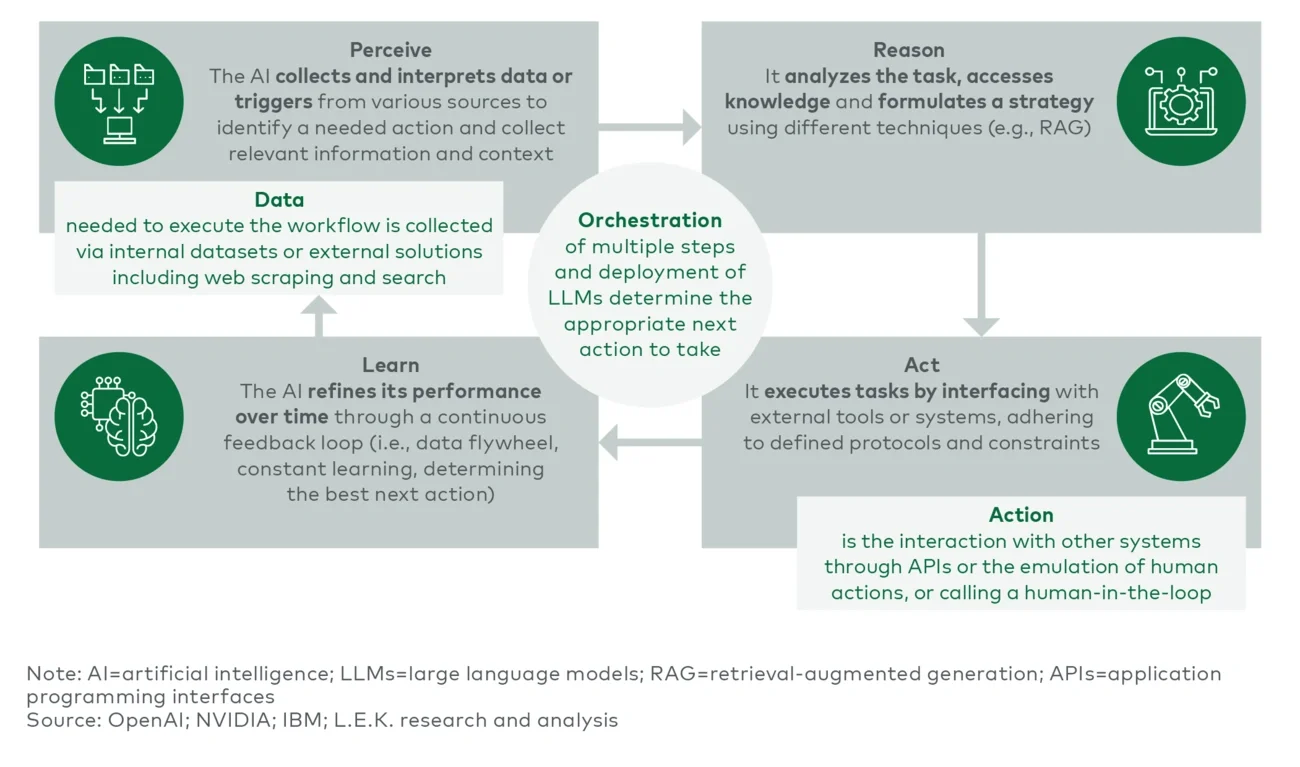
At its core, agentic AI operates through a clearly defined four-step cycle that traditional automation can’t replicate (see Figure 1).

Perceive

Traditional automation solutions respond only to narrowly defined scenarios. Agentic AI, however, actively gathers and interprets data using multiple advanced AI techniques — including sophisticated natural language processing, computer vision and pattern recognition — to understand not just isolated data points but also the broader context surrounding each decision. This rich contextual awareness is guided by governance protocols that ensure data accuracy and ethical usage.

For example, within supply chain management, agentic AI monitors real-time inventory data across multiple warehouses, instantly detecting shortages or disruptions. Simultaneously, it analyzes contextual factors such as demand trends, regional weather patterns and logistical constraints, enabling truly proactive responses.

Reason

Going beyond basic logic, agentic AI leverages advanced analytical frameworks such as retrieval-augmented generation. For instance, in financial services, it evaluates complex financial data, integrates regulatory updates and formulates compliant, optimized trading strategies — much like a seasoned financial analyst, with built-in transparency to ensure auditability.

However, it’s important to recognize that while these systems appear to reason, they do not truly understand in a human sense. Their outputs rely on learned statistical patterns rather than genuine semantic comprehension or self-reflective cognition. As a result, rigorous guardrails, validation processes and human oversight remain essential.

Act

Unlike rigid traditional automation, agentic AI dynamically executes interactions with external systems, always adhering to predefined safety and compliance guardrails. In operations, it autonomously manages high-volume invoice processing and accounts payable tasks, significantly enhancing operational efficiency without manual intervention unless exceptions are required.

Learn

The most transformative aspect of agentic AI is its continuous learning through feedback loops. For example, in personalized marketing, it evaluates campaign responses to identify effective strategies, then iteratively enhances future campaigns — all while ensuring user privacy and adherence to ethical marketing standards. Over time, this adaptive learning capability steadily improves marketing accuracy, efficiency and customer engagement. Stand-alone solutions like commerce platforms or finance systems often lack sufficient context to enable effective learning.

As a result, orchestrating data and actions across multiple systems becomes essential. Moreover, most agentic AI deployments today require semimanual retraining and human-curated oversight loops, underscoring the ongoing need for human judgment to manage operational risks.

Figure 1

The four-step cycle of agentic AI 

Image
The four-step cycle of agentic AI

Figure 1

The four-step cycle of agentic AI 

Image
The four-step cycle of agentic AI

Furthermore, these three foundational components enable and amplify agentic AI’s unique capabilities:

  1. Data — Agentic AI harnesses internal datasets and external sources and gathers external data through web scraping, application programming interfaces (APIs) or other ways, always within stringent privacy standards, to produce rich, actionable insights and maintain real-time awareness. The effectiveness of agentic AI, however, directly depends on the quality of these underlying datasets. Ensuring robust data integration, accurate processing and thorough transformation within the data ecosystem — well before data reaches analytics systems — is therefore essential for maximizing AI’s performance and reliability. 
  2. Action — Agentic AI seamlessly executes tasks through secure interactions with external systems via APIs or human emulation, ensuring compliance and data security. Beyond mere automation, its autonomous capabilities extend to dynamic decision-making made capable by generative AI capabilities, scenario-based action planning, and adaptive responsiveness to unexpected changes or disruptions. This ensures operational agility and flexibility, allowing organizations to quickly capitalize on opportunities and minimize risk across diverse business processes.
  3. Orchestration — Agentic AI strategically coordinates complex workflows, determines optimal next actions and effectively manages multistep processes, guaranteeing cohesive, goal-driven execution at every stage. Effective orchestration involves managing specialized subagents that handle discrete tasks (e.g., document summarization, web search, knowledge base synthesis) and coordinate seamlessly through context-aware delegation. By continuously monitoring progress and outcomes across multiple workflows, agentic AI ensures alignment with broader strategic objectives, enabling sustained operational consistency, scalability and improved resource efficiency. 
Building AI literacy across your organization

Successful implementation of agentic AI isn’t solely a technological shift — it demands organizational readiness through AI literacy and a clearly defined, top-down AI strategy.

AI literacy involves understanding core concepts, appreciating ethical implications, recognizing AI’s capabilities and limitations and identifying opportunities for effective human-AI collaboration.

But even robust AI literacy and strong technological foundations aren’t enough without executive buy-in and strategic alignment. A cohesive enterprisewide AI strategy provides a critical framework, aligning departments around a shared vision, prioritizing high-impact initiatives and balancing targeted use cases with broader organizational transformation.

By investing in structured AI education programs, workshops, continuous learning opportunities and healthy cross-team collaboration, organizations empower employees to confidently engage with, manage and innovate alongside AI systems — positioning themselves for sustainable success in an increasingly AI-driven business environment. 

Tracing the evolution from basic automation to agentic AI

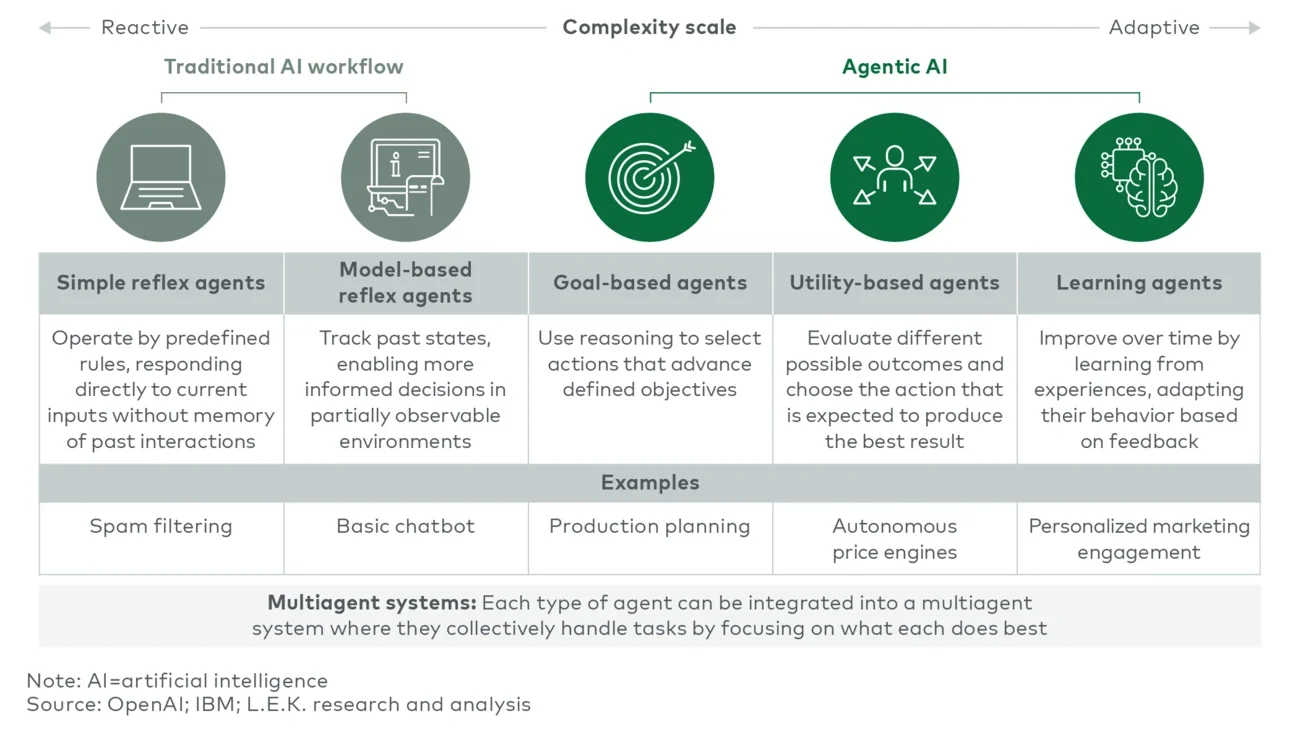
To fully appreciate the significance of agentic AI, it’s helpful to examine how AI has evolved from simple reflex agents to learning agents over time (see Figure 2). 

Figure 2

AI automation evolution 

Image
AI automation evolution

Figure 2

AI automation evolution 

Image
AI automation evolution

Early AI automation implementations were primarily simple reflex agents (e.g., basic automation systems such as spam filters), which react based strictly on predefined rules. Soon, model-based reflex agents (e.g., basic chatbots) — capable of limited contextual awareness and simple interactions — emerged.

Progress continued with goal-based agents, systems like production scheduling tools that proactively pursue defined objectives. Utility-based agents further advanced the field, optimizing outcomes based on evaluating potential scenarios — exemplified by pricing optimization engines.

Most recently, learning agents introduced a revolutionary capability: continuous improvement through experience, notably used in personalized marketing and recommendation systems. However, agentic AI represents the current pinnacle of this evolution. It combines advanced perception, nuanced strategic reasoning, autonomous action and ongoing self-improvement, delivering a level of adaptability, intelligence and responsiveness previously unattainable by earlier AI generations. 

Crucially, this advanced autonomy demands strengthened ethical oversight and robust governance frameworks to responsibly manage the increasingly independent actions of AI systems. Understanding this evolution sets the stage for exploring precisely where agentic AI shines in practical, real-world scenarios.

Exploring practical use cases for agentic AI

Agentic AI’s capabilities may sound impressive in theory, but its true value becomes evident through real-world applications. Businesses across diverse sectors are already leveraging agentic AI to achieve substantial operational gains, drive efficiency and enhance customer engagement.

In customer service, brands like Uber and Bell Canada employ agentic AI to autonomously manage written customer inquiries, providing accurate responses swiftly and efficiently — all while ensuring transparency in customer interactions and adherence to strict data privacy standards.  

Similarly, within sales and marketing, companies such as Adobe and Alaska Airlines leverage autonomous AI agents to independently manage personalized customer interactions and optimize outreach efforts — driving higher engagement and conversion rates, with embedded compliance measures to safeguard consumer trust.

Operations and supply chain management also significantly benefit. For instance, BMW and Cradle deploy agentic AI for forward-demand planning and automated supply chain execution, reducing operational costs and enhancing logistical efficiency, supported by clear human oversight protocols for critical decision points. In cybersecurity, firms like Palo Alto Networks and AppOmni use agentic AI to proactively detect threats and analyze malware, swiftly addressing security risks while maintaining strict data security standards and governance protocols.

The software development sector equally embraces the power of agentic AI, as seen with companies such as Workato that utilize autonomous agents to optimize processes from software building and testing through telemetry data analysis. This not only accelerates innovation and development cycles but also ensures greater accuracy and quality, guided by robust frameworks that ensure ethical AI deployment and data security.

Clearly, the practical applications of agentic AI span a wide range of industries and operational contexts. The examples above highlight its versatility and demonstrate its potential to profoundly transform organizational outcomes.

But realizing these transformative benefits requires a balanced understanding of both opportunities and risks. When strategically applied, agentic AI can actively mitigate many of today’s most pressing business challenges, as illustrated in the following risk-reward framework:

Strategic risk

How agentic AI helps

Market volatility Offers real-time perception and adaptive responses 
Regulatory complexity Has built-in transparency and compliance logic 
Talent shortages Automates repetitive workflows 
Innovation bottlenecks Enables rapid iteration and scaled experimentation 
Siloed systems and insights Orchestrates cross-functional agent collaboration 


To fully capitalize on agentic AI’s strategic potential, organizations must also be ready for common implementation challenges. Anticipating and proactively managing these challenges ensures smoother adoption and maximizes return on investment.

Navigating agentic AI implementation

Deploying agentic AI involves proactively managing orchestration complexity, addressing performance and accuracy concerns inherent in early-stage analytical models, ensuring rigorous oversight for safety and reliability, and establishing robust frameworks for data security, privacy and compliance.

Performance and accuracy remain significant considerations. The analytical engines behind agentic AI systems are still developing and are susceptible to errors, false information and poor planning in multistep workflows. Therefore, continuous model improvement is crucial for broader and deeper integration in high-stakes applications, necessitating ongoing transparency and regular performance audits.

Additionally, deploying agentic AI solely within isolated systems (such as a stand-alone customer relationship management system) typically provides limited results. Effective implementation requires integrating multiple data sources to capture comprehensive context and leveraging outcome-based feedback loops to enable continuous learning and optimization.

Orchestration adds another layer of complexity. Successful implementation requires specialized subagents quarterbacked by a central orchestrator agent, capable of delegating tasks effectively. But effective orchestration also depends on teams clearly dividing workflows into tasks that autonomous agents can successfully execute.  

Leading organizations address these challenges by leveraging robust orchestration platforms offering the context-aware management of multiple agents. Palo Alto Networks, for example, integrates human-in-the-loop validation processes to ensure accuracy and compliance, significantly reducing operational risks.

Safety, reliability and data security are critical, particularly as agentic AI undertakes real-world responsibilities such as executing purchases or managing fraud prevention. Errors in these systems carry tangible consequences, necessitating robust human oversight and stringent data security measures, especially when sensitive data is involved.

Proactively managing these challenges not only streamlines AI implementation but also directly supports achieving strategic early-adopter advantages. Early adopters like Uber and BMW demonstrate the benefits of integrating mature foundational AI models and have achieved substantial operational agility and scalability underpinned by comprehensive ethical governance frameworks. Conversely, delays in adoption can lead to increased operational inefficiencies, higher costs, severe talent shortages and stifled innovation — as evidenced by historical patterns in sectors like retail and manufacturing.

Ultimately, effectively navigating implementation challenges is about more than mitigating risks; it’s about capturing strategic opportunities. Organizations that address these challenges decisively, through transparent, ethical practices and human-centered oversight, position themselves to lead rather than follow, shaping their industries through innovation and proactive adaptation. 

Realizing the full promise of agentic AI

Turning strategic ambition into real-world results requires clarity about your organization’s best path forward. Organizations must strategically choose between deploying purpose-built agents — ideal for rapid deployment in focused, specialized areas — and more-flexible platform-based solutions, which offer broad, scalable applicability across diverse business functions.

Translating your strategic vision into real-world impact and tangible results requires a structured approach to implementation, anchored in a well-defined AI strategy. This strategy should prioritize the right initiatives and thoughtfully balance targeted use cases with broader organizational transformation and growth. Consider the following steps to guide your organization:

  • Identify high-impact work outcomes for agentic AI: Identifying the most obvious opportunities to deploy agentic AI requires an understanding of the work outcomes that teams execute. Breaking down roles into discrete tasks and aligning agentic deployment against those outcomes allows for orchestration and extensibility. Successful prioritization of agentic deployment must balance top-down strategic guidance from leadership with bottom-up insights from empowered teams. Together, these perspectives help pinpoint workflows where autonomy, adaptability or scale deliver measurable, strategically relevant business value, ensuring alignment across the entire organization.
  • Choose your entry path: Selecting the best starting point for agentic AI adoption depends on your organization’s specific context, immediate objectives and long-term vision. Clearly evaluate whether purpose-built agents, designed for targeted impact in specific workflows, or broader platform-based solutions, suited for scalable implementation across multiple functions, align more closely with your strategic goals and internal capabilities. 
  • Assess organizational readiness: Implementing agentic AI effectively requires an honest evaluation of your technical and organizational foundations. Carefully consider your data ecosystem, including integration and transformation capabilities, the presence of a unified data platform, API connectivity, specialized AI expertise and the maturity of your governance structures. Beyond the technical and data readiness, ensure that your teams are ready to become AI managers and think about work and tasks in a way that can be abstracted to AI agent co-workers.
  • Prioritize data quality and management: Successful agentic AI depends fundamentally on robust, well-managed data. Executives should ensure the organization follows structured data management practices outlined in industry standards such as DAMA-DMBOK, the authoritative guide for data management and governance. Adhering to its recommended domains — including data quality, metadata management, data integration and governance — helps establish the strong data foundations required to fully unlock agentic AI’s potential.
  • Pilot strategically: Rather than deploying broadly all at once, begin with well-defined pilot programs. Clearly establish pilot objectives, integrate robust measurement frameworks to monitor effectiveness and include proactive human oversight and transparency measures. By iteratively refining your approach based on pilot insights, you can confidently scale agentic AI initiatives with significantly reduced risk.
  • Scale intelligently: Transition from isolated pilot projects into broader coordinated ecosystems using robust orchestration frameworks. Successfully scaling agentic AI demands thoughtful integration across diverse business functions, continuous ethical review and compliance monitoring, and active development of internal capabilities to manage multiple autonomous agents. This deliberate approach ensures long-term strategic success and sustainable growth.

To move from strategic intent to impactful action, the next step is choosing the best entry point for your organization’s specific context.

Strategic entry paths for agentic AI adoption

Organizations looking to adopt agentic AI strategically have distinct paths, each aligned to different operational needs and strategic priorities:

  • Purpose-built agents — These specialized agents are optimal for organizations seeking immediate, targeted impacts in specific areas such as customer service automation, cybersecurity or supply chain management. They offer rapid, out-of-the-box deployment with straightforward integration, enabling a quick return on investment and minimal disruption to existing systems. However, their specificity can limit their scalability in other use cases, potentially leading to fragmented AI strategies over time.
  • Agentic platforms — Designed for enterprises pursuing flexibility and extensive scalability across diverse business functions, agentic platforms provide comprehensive frameworks to build, customize and manage multiple AI agents cohesively. While the implementation of these platforms involves more complexity and requires robust technical and organizational readiness, the resulting infrastructure significantly enhances the organization’s agility and innovation capabilities. Supported by rigorous ethical governance and transparent operational oversight, these platforms ensure responsible and sustainable agentic AI integration.

Determining the right entry path demands careful consideration of the organization’s immediate goals, long-term AI vision, internal capabilities and readiness for comprehensive governance and oversight.

Your next steps with agentic AI 

The shift from traditional automation to fully autonomous agentic AI isn’t merely technological — it’s strategically essential. Agentic AI is increasingly enterprise-ready and is supported by mature technologies, a growing vendor ecosystem and accelerating enterprise demand. Embracing agentic AI today unlocks tangible competitive advantages such as greater agility, reduced costs and accelerated innovation.  

Delaying, however, could amplify operational inefficiencies and erode market position. In innovation-driven sectors, delayed adoption may significantly heighten competitive risks, while legacy organizations risk becoming further entrenched in outdated processes and frustrated by diminishing returns.

The choice is clear: Take strategic control of your future by investing decisively in agentic AI, building robust governance and scaling ethically and confidently. Don’t just adapt to change — define it.

We would like to acknowledge Shivam Sharma, Hunter Reynolds and Tess Wrigley for their contributions to this piece.  

For more information, please contact us.

L.E.K. Consulting is a registered trademark of L.E.K. Consulting LLC. All other products and brands mentioned in this document are properties of their respective owners. © 2025 L.E.K. Consulting LLC

Questions about our latest thinking?

English
Executive Insights

Advanced In Vitro Models: Opportunities and Challenges for US Drug Development

May 7, 2025

Key takeaways

The recent announcement by the U.S. Food and Drug Administration (FDA) phasing out animal testing requirements for monoclonal antibodies has created a significant tailwind driving accelerated adoption of advanced in vitro models.  

Due to high validation thresholds to either augment or replace in vivo models, as well as organizational silos and a lack of clear regulatory guidance, advanced in vitro models have historically been relegated to supplementary roles rather than replacing primary assays, adding to costs and limiting their integration into standard development workflows.

While the FDA announcement signals a clearly defined future state with reduced reliance on animal testing, the real-world uses of advanced in vitro models today are niche given continued reliance on legacy approaches — namely, low-cost 2D culture models and animal models for assays that must reflect the complexity of in vivo systems. 

To accelerate adoption of advanced in vitro models and build on the momentum of the FDA’s recent announcement, suppliers must strategically focus on well-defined use cases, generate targeted validation data, and tailor a clear deployment model that aligns with drug development workflows and demonstrates a strong, evidence-based value proposition.  

Advanced in vitro models are an emerging approach for preclinical experiments

Pharmaceutical companies invest over $50 billion annually in drug discovery and preclinical development, yet only 7% of drug candidates gain approval. A significant portion of this spending goes toward experimental systems that are overly simplistic (e.g., 2D immortalized cell cultures), insufficiently predictive (e.g., rodent models) or ethically sensitive (e.g., nonhuman primate models), failing to fully replicate human pathophysiology and accurately predict both safety and efficacy of drug candidates.

Much of this testing is also driven by IND-enabling guidelines that rely heavily on animal-based data, reinforcing legacy models. As a result, biopharma companies must navigate the drug development process with suboptimal experimental tools that convey partial insight into biologic function/phenotype, leading to costly development cycles where many drug targets or candidates prove ineffective and fail later in development. These inefficiencies result in pharma companies allocating significant resources (e.g., time, money, labor) to projects unlikely to succeed.

Advanced in vitro models are an emerging class of tools that, alongside in silico modeling and artificial intelligence (AI) insights, are poised to unlock better decision-making regarding candidates earlier in the preclinical value chain. Over the past few years, efforts like the FDA Modernization Act 2.0 and the ISTAND program have begun to ease regulatory barriers and encourage validation of nonanimal methods. More recently, the FDA’s announcement that it would phase out animal testing requirements for monoclonal antibodies (mAbs) marks a significant step forward.

Although this guidance remains relatively high level, it signals growing regulatory momentum toward broader acceptance of advanced in vitro models in drug development. These advanced in vitro models aim to bridge the gap between simplistic 2D cell models (in vitro) and costly, low-throughput and ethically sensitive animal models (in vivo) by closely mimicking tissues or organ systems and providing predictive safety and efficacy data for critical systems (e.g., liver, kidney, heart).

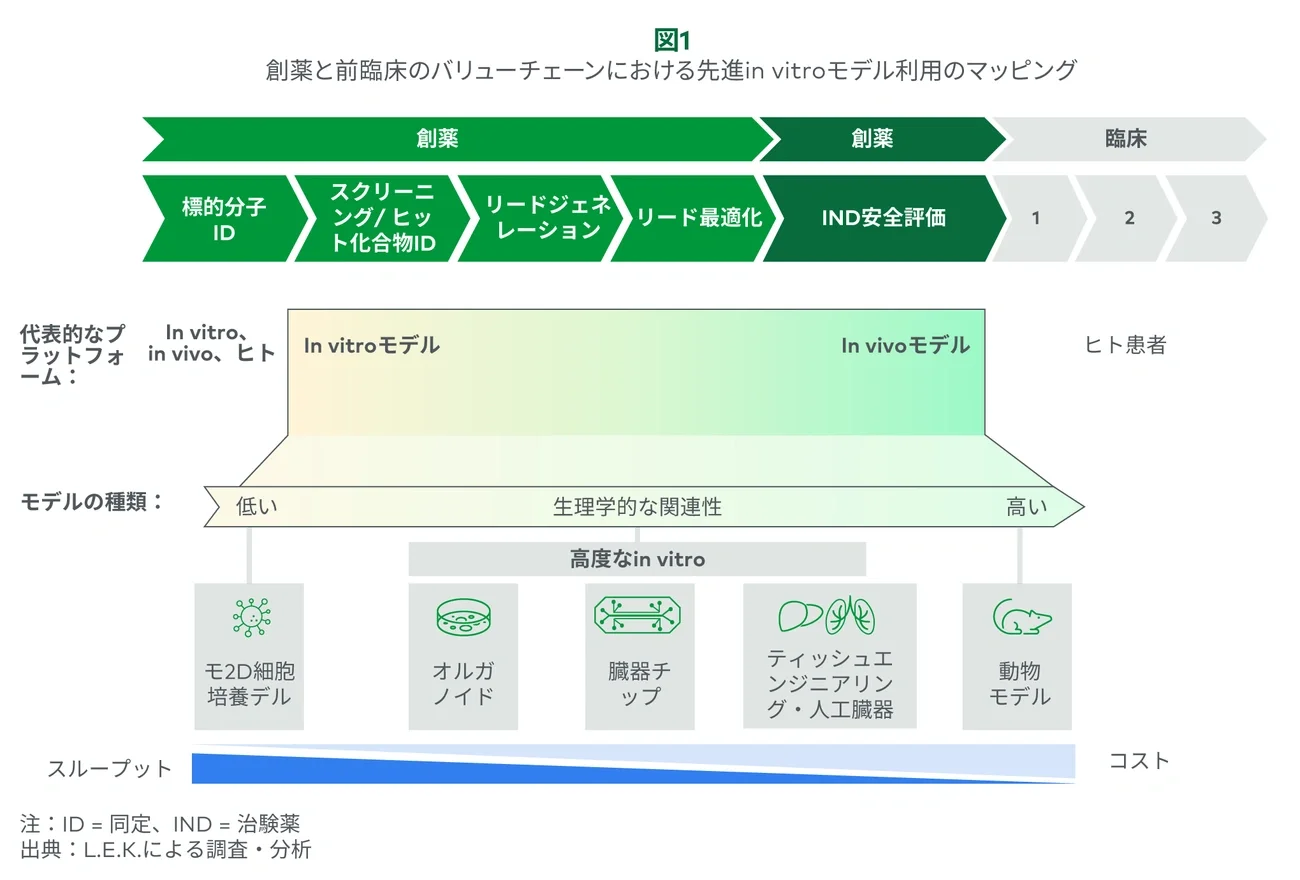
Depending on eliminate application and intended placement in the value chain, advanced models have various archetypes, including organoids (or spheroids), organ-on-a-chip (OOC) systems and tissue-engineered organs (see Figure 1):

  • Organoids are made of small clusters of primary or immortalized cells and, depending on the organ system, can contain multiple cell types. Certain cell types naturally self-assemble into macrostructures, allowing for more physiologically relevant properties compared to their 2D counterparts. Due to organoids’ small size, ease of use and inexpensive design, they can be highly scaled (96-384 wells) and are lower cost compared to other advanced in vitro systems, allowing utilization earlier in the value chain for activities such as hit-to-lead screening.
  • OOC systems consist of microfluidic platforms seeded with organ-specific primary or immortalized cells (often multicellular with endothelial cells) and incorporate flow throughout the platform to mimic the body’s vascular system, which may improve physiologic relevance. Their complex design and fabrication lead to higher costs and limited throughput (24- or 48-well formats), positioning them primarily in lead optimization.
  • Tissue-engineered organs remain in an early stage of development and are primarily used in niche applications during later-stage optimization due to their complexity and cost. These advanced in vitro systems have shown promising data that could improve decision-making and aim to improve each program’s PTRS. 

For example, advanced liver organoids/chips have demonstrated the ability to produce physiologically relevant liver safety biomarkers (e.g., ALT, AST), and solid tumor organoids can replicate the tumor microenvironment to optimize therapeutic delivery and efficacy.

While applications for these technologies are extensive, they have historically faced significant headwinds to pharmaceutical adoption and widespread utilization. Many advanced in vitro tools have ended up stuck in the middle of legacy approaches, lacking the cost-effectiveness and throughput of 2D models as well as the validation and regulatory acceptance of animal models.

Figure 1

創薬と前臨床のバリューチェーンにおける先進in vitroモデル利用のマッピング

Image
創薬と前臨床のバリューチェーンにおける先進in vitroモデル利用のマッピング

Figure 1

創薬と前臨床のバリューチェーンにおける先進in vitroモデル利用のマッピング

Image
創薬と前臨床のバリューチェーンにおける先進in vitroモデル利用のマッピング

In this edition of Executive Insights, L.E.K. Consulting provides an overview of the headwinds impeding the adoption of these technologies and discusses some strategies to overcome these challenges.

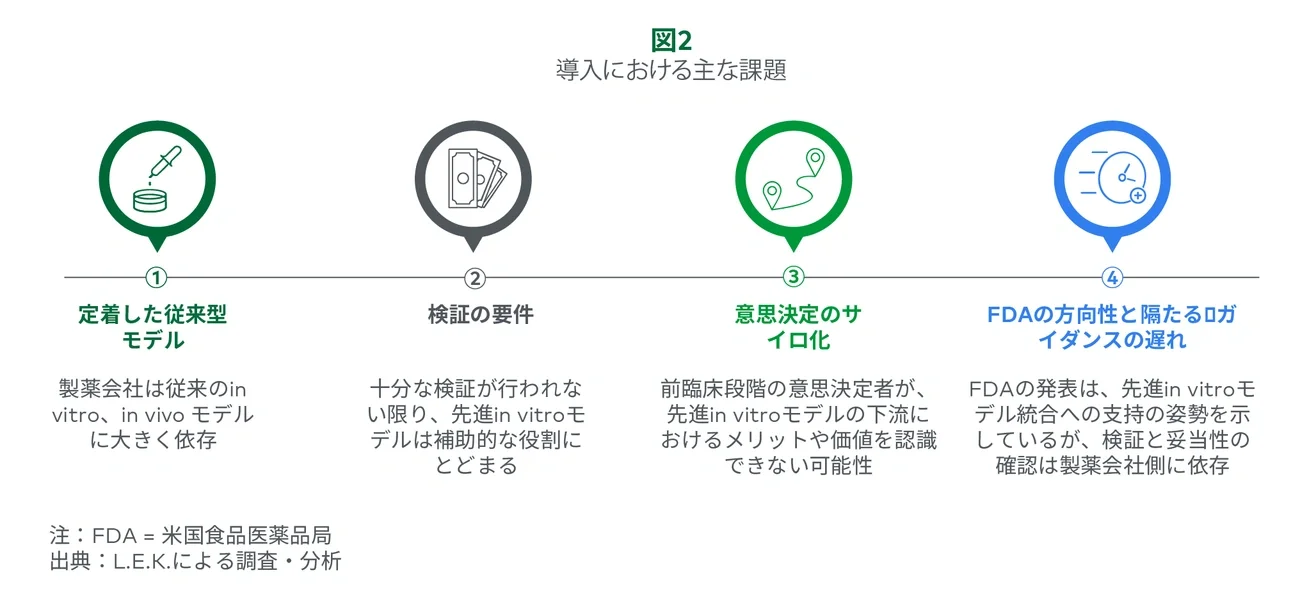
Despite providing promising (albeit often incremental) human-relevant insights, advanced in vitro systems face a number of adoption headwinds as companies seek to expand the role these models play across both discovery and preclinical workflows. L.E.K. has identified four key challenges that must be addressed to unlock broader adoption and commercial impact for advanced in vitro tool suppliers (see Figure 2):

Figure 2

導入における主な課題

Image
導入における主な課題

Figure 2

導入における主な課題

Image
導入における主な課題

1. Current in vitro and in vivo models are highly entrenched within discovery and preclinical development workflows.

In vitro and in vivo models have long been foundational to pharmaceutical development, not because they are perfect but because they are trusted, are practical, and have consistently supported the discovery of clinically successful drugs. In vitro models typically consist of 2D cell models, and while these models are simplistic, pharma leverages them in high-throughput formats (384-well plates) in single-readout assays to assess efficacy or safety across large compound libraries. 

Often these 2D cell model assays recapitulate a disease state (e.g., breast cancer) or test a safety attribute (e.g., hERG ion channel safety). Although advanced in vitro models may offer greater accuracy, the acceptance, entrenchment and throughput of 2D models create a high barrier to adoption.

Additionally, the higher cost of these advanced in vitro systems may not be justified by their performance benefits, making practicality a key consideration. Recently, suppliers have focused on complex disease areas that lack a simple 2D model (e.g., I/O or muscular dystrophy) and where advanced models support a higher throughput not previously possible. Suppliers are increasingly integrating AI with advanced models to drive throughput and extract insights about disease mechanisms. AI and machine learning (ML) algorithms can help simplify complex data and identify early patterns of efficacy and toxicity.

In vivo rodent models are typically used starting in lead optimization to evaluate candidates in physiologically relevant systems. These models are leveraged for a suite of experiments (e.g., safety, efficacy and ADME studies), often with multiple readouts from a single animal. For example, dose escalation studies will also enable toxicity and pathological assessment of organs (e.g., liver, kidney, heart).

While advanced in vitro models may be as predictive as in vivo models, their lack of physiological complexity/context (e.g., multi-organ systems) limits widespread utilization and has kept many researchers from replacing in vivo models. Animal models that are resource-intensive or offer limited translational value (e.g., nonhuman primates) are increasingly viewed as entry points for advanced in vitro approaches, and recently, suppliers have been targeting use cases where large numbers of animals are utilized for only a single specific readout (e.g., gene therapy, titer optimization).

Suppliers are using AI/ML in combination with these systems to further help researchers model vector performance, predict optimal capsid design and understand transduction efficiency. Beyond gene therapy, AI and advanced systems are helping reduce animal use across complex and poorly predicted areas, such as cardiac toxicity and immune response, demonstrating that advanced systems may serve as a strong starting point toward supporting the FDA’s goal of reducing and eventually eliminating animal testing.

2. Advanced in vitro systems are likely a supplemental cost until fully validated. 

Validation is key to convincing stakeholders to choose an advanced in vitro model over the current gold standard; however, it remains a moving target. Without sufficient validation, researchers must still conduct legacy experiments, making advanced in vitro models a supplemental cost rather than a replacement.

Stakeholders often require both retrospective and prospective validation. For retrospective validation, suppliers leverage therapeutics with known toxicity profiles to show that advanced in vitro models can predict similar specificity and sensitivity. Some models have shown toxicity from therapeutics that failed clinical trials but were not deemed toxic using traditional in vitro and in vivo models.

Pharmaceutical stakeholders also seek prospective validation, where other researchers successfully use this advanced in vitro tool to support a drug’s progression to clinical trials and potentially eventual approval. Taken together, retrospective and prospective validation are costly, as they require high upfront investments and initial adoption by multiple champions.

In today’s cost-constrained and time-sensitive environment, studies are often hard to justify, particularly when they do not replace existing experiments. Justifying these extra costs remains a headwind for suppliers, and without broad validation, advanced in vitro models are likely to remain additive to development workflows. To overcome this, suppliers must sharpen their value proposition to attract champions and clearly demonstrate practical utility.

A growing number of suppliers are leveraging AI/ML to validate and benchmark their models against known clinical outcomes to enhance regulatory credibility and commercial adoption. AI/ML algorithms can analyze high-dimensional data (e.g., transcriptomics, phenotypic screens) to demonstrate that in vitro models align with relevant disease biology and drug response. The FDA’s most recent guidance may accelerate broader collaboration across advanced in vitro approaches to build confidence and momentum.

3. Advanced in vitro model value accrues downstream and may go unrecognized by purchasing stakeholders

Discovery and preclinical teams are often siloed from their clinical counterparts, hindering the realization of advanced in vitro models’ full value. This disconnect means the buying team may not recognize downstream benefits, such as improved PTRS, from better early-stage decisions. For example, if an organoid model helps discovery scientists eliminate candidates with hepatotoxic profiles, the benefit of delivering a lead candidate with a lower risk of liver damage to preclinical studies or clinical trials may go unnoticed.

This lack of cross-team visibility also applies to cost and time savings, as preclinical and clinical teams may not fully recognize the impact of early discovery failures. These efficiency gains and cost savings can be overlooked when transitioning candidates across stages of the value chain. Additionally, “kill quickly” is not always incentivized, as many researchers are evaluated based on the number of candidates, not necessarily the success of those candidates downstream.

To demonstrate value, advanced in vitro model suppliers must track how their tools have supported key decision points (e.g., deprioritizing candidates based on early safety or efficacy signals) and highlight the productivity gains (e.g., longer and more costly in vivo studies). This task can be difficult, as each clinical asset likely passes through multiple models and hundreds of experiments, and each advanced in vitro model must lean on its value proposition to convince the pharma industry of its impact.

4. The FDA’s recent announcement signals progress, but broad replacement of animal models will be a cautious and slow process.

Despite the growing evidence supporting advanced in vitro models over traditional in vitro and in vivo testing, the FDA has been slow to fully embrace these technologies and integrate them into regulatory frameworks. While the agency has taken incremental steps in recent years, such as issuing guidance documents, supporting legislation (e.g., FDA Modernization Act 2.0), launching qualification programs (e.g., ISTAND) and supporting collaborative research, the pace of adoption remains cautious.

The most recent FDA guidance indicates a more active stance on reducing animal usage and relying on alternative models. However, beyond the reduction of primate study requirements for mAbs, the roadmap remains aspirational. 

Outside select, more mature applications (e.g., liver OOC), the advanced in vitro space is nascent, with many emerging models lacking validation and the confidence of sponsors. The FDA highlights early-stage concepts, such as whole-body-on-a-chip systems and AI/ML models for pharmacokinetics, but provides limited clarity on regulatory expectations or actionable pathways for adoption.

While the FDA’s tone is supportive of a transition to more predictive tools, for now the burden of validation and regulatory evidence falls to pharma sponsors, which must determine whether the FDA is truly accepting of data from organoids or OOC systems. Additionally, the FDA and the pharma industry must account for other stakeholders such as clinical teams that may be hesitant to recruit for studies built on unfamiliar toxicology data.

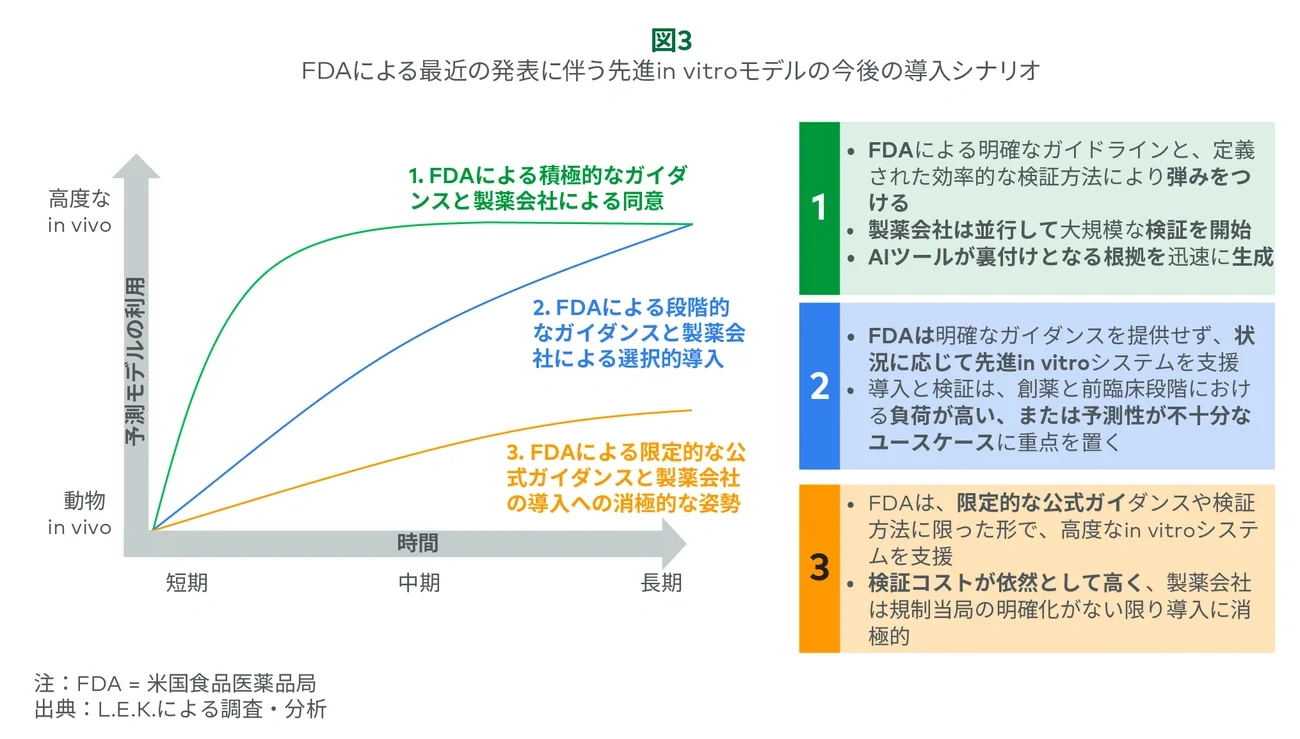
Still, this guidance marks an important inflection point. Depending on how industry and regulators act in the near, mid- and long term, adoption could accelerate meaningfully or continue at a slower pace (see Figure 3). Pharma will play a critical role in generating the validation data needed to shift regulatory perception, especially in high-priority use cases where existing models are costly or poorly predictive. 

If adoption is effectively executed with coordinated validation, clearer expectations and support across advanced in vitro, in silico and AI/ML models, this recent guidance could drive broader adoption efforts across pharma company silos and organizations, offering meaningful tailwinds for suppliers if these efforts translate into real change.

Figure 3

FDAによる最近の発表に伴う先進in vitroモデルの今後の導入シナリオ

Image
FDAによる最近の発表に伴う先進in vitroモデルの今後の導入シナリオ

Figure 3

FDAによる最近の発表に伴う先進in vitroモデルの今後の導入シナリオ

Image
FDAによる最近の発表に伴う先進in vitroモデルの今後の導入シナリオ

To cultivate the adoption and impact of advanced in vitro models, both suppliers and users should consider several key success factors. Given these challenges, how can an advanced in vitro model supplier accelerate adoption and find success within this market? And with the FDA’s recent announcement, how can pharma stakeholders drive meaningful efficiency and return on investment by integrating these models into the drug development process?

  • Pursue a more targeted approach and sharpened value proposition. Suppliers must deeply understand the disease areas and use cases (e.g., safety vs. efficacy) where there is sufficient unmet need or market pain to overcome adoption barriers. This includes clearly defining where their technology fits within the drug development value chain (e.g., target identification, drug screening, candidate selection, lead optimization or clinical trial support). 

    At the same time, pharma should actively assess where advanced in vitro systems can be introduced to add value, particularly in these high-cost, less-predictive areas, as an initial step toward broader integration.

  • Strategically build the necessary data sets to validate the value proposition. Based on the key use cases, suppliers must identify the key pieces of evidence necessary to demonstrate how their solutions complement (e.g., addressing safety concerns) or replace (e.g., outperforming HTS on efficacy) current models or eliminate existing bottlenecks so that pharmaceutical companies can confidently integrate these systems into their workflow. 

    Recent FDA guidance may begin to define a clearer path toward recognizing these models as primary models, rather than supplemental tools, within drug development workflows. The pharma stakeholders should look to partner in this effort by generating or supporting validation in parallel with legacy tools, especially in their high-priority use cases.

  • Establish a clear deployment/business model (e.g., product, service or hybrid approach). Suppliers must clearly define what is included in their offering — from core technologies to ancillary services such as data analysis, regulatory support and validation studies — and tailor their model to reduce adoption barriers for customers unfamiliar with advanced in vitro systems while clearly demonstrating the solution’s value proposition. Pharma should seek supplier support to implement these models effectively within their existing R&D frameworks as the FDA transitions from animal models.

By refining their approach and aligning with industry needs, advanced in vitro model suppliers can overcome adoption barriers and demonstrate their value more effectively. Pharma should also prepare for a future where these models play a larger role, by identifying areas of fit and building internal readiness for adoption.

To explore how L.E.K. can help you navigate the opportunities and challenges in the advanced in vitro market, please reach out to our team. We can offer strategic guidance to set you up for success in this evolving space.

For more information, please contact us.

L.E.K. Consulting is a registered trademark of L.E.K. Consulting LLC. All other products and brands mentioned in this document are properties of their respective owners. © 2025 L.E.K. Consulting LLC

Questions about our latest thinking?

English

Facing the Dementia Wave – Redesigning Elderly Care Pathways

June 4, 2025

Health systems globally face a wave of dementia patients flooding already overburdened systems. With no cure, treatment or 'wonderdrug' on the horizon, but with promising evidence around prevention methods delaying severity, how can care pathways be developed and redesigned to bring homecare, residential care and investors together to scale up access, outcomes and bring down costs? Hear from Eilert Hinrichs and panel members who share perspectives and discuss strategies to cope with demand in the short, medium and long term.  

Footage courtesy of Healthcare Business International 2025 (HBI 2025). 

L.E.K. Consulting is a registered trademark of L.E.K. Consulting. All other products and brands mentioned in this document are properties of their respective owners. © 2025 L.E.K. Consulting 

English
Executive Insights

Looking Ahead: The US Healthcare Provider Landscape in 2035 Part 3

Five areas that successful health systems will have mastered by 2035
June 3, 2025

Key takeaways

Healthcare providers are reshaping operations to stay resilient amid evolving care needs and workforce pressures.

Additionally, AI is becoming a core driver of efficiency, insight and strategic advantage across the care continuum. 

By deepening research and strengthening data and life sciences ties, healthcare providers are accelerating innovation.

Going forward, success will depend increasingly on integrating specialty pharmacy and supply chain strength into everyday care delivery. 

Introduction

This is the third installment in L.E.K. Consulting’s Provider 2035 Executive Insights series sharing our predictions for the U.S. healthcare delivery landscape in 2035.

In the first two installments, we predicted that:

  • Existing government and employer initiatives are unlikely to significantly reduce U.S. healthcare spending, and pressure for new solutions will mount as healthcare spend exceeds 20% of gross domestic product.
  • Payers, big tech, retailers and investors will continue their efforts to participate directly in care delivery, posing a risk to provider organizations trying to maintain the status quo but offering an opportunity for those that act decisively and proactively.
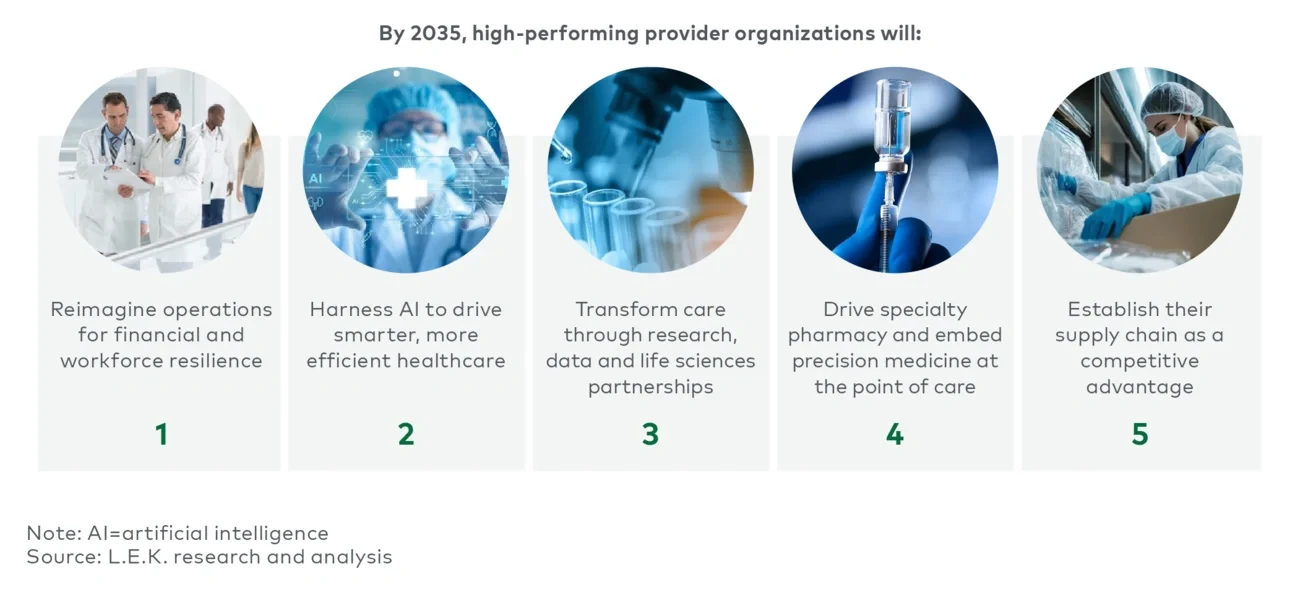
  • Given these pressures and opportunities, we believe the provider organizations that are thriving in 2035 will have taken focused and proactive steps to redefine the way care is delivered and their role in the care delivery ecosystem. Specifically, we think that these organizations will have mastered five key areas (see Figure 1). 

Figure 1

Five key areas of focus for healthcare providers 

Image
Five key areas of focus for healthcare providers

Figure 1

Five key areas of focus for healthcare providers 

Image
Five key areas of focus for healthcare providers

1. Reimagining operations for financial and workforce resilience

The traditional care delivery model is no longer aligned with patient expectations and needs, reimbursement trends, clinician workforce realities and the possibilities that new technologies (both digital and biomedical) enable. This gap is widening, and we expect that the provider organizations that transform their operating model to better reflect this new reality will be the provider organizations that thrive in 2035. 

What leading provider organizations will master

Patient segmentation designModern segmentation of patients, optimizing journeys, settings and team designs for each segment 
Integrated ambulatory footprint Well-integrated ambulatory services such as surgery, infusion, primary care, urgent care, diagnostics and home care 
Optimization of campuses A clear vision for the purpose, configuration and staffing of main campuses and inpatient facilities 
Dynamic capacity planning The use of forecasting, scheduling tools and dynamic models to match supply with patient needs in real time 
Care team models Multidisciplinary designs emphasizing clinician types with greater availability (e.g., APPs) and workflows supported by artificial intelligence (AI) to extend reach 
Workforce development Involvement in clinician education before residency and ongoing career development for leaders 


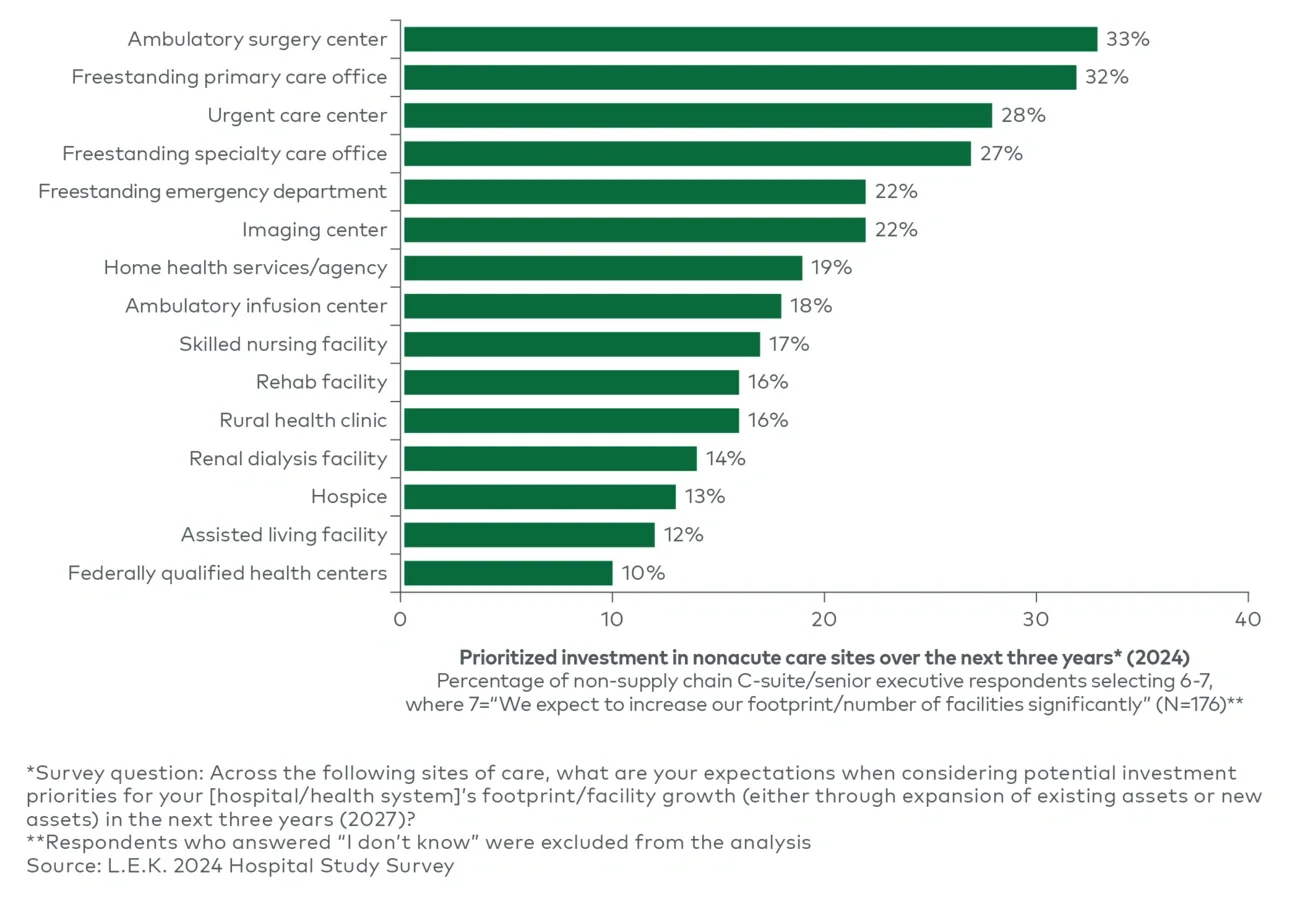
Care delivery is highly capital- and labor-intensive, and change takes time. That means that successful organizations must start now to design this model of the future and allocate their capital investment and transformation effort accordingly (see Figure 2). 

Figure 2

Health system planned nonacute facility investments 

Image
Health system planned nonacute facility investments

Figure 2

Health system planned nonacute facility investments 

Image
Health system planned nonacute facility investments

What should provider organization leaders do now? We recommend the following:

Invest proactively where the “land grab” is already happening in many markets — for example, ambulatory surgery centers, infusion centers and freestanding emergency departments.

Develop the organization’s integration muscle, including the system, workflow and team integration of existing ambulatory sites, and capture learnings.

Modernize the system’s patient segmentation by developing a segmentation that better defines needs and patient journeys, and pilot new patient journey designs.

Build dynamic capacity planning and scheduling capabilities before the complexity of additional care sites and teaming models are added.

Pilot new care team designs and clinician support tools, particularly models that emphasize APPs and tools that reduce administrative burden.

Develop partnerships to participate in clinician education and in doing so gain access to a greater share of the new clinician pipeline.

2. Harnessing AI to drive smarter, more efficient healthcare

AI and automation are no longer futuristic concepts — they are essential strategic drivers of performance, competitive differentiation and innovation. By 2035, AI will be embedded across clinical decision-making and research, revenue cycle management, workforce support and optimization, and patient engagement, enabling providers to unlock new value streams while mitigating financial and operational pressures.

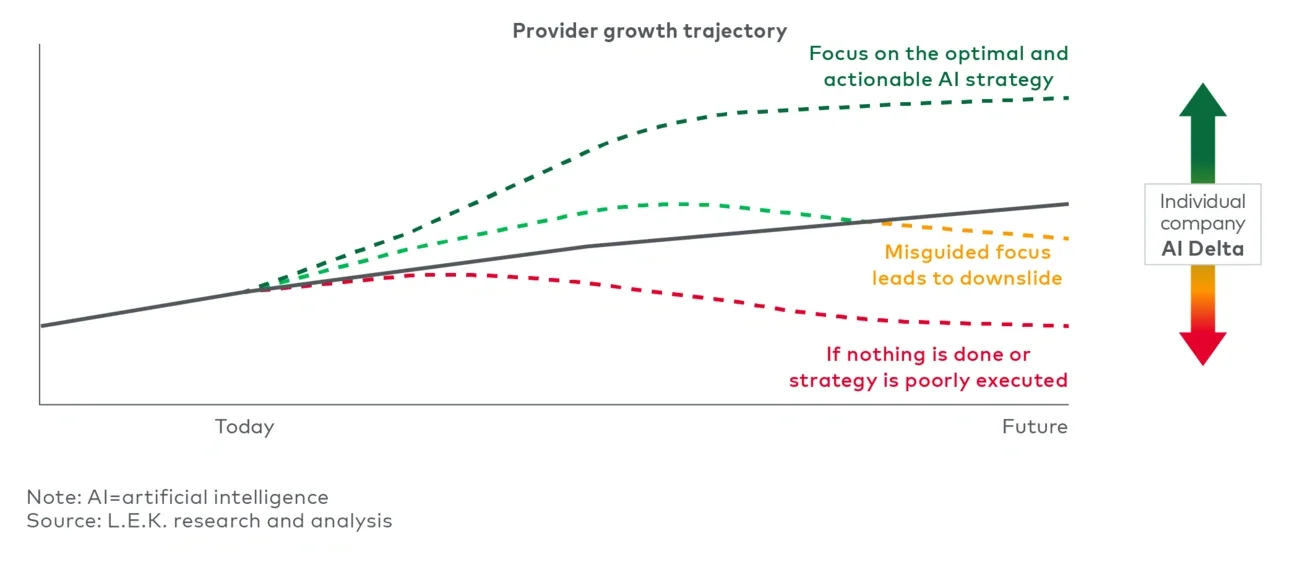
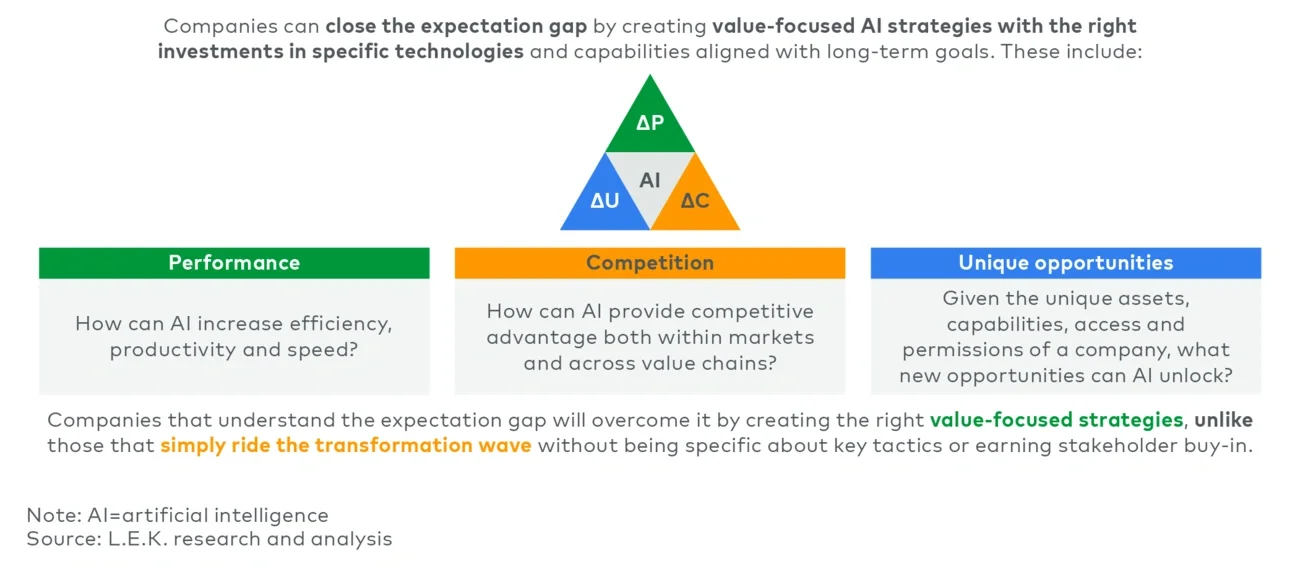
The impact of AI extends beyond efficiency gains. Provider organizations that intentionally harness AI will gain a competitive edge over those that fail to do so (see Figures 3a and 3b). 

Figure 3a

The AI Delta — unlocking AI’s full potential for competitive advantage 

Image
The AI Delta — unlocking AI’s full potential for competitive advantage

Figure 3a

The AI Delta — unlocking AI’s full potential for competitive advantage 

Image
The AI Delta — unlocking AI’s full potential for competitive advantage

Figure 3b

The AI Delta — unlocking AI’s full potential for competitive advantage 

Image
The AI Delta — unlocking AI’s full potential for competitive advantage

Figure 3b

The AI Delta — unlocking AI’s full potential for competitive advantage 

Image
The AI Delta — unlocking AI’s full potential for competitive advantage

What leading provider organizations will master

AI-enabled clinical decision supportAI will help optimize diagnosis, treatment selection and predictive analytics to improve patient outcomes 
Operational and revenue cycle automation AI-powered scribing, medical coding and claims processing will significantly reduce administrative burden 
Patient-centric AI solutions Virtual patient engagement, treatment plans and AI-driven health coaching will redefine the provider-patient relationship 
AI-enhanced partnerships and data monetization Providers will collaborate with tech vendors and academic institutions to fuel AI-driven innovation, including at the front lines of care and in ethically harnessing de-identified data 
AI-powered supply chain and financial optimization Real-time AI-driven demand forecasting, vendor diversification and procurement automation will enable providers to drive cost efficiencies while ensuring supply chain resilience 


What should provider organization leaders do now? We recommend the following:

Build the organizational muscle to scale AI use cases. In our experience, it is more difficult for organizations to scale (not identify) valuable AI applications.

Develop strong AI governance. A strong governance model protects patients, clinicians and the organization and allows teams to move quickly.

Identify and size problems for AI to solve (to focus attention). Distraction is a real risk, and a data-driven sizing of “problems” for AI to solve can help preserve focus on high-impact opportunities amid the barrage of pilot requests.

Learn from others. Provider organizations around the country are deploying new AI technologies and can share lessons already learned.

Push boundaries with clear opportunities for differentiation. In a fast-evolving field, the opportunity for differentiation is real, and provider organizations should not be content with a pure “fast follower” approach.

3. Transforming care through research, data and life sciences partnerships

By 2035, clinical research and innovation will no longer be exclusive to major academic medical centers (AMCs) — all high-performing providers, including regional health systems, community hospitals and physician groups will need to actively participate in research to stay competitive. 

What leading provider organizations will master 

Strategic collaboration with biopharma Establish partnerships with pharma and biotech companies to codevelop clinical research, gain early access to novel therapies and improve patient recruitment for clinical trials 
Data infrastructure and monetization Strategically monetize de-identified patient data, balancing financial opportunity with regulatory compliance and long-term control over licensing and intellectual property 
Expansive clinical trial participation Develop the relationships, processes and infrastructure to engage significantly in clinical trials to compete with AMCs and oncology providers and enable access to novel and targeted treatments 
Genomics-enabled care models Ride the proliferation of genomics and precision therapy vendors and determine which to engage with and deploy 
Expansive clinical trial participation Develop capabilities to treat smaller, more specialized patient groups 


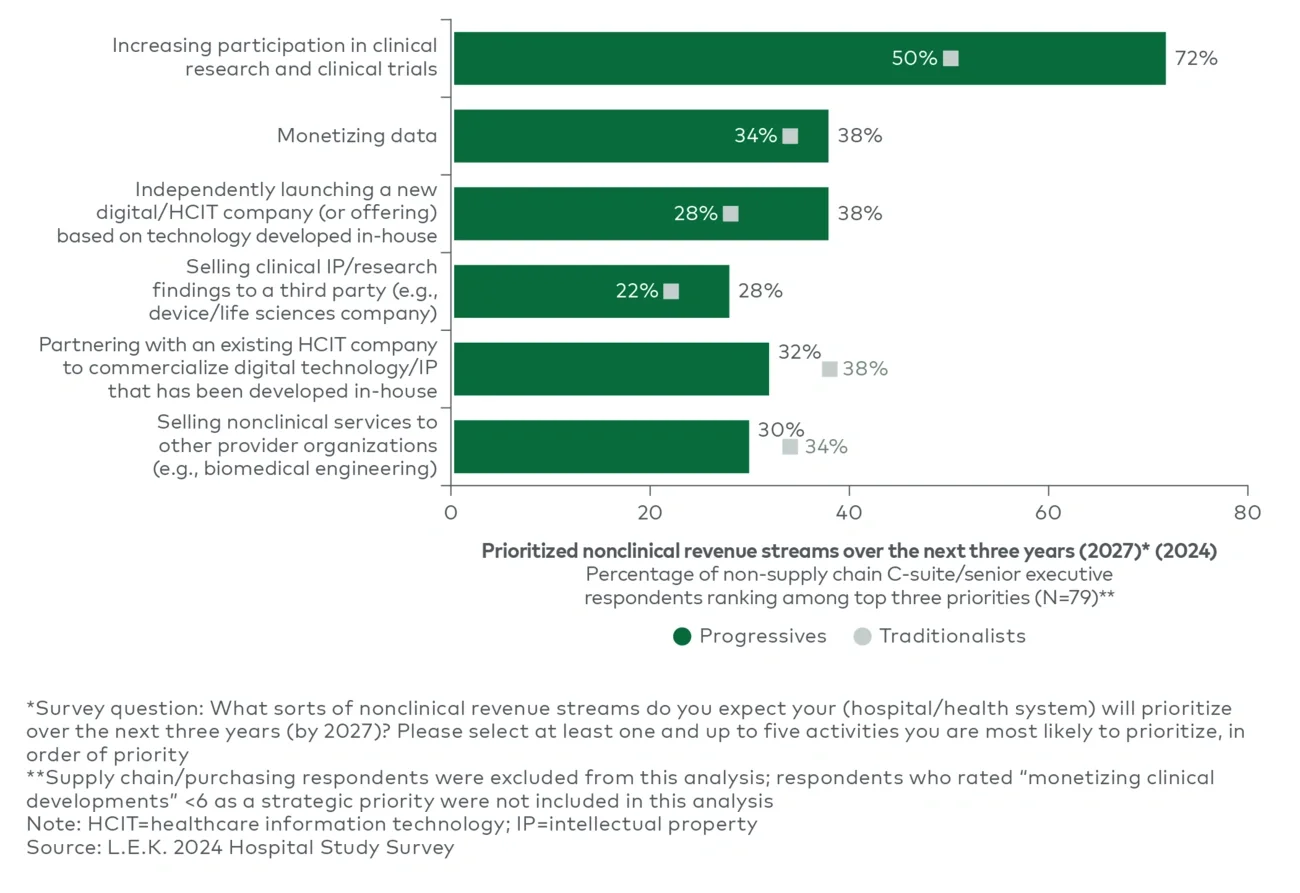
Having a clear strategy for engaging in the life sciences ecosystem will be a competitive necessity. Providers that fail to build capabilities risk losing out on revenue streams, cutting-edge treatment access and long-term patient retention. Those that succeed will be positioned as leaders in next-generation personalized healthcare (see Figure 4).

Figure 4

Health system executives’ prioritized nonclinical revenue streams 

Image
Health system executives’ prioritized nonclinical revenue streams

Figure 4

Health system executives’ prioritized nonclinical revenue streams 

Image
Health system executives’ prioritized nonclinical revenue streams

What should provider organization leaders do now? We recommend the following:

Catalog current research activities. Many provider organizations do not have a full understanding of current research activities, costs and value.

Conduct gaps assessment. Identify capability gaps and blockers to increased clinical trial participation as well as opportunities to close these gaps.

Define priority service lines and target manufacturers. Prioritize research focus based on clinical needs and value to the community and the system, and identify and open discussions with manufacturers that are active in those spaces.

Forge (flexible) partnerships to start to build out the infrastructure. Select and onboard partners to close identified gaps and scale infrastructure (from point solutions to contract research organization partners) but retain flexibility in a fast-changing space.

4. Driving specialty pharmacy and embedding precision medicine at the point of care

U.S. prescription drug expenditures are projected to reach $2.5 trillion by 2035, surpassing one-quarter of total U.S. healthcare spend. This growth will continue to be driven by targeted and high-cost specialty drugs, especially as gene and cell therapies, biologics, and targeted treatments become more prevalent.  

To succeed in 2035 — in terms of both patient outcomes and financial sustainability — provider organizations will need to effectively participate in this growing area. 

Additionally, genomics is no longer the exclusive domain of academic centers or disruptive startups. Community-based health systems and physician groups are beginning to weave genetics into everyday decision-making, gaining access to the $3 billion data and insights spend pool (across biopharma, provider and payer use cases). Yet we believe the lion’s share of value will accrue to organizations that move beyond test volumes and focus on clinical activation and driving clinical value. 

What leading provider organizations will master 

Specialty pharmacy operations Successful providers will develop exceptional patient access (for medical and pharmacy benefit drugs), inventory management and procurement infrastructure (including direct contracts with manufacturers) 
Clinical integration of precision medicine Genomic sequencing and AI-driven diagnostics will enable more-personalized treatment plans, particularly in oncology, neuroscience and rare diseases but increasingly in primary care 
Patient access and convenience Successful providers will develop patient access points that are convenient and cover the spectrum of specialty drug routes of administration (e.g., ambulatory infusion, home, in office) 
Strategic 340B and network optimization As the 340B program evolves, health systems will need to adapt their pharmacy networks and contract strategies to maintain compliance and financial viability 
Proactive drug pipeline intelligence and life sciences partnerships Given the speed at which new therapies enter the market, leading providers will need to have deep visibility into drug pipelines and partner with manufacturers to ensure access 


What should provider organization leaders do now? We recommend the following:

Prepare proactively for various 340B scenarios with a clear action plan to follow should various potential changes to the program be enacted.

Proactively embed genomics at the point of care to capture an outsized share of a rapidly growing market and create data assets competitors can’t match (see our recent learnings regarding how to approach this).

Assess the drug pipeline to identify therapeutic areas and manufacturers around which to build new relationships and programs in the coming years.

Assess current specialty pharmacy operations, particularly related to drug access, patient access/authorization timing, revenue and acquisition cost.

Chart a path to close any identified gaps in current operations (relative to benchmarks and best practices), including potential partnerships.

Build out the delivery footprint, potentially with ambulatory and home infusion operating partners (especially as investment in these industries continues).

5. Establishing the supply chain as a competitive advantage

Supply chain inefficiencies don’t just impact margins — according to the American Hospital Association, in 2024 39% of providers canceled patient appointments due to product shortages.

In today’s complex healthcare landscape, mastering the supply chain is essential. Providers that integrate supply chain intelligence with financial and clinical operations gain cost advantages, operational stability and better patient outcomes. Those that fail to adapt face higher costs, inefficiencies and care disruptions.

By 2035, supply chain mastery will define high-performing organizations, evolving from a back-office function into a strategic pillar of financial sustainability and care delivery.

What leading provider organizations will master

Integrated clinical and financial supply chain systems Real-time interoperability between supply chain, finance and clinical data will enable better cost control, inventory management and service continuity 
Resilient and dynamic procurement and sourcing strategies AI-driven demand forecasting, vendor diversification and proactive contract management will reduce cost variability and exposure to disruptions 
Tech-enabled cost containment Automation, AI-driven procurement tools and predictive analytics will help control rising material and operational costs 
Postacquisition integration excellence As provider organizations continue to grow through M&A, supply chain optimization offers a real value-creation lever 


What should provider organization leaders do now? We recommend the following:

Assess the potential impact of tariffs and identify potential alternate sources to manage down supply costs if necessary.

Assess the current supply chain for resiliency and identify opportunities to diversify supplier networks and improve sourcing agility.

Start the work to integrate clinical and financial supply chain systems.

Identify, select and integrate AI-driven supply chain analytics to predict inventory needs, prevent stockouts and optimize procurement strategies.

Conclusion: The road to 2035 starts today

The healthcare providers that will lead in 2035 are already laying the groundwork today. Mastering these five areas — specialty pharmacy, AI, care delivery transformation, supply chain and research — will define the next era of healthcare leadership.

At L.E.K., we help provider organizations navigate these transformations with strategic clarity and execution expertise. To discuss how your organization can develop a roadmap to 2035, contact us today.

L.E.K. Consulting is a registered trademark of L.E.K. Consulting LLC. All other products and brands mentioned in this document are properties of their respective owners. © 2025 L.E.K. Consulting LLC 

Questions about our latest thinking?

English

Investment Spotlight: Aesthetics, Dermatology and Med Spas

June 5, 2025

This vast and fast-growing sector includes aesthetic procedures but also the treatment of age-related conditions relating to dermatology, obesity, vein diseases, presbyopia and dental. This is an increasingly private pay market which is reliant on stable discretionary spending. Hear from Adrienne Rivlin and panel members who look at trends, models and growth rates across Europe.  

Footage courtesy of Healthcare Business International 2025 (HBI 2025). 

L.E.K. Consulting is a registered trademark of L.E.K. Consulting. All other products and brands mentioned in this document are properties of their respective owners. © 2025 L.E.K. Consulting

English
Executive Insights

The UK Productivity Puzzle: A Long-Term Lack of Private Capital Investment

June 5, 2025

Key takeaways

Expert consensus and L.E.K. analysis identify low private capital investment as a critical factor behind the UK’s weak productivity performance.

With £trillion in idle liquid savings and a strong pipeline of new ventures, the UK has both the capital and entrepreneurial activity to fuel a resurgence.

For over 30 years, the UK has remained in the bottom quartile for capital investment among OECD countries — a clear indicator of untapped potential.

This is a solvable challenge — and a major opportunity. By strengthening investment incentives and improving deployment conditions, the UK can convert its underperformance into a platform for long-term, productivity-led growth.

In this Executive Insights, we look at the UK productivity puzzle and a particular causal factor relevant to L.E.K. Consulting’s work that is one of the toughest questions our clients often face: What is the role of private capital investment?

In the latest government announcement on 15 May 2025, UK labour productivity was 0.2% lower compared with a year ago (comparing Q1 2025 with Q1 2024). The last time the UK observed meaningful growth in this measure — albeit a lacklustre 1.0% year-on-year growth1 — was Q3 of 2022. Since then, it has been flat or in decline. The latest figure (Q1 2025) was just 1.1% higher (in aggregate, not per year) than prior to the pandemic, Q4 2019, over five years ago.

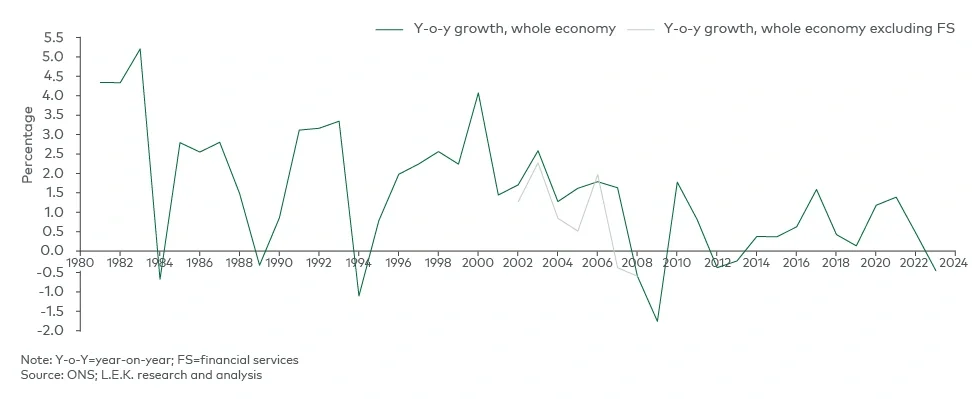
The longer-term view does not provide further comfort. Figure 1 shows the development of the UK’s labour productivity since 1980, revealing a clear trend across each decade.

Figure 1

Year-on-year growth of labour productivity in the UK (1980-2023)

Image
Year-on-year growth of labour productivity in the UK (1980-2023)

Figure 1

Year-on-year growth of labour productivity in the UK (1980-2023)

Image
Year-on-year growth of labour productivity in the UK (1980-2023)

In the 1980s, the UK achieved 2.2% per year improvement in productivity in real terms (i.e. above inflation). Whilst this growth may seem modest, it implies a doubling in labour productivity every 32 years, and therefore that a typical Generation X worker — born in the 1960s — could expect to earn double what their parents earned, even after taking inflation into account.

In the 1990s, the pace of productivity improvement increased, averaging 2.8% per year, or a doubling in productivity every 25 years.

The global financial crisis of 2007-2009 (GFC) dominates the landscape of productivity growth in the 2000s and 2010s, and many have commented on the apparent step change that can be observed on either side of the financial crisis. From 2001 to 2007, productivity growth averaged 1.8%, and from 2010 to 2019 — in the wake of the GFC — it was only 0.4% per annum. (At this rate of growth, it would take fully 160 years to double productivity, which pushes the boundaries of economists’ understanding of ‘in the long term’.)

But is the GFC — and the constraints that it imposed on the availability of capital — at the heart of the decline? Perhaps not, and certainly not entirely.

What is less often observed is that this 2008 bust — which began in the global financial services (FS) sector — was preceded by an equally dramatic boom which saw the FS sector in the UK grow labour productivity by 55% from 2001 to 2007. Once the impact of this small element (noting that FS accounts for around 8% of the UK economy) is removed, the productivity growth in the rest of the economy was only 0.8% per annum from 2001 to 2007, equating to a doubling in productivity every 85 years — a lifetime, not a generation. 

This is the UK productivity puzzle, and it seems to date from at least the early 2000s.

Generation Z children, born in the 2000s, are today graduating and entering a workforce that is barely more productive than when they were born. The problem is older than Facebook (2004), YouTube (2005) and Twitter/X (2006) — and indeed older than ‘Strictly Come Dancing’ (2004), ‘The Apprentice’ (2005) and ‘The X Factor’ (2005).

With all these new ways to communicate, to connect to information, and to find talent, why have we not solved the productivity puzzle?

There is a huge prize at stake. Had the UK’s productivity grown at the 1980s-1990s average rate (2.5% per year across both decades), today we would each be earning 36% more, or an extra £37 per hour.

But what are the causes?

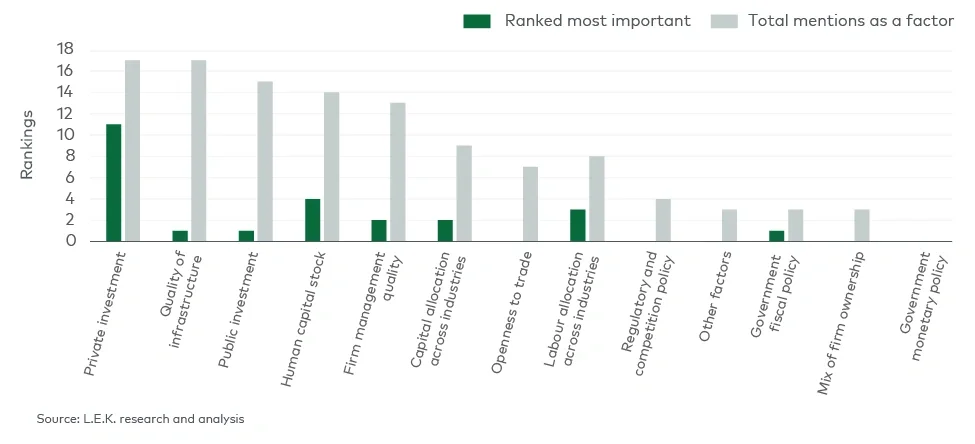
In a July 2024 survey of the literature and expert views, L.E.K. asked 26 UK academic experts on productivity for their views on the causes.2 The results are shown in Figure 2.

Figure 2

Factors in UK productivity slowdown

Image
Factors in UK productivity slowdown

Figure 2

Factors in UK productivity slowdown

Image
Factors in UK productivity slowdown

The survey offered the 26 economists a range of factors to select from, and “private investment” was ranked as the most important factor and shared the top spot in total mentions.

By private investment, we mean capital invested by the private sector for a range of purposes: to allow start-ups to scale, covering their start-up losses and capital programmes; to invest in equipment, machinery and systems; and to invest within businesses in new ventures or services. Investment in this context includes any expenditure that is designed to improve or grow a business that would not be necessary just to maintain the business.

When investment is too low, the explore-versus-exploit choice has tipped too far towards exploitation and the reward for exploration has become too low. Exploring involves taking risks, because it is hard to know whether the changes or initiatives being invested in will work out, and often they do not. New business ventures often fail, and capital invested in them is therefore lost. However, in aggregate and across a portfolio of such investments, the returns need to be (and used to be) high enough to pay back the capital and provide a reward for taking that risk.

The evidence for a shortfall in private investment is strong

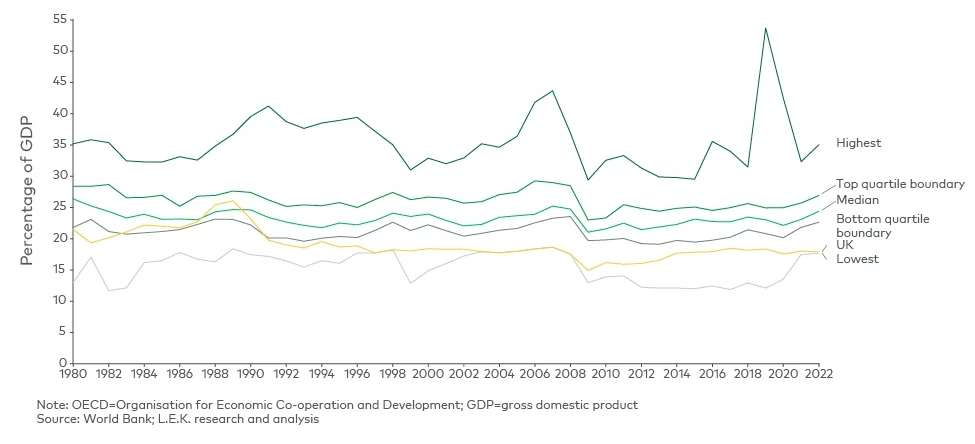
The Organisation for Economic Co-operation and Development (OECD) data for gross fixed capital formation (GFCF) since 1980 is shown in Figure 3. The Y-axis represents GFCF as a percentage of GDP. The grey and green lines show the range across all OECD countries in each year from very low GFCF (in light grey) to very high GFCF (dark green). We also show the bottom and top quartile boundaries. The UK is shown in orange.

Figure 3

Gross fixed capital formation of OECD countries (1980-2022)

Image
Gross fixed capital formation of OECD countries (1980-2022)

Figure 3

Gross fixed capital formation of OECD countries (1980-2022)

Image
Gross fixed capital formation of OECD countries (1980-2022)

The UK is mostly below the bottom quartile line (i.e. in the fourth quartile). There was a period from 1983 to 1990 when the UK invested relatively more and was in the third, and sometimes second, quartile. Since 1991, the UK has been in the fourth quartile in every year.

Over this entire period, the UK invested on average 19% of GDP in GFCF. Some comparable economies invested more — the US, France and Germany were all at 22%, for example. Other advanced economies, such as Switzerland (28%) and Australia (26%), invested much more on average across this period.

The OECD data defines capital as tangible assets, including buildings, machinery and equipment. This therefore excludes intangible investments such as software. The mix of industries is a factor because it would be mostly industrial activities, including manufacturing, primary industries, construction and distribution, which use significant tangible capital. These activities make up 37% of the UK economy versus 47% on average across the OECD, and this may account for some of the difference in Figure 2. 

Nevertheless, the size of the gap shown above is large enough to conclude, as did the economists in the survey, that low private capital investment is a problem in the UK.

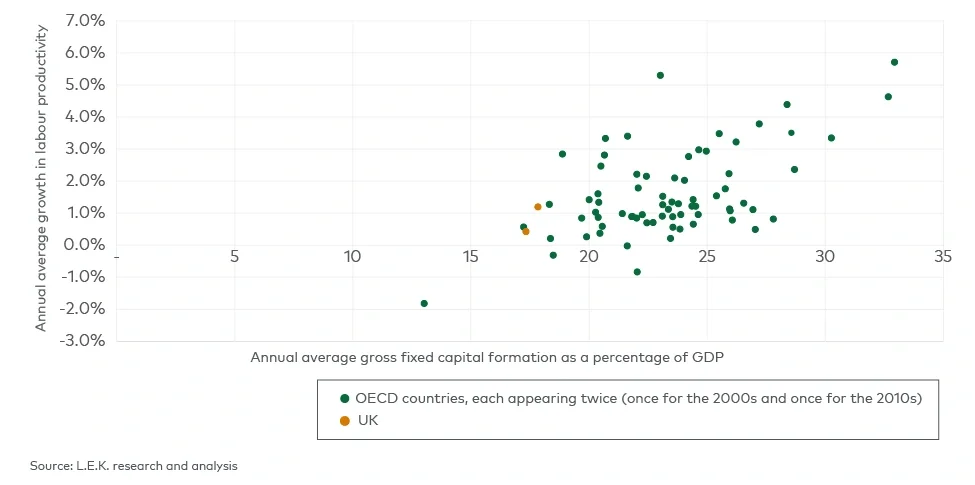
The same OECD data set can be linked to growth in labour productivity. If the investment is successful (overall across the portfolio within a country), then we would expect higher rates of investment to lead to higher growth in productivity. Looking at the period from 2000, on a decadal basis (so the 2000s and then the 2010s), picking up the different investment environment before and after the GFC, we can plot the average investment over a decade (as a percentage of GDP) against the growth rate in labour productivity over the same decade. 

Each OECD country appears twice in the chart (one spot for each decade). There is a strong statistical relationship (*): If GFCF is below c.20% of GDP, labour productivity does not grow. For each 1 PPT increase in GFCF, labour productivity grows by around 0.7% per year faster. The statistics are also valid (and very similar) when looking at each decade separately.

(*) P-value 2x10^-7 and T-stat 5.8; similar results for each decade. In both decades, the UK was in the bottom (worst) quartile on both capital investment and labour productivity growth (see Figure 4).

Figure 4

Gross fixed capital formation vs labour productivity growth across the OECD

Image
Gross fixed capital formation vs labour productivity growth across the OECD

Figure 4

Gross fixed capital formation vs labour productivity growth across the OECD

Image
Gross fixed capital formation vs labour productivity growth across the OECD

It is important to highlight that this relationship assumes that the additional capital investment is productive and profitable. The acceleration in labour productivity growth is not a simple Keynesian result of adding capital expenditure into the GDP equation. If it were just spent on wasteful projects, the benefit would not outlast the expenditure and GDP could simply increase and then fall back without impacting labour productivity at all. 

The relationship shown in Figure 4 is based on additional capital expenditure resulting from private investors identifying and making profitable investments that improve productivity.

As a sample scenario, if the UK were to increase GFC by 3% of GDP and so move to the right on the chart by 3 PPT, the statistical relationship suggests that growth in labour productivity would improve by 2.1% per year and reach 2.5% per year, the average rate achieved during the 1980s and 1990s. Generation Alpha would eventually earn twice what their parents did. This would require an additional £86 billion per year (in 2024 prices, i.e. 3% of the 2024 nominal GDP of £2,851 billion).

Why is this not happening?

In terms of capital that could be invested, the UK public holds £1.9 trillion in net financial wealth (2022 figure, the latest published by the Office for National Statistics in January 2025). Of this, £1.2 trillion is in cash deposit accounts, in cash individual savings accounts and with National Savings & Investments — deposits that are not invested in businesses or other enterprises. This does not include equities, property or pensions, and so this figure represents liquid financial wealth which could be mobilised to invest. This is enough for 14 years of the additional investment of £86 billion in our scenario above. Therefore, the problem is not a shortage of capital.

It also seems that the UK is not short of investable ideas. The ONS recorded 316,000 ‘business births’ in 2023, which is about one per hundred workers.

Addressing the investment gap

We are left with the task of understanding why the UK's substantial pool of capital and strong pipeline of investable ideas are not combining to create profitable investments as productively as in other countries or past UK generations. Are the incentives to invest strong enough? And if not, how can the UK environment become more fertile ground for private capital investment in the future?

For more information, please contact us.

L.E.K. Consulting is a registered trademark of L.E.K. Consulting LLC. All other products and brands mentioned in this document are properties of their respective owners. © 2025 L.E.K. Consulting LLC

Endnotes
1ONS.gov.uk, “UK Whole Economy: Output per hour worked % change per annum SA.” https://www.ons.gov.uk/employmentandlabourmarket/peopleinwork/labourproductivity/timeseries/lzvd/prdy 
2Economic-insight.com, “The UK Productivity Puzzle: A Survey of the Literature and Expert Views.” 

Questions about our latest thinking?

English
Executive Insights

Navigating Retail Headwinds: An Introduction to L.E.K. Consulting’s Four Levers for Success

Volume XXVII, Issue 38
June 10, 2025

Retailers around the globe continue to grapple with persistent headwinds. Although inflation has reduced from its peak and real wages are growing again, pressures remain. In the UK, rising tax and regulatory burdens add complexity, while in Germany, low consumer confidence continues to weigh on the sector. Global uncertainty around the impact of tariffs also looms large.

Despite these challenges, forward-thinking retailers have shown remarkable adaptability: they are optimising costs, enhancing their propositions, personalising the customer experience and seeking new revenue streams (for instance, through retail media). 

Companies that act decisively to address current pressures and continue to improve and innovate will be best placed to capture meaningful market share. As conditions stabilise, these proactive retailers will be poised for accelerated growth.

Four strategic levers for retail differentiation

Across our engagements with leading retailers, we have identified four strategic areas where focused initiatives can yield significant gains ― in some cases improving revenue by 10%-15% and profit by up to 25%. 

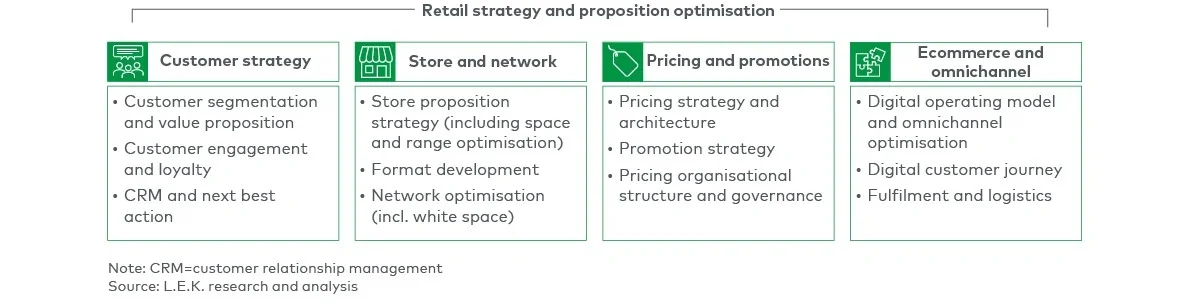
In our upcoming series, we will examine how each lever can help retailers emerge stronger in a challenging environment (see Figure 1). 

Figure 1

L.E.K.’s four value creation levers for retail success

Image
L.E.K.’s four value creation levers for retail success

Figure 1

L.E.K.’s four value creation levers for retail success

Image
L.E.K.’s four value creation levers for retail success

1. Customer strategy

Truly understanding evolving customer needs ― and translating those insights into a winning value proposition ― lies at the heart of sustainable growth. Retailers can set themselves apart by tailoring their offering to distinct consumer segments and missions, thereby driving loyalty and higher lifetime value. 

  • Customer segmentation and value proposition: We bring clarity as to which customer groups matter most, the specific needs they have and how your proposition can be tailored or adapted to best suit the needs of those segments. 
  • Customer engagement and loyalty: We help our clients devise tailored engagement tactics for different segments, optimising long-term value through the right loyalty programmes and communication strategies.
  • CRM and next best action: We work with retailers to deploy automated, data-driven marketing and personalisation at scale, enhancing both the frequency and value of customer interactions.

In one engagement, L.E.K. helped a European tour retailer develop a data-driven approach to targeting customer segments, significantly boosting repeat bookings and overall lifetime value.

2. Store and network optimisation 

Even as consumer behaviour evolves and online shopping grows, physical stores remain valuable ― but only when strategically designed and placed to meet the needs of target customers and their shopping missions. 

  • Store proposition strategy: We work with retailers to define the right proposition to best serve the needs of the local catchment, including optimising space allocation and identifying how to tailor the range, assortment and services to maximise store profitability. 
  • Format development: By understanding local demographics and shopper missions, we help develop the store formats and sizes most likely to drive profitable growth in each location.
  • Network optimisation: We help retailers define the role a physical retail network should play (for both sales and marketing), optimise store locations and network density, identify and quantify whitespace opportunities, and benchmark store performance.

For instance, L.E.K. developed new store propositions for a major European convenience chain, achieving a 10%-15% revenue uplift and a 25% profit increase.

3. Pricing and promotions

With ongoing cost pressures and consumers paying ever-closer attention to price, delivering value without eroding margins is a crucial balancing act. 

  • Pricing strategy and architecture: We define pricing structures that maximise revenue and profitability, while remaining competitive for each priority customer segment.
  • Promotion strategy: We help retailers use promotions more effectively, striking the right balance between volume growth and profitability.
  • Pricing organisation structure and governance: We define the structures and operational processes needed to manage pricing and value across channels as well as to identify ways to measure performance.

L.E.K. has seen firsthand the impact of a well-structured approach, evidenced by a national apparel and footwear retailer’s profit increase of 300-600 basis points after adopting a targeted pricing and promotion strategy.

4. Ecommerce and omnichannel

Despite ongoing economic uncertainty, ecommerce continues to outpace much of physical retail. True omnichannel journeys need seamless integration across digital and in-store experiences to meet consumer expectations ― and to protect the economics of each channel.

  • Integrated ecommerce and multichannel strategy: We support retailers in defining and deploying well-structured ecommerce and multichannel strategies to improve integration between digital and physical experiences, drive customer engagement and conversion, and focus resources on the most value-creating growth levers.

Many retailers are also turning to AI and machine learning to streamline operations and personalise digital interactions, enabling cost efficiencies and higher customer engagement.

Looking ahead

This is the first instalment of L.E.K.’s series on retail optimisation. Over the coming months, we will take a deeper dive into each of these four strategic levers ― sharing practical insights, case examples and suggested next steps for retailers looking to secure profitable growth in an uncertain market. 

Watch our companion video for insight into how leading retailers are applying these four levers in practice.

If you have any questions or want to discuss how we can support your business, please get in touch

L.E.K. Consulting is a registered trademark of L.E.K. Consulting. All other products and brands mentioned in this document are properties of their respective owners. © 2025 L.E.K. Consulting

Questions about our latest thinking?

English
Subscribe to