Navigating the Squeeze: Brand Owners Expect — and Are Planning for — a Rise in Packaging Costs in 2025

April 2, 2025

The majority of brand owners expect packaging costs to increase in 2025, though not nearly as much as in 2021-23, when prices of raw materials surged due to the supply chain crisis. But while they expect to pass on some of these new cost increases to consumers, the historically high levels of inflation in 2022 and 2023 have increasingly made brand owners as well as their end customers relatively more price sensitive.

All of which presents both opportunities — and risks — for packaging converters.

This forward-looking brand owner sentiment around packaging costs was gleaned through L.E.K. Consulting’s seventh annual proprietary U.S. Brand Owner Packaging study, which we ran during the fourth quarter of 2024 and the first quarter of 2025. By illuminating some of the most pressing issues facing brand managers and packaging stakeholders at brand owners, it offers a clear path forward for packaging converters.

How brand owners will respond to higher packaging costs

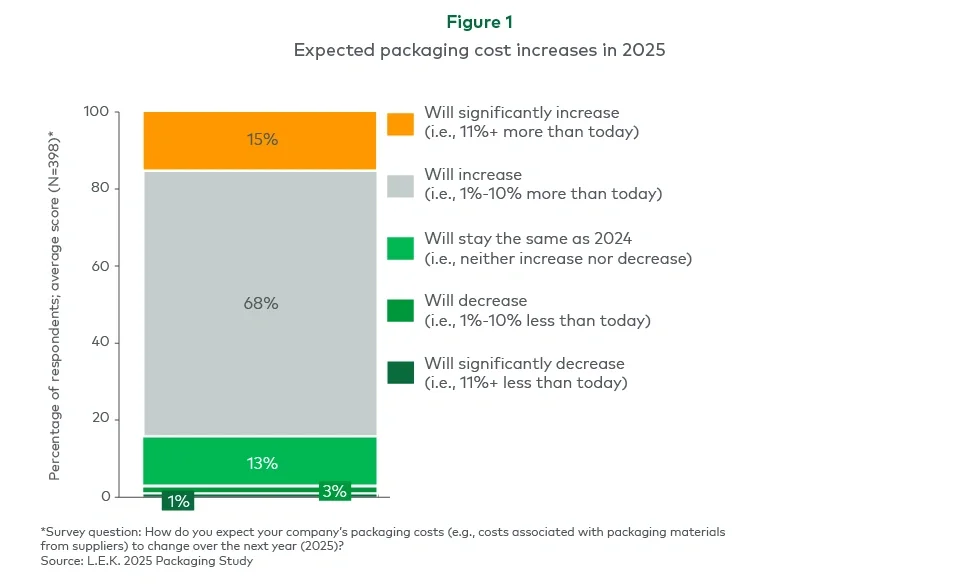
Approximately 83% of brand owners expect packaging costs to increase in 2025, according to our study, with some 68% anticipating a rise of between 1% and 10% (see Figure 1).  

Image
Figure 1. Expected packaging cost increases in 2025
Image
Figure 1. Expected packaging cost increases in 2025

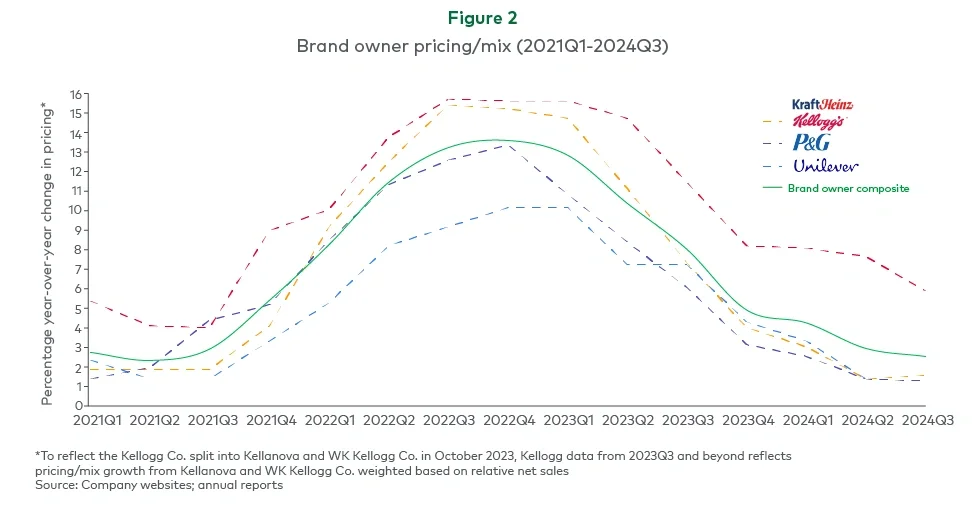
Historically, brand owners have been able to pass on higher prices to end consumers. Between 2021 and 2024, for example, brand owners consistently passed on price increases, the greatest of which were in 2022 and the first half of 2023; the average price increase was approximately 11.5% year over year from Q1 2022 to Q2 2023 (see Figure 2).

Image
Figure 2. Brand owner pricing/mix (2021 Q1-2024 Q3)
Image
Figure 2. Brand owner pricing/mix (2021 Q1-2024 Q3)

That said, in addition to packaging cost increases that drove brand owners to raise consumer prices in order to maintain margins, the higher prices also reflected a number of macroeconomic factors (e.g., rising inflation, supply chain disruptions). Notably, however, consumers are typically less sensitive to price increases for staple items (e.g., food) versus nonessential items (e.g., clothing, entertainment), which enables brand owners to successfully pass on price increases while experiencing more-moderate volume declines.

And while they can pass on their increased costs to end consumers in the form of higher end prices, brand owners indicate that going forward they intend to pass on just some — not all — of them and to absorb others. They will also look to optimize their packaging design.

The potential reward — and risk — for packaging converters

For packaging converters, the pricing environment in 2025 creates opportunities as well as risks.

That’s because, despite the cost pressures, brand owners continue to demand more from their packaging. Indeed, 93% of brand owners indicate they have made changes in their packaging materials over the past four years.

Converters that can develop innovative packaging format solutions to meet brand owners’ need for high-value solutions will be well positioned in this new market environment. Given the drivers of switching among brand owners, converters that can differentiate via their sustainable packaging offerings, along with those that offer solutions to extend shelf life, are expected to be advantaged. A third key area of differentiation for converters is value engineering of packaging to achieve savings in the cost of materials.

So, while there is an opportunity to not just survive but thrive in 2025, converters that are unable to prove their value may face increased scrutiny and pushback from brand owners when it comes to price increases.

To learn more from our four-part series of articles, please see our overview of how brand owners plan to continue changing packaging to meet sustainability goals, and our summary of how brand owners are focusing on innovation to drive growth. Be sure as well to read about the degree of importance brand owners place on packaging.

For more information, please contact us.

L.E.K. Consulting is a registered trademark of L.E.K. Consulting LLC. All other products and brands mentioned in this document are properties of their respective owners. © 2025 L.E.K. Consulting LLC


English

The Power of Packaging: Brand Owners Point to the Crucial Role Packaging Plays in Brand Success

April 1, 2025

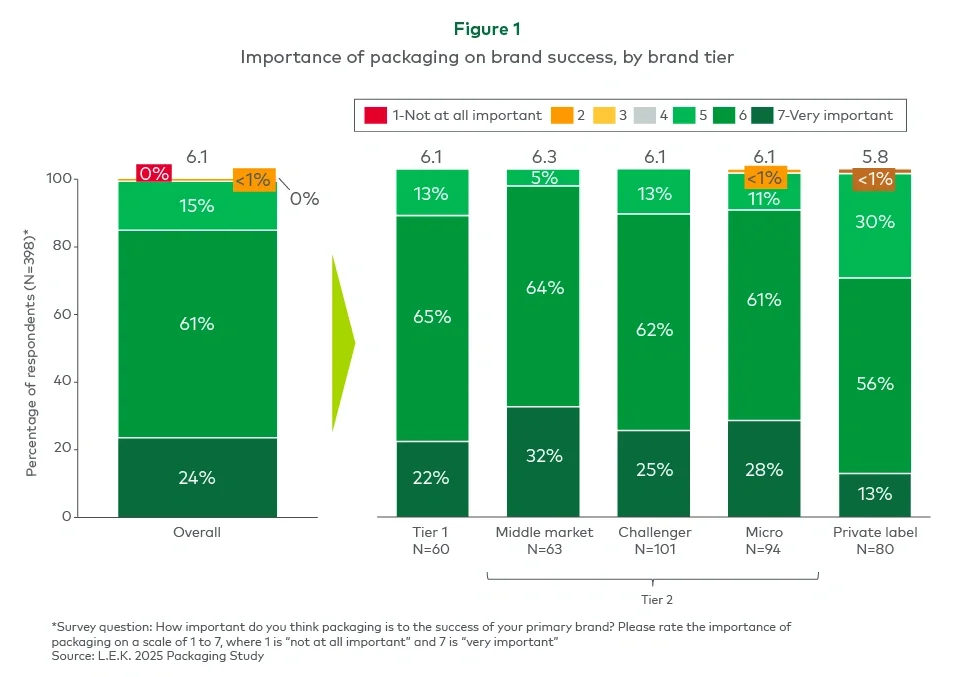
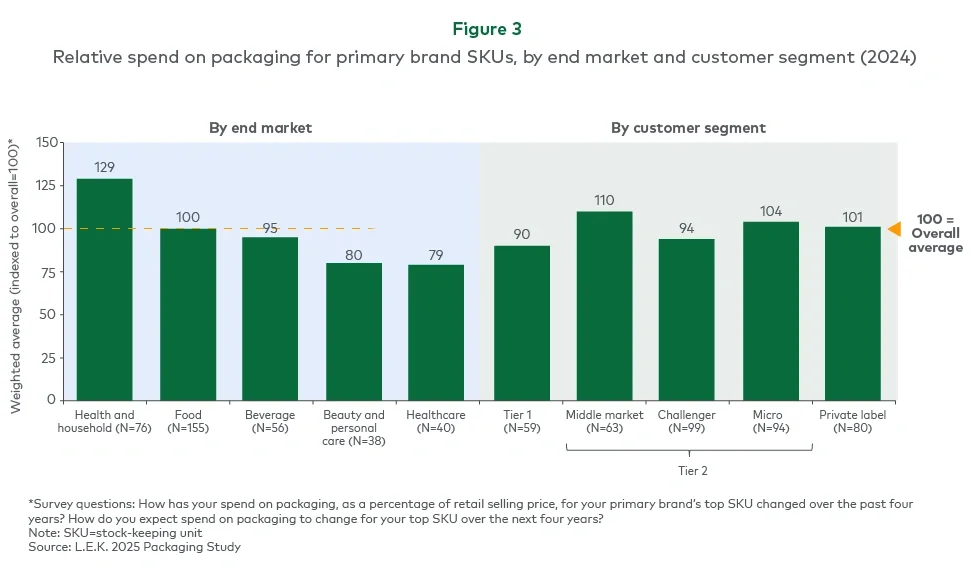
Packaging is viewed by brand owners as critical to a brand’s success, and even more so given headwinds from the current macroeconomic conditions. Middle market and micro brands, in particular, view packaging as integral to their brand positioning and image. Tier 1 brands, meanwhile, tend to spend less on packaging as a percentage of selling price relative to their smaller peers (driven at least partially because of scale economies and buying power), whereas the health and household category spends the most on packaging overall.  

Those are among the findings of L.E.K. Consulting’s seventh annual proprietary U.S. Brand Owner Packaging study. Conducted during the fourth quarter of 2024 and the first quarter of 2025, the study analyzed key issues facing brand managers and packaging stakeholders, from the importance of packaging to brand owners and how they plan to respond to an expected increase in packaging costs in 2025, to how brand owners change packaging to meet sustainability goals and how they are focusing on innovation to drive growth.  

Assessing the results of this latest study of brand owner sentiment can make clear a number of important implications for converters.

Key insights for 2025

With this latest study, we examined a handful of critical issues facing brand owners in 2025 and asked a series of related questions, the answers to which we’ve collected and presented in a series of four distinct articles focusing on these topics:

  • The importance of packaging to brand owners — How important is packaging to a brand’s success? How does relative spend on packaging vary by end market and customer segment?
  • Packaging cost expectations for 2025 — What are brand owners’ expectations for packaging cost changes over the next four years? What actions are brand owners taking in response to increasing packaging costs?
  • Brand owners’ approach to meeting sustainability goals through packaging — How do brand owners define sustainable packaging? How much progress has been made toward meeting sustainability goals, and what primary actions do they expect to take over the next four years to achieve these goals?
  • How brands are leveraging innovation to drive growth — What are brands’ approaches to new stock-keeping unit (SKU) innovation and investment? How are they expected to change going forward? What aspects of product innovation, if any, are driving the introduction of new SKUs?

The importance of packaging to brand owners

As this first article in our four-part series makes clear, despite concerns around challenging macroeconomic conditions, packaging is viewed as critical to the success of a brand, according to our latest study. Nearly all (99%) of our study respondents said they viewed packaging as highly important to brand success, with middle market ($750 million-$2.49 billion in annual revenue) and micro (less than $250 million in annual revenue) brand owners, in particular, emphasizing its relatively higher importance compared with the overall average.  

Also notable is how branded products’ brand owners rated packaging as “very important” at a rate two times higher than private-label brand owners did. Tier 1 brands, meanwhile, tend to spend less on packaging as a percentage of selling price relative to smaller peers (see Figure 1). 

Image
Figure 1. Importance of packaging on brand success, by brand tier
Image
Figure 1. Importance of packaging on brand success, by brand tier

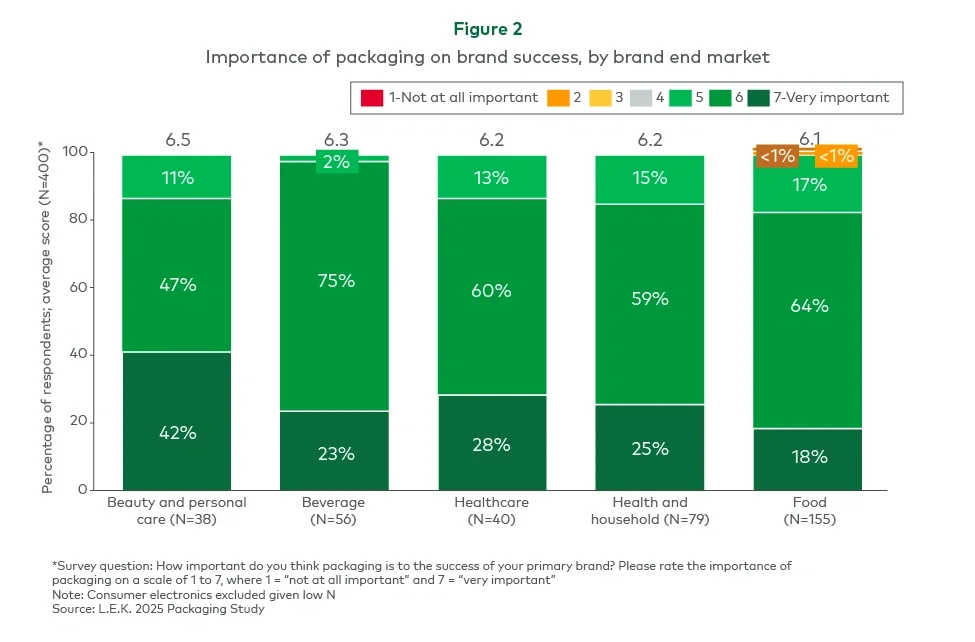
The importance of packaging in brand success is also rated high across end markets, especially in beauty and personal care. But while beauty and personal care brand owners place the greatest importance on packaging, they spend relatively less on packaging as a percentage of retail selling price, given the higher average selling price of their products on an absolute basis relative to other end markets (e.g., health and household, food, beverage) (see Figure 2). 

Image
Figure 2. Importance of packaging on brand success, by brand end market
Image
Figure 2. Importance of packaging on brand success, by brand end market

This creates an opportunity for converters to serve beauty and personal care brand owners with high-value packaging solutions that enable those brand owners to stand out and “win” with end consumers — and in the process, capture higher margins (see Figure 3). 

Image
Figure 3. Relative spend on packaging for primary brand SKUs, by end market and customer segment (2024)
Image
Figure 3. Relative spend on packaging for primary brand SKUs, by end market and customer segment (2024)

To learn more from our four-part series of articles, please see our next summary of study findings, which looks at how brand owners plan to respond to an expected increase in packaging costs in 2025. And don’t miss our overview of how brand owners will continue to change packaging to meet sustainability goals, or how brand owners are focusing on innovation to drive growth.  

About the study

For this seventh annual proprietary study, we surveyed 400 U.S. brand managers and packaging stakeholders to understand their packaging needs and views on trends driving demand.  

As in prior years, the study looks specifically at packaging trends related to spend, the evolution of sustainability in packaging and SKU dynamics, and highlights how perspectives on these topics have changed over the past few years.  

As to survey respondents, we targeted brand managers and other packaging decision-makers at consumer packaged goods companies who were:

  • Responsible for or directly involved in making packaging decisions for a consumer brand
  • Responsible for a consumer brand that is sold in the U.S. but may also be sold into international markets
  • Responsible for a brand within the food and beverage, beauty and personal care, household and wellness, and healthcare end markets

If you would like access to the full results, please contact us.

L.E.K. Consulting is a registered trademark of L.E.K. Consulting LLC. All other products and brands mentioned in this document are properties of their respective owners. © 2025 L.E.K. Consulting LLC

English

The AI Dilemma: Can Society Have Its Code and Compute Too? Do We Need to Go Nuclear?

April 2, 2025

As AI and data scale, so do electricity consumption and carbon emissions. Can nuclear power provide the clean, reliable energy needed to fuel AI’s rise while keeping net zero within reach? Watch Phil Meier at Economist Impact’s 2nd annual Energy Transition Summit for a thought-provoking panel on the intersection of AI, energy and sustainability. 

L.E.K. Consulting is a registered trademark of L.E.K. Consulting LLC. All other products and brands mentioned in this document are properties of their respective owners. © 2025 L.E.K. Consulting LLC
English

Achieving Strategic Clarity in Australia's Software Ecosystem

April 3, 2025

The scalability of software presents limitless growth opportunities for businesses from day one. However, without a clear strategic focus, the sheer number of options can be overwhelming. Gaining strategic clarity allows businesses to prioritize the most impactful growth paths, ensuring sustainable success and the ability to scale globally.

L.E.K. Consulting is a registered trademark of L.E.K. Consulting LLC. All other products and brands mentioned in this document are properties of their respective owners. © 2025 L.E.K. Consulting LLC
English

Creating Value in Software Assets for Private Equity

April 3, 2025

Scaling a software company involves balancing growth strategy, product differentiation, sales and marketing execution, and operational scalability. A clear growth strategy provides clarity on long-term direction, while product differentiation and pricing ensure sustainable monetization.

Strong sales and marketing execution drive customer acquisition and retention, while scalable processes help build long-term efficiency. However, most companies can only optimize one or two areas at a time, making strategic focus critical to sustainable growth and competitive advantage.

Watch the full video to learn how investors and operators can prioritize the right initiatives to maximize value in software assets.

L.E.K. Consulting is a registered trademark of L.E.K. Consulting LLC. All other products and brands mentioned in this document are properties of their respective owners. © 2025 L.E.K. Consulting LLC

English

U.S. Education M&A Landscape: 2024 Roundup and 2025 Outlook

April 4, 2025

While the number of transactions has fluctuated in recent years, North America saw significant growth in transaction value in 2024, outpacing the overall M&A market. Investment in education remained strong, with a rise in mega deals.  

The overall number of deals remained steady, with some recovery in lower-value segments. This recovery is supported by the four-quarter moving transaction value average, which declined from Q4 2021 through Q3 2023, began rising in late 2023, and continued its upward trend in 2024.  

Private equity took a leading role, gaining transaction share from corporate M&A. Corporate training and professional upskilling consistently accounted for the highest share of total transaction volume over the past five years, followed by K-12, higher education and early childhood education (ECE).  

Low interest rates, buyer and seller alignment on value expectations, and strong underlying growth drivers — such as demand for upskilling/reskilling, bridging the K-12 learning gap and the need for higher education to diversity revenue — mark positive shifts for 2025. Investors should watch for policy and regulatory changes, as well as deal fatigue following similar transactions in 2023 and 2024.

Our analysis unpacks the trends shaping education M&A and the strategic priorities investors should consider.

2024 in retrospect: a year of stabilization and selective growth

Private equity dominance

Private equity firms played a leading role in education M&A in 2024, capitalizing on the sector’s recession resilience and technological transformation potential. While corporate buyers remained active, PE investors pursued deals in adjacent sectors such as technology and healthcare, with a strong focus on expanding into education.

The return of larger transactions also stood out. Mega deals over $1 billion spanned K-12, higher education and youth enrichment, underscoring sustained investor appetite for scalable opportunities.

Sector hotspots: K-12, professional upskilling and corporate training

Despite a cautious investment environment, three segments led deal activity:

  • K-12 services continued to attract strong investment, capturing ~37% of disclosed deal value. Digital infrastructure enhancements and personalized learning tools fueled interest in this space.
  • Corporate training and professional upskilling maintained the highest share of total deal volume, as businesses sought scalable solutions to close skill gaps and improve workforce readiness.
  • Higher education saw notable consolidation, with institutions merging to create more financially sustainable models in response to declining enrolment and rising operational costs.

With valuations stabilizing and deal sizes increasing, 2024 set the stage for a more dynamic investment landscape in 2025.

Trends to watch

  1. AI’s expanding role in education. AI is poised to reshape the education sector, particularly in areas such as adaptive learning, personalized instruction and assessment automation. Institutions and businesses will increasingly seek AI-driven solutions to enhance learning outcomes, improve efficiency and optimize student engagement.
  2. Upskilling and workforce readiness. With up to 40% of core workforce skills expected to change by 2027, demand for professional training and certification programs will intensify. M&A activity in this space will focus on scalable, outcome-driven learning models that address employer needs and offer measurable impact.
  3. K-12 well-being and safety investments. Mental health support, student safety and intervention programs will become critical areas of investment. Governments and private investors will prioritize solutions that enhance student well-being, from AI-driven monitoring tools to crisis response platforms.
  4. The evolution of higher education. Mergers among higher education institutions will continue as schools seek scale, operational efficiencies and financial stability. The rise of technology-enabled services, such as online program management and student lifecycle support, will create further M&A opportunities in the sector.
  5. Increasing demand for IT services. With one-time emergency funding depleted, educational institutions are now facing budget constraints, hindering their ability to prioritize and implement effective IT management and cybersecurity.

Navigating the future of education M&A

Education remains a resilient and attractive investment sector, with M&A activity poised to accelerate in 2025. As market conditions evolve, investors will need to align their strategies with the shifting demands of learners, institutions and employers.

For a deeper dive into these trends and their strategic implications, please download our full analysis and get in touch.

L.E.K. Consulting is a registered trademark of L.E.K. Consulting LLC. All other products and brands mentioned in this document are properties of their respective owners. © 2025 L.E.K. Consulting LLC

English

Revitalizing Profitability: A Strategic Supply Chain Transformation for a Premium Kitchen Appliance Manufacturer

March 31, 2025

Background and challenges

Navigating a post-pandemic market, a premium kitchen appliance manufacturer faced decreasing demand, leading to negative EBITDA margin in its largest business unit. The company needed a comprehensive end-to-end supply chain assessment to identify areas to reduce cost of goods sold and improve product margins as part of a holistic go-to-market strategy refresh.  

Approach

L.E.K. Consulting took on the challenge with a two-phase approach to identify and validate cost reduction opportunities and develop a detailed implementation plan to return the company to profitable margins.  

Phase 1: Baseline and opportunity sizing

  • Category spend baseline: Our team leveraged company data to develop a cost baseline to determine the volume and spend across the supplier mix within injection molding, motors, printed circuit board assemblies and other categories
  • Initial opportunity sizing: To prioritize savings opportunities, we evaluated current pricing across the supply base to determine the savings potential from strategic volume allocation and pricing negotiations
  • Opportunity validation: To validate cost savings opportunities, our team executed a request for proposal process with current and potential suppliers, analyzing the optimal supplier mix based on key supplier selection criteria

Phase 2: Category strategy development and implementation planning  

  • Supply landscape assessment: We performed a robust assessment of the supply landscape across each category, including an analysis of market trends and geopolitical factors to inform the category strategies  
  • Future state strategy development: Our team developed multiple category strategies to enable the company to achieve significant material savings, improve supply chain resilience and cultivate strategic partnerships with suppliers  
  • Business impact analysis: Each category strategy included an assessment of the expected profit-and-loss impact
  • Transition planning: Detailed initiative charters were developed as part of a robust transition plan, with action items, timelines, owners, dependencies and risks

Results

The comprehensive supply chain assessment and category strategy development equipped the company with the tools to drive a substantial margin improvement. Key outcomes include:

  • A 10 percentage point (ppt) gross margin improvement: Codified initiatives to be implemented by the company amounted to validated material savings that would enable company to achieve 10 ppt improvement in gross margin
  • Optimized new product development (NPD) process: As a result of the end-to-end supply chain assessment, we also delivered recommendations to optimize the company’s NPD process with a governance structure that facilitates enhanced collaboration between commercial, engineering and operations teams  
  • Roadmap to 20 ppt EBITDA improvement: As part of a holistic go-to-market strategy refresh, our team delivered a roadmap to achieve 20 ppt EBITDA improvement over the course of three years  

For more information, please contact us.

L.E.K. Consulting is a registered trademark of L.E.K. Consulting LLC. All other products and brands mentioned in this document are properties of their respective owners. © 2025 L.E.K. Consulting LLC

English

Global Manufacturing Footprint Rationalization for a Leading Biopharmaceutical Company

March 31, 2025

Background and challenges

A leading biopharmaceutical company engaged L.E.K. Consulting to optimize its global manufacturing network. The client sought to reduce costs while maintaining business continuity and production flexibility so that it could adapt to varying demand. Facing a potential downturn in demand — particularly in a worst-case scenario for several key pipeline products — the company needed a blueprint for network rationalization. This entailed evaluating network configuration options, assessing the financial and strategic implications of potential scale-backs and third-party outsourcing, and weighing various operational risks, including business continuity, supply chain stability and regulatory requirements.  

The biopharma required a strategy that balanced near-term cost savings with longer-term flexibility, ensuring the organization would remain competitive and resilient under changing market conditions.

Approach

  1. Current-state network assessment

    We began by examining the cost burden across the biopharma’s global manufacturing network under a downside demand scenario, establishing a baseline to measure rationalization opportunities. We identified a range of options to reallocate capacity, considering owned and third-party site capacity constraints, regulatory limitations, financial obligations, and capex associated with site capacity expansions. Our approach evaluated average cost per dose across the network under each reallocation option, incorporating the fixed and variable cost profiles of each site.  

  2. Identification of future-state network configurations

    Our team analyzed the economics of internal and third-party sites under the baseline and downside demand scenario volume levels to identify breakpoints where external sites are more attractive than internal sites, including cost of goods sold (COGS), overhead, startup costs and existing financial commitments. We then developed five network configuration options, including divestment of owned site(s) to outsource more volume to third-party contract manufacturing organizations (CMOs) and replacement of higher-cost third-party CMOs with lower-cost blends of insourced production and other CMOs. 

    We evaluated the cumulative three-year cost savings associated with each of the five options relative to the current-state baseline, considering cash impacts in addition to run-rate cost savings (e.g., cash inflow from site divestment). These options provided savings upwards of 7% of total network cost ($80 million), in addition to material cash inflows.

  3. Option evaluation and risk analysis

    We weighted run-rate savings and cash impacts against the critical network risks of each option and the strategic implications of removing network nodes. Divesting owned sites ran increased risk of business continuity interruptions and higher rates of quality issues. However, a greater degree of insourcing would decrease flexibility to scale in higher-volume scenarios and jeopardize key partnerships.  

  4. Recommendations and roadmap

    Based on our findings, we advised a demand-dependent approach. Should the downside scenario not materialize, we recommended preserving the current network and maximizing efficiency through reallocation of capacity. This would enable the biopharma to maintain critical redundancies, avoid network continuity disruptions and maintain control of key manufacturing stages. If the downside demand scenario materialized, we recommended divestment of the highest-cost site to unlock near-term cash flow and materially reduce fixed cost in the network. We also developed a high-level roadmap, identifying triggers for recommended choices and key execution milestones.

Results

Our team provided the biopharma a portfolio of network rationalization options to realize significant cost savings with varying degrees of production outsourcing. The portfolio of options enabled the biopharma to select a future state that best meets anticipated market demand, desired operational flexibility and risk appetite.

  1. Cost reduction

    The biopharma received actionable steps for cutting overhead and production costs, achieving meaningful near-term savings through focused consolidations and reallocation of capacity.

  2. Informed decision-making

    A comprehensive financial model and risk assessment empowered leadership to choose from rationalization strategies and select an option that effectively balanced cost efficiency with network resilience and business continuity.

  3. Financial forecasting and flexibility

    By anticipating multiple demand scenarios, the client can swiftly rebalance capacity across manufacturing activities as needed, safeguarding profitability and maintaining robust supply capabilities.

For more information, please contact us.

L.E.K. Consulting is a registered trademark of L.E.K. Consulting LLC. All other products and brands mentioned in this document are properties of their respective owners. © 2025 L.E.K. Consulting LLC

English

Optimizing Four-Wall DC Operations for a Pharmaceutical Distributor

March 27, 2025

A leading pharmaceutical distributor saw a sharp decline in warehouse productivity after implementing a new Warehouse Management System (WMS). L.E.K. Consulting was engaged to evaluate warehouse performance and identify improvement opportunities. Through a comprehensive, four-facility assessment, L.E.K. uncovered a 17%-34% potential productivity uplift and designed a phased implementation plan to capture the gains and restore sustainable operations.

Challenge:

The company lagged industry benchmarks in warehousing performance, with declining efficiency further driving up labor costs.

New technology investments failed to deliver expected productivity gains, with labor instead increasing to handle operational disruptions.

Management was unclear on where to focus for maximum uplift and sought an outside-in assessment to identify and prioritize 4-wall improvement initiatives.

Approach:

Our team designed a rapid, hands-on 4-wall improvement program to identify operational challenges, develop efficiency uplift solutions and build a playbook for execution:  

  • Performance baselining: Analyzed distribution center operations by assessing key metrics (e.g., pick rates, pick exceptions, labor hours, inventory accuracy) and conducting detailed on-floor observations, interviews and time studies  
  • Root cause analysis and opportunity identification: Identified core issues inhibiting performance (e.g., high congestion in pick aisles), diagnosed root causes (e.g., fast turning items located too close together) and hypothesized improvement opportunities (e.g., revised velocity-based slotting strategy)
  • Solution design and initiative development: Developed set of performance improvement initiatives based on identified issues and organized these into 5 solution themes for rollout to the full distribution network
  • Implementation plan creation: Built a time-phased execution workplan, providing rollout guidance and target completion dates for each initiative  

Results:

This hands-on assessment delivered actionable improvement opportunities that were initiated across the distributor’s network as a comprehensive performance improvement program. Collectively, this program enabled 17% labor reduction or capacity gain in one to two years, with 34% total uplift potential within three to five years.  

Improvement opportunities were organized into five key solution areas:

  • Staffing and labor Deployment: Develop weekly and intra-day labor planning tools to align near-term labor deployment with demand, minimizing idle time and wasted time from job transitions
  • Equipment utilization: Adjust workflows and disseminate best practices for using automated retrieval and storage system to maximize machine utilization and achieve industry standard throughput rates
  • Inventory control and slotting: Establish a consistent standard to track, measure and report inventory health across all facilities (e.g., inventory record defect rate) and right-size locations based on cubic velocity to reduce systematic inventory inaccuracies and eliminate associated productivity loss  
  • Workflow and waving strategy: Utilize waving rules and filtering to right-size waves based on volume, pick type and priority type, level-loading activity across the shift
  • Layout improvement: Minimize narrow aisles for picking and arrange equipment to minimize walk time between functions

We defined 2 to 5 target initiatives within each of these key solution areas, each with corresponding execution guidelines. The improvement program was divided into three phases: the first six months focused on building foundational tools and processes, months 6-24 on gradually rolling out improvement initiatives and months 24+ on aggressively pursuing improvement targets.

Conclusion:

L.E.K.’s 4-wall DC improvement program disrupted the company’s status quo and established a clear path to reverse poor performance trends. If your business is looking to transform your warehousing operations, our Operations and Supply Chain team can help deliver similar impactful results.

Contact us to learn how we can drive sustainable improvements for your organization.

L.E.K. Consulting is a registered trademark of L.E.K. Consulting LLC. All other products and brands mentioned in this document are properties of their respective owners. © 2025 L.E.K. Consulting LLC

English
Subscribe to