Francesco Di Ianni

Are You Getting the Full Picture from Due Diligence?

January 23, 2026

Linking Strategy, Operations and Value Creation

This recording captures key insights from L.E.K. Consulting’s recent webinar on how private equity investors can achieve greater certainty by integrating operational and commercial due diligence.

L.E.K. Consulting Partners Claudio Molinaro, Sébastien Beausoleil, Tom Marshall and Jean-Philippe Grosmaitre share practical perspectives from recent transactions, illustrating how a combined ODD and CDD approach supports clearer investment theses, stronger execution planning and more resilient value-creation strategies.

Watch the recording to learn how to:

  • Link market opportunity with operational reality to strengthen investment decisions
  • Tailor operational diligence to the investment thesis and value-creation agenda
  • Stress-test scalability, timing and execution risk ahead of deal close
  • Use diligence findings to shape post-deal priorities and de-risk growth plans

This webinar is relevant for private equity professionals, portfolio company leaders and corporate development teams seeking a more rigorous, execution-focused approach to due diligence.

Watch the recording now.   

English
Executive Insights

From Discovery to Launch: Building Next-Generation Investment Governance for Biotech

January 13, 2026

Key takeaways

Emerging biopharma companies face a steep escalation in spending and decision complexity as they scale for first launch, with operating costs increasing more than six-fold and investment choices expanding across R&D, CMC, commercial and enabling functions.

Disciplined, enterprise-wide investment governance becomes essential, requiring clear separation of committed vs. incremental spend, consistent frameworks to compare diverse investment types and strategic prioritization to balance near-term launch needs with long-term value creation.

As organizational complexity increases, companies must update their governance model and decision-making processes, clarifying who owns each decision, setting predictable cross-functional meeting cycles, tying funding to clear milestones, creating structured escalation paths and ensuring mid-level leaders are empowered to keep decisions timely as the company grows.

Talent, culture and the full organization must evolve post-launch, combining specialized expertise with preservation of entrepreneurial culture and ensuring a unified understanding of short-term value drivers and capital-allocation pressures so functional decisions reinforce the enterprise’s long-term value story.

Emerging biopharma companies face a dual investment governance challenge as they scale up for first launch. Operating expenditures rise sharply, and the number of investment choices multiplies. These dynamics raise the bar for disciplined investment processes and governance, requiring leaders to separate the baseline from the incremental investment choices, compare options that pay back on different timelines, and make decisions in a timely and disciplined manner.

This edition of L.E.K. Consulting’s Executive Insights offers a practical approach to framing investment trade-offs with concise actions to strengthen the operating model behind investment decisions.

Investment expansion around first launch

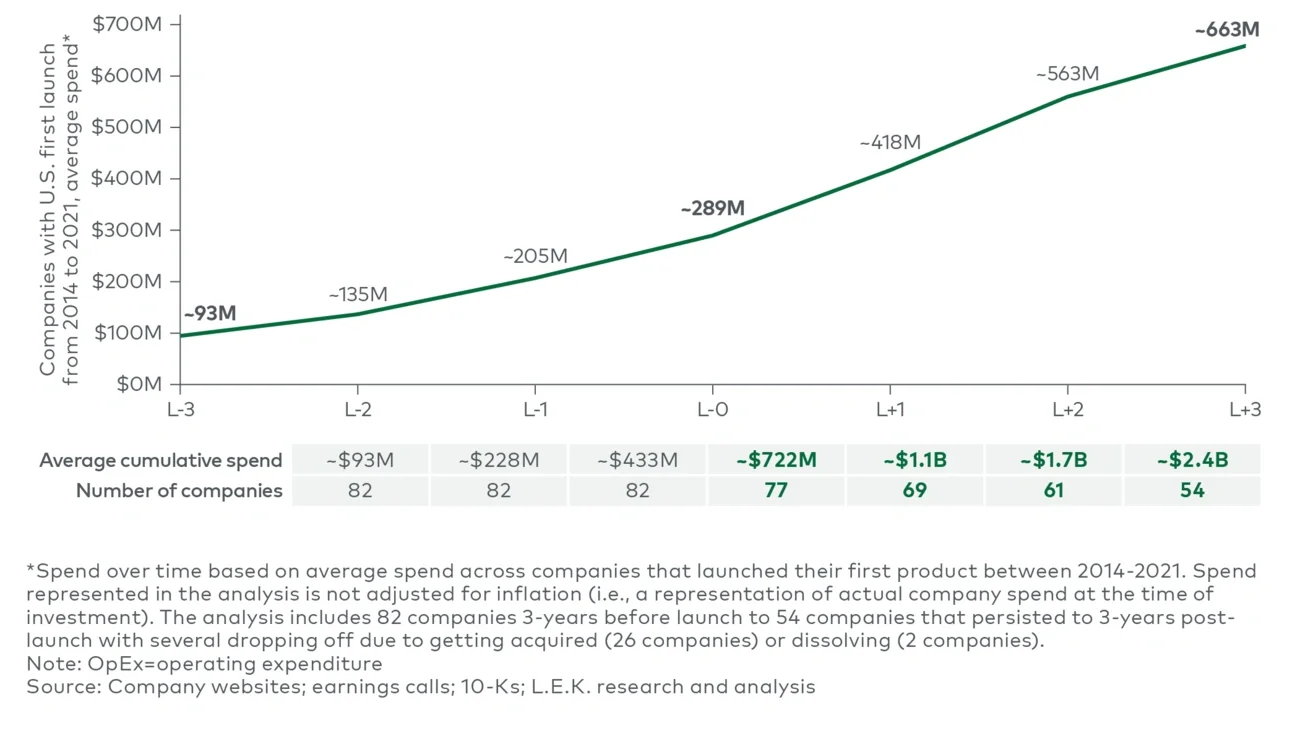
The move from clinical stage to commercial stage represents a profound step change in the scale and complexity of investment. Across roughly 85 biopharma companies that launched their first product in the U.S. between 2014 and 2021, average operating spend rose from about $90 million three years before launch to roughly $650 million to $700 million three years after launch, representing more than a sixfold increase, with approximately $2.4 billion in cumulative spend across that window (see Figure 1).

Figure 1

OpEx spend as emerging biopharmas launch first product

Image
OpEx spend as emerging biopharmas launch first product

Figure 1

OpEx spend as emerging biopharmas launch first product

Image
OpEx spend as emerging biopharmas launch first product

This investment ramp begins well before launch, as organizations conduct late-stage clinical trials, expand chemistry, manufacturing and controls (CMC) capacity, establish commercial infrastructure and build out enabling functions. The spend curve does not flatten after launch: Companies continue to invest heavily in commercialization, life-cycle management and pipeline advancement.

This dramatic escalation in spending underscores the need to strike a careful balance between investing enough to sustain growth and ensure long-term competitiveness while avoiding excessive build-out that erodes economic return. Companies must therefore apply greater discipline in capital allocation and adopt governance structures suited to navigating this trade-off — ensuring that investments are sequenced, right-sized and aligned with a credible path to profitability and shareholder value creation.

Increased decision-making complexity

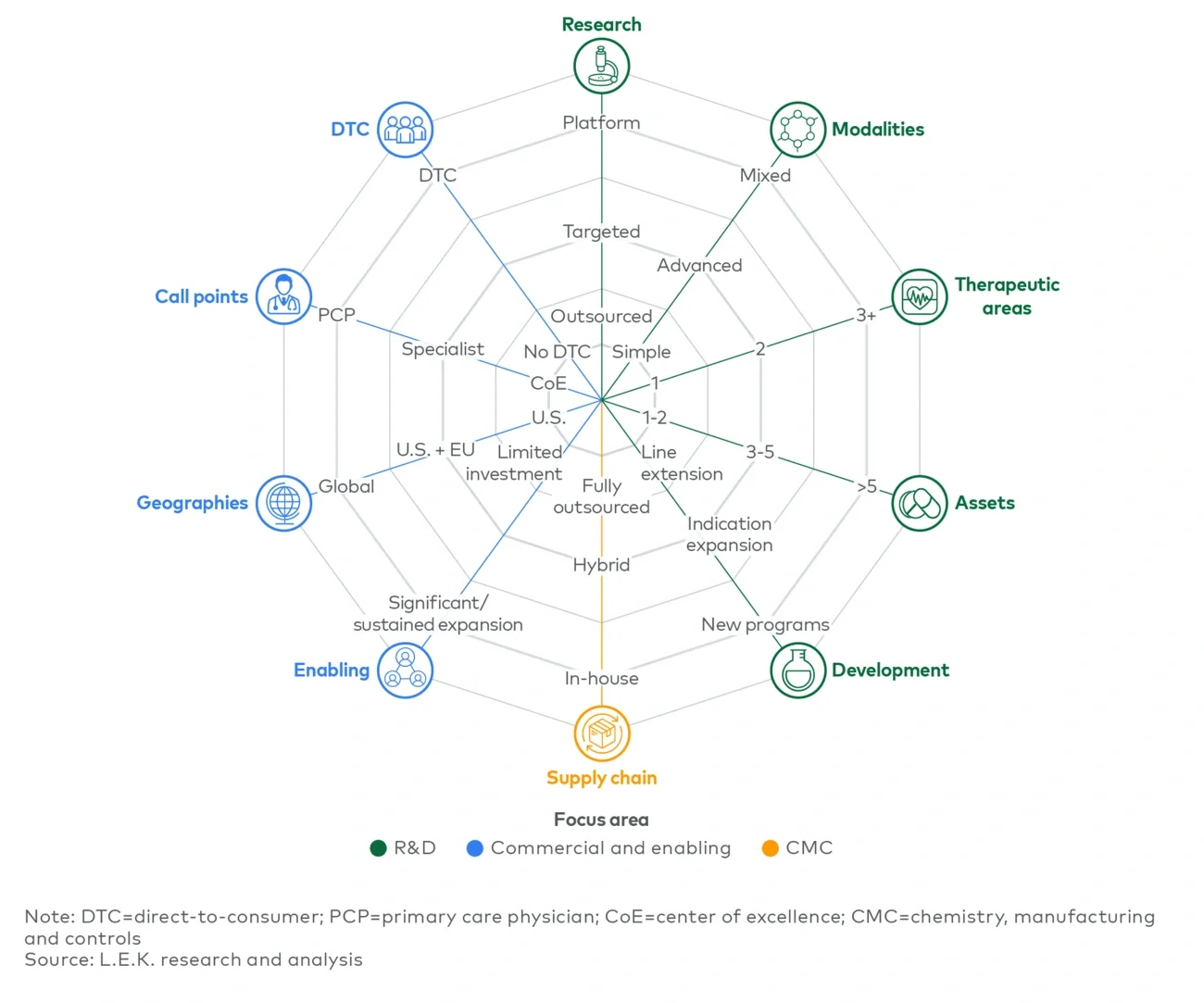
As a company transitions toward commercialization, its investment universe expands exponentially. Several years before launch, most decisions sit squarely within R&D. But as launch nears, the aperture widens, and funding must now be allocated across research, development, CMC, commercial and enabling functions. The complexity multiplies further as emerging biopharma companies layer in new diseases, modalities, geographies, customer segments and supply chain capabilities while preparing for and beginning launch of their first product (see Figure 2).

Figure 2

Vectors of investment decision complexity

Image
Vectors of investment decision complexity

Figure 2

Vectors of investment decision complexity

Image
Vectors of investment decision complexity

Navigating this growing web of choices demands a fundamental mindset shift from a science-centric focus to an enterprisewide, cross-functional approach to investment — a shift that integrates R&D, commercial, and enabling teams through greater operational and strategic complexity.

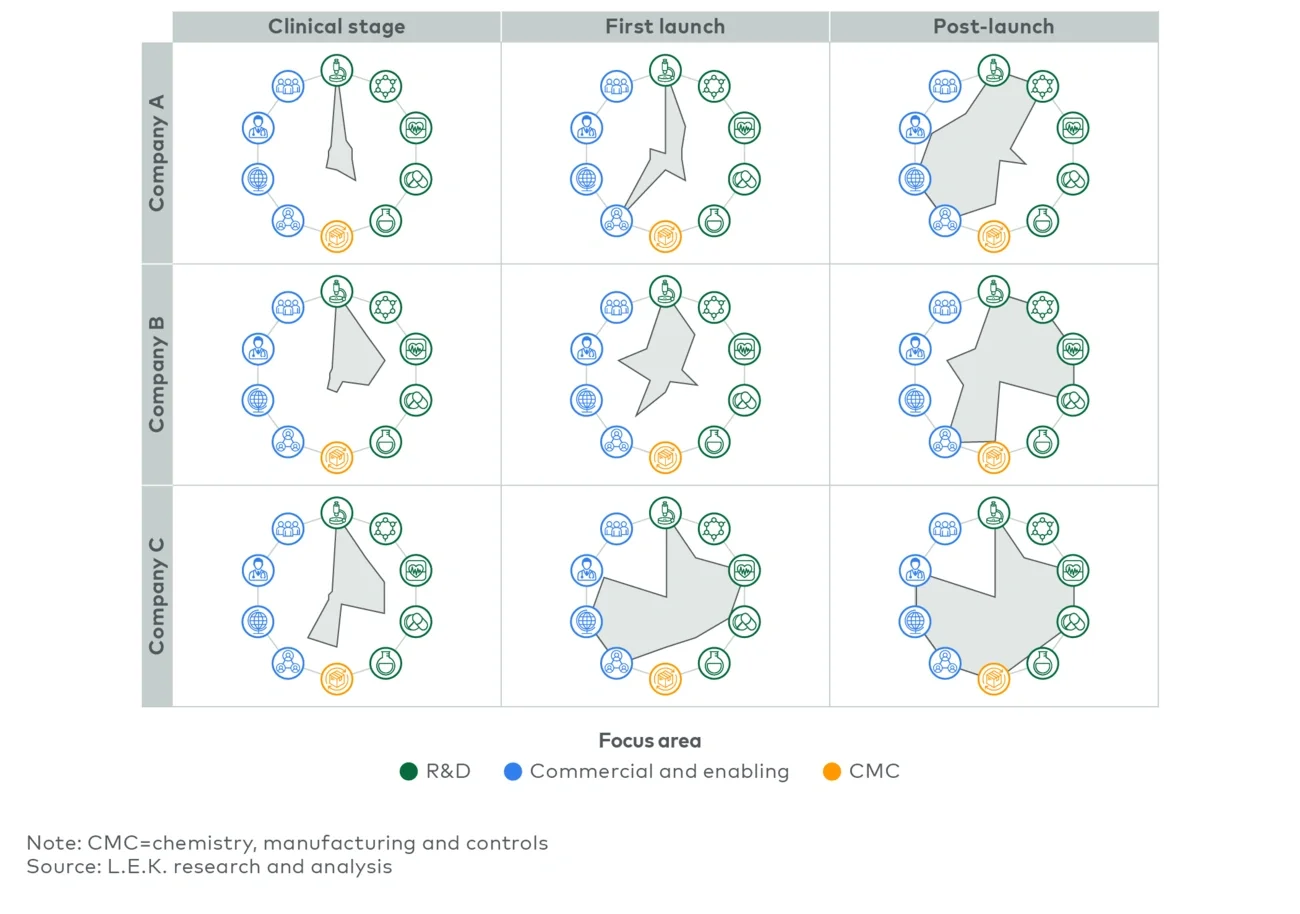
Three examples of U.S. rare-disease first launches illustrate how rapidly investment complexity expands in these companies and how different operating models shape distinct decision paths: Company A leaned heavily into commercial expansion, broadening geographies, call points and patient-finding activities. Company B maintained a focused commercial footprint while doubling down on pipeline growth. Company C invested to drive near-term commercial performance and long-term portfolio value. Despite these differences, all faced a sharp rise in the breadth and complexity of trade-offs at and after launch, as reflected by the expanding area in the spider chart (see Figure 3).

Figure 3

Investment decision complexity evolution

Image
Investment decision complexity evolution

Figure 3

Investment decision complexity evolution

Image
Investment decision complexity evolution

One of the greatest challenges inherent in this increased decision-making complexity lies in managing fundamentally different types of investment decisions, each with distinct evidence bases, payback horizons and strategic implications. Research investments occur a decade or more before revenue materializes and carry high scientific risk, while commercial investments are more de-risked and can deliver immediate topline impact.

The strategic intent also diverges: Commercial spend and CMC spend aim to drive near-term revenue and profitability, whereas research and development fuel long-term sustainability. Building the processes and capabilities to rigorously compare and prioritize across these decision types is essential for emerging biopharmas to sustain shareholder value creation beyond first launch.

Transforming the enterprise model to prosper

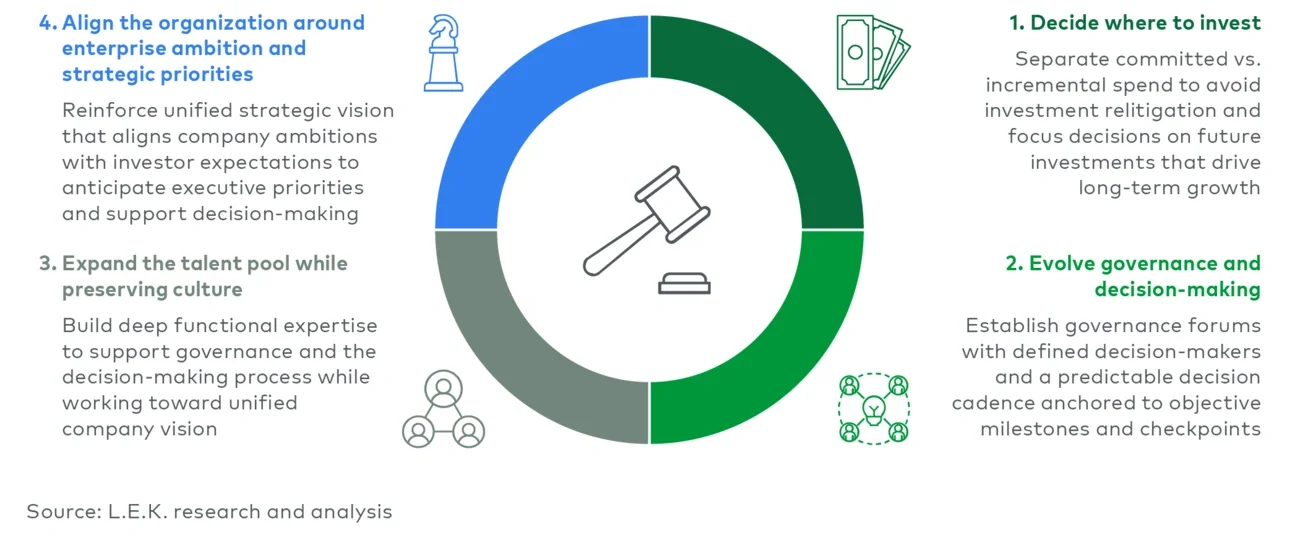
From our experience working with a broad ecosystem of emerging biopharma companies as they navigate the transition from R&D to the commercial stage, we have identified four actions that materially improve investment rigor, organizational effectiveness and enterprise decision-making (see Figure 4).

Figure 4

Key success factors in transforming to a prosperous enterprise model

Image
Key success factors in transforming to a prosperous enterprise model

Figure 4

Key success factors in transforming to a prosperous enterprise model

Image
Key success factors in transforming to a prosperous enterprise model

1. Decide where to invest

As biotech companies approach their first product launch, they must look beyond near-term execution. Investors quickly shift their focus from launch performance to the company’s long-term growth trajectory. Sustaining valuation and evolving the equity story requires a clear strategy for incremental investments that extend value creation beyond the initial launch and establish the foundation for future growth.

Leaders must draw a firm distinction between committed and incremental spending: Committed investments deliver the base plan and maintain essential launch operations. Incremental investments are discretionary and include expansions, accelerations, or upgrades that enhance performance beyond the baseline and create upside value.

A single, transparent inventory of incremental opportunities with defined ownership, objectives, cost, expected value, and timing helps leadership concentrate on meaningful trade-offs and avoid repeated debates about what is “in the base.” As initiatives mature and consistently demonstrate value, they can migrate into the baseline.

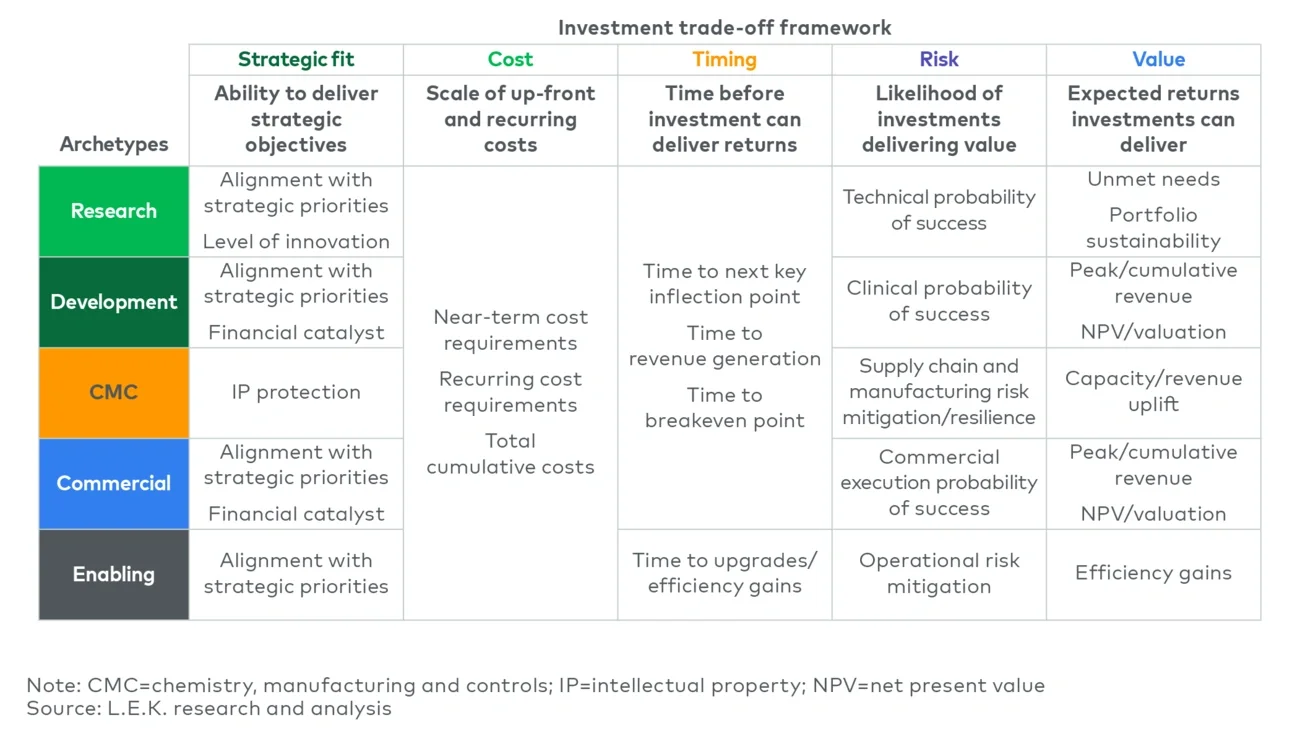
To ensure comparability across functions, all initiatives should be assessed using a unified framework spanning strategic fit, cost, timing, risk and value (see Figure 5). Metrics such as unmet need (in research), probability of success (in development) and peak revenue (in commercial) should be tailored to reflect different investment archetypes. These scores create a shared fact base to inform, not replace, executive judgment and to enable structured, cross-functional debate. The result is disciplined, enterprisewide investment decisions that support both near-term execution and long-term value creation.

Figure 5

Applicability of criteria to investment archetypes

Image
Applicability of criteria to investment archetypes

Figure 5

Applicability of criteria to investment archetypes

Image
Applicability of criteria to investment archetypes

2. Evolve governance and decision-making

As organizations scale and decision complexity intensifies around a first launch, governance must evolve. Decision rights should be explicit so teams understand who proposes, who challenges and who decides. A standing governance forum aligned with the corporate calendar should oversee enterprise, portfolio and functional investments to ensure timely decisions, coordination, and structured escalation to the executive team or board when needed.

A predictable decision cadence that is anchored to the annual plan, a midyear strategic refresh and portfolio checkpoints tied to major readouts help with management of decisions that run on different timelines. Funding should be linked to objective milestones (e.g., completion of investigational new drugs, trial readouts, launch progress, profitability acceleration). Equally important to continually strengthening the next cycle are post-investment reviews that capture what was funded, what happened and what was learned.

As the organization grows, the mid-layer becomes vulnerable: Roles narrow, responsibilities fragment and connection to senior leadership can erode. Clarifying ownership for each critical investment decision and empowering midlevel leaders as active contributors helps prevent this disconnect. While most companies can enhance investment rigor without altering reporting lines, a targeted structural review is prudent to ensure no barriers impede decision quality and to preserve clear pathways for midlevel leaders to access senior governance bodies and escalate issues when needed.

3. Expand the talent pool while preserving culture

The transition from an entrepreneurial R&D environment to a more specialized commercial organization requires shifting to a different talent profile. The early-stage “generalist athlete” who is comfortable wearing multiple hats and navigating ambiguity becomes less scalable as operational complexity increases. To support launch and growth, companies must recruit specialists with deeper functional expertise, often from larger, more structured organizations.

This diversification of talent can introduce risks. New hires may bring a bias toward process over outcomes, consensus-driven decisions, or a focus on building hierarchical teams rather than enabling speed and agility. The right balance blends the adaptability and ownership orientation of the original biotech culture with the functional depth of experienced leaders from scaled organizations. Achieving this balance requires thoughtful selection, structured onboarding and clear expectations about how decisions are made and how work gets executed in scaling the enterprise.

At the center of successful talent expansion is cultural stewardship. The cultural hallmarks seen across many of our biotech clients, such as confidence in the science, resilience through setbacks, openness to risk-taking, adaptability to shifting competitive and capital conditions, and deep patient focus, must not diluteas the company grows. These traits often empowered the company to achieve its first approval. Codifying the principles that define “how we win,” reinforcing them through hiring, development and recognition, and role-modeling them at the top ensure the organizational culture remains a catalyst rather than a casualty of scale. Vertex, for example, grounds its organization in four value principles — commitment to patients, innovation as lifeblood, fearless pursuit of excellence and the primacy of “we” — that guide performance and decision-making across the enterprise.

4. Align the organization around enterprise ambition and strategic priorities

As companies transition from R&D to the commercial stage, execution quality depends on how clearly the organization understands where the company is headed, why it matters and how each function contributes. With growth come specialization and added layers, increasing the risk that teams become siloed or lose connection to the enterprise ambition and goals.
Sustaining alignment requires grounding employees, especially the mid-layer, in the company’s long-term ambition, its strategic priorities and the few critical value drivers that shape its success. Before launch, this alignment forms naturally around the shared goal of first approval. Post-launch, as responsibilities diversify and operating complexity rises, the mid-layer becomes the pivotal conduit that keeps the enterprise narrative alive and ensures day-to-day decisions reinforce (rather than dilute) strategic intent.

Investor expectations should serve as a valuable orienting signal, a way to understand the external factors that shape long-term value creation. These expectations provide a clear lens on what matters most for sustainable growth, including revenue trajectory, expense discipline and the pathway to profitability, and midlevel leaders in particular must understand how they intersect with the company’s strategy. Leaders’ ability to internalize these signals and translate them into enterprise choices helps the organization anticipate executive priorities and supports more consistent, forward-looking decision-making.

Next steps: A brief self-diagnostic

Taken together, these four actions create an enterprise model that scales with spend, complexity and organizational growth. To determine where recalibration will deliver the greatest impact, leadership teams can reflect on the following questions:

Investment discipline. Do we maintain a complete, cross-functional view of both committed and incremental investment opportunities, supported by a unified assessment framework

Comparability and prioritization. Are investment decisions informed by a consistent set of metrics tailored to investment type, enabling transparent trade-offs across functions

Governance and decision rights. Are decision rights (i.e., who proposes, who challenges, who decides) explicit, codified and consistently applied across enterprise, portfolio and functional investments? Do we operate against a predictable corporate planning cadence (e.g., annual plan, midyear refresh, milestone-based checkpoints) that keeps decisions moving

Talent and culture. Have we struck the right balance between early-stage entrepreneurial talent and specialized hires from larger organizations while actively preserving the cultural attributes that drove our initial success?

Enterprise alignment and investor expectations. Do teams across all levels, not just the executive suite, understand the enterprise ambition, strategic roadmap and evolving investor expectations, and how their decisions influence the company’s long-term value drivers?

Midlevel empowerment. Are midlevel leaders sufficiently empowered, connected to enterprise strategy and able to escalate insights and risks to senior governance bodies?

For more information, please contact us.

L.E.K. Consulting is a registered trademark of L.E.K. Consulting LLC. All other products and brands mentioned in this document are properties of their respective owners. © 2026 L.E.K. Consulting LLC.


English

Emerging Opportunities in Dubai’s Higher Education Landscape

January 13, 2026

Dubai’s higher education sector is accelerating its position on the global stage, driven by forward-looking policies, unmatched global connectivity and a strong commitment to academic excellence. These factors continue to make Dubai a preferred destination for students, education operators and international investors alike.

This video from L.E.K. Consulting’s Higher Education Breakfast Briefing in Dubai explores the key enablers shaping the city’s higher education landscape and uncovers emerging opportunities across the ecosystem.

L.E.K. Consulting is a registered trademark of L.E.K. Consulting LLC. All other products and brands mentioned in this document are properties of their respective owners. © 2026 L.E.K. Consulting LLC

English
Executive Insights

From Seats to Calls: Why API Monetization Is the Next Pricing Frontier in the AI Age

January 12, 2026

Key takeaways

Seat-based pricing breaks down under artificial intelligence (AI) workloads, where autonomous agents trigger thousands of application programming interface (API) calls for every task a human performs.

Hybrid and dynamic pricing models are emerging as the most resilient options, aligning cost with value under volatile, agent-driven demand.

Most API costs come from back-end machine activity, with models consuming far more data than they output and billing systems struggling to keep pace.

Pricing innovation is accelerating, with vendors testing outcome-based billing, per-agent licensing and task-level pricing to match machine-scale consumption.

In early 2024, Cursor, a fast-growing AI coding assistant, faced an uncomfortable reality: it was sending 100% of its revenue to Anthropic to cover API costs. Every dollar customers paid went straight to its infrastructure provider. Cursor wasn’t alone. Perplexity burned through 164% of its revenue on cloud and large language model (LLM) costs that same year.

Cursor and Perplexity show how AI workloads are driving exponential API usage, with each query triggering thousands of background calls across models and supporting services. But consider an AI copilot that summarizes deal notes from a customer relationship management system (CRM) or analyzes campaign data from a warehouse. Beneath those activities is another layer of APIs connecting to data sources such as CRMs, data warehouses, communication tools and content platforms — surfacing and moving the live data that powers AI responses, updates records and triggers automated actions.

As agents take over this work, machine-driven usage is outpacing the pricing models built for people. The scale of that shift is staggering, and it’s easiest to see in how AI workloads interact with infrastructure.

The core idea is simple. AI agents generate far more API calls than human users ever could.

A human user might log into a CRM once an hour and pull data. An autonomous agent does the same work hundreds of times faster and without breaks, generating thousands of calls per hour. Traditional seat-based pricing ignores this reality, leaving vendors with models built for people, not machines.

How AI is driving explosive API growth

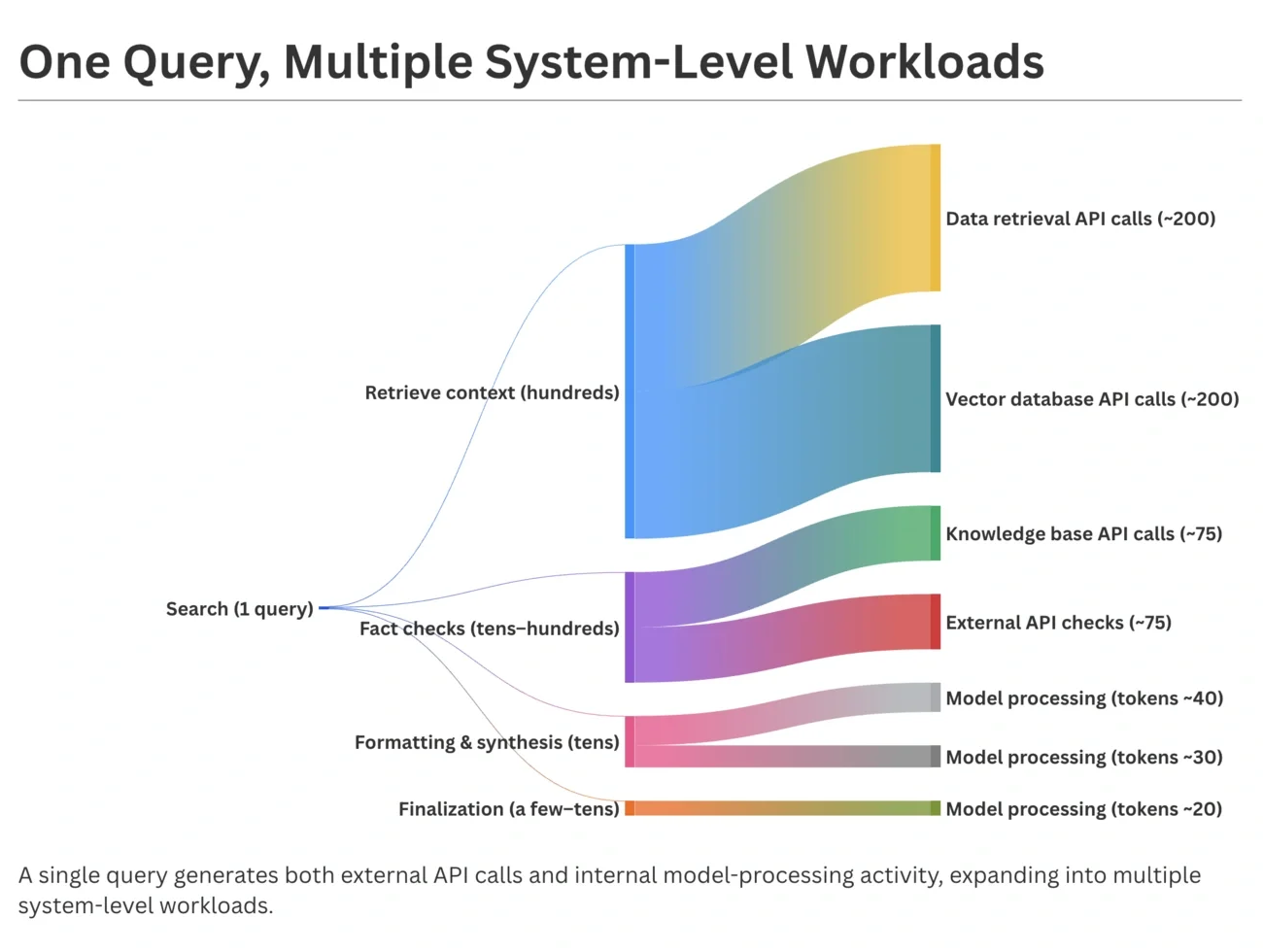
A single query can trigger hundreds or even thousands of API calls to fetch context, check facts, format responses and validate output. Complex workflows multiply this load exponentially, turning thousands of calls into hundreds of thousands per day.

Image

Illustrative breakdown of system workloads generated by one query

Image
Illustrative breakdown of system workloads generated by one query

Image

Illustrative breakdown of system workloads generated by one query

Image
Illustrative breakdown of system workloads generated by one query

This pattern holds across most AI workloads. The visible query is small, but the underlying computation that supports it is large, continuous and costly.

Google revealed at I/O 2025 that it’s processing over 480 trillion tokens monthly, a 50-fold increase from one year earlier. OpenAI's research shows ChatGPT messages grew fivefold between July 2024 and July 2025, reaching 18 billion per week. A single response can require significant retrieval, embedding and model-processing work, meaning most infrastructure cost comes from the underlying computation that models perform rather than the final output they return.

The companies whose APIs fuel AI-driven products now face a choice: monetize usage or subsidize it. Reddit’s 2023 pivot shows the trade-off. After LLMs trained on its data at scale, Reddit began charging $0.24 per 1,000 API calls. Most vendors lack Reddit’s unique data advantage and have less leverage to recover costs.

How pricing is shifting from seats to API calls in SaaS

API-centric pricing represents the next evolution. APIs scale elastically in ways human users never could. Consider a sales team of 20 employees using a CRM system such as HubSpot. Through integrations with finance systems, marketing automation and data warehouses, their CRM generates steady API traffic from routine operations.

Now the company upgrades to add agentic AI capabilities to its HubSpot subscription. These agents can automate customer research, draft personalized outreach emails and update contact records based on prospect behavior. A single agent running these workflows can trigger tens of thousands of additional API calls each day.

Traditional pricing models can’t capture this reality. Seat-based pricing ignores machine consumption entirely, and unmetered APIs expose vendors to runaway costs as AI workloads multiply. The result is a full rethinking of how value is measured and priced.

For a deeper exploration of how consumption-based pricing reshapes unit economics and company valuation, see our analysis on consumption-based pricing models.

How to price APIs in the age of AI agents

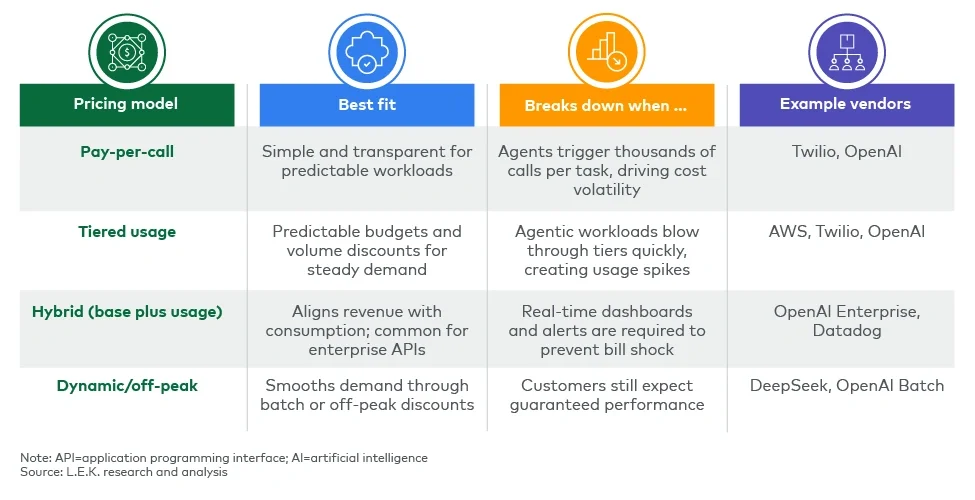
API pricing has moved from an afterthought to a core strategic decision. Most vendors are still experimenting, adapting traditional models to a world where machine-driven consumption dwarfs human activity. Each approach offers benefits and risks when scaled under AI workloads.

Figure 1

API Pricing Models for Vendors Being Accessed by AI Agents

Image
API Pricing Models for Vendors Being Accessed by AI Agents

Figure 1

API Pricing Models for Vendors Being Accessed by AI Agents

Image
API Pricing Models for Vendors Being Accessed by AI Agents

Most vendors evolve across these API pricing models as usage scales — from per-call pricing toward tiered, hybrid or dynamic structures to manage agent-driven variability.

Pay-per-call

Twilio built its business on this model, charging per message or minute. It remains one of the clearest ways to monetize APIs, but it breaks down under AI-scale workloads. A single agent workflow that would take a human five minutes can now generate thousands of automated requests.

Tiered usage

Stripe and AWS offer predictable, volume-based pricing through usage tiers and overage fees. AWS, for example, includes 1 million free API calls per month, which once provided healthy buffers for human-driven workloads. But an AI agent debugging code or researching a customer question can exhaust that free tier in hours.

Hybrid (base + usage)

Hybrid is now the most common model for enterprise APIs. Customers pay a base fee for platform access plus incremental usage charges. This model balances predictability and scalability but introduces complexity. Vendors need real-time dashboards, usage alerts, and soft caps to prevent cost surprises and maintain trust with customers.

Dynamic or off-peak pricing

This emerging method treats API capacity like airline seats: cheaper when idle, more expensive when demand surges. DeepSeek cut off-peak API rates by 75% to smooth traffic spikes, while OpenAI’s Batch API offers similar discounts for non-urgent jobs processed asynchronously.

Levers worth testing as agent traffic grows

As agentic usage grows, vendors are exploring new ways to differentiate between access types:
•    Human vs. agent access pricing
•    Off-peak vs. real-time rates
•    Per-agent identity or license fees
•    Tiered data-class pricing (e.g., compute-intensive or sensitive endpoints)

The next wave of innovation may come from assigning identity or licenses to AI agents themselves, charging per authorized agent rather than per human user. This shift blurs the line between API monetization and digital labor pricing; it will force vendors to decide whether to price by access, usage or even agent seats, and will require them to consider how each approach reshapes value capture.

Why API pricing models are failing under AI workloads

Companies are testing new models, but implementation is exposing critical gaps. The disconnect between how APIs are priced and how they’re consumed has never been wider. Four urgent problems have emerged:
 

  1. The profitability trap is persistent.
    Cursor and Perplexity show how infrastructure costs can swallow revenue. xAI, Elon Musk’s AI startup, reportedly burns about $1 billion a month on infrastructure and operations — proof of how quickly back-end consumption can break even the strongest growth story.
     
  2. Credits confuse customers
    Many vendors defaulted to credit-based systems when launching AI features. As one head of product monetization told Metronome, “Our finance team likes it. Our customers don’t know what a credit does.” Salesforce’s Agentforce combines three pricing methods: per conversation, per lead and credits. Layer in required licenses and API allowances, and customers struggle to forecast total costs.
     
  3. Agentic workloads break assumptions
    An autonomous agent might make 100 API calls or 10,000. Carnegie Mellon research found that AI agents fail on roughly 70% of knowledge-work tasks, and Gartner predicts that more than 40% of agentic AI projects will be canceled by 2027 due to escalating costs.
     
  4. Infrastructure can’t keep up
    Most vendors maintain separate billing stacks for self-serve and enterprise sales. Neither handles dynamic usage well. A customer’s AI agent might burn through a month’s API allocation over a weekend, but billing systems can’t surface that in real time or trigger proactive alerts. Customers often need engineering support just to decode their bills.

Some companies are finding a path forward. Zapier bills for completed tasks rather than raw API calls. Paid.ai raised $33 million to build outcome-based pricing infrastructure. DeepSeek cut off-peak rates by 75% to smooth demand spikes. Companies that tie price directly to customer value are adapting. Those that cling to legacy models face mounting pressure.

We help companies navigate API pricing transformation

Value is shifting from the number of people using a system to the scale of machine-driven activity it supports. API monetization now demands the same strategic attention as product development or go-to-market planning. Getting it right requires balancing technical implementation, customer expectations and unit economics.

L.E.K.’s B2B pricing practice works with software companies to manage these complex pricing shifts. If your organization is grappling with API monetization, agentic workloads or the transition from seat-based to consumption pricing, our team can help you design models that capture value without creating customer friction.

For more information, please contact us

L.E.K. Consulting is a registered trademark of L.E.K. Consulting LLC. All other products and brands mentioned in this document are properties of their respective owners. © 2026 L.E.K. Consulting LLC.

English

What ‘Peak Calorie’ Means for U.S. Food and Beverage Growth

January 12, 2026

What’s the outlook for growth in the U.S. food and beverage (F&B) industry? Sifting through the tea leaves, one sign of the future merits a closer read. Caloric consumption is flattening.

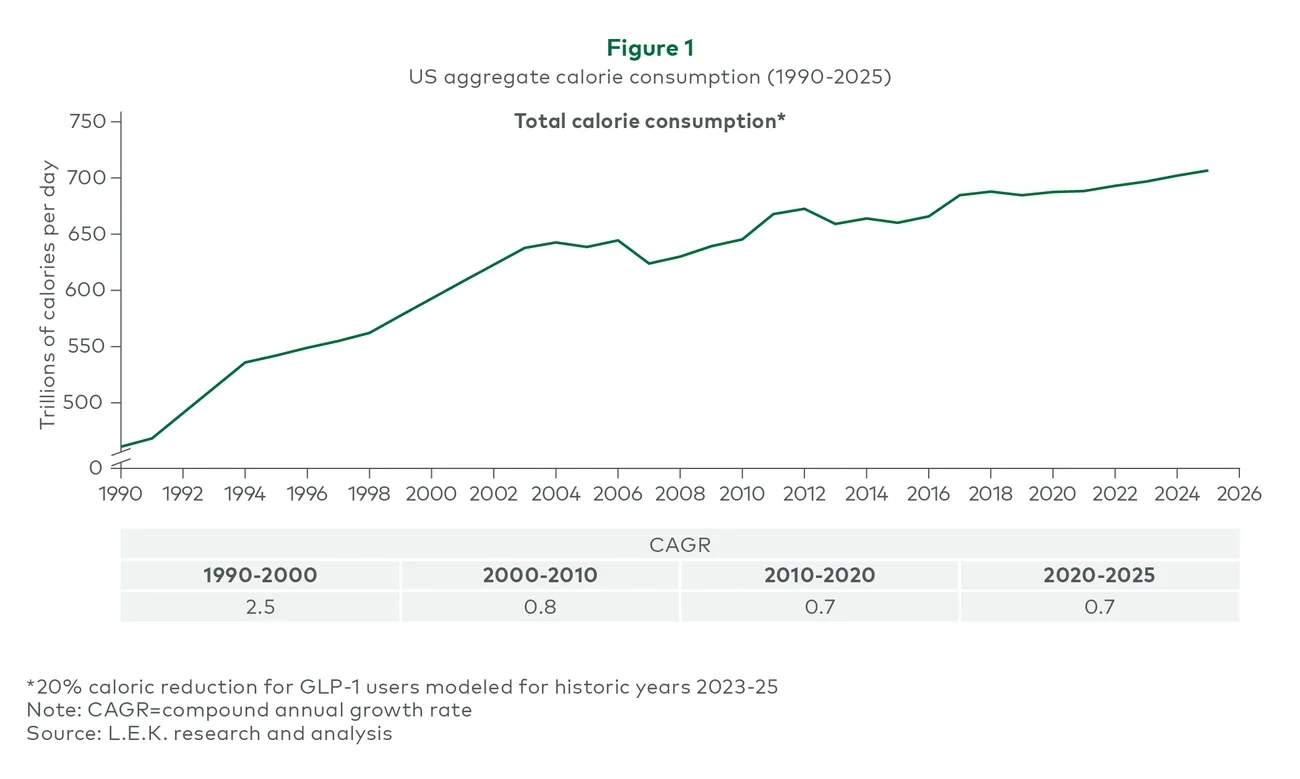
This seems counterintuitive given historical norms. The 1990s saw a steep uptick in caloric consumption due to a confluence of factors, including population growth, increased convenience and an expanding foodservice industry. Although moderating since, annual growth in total calorie consumption has held steady at 0.7% over the past 25 years (see Figure 1). 

Image
U.S. aggregate calorie consumption (1990-2025)
Image
U.S. aggregate calorie consumption (1990-2025)

But a few things have changed recently, and the F&B industry is now facing a “triple whammy” demand headwind. Food consumption growth is driven by per capita and population consumption growth. Per capita consumption is under pressure from the proliferation of appetite-suppressing GLP-1 drugs such as Ozempic, which more than doubled between 2024 and 2025. Population growth is challenged by declining birth rates and immigration changes. Net migration to the U.S. began to decline in 2024 and fell another 66% in 2025. U.S. birth rates have been declining for more than 15 years, with deaths projected to exceed births by 2031 or so, leaving immigration as the only source of population gain.

Growth driver scenarios

Here’s what these trends mean. The growth in total caloric consumption since 2000 has been driven almost entirely by a rising population. On a per-person basis, calorie intake has remained essentially flat.

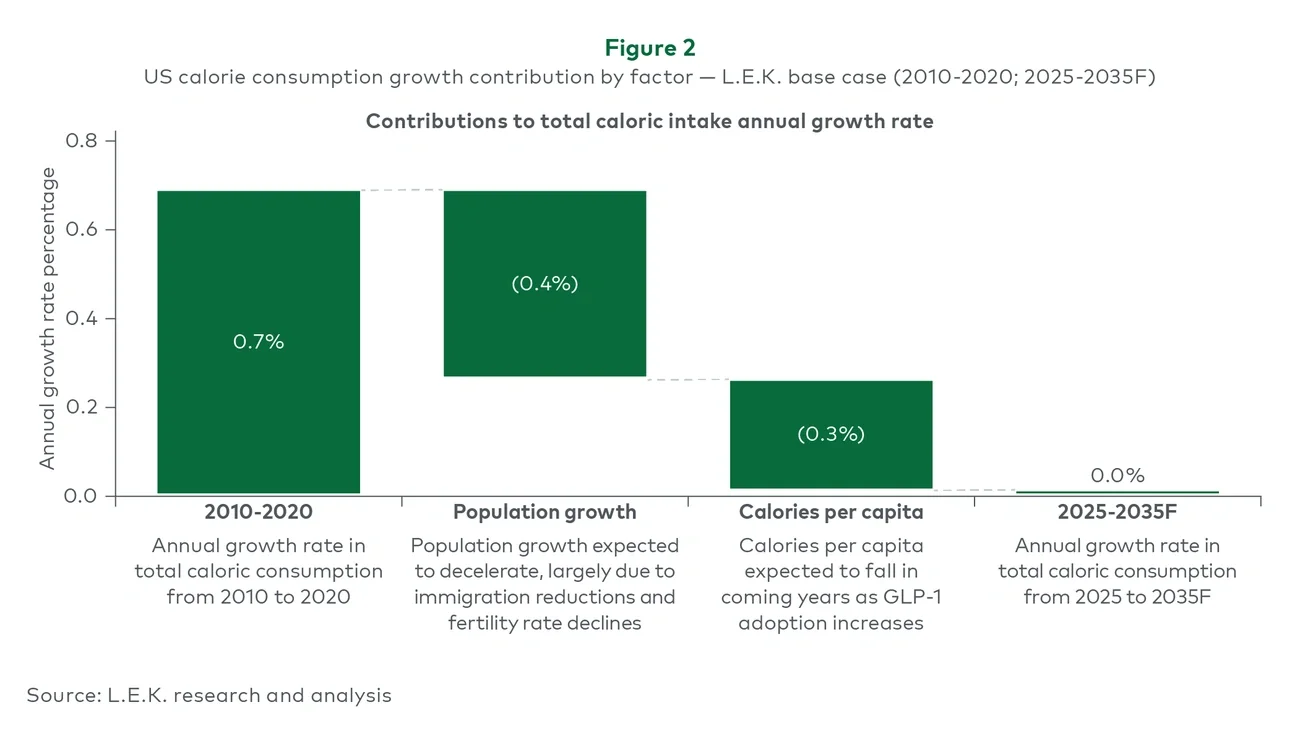
Figure 2 breaks it down. Historically, total caloric consumption has a growth rate of 0.7% per year. Looking ahead, two structural shifts are expected to keep total caloric intake close to flat. First, population growth is projected to slow, driven by declining birth rates and lower immigration. Second, increasing use of GLP-1 medications is expected to reduce the average calories consumed per person.

Importantly, while GLP-1s tend to grab the headlines for the F&B industry, population deceleration is actually expected to be the stronger of the two headwinds. That is, reductions in population growth will contribute more to the projected decline than GLP-1–driven decreases in per capita intake.

Image
U.S. calorie consumption growth contribution by factor — L.E.K. base case (2010-2020; 2025-2035F)
Image
U.S. calorie consumption growth contribution by factor — L.E.K. base case (2010-2020; 2025-2035F)

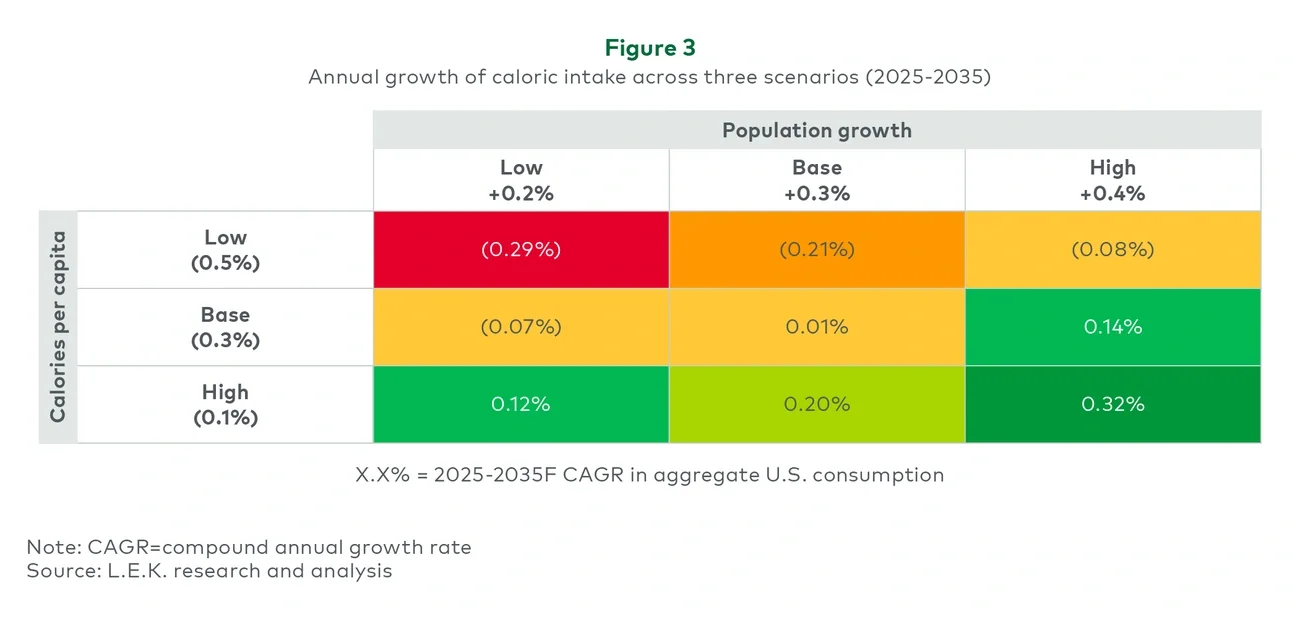
Together, these forces nearly offset past tailwinds, resulting in minimal net growth from 2025 to 2035 across all the scenarios L.E.K Consulting modeled, with annual growth ranging from a slight decline of 0.29% to a modest increase of 0.32%.

In our base case, using the Congressional Budget Office’s (CBO) September 2025 forecast and assuming a 17% GLP-1 penetration, these opposing forces balance almost exactly, producing near-zero growth. We also modeled two variations. The low case imagines less immigration, trimming population growth by 0.1% annually but with higher GLP-1 uptake at 20%, resulting in a small decline. The high case relies on the January 2025 CBO forecast, which projects stronger population growth and assumes lower GLP-1 penetration of 10%, yielding a small increase (see Figure 3).

Image
Annual growth of caloric intake across three scenarios (2025-2035)
Image
Annual growth of caloric intake across three scenarios (2025-2035)

All scenarios point to the same conclusion. Total caloric consumption in the U.S. — and therefore F&B volume growth — is poised to level off over the next decade as demographic trends soften and appetite-reducing medications become more widespread. Said differently, we could soon hit “peak calorie,” and if you apply bearish assumptions, we may have hit the peak already.

Defining future strategies

Peak calorie doesn’t mean individual companies can’t grow. In the absence of steady volume increases, however, competition will heat up. Manufacturers and investors will have to actively differentiate to come out ahead in a market where aggregate demand is no longer rising. Below are a few strategies to consider.

Supply chain optimization

It’s no surprise that in a challenged top-line environment, consumer packaged goods (CPG) are increasingly turning toward solutions to grow the bottom line. In our experience, an effective way to drive profitability goals is to “simplify to grow.” Stamping out complexity across the supply chain has tremendous benefits when “synced up” with commercial priorities. To that end, best-in-class CPG are increasingly interconnecting their commercial and supply chain teams through a repeatable process in lockstep to achieve strategic bottom line goals.

Revenue growth management (RGM) and incrementality

The effectiveness and sophistication of RGM help drive profitable growth with price pack architecture, product pricing/elasticity, trade spend optimization, and product mix and assortment optimization. Price pack architecture drives profitable, incremental growth with surgical innovation on developing product benefits where consumers have a “higher willingness to pay” than the cost to produce — making every unit sold more valuable through RGM. Key RGM levers include refining price pack architecture, improving trade efficiency and managing the product mix to meet consumer preferences and profitability goals.

Drive GLP-1 friendly innovation

Alongside pricing and mix optimization, companies can capture incremental demand by marketing directly to GLP-1 consumer needs. Examples include products that are higher in protein, higher in fiber, more satiating or otherwise tailored to the evolving nutritional profiles of GLP-1 users.

Omnichannel excellence

Another approach is to meet customers and consumers where they are by rethinking the company’s route to market. As buying behaviors continue to evolve, omnichannel distribution will play a growing role in maintaining reach and relevance. Winning with Amazon, Walmart.com and Instacart is critical.

Modernize sleepy categories

Companies can modernize and refresh sleeping or underdeveloped categories using artificial intelligence-data-driven rapid innovation to meet the needs of consumers, retailers and the enterprise. Successful examples — such as Good Culture’s reinvention of cottage cheese and Dots’ breakout success in pretzels — show how thoughtful renovation can unlock meaningful growth even in mature spaces.

Ride the wave of winners

Although the overall “ocean of calories” is flat, there will always be pockets of growth within trend-forward categories and across fast-moving channels. Smaller entrepreneurial companies historically have grown faster than “big food.” While that trend was reversed during the COVID-19 pandemic with the flight to safety, scale, and big brands, our research shows that the share gain of small food brands has returned. Companies will need to sharpen their market-sensing and analytics capabilities to detect where volume is beginning to accelerate across “measured” and “unmeasured” channels, and then act decisively to capture it. This may involve organic initiatives or targeted mergers and acquisitions.

Success in a low-growth environment

U.S. F&B producers have benefited from a decades-long rise in aggregate caloric consumption. Now it looks as though we’ve reached the point where growth in total calories consumed is expected to slow significantly, if not flatten.

This slowdown marks a structural, not cyclical, turning point. Population growth, once the reliable foundation of industry expansion, will no longer drive the same uplift as a combination of reduced immigration and GLP-1 adoption takes hold. Even so, pockets of growth will continue to exist as new products and categories take a share of calories consumed. Future winners will excel through targeted innovation, pricing discipline and adaptive strategy rather than by counting on rising caloric demand.

For more information, please contact us.

L.E.K. Consulting is a registered trademark of L.E.K. Consulting LLC. All other products and brands mentioned in this document are properties of their respective owners. © 2026 L.E.K. Consulting LLC.

English

Unlocking Deal Value: How Operational Due Diligence Shapes a Feasible, High-Impact Value Creation Strategy

January 12, 2026

In this recorded webinar, we explore why linking strategic and operational insights during diligence is essential for healthcare investors seeking robust value creation plans – covering current market pressures, the pitfalls of traditional siloed diligence and the path to a more effective approach. Hear from L.E.K.’s Andre Valente, Tom Marshall, Claudio Molinaro and Sebastien Beausoleil speaking to EHIA’s Deputy Chair Henry Elphick.

L.E.K. Consulting are Strategic Advisor members of the EHIA. This webinar recording is the first of a series of Investing in Healthcare Insights that is available to non-members. Future webinars will be restricted to Members of EHIA and clients of L.E.K. Consulting. Find out more about the benefits of membership of the EHIA on their website.

English

Top Priorities and Strategic Imperatives for US Manufacturers: Aftermarket Capabilities

January 8, 2026

This is the first in a series of articles that analyze key themes from L.E.K. Consulting’s eighth annual U.S. manufacturer survey. It discusses how aftermarket parts and services can be an important lever in driving OEMs’ profitability.

As U.S. manufacturers continue to navigate a challenging macroeconomic environment, executives have identified profitable growth as their most critical priority. One of the best ways to drive margin uplift and profitability is to develop, or expand, aftermarket parts and service capabilities.

An effective aftermarket parts and services offering can provide several strategic benefits to industrial manufacturers across end markets. They include incremental customer touchpoints, elevated margins and reduced reliance on capital goods sales cycles. Meanwhile, a shift toward greater service exposure can help mitigate the impact of an elevated tariff environment. Indeed, with margins in core operations under threat, it is increasingly beneficial for manufacturers to develop an aftermarket offering that diversifies and strengthens revenue sources, all while managing channel partner relationships to reduce potential conflict.

Increased customer engagement and better financials

A manufacturer with an aftermarket offering has incremental ways to engage with their customers. This can be a valuable avenue not only to drive incremental sales of parts or services, but also to identify customer pain points with existing products and, by extension, the potential need for replacement or for entirely new capital goods.

Aftermarket parts and services tend to provide manufacturers with elevated margins, as they can be priced more aggressively because they alleviate costly equipment downtime. They also frequently represent a small portion of operating budgets, which gives aftermarket providers a greater ability to push pricing. And an effective aftermarket organization helps to better balance and de-risk company revenues by shifting the sales mix away from capital expenditures and toward recurring maintenance, repair, and operations or operating expense-driven activities and decision-makers.

With initiatives come challenges

While there are many benefits to expanding aftermarket capabilities, establishing the necessary organizational muscle — or even extending its existing reach — requires managing a host of potential obstacles.

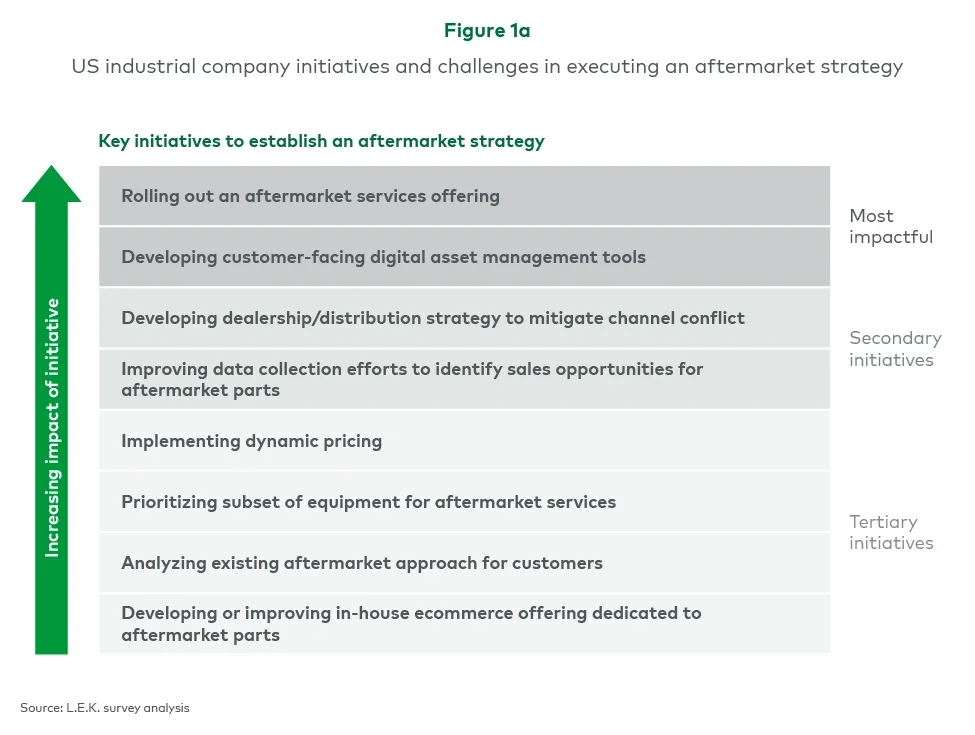
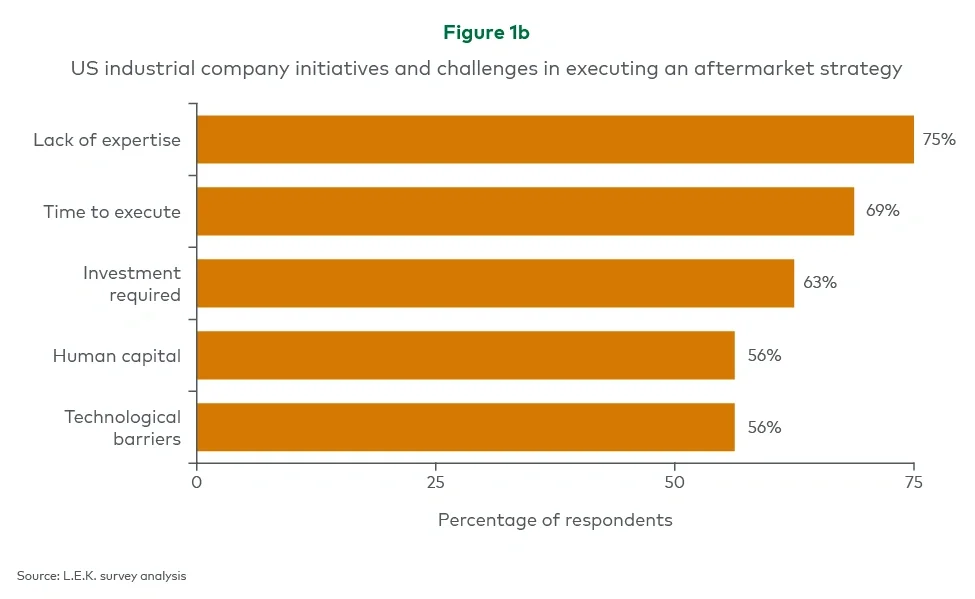
To start, some industrial companies find the expertise required to pursue aftermarket expansion (e.g., pricing strategy, marketing tactics) challenging given the need to balance core business functions with a new add-on service. This is particularly true in today’s environment, where managing tariffs, supply chains and persistent inflation requires a meaningful amount of executive leadership’s attention. Moreover, developing an aftermarket service offering requires investment and time to improve the data collection that will help identify opportunities, and incremental human capital and technology to execute on those opportunities. Add to that channel conflict, which isn’t easy to overcome (see Figures 1a and 1b).

Image
US industrial company initiatives and challenges in executing an aftermarket strategy
Image
US industrial company initiatives and challenges in executing an aftermarket strategy
Image
US industrial company initiatives and challenges in executing an aftermarket strategy
Image
US industrial company initiatives and challenges in executing an aftermarket strategy

A framework for success

L.E.K. has developed a framework to help companies identify and prioritize the right products to use as the foundation for an aftermarket parts and services offering. By successfully determining the strategic value and stand-alone attractiveness of a given opportunity, manufacturers can avoid friction with their existing business models and go-to-market partners. But while the potential returns and margin on aftermarket parts and services organizations are attractive, unlocking them can only be done by way of targeted investment.

To address these potential risk factors and effectively drive the capture of aftermarket opportunities, successful industrial manufacturing companies can pursue several strategic initiatives. They should start at the top with the development of a distinct aftermarket strategy that includes opportunity identification, pricing strategy, and go-to-market efforts. The articulation of a defined strategy and approach is critical to effectively managing existing channel partners and customer relationships in ways that avoid disruption. Once a defined aftermarket objective is in place, companies can look to grow capabilities over time to expand access and customer engagement.

L.E.K.’s Industrial Equipment and Technology practice is optimally suited to help manufacturers at all stages of aftermarket parts and services development, from developing the strategic initiatives necessary to stand up the capability, to helping companies navigate disintermediation dynamics and stakeholder alignment, to partnering with companies with a mature aftermarket service line in identifying incremental revenue or cost savings opportunities. We bring a set of proprietary tools, extensive experience serving the industry and end-to-end implementation capabilities.

For more information, please contact us.

L.E.K. Consulting is a registered trademark of L.E.K. Consulting LLC. All other products and brands mentioned in this document are properties of their respective owners. © 2026 L.E.K. Consulting LLC.

English
Executive Insights

In Pursuit of Prevalent Disease: Where the Next Mega-Blockbusters Will Be Built

January 9, 2026

Key takeaways

Sustaining growth and driving shareholder returns at the scale of today’s large pharma players increasingly requires multiple mega-blockbusters (>$5B in annual revenue). All five large pharma companies that have reached over $300B in market cap are anchored by at least one mega-blockbuster

The obesity experience demonstrates that mass-market diseases can generate outsized franchises when scientific breakthroughs are matched with new evidence, access and commercial models

While specialty markets remain critical engines of innovation, their ability to consistently produce mega-blockbusters may be constrained by mounting competitive, pricing and lifecycle pressures

Capturing these opportunities will require portfolio rebalancing and new capabilities, including outcomes-led evidence strategies, consumer-grade engagement and operations built for scale

Biopharma is entering a period during which the scale of its revenue base and the expectations placed on it by investors are fundamentally reshaping where the industry’s largest value pools will emerge. L.E.K. Consulting’s analysis suggests that the next generation of mega-blockbusters (products with more than $5 billion of peak revenue) will increasingly be found in highly prevalent, chronic diseases rather than in traditional specialty or rare indications.

Three forces underpin this view. First, the world’s largest pharmaceutical companies now operate from revenue bases so large that only outsized assets can materially move the needle on growth and shareholder returns. 

Second, returns in many specialty markets are under pressure from crowding, pricing scrutiny and constrained life-cycle value, while scientific advances are unlocking credible therapeutic innovation in large historically underserved diseases. 

Third, the obesity/GLP-1 market has demonstrated that once-overlooked mass-market conditions can become highly valuable franchises but only when companies pair scientific conviction with new evidence, access and commercial models.

Taken together, these evolving dynamics point to a future landscape where mega-blockbusters will disproportionately emerge from prevalent diseases, and biopharma companies that fail to adapt their portfolios and capabilities accordingly risk structural disadvantage over the next decade.

Why mega-blockbusters are increasingly important

Revenue scale is redefining the growth equation

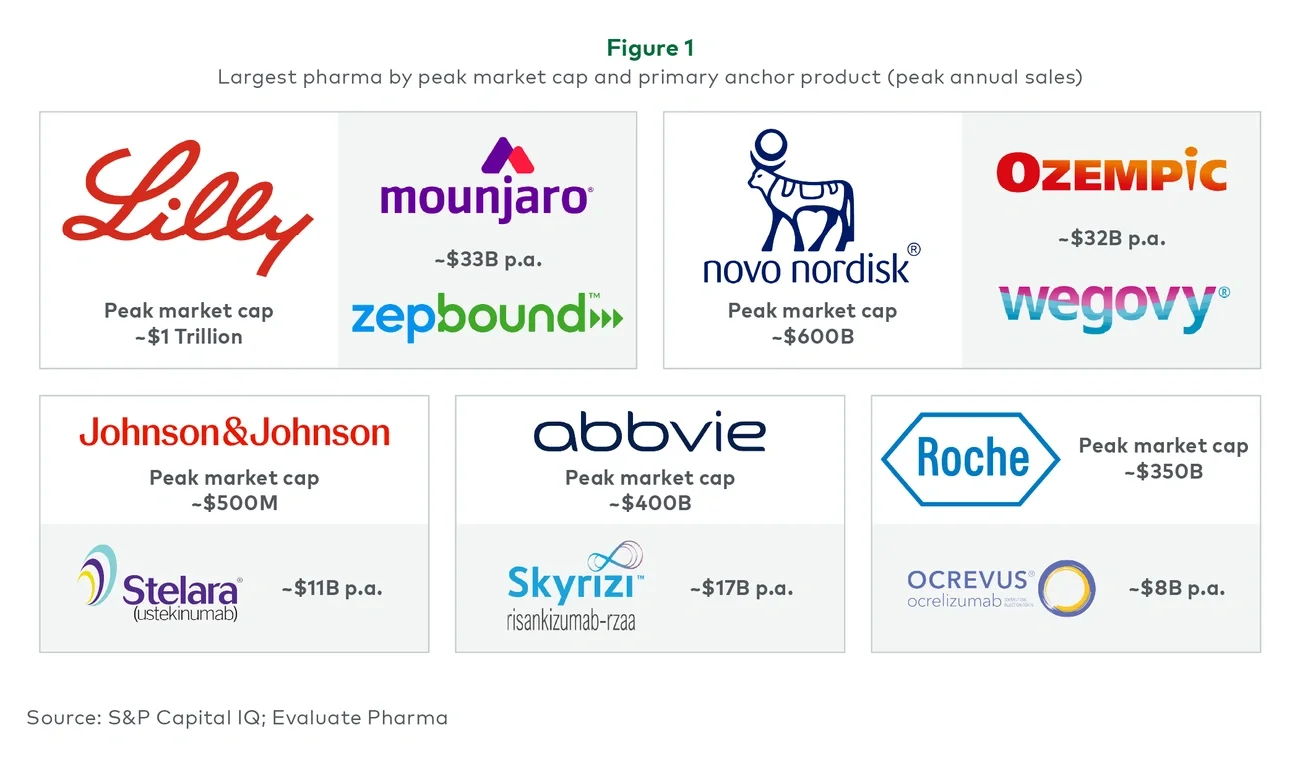
The revenue bases of large pharmaceutical companies have expanded to unprecedented levels. The average top 15 pharma company now generates more than $50 billion in annual revenue. Interestingly, only five pharma companies have reached more than $300 billion in market capitalization and all of them are anchored by at least one mega-blockbuster product (see Figure 1).

Image
Largest pharma by peak market cap and primary anchor product (peak annual sales)

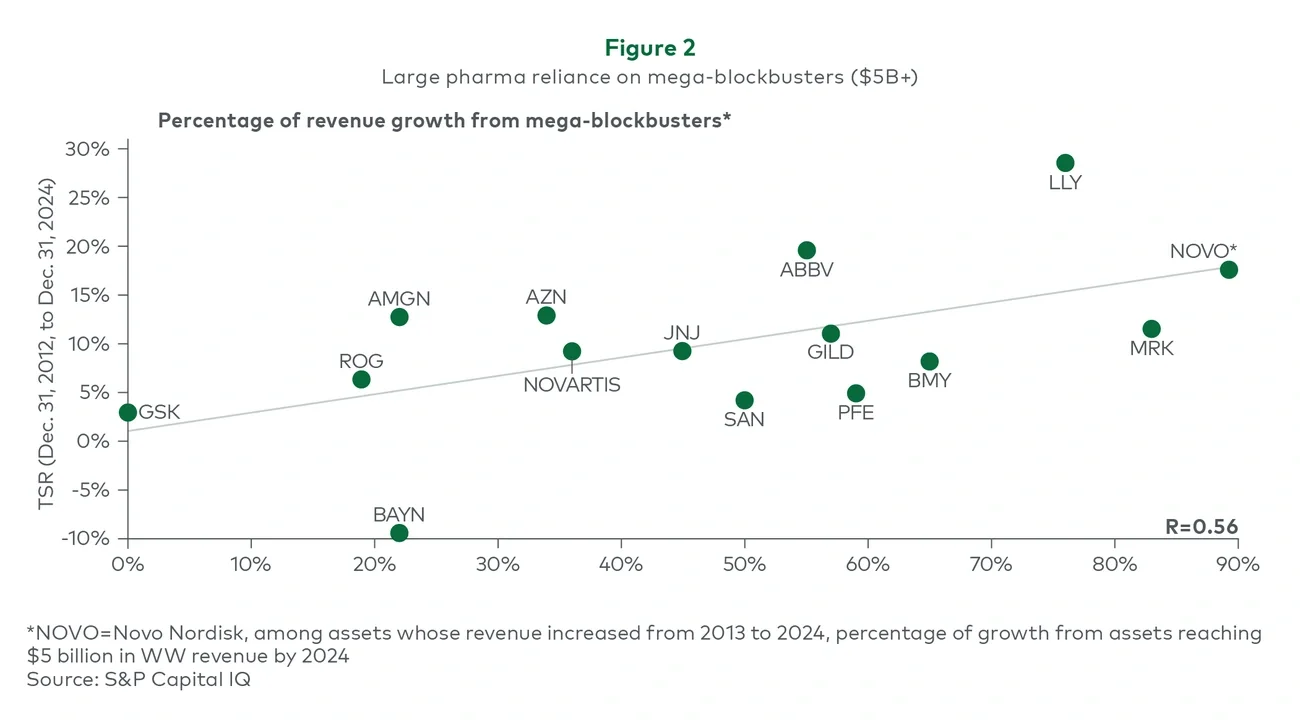
As revenue bases grow, so too does the dependence on outsized assets. Our analysis shows a strong positive relationship between the share of revenue growth driven by $5 billion-plus products and long-term total shareholder return. In practical terms, sustaining even mid-single-digit growth increasingly requires multiple assets capable of scaling to $5 billion or $10 billion-plus in annual sales, a threshold that most specialty and rare indications cannot support (see Figure 2).

Image
Large pharma reliance on mega-blockbusters ($5bn+)

Specialty markets face mounting structural headwinds

Over the past decade, lower-prevalence specialty and rare-disease therapies benefited from favorable pricing dynamics, relatively limited competition and strong payer receptivity to innovation. Today, many of those tailwinds are under pressure. Across oncology, immunology and rare disease, companies now face intensifying competition in crowded categories, growing payer and policy scrutiny, increased patient segmentation, and diminishing life-cycle extension opportunities, particularly in the context of the Inflation Reduction Act, recent most favored nation policy and other pricing pressure. 

While specialty markets remain critical engines of innovation, their ability to consistently produce mega-blockbusters is increasingly constrained. As a result, the industry’s largest growth opportunities are reconcentrating in diseases with large, chronic and expandable patient populations.

The top-selling drug mix is shifting back toward prevalence

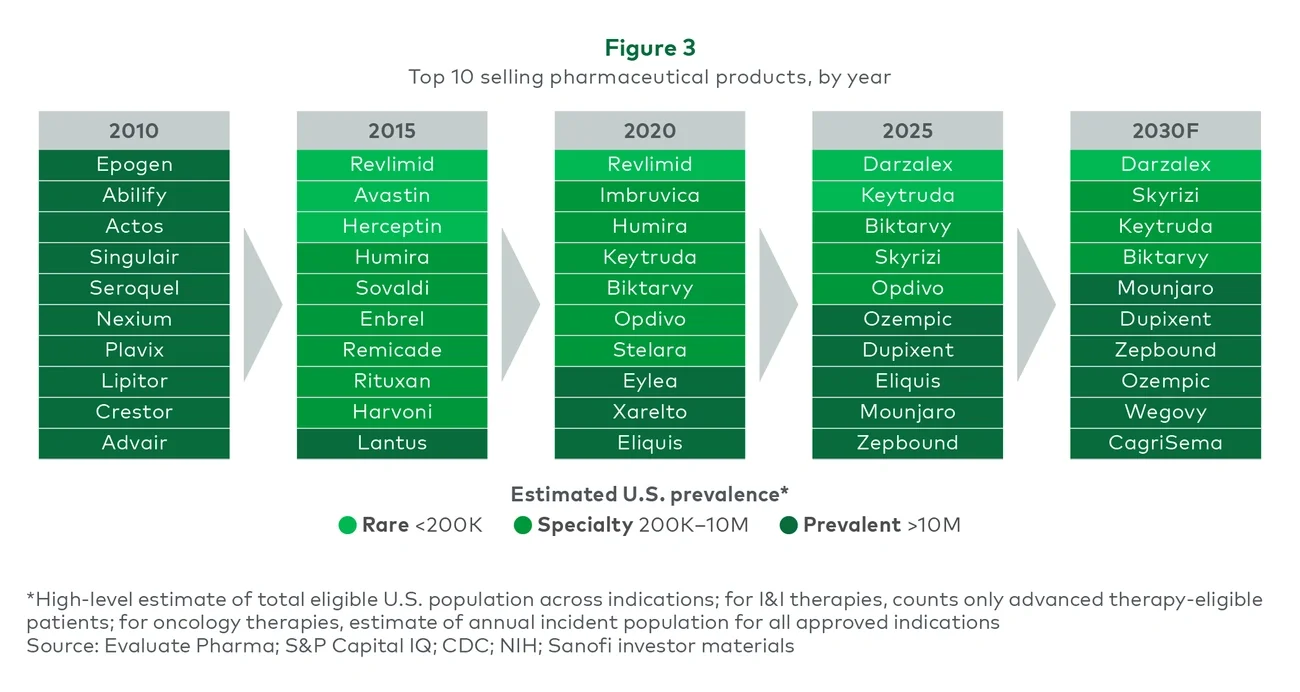
This shift is already visible in the composition of the world’s top-selling therapies. After more than a decade in which specialty and lower-prevalence products dominated the blockbuster rankings, the pendulum is swinging back. 

As seen in Figure 3, by the mid-2020s and increasingly toward 2030, cardiometabolic agents, dermatology biologics and other mass-market therapies account for a growing share of the industry’s largest products, a trend that is expected to continue as we look at pipeline expectations into the mid-2030s.

The message is not that specialty innovation no longer matters, but that the largest absolute value creation is once again occurring in diseases affecting tens of millions of patients.

Image
Top 10 selling pharmaceutical products, by year

Obesity as proof point: How GLP-1s redefined what is possible

Few therapeutic areas illustrate this shift more clearly than obesity.

For decades, obesity was widely viewed as commercially unattractive: Early products suffered from safety and efficacy issues, stigma limited physician adoption and payers resisted reimbursement absent clear outcomes data. These dynamics led many companies to deprioritize the category entirely. 

Yet GLP-1–based therapies fundamentally altered the equation. Step-change improvements in efficacy combined with better safety have fueled patient demand and willingness to pay for these products even in the absence of broad reimbursement. In addition, broader health outcomes data has validated hard clinical benefits beyond weight loss, which is beginning to shift the perception of obesity from a lifestyle market into a medically anchored disease, unlocking the payer coverage required for adoption at scale. 

Beyond redefining obesity’s commercial potential, GLP-1s have accelerated the build-out of direct-to-patient and cash-pay infrastructure that can support opportunities across future high-prevalence disease opportunities. Telehealth initiation, digital patient acquisition and membership-based care models have streamlined an end-to-end “self-service” healthcare platform and normalized consumers paying directly for high-value therapies when coverage is limited. This end-to-end consumer-focused platform has created a commercialization backbone that future high-prevalence products can plug into rather than building it themselves.

The companies that emerged as leaders, notably Novo Nordisk and Eli Lilly, did not succeed overnight. Their advantage was built on decades of investment in incretin science, willingness to fund long and expensive outcomes trials at risk, early commitment to manufacturing scale, and the development of consumer-centric commercial models that complemented traditional physician engagement. 

While there is also a fair bit of serendipity involved, both companies were committed to investing at risk once certain clinical performance thresholds were met, despite some of the remaining pricing, access and distribution challenges.

Obesity demonstrates that prevalent diseases can produce large franchises with transformative value, but only when pharma companies fundamentally reexamine their ability to enter nontraditional spaces that may not be thought of as diseases today (e.g., aging or menopause) and rethink how they discover, develop and commercialize therapies for mass markets.

Where the next mega-blockbusters may emerge

Not every prevalent disease will become the “next obesity.” However, our analysis highlights a set of therapeutic domains that share several defining characteristics: large chronic populations, meaningful residual unmet need, emerging scientific validation, growing consumer engagement and potential to reduce total cost of care. 

Five domains stand out:

  • Cardiometabolic disease (e.g., obesity, type 2 diabetes, MASH, hypertension) combines massive scale with increasing biological tractability and clear links to outcomes and healthcare costs.
  • Neuropsychiatric conditions (e.g., depression, anxiety, substance use disorders, sleep disorders) represent enormous unmet need, with advances in neuroscience and digital tools beginning to unlock new approaches.
  • Consumer-oriented health, wellness and aesthetics (e.g., hair loss, skin health, hormonal optimization) benefit from large patient populations, strong willingness to pay and digital channels, even where payer coverage is limited.
  • Women’s health (e.g., menopause, PCOS, endometriosis) reflects decades of underinvestment, rising advocacy and growing employer and societal focus.
  • Diseases of aging (e.g., mild cognitive impairment, sarcopenia, sensory decline) address expanding populations with high motivation for preventive and quality-of-life interventions.

Each domain presents distinct scientific, access and commercial barriers — but collectively they represent highly plausible sources of future mega-blockbusters.

What it takes to win in prevalent disease

Success in prevalent disease markets requires capabilities that differ meaningfully from those used to win in rare disease and specialty care.

From an R&D perspective, companies must be willing to invest earlier and at greater scale, often funding large long-duration trials and outcomes studies before payer pathways are fully defined. Evidence strategies must anchor value to hard clinical and economic outcomes, not just symptom improvement. Pharma companies must also be willing to consider nontraditional markets that straddle the boundaries of aesthetics, health and wellness, and medical need, but where unmet need and patient willingness to pay are high.

Commercially, mass-market diseases demand consumer-grade engagement models. Seamless end-to-end pathways that leverage new channels, digital acquisition, telehealth platforms, new payment models and simplified distribution will be needed to complement and, in some cases, precede traditional physician-led prescribing. Pricing and access strategies must be designed for sensitivity and scale, often blending reimbursed, employer-based and cash-pay pathways. 

Finally, operations and supply chains must be built — from the outset — with scale in mind. In prevalent disease categories, supply constraints can rapidly become the gating factor that determines leadership.

Strategic implications for biopharma leaders

For leadership teams planning the next decade of growth, some potential implications include:

  • Rebalancing portfolios toward large, chronic diseases where scientific momentum and unmet need can support multibillion-dollar franchises
  • Opening the aperture for investment to include nontraditional areas (e.g., aging) where unmet need and willingness to pay is high
  • Building consumer-centric commercial capabilities alongside traditional medical and sales infrastructure
  • Anchoring evidence strategies to outcomes and cost of care, anticipating payer expectations early
  • Preparing manufacturing and supply chains for mass adoption, not niche uptake
  • Defining clear trigger points that justify disproportionate investment as scientific and commercial risk are retired
     

The next wave of mega-blockbusters will not emerge by accident. They will be built by organizations willing to rethink long-held assumptions about where value can be created, to balance risk-reward trade-offs and to invest accordingly.

Contact us to find out more.

English
Subscribe to