


Executive Insights

Thanks to AI, Consumers Are Arriving at Brand and Retailer Sites Ready to Buy

July 13, 2026

Key takeaways

Thirty percent of U.S. consumers used AI to inform a purchase decision, marking a meaningful shift in how Americans shop.

Among AI adopters, stand-alone AI platforms have overtaken traditional search as the primary starting point for purchase research.

Trust is high among AI adopters: Sixty-six percent believe it provides accurate results, and 85% say it improved their shopping experience overall.

A growing share — more than a quarter — of consumers are arriving at brand and retailer touchpoints with their minds already made up, compressing the window for influence on-site.

Consumers want to feel validated in their purchase decisions. Whether consulting a friend, a salesperson or a search engine, the instinct is the same: Find a trusted source before committing.

Decades ago, the internet expanded that process by giving consumers access to reviews, price comparisons and expert opinions at unprecedented scale, and brands and retailers adapted accordingly. Now, artificial intelligence (AI) is raising the stakes again, but not simply by adding another research tool to the mix.

Unlike search, which surfaces options and leaves the consumer to sort through them, AI delivers a verdict — a short list, or a single recommendation, shaped before the consumer has engaged with any brand directly. For businesses that built their digital presence around capturing attention in that open moment of browsing, this is a different kind of competition, one that plays out upstream. After consulting an AI platform that did the comparing, filtering and short-listing for them, consumers are increasingly arriving at those sites ready to make a purchase.

Brands and retailers need to be ready to cater to consumers who are not just looking but already know what their options are — and just need to decide which of those options to buy.

AI adoption today: Who is using it and who is not

An L.E.K. Consulting survey of 2,650 U.S. consumers conducted in April 2026, cross-referenced against web traffic data from more than 100 brands and retailers across 13 categories, suggests this decision-making shift is already well underway. Stand-alone AI platforms have surpassed traditional search as the primary starting point for purchase research among AI users, a reversal that took just two years. Their impact is widespread, from high-stakes purchases to the everyday, routine decisions that dominate consumer spending. And with AI-referred web traffic growing at a 176% compound annual growth rate while search, social and direct traffic remains flat, the data points to a dynamic that is still in its early stages.

AI use in the purchase funnel is already significant. Approximately 30% of U.S. consumers have used AI tools to inform a purchase decision. And ChatGPT was only made available to the public in November 2022. Among those tools, stand-alone platforms, including ChatGPT, Gemini, Perplexity and Claude, are the most widely used, accounting for 83% of AI-assisted shopping activity. AI within search, such as Google’s AI Overview, is used by 73% of AI-assisted shoppers, and retailer or brand AI assistants, such as Amazon Rufus, by 48%. Many users draw on more than one tool type depending on where they are in the process (see Figure 1).
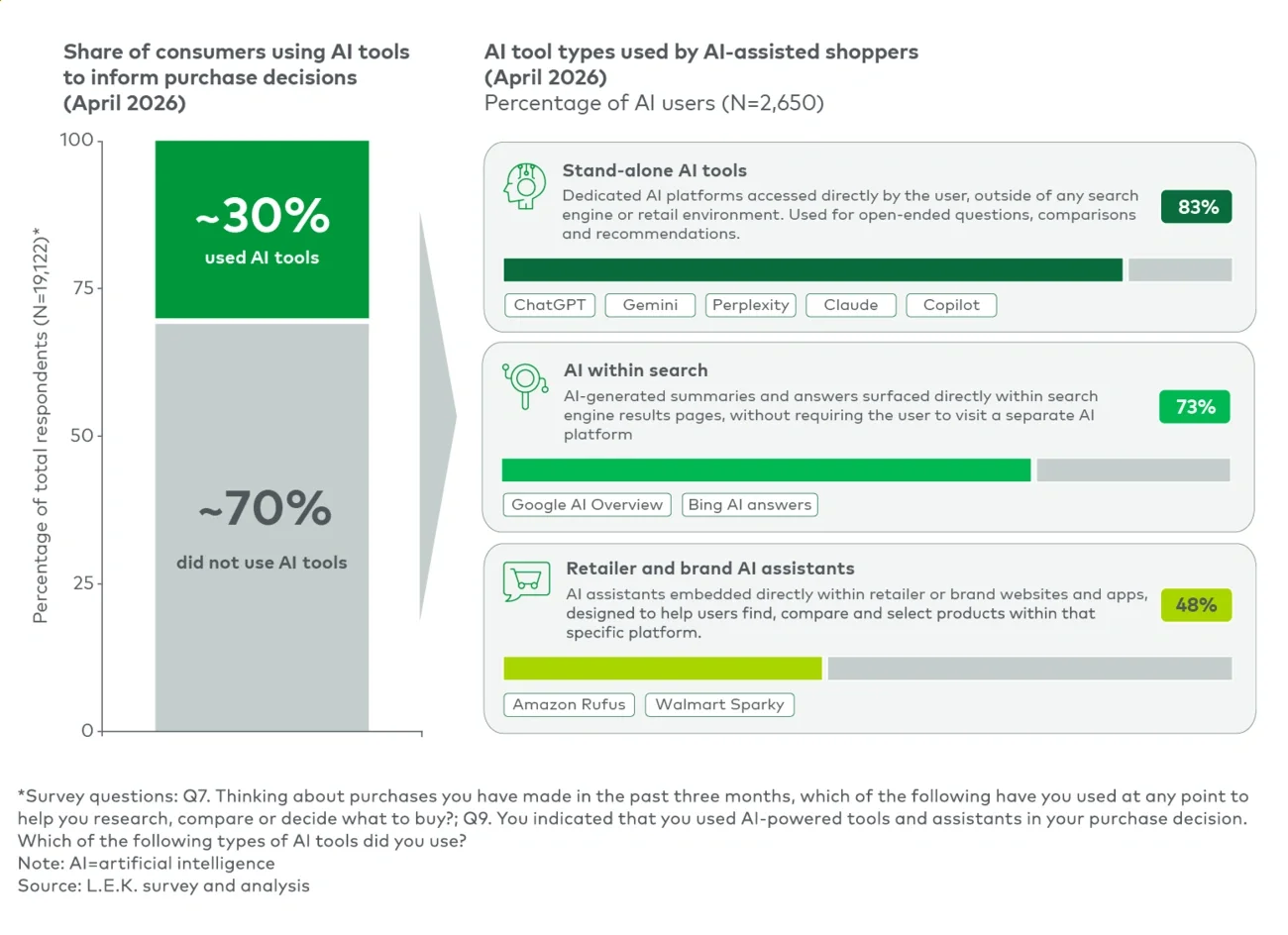
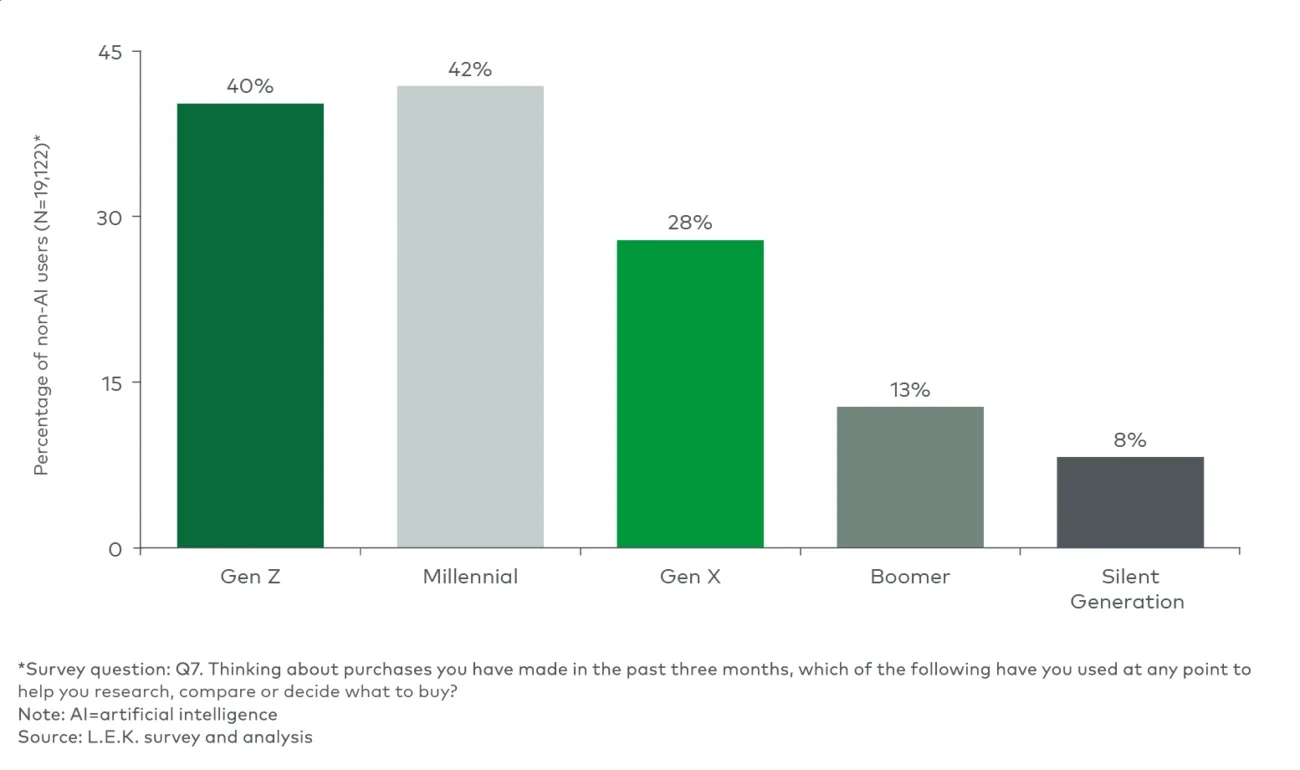
Figure 1: AI tool usage by consumers

Image
AI tool usage by consumers

Figure 1: AI tool usage by consumers

Image
AI tool usage by consumers

Adoption is significant across generations but skews younger: Forty percent of Generation Z and 42% of millennials have used AI for shopping, compared with 28% of Generation X and just 13% of baby boomers (see Figure 2).

Figure 2: Share of consumers using AI tools to inform purchase decisions, by generation (April 2026)

Image
Share of consumers using AI tools to inform purchase decisions, by generation (April 2026)

Figure 2: Share of consumers using AI tools to inform purchase decisions, by generation (April 2026)

Image
Share of consumers using AI tools to inform purchase decisions, by generation (April 2026)

Given that younger cohorts not only represent a growing share of consumer spending but will also account for a larger proportion of purchasing power over the next decade, the current generational skew in adoption is strategically relevant beyond what the headline figure suggests.

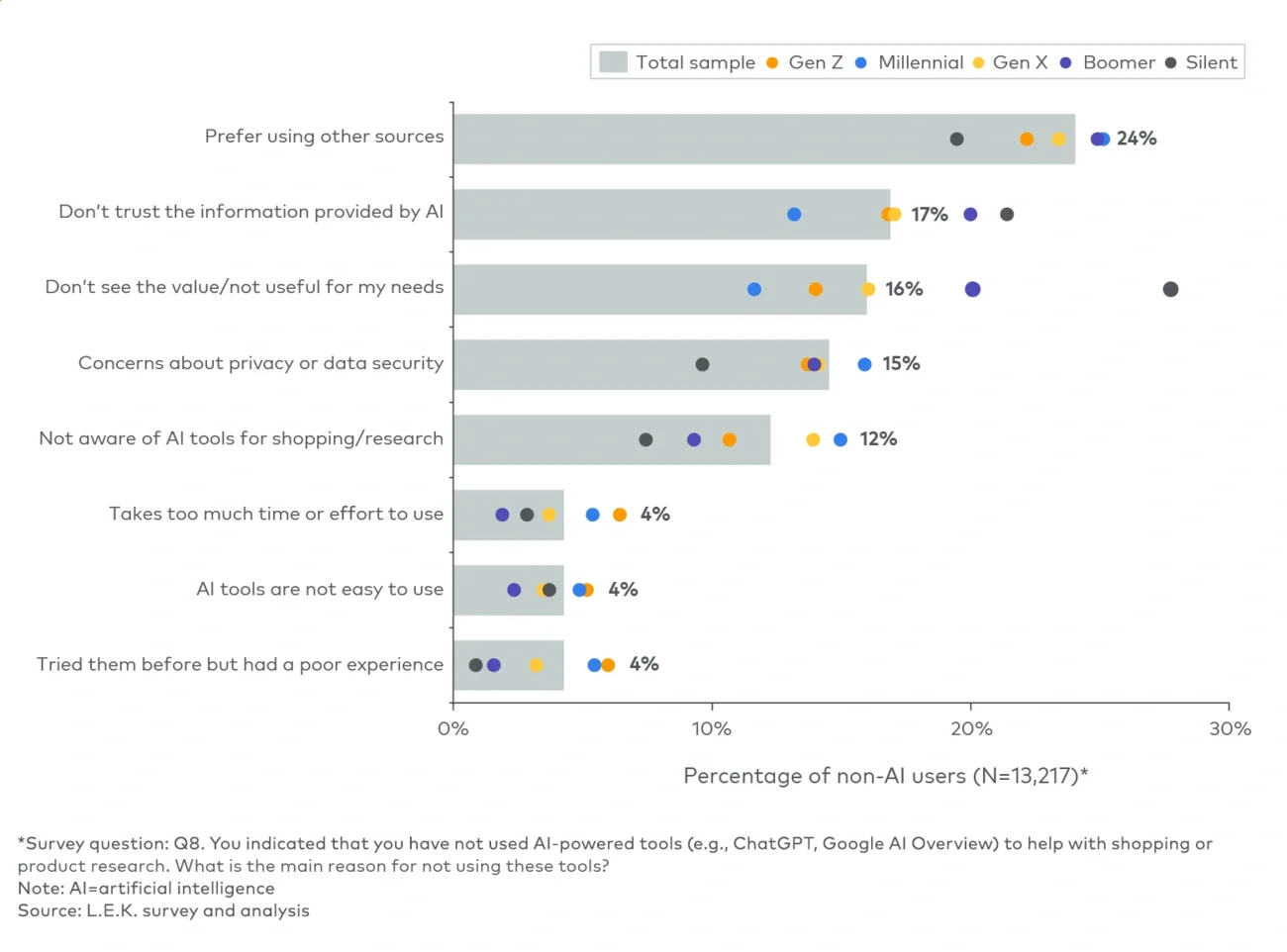
Among the 70% who have not yet adopted AI for shopping, the barriers appear more attitudinal than structural. Preference for familiar sources (24%) and lack of trust (17%) lead the reasons for nonuse, while prior bad experiences rank last, at just 4% (see Figure 3).
 

Figure 3: Primary reasons consumers cite for not using AI tools for shopping research, by generation (April 2026)

Image
Primary reasons consumers cite for not using AI tools for shopping research, by generation (April 2026)

Figure 3: Primary reasons consumers cite for not using AI tools for shopping research, by generation (April 2026)

Image
Primary reasons consumers cite for not using AI tools for shopping research, by generation (April 2026)

Most nonadopters have simply not yet tried these tools, which suggests the ceiling on adoption may be higher than current figures imply.

For AI users, stand-alone platforms have overtaken search as the starting point

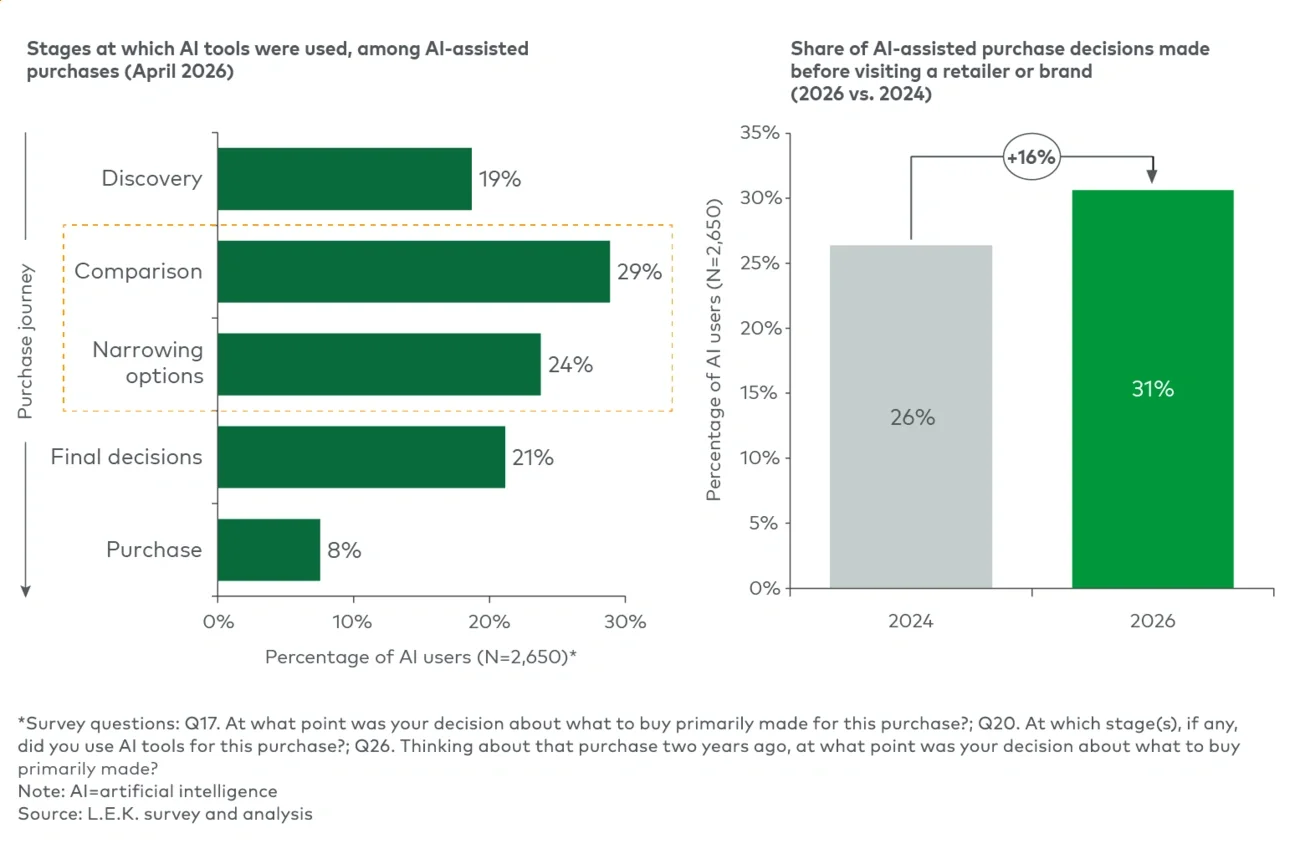
Among current AI users, AI is most commonly leveraged in the middle of the purchase funnel. Comparing options and narrowing down a short list together account for 53% of primary use, ahead of both discovery (19%) and final decision-making (21%).

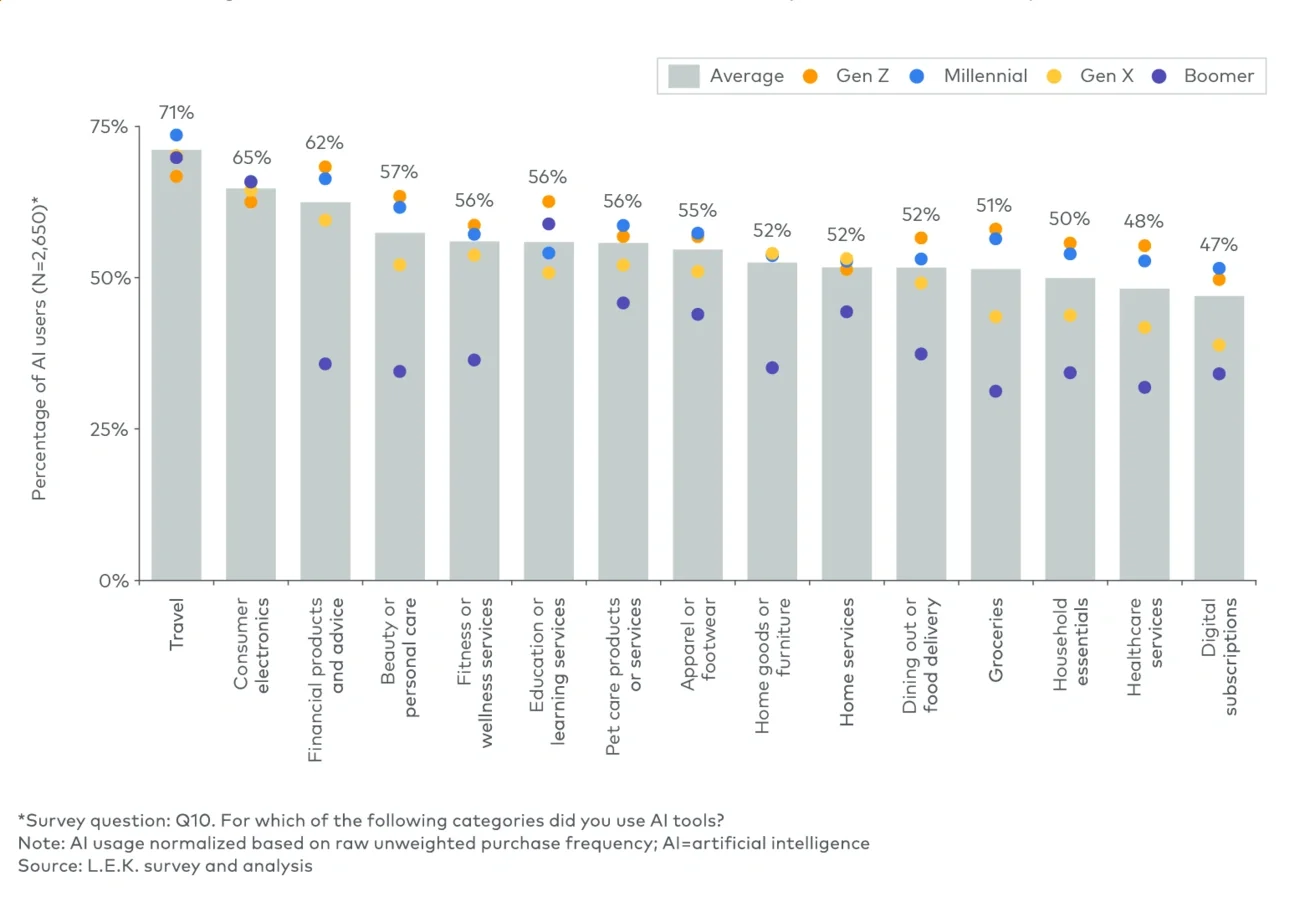
It’s used across a broad range of categories but not uniformly. AI research adoption is highest where the research burden is greatest. Travel (71%), consumer electronics (65%) and financial products (62%) all involve large option sets, meaningful price differences and product complexity that make AI a natural fit for research. In these categories, consumers lean on AI heavily to evaluate options but typically still visit brand and retailer sites to confirm details, check availability and complete the transaction. 

Beyond these considered categories, AI use is widespread across everyday purchases as well. No category tracked falls below 47%, suggesting AI has become a general-purpose research tool rather than one limited to complex or infrequent purchases (see Figure 4).

Figure 4: Categories for which consumers used AI tools to inform purchase decisions (April 2026)

Image
Categories for which consumers used AI tools to inform purchase decisions (April 2026)

Figure 4: Categories for which consumers used AI tools to inform purchase decisions (April 2026)

Image
Categories for which consumers used AI tools to inform purchase decisions (April 2026)

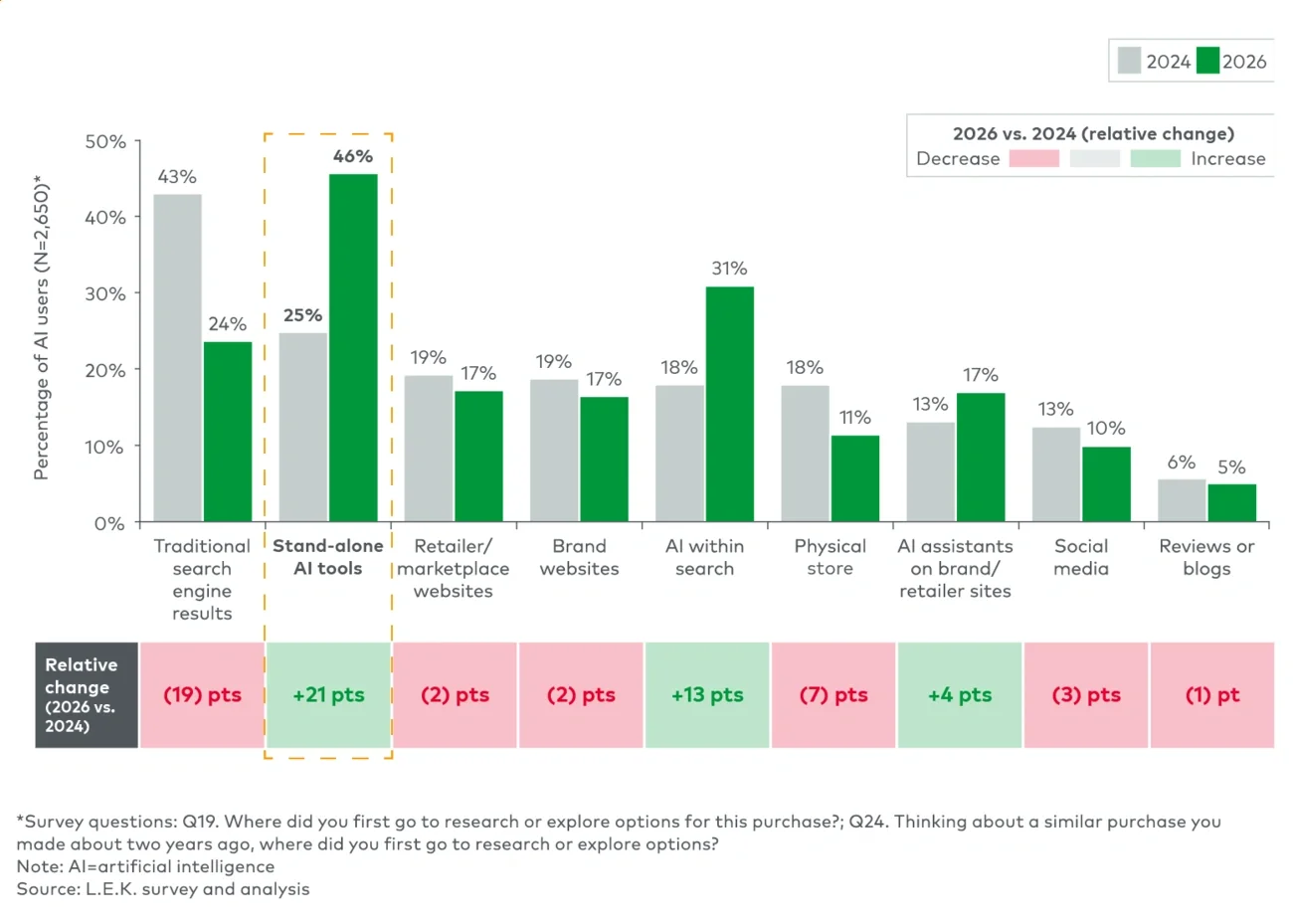
Perhaps the most striking finding is where that research now begins. In 2024, 43% of AI users started their purchase research on a traditional search engine; 25% started on a stand-alone AI platform. By 2026, those figures had nearly inverted. Stand-alone AI now leads at 46% while traditional search has fallen to 24% (see Figure 5).

Figure 5: First source used to research purchase decisions (2026 vs. 2024)

Image
First source used to research purchase decisions (2026 vs. 2024)

Figure 5: First source used to research purchase decisions (2026 vs. 2024)

Image
First source used to research purchase decisions (2026 vs. 2024)

The distinction matters. A search engine returns a list of results, giving every brand an opportunity to compete for a consumer’s attention. A stand-alone AI platform returns a synthesized recommendation or short list, shaped before the consumer has visited a single brand or retailer directly. For companies that have spent years optimizing their search presence, this is a meaningfully different competitive environment.

Consumers are arriving at brands and retailers with more-formed views

Because AI is being used primarily at the comparison and narrowing stages of the purchase process, a growing share of consumers are arriving at brand and retailer touchpoints having already done much of their research. Thirty-one percent of AI users report their purchase decision was largely made before they reached a brand or retailer site, up from 26% two years ago. In other words, by the time these consumers show up, they are less likely to be open to discovery and more likely to be looking to confirm a choice they have, for the most part, already made (see Figure 6).

Figure 6: AI-assisted purchases, by journey stage

Image
AI-assisted purchases, by journey stage

Figure 6: AI-assisted purchases, by journey stage

Image
AI-assisted purchases, by journey stage

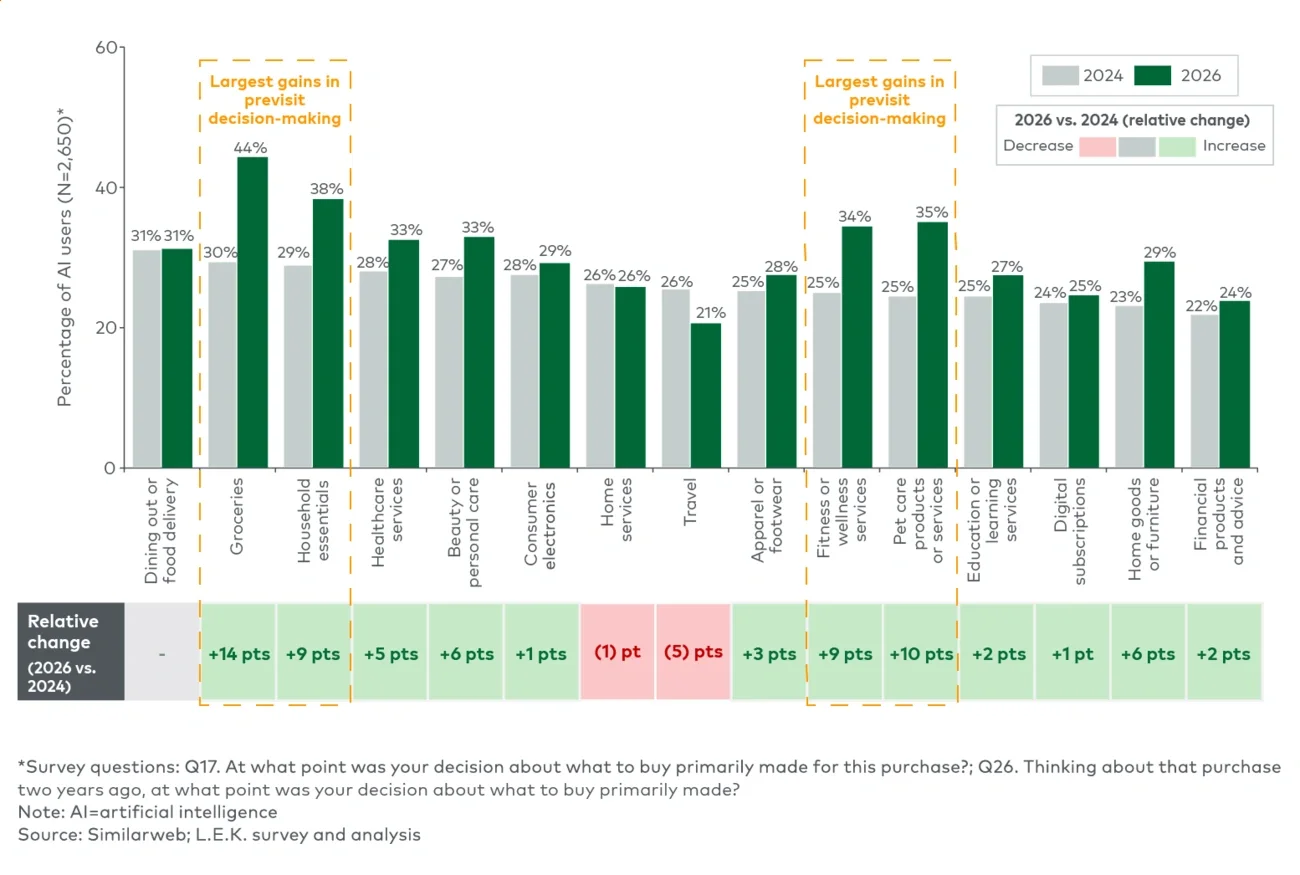
This pattern is most pronounced in everyday replenishment categories. Groceries, household essentials and pet care have seen the largest gains in previsit decision-making over the past two years. AI research adoption is also high in considered categories like travel and consumer electronics, but those consumers more often arrive still open to on-site confirmation of pricing, availability and product details (see Figure 7).

Figure 7: Share of AI-assisted purchase decisions made before visiting a retailer or brand, by category (2026 vs. 2024)

Image
Share of AI-assisted purchase decisions made before visiting a retailer or brand, by category (2026 vs. 2024)

Figure 7: Share of AI-assisted purchase decisions made before visiting a retailer or brand, by category (2026 vs. 2024)

Image
Share of AI-assisted purchase decisions made before visiting a retailer or brand, by category (2026 vs. 2024)

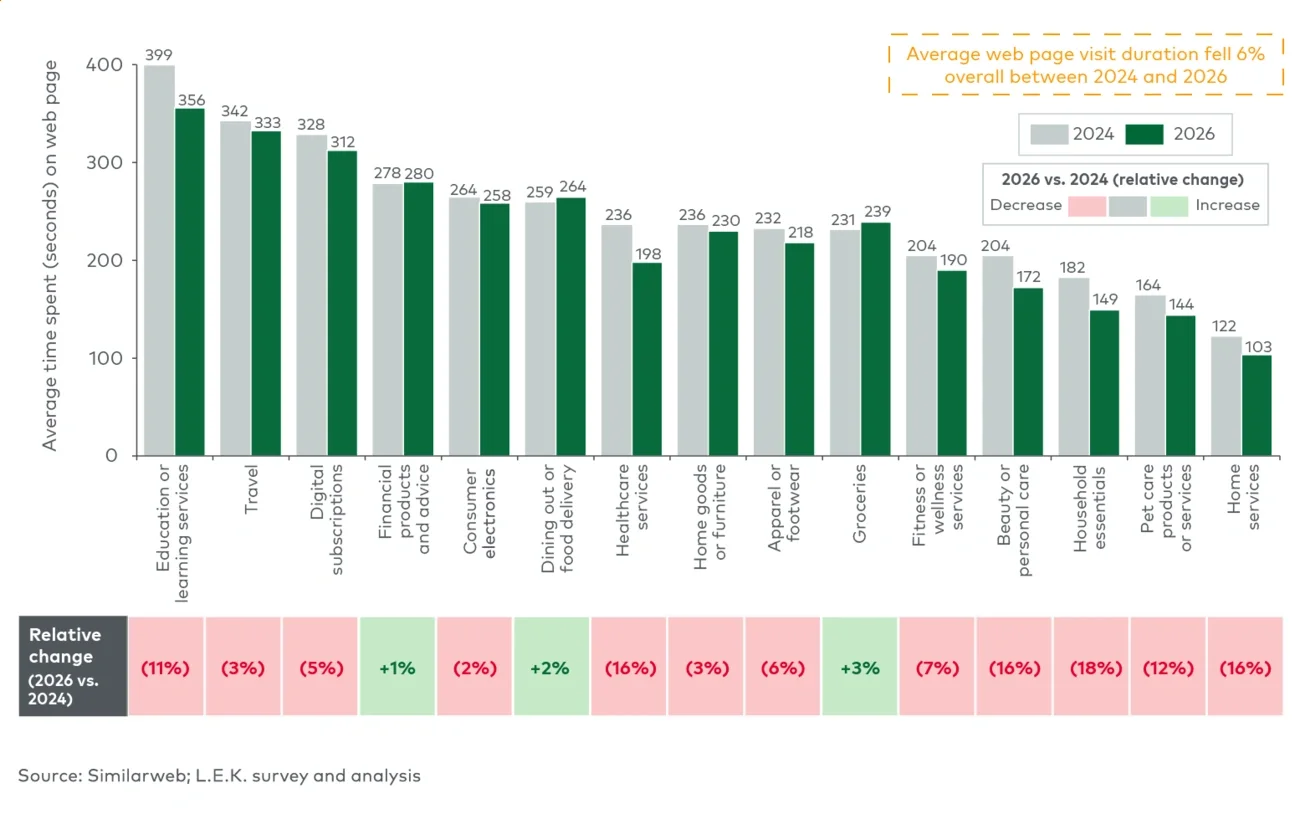
Web traffic data is consistent with this picture. Average visit duration from March 2024 to March 2026 fell 6% overall across the 13 categories tracked, with the steepest declines in household essentials (18%), healthcare services (16%), home services (16%) and beauty and personal care (16%) (see Figure 8).

Average web page visit duration, by category (October 2023-March 2024 vs. October 2025-March 2026)

Image
Average web page visit duration, by category (October 2023-March 2024 vs. October 2025-March 2026)

Average web page visit duration, by category (October 2023-March 2024 vs. October 2025-March 2026)

Image
Average web page visit duration, by category (October 2023-March 2024 vs. October 2025-March 2026)

Groceries, dining out, and financial products and advice were among the few exceptions, each holding roughly flat or edging up slightly. These patterns likely reflect a mix of factors, but they are directionally consistent with consumers arriving at sites with a clearer sense of what they want and spending less time in the discovery and comparison phases that traditionally happened on-site.

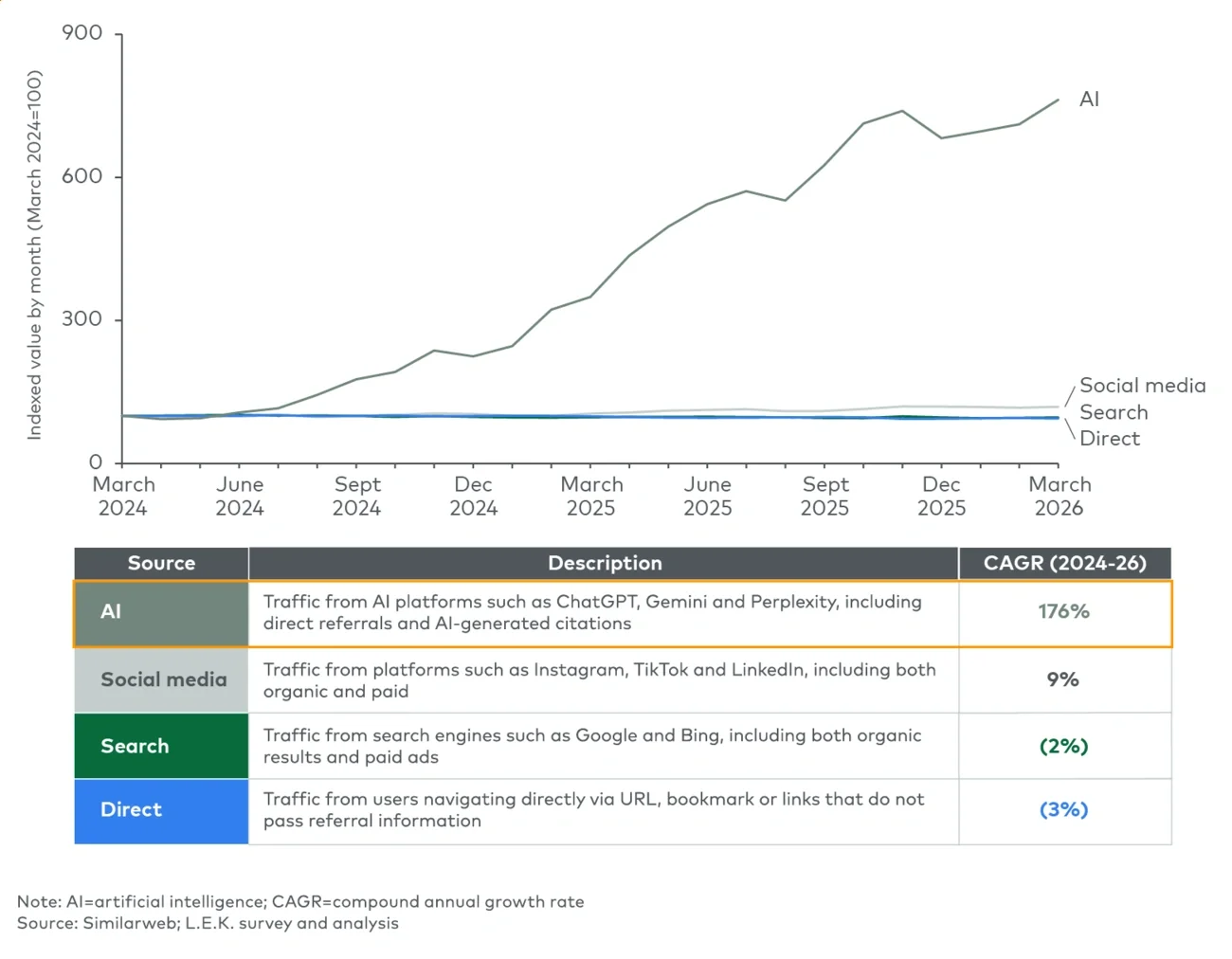
At the same time, the share of web traffic arriving via AI referrals is growing rapidly. AI-referred traffic grew at 176% per year over the past two years, while search, social and direct were each flat or declining over the same period (see Figure 9).

Figure 9 Web traffic origination by source, indexed to March 2024 (March 2024-March 2026)

Image
Web traffic origination by source, indexed to March 2024 (March 2024-March 2026)

Figure 9 Web traffic origination by source, indexed to March 2024 (March 2024-March 2026)

Image
Web traffic origination by source, indexed to March 2024 (March 2024-March 2026)

The role of brand and retailer sites has fundamentally shifted

In absolute terms, AI referrals still account for less than 0.5% of total inbound traffic, but the trajectory is notable. More consumers are not just using AI to research; it is their last stop before moving to brand and retailer sites, shifting the role of brand and retailer sites from places where decisions are shaped to places where they are confirmed and completed.

The implication for brands and retailers is meaningful. Owned digital properties have historically been designed to educate, inspire and guide consumers through the decision process. For AI users, much of that work is happening upstream. This shift elevates the importance of structured, consistent and machine-readable data, as large language models increasingly serve as the first point of contact in the consumer journey. How well companies are positioned to serve that more-decided consumer will increasingly inform the winners and losers in ecommerce and beyond in the coming years. 

AI is influential, but most consumers still validate before buying

Consumer satisfaction with AI-assisted shopping is high: Sixty-six percent of AI users believe these tools provide accurate results, and 85% say the experience improved their shopping overall.

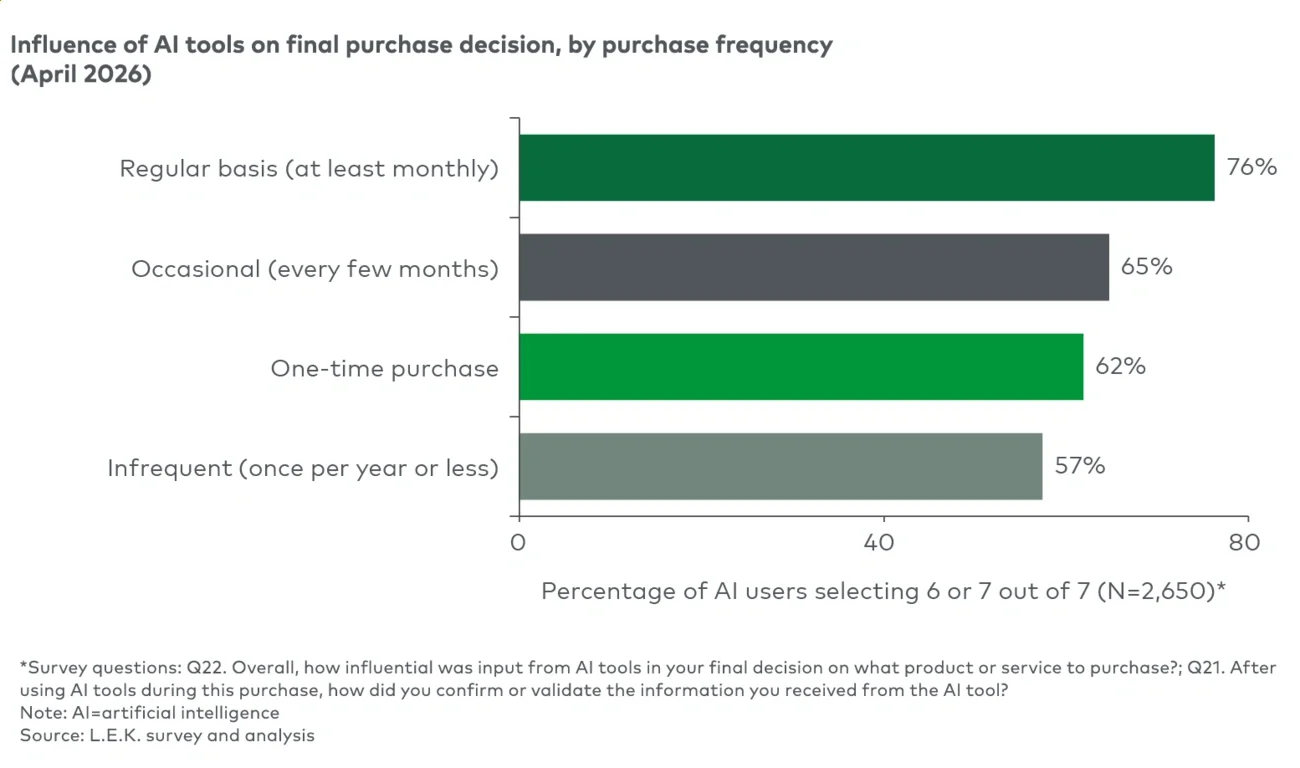
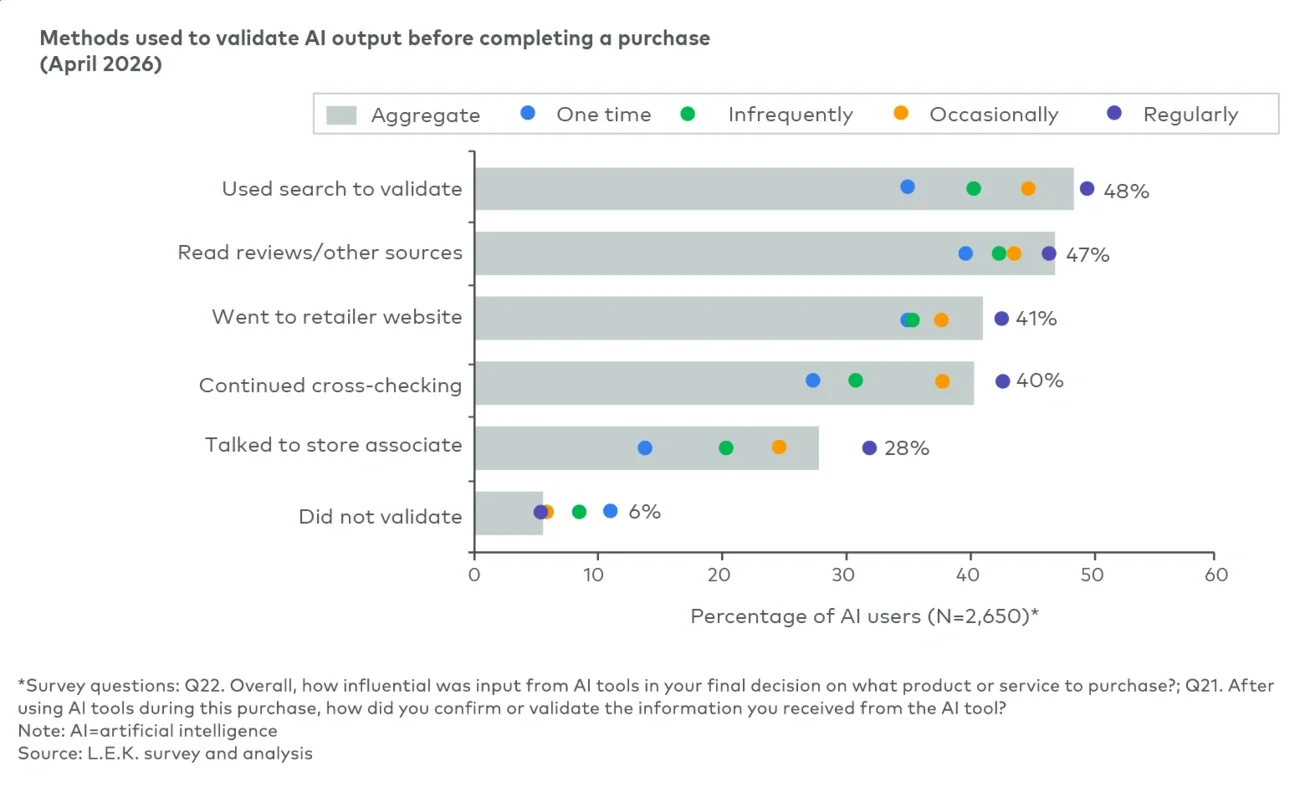
Even so, 94% still validate AI output before completing a purchase, turning to search (48%), reviews (47%) and retailer websites (41%) to cross-check (see Figures 10a and 10b).

Figure 10a: Influence of AI and validation of AI outputs

Image
Influence of AI and validation of AI outputs

Figure 10a: Influence of AI and validation of AI outputs

Image
Influence of AI and validation of AI outputs

Figure 10b: Influence of AI and validation of AI outputs

Image
Influence of AI and validation of AI outputs

Figure 10b: Influence of AI and validation of AI outputs

Image
Influence of AI and validation of AI outputs

That behavior reveals where consumers place their trust. Stand-alone platforms such as ChatGPT and Perplexity are perceived as more objective than AI embedded in retailer sites or search results, and therefore tend to command higher trust. Purchase completion data makes consumer perception even clearer. Only 8% of AI users report having completed a purchase entirely through an AI agent without visiting a brand or retailer site.

Agentic commerce is real but nascent, and the conditions that would support its broader adoption — deeper consumer trust, more reliable product data and seamless checkout integration — are still developing.

Brands and retailers should heed the call to action

Consumers are not outsourcing their judgment. They are front-loading it, using AI to research, compare and narrow options earlier in the process, and they are arriving at brand and retailer touchpoints with more-formed views than before. The 94% who still validate AI output before completing a purchase are not a sign that AI’s influence is overstated. They are a sign that the path to purchase has become more layered, not less, with AI not collapsing the journey into one single step but adding an entirely new step.

The relationship that brands and retailers have with the consumer isn’t being replaced by AI. It is being fundamentally restructured by it. That restructuring has two distinct demands. The first is upstream — ensuring that AI platforms surface the right products, with the right signals, before a consumer has engaged with any owned channel. The second is on-site — recognizing that a growing share of visitors are arriving not to browse, but to confirm.

Brands and retailers that design for both — optimizing for AI visibility while building experiences that meet the already-decided consumer — will be better positioned than those still waiting to see how the shift plays out.

Be sure to read "AI Is Reshaping Discovery, Influence and Visibility Without Fully Replacing Traditional Shopping Paths" for more insights into how AI is changing the way consumers find — and shop — brands.

L.E.K. Consulting is a registered trademark of L.E.K. Consulting LLC. All other products and brands mentioned in this document are properties of their respective owners. © 2026 L.E.K. Consulting LLC

English