
Introduction: The bridge that too often breaks
In virtually every carve-out transaction, there is a gap between what is conveying and operating independently as of day one and what will be required to operate independently at full capability in the months following the transaction. That gap — spanning information technology (IT) systems, back-office infrastructure, human resource (HR) and payroll platforms, regulatory filings, supply chain relationships, and more — is bridged by a transition service agreement (TSA).
A TSA is a contract between a seller (RemainCo) and a buyer (NewCo) under which RemainCo agrees to provide defined services to NewCo for a specified period following the close of the transaction. In its simplest form, it is a temporary outsourcing arrangement. In practice, it is one of the most operationally complex documents in the deal — and one of the most directly connected to whether the transaction creates or destroys value in the months immediately following close.
The challenge is structural. With deal teams focused on the primary transaction agreement, the TSA routinely receives insufficient attention until the final days before signing. Operational leaders and their lieutenants — who best understand what services are actually needed and how they are actually delivered — are frequently excluded from the negotiation until it is too late. The result is TSAs that are incomplete in scope, vague in service definition, unrealistic in timeline and poorly governed. These documents become the basis for disputes, escalations and legal proceedings that consume management bandwidth, damage relationships and delay the transition to independence.
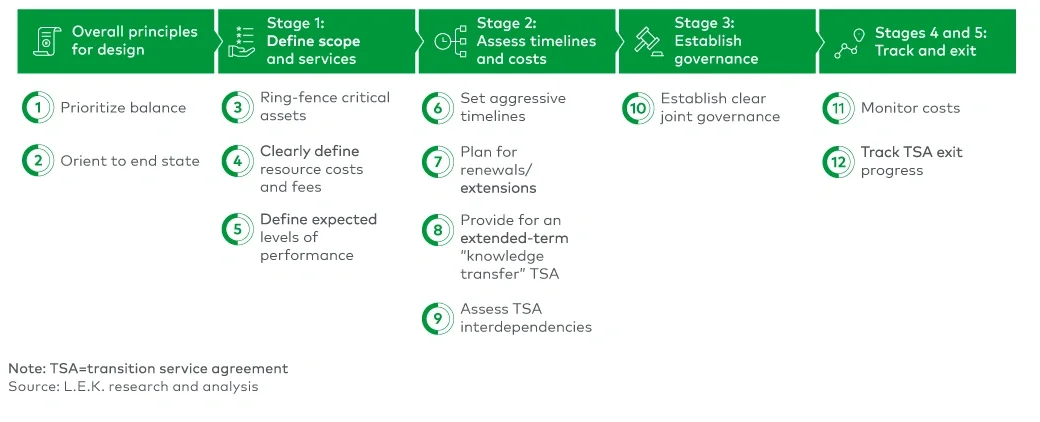
At L.E.K. Consulting, we have supported clients in developing, negotiating and executing TSAs across a wide range of industries, deal types and complexity levels. In this Executive Insights, we set out our framework for what good TSA practice looks like — organized around a five-stage development process and 12 actionable best practices — and highlight where the most common failure modes occur.
The strategic importance of TSAs: Both sides of the table
TSAs serve different but complementary purposes for buyers and sellers.
For the buyer, the TSA provides operational continuity: access to critical systems, processes and expertise that NewCo cannot replicate on day one. Without adequate TSA coverage, NewCo may not be able to bill customers, pay employees, file regulatory submissions or manage its supply chain. For financial buyers in particular — that lack the preexisting infrastructure that a strategic acquirer might leverage — TSAs are often the primary mechanism for ensuring the business does not lose momentum immediately postclose.
Importantly, TSAs also influence the buyer’s competitive positioning in a sale process. Sellers may evaluate bidders not just on price but also on the quality and credibility of their proposed TSA terms. A buyer that demonstrates low TSA dependency, a clear exit strategy and genuine execution experience signals sophistication and reduces transition risk from the seller’s perspective, which can tip a competitive bid in that buyer’s favor.
For the seller, the TSA serves as a mechanism for enabling a cleaner, faster close (as the buyer does not need to establish full stand-alone capability on day one) while simultaneously generating a defined and time-limited revenue stream and limiting ongoing operational exposure to the divested business. However, TSA obligations are not free. They consume human capital, management attention and system resources in an organization that is simultaneously seeking to perform for its own stakeholders. The seller’s goal is therefore to design TSAs that are sufficient to enable a smooth transition while being as limited, specific, and time-bound as possible.
The inherent tension between buyer dependency and seller burden is the central negotiating dynamic of every TSA, and navigating it well requires both parties to understand that a good TSA is one that is genuinely fair to both sides.
A five-stage process for effective TSA development
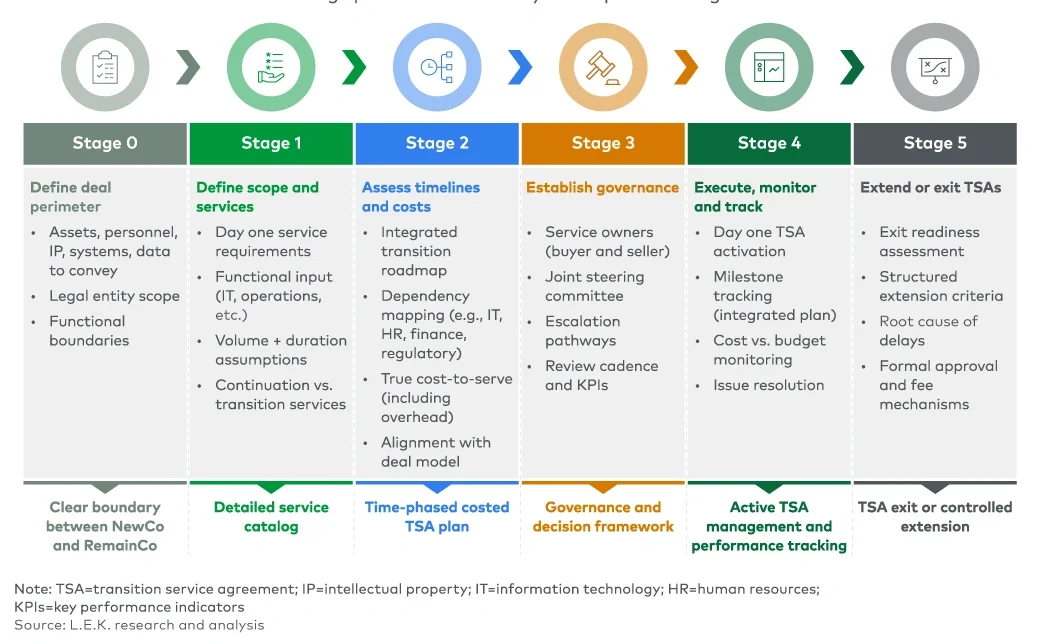
Once the deal perimeter is defined (i.e., what resources, intellectual property, systems, and data will convey with the divestiture), TSA development can begin in earnest. A rigorous TSA development process moves through five stages, each of which must receive appropriate investment from both functional and legal teams (see Figure 1).