Executive Insights

Outsourced Drug Discovery: Early Recovery Signals and Structural Demand Shifts

July 21, 2026

Key takeaways

Key indicators point to an improving outsourced drug discovery market, with biotech funding, biopharma M&A and preclinical pipeline volumes all showing early signs of recovery.

The potential recovery masks structural changes in R&D investment that are reshaping demand for outsourced discovery services.

These shifts include a sustained migration of pipeline growth to China and, for Western players, a continued shift in demand to areas of differentiated expertise.

Western providers will need clearer differentiation as customer expectations rise and competition from Chinese providers intensifies.

After several challenging years for outsourced drug discovery service providers, several headline indicators of demand are showing early signs of recovery. Biotech funding has grown and biopharma M&A has returned to growth, prompted in part by the looming patent cliff. Worldwide discovery and preclinical pipeline volumes have continued to expand. Together, these signals suggest a more constructive market environment than at any point since 2022.

However, the more significant development is how structural changes in biopharma R&D investment are reshaping demand for outsourced discovery services. In this Executive Insights, we describe structural shifts in how biopharma is allocating its R&D dollars. These shifts have been playing out over recent years and are now reshaping the demand picture in ways the headline recovery numbers do not reveal.

Recovery signals are strengthening

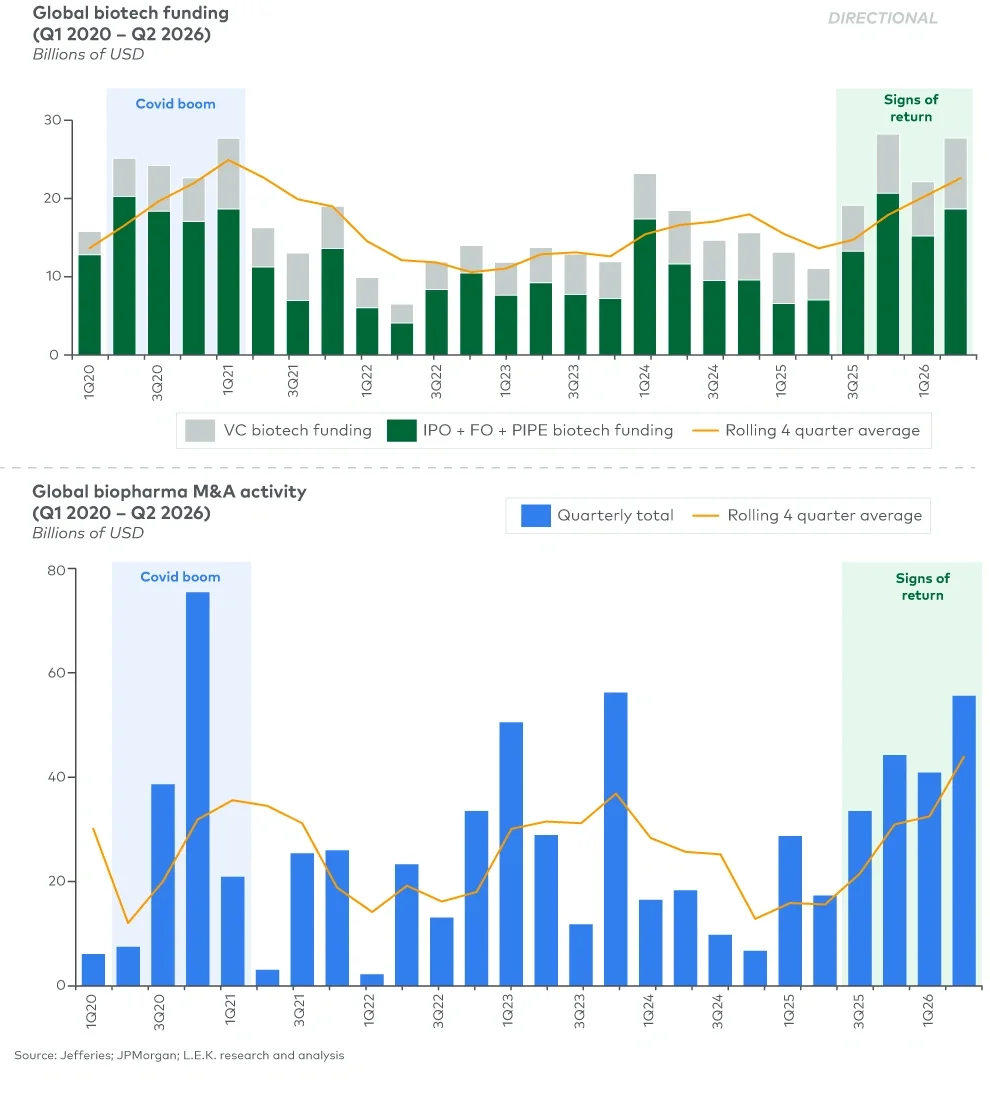
Several indicators point to an improving demand environment. Firstly, biotech funding rebounded materially through 2025 and into the first half of 2026 (see Figure 1). The Q2 2026 quarterly funding reached $28.1 billion and the rolling 4-quarter average continues to rise.

Figure 1

Biotech funding and biopharma M&A are showing early signs of recovery

Image
Figure 1: Biotech funding and biopharma M&A are showing early signs of recovery

Figure 1

Biotech funding and biopharma M&A are showing early signs of recovery

Image
Figure 1: Biotech funding and biopharma M&A are showing early signs of recovery

Biopharma M&A activity has likewise returned to growth, prompted by approximately $370 billion of branded sales at risk to loss of exclusivity between 2024 and 2029 and the need to replenish pipelines. Large-cap pharma has remained active in targeting both private and public assets, with Q2 2026 reaching $55.1 billion in disclosed deal value and the rolling annualised deal value rising in each of the last four quarters.

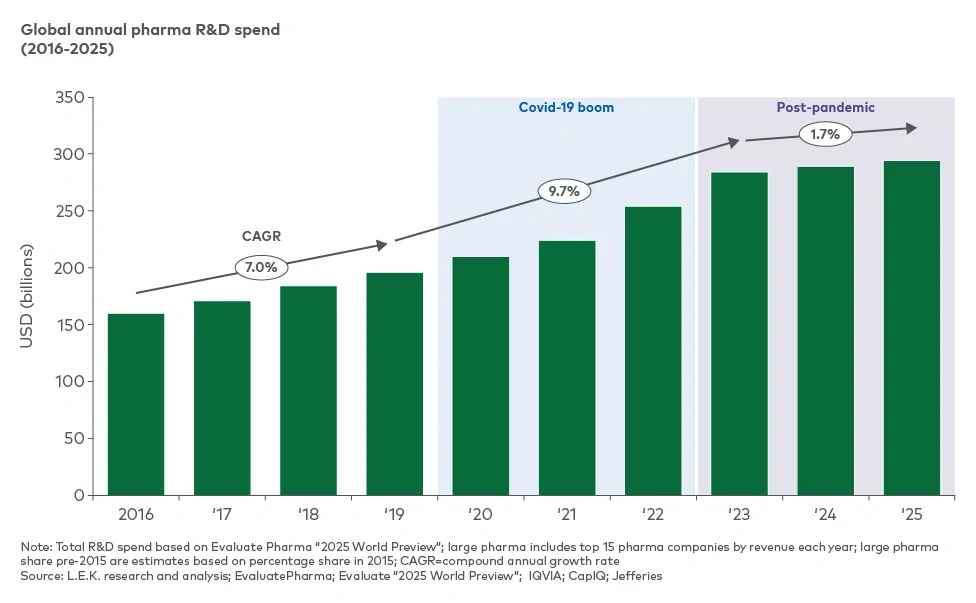
Global biopharma R&D spend has also remained resilient (see Figure 2). Although growth has moderated to approximately 1.7% p.a. in the post-pandemic period from 9.7% during the Covid-19 boom, R&D spend has held steady as a share of pharma sales, indicating that the industry is not structurally cutting its R&D commitment. Many analysts are forecasting a pick-up in R&D spending growth in the coming years, as a reversion towards longer-term trends.

Figure 2

Global pharma R&D spend has remained resilient despite post-pandemic moderation

Image
Figure 2: Global pharma R&D spend has remained resilient despite post-pandemic moderation

Figure 2

Global pharma R&D spend has remained resilient despite post-pandemic moderation

Image
Figure 2: Global pharma R&D spend has remained resilient despite post-pandemic moderation

Together, these indicators support the suggestion that the post-pandemic correction has largely run its course. However, they do not capture three structural shifts in the demand environment that matter more for Western service providers than the headline pattern.

R&D investment is shifting towards later-stage development

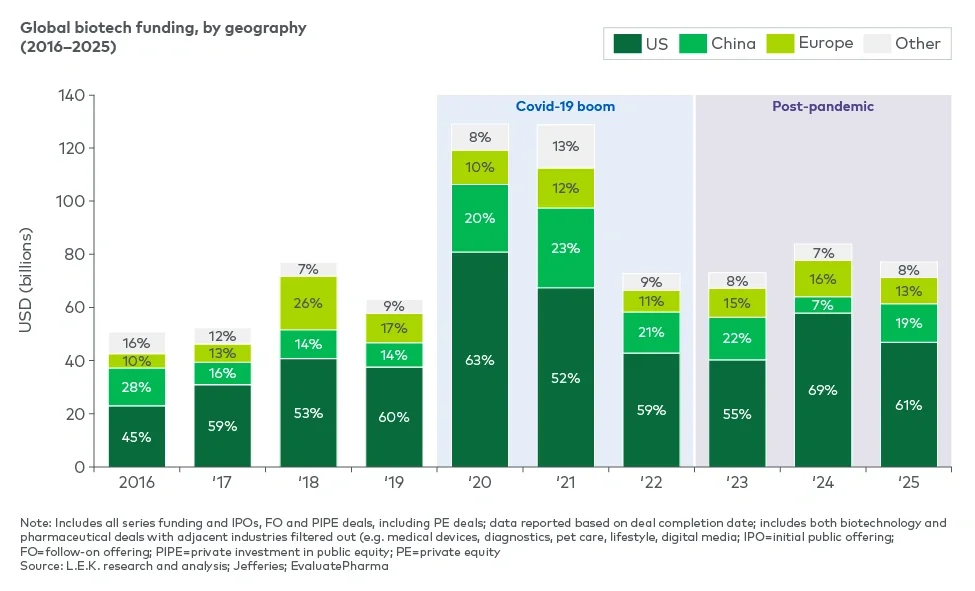
Biotech funding has been geographically concentrated and structurally narrow within geographies. US biotechs continue to account for roughly 60% of global biotech funding, a share that has held relatively steady through the post-pandemic period (see Figure 3). Within the US pool, the recovery over the past couple of years has been characterised by fewer, larger fundraises that have flowed disproportionately to later-stage biotechs, while earlier-stage companies have continued to report inadequate funding breadth. Most of the headline increase in dollars has been explained by deal size rather than deal number.

Figure 3

US biotech funding remains dominant, but recovery has been uneven across geographies

Image
Figure 3: US biotech funding remains dominant, but recovery has been uneven across geographies

Figure 3

US biotech funding remains dominant, but recovery has been uneven across geographies

Image
Figure 3: US biotech funding remains dominant, but recovery has been uneven across geographies

The implication is that biotech funding has skewed towards development over the past couple of years. Fewer, larger fundraises directed at later-stage biotechs imply proportionally less of the biotech funding pool flowing to early-stage discovery and translational research. The biopharma M&A uptick reinforces the same dynamic through a different mechanism: a dollar deployed on business development typically generates less follow-on early-stage discovery investment than a comparable dollar of organic R&D growth would have done.

These observations are based primarily on externally visible measures such as biotech funding and M&A activity. They do not fully capture changes in internal R&D budgets across the biopharma ecosystem. Big pharma has historically responded to budget pressures with measures such as sharper selection of programmes to advance, given that late-stage clinical trials are the single largest cost item.
Whether spending skew towards development is a durable feature of biopharma R&D allocation or a shorter-term artefact of post-pandemic funding is one of the more consequential questions for the discovery services market over the next several years.

Pipeline growth is increasingly concentrated in China

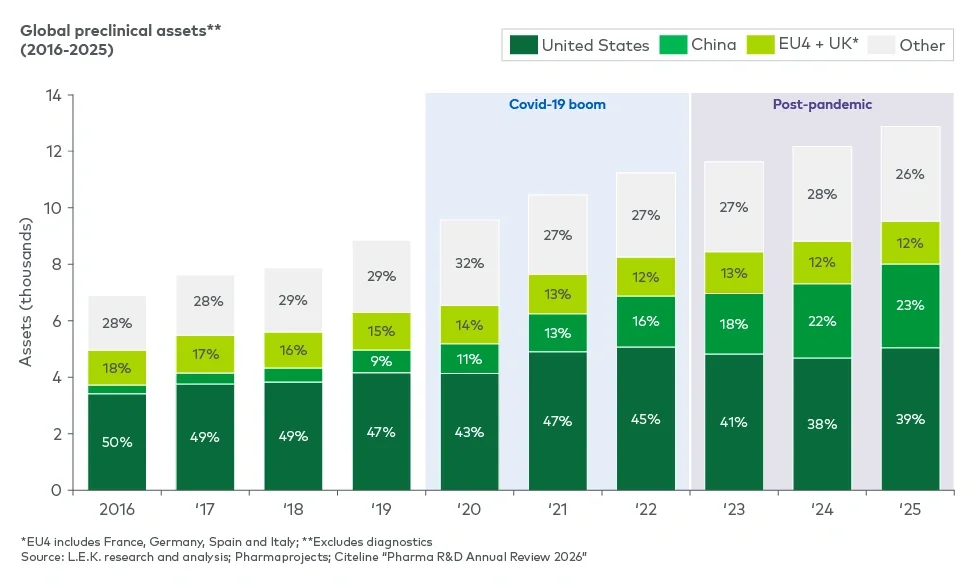
Worldwide discovery and preclinical pipelines have grown at high-single-digit percentages annually since 2020, but the regional segmentation tells a different story (see Figure 4). China’s share of global preclinical assets has roughly doubled, from approximately 11% in 2020 to approximately 23% in 2025. Over the same period, the US share has drifted modestly downward and the EU4 (France, Germany, Italy and Spain) + UK share has been broadly flat.

Figure 4

China is capturing a growing share of global preclinical pipeline growth

Image
Figure 4: China is capturing a growing share of global preclinical pipeline growth

Figure 4

China is capturing a growing share of global preclinical pipeline growth

Image
Figure 4: China is capturing a growing share of global preclinical pipeline growth

This is an established multiyear trend, supported by structural factors that are unlikely to reverse. Chinese biotech innovation has been backed by sustained government investment, an increasingly capable domestic research ecosystem, lower-cost discovery economics, and regulatory and data standards that are converging with US Food and Drug Administration expectations.

As a result, a disproportionate share of the increase in global discovery activity is likely to benefit Chinese service providers. For Western contract research organisations (CROs), the relevant underlying pipeline volume has been roughly flat to modestly positive rather than being at the headline global rate.

A related consequence of China’s pipeline expansion is that the Chinese discovery and preclinical service provider ecosystem is growing. Chinese CROs are now actively competing for Western sponsor work in routine preclinical service categories, including standardised assays, in vivo studies and chemistry services, where they can serve global sponsors at a lower cost.

Western demand is shifting towards differentiated capabilities

Within the relatively slower-growing Western discovery pool, the composition of demand has also been shifting. Routine activities such as basic screening, standard in vitro assays and conventional medicinal chemistry have been losing share to innovative services, including in silico and artificial intelligence (AI)-enabled discovery, structural biology, advanced cellular models, and integrated translational and Chemistry, Manufacturing and Controls (CMC) packages.

This shift reflects sponsors’ efforts to improve R&D productivity. With cost per new molecular entity now above $2 billion and outputs per R&D dollar steady to declining, sponsors under productivity pressure are reallocating their spend with Western providers towards workflows where productivity gains are most plausible. Some less differentiated discovery services (e.g. simple chemical synthesis services) are becoming more cost competitive and may be increasingly outsourced to Chinese providers.

Strategic implications for Western discovery service providers

Several implications follow for Western discovery service providers. First, the addressable demand pool may grow more slowly than headline pipeline counts suggest. Once Chinese pipeline expansion is stripped out, the underlying volume of preclinical and translational work flowing to Western providers has been lower than the global figure.

Second, value within that pool is migrating. Premium activities such as AI-enabled design, structural biology, advanced cell models, integrated translational packages and Investigational New Drug (IND)-ready CMC are growing meaningfully. Less specialised activities are not. Providers concentrated in routine workflows face intensifying competition from Chinese CROs serving the same workflows at lower cost.

Third, sponsor pricing behaviour is bifurcating along the same fault line. Right to win has been moving back to providers in specialist and complex workflows, where capacity may be tightening. Pricing pressure has been intensifying in routine workflows, where the effective supply curve has been extended by Chinese ecosystem providers.

The strategic response to these structural shifts, and how discovery service providers can build differentiated platforms, will be explored in the next Executive Insights in this series.

What comes next for outsourced drug discovery

Outsourced discovery has come through its hardest cycle in two decades. While early indicators point to early signs of a recovery, they are unlikely to be the best guide to future competitive dynamics. The more durable test will be whether structural demand shifts continue to reshape the market. Providers built around differentiated capabilities, rather than volume alone, are likely to be best placed as those shifts play out.

How L.E.K. Consulting can help

L.E.K. partners with discovery service providers and their investors on the strategic and operational questions raised by the demand shifts described above. We support clients on growth strategy and portfolio prioritisation, commercial and operational due diligence on platforms and platform acquisitions, value proposition and go-to-market design, M&A screening and integration, and assessments of competitive exposure to Chinese providers. To find out more, please contact us.

L.E.K. Consulting is a registered trademark of L.E.K. Consulting. All other products and brands mentioned in this document are properties of their respective owners. © 2026 L.E.K. Consulting


English