

Executive Insights

The Device, Not the Molecule: The Under-Recognised Source of Franchise Durability

July 21, 2026

Key takeaways

For a growing share of biologic therapies, the delivery system has become a primary determinant of launch differentiation, site-of-care access and durability against competitive entry.

Many organisations continue to make delivery decisions too late in development and against an evidence base that prioritises technical feasibility over strategic value creation.

The optimal delivery integration model varies by asset profile, making explicit strategic choices critical to maximising return on investment.

Drug delivery has become a strategic asset

In March 2024, the Food and Drug Administration approved Udenyca OBI, the first biosimilar on-body injector referencing Neulasta Onpro. The approval marked the end of a notable period in biopharma. For almost a decade after pegfilgrastim lost exclusivity, Amgen’s delivery format retained roughly half the U.S. market and protected a segment that Coherus estimated to be worth approximately $1.2 billion.

The molecule itself had become commoditised. The delivery system had not.

The example illustrates an increasingly important reality across biologics and specialty pharmaceuticals. While competitive strategy has traditionally focused on clinical differentiation and intellectual property, delivery systems are becoming an important source of commercial advantage in their own right.

As more therapies migrate from infusion centres to home administration, delivery decisions increasingly influence market access, patient adoption, persistence and competitive durability.

The strategic question is no longer whether delivery can create value. It is whether organisations are making the right delivery decisions early enough to capture that value.

Delivery creates value through multiple mechanisms

Delivery innovation can influence asset performance through several distinct mechanisms.

Launch differentiation is often the most visible. In categories where clinical differentiation between therapies is narrow, the delivery experience can become a primary point of distinction for patients, providers and payers.

Delivery also influences site-of-care access. Devices that enable home administration can expand addressable patient populations, alleviate pressure on infusion infrastructure and alter reimbursement dynamics.

A third mechanism is adherence and persistence. Features that reduce friction during administration can improve real-world treatment continuation and increase lifetime patient value.

Finally, delivery can act as a barrier to entry. Competitors seeking to replicate a differentiated delivery experience must often reproduce both the molecule and the associated delivery system, increasing development complexity and extending the period of commercial advantage.

Together, these mechanisms position delivery as a strategic lever rather than simply a development consideration.

Why many organisations under-exploit delivery

Despite its growing strategic importance, delivery often receives less strategic attention than other sources of competitive advantage.

One reason is timing. Critical decisions regarding device architecture, formulation characteristics and delivery modality are frequently deferred until Phase II or later, when clinical and chemistry, manufacturing and controls constraints have already narrowed the available options.

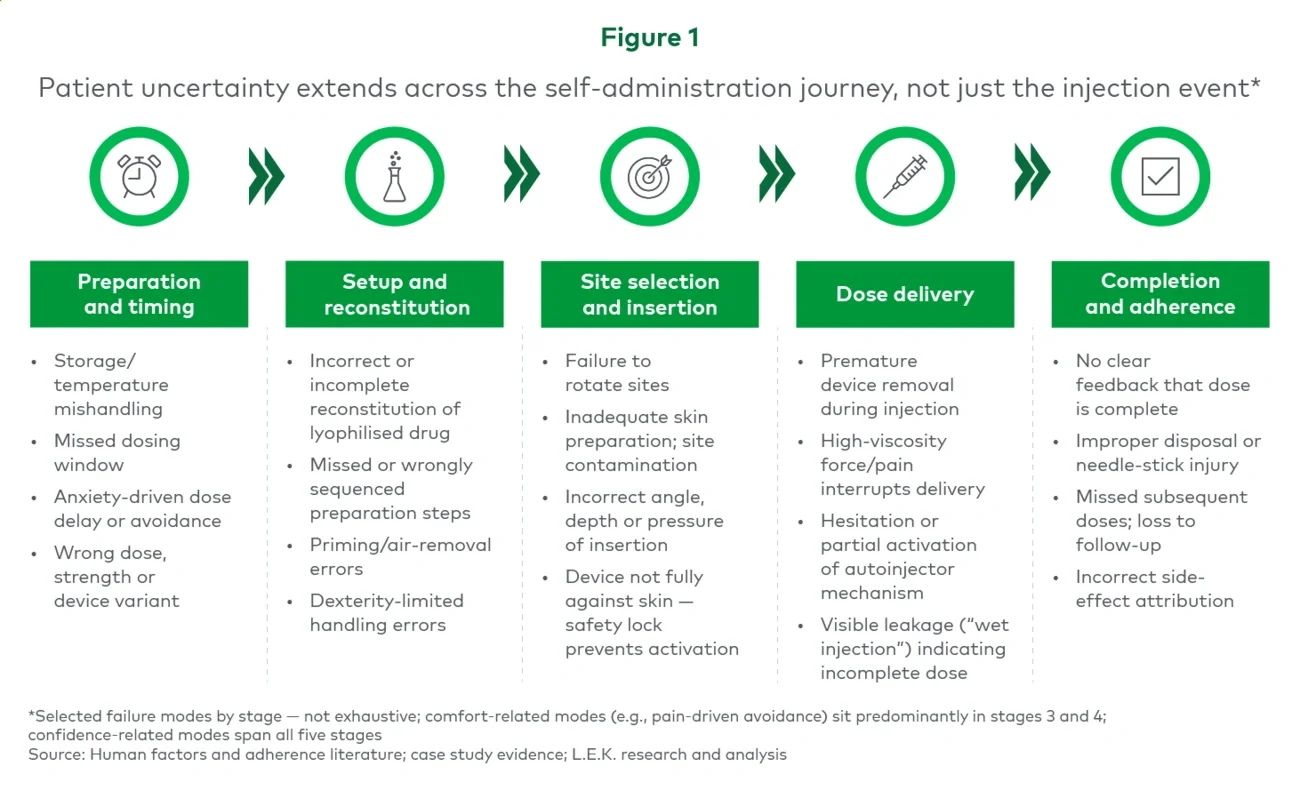
Delivery decisions influence value creation throughout the asset life cycle, from launch differentiation and site-of-care access through to loss-of-exclusivity planning and franchise defense (see Figure 1). Yet many of the choices that shape these outcomes are made before launch preparation begins.

Ownership is another challenge. Delivery decisions are often led by engineering and development functions, with commercial teams providing input later in the process. The result can be optimisation against technical feasibility rather than the competitive realities the asset will face at launch.

The evidence used to evaluate delivery options can present a similar issue. Delivery options are frequently assessed through patient preference research and human factors testing. While these inputs are important, they do not necessarily answer questions about long-term differentiation, payer value, competitive replicability or franchise durability.
Image
Figure 1. Delivery decisions influence value creation and value defense throughout the asset lifecycle
Image
Figure 1. Delivery decisions influence value creation and value defense throughout the asset lifecycle

Choosing the right integration model

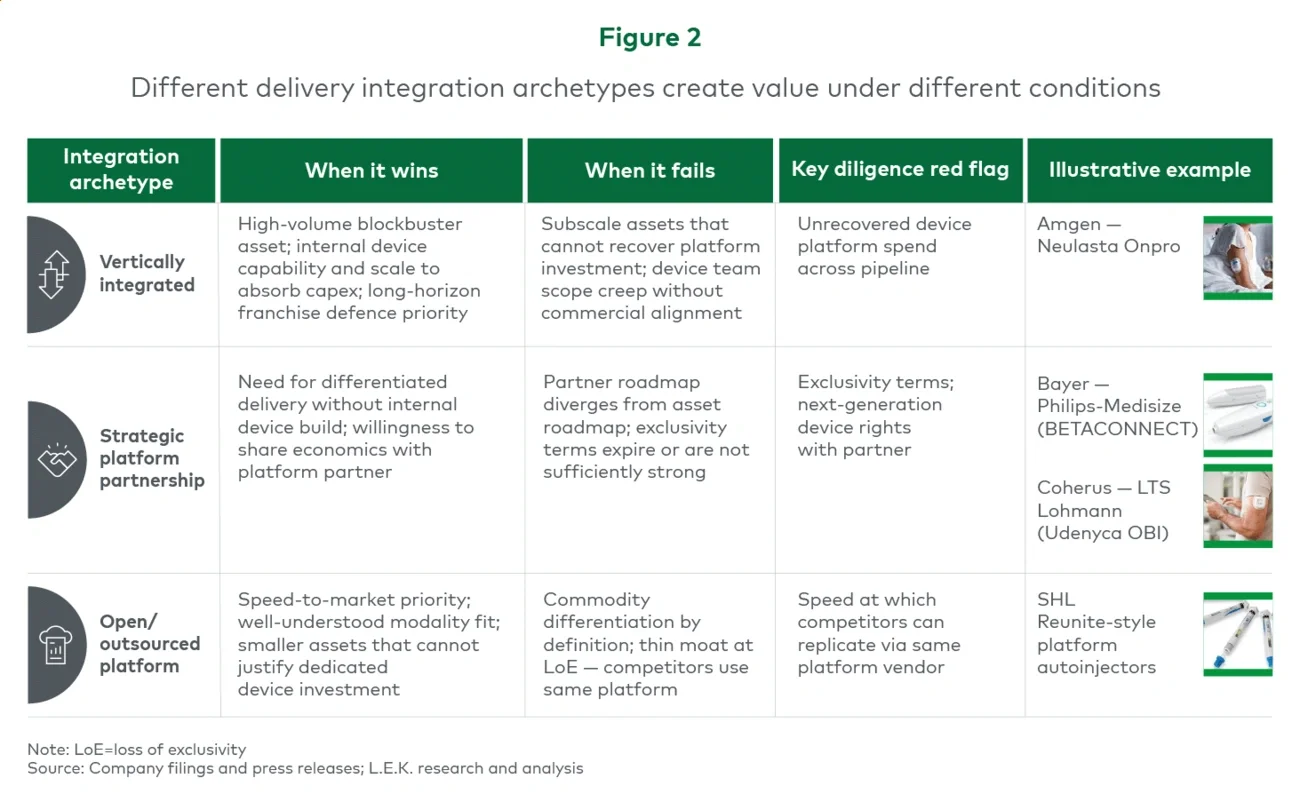
There is no universally correct delivery integration model. The optimal approach depends on the asset’s commercial profile, development requirements and strategic objectives. Three broad archetypes have emerged across the industry, each with distinct value creation potential (see Figure 2).

Vertically integrated approaches can maximise differentiation and control but require sufficient scale to justify investment. These models are typically most appropriate for high-value assets with long franchise horizons.

Strategic platform partnerships provide access to specialised capabilities without requiring full internalisation of device development. Their success often depends on alignment between partner incentives, exclusivity arrangements and long-term product strategy.

Open-platform approaches offer speed and lower capital requirements. They can be highly effective when rapid market entry is the primary objective. However, because these platforms are broadly accessible, they typically provide less protection against future competition.

The strategic risk is not selecting the wrong archetype in absolute terms. It is selecting an archetype that is inconsistent with the commercial profile of the asset.

Image
Figure 2. Different delivery integration archetypes create value under different conditions
Image
Figure 2. Different delivery integration archetypes create value under different conditions

Delivery strategy does not end at launch

The approval of Udenyca OBI also highlights an important limitation of delivery-based differentiation. Delivery advantages are rarely permanent. The relevant strategic question is not whether competitors will respond but how long the differentiated window will remain open and what actions are required to extend it.

Companies that treat delivery as a life cycle play can create additional layers of protection through next-generation devices, connected-care ecosystems, co-formulations and expanded indications.

This perspective requires organisations to evaluate delivery investments across the full commercial life cycle rather than solely through the lens of launch readiness.

When delivery is not the primary source of advantage

While delivery is becoming increasingly important, it is not equally important across all assets.

In some categories, overwhelming clinical superiority may outweigh any delivery advantage. In others, standardised device platforms may limit opportunities for meaningful differentiation.

Similarly, not all therapies justify significant delivery investment. For smaller assets, the economics of proprietary device development may not support a differentiated approach.

Understanding where delivery matters most is therefore as important as understanding how delivery creates value.

Five questions leaders should be asking

For executives, investors and business development teams assessing delivery-dependent assets, several questions can help evaluate the strength of a delivery strategy:

  1. Is the delivery format technically differentiated from standard presentations?
  2. How long is the differentiated window likely to last?
  3. Is the chosen integration model aligned with the asset’s commercial profile?
  4. What is the plan for maintaining differentiation beyond loss of exclusivity?
  5. How much of the asset’s premium is attributable to delivery rather than the molecule itself?

These questions help shift delivery from a technical discussion to a strategic one.

Delivery strategy is becoming franchise strategy

For an increasing share of biologic therapies, delivery systems are becoming a critical source of competitive advantage.

The organisations that create the most value will not necessarily be those with the most-sophisticated devices. They will be those that make delivery decisions early, align delivery strategy with asset economics and manage delivery as a long-term source of franchise value.

The strategic question is no longer whether delivery matters. It is how much of an asset’s future value creation and durability will depend on decisions made long before launch. As biologic markets become increasingly competitive, the distinction between product strategy and delivery strategy is likely to become progressively harder to separate.

How L.E.K. can help

L.E.K. Consulting helps pharmaceutical companies, drug delivery developers and investors evaluate how delivery systems influence product differentiation, site-of-care access and long-term franchise value.

Our work spans delivery strategy, life cycle management, partnership and investment evaluation, and commercial due diligence, helping clients identify the most effective approaches to creating and sustaining competitive advantage.

To discuss how delivery strategy could strengthen differentiation and franchise durability across your portfolio, contact us.

This insight examines delivery through the lens of commercial strategy and franchise value. For a complementary perspective on how delivery design influences patient adherence and correct use, see Confidence, Not Comfort: The Under-Recognised Driver of Patient-Centric Drug Delivery

L.E.K. Consulting is a registered trademark of L.E.K. Consulting. All other products and brands mentioned in this document are properties of their respective owners. © 2026 L.E.K. Consulting

English