
Business-to-business (B2B) software as a service (SaaS) pricing leaders can borrow several moves from the frontier artificial intelligence (AI) labs, but the greatest opportunity lies in a dimension the labs cannot fully reach: the value the product actually delivers.
A SaaS pricing leader ships an AI feature on Monday. By Friday, five power users have burned more compute than the rest of the customer base combined. Finance wants margin protection, sales wants a story simple enough to sell, product wants to ship the next model next week and no customer wants to reopen a contract. Four demands, one pricing decision. The frontier AI labs have been solving exactly this in public for the past 18 months, so what should other SaaS leaders learn from their success?
The labs’ answer is to price a single account across three dimensions at once: the number of users with access, how much they consume and the capability tier they draw on. The price paid and package received are now a function of all three. This is not a quirk of a young category; it is the leading edge of where value-based pricing has been heading for years, forced open by one fact that makes AI different from classic SaaS: The cost to serve is variable and material, not close to zero.
Rather than copying the tactics wholesale, pricing leaders should study the principles underneath. All three of the labs’ axes are proxies for value rather than value itself, and a narrower product can price closer to the outcome it delivers. This edition of L.E.K. Consulting’s Executive Insights examines which of these moves transfer to B2B SaaS, which do not and where the advantage for focused software businesses lies.
- A common currency lets you launch without repricing
The providers sell models with wildly different costs to serve, yet express them in a single currency: tokens or credits with an internal exchange rate. When a new premium model launches, there is no new negotiation. The customer already holds the currency and simply spends more of it.
Contrast the classic SaaS cycle: Repackage the tiers, reprice, renegotiate, wait two quarters. A consumption currency collapses that. Ship a capability, assign it a credit cost and monetize it on day one. The currency decouples product innovation from pricing friction. - Credits are an enterprise trial engine, not just a billing unit
Watch how platforms use user-directed pooled credits (e.g., Microsoft's Copilot Credits, Salesforce’s Flex Credits). The buyer commits to a pool; end users spend it on whatever they value, including brand-new features. That does three things at once: It removes procurement friction from trialing a new product, it generates bottom-up willingness-to-pay data as spend reveals what users value and it turns a top-down seat sale into usage-led expansion.
This reframes one of the hardest problems to solve in enterprise go-to-market: getting a new module adopted. Rather than selling each one, you seed a currency, let consumption surface demand and then price against what you learn. - Protect the margin tail
“Unlimited” is a margin trap when the cost to serve is real, because a small share of heavy users drives a disproportionate share of costs. The providers have responded with metered limits on unlimited plans (e.g., Claude’s weekly limits, Google’s compute-based caps) and asymmetric metering that steers behavior toward cheaper, stickier patterns (e.g., OpenAI pricing output tokens above input).
As you embed AI features, your gross margin is now usage sensitive, so pricing needs a cost-defense mechanism alongside its value-capture role. The heaviest 5% of users are a margin question, not just a support one. - Make repricing a deliberate posture
Model costs are falling fast, and providers have cut prices to match (Anthropic and Mistral among them). That brings up a question every SaaS business with AI in its cost base will face: When your input costs drop, do you capture the saving as margin or pass it through to defend share? Treat it as a conscious choice rather than a default. There is a quieter lever too: Hold headline prices while adjusting the exchange rate. - Reserve capability, not just volume, for the top
Capability-based tiering, where the best models sit in higher tiers, gives customers a reason to upgrade beyond “more of the same,” and a premium power-user tier captures heavy-user value without raising the entry price. Differentiate tiers on what the product can do, not only on how much of it the customers get, and keep the entry point accessible while still capturing the top of the willingness-to-pay curve.
In practice, the tier gate works best when it leaks a little: most labs give lower tiers a metered taste of the flagship (ChatGPT's free plan allows a handful of top-model messages before falling back to a lighter model; Gemini's free tier includes a capped daily allowance of its most capable model). That is product-led growth at work: users who have never seen a stronger model's output struggle to perceive its incremental value, so a capped dose of the best model is often the cheapest way to sell the upgrade while containing cost to serve. - Price the outcome — the dimension the labs cannot reach
The three axes the labs price on are all proxies for value. A token carries no inherent outcome; the same unit of consumption might draft a memo or clear a regulatory filing, so the labs cannot peg price to value without knowing what the customer did with it. Their breadth is the constraint.
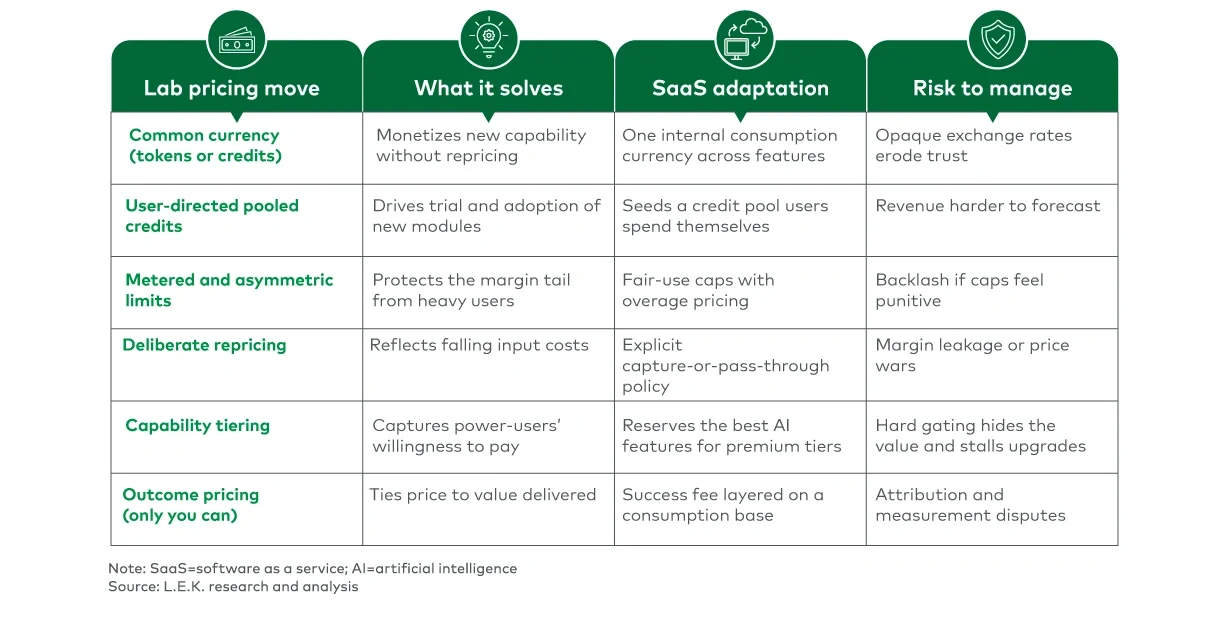
A narrow product does not have that problem. A collections tool knows the dollars it recovers; a fraud product knows the losses it prevents. That line of sight to the outcome is a pricing dimension the labs structurally lack, and it is where a focused SaaS business can capture value the consumption model leaves on the table. Outcome pricing carries its own frictions (e.g., attribution, measurement and slower sales cycles), which is why most players still lean on proxies. But even a partial tie to outcomes, such as a success fee layered on a consumption base, can convert a narrow focus into pricing power (see Table 1).