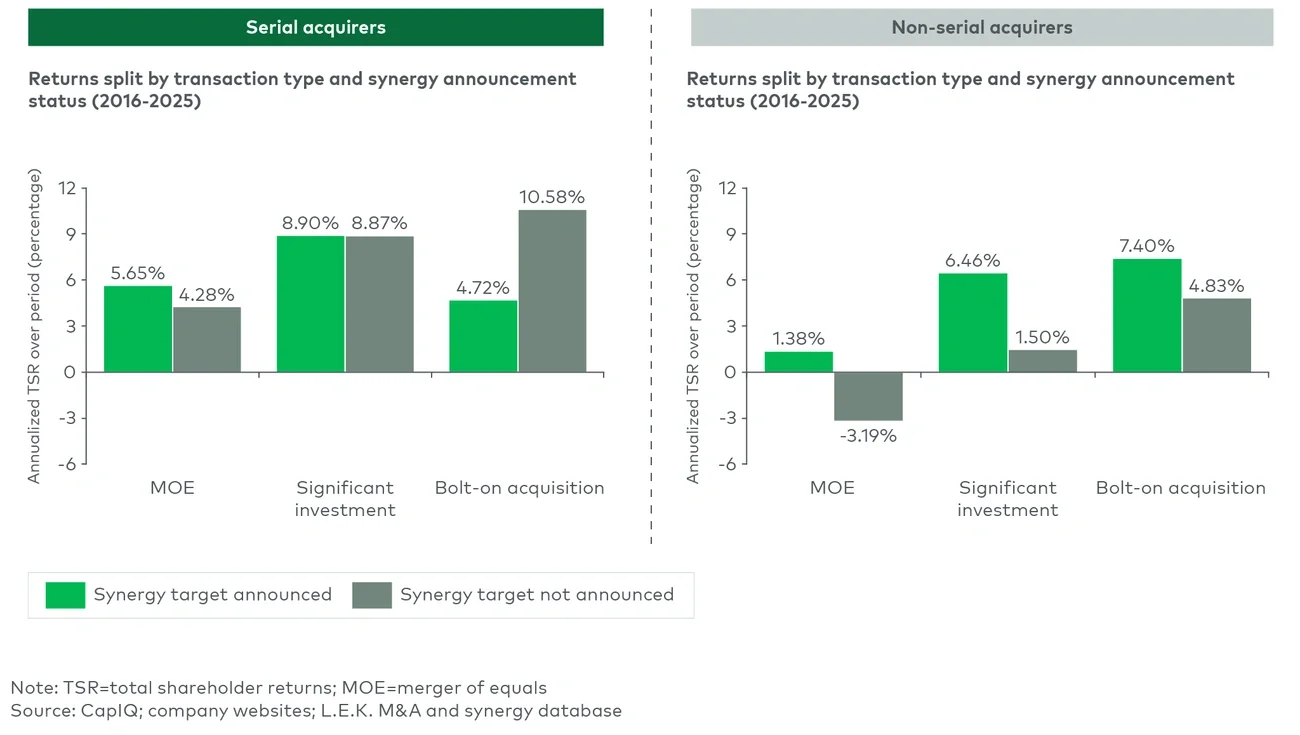
However, there was an exception to this rule. Serial acquirers executing bolt-on transactions that did not announce synergies outperformed serial acquirers that did announce synergies. On the surface, this outcome is a bit misleading. From our experience, we know that many high-performing serial acquirers still have internal synergy goal-setting and tracking mechanisms to ensure success — these are core elements of their M&A and integration playbook. However, many serial acquirers that execute a broad set of bolt-on deals each year (or quarter) feel that their success is best publicly tracked and reported in aggregate across a robust M&A portfolio and overall financial results, rather than by individual transaction.
No. 3: Serial acquirers start to develop perspectives on deals in terms of “types” and craft fit-for-purpose playbooks in order to accelerate shareholder value for each type
These targeted M&A playbooks may translate to more intentional integration in select areas, rather than a one-size-fits-all approach. Note that significant, transformative deals (e.g., MOEs) almost always warrant a more bespoke approach. While ultimately developing the right deal types will vary by industry and by company, we’ve outlined one common framework below to help illustrate how understanding your deal thesis and matching it to the right integration strategy can serve to maximize value.
- Core expansion — targets/assets with similar offerings and business models with the primary goal to build scale, access new geography or market and/or acquire customers
- Capability extension — targets/assets with new capabilities; for example, value chain extension, equipment offering development and/or product mix extension
Maximizing value will have different requirements depending on the role of M&A within your broader strategic vision.
Key success factors for core expansion M&A strategy
A core expansion M&A strategy is straightforward: Build scale and buy access to new markets or customers. It’s bigger, not better, and while selecting the right assets is always key, winners essentially do one thing better than everyone else: they move faster. Of course, achieving that agility is not quite as simple as it sounds, but it captures the essence of what it takes to maximize value when employing a core expansion strategy. Ultimately, the speed at which you can identify and integrate (absorb) assets is the primary limiter on your inorganic growth. So how can you unlock that next gear for your M&A engine?
The best serial acquirers will have some form of each of the following:
- A highly focused integration playbook that distills the most essential elements of integration and is fully aligned to drivers of deal value
- An “adopt and go” philosophy, where the acquiring company’s ways of working and systems
are the presumed end state - A dedicated individual or team focused on driving integration — a sufficient breadth of M&A know-how across leaders in the business can offset this, but only if leaders have sufficient time to meaningfully dig in
- A clear view of what “done” looks like for acquired assets
- A manner of monitoring progress and ensuring clear (single point of) accountability for completion
One of the most critical success factors in driving successful integration at pace is to quickly develop an integration playbook and to jump-start, or level up, native M&A capability with an approach such as our Rapid Integration Deployment; developing a robust playbook is key to building the M&A muscle to execute on further acquisitions and integrations, with or without third-party support.
Key success factors for capability extension M&A strategy
A capability extension M&A strategy comes with a different challenge: How can you cut through the noise and quickly identify the secret sauce that enables the new capability central to the deal thesis? Similar to a core expansion roll-up strategy, a disciplined approach and integration playbook are still a good foundation; however, to maximize the value of a new capability, there will be fundamental differences in the target that must be identified and preserved. Effective identification of which differences are critical (and which are not) is essential to avoid underperformance relative to expected synergies or, even worse, strangling the target business altogether.
The best capability builders via M&A are surgical in their prioritization. They will:
- Clearly communicate with the target the desired capability, its role and the expected synergy within the broader NewCo
- Cut through the noise of broader integration and rapidly distill key enablers (elements of culture, structures, systems or ways of working) that are essential to the target’s complementary capability(ies)
- Constructively challenge the target’s ways of working elsewhere and offer support where NewCo competencies may help drive effectiveness and/or efficiency
- Integrate selectively (or not at all), ensuring key enablers are ring-fenced or elevated
- Apply ruthless focus to ensure the target’s core business is preserved, growth synergies are unlocked and must-have or nonnegotiable integration elements (e.g., financial reporting, compliance) are executed; only afterward is broader integration pursued
Navigating more-complex or hybrid roll-up strategies
Inevitably, opportunities will arise that do not fit cleanly into one of the above deal types. Frequently, these are larger or more-complex transactions that may add scale and/or new capabilities simultaneously (i.e., more-transformative deals that will reshape the future of your business).
In spite of the increased complexity, the key success factors for core expansion or capability extension roll-up strategies still hold true. The challenge for acquirers is to strike an effective balance between driving to “best of both” in key areas and still deploying a more focused and selective approach elsewhere. This is not an easy task, and it is why so many businesses fail to achieve the desired result from M&A. In these instances, a unique blend of integration know-how and deep industry expertise is critical to ensure each integration decision can be tied back to how you win in the market. Sourcing the right talent externally or finding the right partner to help deliver and to coach your team can help ensure you realize the full potential value of the deal and continue to deliver shareholder value quarter after quarter, year after year.
For more information, please contact us.
L.E.K. Consulting is a registered trademark of L.E.K. Consulting LLC. All other products and brands mentioned in this document are properties of their respective owners. © 2026 L.E.K. Consulting LLC