Executive Insights

Value Creation in GCC Healthcare Organizations: Converting Growth Into Value

May 28, 2026

Key takeaways

GCC healthcare markets continue to benefit from structural demand growth, but future value creation will depend on how effectively providers redesign care delivery, patient pathways and operating models

Value creation is increasingly shaped by system dynamics such as reimbursement models, referral flows and alignment with national healthcare priorities rather than capacity expansion alone

Leading providers are shifting toward integrated, pathway-led models that combine local access, referral control and specialist depth to capture a greater share of the patient journey

Sustainable performance requires a dual focus on targeted growth and operational excellence, with digital and site-of-care optimization playing a critical role in improving both economics and patient experience

The Gulf Cooperation Council (GCC) healthcare market remains highly attractive. Demand continues to rise, patient expectations are increasing and governments are placing greater emphasis on private-sector participation. However, the next phase of value creation will not come from growth alone. It will depend on how effectively healthcare organizations redesign care delivery, sharpen service mix and translate scale into performance.

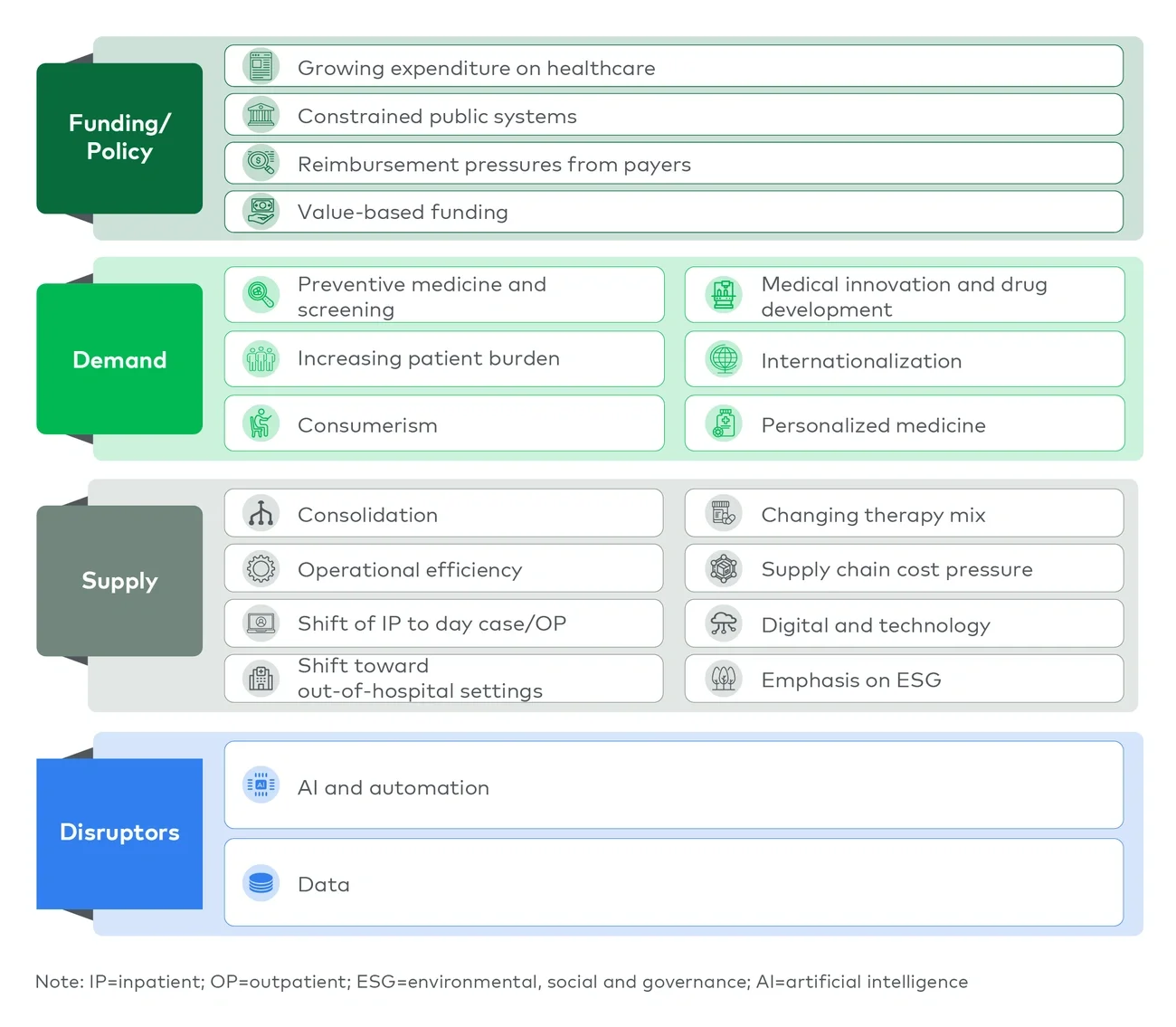
Historically, growth has been driven by structural tailwinds such as population expansion, rising chronic disease burden, insurance growth and undercapacity in key specialties. While these remain relevant, they are no longer sufficient. Value creation is increasingly determined by how healthcare systems are structured, including reimbursement evolution, referral dynamics, patient access points and alignment with national priorities (see Figure 1).

This shift is particularly visible in the United Arab Emirates (UAE) and Saudi Arabia. In the UAE, especially Abu Dhabi, reimbursement discipline, primary care reform and data-driven system management are reshaping demand flows. In Saudi Arabia, scale and insurance expansion are key drivers, with insurance penetration expected to increase from approximately 39% today to over 55% by 2030, further accelerating demand formalization and private-sector participation.

Across both markets, providers must move beyond capturing demand to actively shaping and retaining it.

Figure 1

There are a range of global healthcare megatrends that are relevant for private healthcare providers

Image
Figure 1 represents a range of global healthcare megatrends that are relevant for private healthcare providers

Figure 1

There are a range of global healthcare megatrends that are relevant for private healthcare providers

Image
Figure 1 represents a range of global healthcare megatrends that are relevant for private healthcare providers

The landscape is shifting from volume growth to pathway control

Across the GCC, healthcare systems are moving away from hospital-centric models toward integrated, multisite care pathways. Policymakers are prioritizing access, prevention and efficiency, which is changing how and where care is delivered.

  • In the UAE, this shift is reinforced by the strategic will to have stronger primary care gatekeeping, preventive programs and digital infrastructure
  • In Saudi Arabia, it is driven by health clusters, expanding private participation and new delivery formats

Globally, this transition is already well advanced. Across The Organization for Economic Co-operation and Development (OECD) markets, a growing share of procedures is delivered in outpatient or day-case settings, reflecting a structural shift away from inpatient care toward more efficient sites of care. Many procedures that were historically hospital-based are now routinely delivered on a same-day basis.

As a result, demand is no longer passively captured. It must be actively managed across the patient’s journey. Providers that rely on episodic hospital demand risk losing share to those that control referral flows and outpatient access.

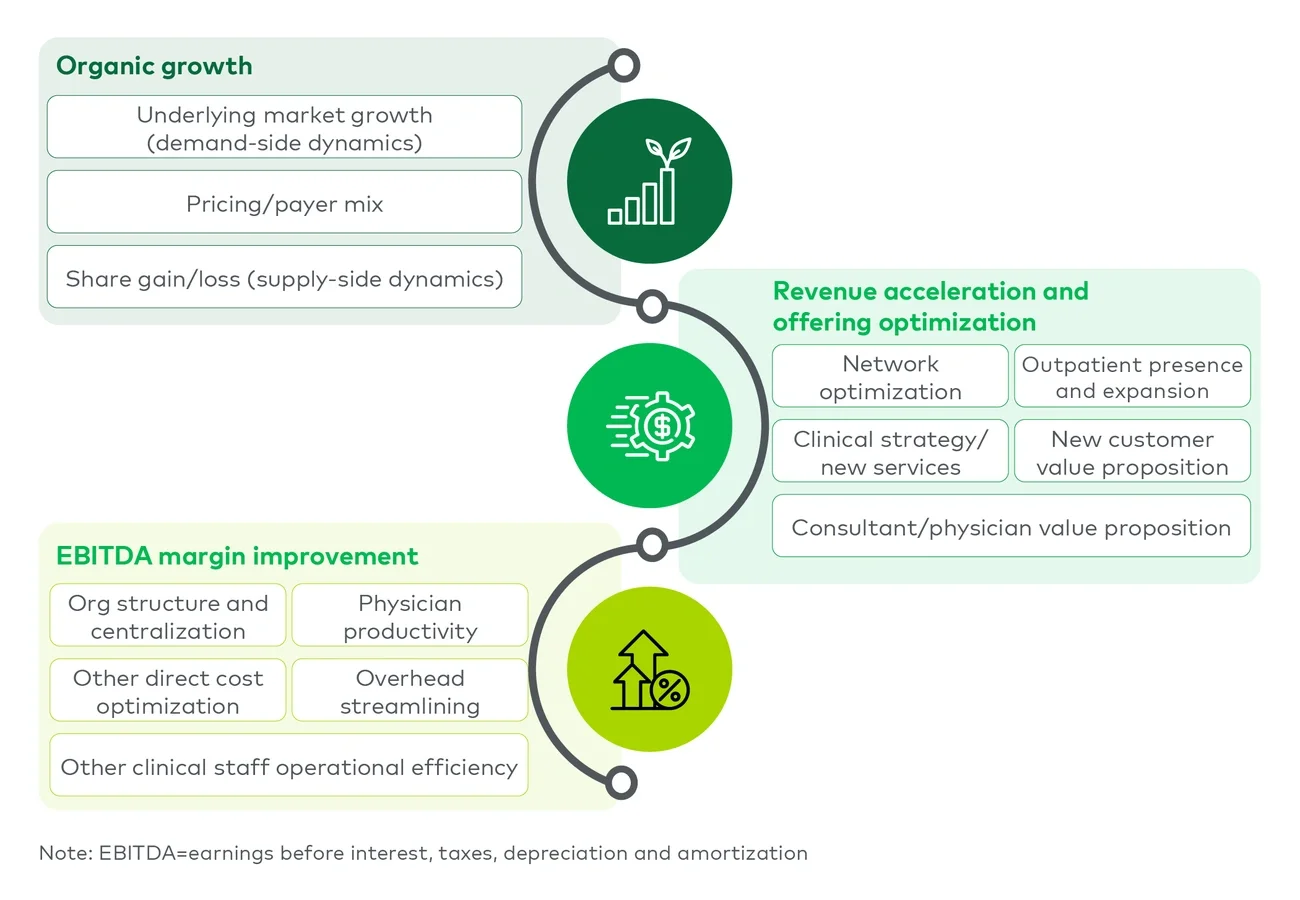
Value creation rests on three linked agendas (see Figure 2)

1. Targeted organic growth, not undifferentiated expansion

Value creation begins with a precise understanding of where attractive growth exists across specialties, care settings, payers and patient cohorts.

  • Not all growth is equally valuable
  • Winning providers align structural demand with clinical capability, market white space and economic returns

In practice, this often means prioritizing:

  • Elective surgery and chronic disease pathways
  • Women’s and family health
  • Outpatient expansion and other nonhospital areas such as long-term care

Across the GCC, this requires moving beyond capacity-led strategies toward networked service deployment that connects care settings and reinforces patient retention.

2. Local access and site-of-care optimization as demand capture levers

Local access is increasingly central to both growth and referral control. Policymakers are encouraging models that improve convenience and reduce pressure on acute care hospitals.

This is accelerating the importance of:

  • Primary care and polyclinics
  • Day surgery and diagnostics
  • Community-based care formats

Equally important is optimizing the settings mix across the care pathway. Hospital infrastructure should be reserved for high-acuity, complex care, while lower-acuity procedures, diagnostics and interventions are increasingly delivered in outpatient or community settings. This shift is supported by global evidence showing that many procedures can be safely delivered outside of hospitals with comparable or improved outcomes and lower costs.

A significant share of demand continues to leak to competitors or major urban centers due to gaps in accessibility, trust or service breadth. Providers do not need full tertiary capability locally, but they must offer a compelling proposition for routine and secondary care supported by clear escalation pathways.

3. Earnings before interest, taxes, depreciation and amortization (EBITDA) margin improvement through operational discipline

Sustainable margin improvement is not driven by cost cutting alone. It requires systematic operational excellence embedded within clinical delivery.

Key levers include:

  • Organizational design and staffing optimization
  • Theater utilization and facility productivity
  • Revenue cycle and claims management
  • Procurement and shared services
  • Automation of administrative processes

A critical component of this agenda is improving the utilization of hospital infrastructure. One important shift is from inpatient to day-case delivery models. For example, in Australia, tonsillectomy day cases increased from 266 in 1993 to 11,199 in 2022, while inpatient volumes remained substantial, increasing from 33,481 to 46,794. This lifted the day-case share from 0.8% to 19.3%, demonstrating how activity can be rebalanced without reducing overall demand.

Leading organizations treat operational performance as a core enabler of both growth and clinical quality rather than as a stand-alone efficiency initiative.


Figure 2

There are multiple value creation levers for healthcare providers, including organic growth, revenue acceleration and offering optimization and EBITDA margin improvement

Image
Figure 2 represents multiple value creation levers for healthcare providers, including organic growth, revenue acceleration and offering optimization and EBITDA margin improvement

Figure 2

There are multiple value creation levers for healthcare providers, including organic growth, revenue acceleration and offering optimization and EBITDA margin improvement

Image
Figure 2 represents multiple value creation levers for healthcare providers, including organic growth, revenue acceleration and offering optimization and EBITDA margin improvement

Why many providers fail to convert growth into value

Volume without conversion limits value

Many providers generate strong outpatient volumes but fail to convert demand into higher-value services such as diagnostics, procedures or inpatient care.

Common root causes include:

  • Limited elective depth
  • Weak referral protocols
  • Low theater productivity
  • Misaligned clinician incentives

The constraint is often execution rather than demand.

Pathway-led models outperform siloed service lines

Service lines such as women’s health, pediatrics and chronic disease management are individually attractive, but their true value lies in how they connect.

Providers that design care around patient pathways rather than departments can:

  • Increase referral density
  • Improve patient retention
  • Capture a greater share of lifetime value

Network strategies fail without governance

Many organizations pursue hub-and-spoke or center-of-excellence models. However, execution often falls short due to unresolved governance questions.

Critical issues include:

  • Ownership of patient relationship
  • Allocation of revenue and costs across sites
  • Clinician incentives and behavior
  • Standardization of protocols and quality

Without clarity, networks remain conceptual rather than value-generating.

Brand and referral activation remain underleveraged

Awareness and trust are often underestimated, particularly outside major cities.

Even strong clinical offerings require:

  • Local brand presence
  • Active physician engagement
  • Clear articulation of service propositions

Demand capture depends as much on visibility and trust as on capability.

Digital and operating model choices are central to future performance

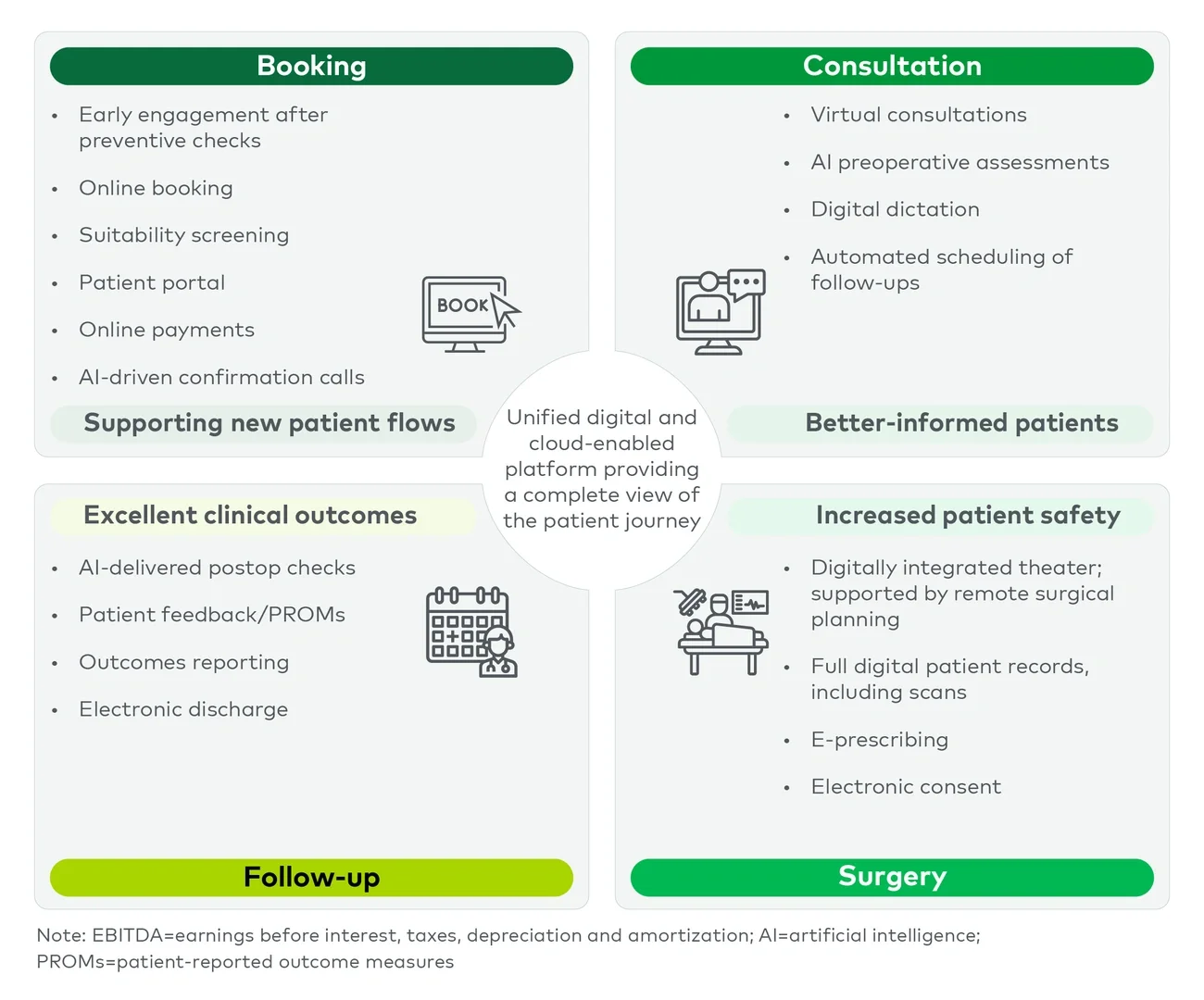
Digital is a key enabler of both growth and efficiency, yet it is often treated as a stand-alone information technology initiative. In reality, it is integral to value creation (see Figure 3).

High-impact use cases include:

  • Patient acquisition and digital engagement
  • Scheduling, eligibility and referral management
  • Chronic disease pathway coordination
  • Virtual care and follow-up
  • Performance transparency and analytics

When deployed effectively, digital improves both patient experience and operational economics.

At the same time, operating model design is becoming a strategic differentiator. Scaled providers create value by combining:

  • Selective centralization of high-acuity services
  • Strong cross-referral mechanisms
  • Professionalized support functions
  • Integrated multisite networks

The interaction between clinical pathways and operational structure ultimately determines performance.

Figure 3

Opportunities for integration of digital solutions across the patient journey enhance both revenue and EBITDA

Image
Figure 3 represents opportunities for integration of digital solutions across the patient journey enhance both revenue and EBITDA

Figure 3

Opportunities for integration of digital solutions across the patient journey enhance both revenue and EBITDA

Image
Figure 3 represents opportunities for integration of digital solutions across the patient journey enhance both revenue and EBITDA

Conclusion

The central question for GCC healthcare leaders is no longer whether demand will grow but which organizations are best positioned to convert that growth into sustainable performance.

Value creation now depends on:

  • Choosing the right service lines and care settings
  • Capturing and retaining patients along the pathway
  • Optimizing site-of-care and infrastructure utilization
  • Building scalable, integrated operating models
  • Embedding operational discipline and digital enablement

For providers and investors, value creation is no longer a post-deal optimization exercise. It is the core strategic agenda. Organizations that combine clinical ambition with operational rigor, local access with network depth and digital capability with pathway control will be best placed to achieve durable leadership in the GCC healthcare market.

If you would like to discuss these themes further or explore their implications for your organization, please get in touch with our Healthcare team.

L.E.K. Consulting is a registered trademark of L.E.K. Consulting LLC. All other products and brands mentioned in this document are properties of their respective owners. © 2026 L.E.K. Consulting LLC

English