

Executive Insights

The End of Price-Led Growth: The 2026 Restaurant Playbook

Rebuilding the guest value equation to win traffic and frequency
May 27, 2026

Key takeaways

Price increases and average check growth are no longer dependable comparable-sales levers; traffic and frequency have moved back to the center of the equation.

The widening spread across brands suggests strategy, not segment exposure, is now differentiating winners.

Winning brands are delivering value that feels holistic to the guest, combining price, quality, portion, experience, convenience and relevance.

For operators, the 2026 playbook centers on visible value, tangible quality, guest-visible AI, loyalty utility, consistent execution and precise occasion targeting.

Price-led growth has run its course

Price increases are no longer driving restaurant growth, and in many cases, they are now suppressing it. In 2026, comparable-sales (comps) performance has shifted back to traffic and frequency, forcing operators to rebuild the guest value equation from the ground up.

The National Restaurant Association expects only 1.3% real sales growth in 2026. Black Box data shows traffic remained negative in both December 2025 and January 2026. The industry continues to grow nominally, but the easy levers are largely gone.

In this environment, pricing is no longer a dependable engine of top-line growth. In some cases, it may now be weighing on traffic and, by extension, comps. Yet the market is not moving in lockstep. A growing set of restaurant brands is outperforming despite the same macro conditions. That widening spread suggests the next phase of comps growth will be driven less by market tailwinds and more by how effectively each brand rebuilds its value equation, especially when serving middle- and lower-income consumers (see Figure 1).
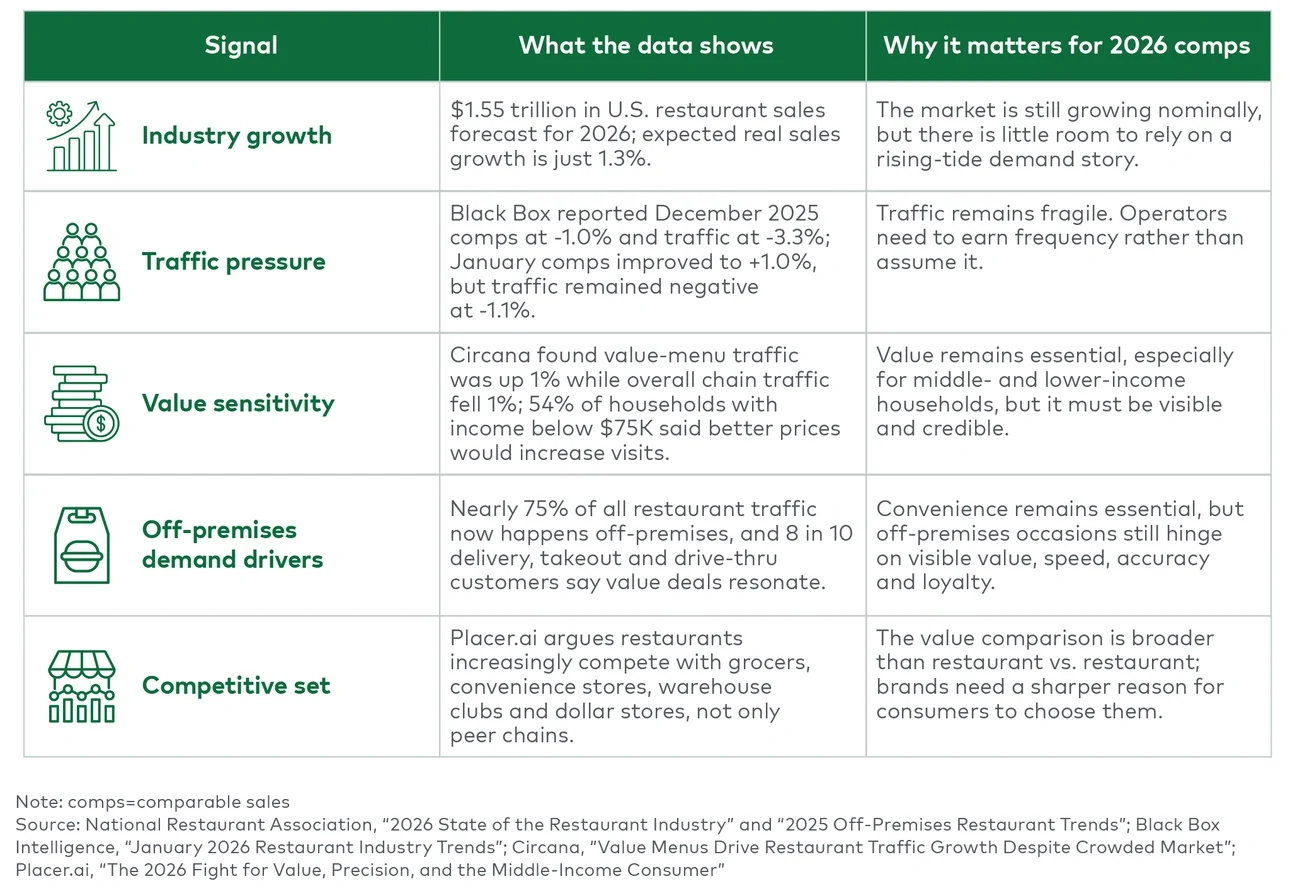
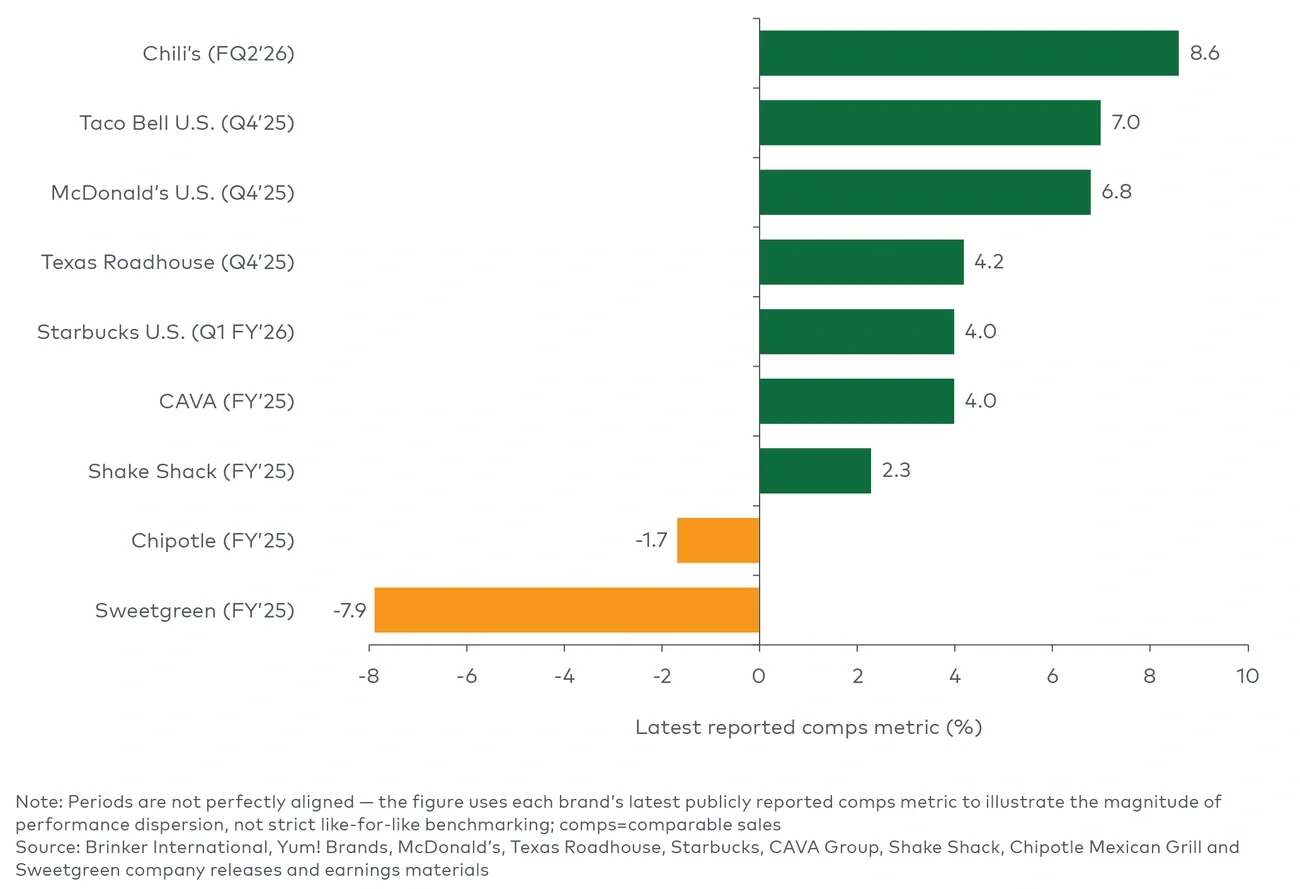
Figure 1

The backdrop explains pressure but not the spread in performance

Image
Figure 1 represents the backdrop explains pressure but not the spread in performance

Figure 1

The backdrop explains pressure but not the spread in performance

Image
Figure 1 represents the backdrop explains pressure but not the spread in performance

The shift: From pricing power to value clarity

This is not a market that can be powered solely by affluent diners. The value equation has to work for households with total income below $75,000. Circana found that 54% of those households would visit restaurants more often for better prices, but value is rarely defined by price alone.

What is emerging instead is a more disciplined form of consumer behavior. Guests are still willing to spend but only when the food, experience and convenience clearly justify the bill. In that sense, value is less an abstract concept than a simple judgment: Was this worth it?

That judgment is shaped by a combination of factors: confidence in portion size and quality, the ease and speed of the experience, and how clearly the offering stands up against alternatives. What looks like a “flight to quality” is often a flight away from “just good enough.” Consumers will trade up when the value is evident and trade down quickly when it is not.

Differential performance suggests strategy is overtaking sector tailwinds

The spread in reported results is striking. Chili’s, McDonald’s, Taco Bell, Starbucks, Texas Roadhouse and CAVA are all posting strong comps growth, while others have seen traffic-driven declines (see Figure 2).

These brands operate in different segments and serve different customer bases, yet they are exposed to the same macro backdrop. The lesson is not that one segment is structurally advantaged. It is that brands with a clearer and more credible consumer proposition are separating from the field.

At a high level, the distinction is becoming easier to observe. The strongest performers are making value legible through price architecture, product quality, experience and execution, while weaker performers are relying on positioning or pricing that customers no longer find sufficient on its own.

Figure 2

Selected concepts show widening dispersion in comps performance

Image
Figure 2 represents selected concepts show widening dispersion in comps performance

Figure 2

Selected concepts show widening dispersion in comps performance

Image
Figure 2 represents selected concepts show widening dispersion in comps performance

The new restaurant value equation

Based on current performance patterns, six moves are emerging among outperforming brands. Together, they form a more complete definition of value — one that is experienced, not simply priced.

1. Start earning preference, don't just offer low price

Value has to be immediately legible to the guest. The objective is not to be the cheapest option on the block; it is to feel like the smartest purchase. Chili’s resurgence has been built not on indiscriminate discounting but on a combination of competitive pricing, sharper communication, menu clarity and improved operations. Taco Bell’s value architecture similarly establishes a clear entry point while preserving brand distinctiveness. These brands are not just winning one quarter but quarter after quarter, earning customer preference.

Customer value is not a cheaper sandwich. It is total confidence that the meal, the experience and the convenience made it worth the spend.

— Abigail Pringle, Former President, U.S., The Wendy’s Company

2. Deliver value they can see, taste and trust

What looks like a flight to quality is less about premiumization for its own sake than about reducing valueless complexity. Our work suggests that consumers who said dining out was not worth the money most often pointed to food quality and portion size. Brands must conduct disciplined menu simplification. The best operators don’t approach this as cost-cutting but rather as a disciplined review of their value creation equation across three lenses: the customer, operations and economics.

Chili’s continues to benefit from a highly satisfying dine-in experience enabled by its menu simplification and accessible pricing. CAVA is capturing share with bold flavors, customization and a health-forward proposition that still feels attainable. Shake Shack continues to position around high-quality food, warm hospitality and value. By contrast, premium price positioning without equally visible product or experience advantages is becoming harder to sustain.

As Abigail Pringle, Former President, U.S., The Wendy’s Company, puts it, “The guest wants better value and an experience they can consistently trust. Every menu item must earn its place by delighting the customer, strengthening the brand and justifying its operational cost.”

3. Make AI guest-visible and employee-valuable

The most productive applications of artificial intelligence (AI) are increasingly those that customers can feel directly. Voice ordering, improved accuracy, more relevant offers and smoother service recovery all contribute to a better and more consistent experience. In that sense, the return on AI is not just labor efficiency but also improved traffic and customer satisfaction through reduced friction. Leveraging AI in the back of the house (inventory, staffing, scheduling, forecasting) seamlessly creates more opportunity for the restaurant general manager (GM) and crew to focus on the guest experience and simplify the historically arduous and manual work of restaurant operations.

AI first and foremost should be designed to take friction out of the customer visit and enable the GM and restaurant team to focus on the guest experience. As a result, you will drive sales and improve labor efficiency.

— Abigail Pringle

4. Frequency is a loyalty and data problem

Loyalty has become too important to treat as a digital coupon book. Leading brands are investing heavily in loyalty ecosystems and data to enable personalization. McDonald’s generated nearly $37 billion in systemwide sales with loyalty members in 2025 and ended the year with nearly 210 million 90-day active members globally. Starbucks’ 35.5 million active U.S. members reflect a program built not just around discounts but also around utility, tiering and more meaningful redemption. The strongest programs create habit, relevance and identity. The weakest ones simply train customers to wait for the next offer.

The strongest loyalty programs increase revenue and customer visits by fostering an emotional connection to the brand and creating relational value, not just transactional discounts. The weakest ones teach customers to wait for the next coupon.

— Abigail Pringle

5. Operational excellence is a growth strategy, not a secondary consideration

Operational excellence is once again a top-line issue. In this environment, execution is not just about cost control — it is a primary driver of repeat visits. Black Box found that limited-service restaurants with no GM turnover in 2025 saw a 1.0-point traffic lift and a 22-point reduction in hourly churn. Additionally, pickup is gaining while delivery weakens, which makes order accuracy, pickup flow and the handoff experience more important than ever. Chipotle’s own “Recipe for Growth” underscores the point by centering more accurate and more efficient execution as a path back to transaction growth.

A clean dining room, an accurate order, a calm pickup shelf and a faster and more reliable drive-thru are no longer back-of-house details. They are increasingly part of the brand promise and impactful experience.

6. Compete with precision for the right occasion

The competitive set has widened. Restaurants are increasingly competing not only with each other but also with grocers, convenience stores, warehouse clubs and other food retail formats that can provide for the same eating occasion.

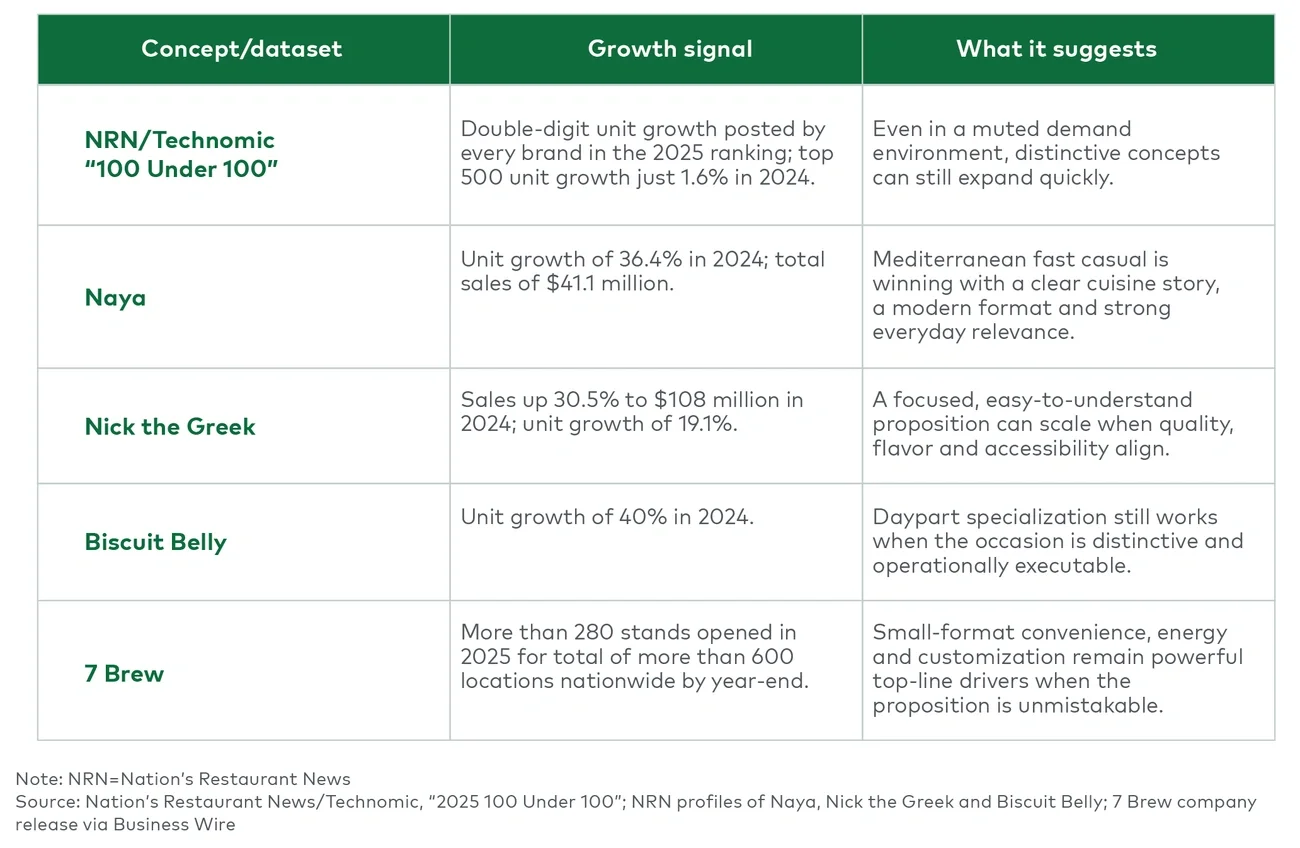
This makes precision critical. Winning brands are clear about the occasion they serve — the daypart, the need state, the customer segment — and build their proposition accordingly. Broad, undifferentiated traffic strategies are becoming less effective in a more fragmented competitive landscape (see Figure 3).

Figure 3

Emerging growth concepts show the market still rewards sharp positioning

Image
Figure 3 represents emerging growth concepts show the market still rewards sharp positioning

Figure 3

Emerging growth concepts show the market still rewards sharp positioning

Image
Figure 3 represents emerging growth concepts show the market still rewards sharp positioning

Closing perspective

The implication is not that growth has disappeared. It is that growth has become more selective. The industry may continue to point to consumer pressure, but the widening gap between winners and laggards suggests a more important shift.

2026 is a strategy test.

The next phase of comps outperformance will come from brands that can translate value into something the guest can see, taste and feel without eroding economics. This will require sharper menu architecture, clearer product signals, technology that improves the experience, loyalty that builds habit, consistent execution and tighter occasion targeting.

Concepts that rebuild the full value equation for their guests can still take share. This is even more critical among lower-income-focused concepts. Restaurants that rely on pricing alone are likely to find that the lever has lost much of its force. Winning brands will deliver value that customers can immediately recognize and choose again and again.

Note: This Executive Insights was written in collaboration with operator perspectives from Abigail Pringle.

For more information, please contact us.

L.E.K. Consulting is a registered trademark of L.E.K. Consulting LLC. All other products and brands mentioned in this document are properties of their respective owners. © 2026 L.E.K. Consulting LLC

English