


Executive Insights

The CEO Agenda for the ‘New’ Payments Enterprise

May 29, 2026

Key takeaways

The payments industry is undergoing structural change as real-time money, embedded ecosystems, agentic commerce, trust monetization and regulatory shifts reshape how value is created and scaled. Emerging 2026 pressure points are accelerating the need for enterprise-wide transformation.

As AI agents increasingly influence commerce and payments decisions, competitive advantage will shift toward providers that are easiest to integrate with, trusted by default and able to deliver reliable performance at scale.

Embedded ecosystems and real-time infrastructure are redefining growth and distribution economics, pushing firms to simplify partner enablement, standardize integration and balance speed with control.

Trust is becoming a monetizable growth lever, with firms increasingly packaging fraud, identity and compliance capabilities as differentiated services while navigating rising operational and regulatory complexity.

The payments industry is entering a period of structural change in which multiple forces are reshaping economics, distribution and operating models. The foundations of how money moves, how value is created and how risk is managed are being rearchitected simultaneously. Intelligent and agentic commerce is reshaping discovery, conversion and operations as software is increasingly mediating decisions that were once made by humans. Embedded ecosystems are reorganizing how financial products are distributed and consumed. Real-time and programmable money are compressing cash cycles and altering segment-level economics. Trust is evolving from a control function into a potentially differentiated, monetizable layer. And legal and regulatory shifts are increasingly reshaping the economic boundaries of the system.

What makes this moment distinctive is not the presence of these forces individually, but the way they interact. Decisions made in one domain increasingly constrain or amplify options in others. As a result, payments strategy is becoming less about optimizing isolated initiatives and more about designing an enterprise that can adapt, scale and compete across interconnected shifts.

Payments leaders are increasingly turning their attention from simply improving their organizations toward architecting enterprises capable of expanding into new segments, scaling through partners, monetizing trust, and operating with reliability and control at real-time speed. Doing so requires a clearer view of where strategic pressure is building and where uncertainty is highest.

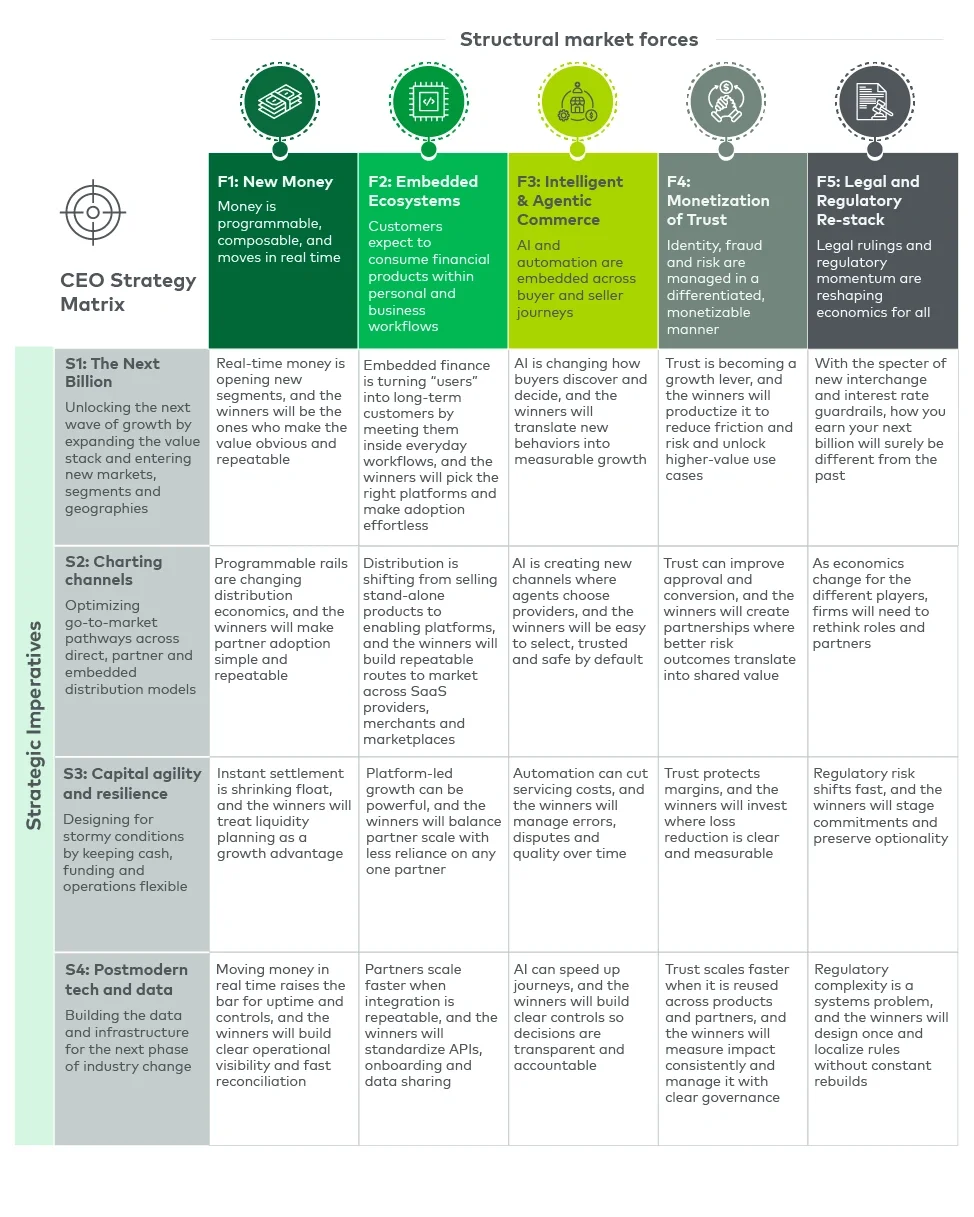
This anchor publication from L.E.K. Consulting introduces the CEO Strategy Matrix, a framework designed to help executive teams navigate this complexity. The matrix surfaces where core strategic imperatives intersect with structural market forces and where unresolved questions are emerging that demand chief executive officer (CEO)-level attention.

The paper does not attempt to provide a single definitive answer across the matrix — as with any thoughtful strategy, the path each firm chooses to navigate the matrix will be unique to its own point of departure and capabilities. Instead, we lay out the landscape and explore a set of intersections where we see growing strategic tension and leadership uncertainty. These areas will be the focus of continued research and follow-on analysis in the months ahead as we test how firms are responding and where competitive advantage is beginning to form.

Introducing the CEO Strategy Matrix

We built the CEO Strategy Matrix as a way to translate broad market forces into an actionable executive agenda. The matrix explores the intersection of five market forces and four strategic imperatives to highlight where CEO-level trade-offs are concentrating. Each intersection represents a distinct set of strategic questions. At any given moment, only a subset of intersections will exert meaningful pressure on leadership teams, and these priorities will vary by business model, geography and starting position.

In this anchor paper, we highlight five of the intersections where early signals point to the greatest opportunity for durable advantage and the most consequential strategic choices facing CEOs’ teams today. These sections are intended to frame the questions, tensions and enterprise design considerations that CEOs and their leadership teams are beginning to confront. They also establish the agenda for subsequent research, which will deepen the analysis and surface clearer points of view as evidence emerges.
Image
CEO Strategy Matrix

Note: AI=artificial intelligence; SaaS=software as a service; API=application programming interface 
Source: L.E.K. research and analysis 

Image
CEO Strategy Matrix

Note: AI=artificial intelligence; SaaS=software as a service; API=application programming interface 
Source: L.E.K. research and analysis 

The 2026 pressure points

1. Redesigning money: Real-time and programmable liquidity as a growth engine

Intersection: New money × The next billion

Real-time and programmable money are often framed as faster payment rails. In practice, they may be far more disruptive. By compressing settlement cycles and enabling conditional movement of funds, these capabilities have the potential to change which segments can be served profitably and how value is captured. For CEOs, the open question is where these innovations fundamentally alter economics. Faster settlement reduces float but improves liquidity. Programmability enables new use cases but introduces operational and control complexity. The net impact will likely vary widely by segment, geography and business model.

Many firms are piloting real-time capabilities, but few have translated them into repeatable segment-level strategies. The risk is investing in infrastructure without clarity on where it creates durable advantage.

Emerging CEO questions:

  • Which segments or use cases become viable only with real-time or programmable money?
  • How do compressed cash cycles change unit economics, pricing and risk allocation?
  • Where does programmability unlock new revenue versus creating operational burden?
  • What operating capabilities are required to deliver reliability at real-time speed?

2. Competing in an agentic commerce economy

Intersection: Intelligent and agentic commerce × (The next billion + Charting channels)

Artificial intelligence (AI) is beginning to alter how payments products are discovered, selected and operated. Automation is spreading across onboarding, routing, risk, dispute management and customer service, while agents increasingly mediate decisions that were once made by humans. For payments leaders, this raises a fundamental question: How does competition change when agents, not people, become the decision-makers?

Early signals suggest that agentic commerce may reshape both growth and go-to-market advantage. Automation has the potential to make previously uneconomic segments viable by reducing friction and cost to serve. At the same time, agent-mediated discovery could shift distribution power toward providers that are easiest for machines to integrate with, evaluate and reliably select.

What remains unresolved is how quickly these dynamics will materialize and what it will take to compete effectively when performance signals, integration depth and reliability matter as much as brand or sales coverage. Many firms are experimenting, but few have clarity on where automation truly expands access versus where it simply reallocates value.

Emerging CEO questions:

  • Where can automation meaningfully expand the addressable market, rather than just improve efficiency?
  • How might agent-mediated selection change what distribution advantage means in payments?
  • What signals (performance, reliability, economics) will matter most when agents choose providers?
  • How should firms test whether AI-driven capabilities are creating growth, not just lowering cost?

Market signal call-out: Agent-driven commerce is on track to reach about 9% of U.S. digital commerce by 2029.

3. Productizing trust: Turning risk, identity and compliance into growth

Intersection: Monetization of trust × The next billion

Trust has long been treated as a defensive requirement in payments — necessary to operate, but rarely a source of differentiation. That assumption is being challenged. As fraud, identity and compliance demands rise, customers and partners are increasingly willing to pay for higher assurance, lower friction and better outcomes. This shift raises a strategic question: Can trust move from an internal control function to a monetizable product layer and, if so, under what conditions?

Some firms are beginning to package elements of their trust stack as embeddable services. Others are experimenting with tiered assurance models tied to pricing, conversion or approval rates. Yet there is little consensus on what customers will pay for, how trust should be bundled or how monetization affects adoption and retention.

Emerging CEO questions:

  • Which trust capabilities create measurable customer value with clear willingness to pay?
  • How should trust be packaged (stand-alone, bundled or embedded) to maximize adoption?
  • What outcomes can credibly support pricing and differentiation?
  • How can firms build a unified trust stack that scales across products and partners?

Market signal call-out: Klarna’s Merchant Protection Program now guarantees merchants the full purchase amount on eligible transactions, effectively packaging fraud and dispute protection as a bundled trust layer within its payments offering.

4. Orchestrating embedded scale: Building partner enablement that launches faster

Intersection: Embedded ecosystems × Postmodern tech and data

Embedded finance is no longer constrained by demand. Merchants, platforms and software as a service (SaaS) providers increasingly expect financial capabilities to be delivered within their workflows. As embedded ecosystems scale, payments firms are discovering that partner enablement, not product breadth, is the bottleneck. Time to launch, integration friction and inconsistent implementations often erode economics and customer experience.

The unresolved challenge is how to industrialize embedded distribution without sacrificing flexibility. Firms must balance standardization with partner differentiation, speed with control and scale with reliability.

Emerging CEO questions:

  • What partner enablement capabilities truly matter to win embedded distribution (integration, implementation, operations, support)?
  • What capabilities must be standardized to enable partners to launch quickly and repeatably?
  • Where does customization create real value versus unnecessary complexity?
  • How should reliability, controls and experience standards be enforced across partners?

Market signal call-out: “The next phase of embedded finance will be defined less by who offers the most products and more by who can build a repeatable enablement layer for partner scale. As ecosystems grow more complex, the differentiator becomes the ability to combine speed, reliability, compliance, and intelligent infrastructure into an experience that allows partners to launch quickly without recreating operational friction each time. The banks that win will standardize the foundational enablement layer while preserving flexibility where it truly differentiates the partner and customer experience.”

-Whitney Woyke, EVP of Retail & Embedded Banking, Emprise Bank

5. Owning the embedded channel mix: Where to play, how to bundle, how to scale

Intersection: Embedded ecosystems × Charting channels  

As embedded finance expands, payments leaders face a more complex channel landscape. Direct merchants, vertical SaaS, horizontal platforms, marketplaces and ecosystem partners each offer different economics, control points and scalability profiles.

The strategic question is where does embedded distribution create sustainable advantage? Treating every opportunity as strategic risks spreading resources thin and accumulating complexity faster than growth. At the same time, bundling decisions (what products to offer, how to price them and how partners participate in value creation) are becoming more consequential.  

Emerging CEO questions:  

  • Which embedded channels offer true scalability versus near-term volume?
  • How should product bundles differ by channel to balance adoption, economics and speed?
  • What partner roles and incentives support repeatable growth?
  • How can firms expand embedded distribution while avoiding channel conflict? 

Market signal call-out: "The winners in the embedded landscape will be those who can orchestrate multi-party value chains without diluting their unit economics through over-customization. Success requires a 'distribution-first' architecture that allows for flexible bundling at the edge while maintaining a standardized, lean core for global scale."

-Kevin Fox, CRO, Thredd

Conclusion

The payments enterprise is being reshaped across multiple dimensions at once. None of these forces operate in isolation — each amplifies the others, creating new opportunities as well as new constraints.

The CEO Strategy Matrix is designed to help leaders see this system holistically. It does not prescribe a single path forward; instead, it provides a structured way to identify where strategic pressure is building, where uncertainty is highest and where enterprise design decisions will matter most.

The intersections explored in this anchor paper reflect areas where executive attention is increasingly required, but not yet settled. In the months ahead, we will deepen the analysis across these intersections, test emerging hypotheses and surface clearer points of view as evidence develops.

L.E.K. Consulting is a registered trademark of L.E.K. Consulting LLC. All other products and brands mentioned in this document are properties of their respective owners. © 2026 L.E.K. Consulting LLC

English