Executive Insights

From Reimbursement to Provision: Saudi Arabia’s Vertical Integration Window for Health Insurers

July 8, 2026

By most measures, Saudi Arabia’s healthcare market is a growth story without an obvious flaw. Total healthcare spending is forecast to reach USD76 billion in 2026, growing at about 7% per year since 2022, while gross written premium for private medical insurance nearly doubled between 2018 and 2023, from USD5.4 billion to USD10.4 billion, and roughly one-third of the population now carries some form of private coverage. Yet the kingdom’s insurers have captured remarkably little of this prize. Growth has flowed through their books rather than to their bottom line

That is about to change, for those willing to change what business they are in. An amendment to the Private Health Institutions Law in April 2019 (Cabinet Decision No. 559) allows joint-stock and foreign companies, including insurers, to own and operate clinics, diagnostics centers and hospitals for the first time. The question facing every health insurance executive in Riyadh is no longer whether vertical integration is permitted. It is whether to move now, and where.

The provider-payer profitability gap is structural, not cyclical

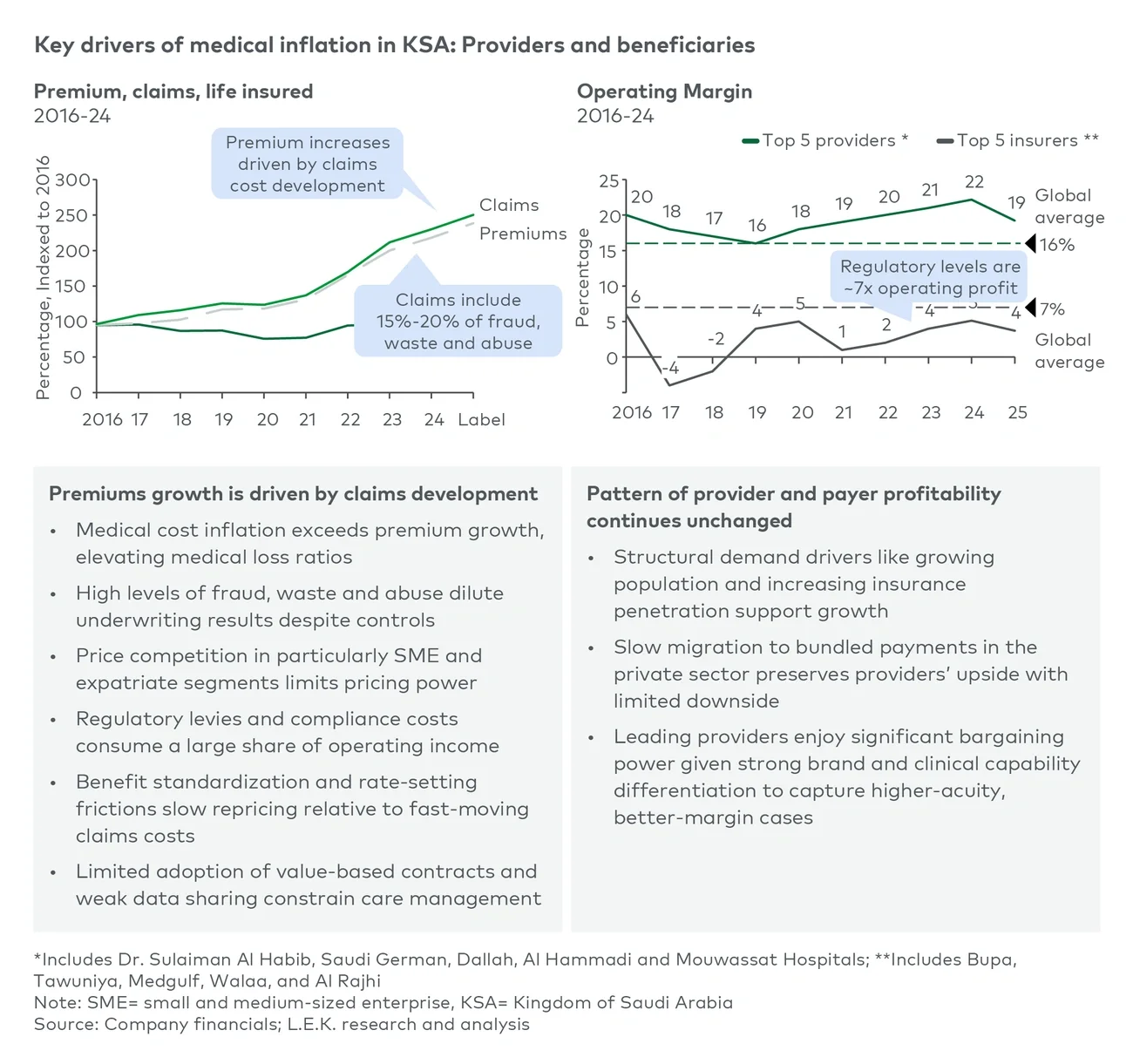
Between 2016 and 2024, Saudi Arabia’s top five private providers earned operating margins of 16%-22%, comfortably above the 16% global average for their peer group. The top five insurers oscillated between -4% and 6% over the same period, settling at about 5% in 2024, still below the 7% global benchmark (see Figure 1).

Image
Premium and claims development, and operating margins of Saudi Arabia’s top five providers versus top five insurers, 2016-24

It is tempting to read this as a cyclical squeeze that better underwriting will eventually correct. The evidence points the other way. Claims have grown faster than premiums since 2016, with medical cost inflation persistently elevating loss ratios. Fraud, waste and abuse account for up to 10%-12% of overall claims, according to ANB Capital’s 2025 Saudi insurance sector report, while regulatory levies consume a multiple of insurers’ operating profit. Providers, meanwhile, hold the structural advantages: strong brands and clinical differentiation that capture higher-acuity cases, and a slow migration to bundled payments that preserves their upside with limited downside. A payer that does not touch care delivery is a price taker at every link of the chain.

Three forces have redrawn the boundary of the insurer’s business

The case for integration rests on three forces converging at once

1. Demand

Private medical insurance is projected to comprise approximately 35% of total healthcare spending by 2026, propelled by mandatory coverage for private-sector employees and expatriates and by widening benefit requirements from the Council of Health Insurance.

2. Regulation

The kingdom’s Vision 2030 strategy targets raising the private sector’s share of healthcare delivery from 40% to 65% by 2030, with privatization plans covering about 290 hospitals and approximately 2,300 primary health centers. The 2019 ownership reform gives insurers a licensed route, through the Ministry of Health and the Ministry of Investment, to own assets across that expanding private estate.

3. Precedent

The first insurer-backed vehicles are already operating. Tawuniya’s Meena Health announced plans in 2024 to open 46-52 primary care centers by 2027 with a budget of SAR500 million, and Bupa Arabia’s CareConnect launched its first clinics in 2025.

Individually, each force is an encouraging signal. Together, they convert vertical integration from a regulatory hypothetical into a live strategic race.

Consultation and diagnostics are the natural first moves

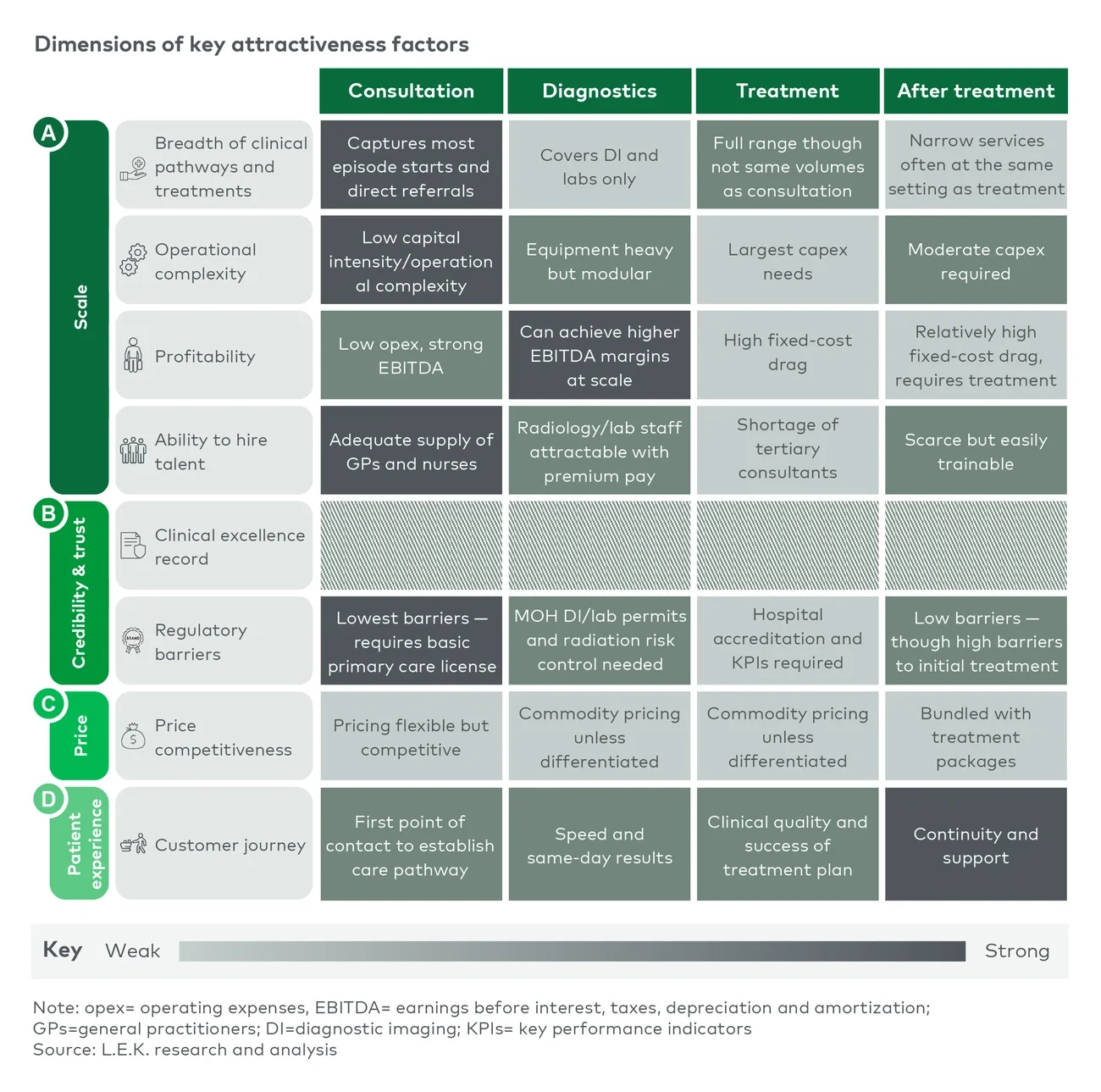
The instinct of many boards will be to anchor integration in hospitals, where the revenue pools are largest. The economics argue for the opposite sequence. Figure 2 compares the four stages of the patient pathway across scale, credibility, price and patient experience.

Figure 2

Attractiveness of care-delivery segments across the patient pathway

Image
Figure 2 Attractiveness of care-delivery segments across the patient pathway

Figure 2

Attractiveness of care-delivery segments across the patient pathway

Image
Figure 2 Attractiveness of care-delivery segments across the patient pathway

Consultation offers the lowest capital intensity and operational complexity, the lightest licensing requirements, an adequate supply of general practitioners and, critically, control of the point where most care episodes begin and referrals are made. Diagnostics is equipment heavy but modular, can achieve higher EBITDA margins at scale and can attract radiology and laboratory staff with premium pay. Treatment carries the largest capital expenditure needs, hospital accreditation requirements and a shortage of tertiary consultants, while posttreatment services are typically bundled with treatment and rarely stand alone.

The economics compound on both sides of the ledger. Ownership generates new revenue beyond premiums, through consultation fees and diagnostic imaging and laboratory services, while shared administrative infrastructure lowers cost to serve. It also closes the data loop: An insurer with real-time clinical data, not just claims data, can monitor billing integrity directly, identify at-risk members early and intervene before an episode escalates into an expensive admission. Cost recovery alone justifies attention: With fraud, waste and abuse running at up to 10%-12% of claims, even partial recapture inside an owned network moves the loss ratio more than most repricing cycles.

The sequencing matters as much as the selection. Consultation first secures the referral engine, and then diagnostics captures the spending that those consultations originate. An insurer that owns both controls the entry point of the pathway and the single richest source of clinical data, before committing a riyal to a hospital bed.

Global payers have already proven the playbook

None of this is untested. Bupa in the United Kingdom expanded from private medical insurance into own-brand hospitals, dental clinics and a digital general practice through decades of acquisition. Sanitas, Spain’s second-largest health insurer, has invested over EUR1 billion since 2021 in hospitals and its Blua digital primary-care platform. CVS Health became a payer-provider by acquiring Aetna in 2018 for USD69 billion, rolled out 1,200 HealthHUBs and in 2023 bought Oak Street Health and Signify Health to tighten vertical control. UnitedHealth Group’s Optum arm now spans more than 90,000 physicians alongside urgent-care and home-health provision. Optum has since grown into a substantial contributor to UnitedHealth Group’s operating earnings, evidence that provision can become a profit engine in its own right rather than a cost-control appendage. Kaiser Permanente, fully integrated since the 1940s, remains the standing proof that payer-provider alignment lowers hospitalization rates and cost to serve. 

The honest caveat is that none of these journeys was frictionless. Integrated payers abroad have drawn regulatory scrutiny, provider resistance and periodic member backlash. The lesson for Saudi insurers is not that integration is easy; it is that the model works when the entry point, the governance and the pace are chosen deliberately.


Four risks decide whether integration creates or destroys value

The market is tilting in favor of movers, but four executional risks separate value creation from value destruction

1. Capability

Insurers lack provider operating experience, from clinical supply chains to accreditation by the Saudi Central Board for Accreditation of Healthcare Institutions, and the capital intensity of fit-outs, equipment and start-up working capital is real.

2. Regulation

The kingdom’s Vision 2030 strategy targets raising the private sector’s share of healthcare delivery from 40% to 65% by 2030, with privatization plans covering about 290 hospitals and approximately 2,300 primary health centers. The 2019 ownership reform gives insurers a licensed route, through the Ministry of Health and the Ministry of Investment, to own assets across that expanding private estate.

3. Culture and trust

Clinical staff may resent a perceived cost-control culture, independent hospitals will push back against insurer-owned competitors, and members may fear that insurer-employed doctors will undertreat to save money.

4. Market dynamics

The provider landscape is fragmented, with many single-site clinics operating under weak governance, which makes roll-up acquisitions complex, and Vision 2030 interest is already inflating valuation expectations.

Each of these risks is manageable; none is avoidable. Pricing them into the integration plan from the outset, with independent governance for the provider arm and arm’s-length network pricing, is what keeps the regulator and the member onside.

What insurers and independent providers should do now

For insurers, the agenda over the next four quarters is concrete

  • Secure licenses and prime sites for consultation and diagnostics now, while clinical talent and locations remain contestable
  • Build or buy small: Clinics, polyclinics and diagnostic centers offer faster payback and lighter regulatory drag than hospital acquisitions
  • Ring-fence the provider arm with independent governance and arm’s-length pricing to preempt scrutiny of self-referral and related-party transactions
  • Design member journeys that reward in-network use through convenience and quality rather than coercive copays, protecting trust while steering volume

Independent providers face a mirror-image choice: Become essential or replicate integration. Becoming essential means specializing in complex, high-acuity care where outcomes and reputation force network inclusion despite payer integration. Replicating integration means horizontal consolidation for scale, strategic alliances with direct employer access or backward integration into risk-bearing itself.

With licenses granted and the first insurer-owned clinics open, vertical integration in Saudi healthcare has moved from a regulatory question to a capital allocation question. Insurers that wait will pay more for scarcer assets, negotiate against rivals’ captive networks and continue to absorb claims leakage that integrated competitors are converting into margin.

In the next chapter of Saudi healthcare, the insurers that own the front door of care will set the terms for everyone behind it.

Conclusion: From reimbursement to provision

Saudi Arabia’s health insurance market is growing, but insurers will not capture the full value of that growth through pricing discipline alone. The opportunity now is to move closer to care delivery, starting with consultation and diagnostics, where insurers can influence referrals, improve data visibility and manage costs more directly.

Vertical integration should therefore be treated as a strategic capital allocation decision, not simply an operating expansion. Insurers that move early, sequence carefully and maintain strong governance will be better positioned to convert claims pressure into margin advantage. Those that wait risk facing higher asset valuations, stronger captive networks and a weaker negotiating position in the next phase of Saudi healthcare.

English