


Why the most successful hotels are built through collaboration, not control
Hotel owners and operators have always shared the same goal: building distinctive assets that deliver strong financial returns. Historically, owners delegated hotel operations, and much of the commercial strategy, to management companies and brand partners. That approach continues to make sense, particularly in luxury hospitality where brand standards, service delivery and operating expertise are central to the guest experience.
Today, however, the economics of hotel ownership are evolving. Owners, lenders, investors and brands are placing greater emphasis on revenue growth, profitability and long-term asset value. At the same time, operating costs remain elevated and growth opportunities are becoming harder to find. As a result, many owners are taking a more active role in asset performance.
The most successful owners are not becoming operators. Instead, they are becoming more sophisticated partners. They are focusing on where they can influence outcomes, bringing stronger benchmarks and sharper questions to discussions with operators, and identifying opportunities to unlock value that already exists within the asset.
Focus on influence rather than control
One misconception in hospitality is that stronger asset performance requires greater owner control. In practice, the opposite is often true. The strongest owner-operator relationships are built on a clear understanding of roles and responsibilities.
Operators remain best positioned to manage day-to-day hotel performance, guest experience, staffing and execution. Owners, by contrast, typically create the greatest value through capital allocation, strategic decision-making, benchmarking and long-term asset planning.
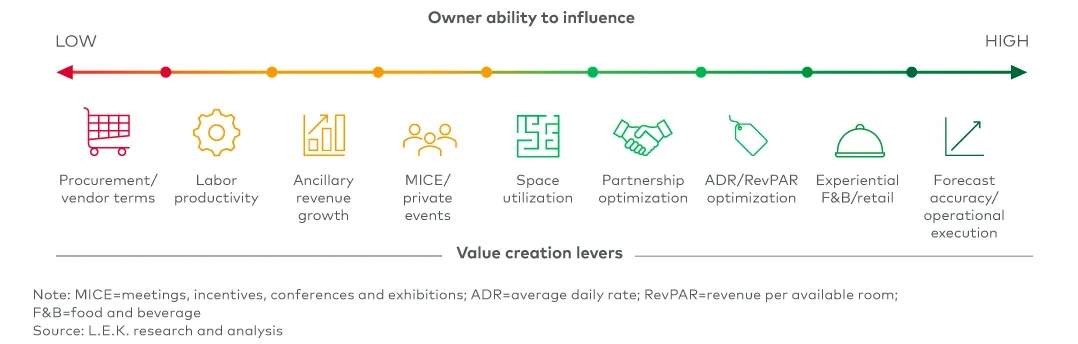
This distinction matters because many of the most important value creation opportunities sit at the intersection of ownership and operations. Pricing strategy, channel management, food and beverage concepts, event programming, technology investments, and space utilization all benefit from close collaboration between owners and operators.
Rather than focusing on operational control, the most effective owners concentrate their attention on the areas where they can meaningfully influence outcomes and support operators in driving performance (see Figure 1).