


Executive Insights

Corporate Strategy in an Era of Market Disruption: Why Continuous Evaluation Is the Strategy Team’s New First-Order Duty

August 7, 2026

Key takeaways

Banking disruption is arriving rapidly and unevenly, in contrast to the methodical planning processes banks have long utilized

Continuous evaluation, tied to what each disruptive shift might mean for the bank’s business model, is now a core competency for banking strategy teams

L.E.K. Consulting’s Horizon Indicator framework converts market noise into prioritized actions

The payoff is optionality: a strategy resilient across multiple scenario outcomes

Disruption is arriving rapidly and unevenly, faster than any traditional planning calendar can effectively triage

We are all familiar with the feeling: Every morning your inbox is filled with messages about some innovative capability that will fundamentally strangle the current business model, only to be followed by a somewhat smaller number of opinion pieces on how these technological advancements are overblown and the safest path is to be a second mover. To some it’s fascinating, to most it’s frustrating and to others it’s paralyzing. The fog of disruption is all around us.

Every bank executive now concedes that annual planning is too static, slow and distributed for the pace of external change. The harder problem is that disruption is not only fast but also uneven. Tokenized deposits, agentic commerce, embedded finance, stablecoin and artificial intelligence-enabled operating models are all advancing at once, but at varying speeds, and each lands differently across a traditional bank’s lines of business. A force that is noise for one line of business could be an existential threat for another, and a force that is novel this quarter can reach critical mass the next, once a network scales, a charter is granted or a competitor consortium sets the standard. No annual review can track a landscape that moves this way.

L.E.K. Consulting follows 10 strategic battlegrounds that have the potential to reshape banking economics (see Figure 1), and their defining feature is that they will not mature on the bank’s planning schedule.
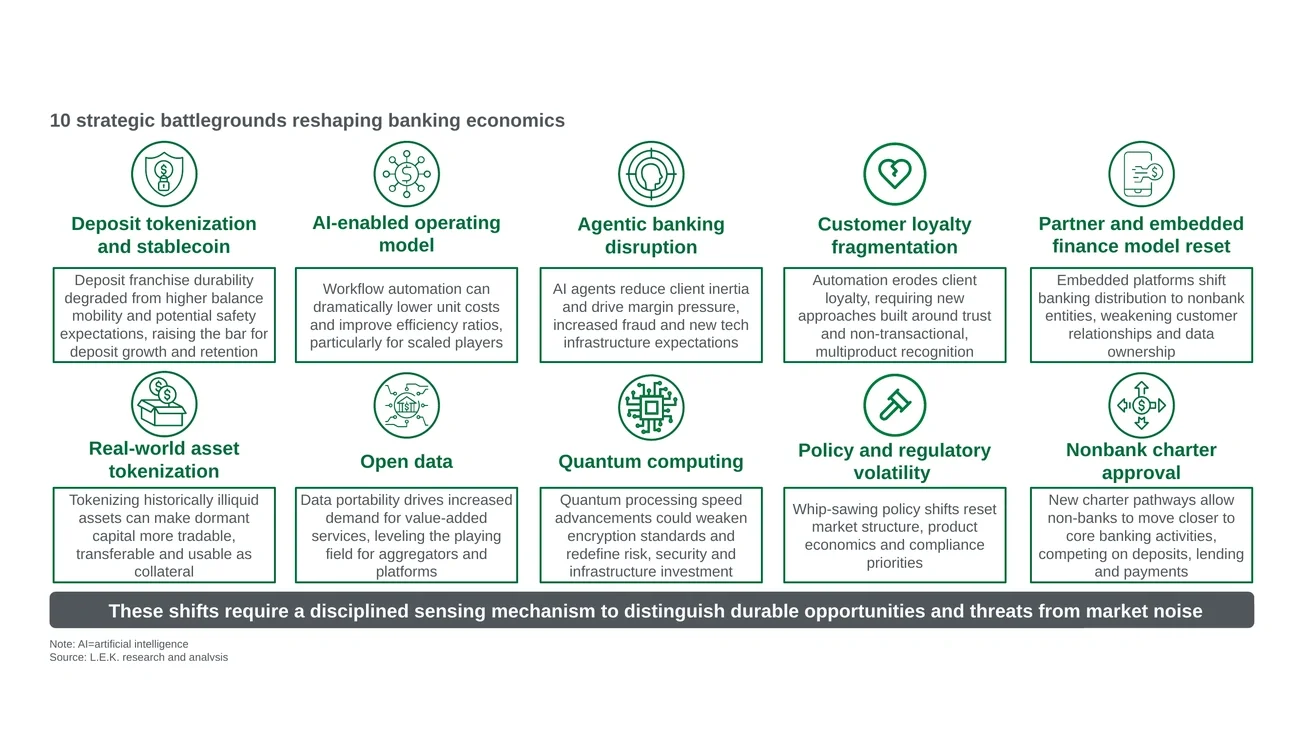
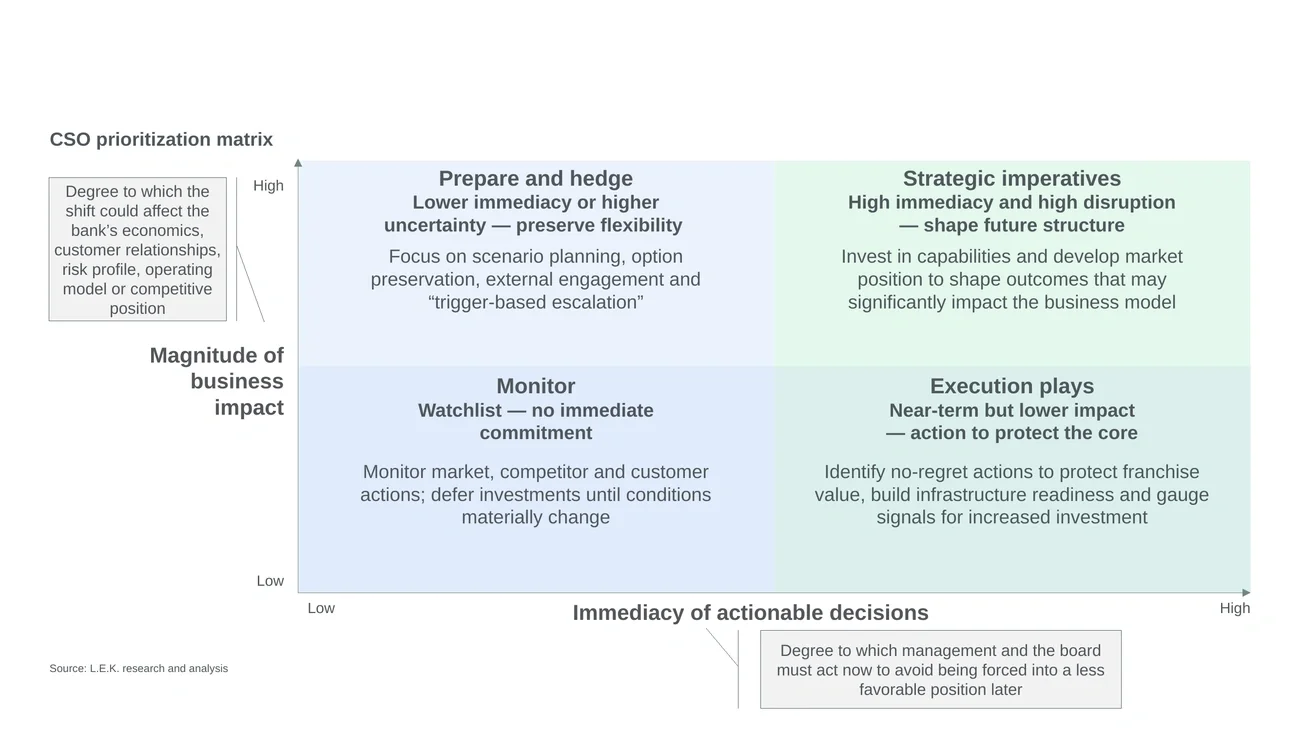
Figure 1

Ten strategic battlegrounds reshaping banking economics

Image
Figure 1: Ten strategic battlegrounds reshaping banking economics

Figure 1

Ten strategic battlegrounds reshaping banking economics

Image
Figure 1: Ten strategic battlegrounds reshaping banking economics

Continuous evaluation tied to business impact is the strategy team’s new first-order duty

The traditional mandate of enterprise visioning, planning, quarterly business reviews and execution discipline remains necessary but is no longer sufficient. The strategy team’s increasingly preeminent duty is now to keep the institution continuously informed of how the external landscape is shifting and what each shift means for the bank’s own economics, funding, customers, operating model and investment priorities. Evaluation without that translation is market commentary. The discipline is to weigh every prioritized force by magnitude of business impact and immediacy of decision so each battleground resolves into one of four postures: Monitor those that remain distant and contained, prepare and hedge where impact is high but timing is uncertain, run execution plays where action is near term but exposure is modest, and treat as strategic imperatives the few that are both large and urgent (see Figure 2). Reviewed continuously rather than annually, these postures move as the evidence moves.

Figure 2

Strategy team’s prioritization matrix

Image
Figure 2: Strategy team’s prioritization matrix

Figure 2

Strategy team’s prioritization matrix

Image
Figure 2: Strategy team’s prioritization matrix

Turn market signals into clear action triggers

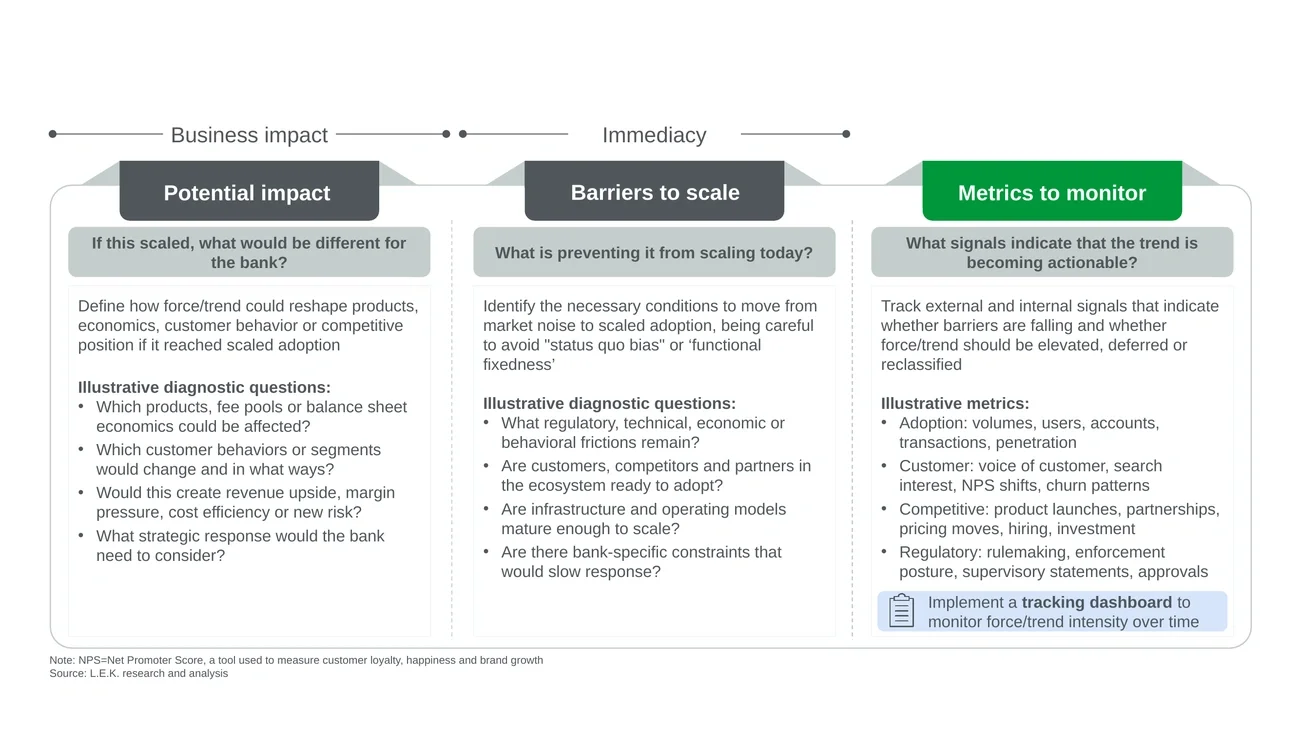
Banks rarely lack information; rather, the real challenge is knowing which signals matter and when they require action. L.E.K.’s Horizon Indicator framework (see Figure 3) creates a consistent way to make that judgment. For each emerging force, leaders assess what could change for the bank if it gains scale, what is limiting its progress today and which signals would show those constraints are weakening. These answers establish clear thresholds for when an issue should be raised with senior management or the board, kept under review or set aside. The discipline guards against the two opposite failure modes in bank strategy: status quo bias, which dismisses genuine shifts as noise, and hype-chasing, which commits capital to noise dressed as shift. This discipline is particularly important for banks that prefer to adopt innovation after the market has become clearer. That approach only works when leaders can identify change early enough to respond with speed and confidence.

Figure 3

The Horizon Indicator framework

Image
Figure 3: The Horizon Indicator framework

Figure 3

The Horizon Indicator framework

Image
Figure 3: The Horizon Indicator framework

The payoff is optionality: A strategy built to withstand multiple futures

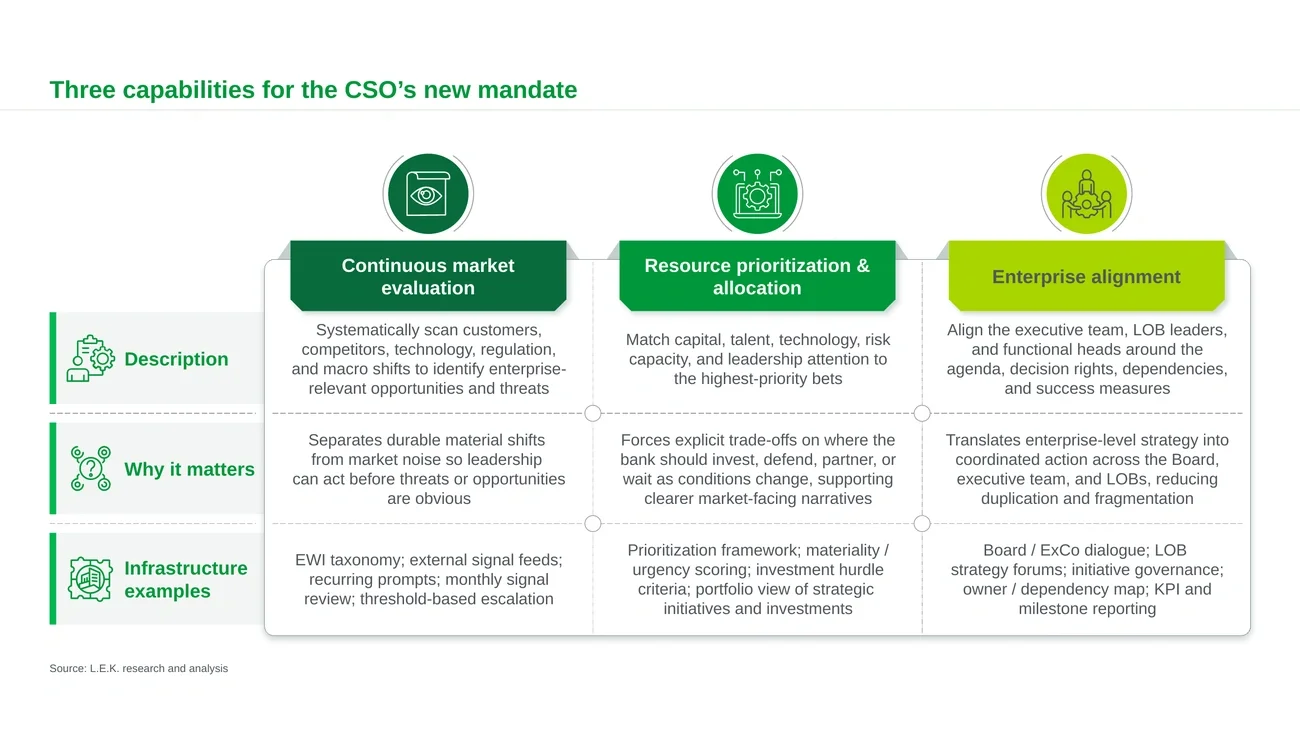
This system builds a more resilient strategy. A bank that senses continuously does not need to predict which scenario will materialize because it holds positions that perform across several: pilots that can scale if a shift proves durable, partnerships and hedges where timing is uncertain, and pre-agreed-upon triggers that promote capital investments when the evidence presents itself. That optionality is built, not bought, and it requires a strategy team that can sense, prioritize and align the organization.

What strategic optionality requires
Image
What strategic optionality requires


None of this displaces the planning calendar, but the calendar can no longer be where strategy lives. The forces reshaping banking economics will not arrive on schedule or all at once, and the institutions that thrive will be those that watch continuously, understand what each shift meant for their own business and build the options early. The rest will learn of them from the competitive marketplace, and that is the difference between choosing a position and being forced into one.

L.E.K. Consulting is a registered trademark of L.E.K. Consulting LLC. All other products and brands mentioned in this document are properties of their respective owners. © 2026 L.E.K. Consulting LLC 

English