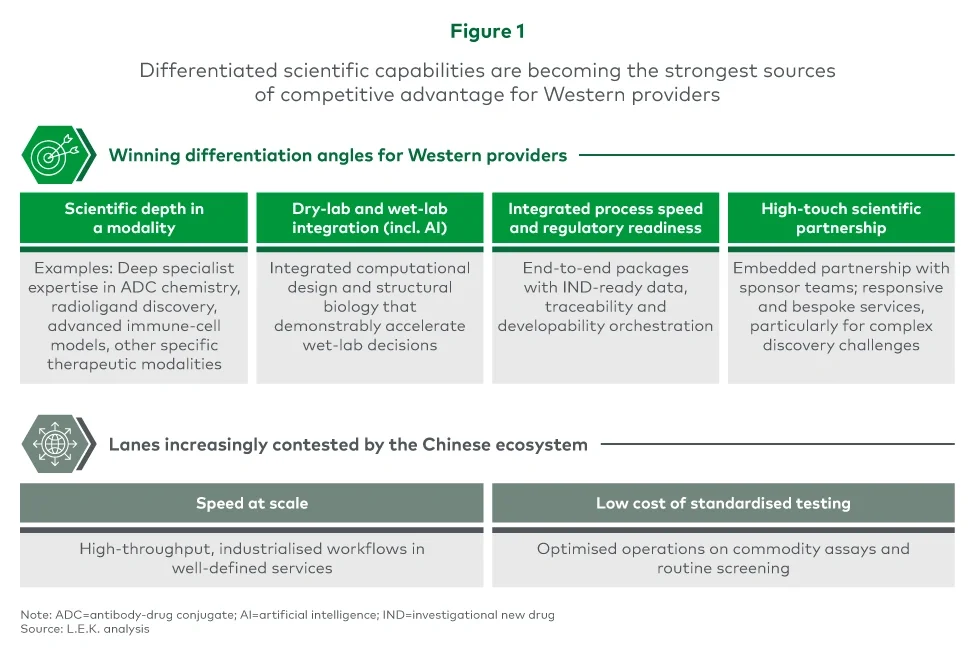
The competitive landscape for these value propositions has shifted. The low cost and speed-at-scale lanes on standardised work are increasingly contested by players in the Chinese CRO ecosystem, which has scaled materially and now competes for more routine work at lower price points. Western providers attempting to compete in these lanes face a structural cost disadvantage. The strong defensible positions for Western providers sit in the other areas.
Winning differentiation angles for Western providers
Several angles look most credible for Western discovery service providers in the reshaped market. The platforms most likely to succeed are those that have selected one or two of these angles and built operations, M&A strategy, and commercial model coherently around them.
Scientific depth in specialist modalities
Deep expertise in areas such as ADC linker chemistry, radioligand discovery, advanced cell models for immunology, or other modality-specific niches is among the most defensible angles because it is hardest to replicate.
It aligns directly with the direction of sponsor demand, as modalities continue to proliferate and few sponsors have the in-house expertise to advance every modality in their pipeline. The scientific complexity of these workflows makes short term replication challenging.
Dry-lab and wet-lab integration
Platforms with genuine investment in areas such as computational design, structural biology, and data infrastructure that demonstrably accelerate wet-lab decisions are increasingly attractive to sponsors under productivity pressure. AI is changing the relative value of different parts of the discovery workflow: it raises the value of data-rich, decision-intensive work, and reduces the relative value of routine experimentation.
Offerings that can credibly demonstrate measurable improvements in hit rates, cycle times, or decision quality through their integrated dry-lab and wet-lab approach will increasingly stand out.
- Integrated process speed and regulatory readiness
The ability to deliver IND-ready data packages with traceability, integrated developability assessment, and tight orchestration across discovery, preclinical, and CMC activities addresses a pain point that sponsors find increasingly hard to manage internally as modality complexity rises. Providers that can credibly compress the discovery-to-IND timeline have a defensible position with sponsors who would otherwise need to manage that complexity in-house or across vendors. - High-touch scientific partnership
Some sponsors, such as smaller biotechs, value embedded scientific partnership over throughput. Platforms that build their proposition around the scientific quality of the partnership and the responsiveness of the service can defend premium positioning in specific customer segments, particularly where the alternative requires the sponsor to coordinate multiple vendors at higher transaction cost or to manage IP and confidentiality considerations associated with working with a range of providers.
Across all of these angles, quality has become table stakes rather than a differentiator. Platforms that fail on quality cannot compete. Each angle also requires sustained investment in specific capabilities - scientific talent, computational infrastructure, regulatory expertise, customer relationship management - that build over time and become harder for new entrants to replicate.
Common pitfalls in scaling a discovery service platform
Building around differentiation angles is necessary but not sufficient. We have identified several pitfalls which companies must avoid in parallel.
- End-to-end overreach
Platforms often attempt to serve too many customers in too many workflows, without establishing a defensible position in any of them. The useful test is whether the platform can credibly claim to be a top three to five choice in at least one workflow for at least one customer segment. - Adjacencies without synergy
Services that appear adjacent on paper (for example chemistry and biology, in vitro and in vivo, discovery and preclinical) often have different decision-makers, different buying dynamics and demand profiles in practice. Acquiring across them does not automatically create cross-sell, and the integration cost of trying may exceed the realised revenue synergy. - Poor integration
Acquired services may sit under one brand and one P&L while remaining commercially and scientifically separate. The intended customer experience of a coherent platform with shared project management, integrated data, and a single relationship may not materialise. Sponsors notice quickly, and the platform's reputation may suffer. - Misaligned go-to-market
Platform strategies often fail to translate into changes in sales force structure, account ownership, incentives, and messaging. Sales teams continue to sell the services they understand to the customers they know, while the strategic narrative for investors describes a platform that exists primarily in theory rather than in practice.
Positioning for the next phase of growth
The next cycle of value creation in outsourced discovery services will reward platforms that have chosen differentiation angles with conviction and operationalised them across the organisation. Scientific depth, integrated delivery, computational-experimental integration, and high-touch scientific partnership are all credible paths for Western providers, and each connects directly to the demand shifts now reshaping the market. The opportunity is becoming increasingly tangible as the structural tailwinds supporting differentiated providers continue to strengthen. Western providers that choose a defensible area of differentiation and align their operating model behind it will be better positioned to create sustainable value as sponsor priorities continue to evolve.
How L.E.K. Consulting can help
L.E.K. partners with discovery service providers and their investors across the value-creation cycle, from strategic positioning and value proposition design through to M&A screening, commercial and operational due diligence, post-merger integration, and operating model design. We work with both incumbents seeking to sharpen their differentiation in a more contested market and investors evaluating platform investments in the reshaped landscape. To find out more, please contact us.
L.E.K. Consulting is a registered trademark of L.E.K. Consulting. All other products and brands mentioned in this document are properties of their respective owners. © 2026 L.E.K. Consulting