


Top Priorities and Strategic Imperatives for US Manufacturers

August 6, 2026

Key takeaways

U.S. manufacturers have shifted their near-term focus toward protecting margins and managing inflation, while remaining confident in long-term growth and transformation.
 

Amid trade and geopolitical uncertainty, more than 50% of executives report only moderate to low confidence in navigating market conditions over the next six months, leading many to favor reversible actions over major capital commitments.
 

Confidence improves over time, with about 67% of manufacturers expecting their company to outperform over the next three or more years, compared with just 15% over the next six months.

Meanwhile, AI adoption continues to advance, with nearly 90% of manufacturers reporting positive returns from generative and agentic AI despite a broader near-term focus on financial fundamentals.

U.S. manufacturing executives entered 2026 facing uncertain macroeconomic conditions as they set out to drive top-line growth while protecting margins against an increasingly unpredictable backdrop of inflation, renewed tariff threats, supply chain disruption and broad economic uncertainty. The conflict with Iran, a shifting trade policy agenda and softening consumer sentiment have together raised the cost of getting strategy wrong.

To understand how manufacturers are responding to this new environment, L.E.K. Consulting surveyed 200 U.S. industrial executives and supplemented their responses by conducting in-depth interviews with senior leaders. What emerged is a sector that has refocused its attention on financial fundamentals in the near term while keeping a confident, optimistic eye on the longer-term prize.

The clearest strategic tension in this year’s data is the gap between planning and execution (see Figure 1).
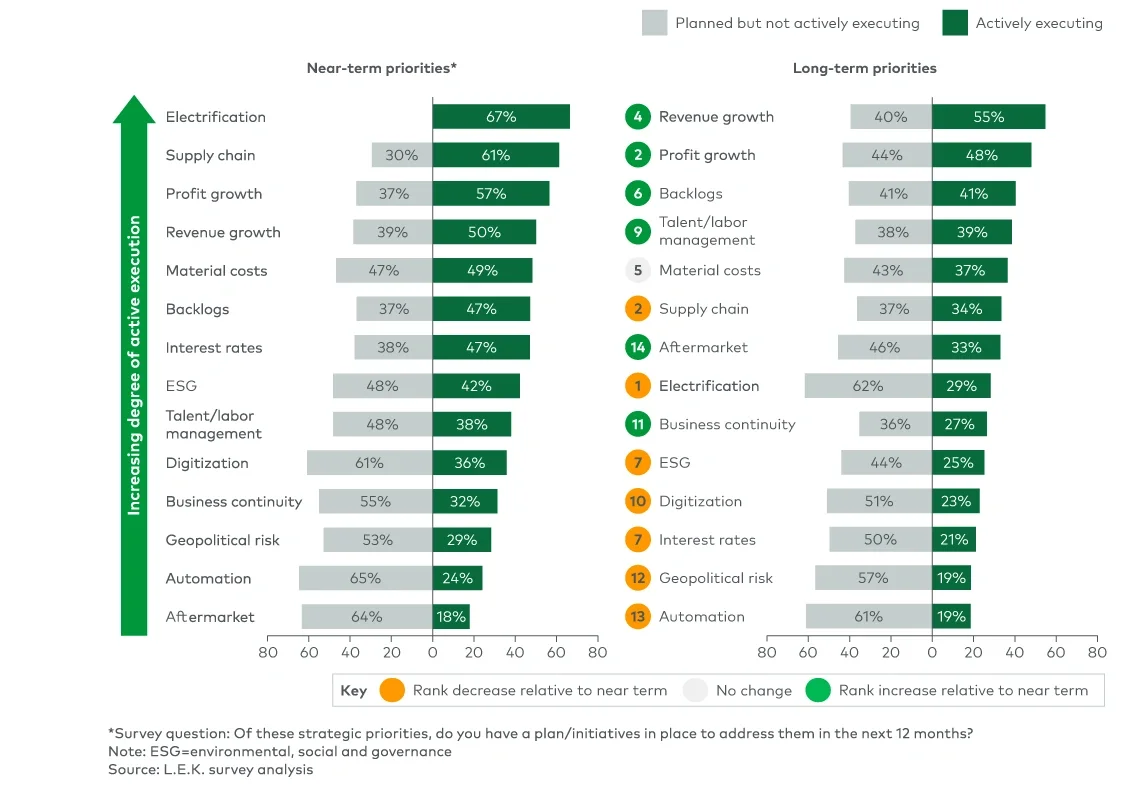
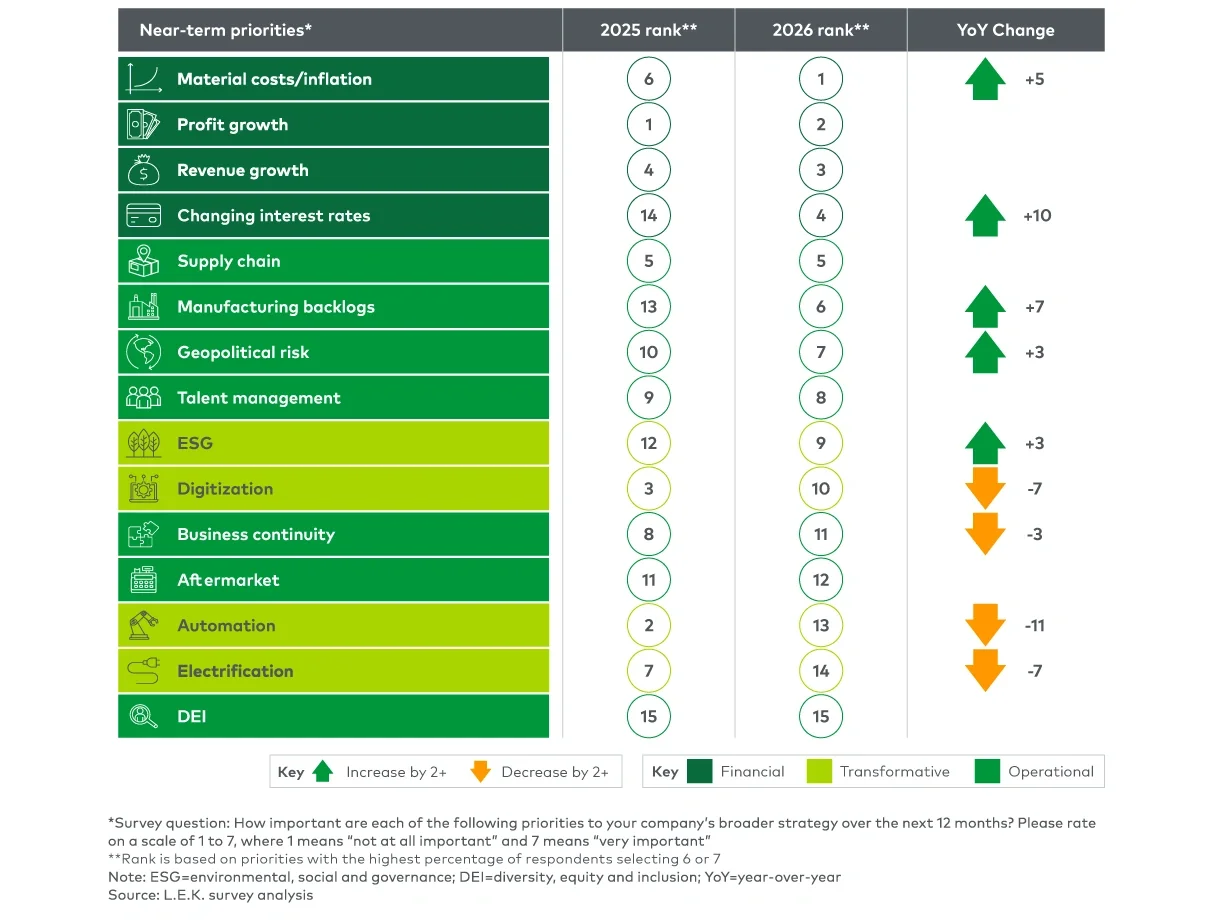
Figure 1

Percentage of respondents actively executing on near-term and long-term priorities

Image
Figure 1 Percentage of respondents actively executing on near-term and long-term priorities

Figure 1

Percentage of respondents actively executing on near-term and long-term priorities

Image
Figure 1 Percentage of respondents actively executing on near-term and long-term priorities

Manufacturers are far more likely to be actively executing on core, financially driven priorities than on the transformative initiatives they rate highly for the long term. Overall, the relative importance of priorities has shifted markedly since last year, even as the underlying ambitions remain familiar.

In 2026, protecting the core comes first

Financial priorities now dominate the near-term agenda. A combination of material costs and inflation leapt five spots to become the single most important near-term priority in 2026, followed by profit growth and revenue growth. Changing interest rates and manufacturing backlogs climbed while automation, digitization and electrification fell, signaling a more defensive short-term outlook on the part of manufacturers, as priorities that command capital without an immediate return have, for now, given way to protecting the core (see Figure 2).

Figure 2

Near-term strategic priorities

Image
Figure 2 Near-term strategic priorities

Figure 2

Near-term strategic priorities

Image
Figure 2 Near-term strategic priorities

To address material costs, manufacturing firms are developing detailed forecast plans and adjusting pricing while centering profitability initiatives around a strategic push toward higher-margin products and improving utilization across the existing asset base — practical, margin-accretive actions that are achievable within the year.

Deliberate patience amid trade and geopolitical uncertainty

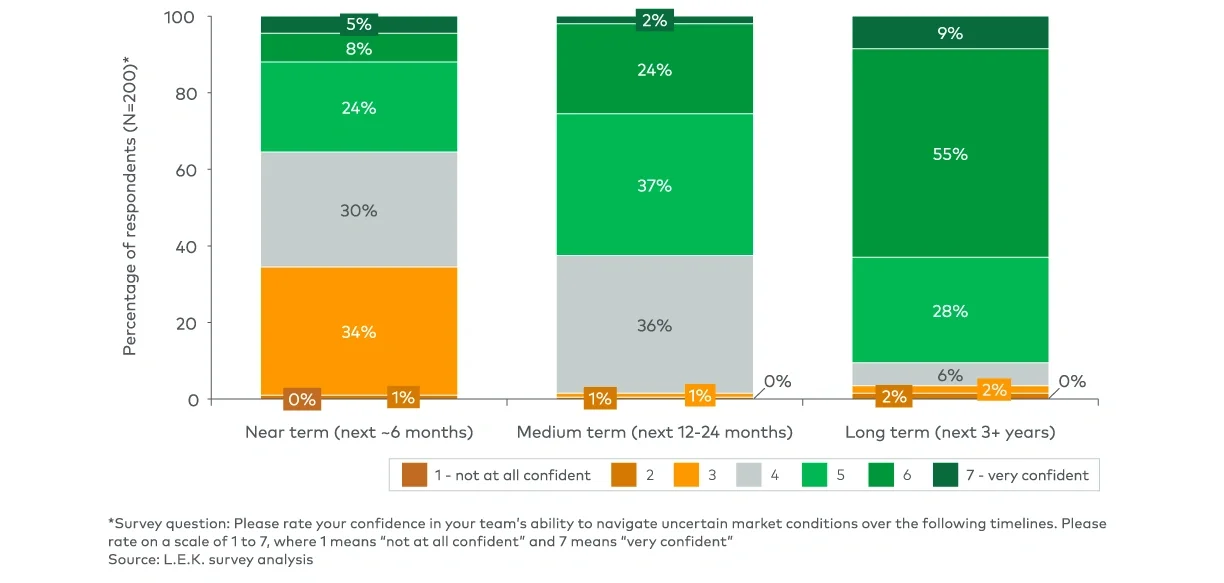
Geopolitical instability and uncertainty around trade policy have manufacturers largely taking a deliberate wait-and-see approach, with more than 50% of respondents expressing moderate to low confidence when it comes to navigating uncertain market conditions over the next six months (see Figure 3).

Figure 3

Respondent confidence in navigating uncertain market conditions over various timelines (April 6-14, 2026)

Image
Figure 3 Respondent confidence in navigating uncertain market conditions over various timelines (April 6-14, 2026)

Figure 3

Respondent confidence in navigating uncertain market conditions over various timelines (April 6-14, 2026)

Image
Figure 3 Respondent confidence in navigating uncertain market conditions over various timelines (April 6-14, 2026)

In the face of such uncertainty, few manufacturers are committing to costly, hard-to-reverse moves such as reshoring or relocating supply chains. Instead, the most common preparations are low-commitment and reversible, such as exploring new supplier relationships and reviewing pricing strategy. The actions most often completed to date, including identifying cost-cutting areas and holding preemptive customer discussions, are consistent with executives taking a patient and measured approach to managing macroeconomic conditions. Higher-commitment moves are seen as impactful, but executives are reluctant to deploy capital without greater certainty of the outcome.

Caution today, confidence over the horizon

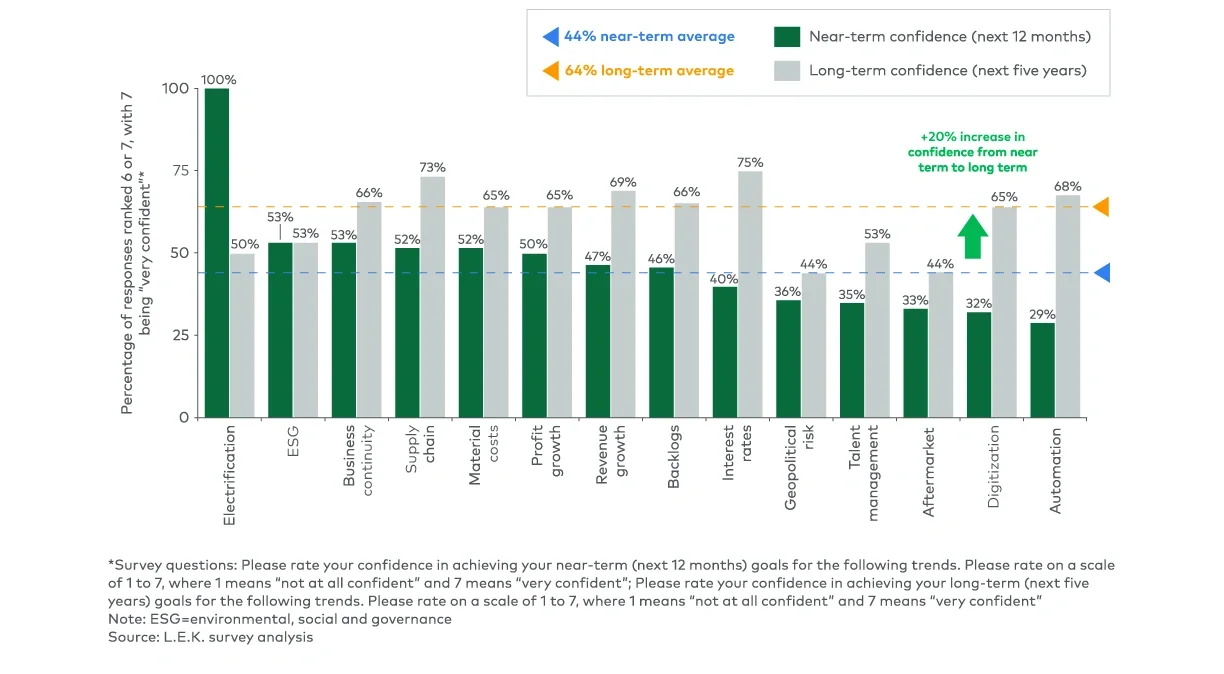
Despite the defensive near-term posture, sentiment about the future is upbeat. While roughly one-third of respondents lack confidence in navigating market conditions over the next six months, that uncertainty fades over longer horizons. In fact, as seen in the figure below, confidence in achieving business objectives rises by around 20 percentage points from the near term (next six months) to the long term (next three-plus years) (see Figure 4).

Figure 4

US industrial company confidence in achieving goals (April 6-14, 2026)

Image
Figure 4 US industrial company confidence in achieving goals (April 6-14, 2026)

Figure 4

US industrial company confidence in achieving goals (April 6-14, 2026)

Image
Figure 4 US industrial company confidence in achieving goals (April 6-14, 2026)

The gap is widest precisely where near-term confidence is lowest — in automation, digitization and interest rates — which suggests that manufacturing executives view today’s constraints as temporary rather than structural. Such optimism extends to relative performance. Manufacturers are more bullish about their own prospects than those of the broader industry. And expectations strengthen as the time horizon grows, with some 67% saying they expect their company to perform moderately or significantly better over the next three or more years compared with just 15% who say they expect the same over the next six months.

AI and automation quietly prove their return

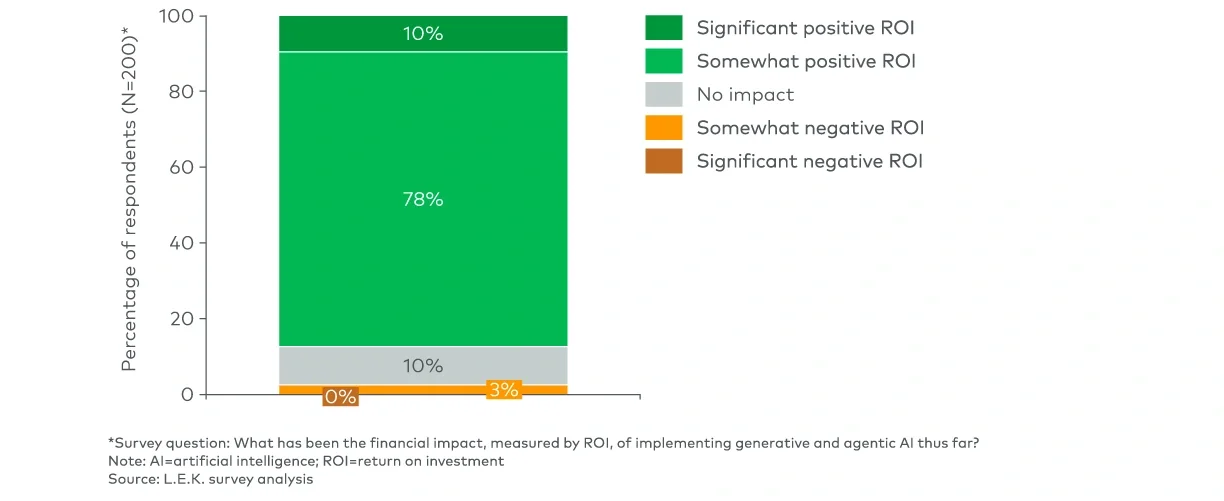
While automation as a stated priority has slipped in the near term, the investment in artificial intelligence (AI) and digital tooling continues — and is beginning to pay off. The majority of survey respondents have deployed generative and agentic AI, led by use cases in quality management, supply chain planning and procurement, and predictive maintenance. Crucially, nearly 90% of manufacturers report positive return on investment to date, which makes it clear that the early traction is driving favorable outcomes and supports greater deployment over time as companies move from initial trialing to more-advanced use cases such as generative design and AI copiloting (see Figure 5).

Figure 5

Financial impact of generative and agentic AI implementation (April 6-14, 2026)

Image
Figure 5 Financial impact of generative and agentic AI implementation (April 6-14, 2026)

Figure 5

Financial impact of generative and agentic AI implementation (April 6-14, 2026)

Image
Figure 5 Financial impact of generative and agentic AI implementation (April 6-14, 2026)

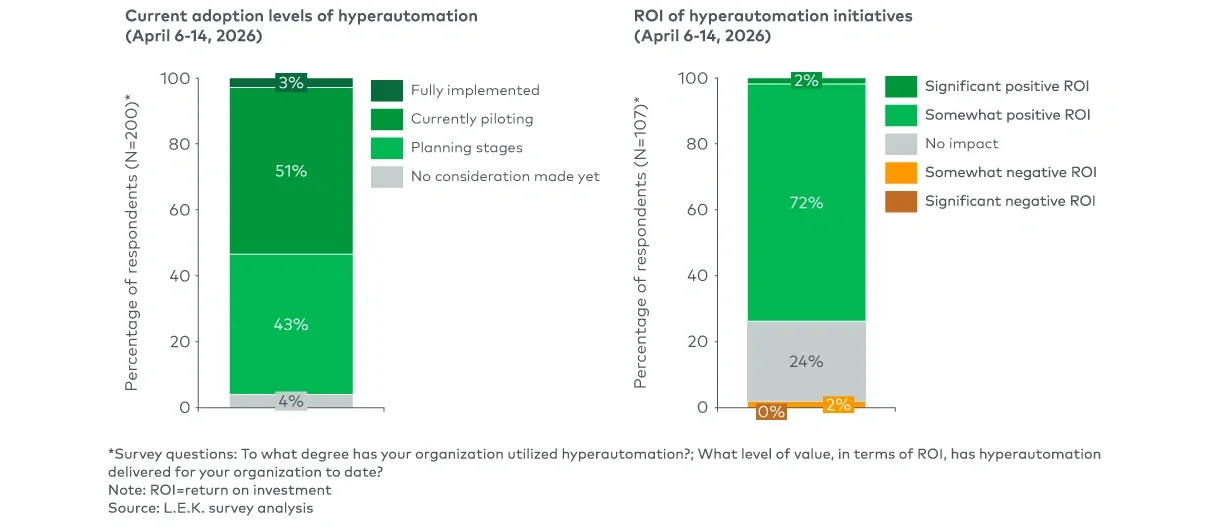
Similarly, hyperautomation, which is the coordinated use of multiple automation technologies (e.g., AI/machine learning, robotics, etc.) to automate complex, end-to-end workflows, sits at an earlier stage but is gaining ground. Roughly half of surveyed companies are piloting it, with consistently positive returns (see Figure 6). In other words, transformative technology is quietly advancing beneath the near-term focus on fundamentals and remains central to long-term strategy.

Figure 6

Adoption and ROI of hyperautomation

Image
Figure 6 Adoption and ROI of hyperautomation

Figure 6

Adoption and ROI of hyperautomation

Image
Figure 6 Adoption and ROI of hyperautomation

Closing the gap between planning and execution

Taken together, the 2026 survey results showcase a sector that has tightened its grip on the fundamentals without losing sight of the horizon. In the near term, manufacturers are protecting margin and cash, managing input-cost inflation and mitigating macroeconomic uncertainty with measured, reversible moves. Over the long term, they remain confident about delivering profit and revenue growth and realizing the potential of automation, digitization and AI. The firms that close the gap between planning and execution on transformation while holding the line on financial performance will be best placed to outperform as conditions normalize.

For a more granular view of your strategic priorities, from pricing and the aftermarket to automation, digitization and supply chain resilience, please contact us.

L.E.K. Consulting is a registered trademark of L.E.K. Consulting LLC. All other products and brands mentioned in this document are properties of their respective owners. © 2026 L.E.K. Consulting LLC

English