Executive Insights

Quantum Computing in Biopharma: Future Prospects and Strategic Insights

May 1, 2025

Key takeaways

Quantum computing (QC) in the pharmaceutical sector is transitioning from academic research to a specialist, pre-utility phase, with annual investments potentially reaching approximately $25 million for some pharmaceutical sponsors in the next five years.

The learning curve for QC is steep and talent is scarce, requiring organizations to build diverse teams for competitive advantage; both PharmaCos and QC companies must invest in innovative ecosystems to rapidly train and recruit qualified professionals.

The first applications of QC in pharmaceutical companies (PharmaCos) will likely be in discovery (including drug design and synthesis), clinical development and operations, the supply chain, and manufacturing; the near-term greatest advances are expected to be in hybrid workflows that integrate QC, artificial intelligence and classical computing. 

There are five key questions PharmaCo executives should ask themselves to ensure they are ready to capture the value of QC in their organization. 

Quantum computing — what can it do for biopharma?

Rising clinical thresholds, the growing need for complex drug modalities and extended development timelines are making novel molecular entities (NMEs) increasingly difficult to develop. The annual R&D spend per NME, from discovery to launch, is estimated at $1.5 billion-$3.5 billion, with annual R&D spend across the top 15 pharmaceutical companies (PharmaCos) growing roughly one and a half times since 2010 and projected to reach up to $18 billion by 2030.1 

Compounding this challenge, biopharma faces mounting pressure to accelerate innovation due to compressed product life cycles under the Inflation Reduction Act, and more than $200 billion in biopharma revenue is potentially at risk from loss of exclusivity by 2030.  

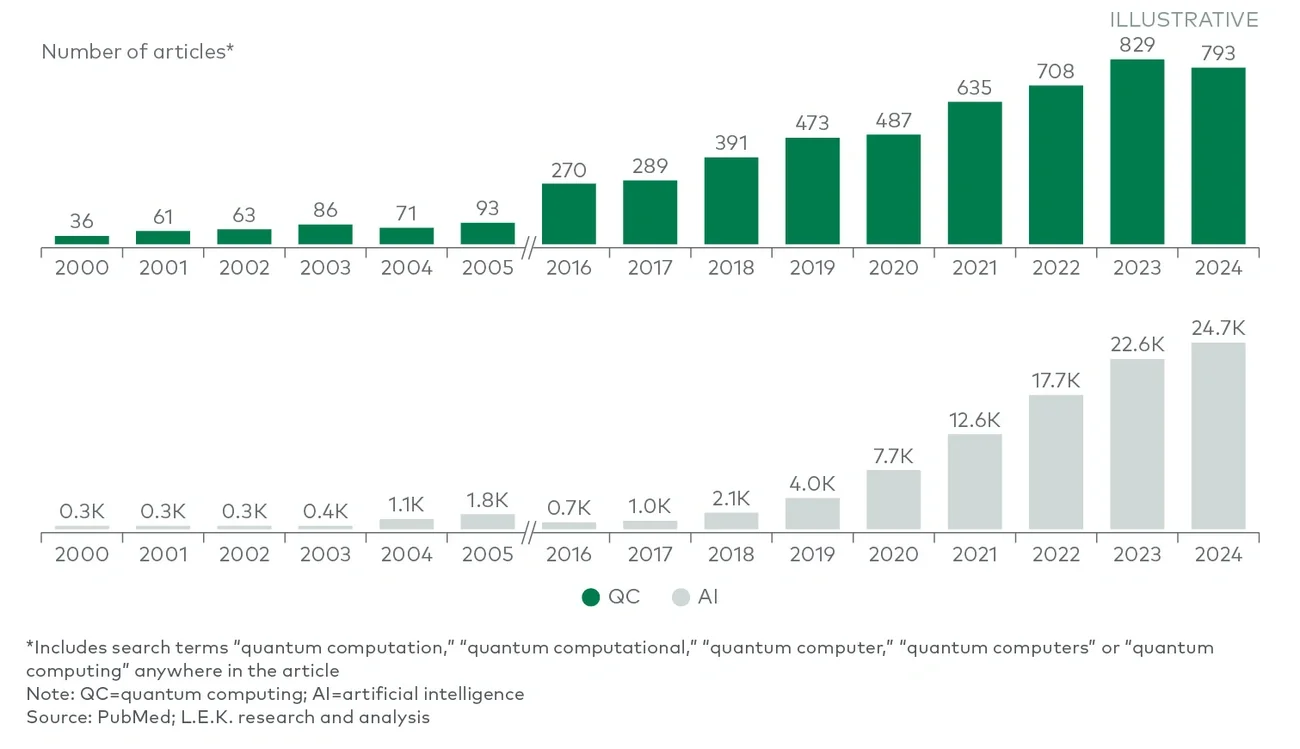
Could technological advances in artificial intelligence (AI) or quantum computing (QC) help address biopharma’s throughput and spending challenges? AI has seen explosive growth in the past five years, and QC is following suit, as evidenced by increasing publication trends (see Figure 1). QC leverages principles from quantum mechanics to process information exponentially faster than classical computing. The potential for QC and AI to revolutionize the biopharma industry together by offering unprecedented computational power and problem-solving capabilities is enormous.

Figure 1

Image
PubMed mentions of QC and AI (October 2000-2024)

Figure 1

Image
PubMed mentions of QC and AI (October 2000-2024)

To date, AI has seen significantly more investment due to its relative maturity, accessibility and market readiness. However, AI’s gain is not QC’s loss. QC and AI are complementary. QC can enable faster training of and inference from AI systems and brings an ability to process data in ways classical computers cannot. Through this it can unlock computational possibilities that are currently unobtainable.

Investment in QC has grown globally. Cumulative investment in the QC market is fueled by both the public and private sectors, totaling around $8 billion in the U.S., approximately $15 billion in China and about $14.3 billion across the U.K., France and Germany through 2024. While private investments in quantum technology have declined from COVID-19 highs due to tightening funding environments and higher interest rates ($2.3 billion worldwide private investment in 2022 versus around $1.3 billion in 2023), quantum intellectual property (IP) development over the past 10 years has increased significantly.

Beyond growth in investment and IP development, the capacity of quantum computers via qubits — the fundamental units of quantum information — has expanded dramatically. IBM progressed from a 5-qubit processor in 2016 to a 433-qubit processor in 2022, with plans to achieve more than 1,000 qubits in 2025. This advancement extends across the industry, with companies such as Google, IonQ and QuEra also demonstrating remarkable improvements in qubit capacity

What is quantum computing?

Quantum computing (QC) harnesses the principles of quantum mechanics to solve complex calculations beyond the capabilities of classical computers, representing a branch within the broader field of quantum science.

QC compared to quantum science and quantum mechanics

QC applies principles from quantum mechanics to process information in fundamentally new ways, enabling exponentially faster problem-solving for certain tasks compared to classical computers. It is an interdisciplinary field within quantum science, which broadly studies quantum phenomena across physics, chemistry and engineering. 

Quantum interference

A fundamental principle that enables QC to be successful is quantum interference, which emerges due to the wavelike nature of quantum particles. By combining the probability amplitudes of these waves to create patterns, quantum computers can process information uniquely.

Key aspects of quantum interference include:

  • Computational parallelism: Enables simultaneous evaluation of multiple solutions, making certain problems tractable
  • Precision enhancement: Amplifies correct solutions while suppressing errors, improving quantum sensing accuracy
  • Coherent control: Facilitates precise manipulation of quantum states for advanced quantum logic and circuits

Quantum interference underpins quantum advantage across computing, communication and sensing, offering new insights into information processing.

Quantum stack

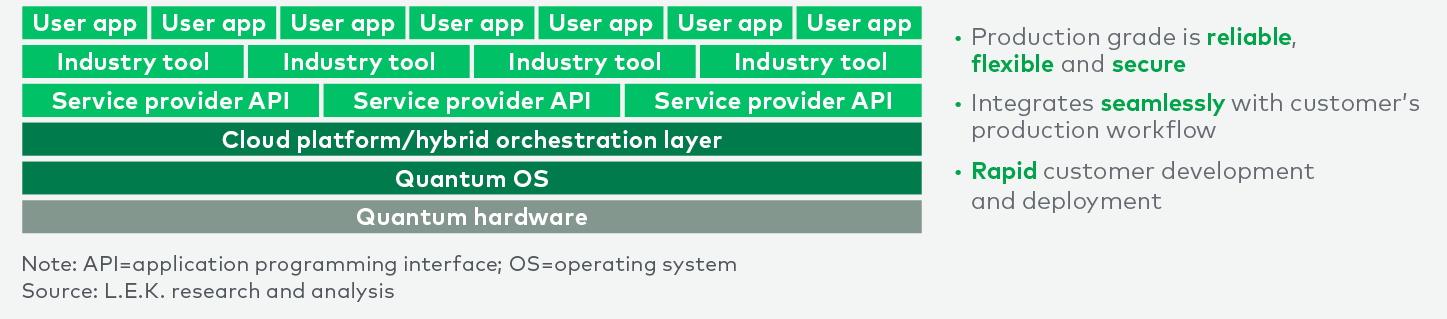
Integrating quantum interference into quantum networking requires a structured quantum stack, which defines the hardware and software layers essential for scalable QC. 

Quantum stack overview

Enterprise-grade solution

Quantum networking 

  • Production grade is reliable, flexible and secure
  • Integrates seamlessly with customer’s production workflow
  • Rapid customer development and deployment 

Quantum networking connects quantum computers using quantum mechanics to surpass classical communication. By transmitting quantum states instead of binary data, these networks enable secure, high-performance distributed computing.

Potential benefits to biopharma from quantum networking include:

  • Secure transmission of clinical trial data/real-world data
  • Interoperability across pharma entities for collaboration  

Pioneering QC applications in drug discovery and clinical trials

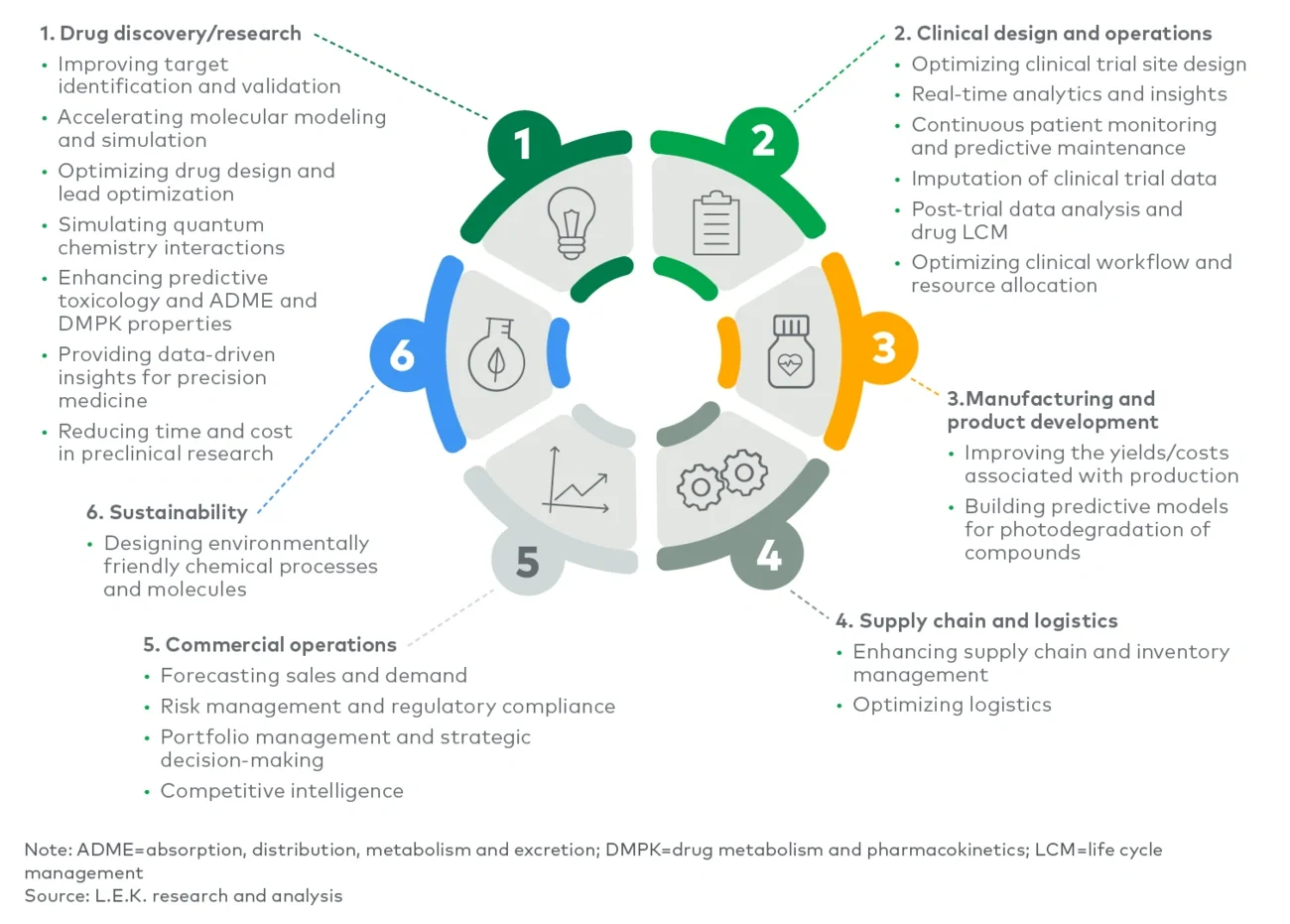
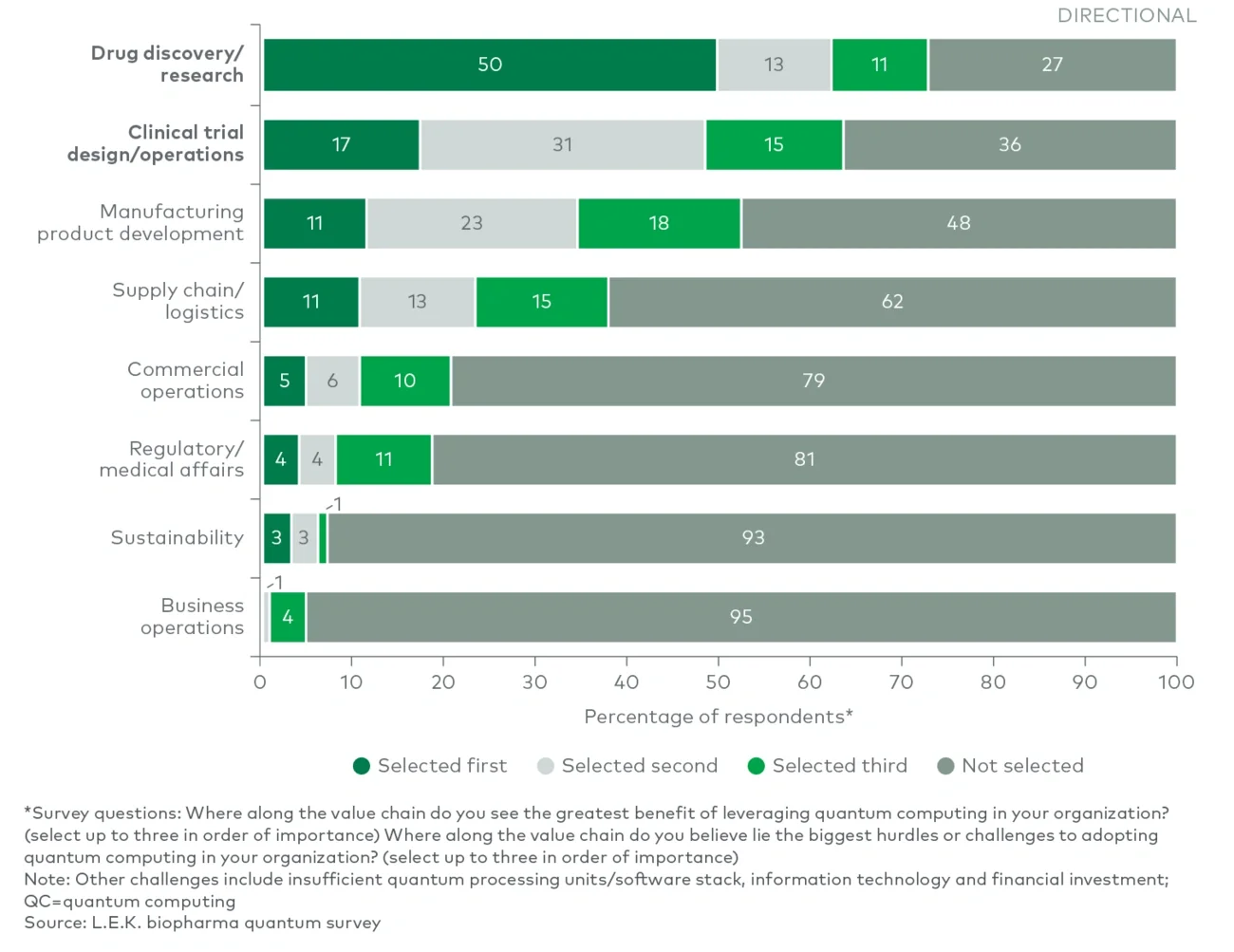
QC has the potential to revolutionize the biopharma value chain by overcoming classical computing’s limitations in handling complex datasets and simulations (see Figure 2). The most impactful areas are expected to be in drug discovery and research. QC directly addresses the inherent limitations of classical computing in computer-aided drug design because molecules operate by quantum rules — their behavior fundamentally involves dealing with exponentially large-state spaces, which classical systems can only approximate at great computational cost. 

Quantum-enhanced generative models can also explore vast chemical spaces faster than classical techniques can, leading to the discovery of more novel drug candidates previously inaccessible for many years with classical computing, reducing R&D timelines, lowering costs and improving success rates. 

In clinical design and operations, QC can enhance patient stratification and trial optimization by analyzing complex genomic, biomarker and real-world patient data. Quantum machine learning can identify optimal patient subgroups for personalized medicine, reducing trial failures and improving efficacy predictions. Quantum optimization can also refine trial site selection and adaptive trial designs, increasing efficiency and reducing costs.

Beyond R&D, QC can drive efficiencies across other areas of the value chain. QC can help optimize manufacturing and supply chain processes, improve predictive analytics for commercial functions, and increase efficiency of operations to improve sustainability.

While still evolving, QC’s ability to tackle biopharma’s most computationally challenging problems could lead to groundbreaking efficiencies and transformative advancements. 

Figure 2

Six areas of biopharma capabilities for quantum technology use cases 

Image
Six areas of biopharma capabilities for quantum technology use cases

Figure 2

Six areas of biopharma capabilities for quantum technology use cases 

Image
Six areas of biopharma capabilities for quantum technology use cases

Emerging interest is driving QC into a pre-utility phase in biopharma

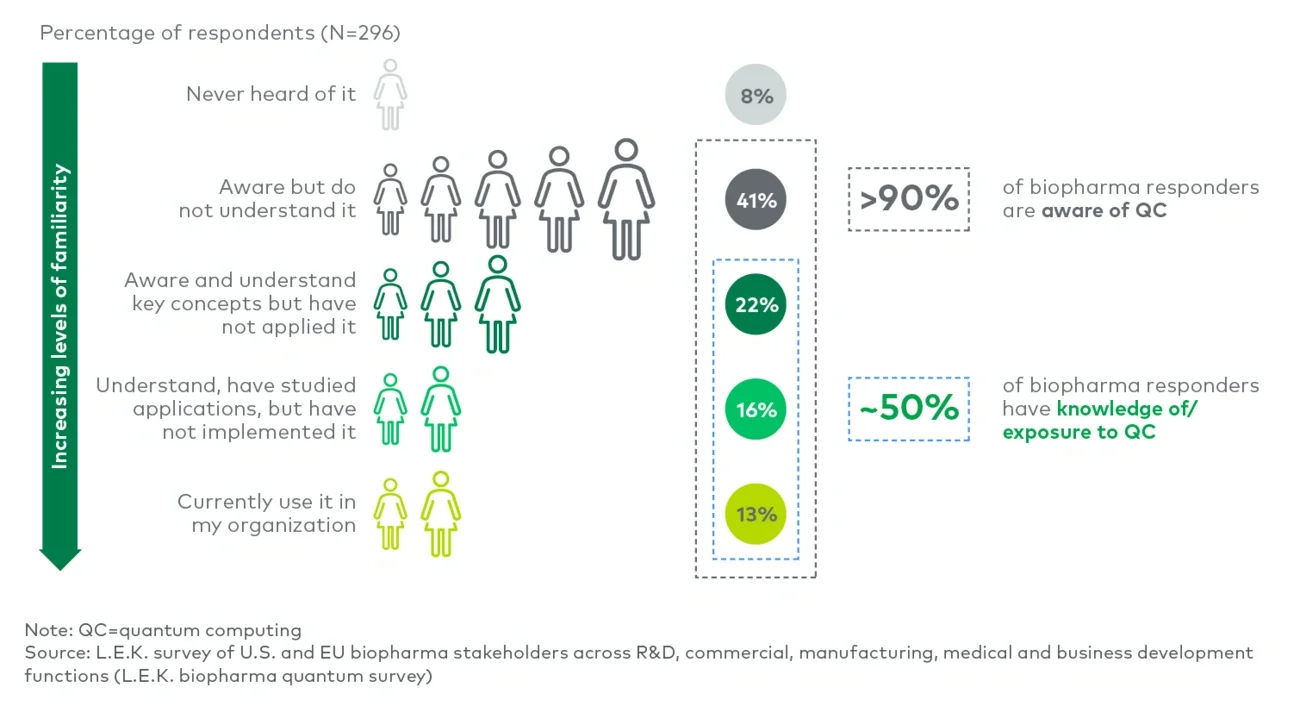
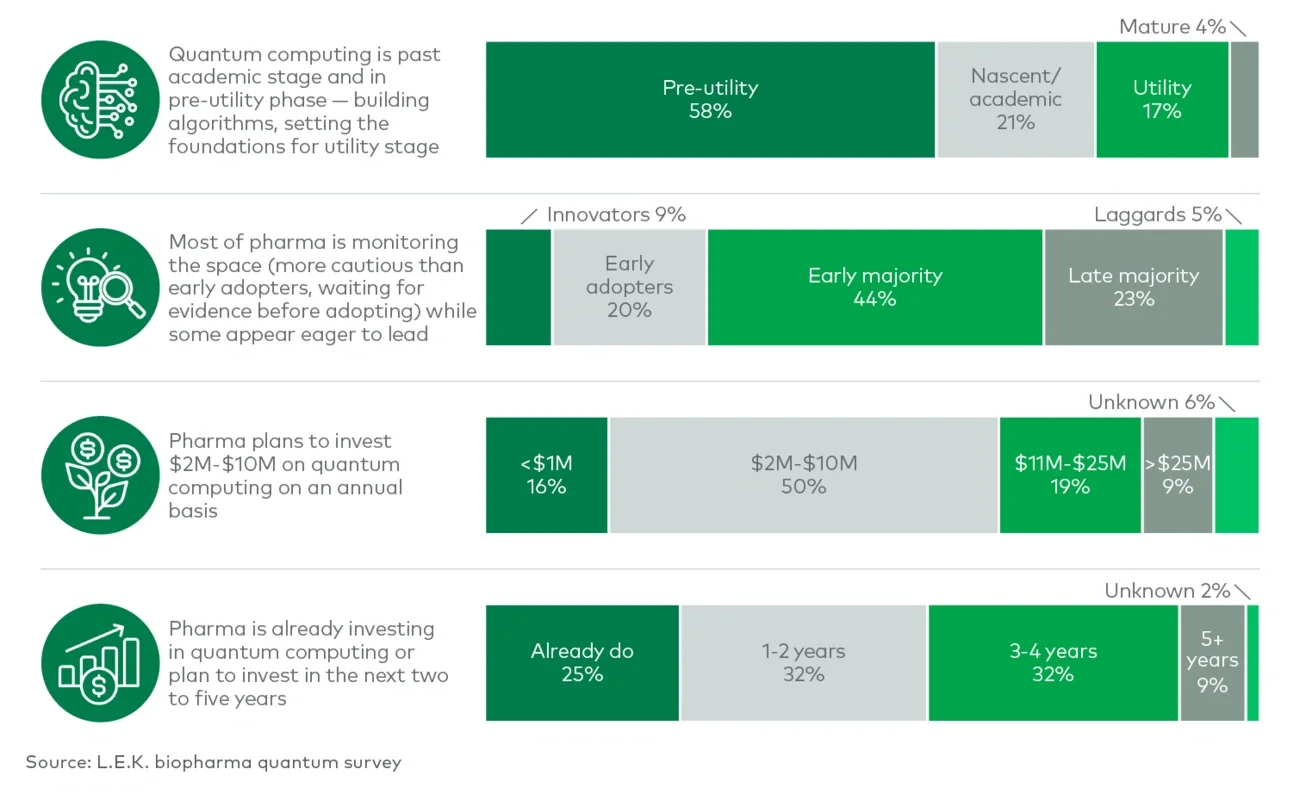
With these high-value QC use cases, it is not a surprise that an L.E.K. Consulting survey of roughly 300 U.S. and EU biopharma stakeholders indicated that over 90% of them are aware of QC and its potential. Additionally, about 50% of respondents, representing 110 unique biopharma companies, stated they understand key concepts and have had exposure to QC or have experience studying its applications (see Figure 3). 

Figure 3

Biopharma familiarity with QC 

Image
Biopharma familiarity with QC

Figure 3

Biopharma familiarity with QC 

Image
Biopharma familiarity with QC

Biopharma participants suggest that QC is making significant early strides, transitioning from academic research to a specialist, pre-utility phase. In this phase, there is a focus on developing practical algorithms and applications to lay groundwork to drive commercial value. Approximately 44% of biopharma stakeholders are in the “early majority,” awaiting evidence before integrating QC, while 30% are innovators or early adopters eager to drive innovation. Investment in QC is set to grow, with 50% of PharmaCos planning annual budgets of $2 million-$10 million and 20% expecting $11 million-$25 million over the next five years. This reflects a growing recognition of QC’s benefits (see Figure 4). 

Figure 4

Image
Biopharma expects to develop quantum capabilities by leveraging partnerships

Figure 4

Image
Biopharma expects to develop quantum capabilities by leveraging partnerships

PharmaCos are experimenting with QC applications across the pharmaceutical value chain, first focusing on drug discovery and clinical trials (see Figure 5).

Expansion of capabilities within sustainability, commercial operations, manufacturing and product development may also be enabled by QC technology. However, the exact impact and best-suited QC modalities for each use case are still being defined.

Recent key advances in QC lead to the need for biopharmas to engage with quantum processing units and enablers

Given the excitement and investment in the space, the landscape of QC is quickly evolving, marked by significant technological advances across the ecosystem. Major milestones from large tech players in 2024 include:

  • IBM’s launch of Quantum Heron, its most advanced quantum computer with 156 logical qubits
  • Google Quantum AI’s new Willow chip, which enables exponential error reduction and enhanced performance in superconducting quantum systems 

Figure 5

QC benefits across the value chain

Image
QC benefits across the value chain

Figure 5

QC benefits across the value chain

Image
QC benefits across the value chain

Pure-play QC players have also made substantial strides, including:

  • IonQ’s Tempo quantum computer achieving 99.9% 2-qubit gate fidelity, positioning the company as a leader in trapped-ion technology
  • Quantinuum’s achievement of 12 logical qubits with its system model H2, a threefold advance over previous models

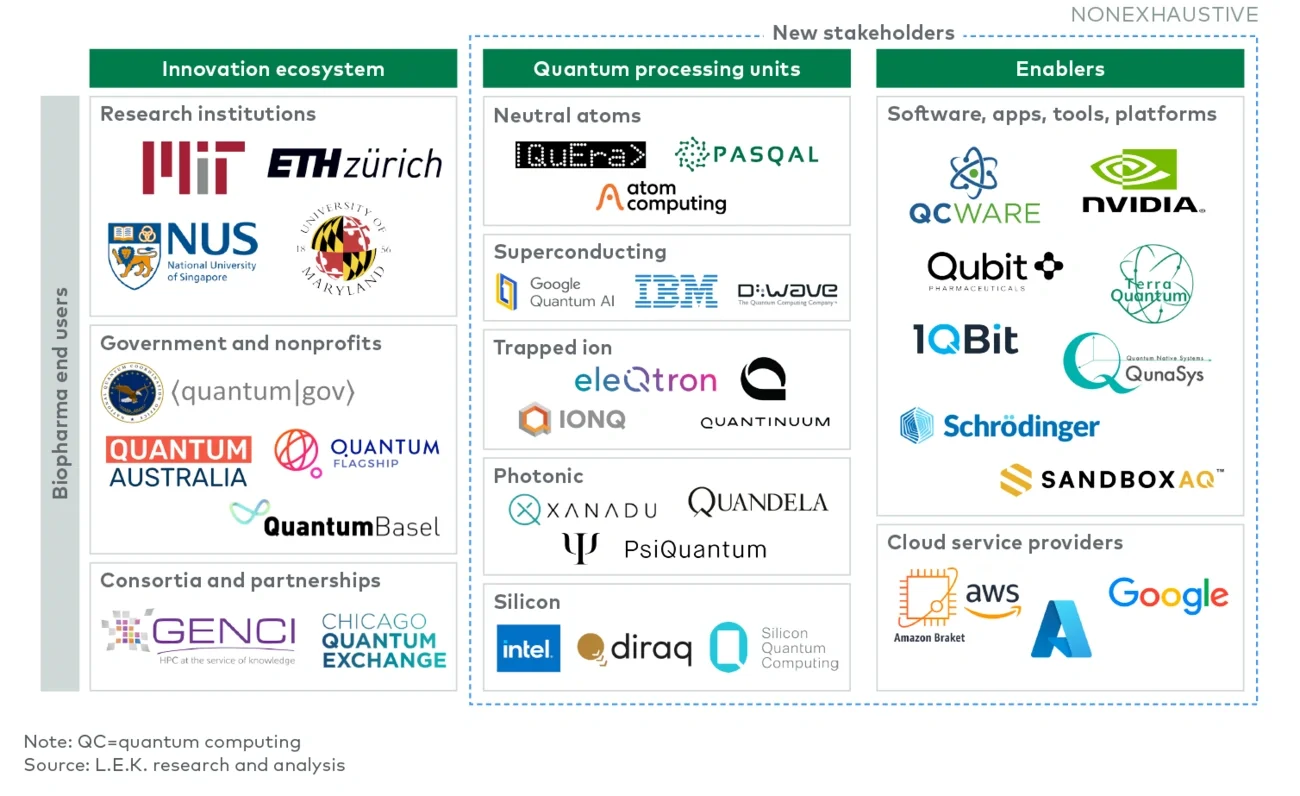
With these advancements in QC, two key stakeholder groups are emerging: the quantum processing unit providers and the enablers that facilitate access to QC. These stakeholders drive momentum and funding for QC. Like engaging with AI players, biopharma stakeholders should proactively collaborate with these diverse QC ecosystem players to fully harness these technologies and stay competitive in this evolving field (see Figure 6). 

Figure 6

Growing number of new stakeholders in the evolving QC ecosystem 

Image
Growing number of new stakeholders in the evolving QC ecosystem

Figure 6

Growing number of new stakeholders in the evolving QC ecosystem 

Image
Growing number of new stakeholders in the evolving QC ecosystem

Strategic partnerships needed to compete within a specialized market

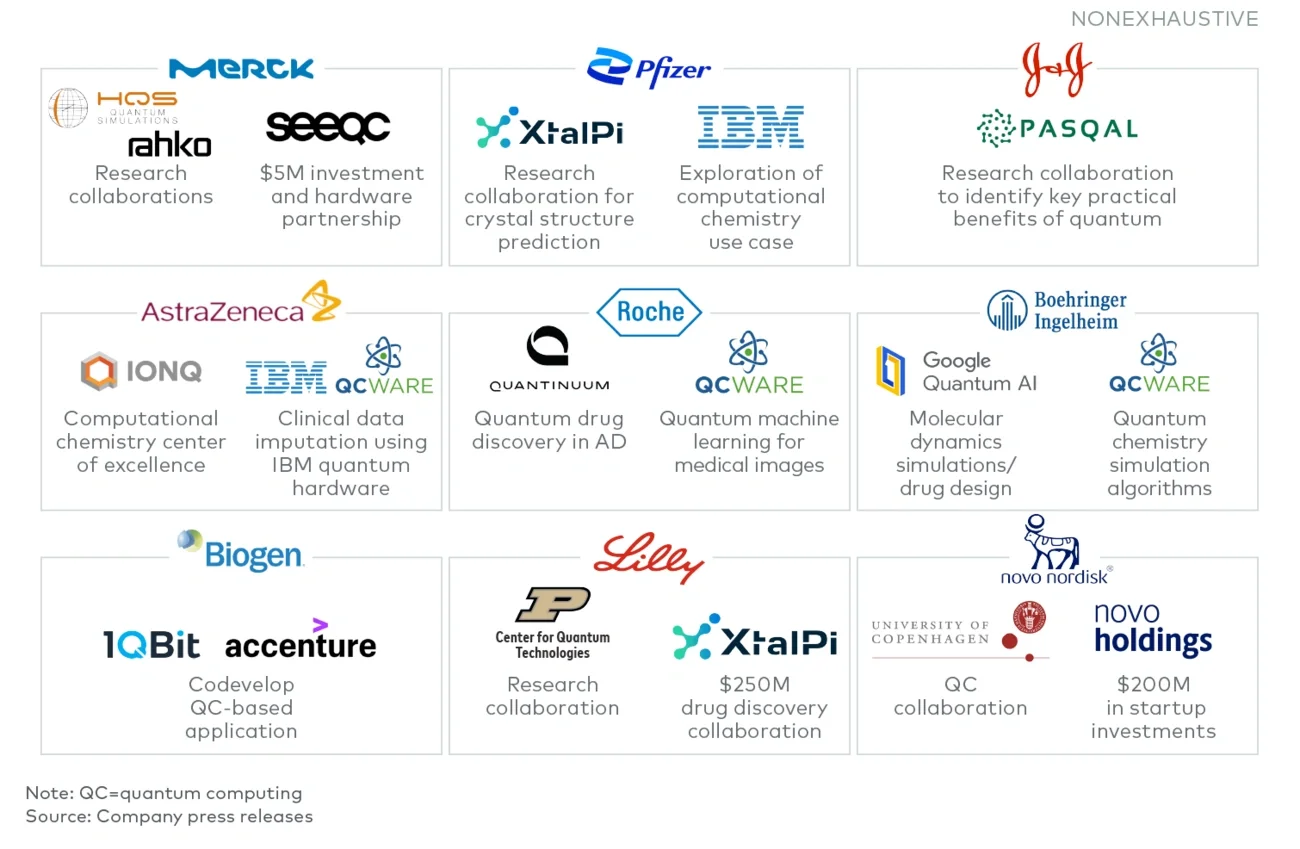
Due to the growing complexity of the QC ecosystem, successful integration of workflows depends on building capabilities through strategic partnerships. Notable collaborations include:

  • IBM Quantum with GSK, Moderna and AstraZeneca: Optimizing messenger RNA research and clinical data imputation using IBM’s Quantum Heron and Condor processors
  • Google Quantum with Boehringer Ingelheim: Exploring molecular simulation algorithms to aid in drug discovery with Google’s Sycamore processor

Partnerships underscore the industry’s commitment to integrating QC into pharmaceutical workflows, highlighting the collaborative efforts needed to overcome technical challenges and achieve utility (see Figure 7). Building in-house expertise and fostering external partnerships will be crucial to leverage necessary talent quickly. Companies that act swiftly will gain a competitive advantage, positioning themselves as leaders in this emerging field. 

Strategic partnerships needed to compete within a specialized market

Due to the growing complexity of the QC ecosystem, successful integration of workflows depends on building capabilities through strategic partnerships. Notable collaborations include:

  • IBM Quantum with GSK, Moderna and AstraZeneca: Optimizing messenger RNA research and clinical data imputation using IBM’s Quantum Heron and Condor processors
  • Google Quantum with Boehringer Ingelheim: Exploring molecular simulation algorithms to aid in drug discovery with Google’s Sycamore processor

Partnerships underscore the industry’s commitment to integrating QC into pharmaceutical workflows, highlighting the collaborative efforts needed to overcome technical challenges and achieve utility (see Figure 7). Building in-house expertise and fostering external partnerships will be crucial to leverage necessary talent quickly. Companies that act swiftly will gain a competitive advantage, positioning themselves as leaders in this emerging field. 

Figure 7

Major pharma companies have established relationships with QC organizations 

Image
Major pharma companies have established relationships with QC organizations

Figure 7

Major pharma companies have established relationships with QC organizations 

Image
Major pharma companies have established relationships with QC organizations

The near-term impact: Intersection of QC, AI and classical computing

The most promising near-term advancement is combining QC with AI and classical computing in hybrid workflows. This combination leverages the strengths of all technologies, enabling more accurate simulations of complex systems, enhanced machine learning models and improved process optimization for larger datasets at significantly faster speeds. More than 70% of biopharma stakeholders anticipate that QC will augment classical computing and AI, offering more precise and efficient solutions, especially in navigating breakthroughs in drug discovery and development.

For example, Qubit Pharmaceuticals leverages QC for advanced target characterization and molecular dynamics within small-molecule drug discovery while simultaneously utilizing AI-driven generative modeling, virtual screening and predictive analytics. Additionally, Qubit has partnered with Pasqal to leverage both classical computing and QC to model proteins, NMEs and water molecules at high levels of accuracy. 

Further, IonQ’s collaboration with AstraZeneca includes the creation of an applications development center within AstraZeneca’s BioVentureHub to advance QC for drug discovery and development. In addition, IonQ has collaborated with NVIDIA, AstraZeneca and AWS to advance drug development using computational tools — achieving 20x speedups in molecular simulations versus AWS’ previous implementation — and paving the way for quantum-accelerated biopharma and materials science.

Further advancements, including running AI on quantum computers, are exciting but not expected to be seen for longer periods of time.

The path forward for QC in biopharma

The integration of QC into the pharmaceutical industry holds immense potential to revolutionize drug discovery and clinical trials. While QC represents a longer-term (five-to-10-year) strategic investment requiring scalable hardware, advanced error mitigation and correction, and specialized algorithms, the opportunities it presents are significant. QC can enhance predictive analytics, optimize clinical trial designs and expedite the discovery of novel therapies, ultimately accelerating drug development and reducing time to market for new treatments.

Despite current challenges such as talent acquisition and a steep learning curve, strategic investments, partnerships and AI integration can enable the industry to harness QC’s transformative power. Continued collaboration and innovation will be crucial.

Biopharma stakeholders should address the following key questions to effectively utilize QC’s benefits and remain competitive:

  • Does my organization have a clear plan on how to experiment with and deploy QC within key functions, especially R&D?
  • Within R&D, are there specific use cases that would be most appropriate for QC? On what basis should these be identified?
  • How do I balance external partnerships and collaborations alongside internal capabilities to accelerate realization of the potential from QC in R&D?
  • To implement QC effectively, what key internal operating model requirements must be met, specifically regarding talent, hardware, data infrastructure and software?
  • To what extent should QC be leveraged alongside AI? Is there a benefit from integrating early (e.g., hybrid workflows) or operating independently prior to integration? What is the optimum roadmap for my organization?

By considering these questions and investing strategically in QC, the pharmaceutical industry can harness new opportunities and achieve remarkable progress across drug discovery, clinical development and operation, the supply chain, and manufacturing.

Note: L.E.K. conducted a number of interviews with both AI and pharma experts including Google, IONQ, Qubit and others to help triangulate and inform the findings.

For more information, please contact us.

L.E.K. Consulting is a registered trademark of L.E.K. Consulting LLC. All other products and brands mentioned in this document are properties of their respective owners. © 2025 L.E.K. Consulting LLC

Endnote
1L.E.K. analysis of Evaluate Pharma. 

Questions about our latest thinking?

English