

Executive Insights

Modular Medicines: Combinatorial Modularity as a Strategic Source of Innovation

April 14, 2026

Key takeaways

Biopharma is moving from molecule-by-molecule “discovery” iteration/optimization toward modular “design-and-assemble” medicines. 

Modular medicines recombine validated payloads, functional controllers and targeting/delivery layers. 

Patent-cliff urgency, crowded biology and rising chemistry, manufacturing and controls (CMC) complexity are pushing sponsors toward modularity because it can cut stacked technical risk, shorten design-make-test cycles and reuse platform CMC/analytics precedent to accelerate timelines and reduce iteration cost. 

There are four key implications: (1) competitive advantage shifts downstream into CMC, analytics and manufacturing responsiveness; (2) “platformized” manufacturing and comparability playbooks become key partner differentiators; (3) precision therapies become more economically viable as platforms enable smaller indications and even “N-of-1” scale-out; and (4) supply chains and capacity planning shift from scale-up economics to cost-per-configuration, rapid changeover and rapid release. 

Biopharma has introduced a new design paradigm where success is less about highly iterative “discovery” and more about designing and assembling validated components. Rather than focusing on entirely novel targets or uniquely developed molecules for each design-make-test cycle, innovators are recombining proven building blocks to accelerate development, reduce biological risk and improve capital efficiency. The growth of the building-block tool kit, in turn, becomes an additional source of novelty and innovation for the modular medicines approach.

A vivid proof point was the rapid deployment of a personalized gene-editing therapy at Children’s Hospital of Philadelphia in spring 2025 (Baby KJ). While the scientific details of each of these cases will be unique, the operating model enabling these breakthroughs will be the highly modular therapeutics design: Leverage validated components, adjust to patient-specific circumstances, move fast as a disciplined quality and leverage the Food and Drug Administration’s emerging regulatory pathways.

This edition of L.E.K. Consulting’s Executive Insights builds on our prior work on advanced modalities to explain why “design modularity” is emerging, where its impact is most pronounced and what it means for manufacturing partners and toolmakers.

Modular medicines defined

Unlike traditional drugs — constructed as individually optimized unique molecules resulting from intensive iteration and screening — modular medicines separate core functions into components that work together as an integrated system. Those components can be reused and recombined to design (rather than to discover de novo) new therapeutics, and the components themselves can improve over time, expanding the scope of design space.

A practical segmentation is three technology layers:

  1. Payloads: the therapeutic “work” (e.g., genetic payloads, high-potency active pharmaceutical ingredients) that drives the biological effect
  2. Functional controllers: regulatory/tuning elements (e.g., untranslated regions, promoters, linkers, “kill switches” that turn off expression and mediate safety) that shape potency, pharmacokinetics, localization or expression
  3. Targeting/delivery effectors: the mechanism (e.g., adeno-associated virus (AAV) capsids, lipid nanoparticles (LNPs), monoclonal antibodies) that governs biodistribution and uptake

Food delivery is a useful analogy: The payload is the meal itself, the controller is the specific order instructions (“leave on the doorstep”) and the targeting/delivery effector is the driver (see Figure 1).
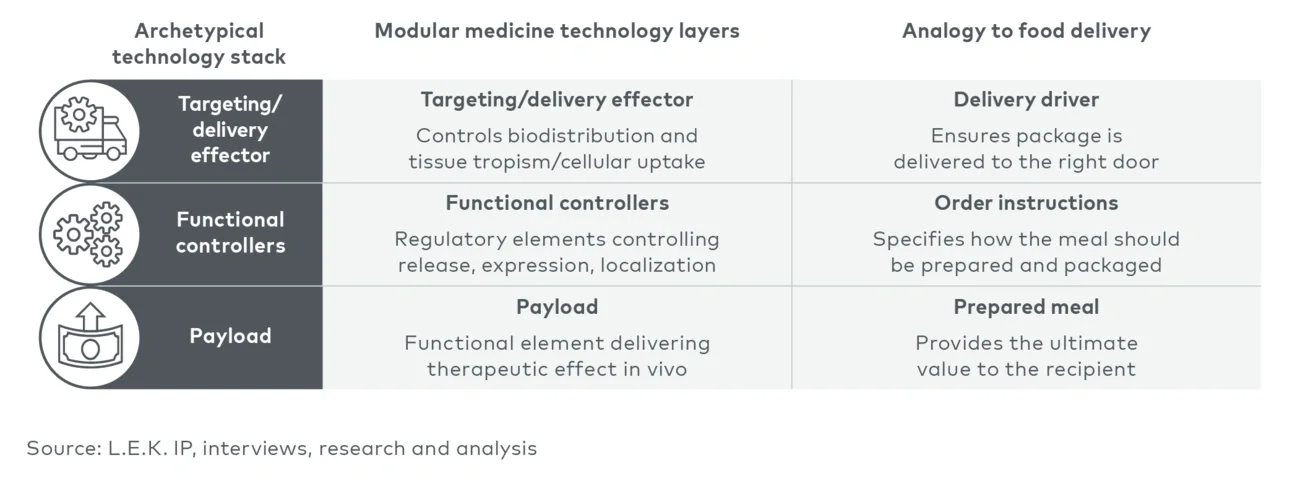
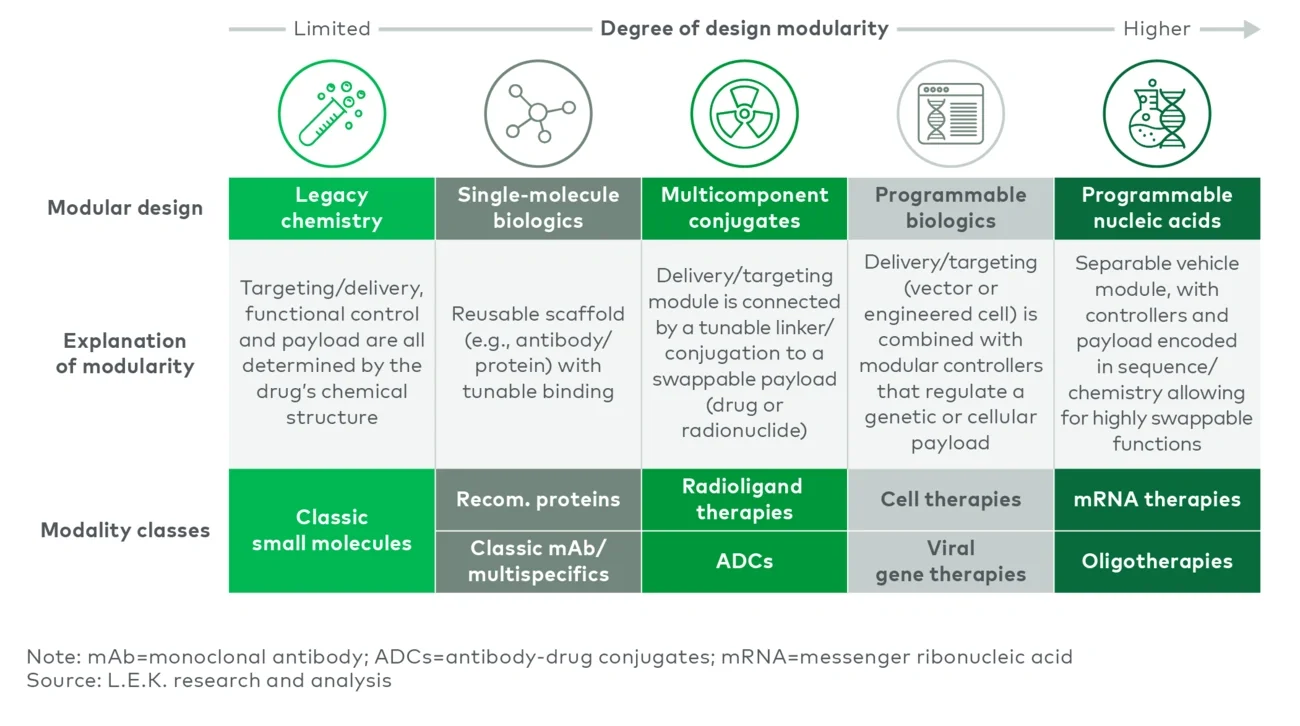
Figure 1

Modular medicine technology stack, by analogy to food delivery service

Image
The image compares medical technology layers (delivery, control, payload) with food delivery roles.

Figure 1

Modular medicine technology stack, by analogy to food delivery service

Image
The image compares medical technology layers (delivery, control, payload) with food delivery roles.

Why modularity and why now?

Three demand-side pressures are driving biopharma toward modular design, while a growing technology tool kit and supportive regulatory stance are making it more feasible.
 

  1. Addressing potential biopharma revenue gaps
    The upcoming patent cliff increases urgency to refresh pipelines with assets that can be developed efficiently. Investors and acquirers have become more risk aware, often gravitating toward later-stage or “de-risked” programs. Modularity supports a middle ground: generating more shots on goal while presenting fewer unvalidated novel components within any single program.
  2. A growing need for differentiation against a crowded pipeline
    When competing programs address the same biological targets, product differentiation comes from delivery, tissue specificity, controllability and durability. Modular design enables sponsors to pair a validated target or payload with a novel targeting/delivery effector or controller element — potentially delivering a differentiated profile by increasing precision, safety and/or efficacy without taking on the technical risk of an entirely novel drug platform.
  3. Ongoing mandates to increase R&D efficiency
    Advanced biologic modalities — including complex analytics, long lead times, constrained capacity and inflexible infrastructure — raise the CMC burden. Modularity can mitigate this by enabling comparability strategies, reuse of analytical methods and select preclinical data and process precedents that shorten the path to investigational new drugs (INDs) and reduce preclinical costs.

What is enabling the shift toward modularity?

Growing toolbox of validated components for modular designs
The library of components is expanding (antibody scaffolds, LNPs, AAV capsids, cell therapy backbones, linkers, promoters). As validation accumulates, sponsors can increasingly mix and match with higher development throughput by leveraging precedent, similar to what is done with excipients and other highly validated components of drug formulation.

Increasing traction of artificial intelligence (AI)-enabled design
AI-enabled platforms are emerging as powerful design engines — optimizing sequences (including guide ribonucleic acids (RNAs)), predicting structure/function relationships for proteins and creating next-generation delivery vehicles (capsids, lipid compositions). These workflows compress the design-make-test loop and shift more work upstream into in silico exploration in the dry lab.

Supportive regulatory stance for ‘platforms’
Regulators are evolving alongside the shift. Emerging initiatives explicitly recognize platform reuse, creating pathways to reuse elements of CMC and preclinical learnings across related programs when anchored to a well-characterized platform and a strong comparability strategy.

Real-world proof points for personalized genetic medicine
Personalized genetic medicines are also demonstrating a scale-out operating model where elements of a platform are standardized (e.g., delivery system, unit operations, analytics, quality controls), and the variable layer can be changed quickly and predictably. Programs like Baby KJ (and earlier exemplars such as the personalized antisense oligonucleotide (ASO) drug Milasen) show that individualized therapeutic sequences can leverage validated process know-how and testing frameworks to reach patients on dramatically compressed timelines.
 

Modularity is a spectrum (and the industry is moving along it)

Design modularity is not binary; it sits on a spectrum (see Figure 2). Legacy small molecules tend to be the least modular because each target requires de novo hit identification and an iterative structure-activity relationship. Single-molecule biologics have tunable domains but remain individually optimized. Multicomponent conjugates (e.g., antibody-drug conjugates (ADCs)) combine known parts to create new functionality.
 
Programmable biologics (viral vectors, engineered cells) use a chassis as the delivery/targeting layer for swappable payloads and control parts. At the end of the spectrum, with the highest design modularity, are programmable nucleic pair sequence-defined payloads with standardized delivery layers (e.g., LNPs, or bioconjugates such as GalNAc).
 

Figure 2

Design modularity spectrum

Image
A table shows types of biologic drugs and how flexible their design is, from low to high modularity, with examples like small molecules, proteins, and mRNA

Figure 2

Design modularity spectrum

Image
A table shows types of biologic drugs and how flexible their design is, from low to high modularity, with examples like small molecules, proteins, and mRNA

Real-world examples: Modular logic across modalities and historical trends

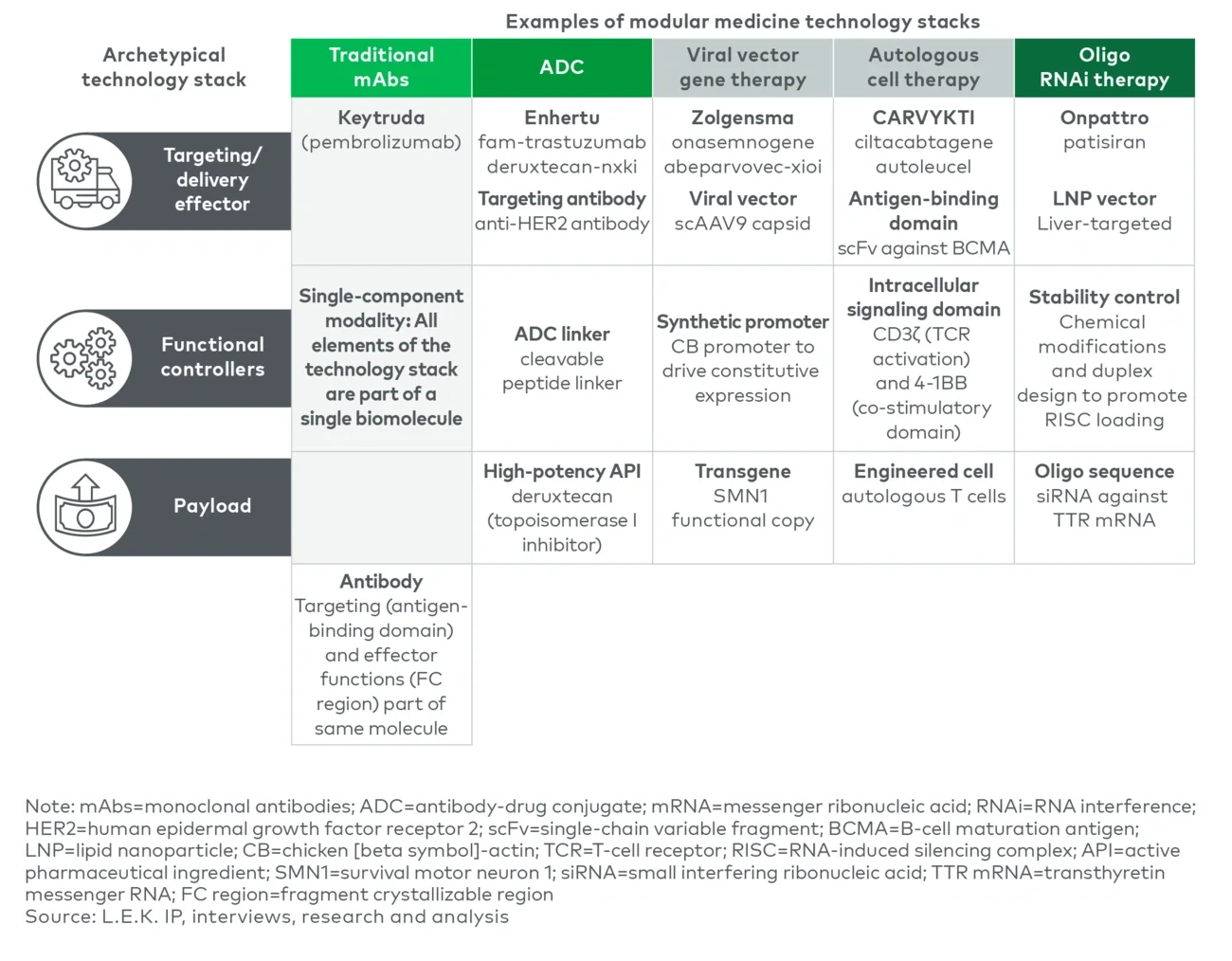
Several approved therapies illustrate modularity as a common innovation pattern (see Figure 3):

  • Enhertu (ADC): combines a validated human epidermal growth factor receptor 2 (HER2) antibody scaffold with a linker-toxin system, expanding segmentation to HER2-low
  • Zolgensma (AAV gene therapy): pairs a known capsid with a promoter/payload system to treat spinal muscular atrophy
  • Carvykti (autologous cell therapy): uses tuned binder and signaling modules on an established chimeric antigen receptor backbone
  • Onpattro (small interfering ribonucleic acid (siRNA)/LNP): pairs a sequence-defined payload with a prevalidated delivery approach, de-risking delivery and immunogenicity

Figure 3

Examples of modularity tech stack in approved drugs

Image
A table compares different modular medicine types (like mAbs, gene therapy, mRNA), showing their delivery, build, and payload, with examples like Keytruda and Zolgensma.

Figure 3

Examples of modularity tech stack in approved drugs

Image
A table compares different modular medicine types (like mAbs, gene therapy, mRNA), showing their delivery, build, and payload, with examples like Keytruda and Zolgensma.

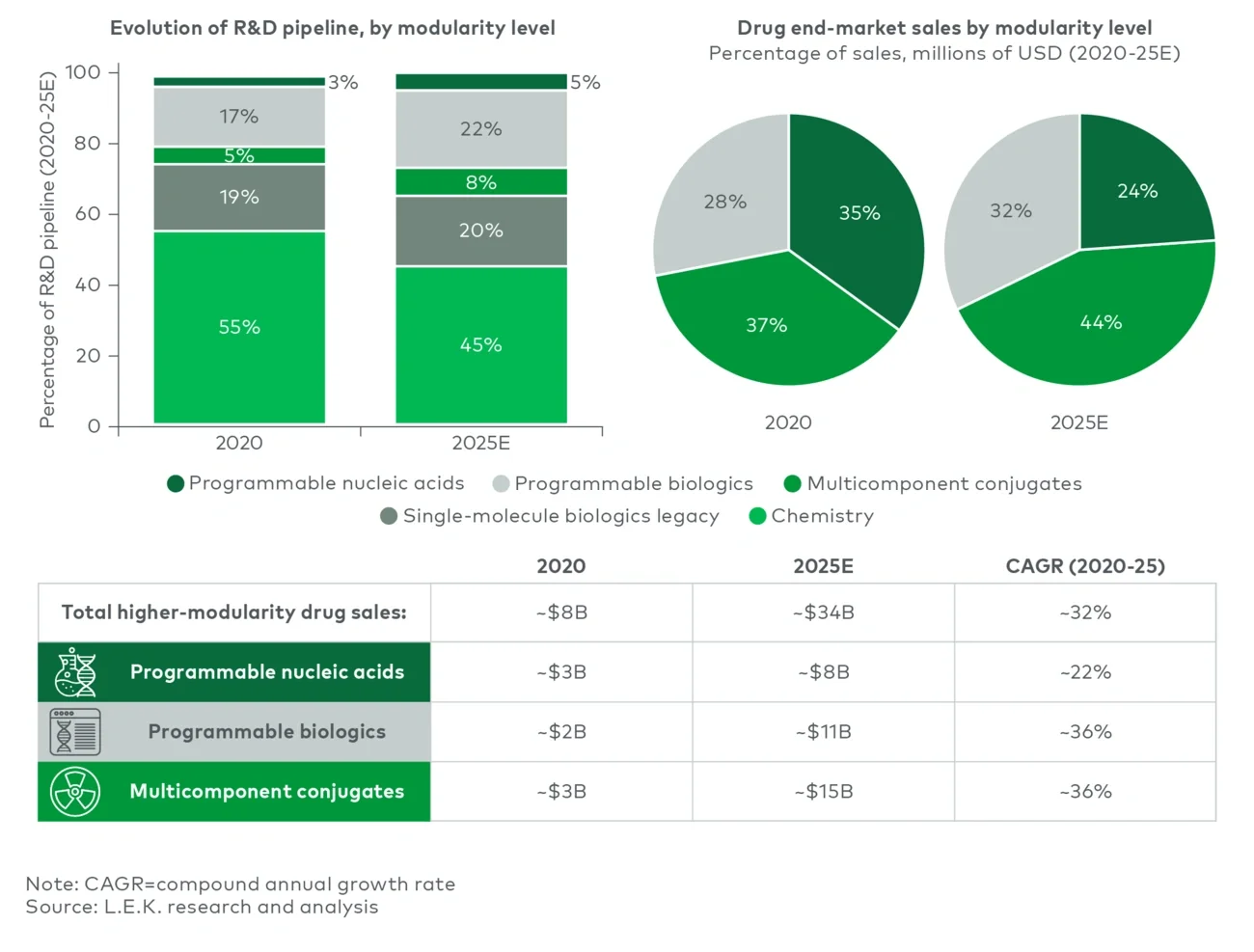
Both the R&D pipeline and drug sales end markets are evolving toward higher levels of design modularity. Increasing along the modularity spectrum yields practical advantages: faster design-make-test cycles, greater leverage of prior CMC and preclinical precedent and (in some cases) access to regulatory pathways that recognize platform reuse.

Historically, the R&D pipeline has shifted from 25% more modular modalities in 2020 to 35% more modular modalities by 2025. Similarly, the end market for these more-modular drug classes has grown dramatically, from approximately $8 billion in 2020 to around $34 billion estimated for 2025, a five-year growth rate of more than 30% (see Figure 4).

Figure 4

Historical trends in pipeline and drug sales, by level of drug design modularity

Image
A chart shows how drug research and sales by modularity change from 2020 to 2025, using bar graphs, pie charts, and a table

Figure 4

Historical trends in pipeline and drug sales, by level of drug design modularity

Image
A chart shows how drug research and sales by modularity change from 2020 to 2025, using bar graphs, pie charts, and a table

Combining design modularity with manufacturing 'platformization' to unlock scale


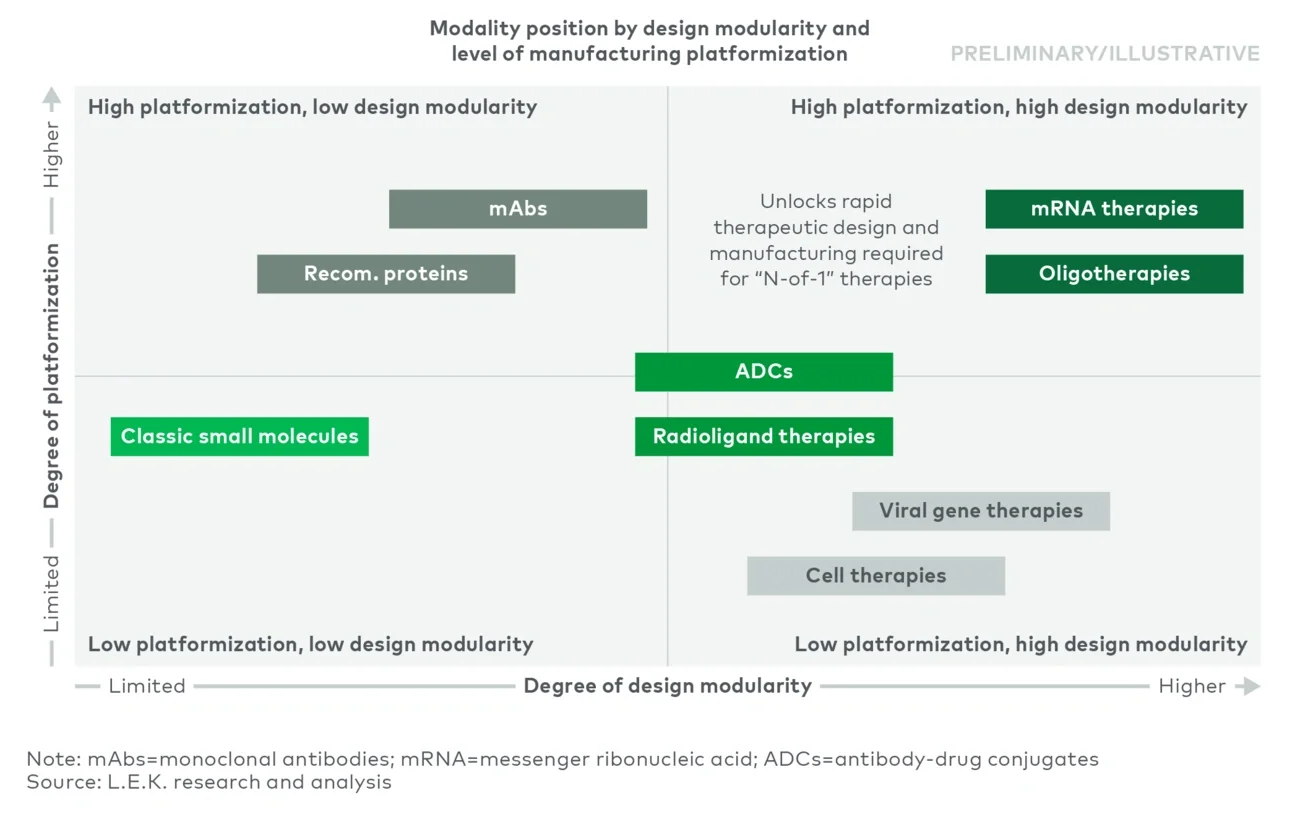
The value of design modularity can be force multiplied when combined with high manufacturing platformization - when a codified set of raw materials and process inputs plugs into an established manufacturing workflow and quality system so each new program is a controlled modification of a base "recipe," not a bespoke process for every product.
 

In practice, manufacturing platformization means common unit operations, qualified raw materials, shared analytical methods, digital enablers (chain of identity, chain of custody) and comparability playbooks that are widely shared across programs. The result is a smaller CMC lift, faster changeover time and reduced regulatory review friction.
 

When drugs with high design modularity plug into a workflow with high manufacturing platformization, it becomes possible to successfully address very small indications, as evidenced by successful "N-of-1" projects for ASO- and RNA-based gene editing therapies (see Figure 5). Conversely, low manufacturing platformization can require intensive CMC optimization ahead of launch, as evidenced by the "Process is the product" mantra for early cell and viral gene therapies, as well as the supply challenges that have characterized several early cell and gene launches (e.g., Kymriah, Carvykti, Casgevy).

Figure 5

Matrix of design modularity and manufacturing platformization

Image
A chart shows different therapies based on how flexible their design and manufacturing are, from low to high

Figure 5

Matrix of design modularity and manufacturing platformization

Image
A chart shows different therapies based on how flexible their design and manufacturing are, from low to high

Implications for life sciences tools suppliers and contract development and manufacturing organizations (CDMOs)

  • Opportunities for innovation and risk move downstream into CMC and supply chain
    As drug design becomes more configurable, competitive advantage shifts toward executing fast, high-quality configuration cycles. That elevates CMC design, analytical strategy and manufacturing agility; CDMOs may increasingly help define manufacturable configurations, not just produce batches.
  • Platform manufacturing becomes a commercial differentiator
    Sponsors will increasingly ask how easily new programs can plug into a partner’s validated platform. CDMOs with reusable process/analytics templates, comparability precedent and strong digital traceability can reduce sponsor burden and accelerate timelines.
  • Precision therapies expand addressable micromarkets
    Faster design-to-IND and permission space to reuse platform data support continued indication fragmentation and subsegmentation, unlocking smaller populations that historically would not have been commercially viable under bespoke development models.
  • Scale-out economics challenge scale-up mindsets and reshape supply chains 
    Programmable modular therapies imply smaller batches and more-frequent changeovers. Cost advantage shifts from economies of scale to economies of repetition: Suite utilization, parallel closed processing and rapid release become central, while supply chains must support smaller quantities with tighter delivery tolerances and variable demand.

Taken together, modular medicines will reward partners that treat manufacturing and analytics as configurable platforms rather than one-off projects. Tools companies and CDMOs with flexible capacity, standardized component libraries and data-rich quality systems will be best positioned to grow alongside the next generation of modular medicines.

For more information, please contact us.

L.E.K. Consulting is a registered trademark of L.E.K. Consulting LLC. All other products and brands mentioned in this document are properties of their respective owners. © 2026 L.E.K. Consulting LLC

English