




Executive Insights

Today’s Imperative for Retailers: No. More. Basic. Retail.

May 20, 2026

Key takeaways

The shift to Amazon and online shopping is making it harder for traditional retailers to compete across retail categories.

Basic retail is no longer enough to win, driving a widening gap between leading retailers gaining share and lagging retailers losing traffic and relevance.

Winning retailers stand out in five areas: they are top of mind for specific shopping needs, offer value-added in-store services, deliver strong online and in-store experiences, keep assortments fresh and relevant, and have knowledgeable store staff.

Retailers that execute well across these areas see stronger traffic and overall growth.

Nearly all retail growth over the past decade has come from online channels. There is no tailwind for brick-and-mortar sales. Retailers cannot compete on legacy or retail fundamentals alone. Retailers must clearly define their role in the consumer trip and consistently deliver against the capabilities that matter most. Winning retailers are those that differentiate through strategy and focused execution, while others are losing relevance and falling out of the consideration set.

Consumers are taking fewer trips to physical stores and narrowing the set of retailers they do consider. Ecommerce sales are growing roughly two to three times faster than total retail sales, fundamentally reshaping how consumers shop. As a result, shoppers are prioritizing a smaller group of trusted physical retail destinations that can meet their needs efficiently, rather than visiting multiple stores. A small set of retailers is capturing a disproportionate share of consumer visits, while others fall out of the consideration set. Across approximately 130 major U.S. retailers, the 10 highest-traffic retailers account for roughly three-quarters of total visits (around 23 billion annual visits).

This shift is being accelerated by the continued rise of online-first players, most notably Amazon, as well as the growing advantage of mega-scaled retailers like Walmart and Target, which are capturing an increasing share of retail spend across categories. As consumers default to online channels for convenience, price transparency and speed, other retailers are accounting for a smaller share of trips (see Figure 1).
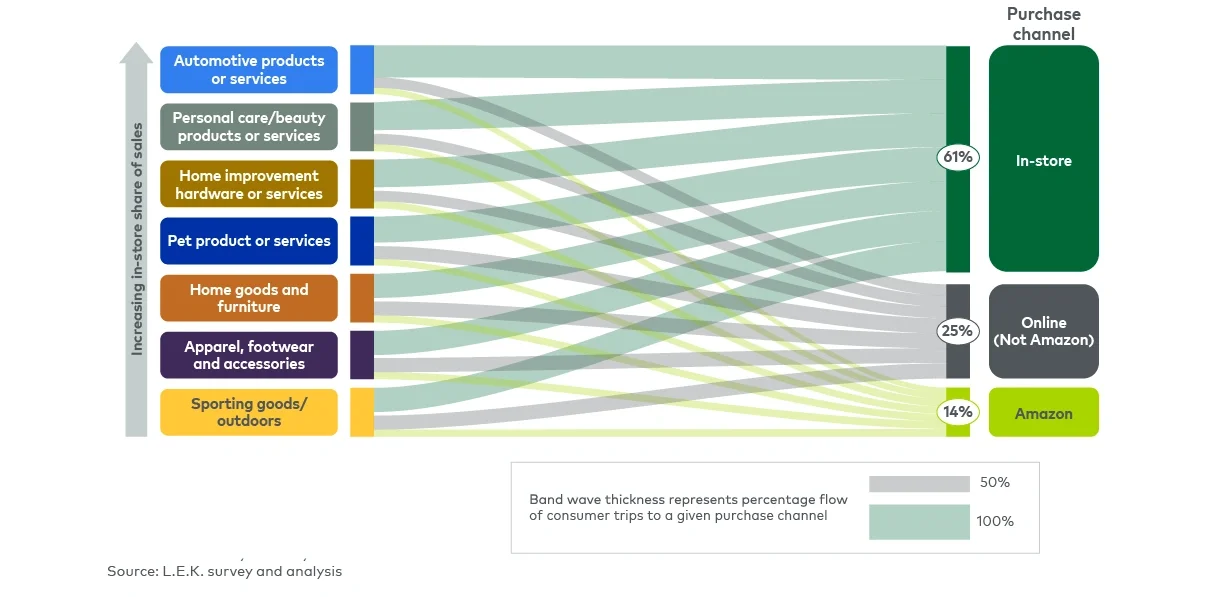
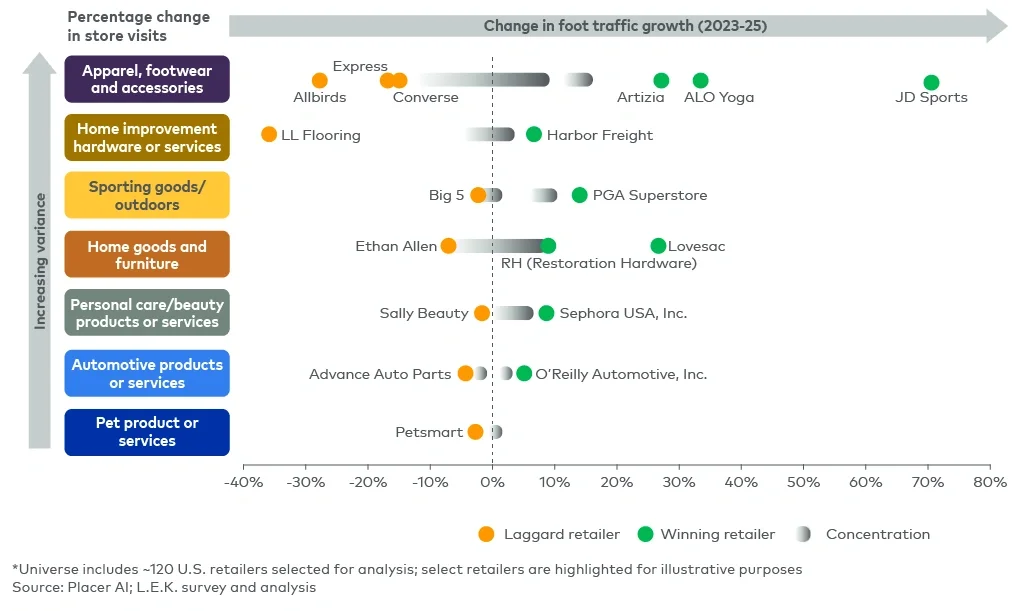
Figure 1

Consumer trips are increasingly concentrated in Amazon and other online channels across categories

Image
Flow chart illustrating consumer shopping behaviors across categories like automotive products, personal care, home improvement, pet products, home goods, apparel, and sporting goods. Lines show the percentage distribution among purchase channels: In-store (61%), Online (Not Amazon) (25%), and Amazon (14%). Thicker bands indicate higher percentage flows.

Figure 1

Consumer trips are increasingly concentrated in Amazon and other online channels across categories

Image
Flow chart illustrating consumer shopping behaviors across categories like automotive products, personal care, home improvement, pet products, home goods, apparel, and sporting goods. Lines show the percentage distribution among purchase channels: In-store (61%), Online (Not Amazon) (25%), and Amazon (14%). Thicker bands indicate higher percentage flows.

Within this backdrop, retailer performance is diverging sharply. Even retailers selling similar products to similar customers are seeing materially different outcomes in traffic, engagement and growth. The differential performance between winners and losers within categories has never been broader. This divergence points to strategy and execution, not category exposure, as the primary driver of performance.

Consumers are narrowing their consideration set. With a narrowing set of consumer journeys ending in retail stores versus online, many are consolidating trips and prioritizing a smaller group of retailers that can meet their needs efficiently. Rather than visiting multiple stores, they are increasingly choosing fewer, more-trusted destinations.

As a result, a small set of retailers is capturing a growing share of visits, while others fall out of the consideration set, reinforcing a widening gap in performance (see Figure 2).

Figure 2

Distribution of store visit growth across about 120 US retailers, by category (2023-25)

Image
Figure 2 Distribution of store visit growth across about 120 US retailers, by category (2023-25)

Figure 2

Distribution of store visit growth across about 120 US retailers, by category (2023-25)

Image
Figure 2 Distribution of store visit growth across about 120 US retailers, by category (2023-25)

What differentiates winners is how well they serve the specific “mission” a customer is trying to complete. Most purchases have a specific context or circumstance, whether it’s solving an immediate need, getting access to expertise, researching a considered purchase or browsing for inspiration. Retailers that orient their stores to differentially meet the needs of these missions become the default destinations, while others fall out of consideration.

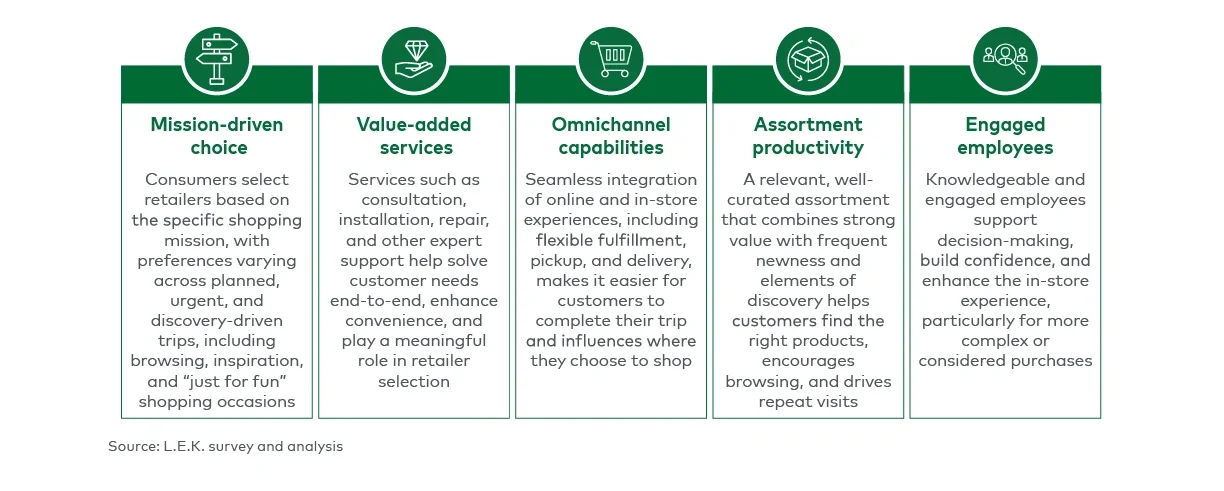
Those gaining share stand out in five critical ways: They align tightly with key consumer missions where they can uniquely win versus Amazon or other online retailers, embed services where they add value, reduce friction through effective omnichannel capabilities, maintain assortments that feel current and worth revisiting, and foster engaged, well-equipped store teams who actively support customers in the moment of decision. While the relative importance of these factors varies by category, together they explain why some retailers continue to capture disproportionate consumer attention while others fall even further behind (see Figure 3).

Figure 3

Winning retailer strategies in five areas

Image
Figure 3 Winning retailer strategies in five areas

Figure 3

Winning retailer strategies in five areas

Image
Figure 3 Winning retailer strategies in five areas

1. Winning retailers are top of mind for specific consumer missions

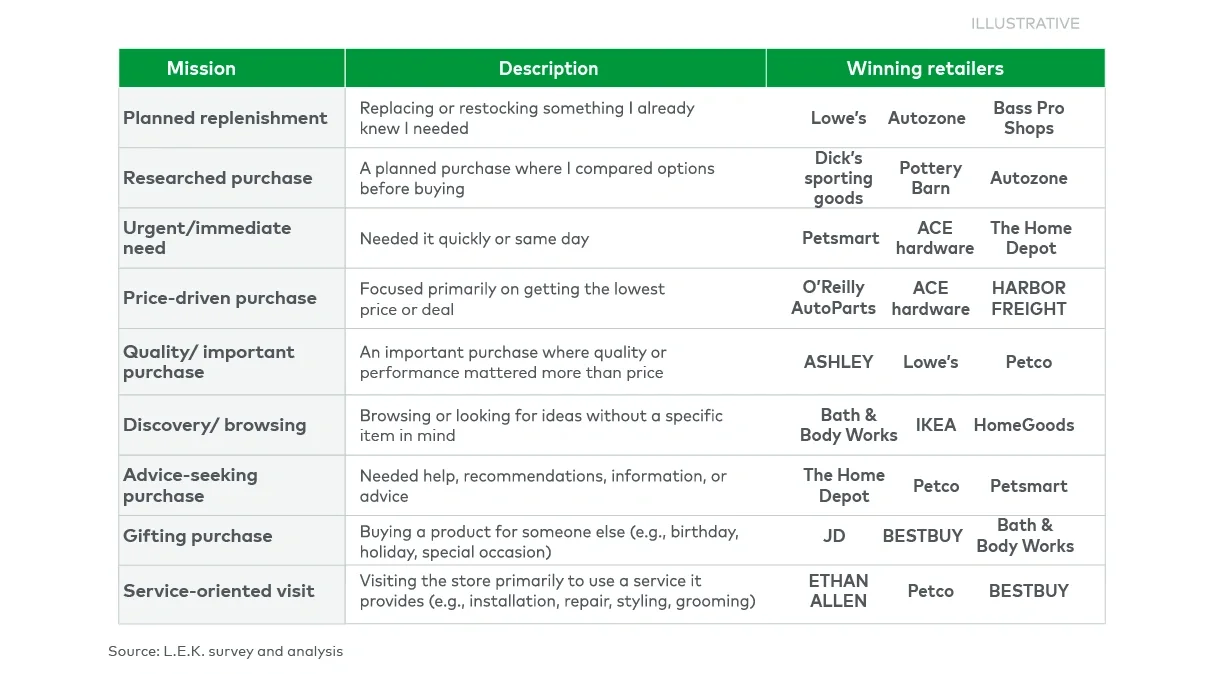
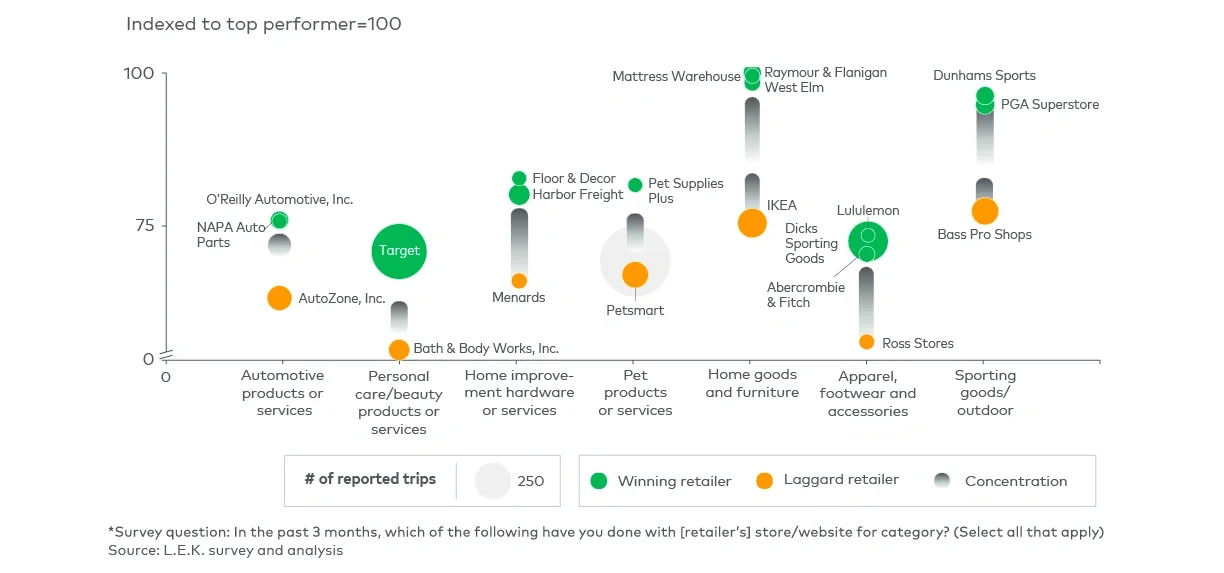
Consumers do not choose retailers randomly. They select the retailer with the experience that best fits the specific trip they are trying to complete. Winning retailers are not broadly strong across all missions. Instead, they are consistently top of mind for one or two missions that they have uniquely configured their stores to serve, and that position drives a disproportionate share of visits and purchases (see Figure 4).

For example, AutoZone has established itself as a go-to destination for urgent, problem-solving trips in automotive. Its strong in-stock position, knowledgeable staff and fast fulfillment enable it to capture time-sensitive demand.

Other retailers win by owning more discovery-driven missions. TJX and its HomeGoods banner have built strong positions around “treasure hunt” shopping, where frequently changing assortments and unexpected finds make browsing inherently engaging and fun for shoppers.

By contrast, retailers that do not clearly lead in any mission struggle to capture meaningful share. Stores such as Kohl’s and JCPenney compete across a broad set of categories but lack a clearly defined role in consumers’ minds, making them less likely to be considered.

Success in retail today is less about being everything to everyone and more about owning a distinct mission for your target consumer.

Figure 4

Winning retailers capitalize on a specific mission that serves intentional consumers

Image
Figure 4 Winning retailers capitalize on a specific mission that serves intentional consumers

Figure 4

Winning retailers capitalize on a specific mission that serves intentional consumers

Image
Figure 4 Winning retailers capitalize on a specific mission that serves intentional consumers

2. Services can reinforce a retailer’s relevance and drive consumers to the store

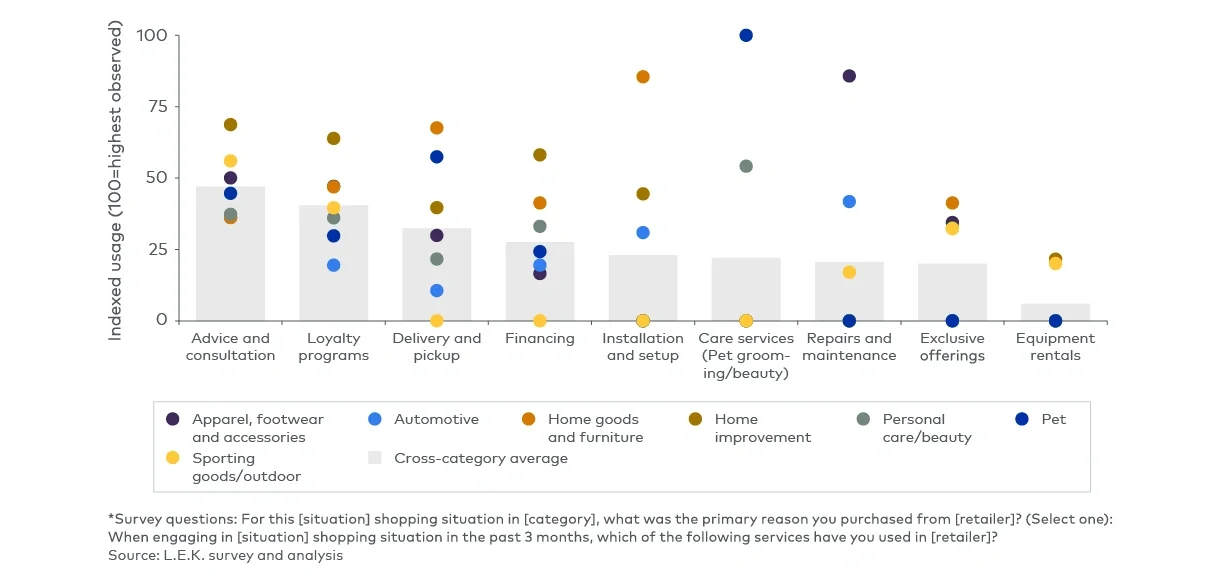
Services extend the role of the retailer beyond the product purchase. Depending on the category, offerings such as professional advice, installation, pet grooming, in-home support and consultations help meet a consumer’s need end-to-end while reinforcing the value of visiting a physical location (see Figure 5).

Figure 5

 Value-added services usage by product category

Image
Figure 5 Value-added services usage by product category

Figure 5

 Value-added services usage by product category

Image
Figure 5 Value-added services usage by product category

Services are not just an add-on. In many cases, they are a core driver of retailer choice, particularly when purchases require expertise or ongoing support. Retailers that embed services into the shopping experience are better positioned to capture high-intent trips and increase repeat visitation. Petco is a clear example, having built a differentiated position through grooming, veterinary care and training, driving incremental trips and deeper engagement.

This dynamic is also evident in home goods, where services are tied to inspiration and project-based needs. Retailers such as Williams-Sonoma have strengthened their premium cookware destination positioning through cooking classes, in-store demonstrations and expert guidance, while others offer design services and consultations to help customers plan and execute projects. These capabilities extend the role of the store beyond the transaction, providing both inspiration and support. Retailers without comparable service integration are less likely to be chosen for these missions, limiting their ability to capture high-intent demand.

3. Omnichannel capabilities reduce friction in the purchase journey

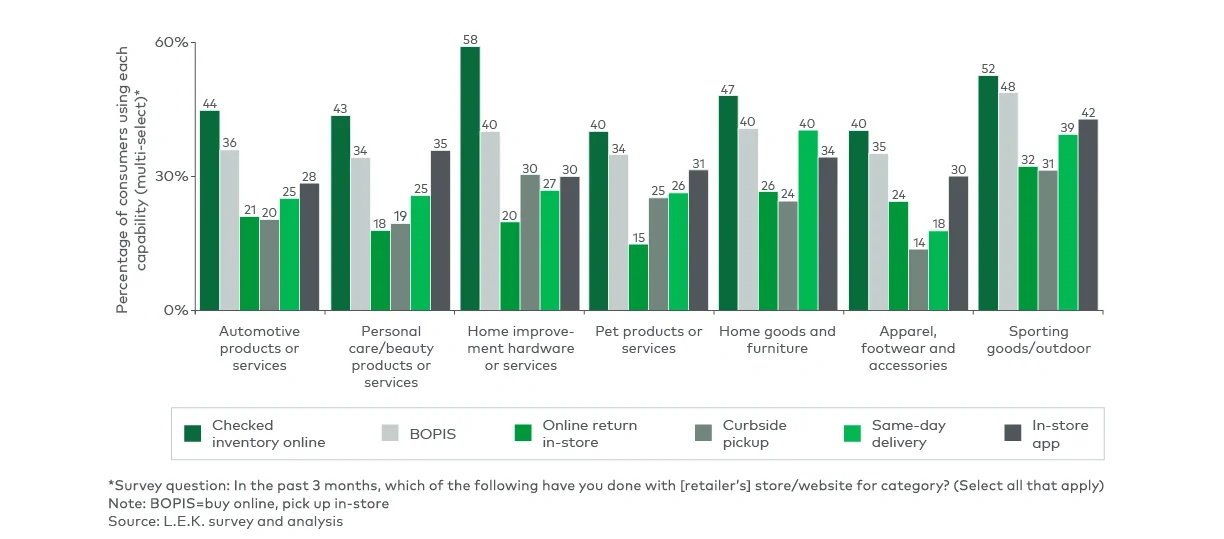
Many retailers now offer table-stakes omnichannel capabilities, but their impact depends on whether they make the consumer trip easier to complete. Consumers expect to move seamlessly between digital and physical channels, whether checking inventory before visiting, buying online and picking up in-store, or using expedited delivery (see Figure 6).

Figure 6

Share of consumers using omnichannel capabilities, by product category

Image
Figure 6 Share of consumers using omnichannel capabilities, by product category

Figure 6

Share of consumers using omnichannel capabilities, by product category

Image
Figure 6 Share of consumers using omnichannel capabilities, by product category

Winning retailers are also using digital and artificial intelligence (AI)-enabled tools within stores to elevate the experience, thereby equipping associates with better product information, enabling more personalized recommendations and helping customers quickly find and evaluate options. These omnichannel features can improve conversion, increase basket size and make in-store shopping more efficient. While many retailers offer elements of omnichannel, only a small subset have capabilities that consistently reduce friction across the journey (see Figure 7).

Figure 7

 Top retailers by average number of omnichannel capabilities used per trip

Image
Figure 7 Top retailers by average number of omnichannel capabilities used per trip

Figure 7

 Top retailers by average number of omnichannel capabilities used per trip

Image
Figure 7 Top retailers by average number of omnichannel capabilities used per trip

These capabilities are often critical to completing the trip efficiently. Home Depot illustrates this in project-based home improvement, where purchases require both planning and immediate execution. Investments in real-time inventory visibility, buy online/pick up in store and same-day fulfillment enable customers to quickly source the right products and support high-intent trips.

Retailers are also embedding digital and AI-enabled tools into their service models to reduce friction. Target, for example, has deployed a customer-facing AI agent to resolve postpurchase inquiries, improve response times and reduce reliance on in-store and call center staff. By automating routine interactions and surfacing information more efficiently, these tools free up associates to focus on higher-value needs. These capabilities complement traditional omnichannel services such as curbside pickup and same-day fulfillment, supporting both planned and immediate purchase occasions.

Omnichannel functionality is no longer a point of differentiation but a baseline expectation. Retailers that execute well will reduce friction and capture demand, while those that fall short risk losing relevance in the consideration set.

4. Assortment relevance drives repeat visits

Retailers must offer assortments that directly connect to the needs of the missions they are trying to capture. Depending on the need being served, consumers are more likely to return to retailers that consistently introduce new products, align with evolving preferences and deliver strong value alongside frequent restocking. Most often, consumers are seeking well-curated assortments instead of overly broad assortments when shopping in physical stores.

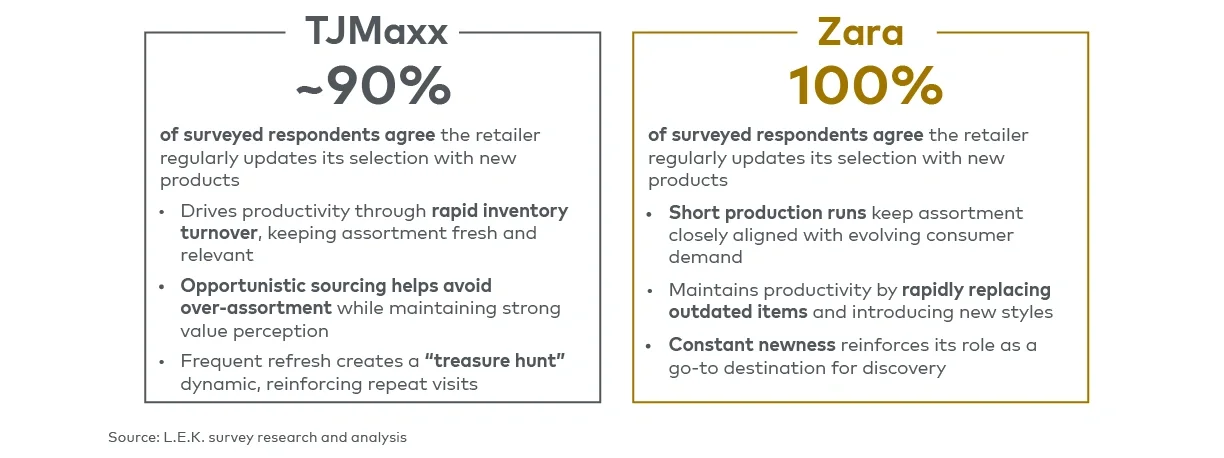
Assortment relevance is a key determinant of whether a retailer remains in the consideration set over time. Zara exemplifies this, leveraging a vertically integrated model to introduce new styles rapidly, stay aligned with emerging trends and offer fashion at accessible price points. This combination of newness and value reinforces its position as a destination for discovery and drives frequent visits (see Figure 8).

A similar effect is seen in off-price retail, where TJX sustains traffic through continuously changing assortments driven by opportunistic buying and high inventory turnover, enabling it to offer branded products at compelling value. The resulting “treasure hunt” experience encourages repeat visits, as consumers expect new finds each time they shop (see Figure 8).

By contrast, retailers that default to undifferentiated assortment lose repeat engagement and fall out of the purchase journey. Maintaining a dynamic, relevant assortment that delivers strong value against the specific needs of the consumer’s shopping mission is therefore critical not only for conversion, but also for sustaining long-term traffic and customer loyalty.

Figure 8

Assortment productivity case studies

Image
Figure 8 Assortment productivity case studies

Figure 8

Assortment productivity case studies

Image
Figure 8 Assortment productivity case studies

5. Highly engaged store associates support differential in-store experiences

For many categories, particularly more complex or considered purchases, store associates play a critical role in helping consumers complete the trip and have a positive experience. Knowledgeable staff guide product selection, answer questions and reduce uncertainty, making them the most important part of the in-store value proposition. Highly engaged employees bring differentiated retail strategies to life and enable highly positive consumer experiences.

This role is most pronounced where consumers lack expertise or purchases carry higher stakes, but it remains important across all retail environments. In higher-consideration categories, associates guide decisions and build consumer confidence. In more routine purchases, they improve efficiency, resolve issues quickly and contribute to a value-added in-store experience. Retailers that invest in training and empower associates to provide credible, hands-on support are better positioned to convert shoppers and build trust.
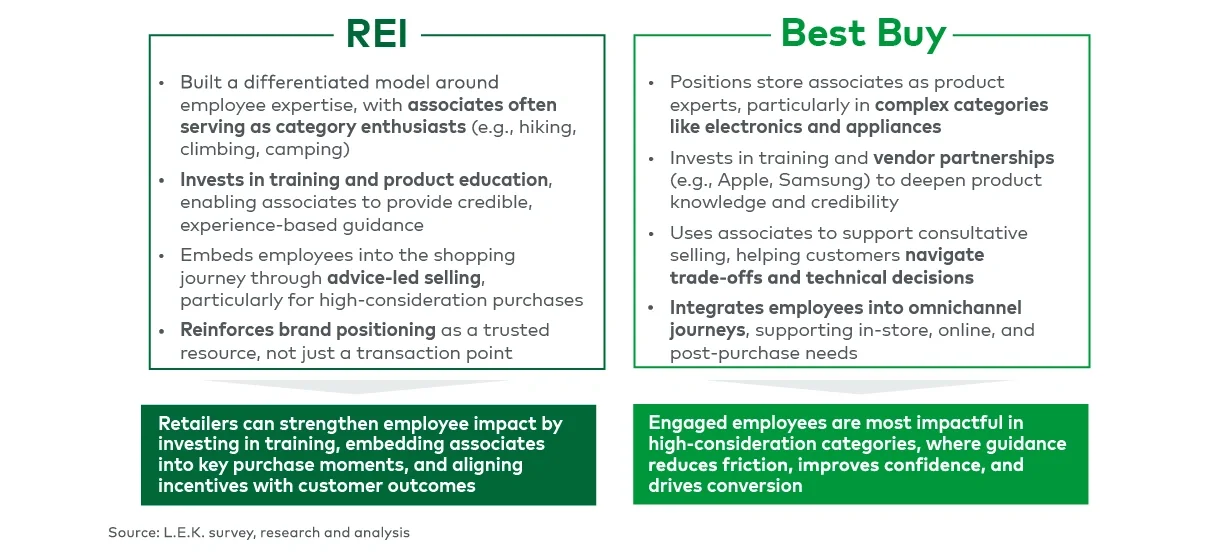
REI is a clear example, with store associates who are often category enthusiasts who can provide tailored advice on technical products, reinforcing the retailer’s position as a trusted resource (see Figure 9).

A similar dynamic exists in categories such as home improvement and electronics, where associate support can meaningfully influence purchase decisions. Retailers that combine product availability with knowledgeable in-store assistance are more likely to capture these trips, while those that lack this capability risk losing customers seeking guidance elsewhere.

As retail becomes increasingly mission-driven, strong in-store execution remains an important differentiator.

Figure 9

Examples of brands demonstrating engaged employees

Image
Figure 9 Examples of brands demonstrating engaged employees

Figure 9

Examples of brands demonstrating engaged employees

Image
Figure 9 Examples of brands demonstrating engaged employees

Conclusion

Across categories, a small set of retailers is pulling ahead by aligning their strategy to the specific missions they can win, while others continue to lose relevance.

Winning retailers have established a clear role in the consumer journey and consistently deliver against the capabilities that matter most: supporting key missions, embedding services, reducing friction through omnichannel, maintaining relevant and well-priced assortments, and providing in-store expertise.

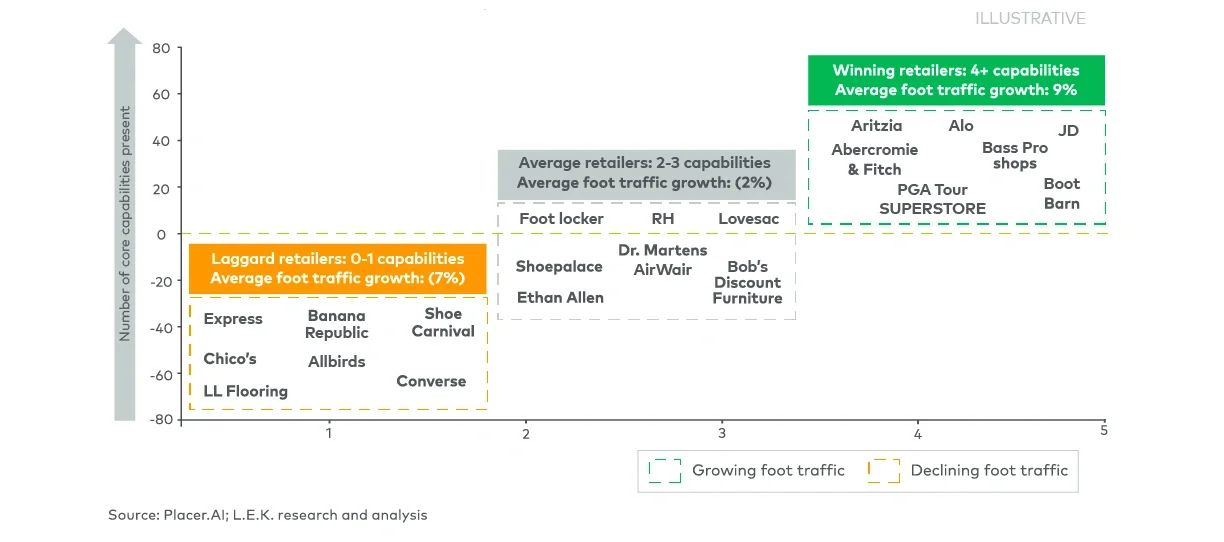
Retailers that deliver across more of these five capabilities capture stronger traffic growth and exemplify a clear positive relationship between capabilities and performance (see Figure 10).

Figure 10

 Top and bottom decile US retailers, plotted by number of core capabilities and foot traffic (2023-25)

Image
Figure 10 Top and bottom decile US retailers, plotted by number of core capabilities and foot traffic (2023-25)

Figure 10

 Top and bottom decile US retailers, plotted by number of core capabilities and foot traffic (2023-25)

Image
Figure 10 Top and bottom decile US retailers, plotted by number of core capabilities and foot traffic (2023-25)

Where does your banner stand across these dimensions?

  • Are you clearly associated with the missions that matter most to your customers, or are you competing broadly without a defined role?
  • Are your services and omnichannel capabilities meaningfully adding value or reducing friction, or are you simply meeting baseline expectations?
  • Does your assortment consistently feel relevant and deliver value, or does it give customers a reason to look elsewhere?
  • Are your store teams enabling confident decision-making and a differentiated experience, or are they merely supporting transactions?

The gap between leaders and laggards is widening, and the cost of inaction is increasing. There are fewer and fewer basic retailers remaining in the market. Retailers need to make deliberate strategic choices across mission alignment, services, omnichannel, assortment and store execution in order to remain competitive.

For more information, please contact us.

L.E.K. Consulting is a registered trademark of L.E.K. Consulting LLC. All other products and brands mentioned in this document are properties of their respective owners. © 2026 L.E.K. Consulting LLC

English