


Executive Insights

One and Done? The Implications of a Single Pivotal Trial Pathway for FDA Approval

May 26, 2026

Key takeaways

Recent commentary from Food and Drug Administration (FDA) leadership may open a pathway for more single pivotal trial approvals, which has the potential to accelerate development timelines and lead to significant cost savings.

Still, several uncertainties remain regarding the trial requirements and broader repercussions.

Biopharma leaders should take a systematic approach to understand clinical development plans under varying scenarios, prioritizing the ones that maximize global value while minimizing risk. 

Single-trial approvals are relatively common in oncology, orphan, and/or accelerated approval settings, suggesting the greatest incremental regulatory impact may be for broader, non-orphan assets where evidentiary requirements have historically been more extensive.

It takes 10-15 years and over $2 billion on average to bring a single drug to approval. This is driven by evidentiary requirements — several phases of clinical trials, each requiring greater enrollment of patients — and the failures along the way.

In February 2026, Center for Biologics Evaluation and Research (CBER) Director Vinay Prasad and Food and Drug Administration (FDA) Commissioner Martin Makary published a commentary/opinion piece in the New England Journal of Medicine titled “One Pivotal Trial, the New Default Option for FDA Approval — Ending the Two-Trial Dogma.” The article closes noting that the Food and Drug administration’s (FDA) new default position is “one adequate and well-controlled study, combined with confirmatory evidence, will serve as the basis of marketing authorization of novel products.”

This latest information reflects long-standing debates about trial design efficiency, evidentiary and data sufficiency, and the balance between rapid access and robust evidence for novel medications. Prasad and Makary suggest that this will lead to cost and time savings, resulting in a “surge in drug development.”

Industry response has been generally positive, with reactions ranging from transformative to cautious optimism. However, former Center for Drug Evaluation and Research (CDER) Director Richard Pazdur has called this “very dangerous,” highlighting that “these [end points] may be subject to bias, and sometimes it’s important to have clinical trials and duplications of clinical trials in those areas. My caution is, all that glitters is not gold, one has to be very careful, and I hope the upcoming guidance that is being written on this is cognizant of the differences that would exist between other therapeutic areas.”

With the departures of Makary and Prasad, it is unclear if this will become the new standard. If it does, this change could be seen as a win for biopharma, although uncertainties remain. In this edition of Executive Insights, L.E.K. Consulting contextualizes the news and provides key questions that biopharma executives should be asking.

In this edition of Executive Insights, L.E.K. Consulting contextualizes the news and provides key questions that biopharma executives should be asking.

How big of a shift is this? What drugs are impacted?

Under Title 21 of the Code of Federal Regulations, FDA approval requires “substantial evidence” of effectiveness. Historically, this has often been interpreted as evidence derived from two adequate and well-controlled studies. However, the statute does not explicitly mandate two trials.

Precedent has allowed approval based on a single adequate and well-controlled study with confirmatory evidence in appropriate circumstances. This distinction is important, and the commentary from Prasad and Makary does not alter the statutory standard but reframes how substantial evidence may be demonstrated in modern development settings.

Looking at approvals over time before the Trump administration, a declining number of therapeutic approvals have required multiple efficacy trials to support approval, with 60%-70% of CDER and CBER new molecular entity (NME) approvals in 2024 relying on a single trial (see Figure 1).
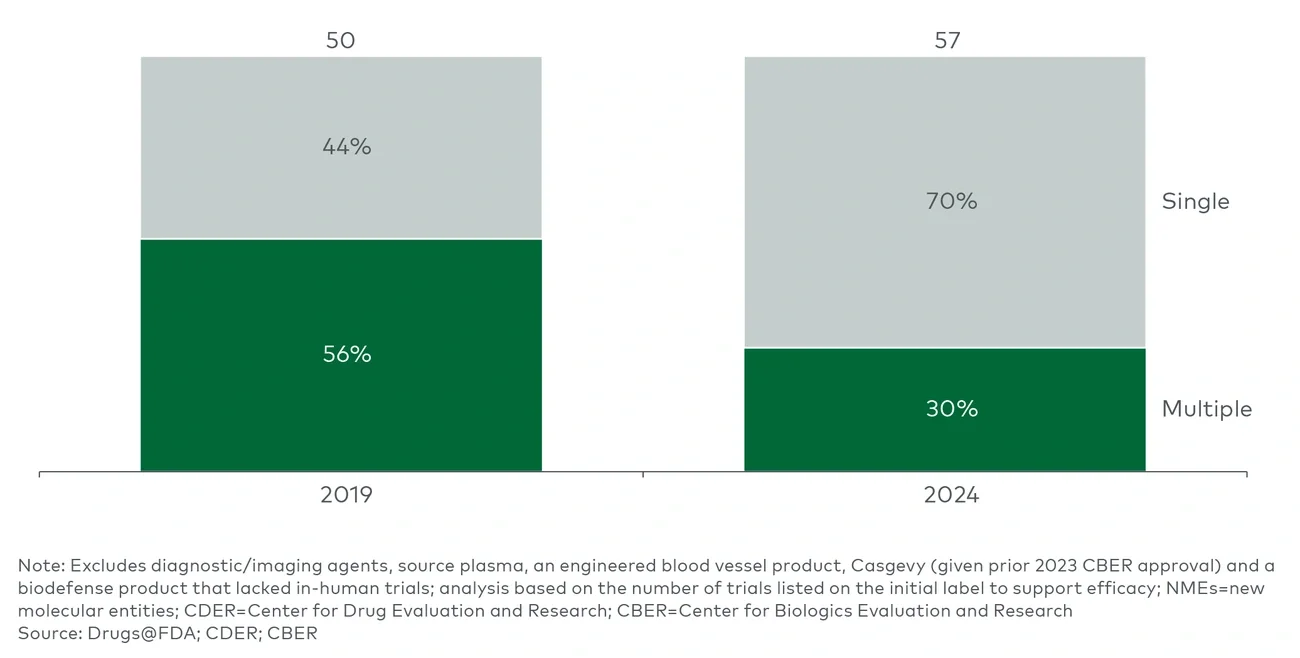
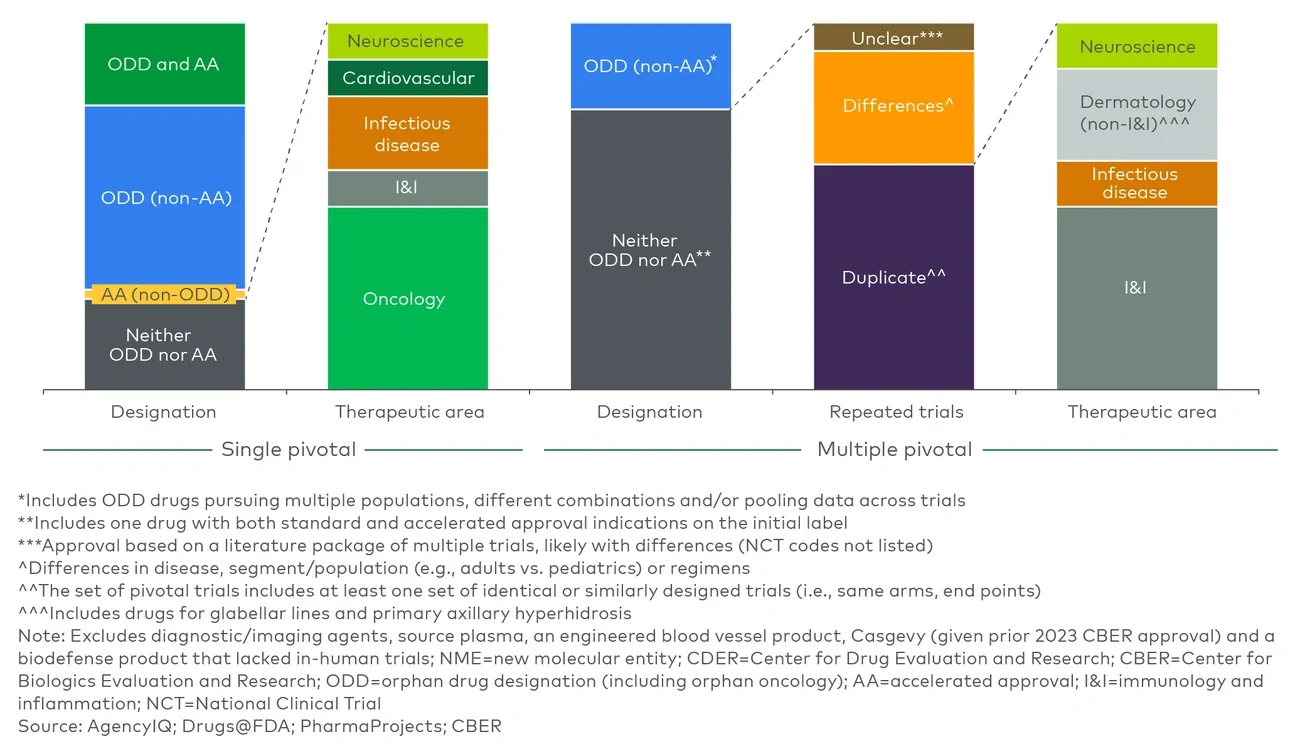
Figure 1

NMEs by number of pivotal efficacy trials (CDER and CBER)

Image
Figure 1 NMEs by number of pivotal efficacy trials (CDER and CBER)

Figure 1

NMEs by number of pivotal efficacy trials (CDER and CBER)

Image
Figure 1 NMEs by number of pivotal efficacy trials (CDER and CBER)

Most of these single pivotal approvals (75%) had an orphan designation and/or were approved through the accelerated approval pathway (see Figure 2). Among those that required more than one efficacy trial, few had orphan designation and none was approved through an accelerated pathway. Approximately 15% of the 2024 NME approvals leveraged repeated trials (i.e., identical designs), which are most likely to be impacted by this new single pivotal option.

Figure 2

Breakdown of 2024 NME approvals (CDER and CBER)

Image
Figure 2 Breakdown of 2024 NME approvals (CDER and CBER)

Figure 2

Breakdown of 2024 NME approvals (CDER and CBER)

Image
Figure 2 Breakdown of 2024 NME approvals (CDER and CBER)

What uncertainties remain?

Trial requirements and optionality: The potential cost savings and timeline improvements depend on the characteristics of the single pivotal option (including any differences in postmarketing evidence generation). The Prasad and Makary article frames this shift as modernization rather than as a lowering of evidentiary standards. It emphasizes magnitude of effect, statistical analyses and a range of trial design elements (including end point and comparator selection) as critical building blocks of credibility.

It remains unclear whether the single pivotal option is equivalent to one of the former two pivotal designs or it is more burdensome. Eliminating a second global Phase 3 study could reduce duplicated enrollment, site management and operational costs. However, this change is likely to increase trial design complexity (e.g., sample size, statistical powering, follow-up timing, geographic representation, postmarketing commitments), which may offset part of the theoretical savings. It is unclear to what degree the FDA may enact one trial as the primary path or allow pharma companies to choose to take a multiple pivotal path if they choose.

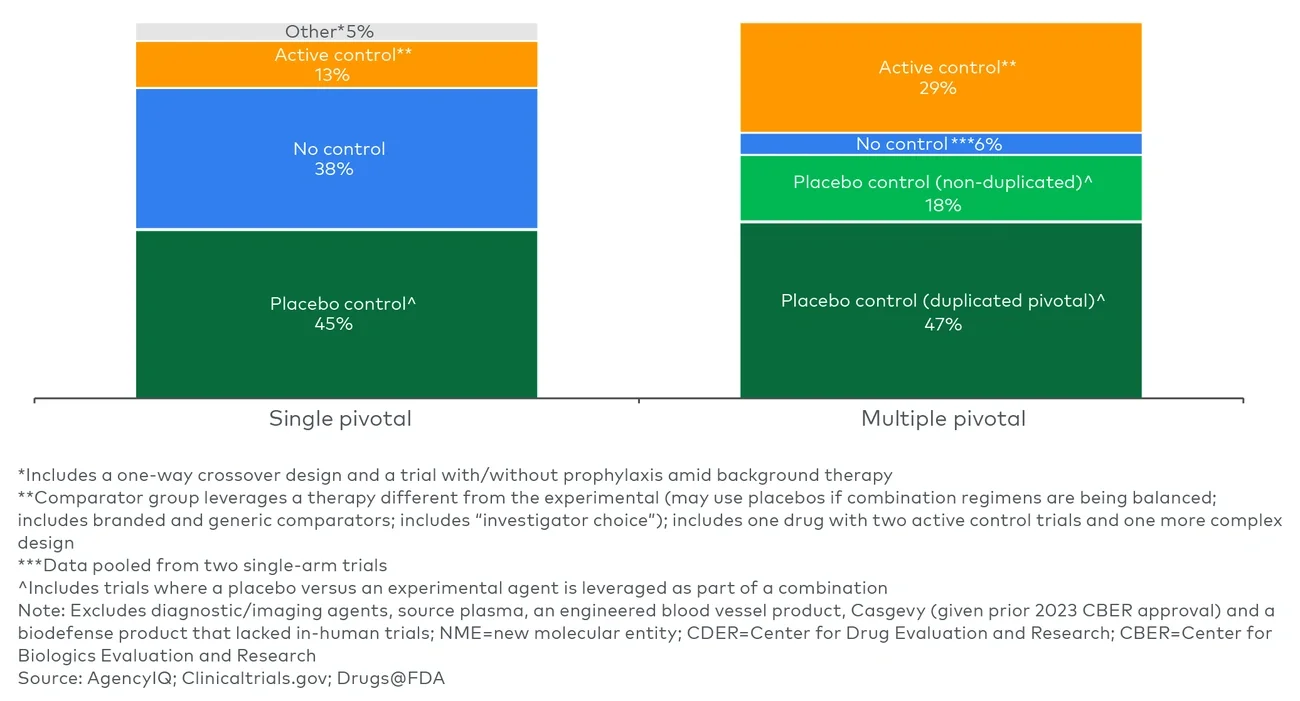
Comparator risk: If the single pivotal option drives greater focus on active controls and head-to-head trials, it could increase both cost (especially if a branded comparator) and risk. Of the 2024 single pivotal approvals, approximately 80% were either placebo controlled or lacked a control group (see Figure 3). Active control trials were more common among multiple pivotal approvals (roughly 27% vs. 16%). When leveraged, head-to-head trials can provide a clear rationale for drug access and uptake, but a negative result could diminish the drug’s value proposition.

Manufacturer appetite for single pivotal trials: While many companies would likely prefer a single trial for approval, this may not be true across all therapeutic areas as it consolidates risk into a single trial. Hesitance may be more likely in indications with high placebo rates (e.g., psychiatry). If run as a single pivotal trial, it opens several questions: Would the FDA accept a positive single trial for approval? If negative, could a second trial be run? What happens in the case of mixed results?

Postmarketing data requirements: If the single pivotal option shifts more regulatory risk post approval (similar to an accelerated approval), it may lead to more withdrawals from the market if the approval data is not confirmed. For context, of the 278 accelerated approvals from 1992 to 2021, approximately 12% were withdrawn (versus about 50% converted to full approval and about 39% pending at the time the analysis was published). A more recent oncology-focused analysis highlights approximately 22% withdrawn among 2013-17 approvals (versus 63% converted and 15% pending). The FDA may also be stricter in enforcing and monitoring postmarketing commitments.

Regulatory durability: With development programs spanning multiple years, it is likely that they span multiple leadership and/or policy changes. It is unclear whether these changes will hold with future administrations. Likewise, drugs that were targeting a single pivotal approval before Prasad and Makary’s article may also see increased scrutiny from the current administration. This issue has been apparent through recent high-profile FDA actions, which saw differences in opinion on the robustness of end point and comparator decisions (e.g., Disc Medicine, Uniqure). Prasad and Makary’s recent departures raise additional uncertainties regarding the impact of their article.

Global repercussions: Trials are often designed to meet the requirements of multiple global regulatory agencies of other countries, with some countries relying on FDA approval as a key input to their own approval pathways. It is unclear whether this change will impact this relationship, leading to changes in biopharmas’ global clinical development planning.

Physician and payer reactions: With less data generated, physicians and payers (U.S. and global) will need to weigh the strength of new therapies and compare data across competitors. Their reactions might impact the adoption of, pricing of and access to new drugs.

Figure 3

2024 NME approvals by control group (CDER and CBER)

Image
Figure 3 2024 NME approvals by control group (CDER and CBER)

Figure 3

2024 NME approvals by control group (CDER and CBER)

Image
Figure 3 2024 NME approvals by control group (CDER and CBER)

Considerations for biopharma leaders

To prepare for the potential shifts in trial requirements and expectations, biopharma leaders should evaluate development strategy through a structured decision framework:

  • What options exist for FDA approval?
  • Which option should be prioritized, considering the potential asset or portfolio value across differing timelines, global development costs and commercial scenarios?
  • What operational enhancements are required to ensure strong execution and timely pre- and post-approval evidence generation?
  • What additional FDA interactions might be required to ensure an aligned registrational trial design?
  • What are the broader implications for the portfolio and financing requirements?

Conclusion

The discussion about a single pivotal trial pathway reflects a broader evolution in regulatory interpretation, statistical methodology and development strategy. This may be the culmination of a trend toward majority single pivotal approvals. It does not appear to alter the statutory requirement for substantial evidence, nor does it eliminate alternative evidentiary pathways. A single pivotal trial strategy may offer efficiency in some contexts, but it may also concentrate risk and introduce downstream uncertainty in others. The optimal path will vary by asset, competitive landscape, capital structure and global footprint. 

Strategic advantage will accrue to organizations that rigorously assess both pathways; proactively align with regulators, payers, physicians and other stakeholders across jurisdictions; and embed evidentiary decisions within broader portfolio and capital strategy.

If you are considering optimizing your clinical development plan for this new pathway, contact us.

L.E.K. Consulting is a registered trademark of L.E.K. Consulting LLC. All other products and brands mentioned in this document are properties of their respective owners. © 2026 L.E.K. Consulting LLC

English