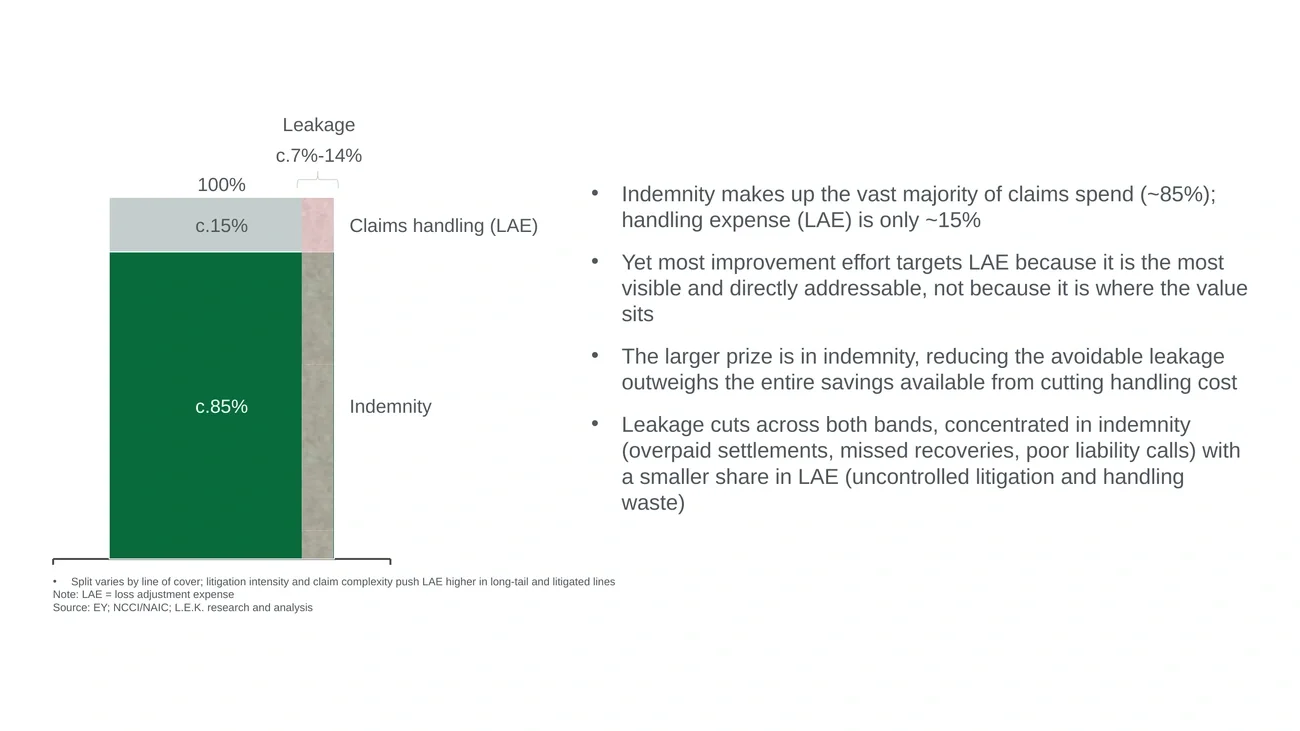
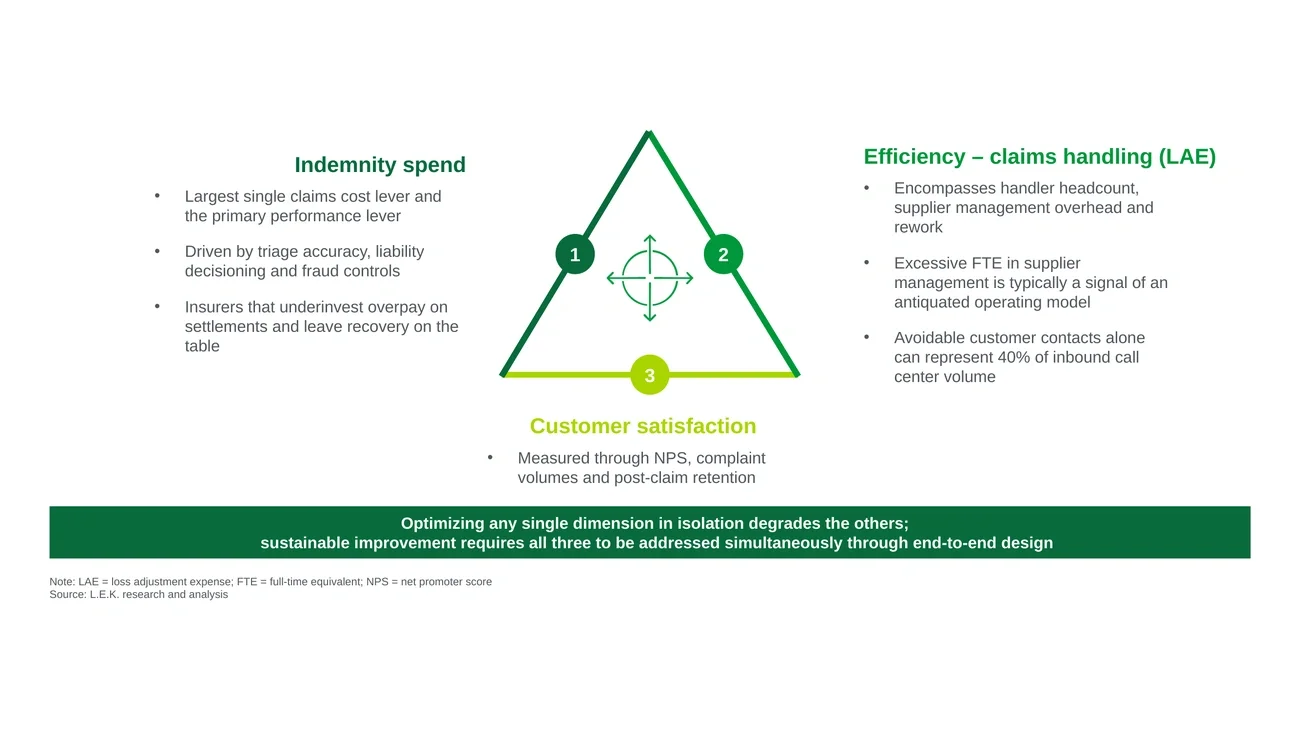
This is the trade-off that AI is beginning to dissolve. For most of the function’s history, the three imperatives were genuinely competing — better outcomes cost more to produce, and faster, cheaper handling came at the expense of accuracy. AI and integrated data create the ability to improve all three measures. Better triage, liability decisioning and fraud detection can now improve indemnity, reduce handling cost and raise customer experience at the same time, not by trading one against another but by making earlier decisions more accurate and more auditable.
But that gain is conditional. AI does not improve outcomes for whoever deploys a model. Instead, it improves outcomes for whoever holds the data and controls the workflow on which the model runs. A point solution applied to a single step on fragmented and untrusted data shifts the frontier very little. The same capability applied across an integrated, well-governed claims ecosystem shifts it materially. This is why the question of who optimizes is inseparable from the question of who orchestrates, and why AI, far from being a neutral enabler, is raising the stakes on where orchestration ultimately resides.
The claims value chain has become an ecosystem
A claim today touches multiple nodes:
- Digital intake platforms
- AI-driven triage and routing engines
- Provider networks
- Desk- and field-adjustment services
- Medical and legal networks
- Restoration and repair ecosystems
- Payment, subrogation and recovery platforms
Each node may sit with a different provider, platform or network participant. Increasingly, these providers are connected through application programming interfaces, data exchanges and shared workflows. In some cases, they are coordinated in real time.
This is no longer a traditional vendor model. It is an ecosystem.
And like any ecosystem, performance depends less on optimizing individual participants and more on how effectively the entire system is coordinated. Improving a single node in isolation may create incremental gains, but the greatest impact comes from orchestrating workflows, decisions, data and handoffs across the full claims journey. That imperative (coordination over isolated optimization) is now driving the ecosystem itself to consolidate for reasons that are structural rather than incidental.
Why the ecosystem is consolidating
The shift from fragmentation to consolidation is not accidental. It is driven by structural forces.
First, integration has become a bottleneck. Many carriers operate with a patchwork of systems and vendors, leading to inconsistent data, manual handoffs and limited visibility into performance.
Second, claims outcomes are increasingly path-dependent. Early decisions (e.g., how a claim is triaged, which vendor is assigned, how communication is handled) have outsized impact on cost, cycle time and customer experience. Managing these decisions requires a good understanding of the capabilities across the network, good data and coordination across multiple players.
Third, data has become the central asset in claims. Fraud detection, severity prediction, customer engagement and vendor performance all depend on integrated data flows. Fragmented ecosystems undermine this capability.
Finally, the role of vendors is changing. TPAs, for example, are no longer just providers of overflow capacity. They are evolving into strategic partners that bring digital capabilities, analytics and operational expertise to the claims process in return for higher panel shares or even Solus panel positions. This changes the very nature of the business model away from body shops and more toward technology and infrastructure providers.
Taken together, these forces are pushing the industry toward a different model, one with fewer vendors, deeper relationships and greater integration. The open question is who ends up owning the coordination that results — carriers investing to internalize orchestration or the TPAs, networks and platforms expanding across the value chain to provide it on their behalf? Answering that starts with understanding how the vendor landscape itself is reorganizing.
A bifurcation in the vendor landscape
As the ecosystem evolves, vendor business models are converging on three archetypes, distinguished less by what they do than by how much of the ecosystem they coordinate:
- Point solution providers deliver deep capability in a narrow part of the chain.
- Network providers are asset-light intermediaries that coordinate access, capacity and service delivery across a fragmented provider base.
- Platform players integrate horizontally and vertically across the chain, combining operations, technology and data to influence outcomes across the full life cycle.
The distinction that matters is not scope but control: who coordinates the ecosystem, and thus where the economic value accrues.
1) Point solution providers are highly specialized firms that deliver deep capability in a narrow area, across the claims management, software and remediation layers. They span four broad types:
- Claims administration point solutions: providers focused on single workflow functions such as first notice of loss intake, payment administration, communications, document management or subrogation support
- Specialized advisory providers: independent adjusters, managed care organizations, medical review firms, engineering experts, legal services and other specialist advisors that support claim evaluation and resolution
- Remediation and repair providers: contractors, roofers, mitigation providers, restoration firms, replacement-vehicle services, providers and repair networks
- Software and insurtech providers: fraud detection tools, damage estimation software, AI triage engines, workflow automation tools, document processing platforms and other digital claims technologies
These players often bring innovation and performance improvements at the task level.
2) Network providers are asset-light intermediaries that sit between claim allocators (be they insurers or TPAs) and the provider layer (collision repair garages, medical specialists, roofers).
3) Platform and ecosystem players display both characteristics, integrating horizontally and vertically across the value chain — organizations that span multiple parts of the claims life cycle and integrate capabilities into a unified offering. This includes large TPAs, claims platforms and service providers that combine operations, technology and data.
In practice, this distinction is even less clear-cut than it appears, as many platform players struggle to deliver on their promise due to weak integration, overlapping capabilities and unclear strategy. Fragmented execution and legacy constraints can significantly limit their ability to truly orchestrate the ecosystem. At the same time, high-performing point solutions can scale effectively within specific parts of the value chain, particularly where they deliver measurable outcomes but are less able to influence the broader constraints of the ecosystem in which they operate.
The implication is not that one archetype wins and the others lose. Each can win or lose, depending on the clarity and focus of its strategy. Point solutions win by becoming the unambiguous standard in a defensible niche, deep enough that orchestrators must integrate them rather than replace them; they lose when they stay narrow on commoditizing ground and become interchangeable capacity. Networks win by turning coordination into a genuine data and performance advantage; they lose when they remain pass-through intermediaries that add scale but no intelligence. Platforms win when they actually integrate (i.e., when breadth translates into orchestration); they lose when they accumulate capabilities without connecting them and when breadth becomes overhead rather than control. In every case, the winners are those with a clear view of the specific leadership position they are building toward and the discipline to focus on it.
For vendors and their investors, the imperative is to build genuine end-to-end value (even from an existing point-level position) rather than remain a capability others orchestrate around.
Implications for carriers
For carriers, the implications are both strategic and operational.
First, claims strategy and, within this, vendor strategy are reaffirmed as core competencies. Orchestration is now a capability in its own right. Carriers must understand their ecosystem at a granular level — where each partner sits, how they interact and where value is created or lost — and actively coordinate it rather than procure against it.
Second, not all vendors create equal value. The distinction between different models and the benefits/costs they provide matters. Carriers that continue to optimize for cost at the vendor level risk missing larger opportunities at the system level, and where carriers focus on savings in claims overhead, they can miss substantial opportunities in indemnity spend efficiency.
Third, orchestration becomes a source of competitive advantage. As claims functions become more data-driven and interconnected, the ability to coordinate across the ecosystem will differentiate leaders from laggards.
Finally, claims itself becomes a networked capability. It is no longer defined by internal processes but instead by how effectively the ecosystem is designed and managed.
Implications for investors
For investors, the critical question is no longer simply whether a company has a differentiated product or service. It is whether that company can become strategically embedded within the orchestration layer of the claims ecosystem.
As carriers and large ecosystem players consolidate workflows, vendor panels and data flows, many stand-alone point solutions risk becoming increasingly interchangeable. A provider that improves a narrow task may still struggle to defend pricing power or distribution if another party controls claim routing, customer engagement and workflow coordination.
This creates a meaningful strategic risk for investors. If insurers or large platform players internalize orchestration capabilities, portions of today’s fragmented claims ecosystem may lose relevance over time. In that scenario, investors could be left owning highly specialized assets that remain operationally useful but no longer occupy a strategic control point within the value chain.
AI sharpens this risk rather than softening it. As models lower the cost and raise the feasibility of internalizing orchestration, carriers and large platforms that hold the data and own the workflow are increasingly able to absorb capabilities they once acquired. For investors, this reopens the central issue: A strong model is not a durable asset if the party that controls the data can replicate or commoditize it. The defensible position is ownership of the orchestration layer itself, not of a capability that runs on someone else’s layer.
By contrast, providers that successfully expand from execution into orchestration may benefit from stronger customer entrenchment, broader data access, greater workflow control and more durable economics.
This dynamic mirrors patterns seen in other industries where orchestration and platform control often capture disproportionate value over time.
Final thoughts
The claims function is not simply being optimized. It is being re-architected.
What was once a fragmented landscape of vendors is becoming a connected ecosystem of strategic partners. The shift is subtle, but its implications are significant.
AI is what turns this from a gradual evolution into a contest. By making integrated data and automated decisioning dramatically more valuable, AI raises the prize for whoever controls the coordination layer and lowers the barrier to seizing it. It does not settle who that will be. Carriers, platforms and networks are now competing for the same orchestration position, and the technology that makes orchestration more powerful also makes its ownership more contested. The unresolved question is no longer whether the ecosystem consolidates around an orchestration layer but rather who ends up owning it.