

Executive Insights

AI Is Making Your Operating Model Obsolete — Here’s What It Should Look Like Instead

June 20, 2025

Key takeaways

In a world where artificial intelligence (AI) capabilities are widely available, businesses will have to understand the best way to use AI in order to stay competitive.

Five principles help the AI-first organization get the most out of AI as a “team member” while accommodating the technology’s rapid evolution.

An AI-first organization orients its operating model around outcomes rather than processes. 

Early adopters of the AI-first ethos have focused on developing general AI fluency while changing the operating model domain by domain. 

Businesses have always sought better ways of working, and to some extent, they’ve succeeded. Software as a service transformed the deployment of new tools. Remote work took down barriers to talent and collaboration. Agility reshaped teams into responsive, customer-focused value delivery units.

However, rarely have these factors fundamentally changed a company’s overall operating model. Most businesses still organize around how work is done rather than what the work achieves. Traditional enterprise technology may make tasks easier, but it’s still driving processes, not outcomes.

It’s not news to anyone that you can have great tech-powered processes and still fail to deliver meaningful outcomes. But the status quo was arguably workable so long as AI outputs were constrained by the availability of scarce, highly trained specialists. Then generative AI made AI-driven decisions directly accessible to anyone.

The other shoe dropped with the introduction of agentic AI, enabling systems to take on increasingly complex tasks.

As with other digital breakthroughs — think smartphones, cloud computing, the internet or the graphical user interface — AI isn’t likely to be intrinsically differentiating. You can expect competitors to have similar capabilities. This means the winning edge will go to businesses that understand the best way to deploy AI. And to enable that, businesses must revisit their operating models with an AI-first, outcome-oriented mindset.  

In the rest of this Executive Insights, we’ll show you what an AI-first organization looks like, discuss the approaches that some companies have taken to being AI-first and share a few tips to consider as you evaluate your own organizational construct.

Defining the AI-first organization

Let’s start with what “AI first” is not. It’s not about building a dedicated AI unit. Nor is it an evolution of the digital-first organization, which emphasizes the use of digital platforms such as customer relationship management systems, apps and digital supply chains.

An AI-first organization recognizes that not every decision needs to be made by a human and that the decisions humans do make are often improved with AI input. In the consumer industry, for example, human creativity delivers up to 20 times more high-interest innovations when paired with AI augmentation.

At the same time, you can’t simply provide workers with access to AI capabilities and expect that alone to yield transformative results. To go from AI-enabled to AI-first, the workplace must be redesigned to get the most out of adding AI as a team member.

This means doing away with rigid structures and process-driven centralization, which are poorly suited to dynamic, real-time, unstructured intelligence and evolving beyond just agile pods. Instead, an AI-first organization deploys AI as a team member focused on outcomes connecting people and AI to deliver high-quality outcomes collaboratively (see Figure 1). 
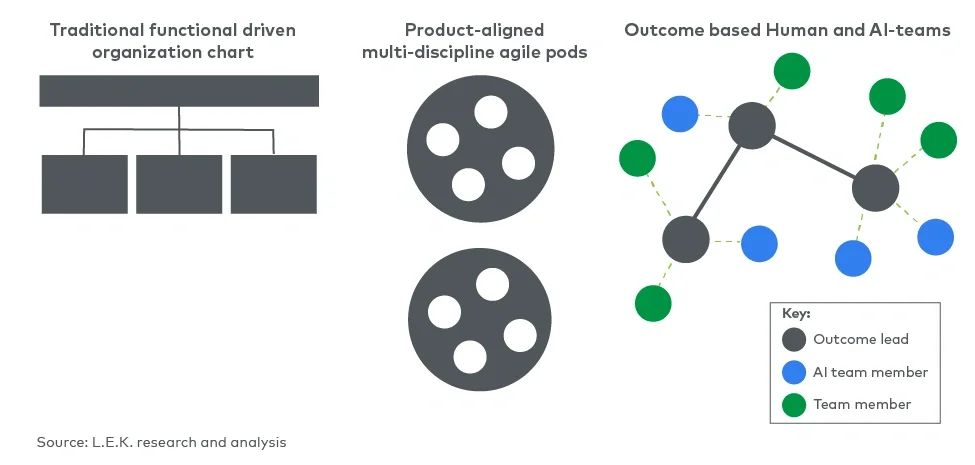
Figure 1

The evolution to interconnected AI-enhanced teams 

Image
The evolution to interconnected AI-enhanced teams

Figure 1

The evolution to interconnected AI-enhanced teams 

Image
The evolution to interconnected AI-enhanced teams

The work itself is organized by decision domain or areas of authority that can cut across multiple departments (think allocating capital, setting a pricing strategy or hiring skilled staff). This way, organizations can accommodate the speed and uncertainty of AI while integrating it with business outcomes.

Breaking it down further, here are five principles that define an AI-first organization:

  1. Data-centric versus process-centric approach. Trust and prioritize data (both structured and unstructured) over rigid workflows.
  2. Continuous transformation. Make advancement part of daily operations, not just innovation labs.
  3. Loose pairings plus modular design. Design systems or services and teams for plug-and-play evolution.
  4. Empowerment. Empower employees — even individual contributors — to manage machines and collaborate with them to make the right decisions in an organization.
  5. Fluency over structure. Build organization wide fluency in AI and data rather than issuing top-down mandates. (This can also help close any AI talent gaps — a problem for 41% of executives, according to L.E.K. research.)

The idea is to put AI at the center of how the business makes decisions, does its work and ultimately delivers value to the market. 

Can AI be trusted?

AI systems can run into problems that call their reliability into question. Facial recognition systems have misidentified people as criminals. In-house tools have produced legal briefs citing nonexistent cases. Complex lending algorithms have denied loan applications without any explanation. 

Incidents such as these reflect the limitations of present-day AI technologies. To address these issues, more developers are adopting responsible AI (RAI) principles to guide their work. Some use in-house frameworks the way Microsoft and IBM do, while others rely on third-party standards such as those from the Institute of Electrical and Electronics Engineers or the Organisation for Economic Co-operation and Development.

Either way, developers are making progress. According to researchers from Stanford, the Massachusetts Institute of Technology (MIT) and Princeton, companies that build foundational models — large, deep, AI neural networks — increased their transparency significantly in just seven months, with the average score rising from 37 to 58 on a 100-point scale.  

The importance of trustworthy systems isn’t lost on business users. According to a recent MIT survey, 87% of executives consider RAI as a medium-to-high priority for their organization. An AI-first operating model can help organizations translate this widespread awareness into action by, among other things, ensuring people understand AI well enough to work with it wisely.

Early adopters of the AI-first construct

Some companies have already started to reshape themselves into AI-first organizations.

At Shopify, everyone is required to use AI in their work and can tap into a range of AI capabilities within the organization. Requests for additional head count at the ecommerce company are turned down unless teams can show why AI can’t do the job. Meanwhile, the CEO has encouraged employees to consider including AI agents in their project teams.

Duolingo is another company with a mandate to integrate AI with every position. The language-learning app maker, which has used AI to build new features and accelerate its content development process, is rolling out organization wide initiatives aimed at reshaping how employees work. Notably, Duolingo compares its recent decision to go AI-first with its pivotal 2012 shift to a mobile platform.

Then there’s Bank of New York Mellon Corp., also known as BNY. After a year of upskilling tens of thousands of employees on its enterprise AI platform, BNY announced plans to have autonomous AI handle processes in risk management, knowledge management and customer service. The bank is also looking at ways to use AI in product and service development, with an eye to reshaping financial market infrastructure.

The common thread through these examples is the pervasive nature of AI deployment. Even companies in heavily regulated industries are expecting major disruption from AI and are trying to get ahead of it by putting AI in the hands of everyone in the organization. In doing so, they’re laying the groundwork for a more fluid and modular understanding of how work gets done. 

Throwing out the playbook

Reorienting a business operating model from process to outcomes is hard because it requires deep structural, cultural and behavioral change. Most organizations are built around process efficiency, not outcome ownership. Changing that foundation requires a significant shift in mindset.

That may seem like a tall order. After all, not every company has the tech orientation of a Shopify or a Duolingo — not to mention the resources to develop AI fluency in advance the way BNY did. But any company can redesign work one domain at a time, using the five principles we outlined earlier as a guide. Here’s what the process looks like at a high level:

  • Build a coalition of the willing. Identify teams with the data and AI fluency to drive adoption and deployment. 
  • Define the work and outcomes. Develop a deep understanding of the tasks and outcomes that make an impact. Then work backward to develop AI (agents and other types) that can carry out the same.
  • Deploy AI. Gradually deploy AI solutions into teams. Establish the appropriate management approach and ratio of humans to AI for the right types of jobs.
  • Measure and adapt. Measure effectiveness and adapt deployment, adjusting as needed and as new AI capabilities emerge. Utilize feedback loops to enhance AI teammates’ effectiveness.
  • Scale. Shift deployment and scale across the organization, domain by domain.

AI progressed from tool to autonomous collaborator — one that can optimize processes, support decisions and orchestrate systems on the spot. Businesses that fail to capitalize on this capability will find themselves at a competitive disadvantage. On the flip side, companies that start the transition to an AI-first organization today can take their cues from early adopters. These steps can move you a long way toward preparing for the AI era, in which normal business operations are defined not by what they do but by what impact they want to create.

For more information, please contact us.

L.E.K. Consulting is a registered trademark of L.E.K. Consulting LLC. All other products and brands mentioned in this document are properties of their respective owners. © 2025 L.E.K. Consulting LLC 

Questions about our latest thinking?

English