


Over the past three years, commercial trials for autonomous taxis have commenced in several cities in the US and China. Companies such as Cruise and Waymo in the US and Apollo in China are allowing consumers to order and pay for pickups by autonomous ‘robotaxis’ via an app. Regulatory approval for these trials has come in phases, broadly following the pattern in Figure 1 below:
Executive Insights
What Can We Learn From Autonomous Vehicles’ First Driving Test?
What Can We Learn From Autonomous Vehicles’ First Driving Test?
June 22, 2023
Key takeaways
Commercial trials for autonomous taxis have scaled up internationally, creating new roles for humans and disrupting the taxi transport industry.
Despite the success of early trials, there are several barriers and growing pains to consider as taxi transport companies proceed with autonomous vehicle (AV) testing.
Technological testing, regulation, stimulating consumer demand and cost are the main challenges preventing companies from immediately adopting AVs on a widespread scale.
Provided that AVs can overcome these hurdles, companies should consider how robotaxi fleets will enter the market and change the transport industry in the long term.
Figure 1
Map of US trials
Image
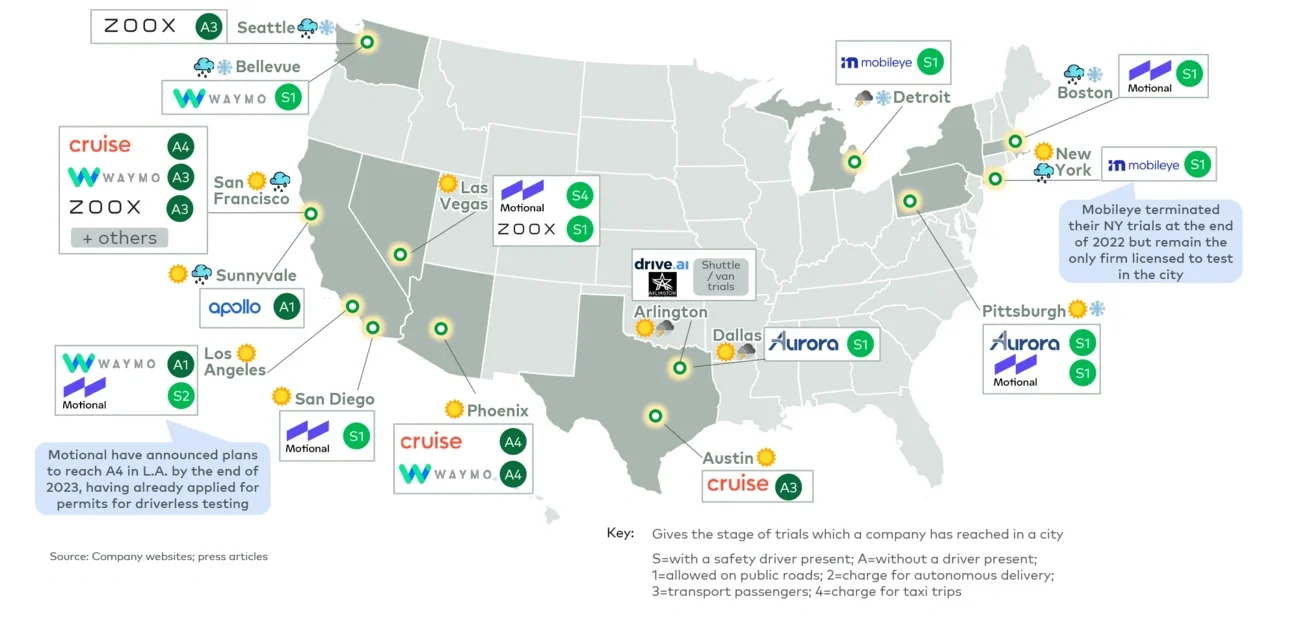
The trials have scaled up over the past three years, with Apollo (part of tech giant Baidu) active in at least nine Chinese cities and recently announcing the addition of 200 more AVs to its fleet by the end of 2023. In the US, Cruise (backed by General Motors) and Waymo (a Google subsidiary) have expanded to cities across the Southwest and serve customers with a combined fleet size of roughly 1,000 vehicles. Between September and November 2022, Cruise reported more than 2,500 paid passenger trips, covering over 26,500 miles.
In the US, firms have adopted different ‘depth’ vs ‘breadth’ strategies. Firms like Cruise and Waymo have opted for depth and are running more sophisticated passenger-charging trials across a limited number of locations. Other AV firms like Motional (a joint venture by Hyundai and Aptiv) have emphasised breadth and are running earlier stage trials across a wider range of locations and conditions.
Trials reveal new jobs for humans
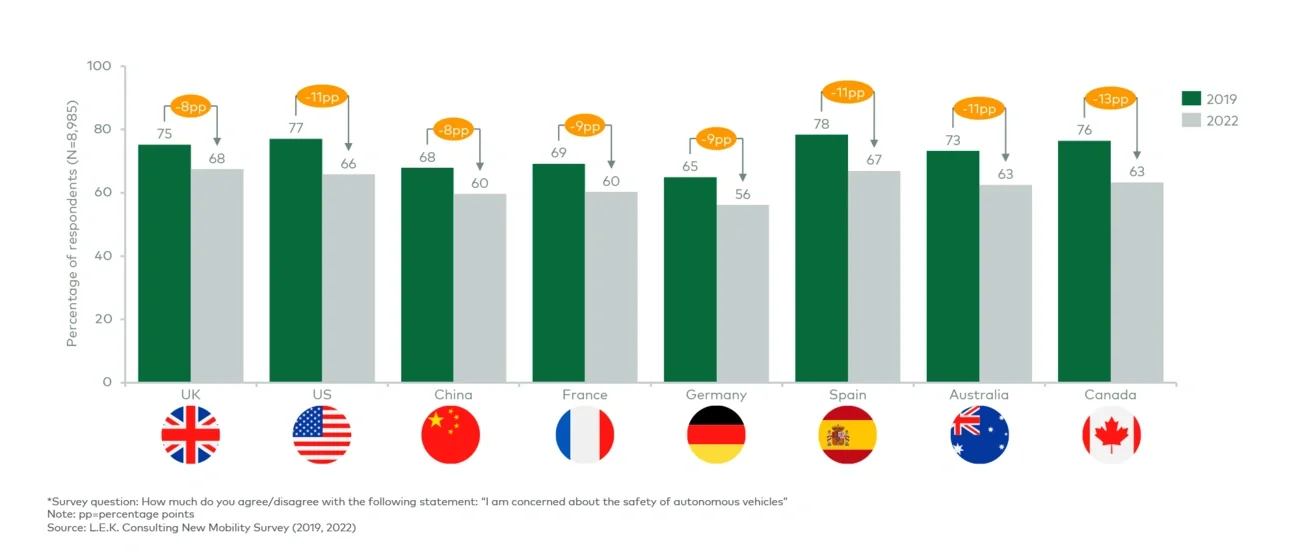
The trials have been broadly successful, and firms are continuing to expand into new locations. Apollo recently announced that they will offer services in Hefei, China, and Cruise is planning to offer paid trips in Austin, Texas, later this year. Public uptake has been strong; there are currently large waiting lists to gain access to Cruise’s robotaxis in San Francisco, Austin, and Phoenix, Arizona. This reflects a gradual long-term shift in public perception of the safety of AVs, which is steadily improving (see Figure 2).
Figure 2
L.E.K. Consulting New Mobility Survey results (2019-22)*
Image
Accidents resulting in injury have been very rare, but there have been frequent reports of minor disruptions, such as AVs causing congestion by halting in the middle of the road when encountering roadworks. These growing pains suggest that even when AV taxis become more widespread, they may not be able to operate entirely autonomously, with some human roles still required:
Engineers — to be deployed to vehicles which are experiencing defects; this could range from a technical issue with a sensor to a broken window or seatbelt
Fleet operators — to remotely take over navigation of a vehicle in emergency situations; this is already being done by Apollo in China
Customer service reps — to handle customer complaints, which could range from payment issues to lost property requests
Cleaners — to maintain the vehicles’ appearance
Several hurdles remain before fleets of robotaxis become commonplace in major cities
Technology
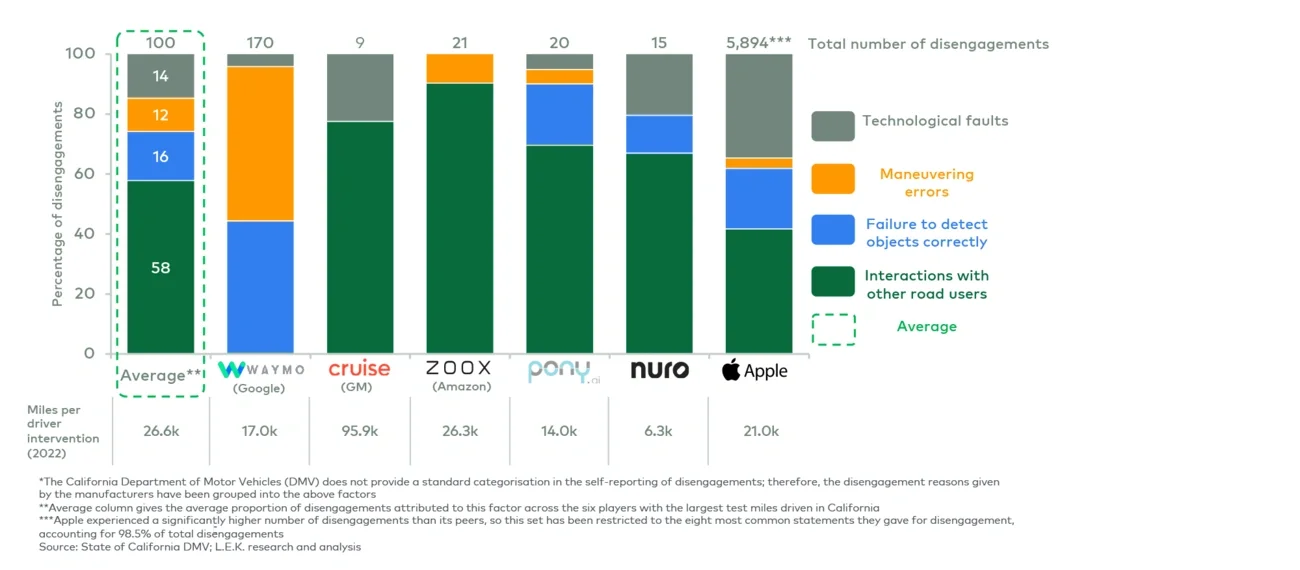
The robotaxi trials are a step towards widespread AV adoption, but significant barriers remain. AV technology has advanced over the past few years, as evidenced by the improving disengagement (i.e. disengaging from autonomous mode) data reported during testing on California roads. However, more testing in a greater range of inner-city environments is required.
Figure 3
Most common reasons for disengagement in California public road tests for the top six players by mileage* (December 2021-November 2022)
Image
Thus far, testing in European cities with older, narrower, more irregular road layouts has been limited. This could prove more challenging than the predominantly grid style city layouts where most AVs trials are currently taking place. AV technology also requires more testing and trials in more diverse weather conditions. The advanced American trials have taken place in cities with predominantly warm, dry climates — Cruise’s license in San Francisco does not currently permit it to operate in heavy rain. AV technology still needs to demonstrate that it can perform in extremely wet, snowy and stormy conditions before it can realistically receive widespread regulatory approval. AV firms recognise this, and Waymo has announced plans to trial their AVs in Bellevue, Washington, to collect performance data in a predominantly rainy climate.
Regulation
A number of local governments have allowed AV testing on public roads; however, most countries still lack detailed legal procedures to account for fleets of level 5 AVs sharing the road with human drivers, and all the associated complications.1 Some AV companies like Waymo and Aurora are seeking to engage regulators to discuss how such legal systems can be developed. Waymo recently published a document which they described as a blueprint for developing a wide-ranging safety case to be delivered to regulators and have encouraged other AV firms to contribute.
Stimulating consumer demand
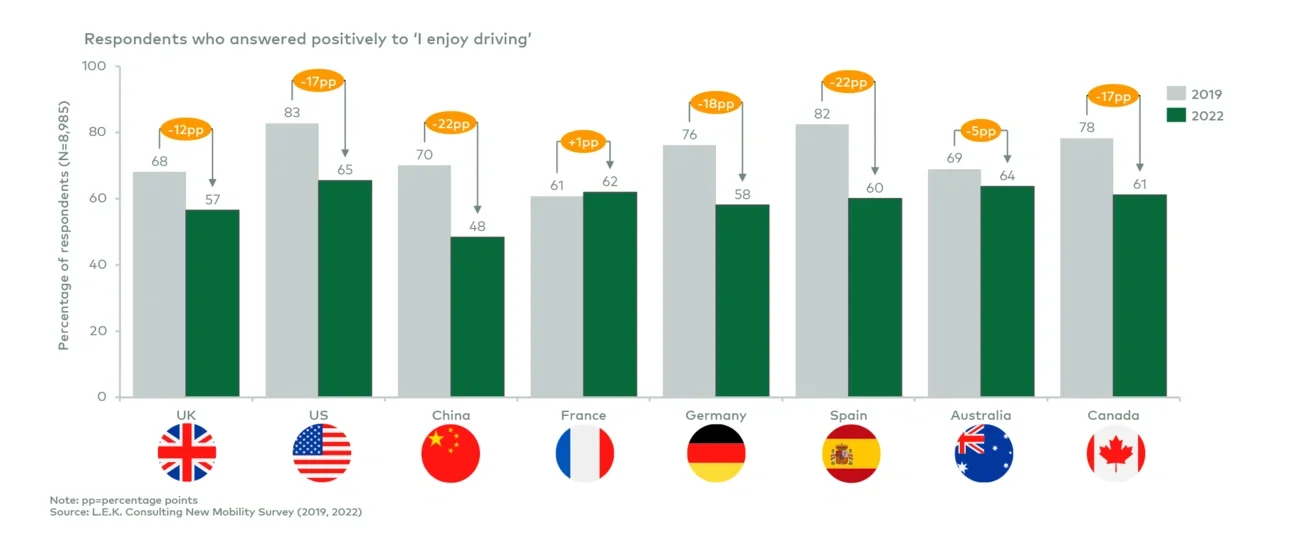
The final barrier to widespread AV adoption is stimulating consumer demand. Improving overall public confidence in AV safety is part of the challenge, but another factor is that many consumers must also be willing to forgo the enjoyment of driving. This trend is already underway (see Figure 4), and there could be an initial opportunity for robotaxis to capture inner-city journeys, where traffic is significantly more congested and driving is less enjoyable for motorists.
Figure 4
L.E.K. New Mobility Survey results on enjoyment of driving (2019-22)
Image
Once these barriers are overcome, what’s next?
The commercial trials are a notable milestone for AV technology and have provided valuable early learnings on public perception and how robotaxi fleets may operate in the future. They have also shown us that there are still significant hurdles to clear before we move into the fast lane towards widespread AV adoption.
However, if these hurdles can be overcome, we can start to examine how AVs may enter the market on a wider scale.
For more information, please contact strategy@lek.com.
L.E.K. Consulting is a registered trademark of L.E.K. Consulting. All other products and brands mentioned in this document are properties of their respective owners. © 2023 L.E.K. Consulting
Endnotes
1Per SAE International’s definition of automation levels, 5 is “total vehicle control with no intervention under all conditions.”
Questions about our latest thinking?
Questions about our latest thinking?
Related insights
You might also be interested in these insights.


English