


Innovation in life sciences (LS) tools and diagnostics is difficult because value is created by scaled applications across the triad of hardware, consumables and software. Because performance, reliability and outcomes emerge at the system level, innovation and growth quickly increase coordination demands across the entire value chain. In this context, the innovation-forward operating model becomes a primary determinant of sustained value creation.
Early-growth tools and diagnostics companies frequently stall as they move beyond initial product-market fit. Initial success is often driven by founder-led invention — a breakthrough technology, instrument, assay or data layer. But commercial scaling requires a shift from a founder-led cadence to a repeatable innovation engine that can manage system interdependencies and long capital-intensive paths to return on investment. Without that shift, organizations drift toward fragmented roadmaps and slow launches, where incrementalism crowds out material improvements.
These challenges cannot be solved by importing operating models from adjacent sectors. Biopharma models are asset-centric and optimized for products that are managed relatively independently, while software models assume modularity and asset-light quick iteration. Tools and diagnostics sit between these extremes: They require continuous innovation, but within physically integrated systems where changes propagate across hardware, reagents/kits, software and workflows.
In this environment, operating-model misalignment shows up quickly in cost creep, manufacturability difficulties, customer issues and inconsistent commercial performance.
As platforms scale, R&D intensity typically moderates but remains structurally elevated: mature category leaders such as Illumina still invest approximately 20% of revenue in R&D, and scaling companies even higher (e.g., Oxford Nanopore 44%, 10X Genomics at 37% in 2025) compared to around 23% U.S. public commercial biopharma R&D average or 10%-20% of scaled software companies (e.g., Microsoft, Adobe).
When 25%-50% of revenue is reinvested into R&D, the operating model becomes a first-order determinant of runway, launch cadence and margin trajectory — and must be deliberately designed to sustain system-level innovation while progressively focusing R&D intensity with scale.
In this article, L.E.K. Consulting outlines seven steps to build a scalable, repeatable and commercially successful innovation engine for emerging and growing tools and diagnostics companies (Figure 1).
Sustaining Breakthrough Science Through Discipline
Key takeaways
In life sciences tools and diagnostics, sustained value creation depends as much on the innovation-led operating model as it does on breakthrough science, given tightly integrated hardware, consumables and software systems.
As companies scale, they must transition from founder-led invention to a repeatable innovation engine anchored in structured market validation and explicit decision discipline.
Building that engine requires seven reinforcing disciplines that connect broad opportunity sourcing and rigorous early screening to evidence-based governance, capital allocation and active portfolio management.
Long-term outperformance demands continuous self-assessment and deliberate evolution of the operating model to maintain focus, adaptability and durable growth.
Figure 1
Summary of seven steps
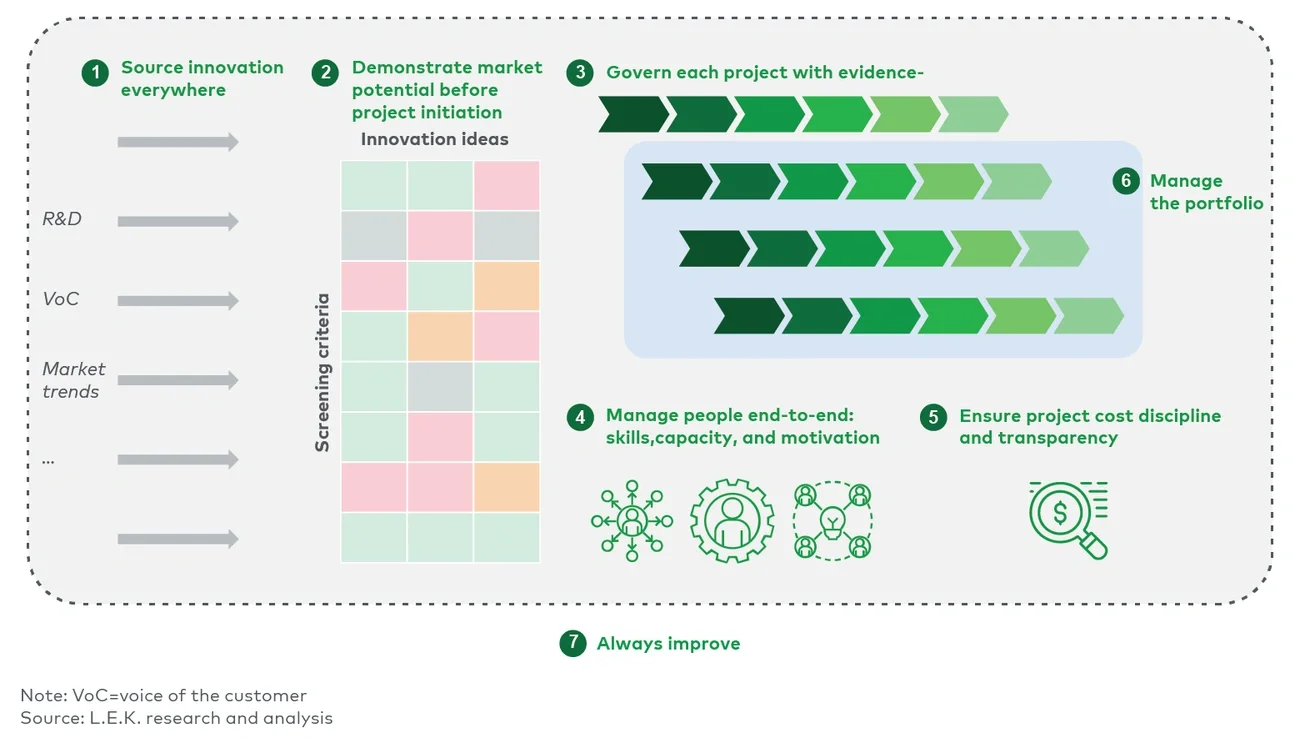
Seven steps to drive innovation-led growth
1. Source innovation everywhere
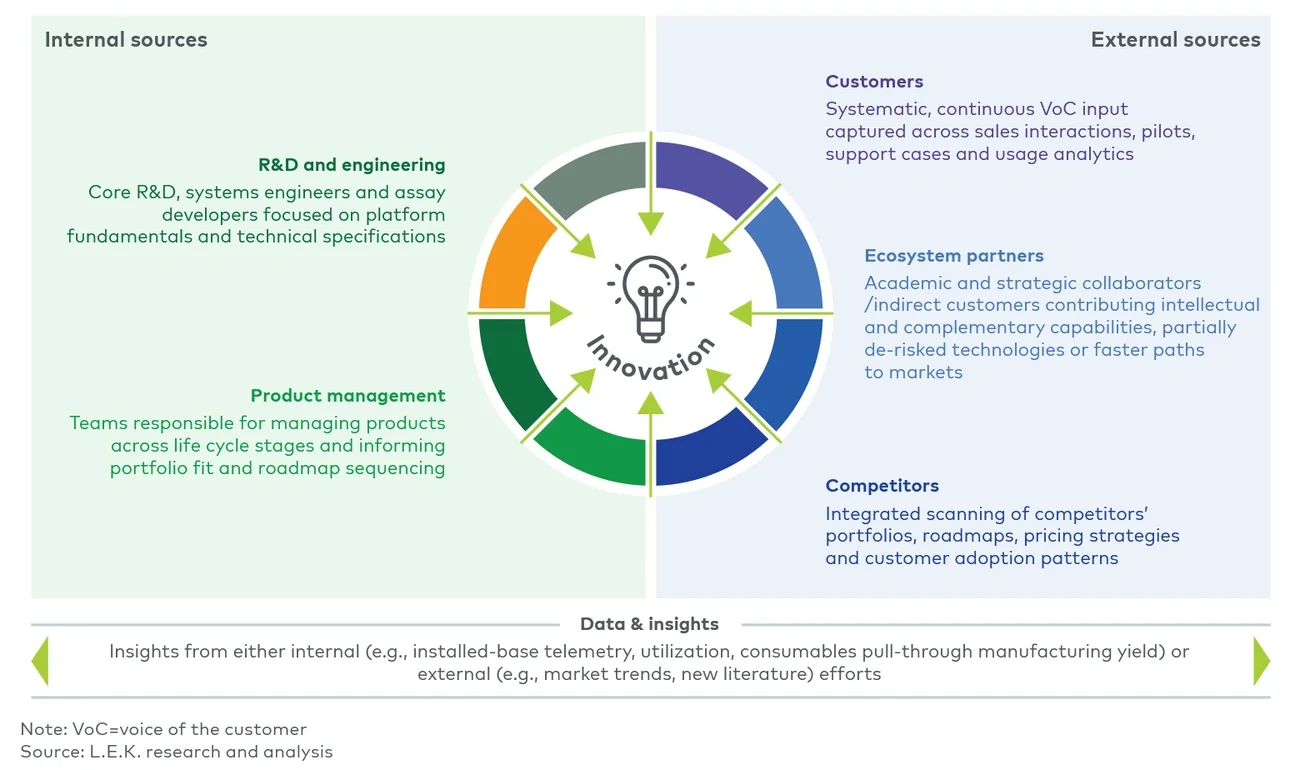
Innovation in tools and diagnostics should be sourced through a wide-aperture system that reflects the multidisciplinary, workflow-driven nature of the business (Figure 2). Breakthrough and incremental opportunities emerge when inputs from external technology trends, customers and end users, customer-facing teams, and internal scientific and engineering expertise are deliberately integrated — not when ideas flow from a single function.
Continuous voice-of-customer (VoC) feedback, captured across external research, sales, applications, service and support interactions, should be treated as a persistent input, grounding innovation in real-world workflows, customer needs and current constraints.
Over-reliance on central R&D can bias portfolios toward technically elegant solutions for problems of limited customer value; under-leveraging field, service and applications teams leaves a critical insight engine untapped. Leading companies therefore create multiple visible pathways for ideas to enter and be evaluated, ensuring innovation is informed by scientific possibility and by structured external research of adoption dynamics, unmet needs and evolving customer constraints.
Figure 2
Overview of internal and external innovation sources
2. Demonstrate market potential before project initiation
Tools and diagnostics organizations push the frontier of what is scientifically and technically feasible. That capability underpins category creation, but it also creates risk: Without concept discipline, teams can pursue technically impressive solutions with weak product-market fit, unclear economics or limited relevance to priority segments. As ideas are triaged into viable concepts, companies should explicitly link the market problem to the target workflow, downstream economic value and required solution architecture.
We recommend an adaptation of the Heilmeier Catechism — originally developed by George Heilmeier during his tenure as the Defense Advanced Research Projects Agency director — as a structured early screen. The catechism should be applied across the entire hardware-consumables-software ecosystem and its role within the broader platform.
LS tools and diagnostics — adapted Heilmeier screen:
- What problem are you solving and for which workflow?
Articulate the objective in plain language, grounded in a specific workflow or use case. - How is this workflow addressed today, and where does it break down and create meaningful pain points?
Describe current solutions and their technical and economic limits — and why those limits matter to buyers. - What is new in the proposed solution, and which component of the triad creates primary value?
Clarify what is differentiated across hardware, consumables and/or software, and which triad component is the primary source of value versus an enabler. - Who cares, and why does it matter economically?
Define target customers and decision-makers, the value proposition and how value is captured (e.g., expansion of installed bases, increased consumable pull-through, adoption for scaled applied markets). - What are the technical, market, commercial and execution risks?
Assess feasibility and performance risk, competitive and demand uncertainty, and operational execution risk (e.g., manufacturability, cost, speed, scalability). - How does this fit within the existing and future workflows and across the triad system?
Assess adoption and disruption risk alongside backward compatibility and future platform alignment. - What will it cost, and how long will it take?
Estimate development effort, ongoing capital and talent requirement, and time to market. - What are the intermediate and final proof points?
Define measurable milestones that demonstrate technical feasibility, customer value and commercial viability.
Applying this adapted catechism early forces teams to confront workflow relevance, system coherence and economic logic before committing significant product development resources. In practice, it helps prevent spec chasing, concept inflation and ideas that are technically sound but commercially fragile.
3. Govern each project with evidence-based stage gates
Pursuing step-change innovation requires organizations to make hard choices. Teams cannot take bold technical or market risks if career progression and organizational norms implicitly reward only success. Companies that consistently outperform on innovation understand opportunity cost and reinforce a culture that creates space by stopping many initiatives early to free capital, talent and leadership attention for the initiatives that truly matter.
Yet many tools and diagnostics organizations struggle to do so, underestimating opportunity cost and allowing unattractive efforts to persist as “zombie” projects that drain scarce resources.
To counter this dynamic, companies must institutionalize clear shifting/stopping rules and recognize teams for early, evidence-based decisions to change course or disengage. Each project should explicitly define its key potential failure points (e.g., technical feasibility, workflow relevance or economic value) and track evidence against these uncertainties throughout development.
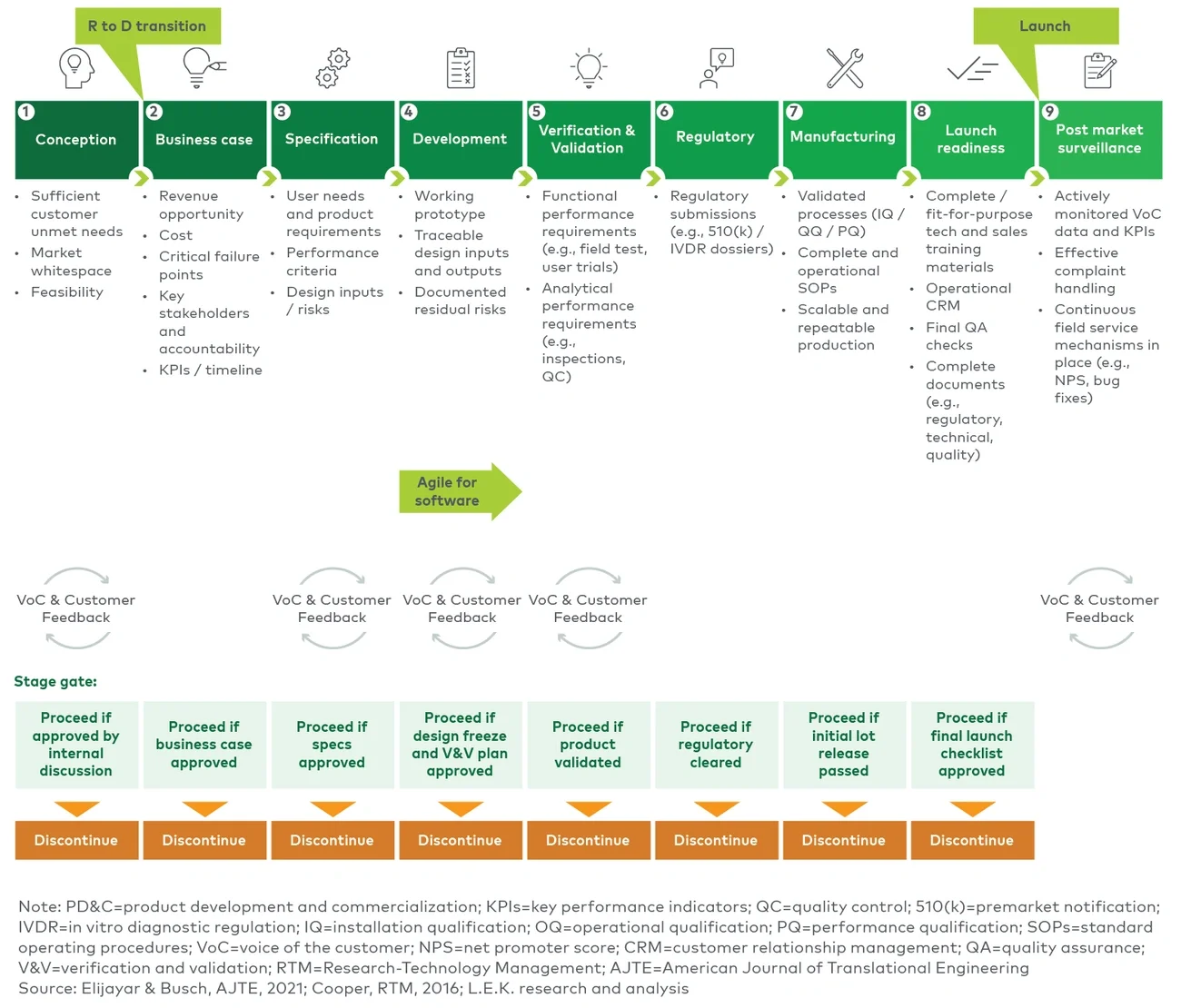
Such discipline requires a robust stage-gated product development and commercialization (PD&C) process, the end-to-end governance mechanism that oversees an idea’s progression from early research through development, scale-up, launch and post-launch life cycle management. At defined transition points, PD&C governance requires explicit, evidence-based decisions to sustain, shift or stop investment based on the status of core assumptions, workflow relevance and economic value.
• Sustain: Core assumptions remain intact and evidence supports continued investment
• Shift: Targeted course correction is required to address specific risks or learnings
• Stop: Feasibility, differentiation or market value has eroded beyond recovery
Embedding this decision logic within PD&C governance normalizes stopping as a sign of rigor — not failure (see Figure 3). Done well, the PD&C process increases speed and quality, sustains motivation across programs and reduces rework as the organization scales.
Figure 3
Example stage-gated PD&C activities
4. Manage people end-to-end: capabilities, capacity and motivation
Tools and diagnostics companies rely on highly specialized talent across systems engineering, assay development, software, manufacturing, quality, field/tech support and regulatory functions. As portfolios scale and multiple programs run in parallel, execution risk increasingly stems from mismatches between capabilities (what skills exist) and capacity (where time and attention are available). Managing people effectively requires addressing both while maintaining culture.
Company leaders should plan and manage capabilities across the full innovation and life cycle continuum — anticipate when specialized expertise (e.g., systems engineering, QA/RA) is needed, invest in upskilling to reduce single points of failure and ensure critical roles are staffed at the right inflection points. In parallel, manage capacity and flow by tracking real availability (not theoretical headcount), surfacing hidden queues and informal workstreams and adjusting ways of working to relieve bottlenecks.
5. Enforce project cost discipline and transparency
The greatest risk is rarely underinvesting in innovation. Instead it is allowing diffuse, low-visibility spending to quietly erode cash runway and crowd out high-value opportunities. Financial discipline requires allocating direct and indirect costs to projects with enough granularity to reflect true spending across the triad. Leaders should be able to track burn by project, understand how spend evolves by stage and distinguish value-creating investment from sustaining or rework-driven cost.
Without this transparency, many organizations drift into the “spreading peanut butter” resourcing model: funding too many initiatives in parallel and diluting capital across them. The result is slow progress, rising burn and high-potential efforts that never receive sustained investment. Avoiding this outcome requires making financial trade-offs explicit so that capital is deliberately concentrated rather than implicitly diluted.
To maintain rigorous discipline, governance should be proportional to financial exposure and uncertainty. Early-stage and exploratory work can draw from a defined “innovation pool” with lighter tracking to enable rapid learning. As initiatives mature, increase in capital intensity or demonstrate product-market traction, they should transition to dedicated cost lines with clearer accountability for development spend, capital requirements and design-to-value trade-offs.
The goal is not bureaucracy but instead tracking early warning signals that preserve runway and keep flexibility to invest where it matters most.
6. Manage the portfolio
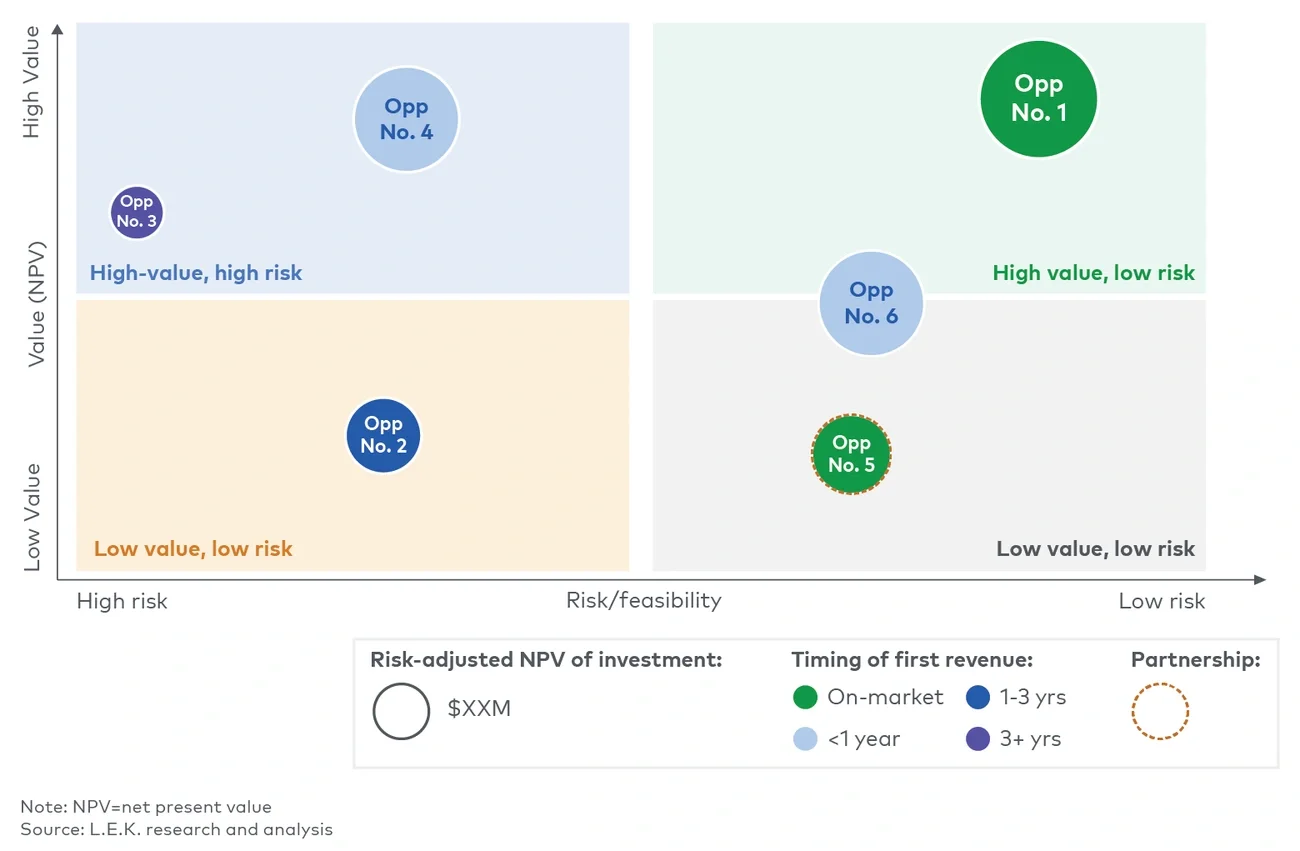
Portfolio complexity compounds quickly as products expand across triad scope, workflows, market segments, geographies, regulatory regimes and more. As a result, portfolio stewardship cannot be episodic, reactive or intuition-driven; it requires proactive evidence-based reassessment of every product and concept across the full life cycle (see Figure 4).
Effective portfolio management enables organizations to continuously optimize value by balancing risk, opportunity and cost. This requires that organizations:
- Actively rationalize the commercialized portfolio as new offerings launch, streamlining overlapping products, variants and use cases to reduce customer confusion, supply-chain complexity and service burden
- Maintain a thoughtfully balanced pipeline, spanning high-risk/high-reward innovations, moderate risk enhancements that extend or reposition current product, and lower-risk life cycle updates that sustain and refresh the product
- Align triad life cycle governance, with explicit plans for backward compatibility, forward integration into future platforms and disciplined product and feature retirement
- Drive reuse and platforming across shared elements of the offering to reduce complexity, accelerate development and lower sustaining costs
When applied consistently, portfolio management becomes a value-optimization engine, not just a project list review process.
Figure 4
Example portfolio prioritization matrix
7. Always improve
Leading tools and diagnostics companies do not stand still. They cultivate a culture of continuous challenge by systematically questioning processes, assumptions and ways of working across the organization. The objective is not change for its own sake, but for sustained value creation — better products, higher reliability, greater operational effectiveness and shorter cycle times as complexity and scale accumulate.
Digital tools and artificial intelligence (AI) are increasingly central to this effort, but they should be viewed as enablers of continuous improvement, not ends in themselves. The opportunity is not to layer technology onto existing workflows or pursue an “AI first” posture divorced from customer value. Rather, advances in automation, data and AI should prompt organizations to rethink workflows, decision rights, skill requirements and performance metrics to improve outcomes.
Technologies and partners should be adopted deliberately, only where they deliver clear, measurable gains; accumulating tools or partnerships for novelty or perceived sophistication often increases complexity without commensurate benefit while diverting resources away from critical projects.
Based on the steps outlined, we encourage leaders to consider a small set of self-assessment questions to diagnose their operating model — an approach we often use with leadership teams to translate innovation ambition into scalable, system-level execution:
- Innovation sourcing: Are we exploring enough sources of innovation?
- Market relevance: Have we conducted a structured assessment of the market opportunity and how our new programs fit?
- Stage gates: Are our stage gates designed to force explicit stop, pivot, or scale decisions — or do initiatives advance by default?
- Talent and capacity management: Do we understand and actively manage our people?
- Cost transparency and focus: Can leaders see the true cost of each initiative and actively allocate resources on the few that matter most?
- Portfolio discipline: Have we proactively reviewed our portfolio against defined prioritization criteria?
- Continuous improvement: Are we getting faster, more reliable and less wasteful over time?
If these questions highlight opportunities to strengthen your innovation operating model, please reach out to L.E.K. to further assess your current state and define a more disciplined, scalable path forward.
Note: We thank our external readers Jenny Mackey, Adam Siebert and Thomas Bell for their input and support.
L.E.K. Consulting is a registered trademark of L.E.K. Consulting LLC. All other products and brands mentioned in this document are properties of their respective owners. © 2026 L.E.K. Consulting LLC


