
Background
We have previously published Executive Insights on free and flat transit fares and transit fare discounting, as strategies for driving post-pandemic patronage growth.1 The introduction of a deeply discounted transit flat fare in Queensland, Australia, in August 2024 provides a contemporary case study to revisit the conclusions presented in those earlier Executive Insights.
Introduction
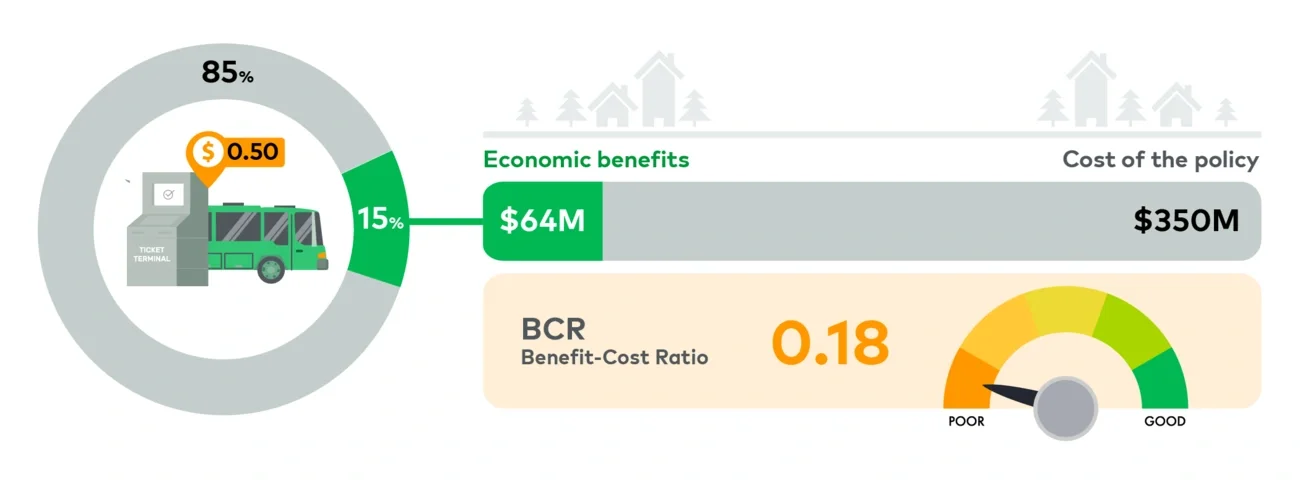
From 5 August 2024, a $0.50 (all monetary amounts are in Australian dollars) one-way flat fare was applied to all Queensland public transport services statewide, including buses, trains, ferries and light rail. Initially introduced as a six-month trial, $0.50 flat fares were made permanent from February 2025.
At the time the trial was announced, the stated policy rationale was to drive public transport patronage levels back to pre-COVID levels, reduce the use of private cars and associated road congestion, specifically in South-East Queensland (SEQ), and provide cost of living relief.2
Undeniably, this initiative has been generally very well received by existing and new public transport customers. It represents a discount of c.75% compared to the average adult fare before the introduction of $0.50 fares.
As would be expected with a fare reduction of this magnitude and a much simpler fare system, available data shows that there has been a material increase in public transport use — an 18.3% year-on-year increase after the first six months to 2 February 2025, equivalent to an additional c.14.4 million trips.3 It has also significantly reduced the level of fare evasion, with the number of infringement notices falling by around 40% between 5 August 2024 and 2 February 2025, compared to the same period a year earlier.
It is less clear that the $0.50 fare initiative has had any material impact on road congestion in SEQ. Early claims suggest there has been some marginal reduction in traffic congestion and an associated improvement in average road speed.
Over and above these high-level indicators, from a public policy perspective, we need to look carefully at these early results through a financial, economic and social lens.
Financial considerations
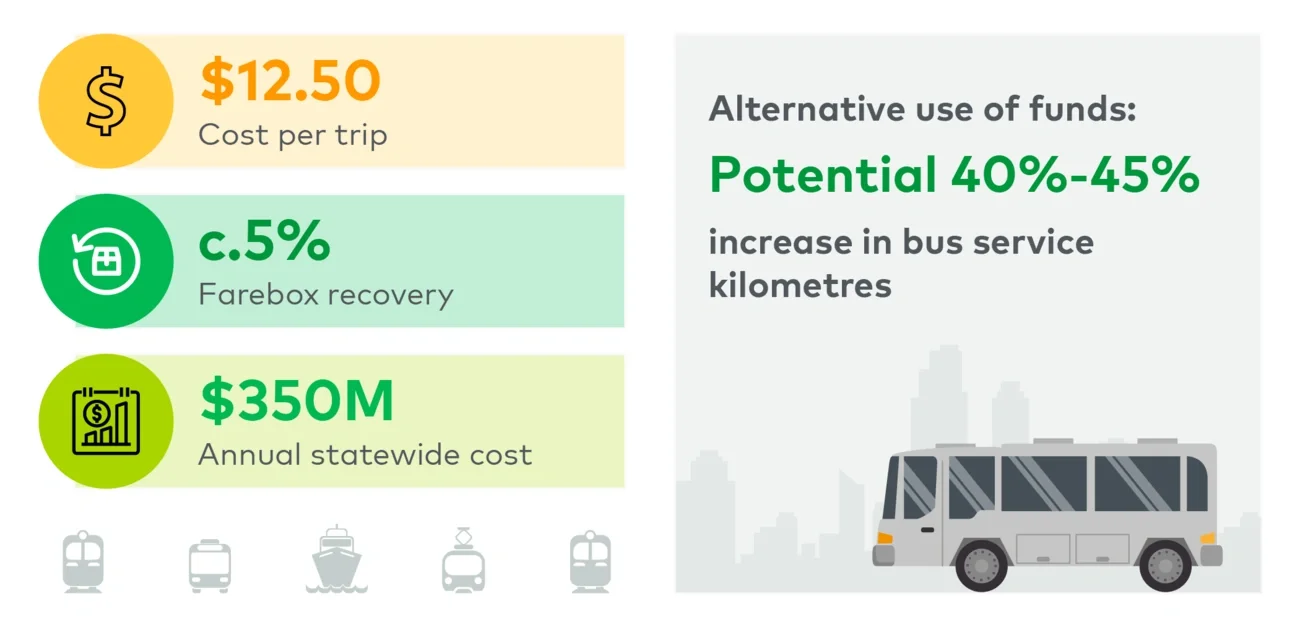
As of 2 February 2025, it was reported that public transport users had saved more than $181 million compared to the equivalent period in 2023.3 If the full 18.3% year-on-year increase in trips is attributed to the $0.50 fare initiative, the actual cost of securing the additional patronage is around $12.50 per trip.
We note that the average fare paid will be less than $0.50, as some concession groups are entitled to free travel (e.g. children under age 5, some veterans, individuals with impaired vision). However, even assuming average farebox revenue of $0.50 per trip, it suggests that currently c.5%4 of the operating cost of delivering public transport in Queensland is being recovered from the customer via the farebox.
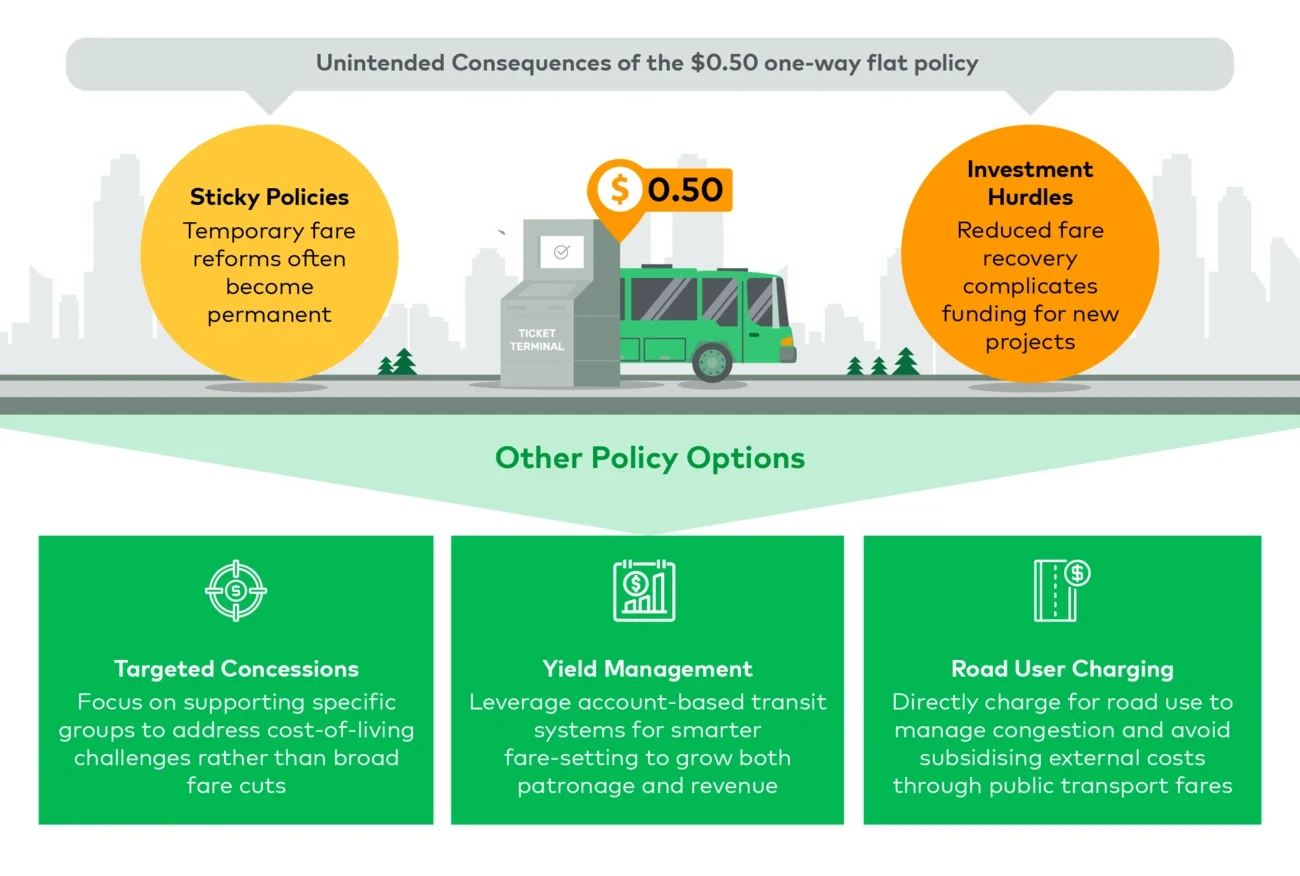
While the appropriate contribution that customers should make to the recovery of transit operating costs is a complex issue (including the need to provide a safety net for the transport-disadvantaged), the $0.50 fare has pushed Queensland into an unenviable position.