

In a bid to provide consumers with more options — and earn more of their business — the streaming industry is trying bundling on for size.
Streaming has become an essential outlet for all traditional content businesses. While this evolution has allowed many households to “cut the cord” on traditional multichannel linear television, it has also left many consumers juggling multiple subscriptions. Some may find themselves spending as much on streaming services as they once did on cable TV, leading to churn as consumers rebalance their monthly budgets.
One solution the industry has turned to is bundling. This familiar concept from the world of television subscriptions now allows consumers to purchase a family of different streaming services for one monthly payment, sometimes with the services collapsed into the same app (such as Disney+ and Hulu, or Paramount+ and Showtime). But do these bundling strategies drive incremental revenue for streamers or merely cannibalize revenue from existing subscribers? So far, that’s an open question.
Tiering and price increases
In recent years, as subscriber growth has slowed and content production costs have skyrocketed, streaming services have had to find ways to increase revenue. This has often been achieved through price increases and the implementation of tiered pricing structures to maintain affordable entry points for new subscribers while raising premium-tier pricing ever higher.
Tiered pricing makes a lot of sense here as not every customer has the same willingness or ability to pay, nor do they value the same features. By introducing some complexity, different products can be tailored to different users along the willingness-to-pay curve. In subscription video services, tiering primarily reflects differences in picture quality, number of permitted users and advertising, rather than content.
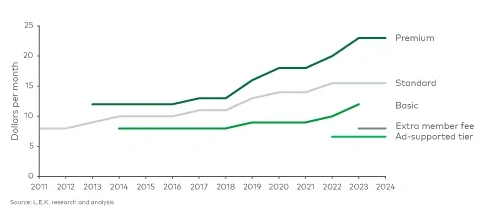
Netflix, for example, launched its stand-alone streaming service in 2011 for $7.99 a month. Two years later, the company introduced a premium tier at $11.99 a month, which included access to four simultaneous streams and 4K resolution. By late 2022, Netflix had four tiers of service, including a new ad-supported plan that cost $6.99 a month for almost all the same content.
Other services, such as Hulu, had already demonstrated the value of streaming services with ads. Ad-supported tiers often have higher combined average revenue per user than ad-free ones. At the same time, ad options expand the audience base with an accessible price point.
In Netflix’s case, the basic standard-definition plan has now gone away, replaced by an ad- supported high-definition plan. Netflix is also leading streamers in tackling password sharing by offering a discounted tier for related accounts (see Figure 1).