


Executive Insights

Developing an Aftermarket Strategy: Four Questions Every Industrial OEM Should Ask

April 14, 2021

Key takeaways

While the aftermarket is a source of highly profitable recurring revenue, it can be a challenging opportunity to unlock.

Many manufacturers aren’t capturing more of the aftermarket segment because of the level of operational complexity and the difficulty of identifying end customers with aftermarket needs.

We’ve developed a framework based on four questions to help manufacturers unlock the value of aftermarket sales.

Manufacturers should consider drafting an aftermarket offering around priority equipment, in segments most relevant to their capabilities, using digital technology to accelerate their go-to-market approach.

Most industrial manufacturers want more aftermarket sales. Why wouldn’t they? The aftermarket is a source of highly profitable recurring revenue. It also strengthens relationships with end customers, and — because the aftermarket attracts new customers as well — it is a way to capture incremental market share.

We’ve also heard from many end customers who say they prefer buying aftermarket parts from the original equipment manufacturer (OEM) or approved original equipment suppliers. This feedback has been fairly consistent across industrial end markets, indicating manufacturers have a significant opportunity in the aftermarket.

So why is this opportunity so challenging to unlock?

At L.E.K. Consulting, we’ve developed a framework for putting an aftermarket strategy together (see Figure 1). It’s based on four questions aimed at helping manufacturers unlock the financial and strategic value of aftermarket sales while minimizing potential disruptions to the core business. In future Executive Insights, we’ll explore each of those questions in greater detail. For now, let’s take a brief look at what they’re all about.
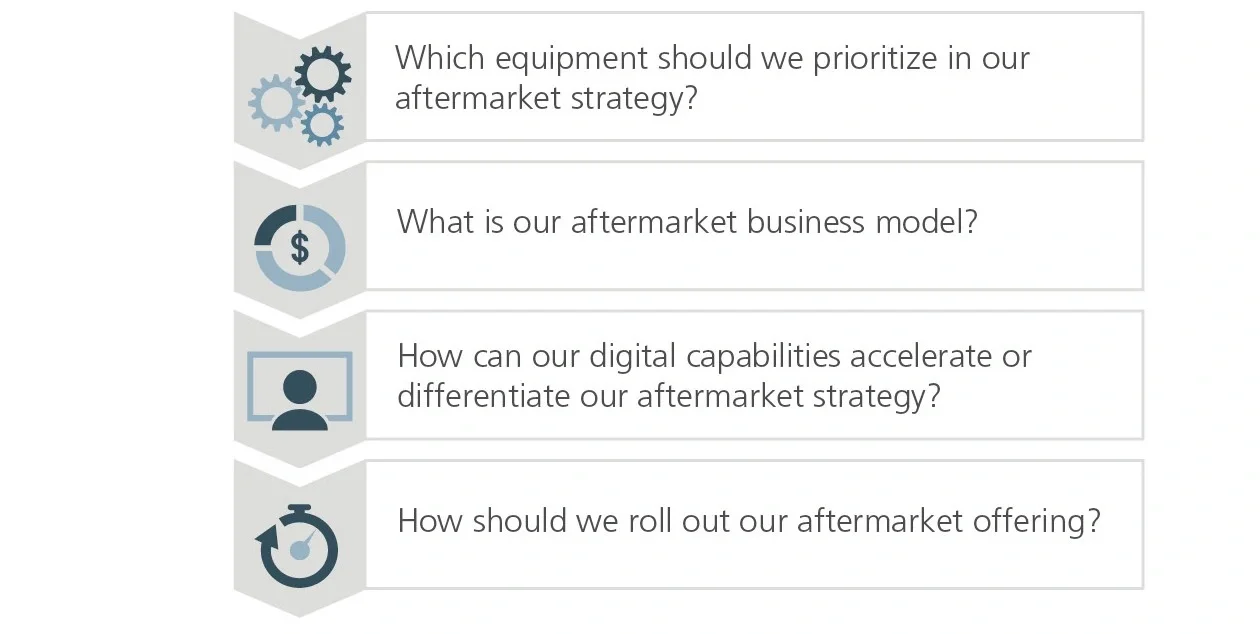
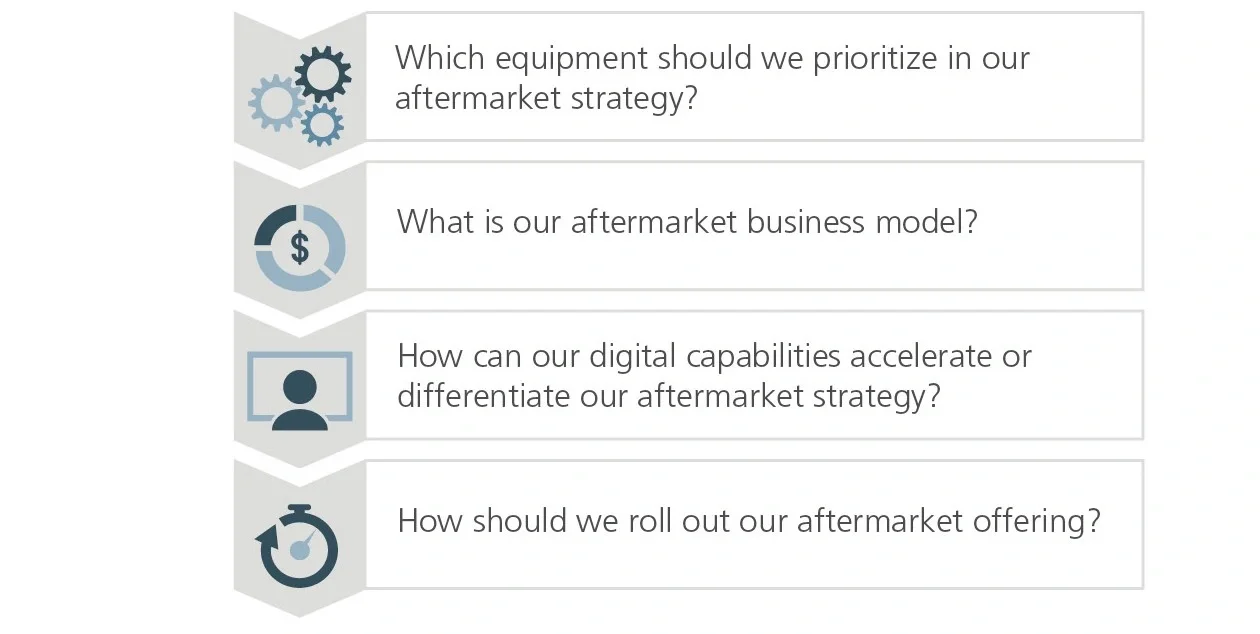
Figure 1

The L.E.K. industrial aftermarket strategy framework: four must-answer questions

Image
industrial aftermarket strategy framework

Figure 1

The L.E.K. industrial aftermarket strategy framework: four must-answer questions

Image
industrial aftermarket strategy framework

When it comes to the aftermarket, a common stumbling block is the idea of applying it to the whole product portfolio at once. That’s not only a daunting proposition, it’s also potentially disruptive to essential business operations.

But, in fact, you can limit the scope — and often there are good reasons to do so. An aftermarket strategy can provide very different benefits and rates of return across the product portfolio. To prioritize implementation, think about each major product category or business unit in terms of:

  • Who the end customers are and how frequent their purchases are

  • How effectively the organization’s sales force and/or distribution network covers these customers

  • What the total value of related goods and services would be over the product’s useful life — including consumables, replacement parts, major overhauls and other requirements

  • How a robust aftermarket offering would make the products easier to repair, less expensive to own, or otherwise more compelling to the end customer

  • Where insights into aftermarket customer needs could benefit the core business, such as through focusing research and new product development efforts

Ultimately, the products or business units best suited to an aftermarket strategy will have two basic attributes. They’ll bring positive returns in the near term. And they’ll help other products and services succeed in the aftermarket.

One reason is that it takes different capabilities to sell aftermarket parts and services than it does to sell newly built units, which is at the core of manufacturers’ capabilities. It can also be difficult to locate decades’ worth of sold products that are operating in the field. Then there’s the operational complexity that servicing aftermarket demand can introduce (think small manufacturing runs and inventorying a large number of SKUs). 

Manufacturers also have dealers, distributors and other channel partners to consider. Their presence makes it harder to identify end customers with aftermarket needs, since these intermediaries historically have been the ones to serve them. Moreover, selling directly to end customers can alienate these critical sales channels and put the original equipment business at risk.

Venturing into the aftermarket requires careful planning to capture the benefits (e.g., deeper customer relationships, high margin recurring revenue stream) while avoiding friction with the core operating model.

After prioritizing the business units or products, the next step is to define the best aftermarket model — in other words, what is the offering and how will the organization deliver it?

This is a major undertaking. It involves developing an aftermarket concept and refining it incrementally as stakeholders weigh in. Stakeholders include key internal decision-makers as well as channel partners, end customers and third-party service partners.

For most manufacturers, the most critical decision is whether to offer aftermarket services (e.g., maintenance, inspection, repair) in addition to replacement units and parts for repairs. Aftermarket services can produce highly profitable recurring revenue. They enable stickier customer relationships and can provide valuable user data for R&D and product development.

But service operations are typically decentralized, especially if the services are time sensitive (such as emergency repairs). They are also difficult to scale and require new capabilities and resources that may have few operational synergies with existing manufacturing assets. Keep in mind, too, that offering aftermarket services directly to end users almost always risks conflict with OEM channel partners.

  • In a direct model, the OEM provides parts and/or services directly to end users

  • In an indirect (“servicing the servicer”) model, parts and/or services are delivered through existing channel and service partners that can add their expertise, capabilities and resources (e.g., preventive maintenance alerts triggered by networked equipment)

  • In a hybrid model, different offerings or services to different customer segments can be delivered through a direct or indirect approach

There’s no one-size-fits-all approach. Each of these models has its pros and cons, as Table 1 shows. The right model will depend on the organization’s current capabilities, market dynamics and the potential for channel conflict, among other factors.

Table 1

Benefits and considerations of aftermarket delivery models 

Image
benefits and considerations of aftermarket delivery models 

Table 1

Benefits and considerations of aftermarket delivery models 

Image
benefits and considerations of aftermarket delivery models 

A digital strategy can help the aftermarket business take off. For example, mobile devices reveal information about the end customer — location, application and more — that manufacturers can use to personalize their promotions. The promotions themselves can be digital, creating ways to engage the customer without relying on channel partners.

Manufacturers can even differentiate themselves from channel partners via their Industrial Internet of Things (IIoT) strategy. An IIoT platform of digitally connected equipment transmits streams of data. Using predictive analytics and other advanced applications, manufacturers can examine that data for troubleshooting and preventive maintenance, then facilitate timely service of the equipment — either with their own field service team, approved service partners, or even remotely.

The data has other uses as well. OEMs are the logical ones to aggregate and analyze large data sets from equipment operating in real-world conditions, and they can apply what they learn to lift activity along the value chain. For example, data-driven insights can enable a “service the servicer” model with an ecosystem of trusted service partners. The aim would be to increase the volume of parts sales through servicer lead generation, maintenance and repair trends, or other business intelligence.

An aftermarket offering should complement the core original equipment business, not put it at risk. Maintaining that objective requires careful planning and execution at the launch stage. Considerations include:

  • Pricing the aftermarket offering
  • Timing the sequence of events during the rollout
  • Communicating the aftermarket offering to channel partners
  • Targeting higher-priority customers segments such as end markets or strategic accounts
  • Marketing the aftermarket offering
  • Strategizing to mitigate channel conflict and potentially drive synergies between equipment and aftermarket selling efforts

In addition to these considerations, manufacturers should set up metrics and feedback loops so they can fine-tune the aftermarket offering. The metrics are for measuring and monitoring the offering’s performance, while the feedback loops are for gathering input from internal stakeholders, channel partners and end customers. Both are key to optimizing aftermarket products and services through continual improvement processes.

Many manufacturers aren’t capturing their fair share of the aftermarket segment. This seems counterintuitive given that both OEMs and end customers are motivated to interact more actively on aftermarket sales. L.E.K.’s industrial aftermarket strategy framework prompts manufacturers to draft an aftermarket offering around priority equipment, in segments most relevant to their capabilities, using digital technology to accelerate their go-to-market approach. This way, manufacturers can navigate the pitfalls of direct-to-end-customer aftermarket sales while setting themselves up for successful execution.

English