

Brand Owners Have Shock-Proofed Their Sourcing Strategies

2026 U.S. Packaging Brand Owners Study Part 4
April 13, 2026

The packaging supply chain has faced significant disruption since 2021, prompting many brands to reevaluate their supply chains and consider potential actions to increase supply chain resiliency. But reduced supply chain risk is just one of several reasons why the vast majority (roughly 91%) of brand owners multisource their packaging — improved cost competitiveness, shorter lead times and better geographic coverage are all considered to be of roughly equal importance.

The reasons were revealed through L.E.K. Consulting’s eighth annual U.S. Brand Owner Packaging study, for which we surveyed 450 U.S. brand managers and packaging stakeholders in the fourth quarter of 2025 and first quarter of 2026.

Brand owners spread the risk — but not the spend

Nearly two-thirds of brands utilize both a primary and secondary supplier to source packaging for a particular format, with the lion’s share of spend going to the primary supplier (see Figure 1).

Image
Number of packaging suppliers used per packaging format (2026)
Image
Number of packaging suppliers used per packaging format (2026)

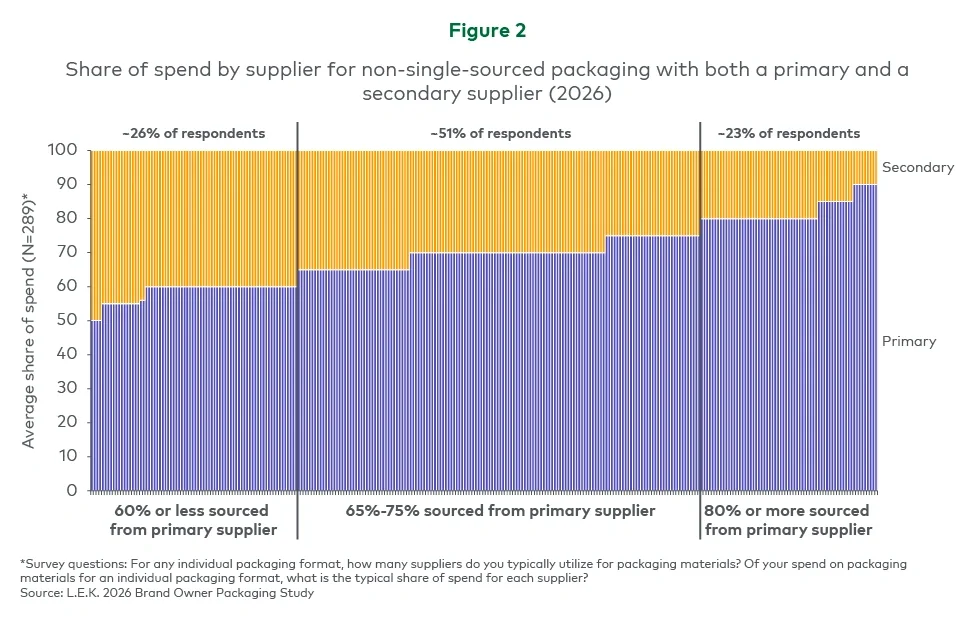
Among brands that use both a primary and secondary supplier (around 64% of respondents), roughly a quarter allocate 60% or less to their primary supplier, about half allocate 65%-75%, and the rest concentrate 80% or more (see Figure 2).

Image
Share of spend by supplier for non single sourced packaging with both a primary and a secondary supplier (2026)
Image
Share of spend by supplier for non single sourced packaging with both a primary and a secondary supplier (2026)

For brands that go further and use three or more suppliers (roughly 27% of respondents), the vast majority of them (about 80%) allocate a maximum of 60% of spend to their primary supplier; the rest (around 20%) allocate more (65%-75%).

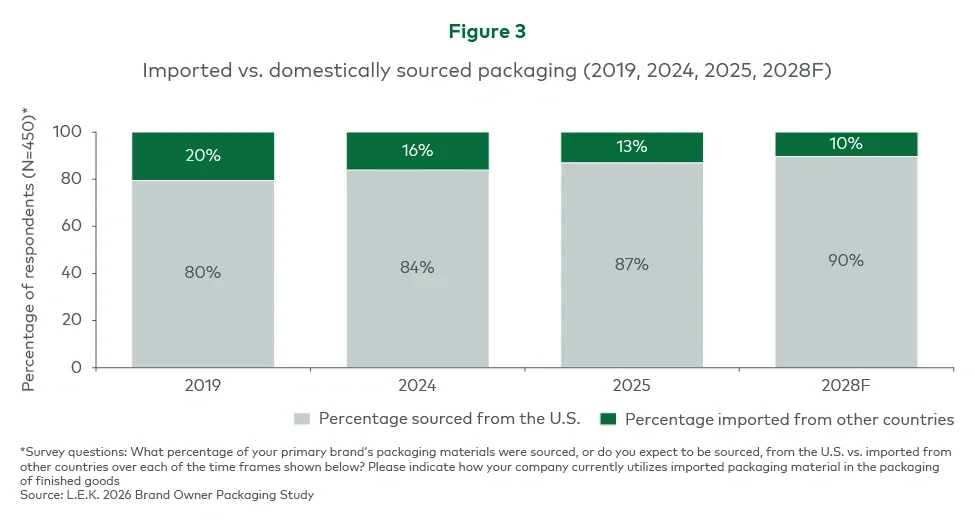
This push to diversify suppliers also has a geographic dimension. Brand owners have been steadily shifting toward domestic packaging suppliers — and by 2028, the percentage of packaging across surveyed end markets sourced from outside the U.S. is forecast to be half of 2019 levels, just 10%, driven in large part by the resilience advantages of domestic supply chains and the tariff risk from imported materials (see Figure 3).

Image
Imported vs domestically sourced packaging (2019, 2024, 2025, 2028F)
Image
Imported vs domestically sourced packaging (2019, 2024, 2025, 2028F)

To learn more about brand owners’ packaging needs in 2026, read about how brands are leveraging digital tools and AI across the packaging value chain, how foodservice brands are approaching packaging and how that differs from consumer packaged goods brands, and how packaging is impacting brands’ success.

If you would like access to the full results of the study, please contact us.

L.E.K. Consulting is a registered trademark of L.E.K. Consulting LLC. All other products and brands mentioned in this document are properties of their respective owners. © 2026 L.E.K. Consulting LLC

English