

Last year L.E.K. Consulting published Developing an Aftermarket Strategy: Four Questions Every Industrial OEM Should Ask, which identified the aftermarket as both a source of highly profitable recurring revenue and a challenging opportunity to unlock. Further, we noted that many manufacturers aren’t capturing more of the aftermarket segment due to operational complexity and the difficulty of identifying end customers with aftermarket needs.
With that in mind, we developed a framework based on four questions to help manufacturers unlock the value of aftermarket sales:
- Which equipment should we prioritize in our aftermarket strategy?
- What is our aftermarket business model?
- How can our digital capabilities accelerate or differentiate our aftermarket strategy?
- How should we roll out our aftermarket offering?
This follow-up article expands on the first key question: Which equipment should we prioritize in our aftermarket strategy?
Capturing aftermarket sales from the whole product portfolio can be a daunting proposition and potentially be disruptive to essential business operations. However, by limiting the scope of its aftermarket strategy, an original equipment manufacturer (OEM) can focus on the parts of its product portfolio that provide the highest benefits and rates of return with the least amount of risk.
Determining the opportunity
To help OEMs determine which equipment to prioritize for an aftermarket strategy, we developed a series of questions that can be asked for each major product category or business unit. These questions help outline the opportunity in terms of stand-alone attractiveness of the product category and the strategic considerations for the business.
Stand-alone attractiveness
-
How effectively does the organization’s sales force and/or distribution network cover its end customers, and to what degree can the organization identify its end customers and locate its installed base?
-
What is the total value of aftermarket goods and services over the product’s useful life — including frequency of purchases across consumables, replacement parts, major overhauls and other requirements?
Strategic value
-
How would a robust aftermarket offering make the products easier to repair, less expensive to own or otherwise more compelling to both distributors and end customers?
-
Where could insights into end customers’ needs benefit the core business, such as through focusing on research and development (R&D) and new product development efforts?
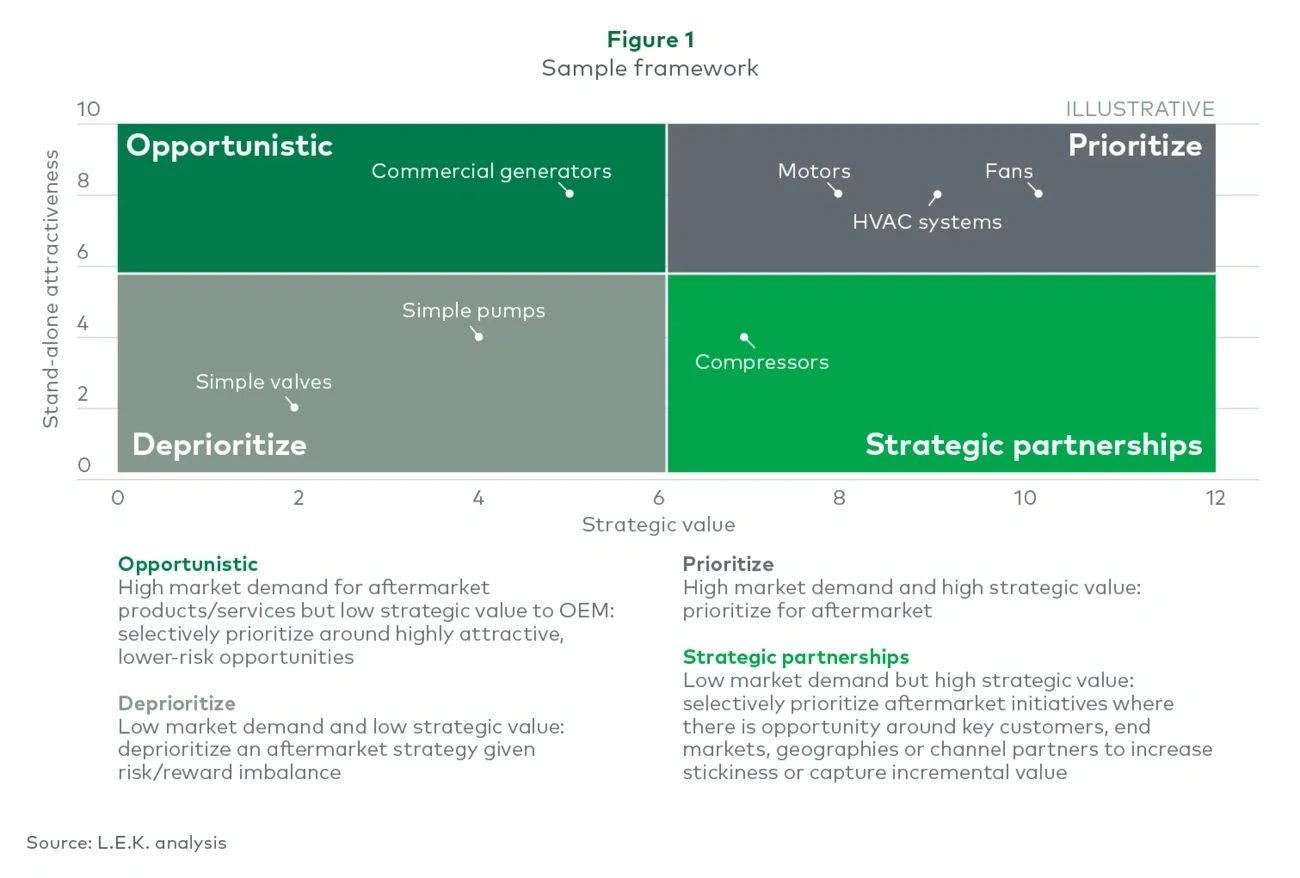
Ranking each major product category or business unit across these criteria on a 1-to-5 scale (1 being least attractive and 5 being most attractive) and then plotting them in the framework (see Figure 1) identifies equipment that is more attractive and more strategically important to the business.