



Successfully navigating these challenges will determine which organizations translate agentic adoption into sustainable growth, efficiency gains and stronger customer outcomes.
Executive Insights
Built for Agents — Winning in the Era of Agentic Commerce
Built for Agents — Winning in the Era of Agentic Commerce
April 13, 2026
Key takeaways
Commerce is shifting as AI agents move from assisting in search to autonomously comparing, negotiating and transacting, with agentic ecommerce projected to reach approximately 9% of total U.S. ecommerce by 2029.
The Agentic Business Maturity Model outlines a progression from digital to AI-augmented to fully agentic operations, where systems interact directly with autonomous agents.
As businesses advance toward the agentic stage, core functions such as marketing, pricing, payments and fulfillment become data-driven, API-native and increasingly autonomous.
However, agent-mediated commerce introduces new risks around margin pressure, operating complexity and reduced direct customer touchpoints, raising the stakes for data quality, interoperability and trust.
Commerce is entering a new era, one where artificial intelligence (AI) agents increasingly search, evaluate and transact on behalf of humans and organizations. These autonomous systems will soon influence every step of the customer journey, from discovery to payment. This will reshape not only how individual businesses reach their customers but also how platforms coordinate transactions across participants. This is a fundamental shift as the next competitive frontier will be more about being discoverable and interoperable with intelligent agents.
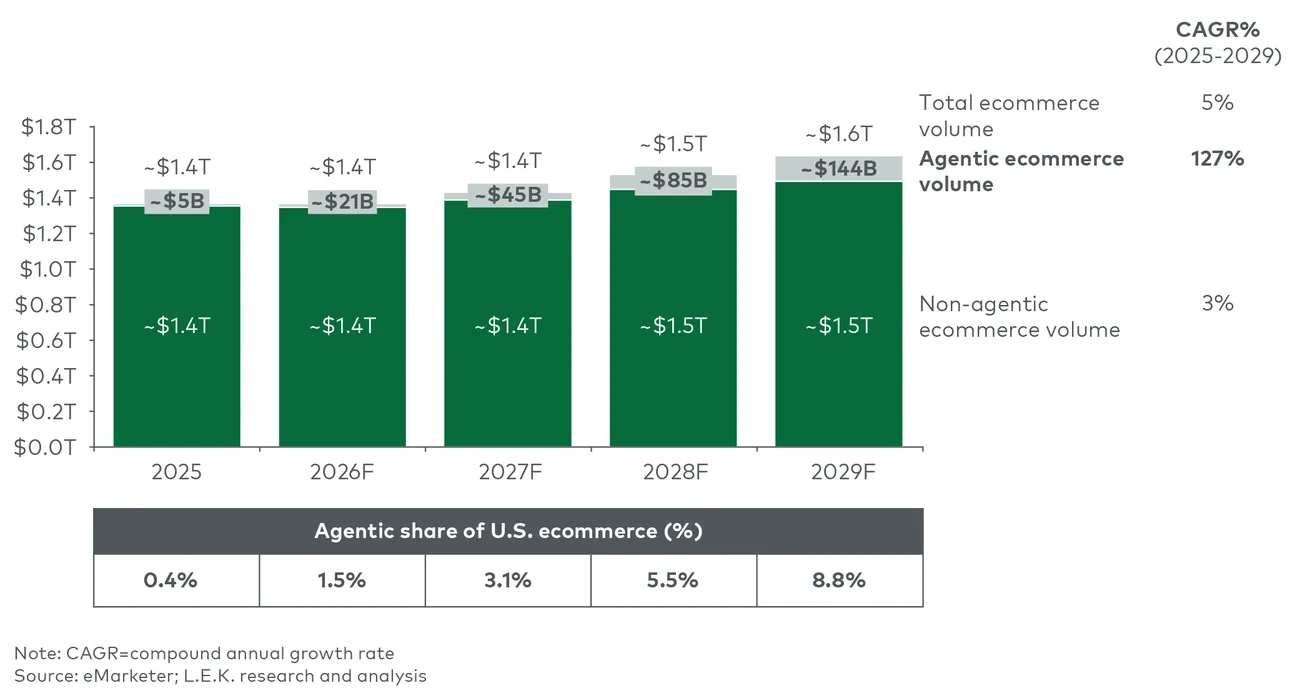
Agentic commerce is accelerating rapidly as AI systems take on more active roles in how products are discovered, evaluated and purchased. Over the next several years, spending influenced and executed by AI agents is expected to grow significantly as capabilities improve and consumer and enterprise trust deepens. What begins with agents assisting in search and recommendations is moving toward autonomous comparison, negotiation and checkout across categories. By 2029, agentic ecommerce is projected to represent approximately 9% of total U.S. ecommerce volume, reflecting a meaningful shift in how transactions are initiated and completed. This growth signals that agent participation in commerce is becoming embedded in the market, creating real scale and strategic urgency for businesses today (see Figure 1).
Figure 1
U.S. agentic ecommerce market forecast (2025-2029F)
Image
The Agentic Business Maturity Model
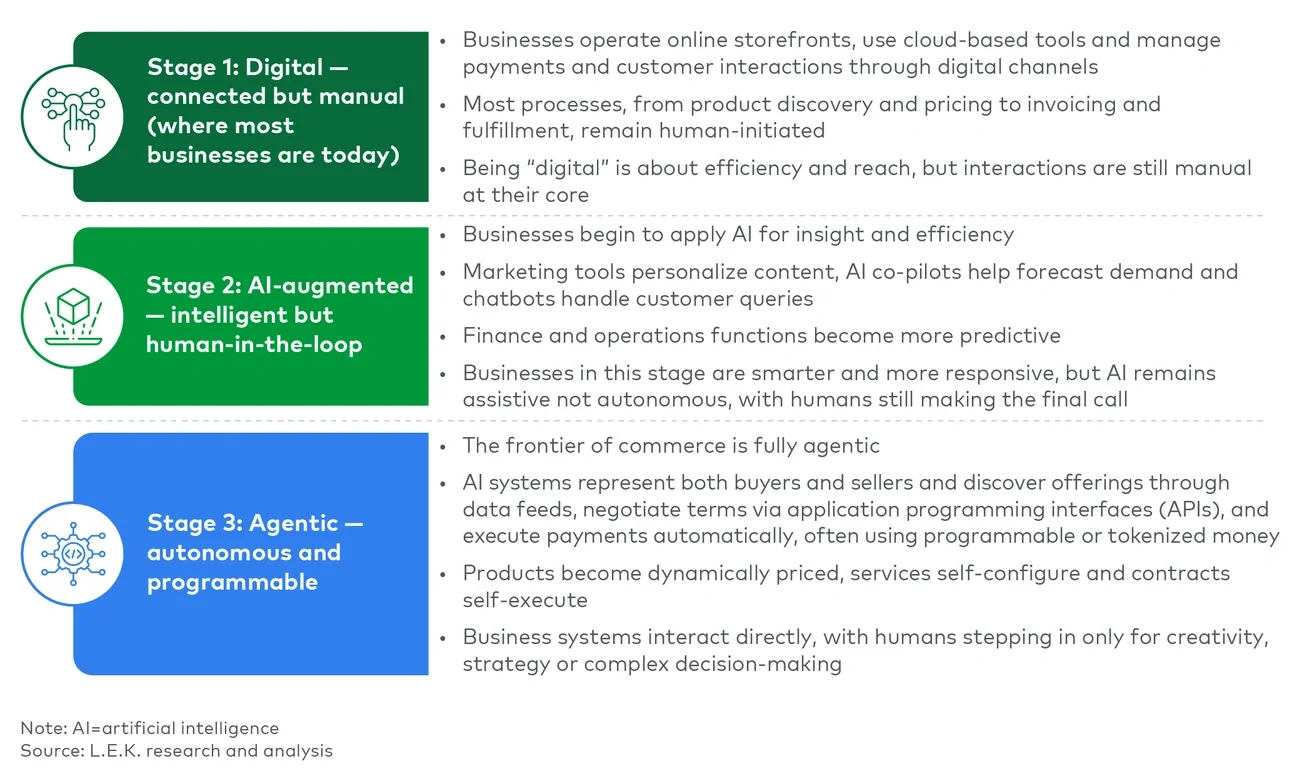
We introduce the Agentic Business Maturity Model, a practical framework to help leaders understand how their organizations can evolve from traditional digital operations to fully participating in agentic ecommerce. The model defines three stages of maturity: digital, AI-augmented and agentic (see Figure 2). Each stage reflects a step change in how technology is embedded in the business, from basic digitization to AI-supported decision-making and ultimately to systems that are designed to interact directly with autonomous agents. Progressing through these stages requires advances in automation, data integration and agent readiness, as well as shifts in operating models and leadership priorities.
Figure 2
Three stages of transformation
Image
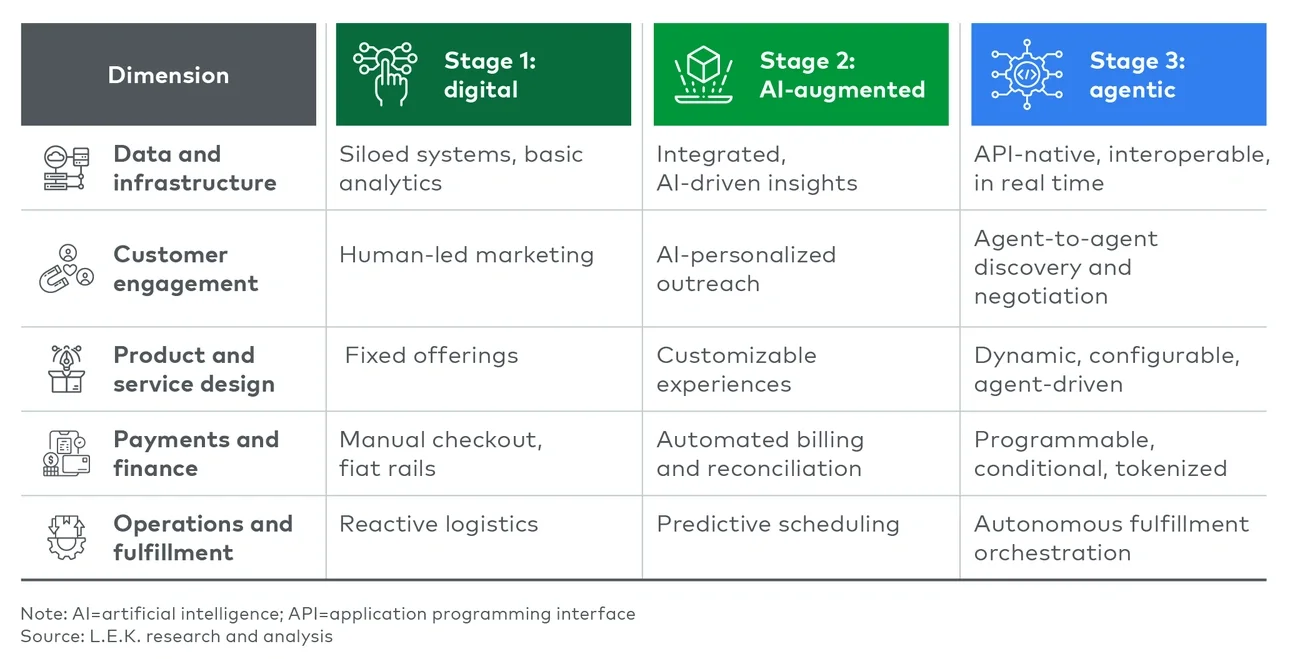
Together, these stages outline a clear path of organizational evolution. The progression from digital to AI-augmented to agentic reflects increasing levels of automation, data integration and system interoperability across the enterprise. As businesses advance, decision-making becomes more data-driven, processes become more automated and technology plays a more active role in coordinating activity across functions and external partners. Figure 3 illustrates how this progression manifests across core business dimensions, highlighting the operational and structural shifts associated with each stage of maturity.
Figure 3
The Agentic Business Maturity Model across core dimensions
Image
As businesses progress along this maturity curve, every major function in the business will be reshaped by agentic technologies:
From human persuasion to algorithmic discoverability, businesses will market not just to people but to agents, which will evaluate data, not ads
Product information must be agent-readable: Structured data, real-time pricing and performance metrics will replace marketing copy as the key to visibility
Reputation and reliability data (fulfillment rates, verified reviews, transaction history, etc.) become the new “trust signals” that agents prioritize
For platform operators, discoverability extends to the ecosystem level, ensuring both the platform and its participants are visible to agentic buyers
Products evolve from fixed offerings to data-exposed configurable services that agents can query and assemble dynamically
Personalization moves from after-the-fact marketing to real-time configuration at the point of agentic demand
Feedback loops accelerate as agents continuously monitor and report customer outcomes, enabling faster iteration cycles
Platforms may modularize their capabilities, exposing functions such as fulfillment, payments or logistics as agent-accessible APIs
Operations shift from reactive to predictive; AI co-pilots anticipate demand, optimize scheduling and even trigger automated procurement or replenishment
Programmable logistics will link inventory, delivery and payments (e.g., automatically releasing funds when delivery confirmation is recorded)
Supplier and customer agents may directly coordinate fulfillment, bypassing manual workflows entirely
In multisided platform environments, fulfillment coordination will occur across ecosystem participants, with agents autonomously managing handoffs and settlements
Pricing becomes dynamic and negotiated by agents in real time, based on context, demand or customer history
Consumption and usage-based pricing models scale more easily, as agents can continuously monitor utilization and optimize purchases against budget, performance or policy constraints
Payments become programmable and executed automatically upon delivery, performance verification or usage thresholds
Tokenized or stablecoin-based payments may unlock microtransactions and usage-based models previously impractical for businesses
Bookkeeping and reconciliation become continuous and autonomous
Cash flow becomes real time as agents transact and settle instantly and businesses gain liquidity and forecasting precision
Financial operations evolve from reporting to strategic orchestration, guided by predictive analytics and AI oversight
For platforms managing multiparty payments, programmable money and real-time settlement enable transparent automated distribution of funds across participants
Agents will increasingly handle customer support, resolving issues, processing refunds or scheduling services autonomously
Businesses appear “always on” through agentic service layers, while humans focus on escalation and relationship-building
Trust, transparency and responsiveness become competitive differentiators in agent-mediated ecosystems
Agents may operate across platform boundaries to resolve disputes or coordinate multiparty service outcomes autonomously
The traditional website gives way to an API-first architecture, where offerings are agent-accessible and interoperable
Identity and consent protocols will be critical for agent authentication and secure transactions
Businesses will need modular, composable systems capable of integrating with both human and agentic partners
These shifts signal a fundamental reordering of how businesses operate, moving from human-centered execution to data-driven collaboration between humans and intelligent agents.
Business challenges with agentic commerce
Business challenges with agentic commerce
The shift to agentic commerce introduces a new set of operational, strategic and economic risks for both individual enterprises and platform businesses. As agents increasingly mediate discovery, negotiation and transactions, businesses will need to rethink how they protect margins, manage control points and sustain differentiation.
Key challenges include the following:
Revenue growth pressure
Agent-driven comparison increases price transparency and performance benchmarking, which can intensify competition and make differentiation more dependent on measurable value
Margin management
Real-time negotiation and dynamic pricing require tighter controls to protect profitability while remaining competitive in agent-mediated marketplaces
Operating complexity
Supporting agent-to-agent transactions demands stronger data quality, API reliability, system integration and security, increasing operational requirements
Finance and billing readiness
Dynamic and usage-based pricing models require more-advanced billing, reconciliation and forecasting capabilities
Customer relationship impact
When agents act on behalf of customers, businesses may have fewer direct touchpoints, making trust, fulfillment reliability and service performance even more critical to satisfaction and repeat demand
Platform strategy alignment
Platform businesses must ensure their role continues to drive growth and loyalty as more activity is initiated and evaluated by autonomous systems
Implications for business leaders
Implications for business leaders
Agentic commerce will reshape where advantage is created and how it is sustained. Leaders should treat this as a strategic shift in market structure and respond accordingly.
Design the enterprise for agent participation
Make structured data, API access and system interoperability core elements of the operating model, not technical afterthoughts
Compete on verifiable performance
As agents evaluate providers based on measurable outcomes, operational reliability, service quality and fulfillment consistency become central to demand generation
Own structurally defensible control points
Identify where the organization can create a durable advantage, whether through proprietary data, embedded workflows, customer relationships, ecosystem coordination or specialized capabilities
Modernize monetization strategy
Prepare for dynamic pricing, negotiated transactions and usage-based models that align revenue with measurable value delivered
Build trust
Keep product data accurate, pricing transparent, policies clear and systems secure; even simple factors such as structured product information, verified reviews and predictable response times increase visibility and selection in agent-driven marketplaces
Positioning for the agentic era
Agentic commerce adds a new layer to how markets function. As AI agents take on a greater role in evaluating options and executing transactions, the criteria for selection will become more structured and performance-driven. Data quality, interoperability, reliability and trust will shape outcomes in ways that are increasingly systematic.
This shift will unfold over the course of years, but its direction is clear. Businesses that prepare thoughtfully, strengthen their foundations and make deliberate choices about where they will differentiate will be positioned to benefit as agent participation grows. Those that treat it as peripheral may find their competitive position gradually eroding as commerce becomes more autonomous.
L.E.K. Consulting is a registered trademark of L.E.K. Consulting LLC. All other products and brands mentioned in this document are properties of their respective owners. © 2026 L.E.K. Consulting LLC
Related insights
You might also be interested in these insights.


English