AI and digital enablers
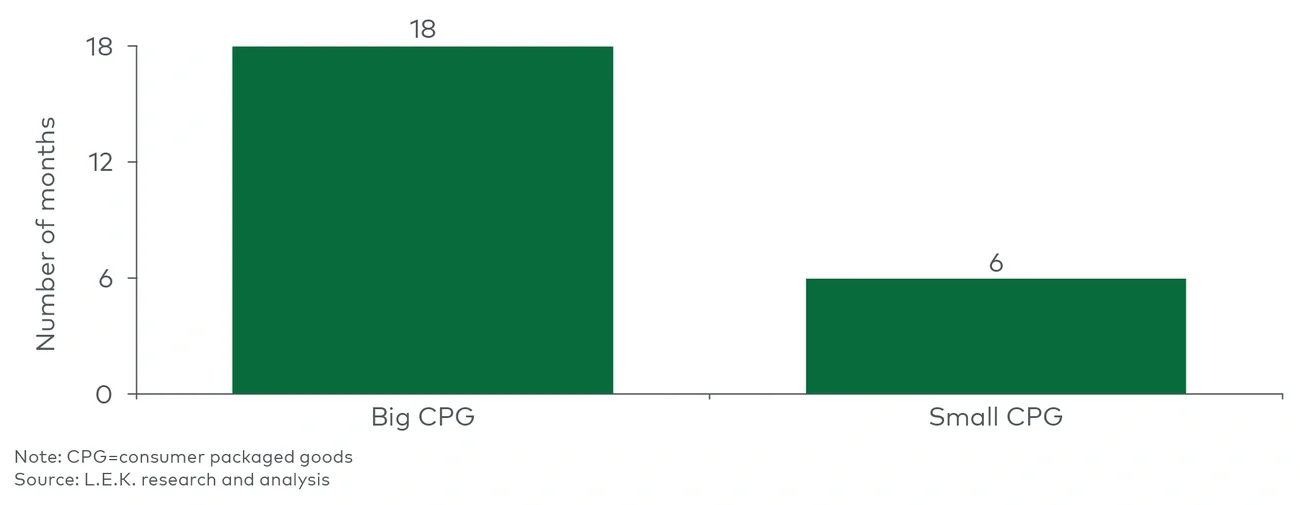
It’s no longer possible to maintain competitive advantage if it’s taking a year and a half to scale. Consumer preferences are constantly evolving, and there’s more innovation than ever before, especially from start-up brands. Indeed, while companies of all shapes and sizes are rapidly reimagining business processes with AI, many large CPG companies are lagging on this front.
But new digital technologies, AI and automation have created new ways to transform business processes. Agents can synthesize and reason across large, complex and multimodal datasets (e.g., specs, forecasts, retailer requirements), enabling faster, more consistent product and commercial decisions. They can also be embedded as coordinators across siloed functions, systems and tools, reducing manual handoffs, rework and reliance on manual status chasing. And targeted automation can enable “right first time” artifacts (e.g., specs, financials, stage-gate materials) by enforcing standards, pre-validating inputs and flagging inconsistencies before they cause downstream issues.
Automation and agentic AI can be used to provide real-time visibility into readiness, risks and economics to support faster, data-driven decisions that address sector complexity and retailer and category nuance. One AI-native CPG innovator uses generative AI to spot unmet demand early, translate insights into shelf-ready products quickly and launch with retailers as a live testbed. By iterating in near-real time based on velocity, repeat and basket data, this company compresses time to market and uses speed to outpace slower, stage-gated incumbents.
Importantly, the use of AI, both generative and agentic, is not limited to nimble start-ups; it is increasingly being used by some of the most well-known CPG brands.
Taking a lean approach is as important as ever
In addition to the transformational opportunities that new digital technologies bring to commercialization, there is still a place for applying lean principles to remove non-value-added steps, reduce variation and minimize rework. Doing so will not only enable faster throughput but also produce more predictable outcomes.
Best-in-class CPG companies, especially smaller, nimbler players, can both launch products faster and quickly identify underperforming products — and pull them from the market as soon as four weeks from launch. Key enablers include:
- Less bureaucracy
Small CPG companies are outpacing large ones, reinforcing the advantage of nimble decision-making - Increased R&D spend
Ensuring effective deployment is key - Strategic use of co-manufacturers
F&B growth, for example, is about two times the market rate when they’re used as partners
How L.E.K. optimizes the commercialization process
At L.E.K. Consulting, we combine our deep sector expertise with our digital and performance improvement capabilities to help companies reimagine their commercialization process. We have a battle-tested approach to streamlining innovation, combining our commercial and supply chain capabilities in parallel to achieve optimal results. We bring outside-in perspectives from our over 2,000 client projects in F&B and CPG. We can move quickly to get this project done in weeks versus months.
If you want to transform your commercialization process, get your innovation to market faster and drive growth, contact us today.