L.E.K. Consulting’s Building & Construction practice recently held a roundtable of leading commercial building and construction executives representing the following parts of the value chain: infrastructure/foundational materials (e.g., concrete, cement, aggregates), exterior-facing products (including building envelopes and HVAC), interior products (e.g., appliances, countertops, flooring, kitchen products, plumbing, interior finishings, furnishings) and job site materials, with perspectives on real estate development, manufacturing, distribution and installation.
During the discussion, three key themes emerged:
- The recovery and volatility of construction demand
- Addressing logistics, material and labor supply challenges
- Digitalization opportunities
In this article, we’ll discuss each theme in detail.
The recovery and volatility of construction demand
Commercial construction held up well in early 2020, and then began to decline as a result of COVID-19. Forecasts for commercial construction were more bearish into late 2020, but recovery expectations have since improved, with some volatility. The Architectural Billings Index, a forward-looking measure, now exceeds the 2019-20 average of 46.3, surpassing 50 in February 2021 (indicating positive momentum), and reached an all-time high of 59 in May 2021. Similarly, ABC’s Construction Confidence Index remains over 50 (a rating over 50 indicates positive sales growth), although the index fell from a high of 65.7 in June — a change driven by labor and supply chain challenges.
Still, roundtable participants are seeing positive momentum. Spending is increasing. As one executive put it, “The purse strings are coming undone.” And some participants see variations in sector performance and a range of differences in activity among end markets — as one said, “For most of us, it’s a journey of diversity.”
Other observations included:
- Data centers and warehouses have “propelled us through COVID-19,” according to one participant. Although the growth rate is expected to fall from its recent peak, activity will remain strong.
- Healthcare is forecast to experience slightly strengthening growth. At least one executive is seeing a slowdown in the growth rate, stating that “healthcare is a mover for us, but we are seeing slower growth now.”
- Education, retail and manufacturing are expected to show a fall in demand between 2020 and 2021 but will likely experience modest growth in 2021-22, with even higher growth rates in 2022-25.
- Office and retail have shown more resilience than expected. Initial reporting indicates companies are using amounts of space similar to pre-pandemic times, but they are reconfiguring that space for social distancing and hybrid working. This trend, along with some relocations, is leading to what one participant called “surprising resilience” in the sector. For example, one furniture supplier highlighted an influx of recent orders due to office reconfigurations.
- Hospitality is still challenged, with recovery not expected to begin until after 2022.
Addressing logistics, material and labor supply challenges
Executives highlighted these predominant challenges:
- Logistics. Transport and port delays have increased, driven by COVID-19-related factors and labor shortages, such as a lack of truckers and bottlenecks at ports. One executive noted that ships coming into the U.S. are often held in port: “Sixty percent of my products come from outside the U.S. — ships parked in Long Beach, Los Angeles, in Savannah.” The short supply of trucks and truckers has been a continual challenge, and participants foresee little immediate relief.
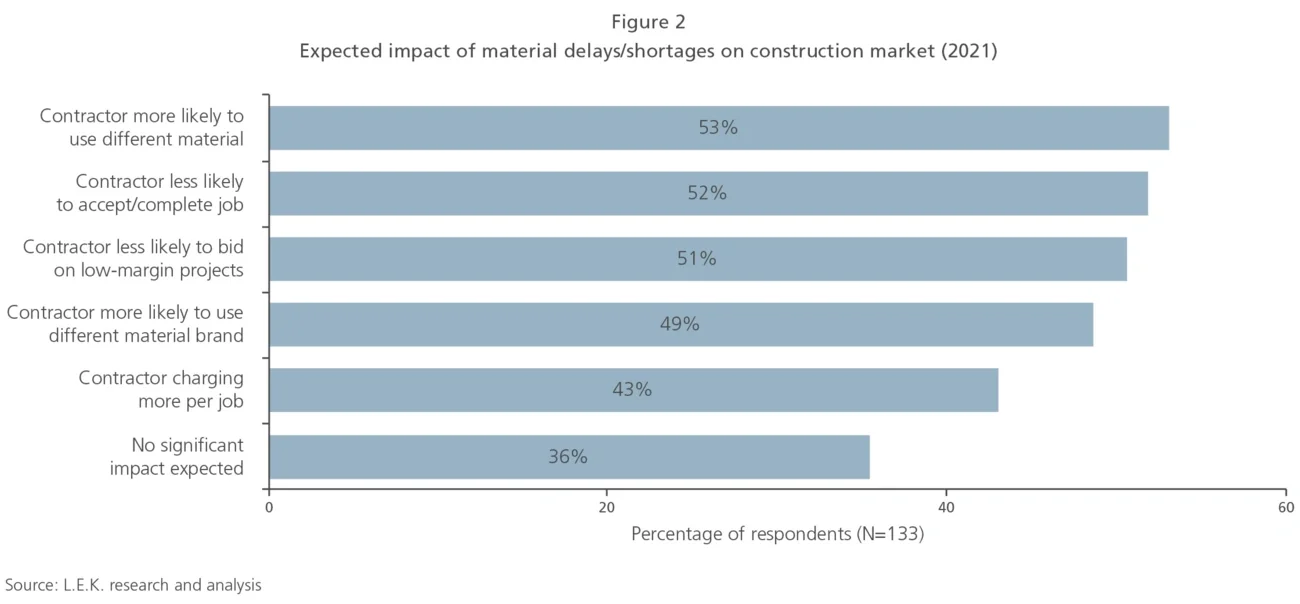
- Material. Construction input prices rose 22% year over year, but with significant variation by material type. Steel mill products and softwood lumber have led the charge, though many other materials have experienced substantial increases (e.g., prices of ferrous wire, rope and cable increased by 30% between August 2020 and August 2021). Some supply challenges, particularly for more commodity materials, are expected to resolve and improve, but the process of addressing major supply bottlenecks (such as developing new capacity) can have significant lead times. Products dependent on multiple material inputs and/or products that have a high import component are expected to be vulnerable to supply disruptions, given the increased risk of a critical component becoming unavailable.
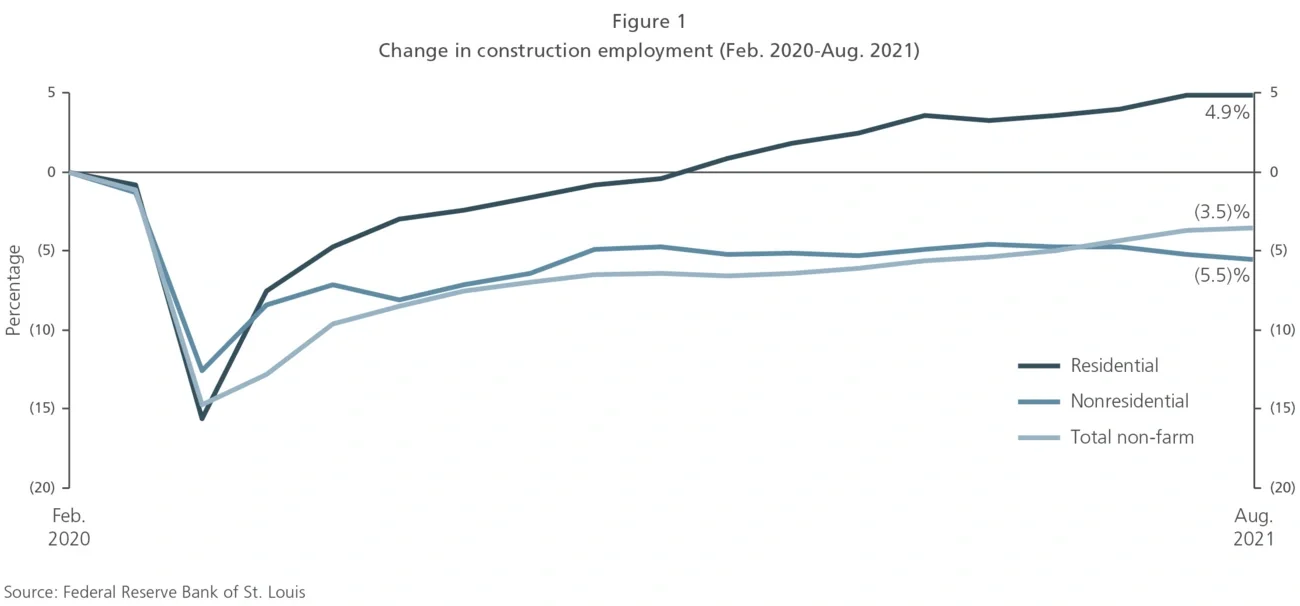
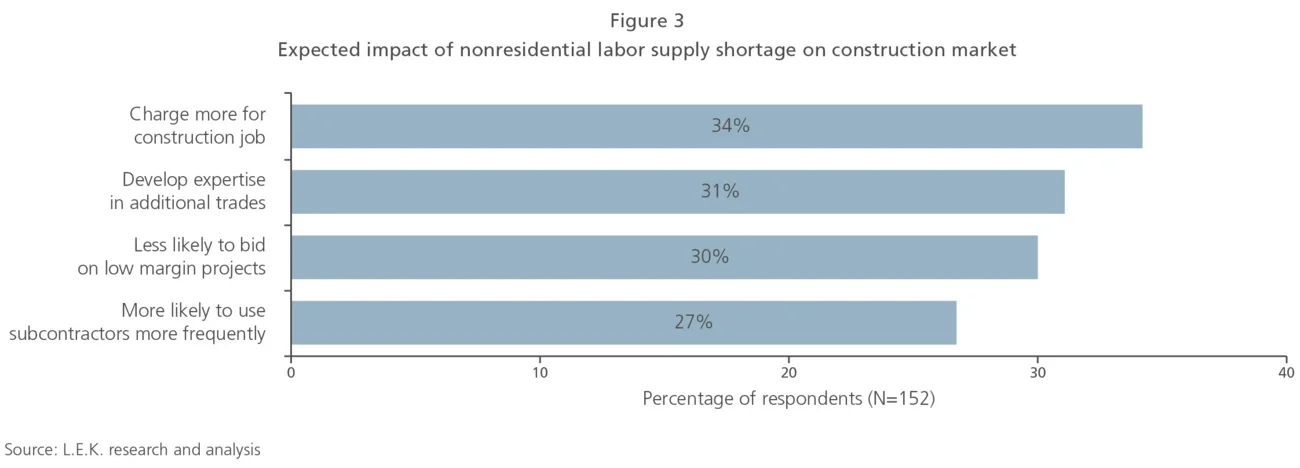
- Labor. Nonresidential construction labor is still 5.5% below its February 2020 level. In contrast, the level of residential construction employment has increased 4.9% in the same period (see Figure 1).